
You are here
Feed aggregator
Législatives en Slovénie : face-à-face gauche-droite et scène politique éclatée
La Slovénie est déjà en campagne pour les législatives du 22 mars. La droite menée par le vétéran « trumpiste » Janez Janša accuse le gouvernement de centre-gauche de Robert Golob de mener une expérience « socialiste ». Ce dernier compte sur ses mesures sociales pour emporter un second mandat. Décryptage.
- Articles / Slovénie, Politique, Courrier des Balkans, Jansa, Une - Diaporama
Categories: Balkans Occidentaux, Pályázatok
EU action on cancer – State of play
Written by Laurence Amand-Eeckhout
BackgroundAs defined by the World Health Organization (WHO), cancer is a generic term for a large group of diseases that can affect any part of the body. One defining feature of cancer is the rapid creation of abnormal cells that grow beyond their usual boundaries, which can then invade adjoining parts of the body and spread to other organs (metastasis). Cancer arises from the transformation of normal cells into tumour cells in a multistage process that generally progresses from a pre-cancerous lesion to a malignant tumour.
According to the WHO’s International Agency for Research on Cancer (IARC), at least 40 % of all cancer cases could be prevented with effective primary prevention measures, meaning that around four in 10 cancers are potentially avoidable by reducing exposure to established modifiable risk factors. The main risk factors for cancer include tobacco use, alcohol consumption, unhealthy diet, obesity, physical inactivity, hormonal factors, environmental and occupational exposures, ultraviolet radiation, and infections such as those caused by hepatitis B and C viruses and some types of human papillomavirus. The burden of cancer can also be reduced through early detection and timely access to appropriate treatment.
World Cancer Day takes place every year on 4 February. It was established on 4 February 2000 at the initiative of the Union for International Cancer Control. The three-year ‘United by unique‘ campaign (2025-2027) aims to raise awareness of the importance of people-centred care.
Facts and figuresAccording to estimates from the IARC, about one in five people worldwide will develop cancer at some point during their lifetime.
There are no official EU statistics for the total number of people currently living with cancer in the EU. Available Eurostat data focus on deaths from cancer, cancer healthcare and equipment for treatment.
Cancer is currently the second leading cause of mortality in the EU, after cardiovascular diseases (Eurostat). In 2024, around 2.7 million people were diagnosed with cancer in the EU and around 1.27 million died (data published in December 2025 by ECIS, the European Cancer Information System). Compared with 2022, this represents a slight decrease of 1.7 % in new cases and 1.9 % in deaths. Nevertheless, these estimates illustrate the substantial burden of cancer, and projections indicate that these figures are expected to rise further: owing to an ageing population, unhealthy lifestyles, and unequal access to screening and care, by 2040, cancer diagnoses are expected to increase by 19 %, and cancer deaths by 27 %, which would make cancer the leading cause of death in the EU.
According to the EU Country Cancer Profiles Synthesis Report 2025, published jointly by the European Commission and the Organisation for Economic Co-operation and Development (OECD), between 2023 and 2050 cancer is expected to reduce population life expectancy by 1.9 years on average in the EU compared with a scenario without cancer.
The four most common cancer causes of death for both men and women in the EU are estimated to be lung cancer (19.7 % of all cancer deaths), followed by colorectal (12.2 %), pancreatic (7.5 %) and breast cancer (7.3 %). Among men, the main diagnoses are prostate cancer, followed by lung and colorectal cancer. Among women, the main diagnosis is breast cancer.
As highlighted in the 2024 joint European Commission/OECD report on cancer inequalities, significant inequalities persist across the EU in exposure to risk factors, particularly affecting those with lower levels of education, who show higher rates of smoking, obesity and harmful alcohol consumption, resulting in higher cancer incidence and mortality. In addition, substantial gender-based differences exist in exposure to cancer risk factors, to the detriment of men, particularly with regard to tobacco use, alcohol consumption, unhealthy diets and overweight.
In 2021, the Commission estimated the overall economic impact of cancer to exceed €100 billion annually. In a 2025 report, the OECD estimates that in the EU-27+2 (Iceland and Norway), workforce productivity is reduced by €50 billion each year, with cancer projected to cost €97 billion annually between 2024 and 2050.
EU actionSince the mid-1980s, the EU has worked alongside Member States to combat cancer. Under Article 168 of the Treaty on the Functioning of the European Union, the EU complements and adds value to national public health actions. EU efforts focus on prevention, research and information (e.g. awareness campaigns), while fostering cooperation between Member States. The EU also adopts legislation tackling cancer risk factors, such as exposure to environmental pollution or hazardous substances and radiation, obesity, alcohol-related harm, tobacco consumption and smoke- and aerosol-free environments. In 2023, the revised Consumer Credit Directive (Directive (EU) 2023/2225) strengthened consumer protection in credit agreement, particularly for cancer survivors (‘right to be forgotten’).
In February 2021, as part of the European health union, the European Commission adopted the Europe’s Beating Cancer plan to address cancer-related inequalities and help improve prevention, treatment and care. A total of €4 billion has been allocated to the plan, drawn from various programmes. The plan is structured around four key action areas (prevention; early detection; diagnosis and treatment; and quality of life for cancer patients, survivors and carers) and supported by 10 flagship initiatives, under implementation. In February 2025, the Commission published a review of the plan from its launch until the end of 2024. It highlights that implementation is well underway (more than 90 % of actions have either been concluded or are ongoing), that the plan is a successful example of a health-in-all-policies-based approach, and that governance of the plan has proved to be efficient so far, with several groups providing expertise (comprising stakeholder representatives, Member State experts and Commission services). However, delays and gaps persist, notably concerning financial and institutional barriers.
The EU has invested continuously in cancer research through successive framework programmes for research and innovation. Under Horizon Europe (2021-2027), the Cancer Mission ensures that new research and innovation developments are effectively translated into concrete solutions to improve cancer control.
European ParliamentIn June 2020, the European Parliament set up a Special Committee on Beating Cancer (BECA), which ended its mandate in December 2021. The committee’s final report was adopted by Parliament in February 2022. Its recommendations focus on cancer prevention, equal access to cancer care across borders, and a European approach addressing medicine shortages.
In its resolution of 13 December 2023 on non-communicable diseases (NCDs), Parliament pointed out that many people living with NCDs (including cancer) are undiagnosed and unaware of their illness, and thus fail to get proper, timely treatment. It invited the Commission to collect examples of best practices regarding screening for and early detection of NCDs. Parliament also stressed the importance of ensuring the collection of comparable, high-quality data on NCDs at EU level.
Since the start of the current legislature, MEPs have submitted a range of written questions to the Commission concerning cancer-related issues. In 2025, these included questions on the funding of the Europe’s Beating Cancer plan (E‑004037/2025) and its inclusion in the next multiannual financial framework (E-004760/2025); the protection of cancer survivors from discrimination (E-001252/2025); the harmful effects of sunbeds (E-001259/2025); measures to reduce cancer risk in children and young people (E-002125/2025 ); and the assessment of the effectiveness of innovative cancer therapies (E-001448/2025).
The Committee on Public Health (SANT) monitors the implementation of the Europe’s Beating Cancer plan. It is preparing an own-initiative report to assess the plan’s implementation, supported by an EPRS study (European implementation assessment) published in October 2025. The study, which assesses the implementation of the plan across EU Member States between 2021 and 2024, focuses on three core areas: gaps and delays in implementation, particularly in prevention, cancer care and quality of life; the plan’s impact on cancer inequalities across the EU; and lessons learned and their relevance for future EU initiatives on NCDs. It also proposes actions to improve cancer prevention and control in the EU.
Read this ‘at a glance’ note on ‘EU action on cancer – State of play‘ in the Think Tank pages of the European Parliament.
Categories: European Union, Swiss News
High Seas Treaty Will Transform Our Fragile Ocean for the Better
Game-changing international ocean treaty comes into force. Credit: NOAA
Deep-sea corals were among the treasures found during an expedition in the North Marianas Islands in the Pacific Ocean. Source: UN News
By Pietro Bertazzi and Oliver Tanqueray
AMSTERDAN / LONDON, Feb 3 2026 (IPS)
“The ocean’s health is humanity’s health”, said UN Secretary-General Antonio Guterres, in September 2025.
He was commenting after the High Seas Treaty (BBNJ) [1] finally achieved ratification, going on to call for “a swift, full implementation” from all partners. As of January 17, 2026, the treaty has come into force, meaning the time for implementation is now. What is the High Seas Treaty?
Only 1% of the high seas are currently protected. The new treaty will greatly increase safeguards, with significant implications for activities covering nearly 50% of the Earth’s surface.
The High Seas Treaty establishes, for the first time, a legal mechanism to govern activities affecting biodiversity in the areas of the ocean that lie outside the jurisdiction of any single country (ie their Exclusive Economic Zones, typically 200 miles from their coastline).
The agreement was achieved after nearly 20 years of dialogue, much of which was carried by Small Island Developing States (SIDS), Indigenous peoples and coastal communities. For them, the relationship with the ocean is most direct and the threats to it are most existential.
The entry into force of such a significant legal instrument sends a powerful message on the value of collaboration, and its importance in confronting the environmental risks facing the economy and humanity.
The agreement will change the ways that activities taking place in the High Seas – and those affecting them – will be planned, monitored, managed and reported on. This level of transparency will drive a cycle of accountability and improvement in the relationship between our economy and the natural world on which it depends.
What you need to know
The treaty’s role as an international legal mechanism will have significant effects on companies and financial institutions to respond to.
Key outcomes
1. Increased transparency on ocean-based activities
The agreement sets out monitoring and transparency requirements of countries – including Environment Impact Assessments (EIA) – alongside high seas genetic material, samples and digital sequence data, as well as a publicly accessible database to promote publicly available real economy data and data exchange.
This means that many aspects of companies’ high seas-related projects will be accessible to stakeholders.
Anticipating increased public information on environmental studies and mitigation plans, companies should prepare to report on high seas activities, such as fishing, shipping, energy infrastructure, mining and bioprospecting, as well as potential impacts of new activities such as carbon dioxide removal technologies.
Companies can also further identify opportunities through new publicly available data and recognize the halo benefits that increased coverage of marine-protected areas brings.
2. Increased expectations on corporate disclosure
New EIAs will amplify the need for standardized corporate data on marine impact – coupled with growing investor and policy focus on companies’ high seas activities, strategies and governance.
Financial institutions (FIs) and regulators will expect companies to report on how they comply with treaty obligations such as the number of high seas environmental assessments completed, presence in protected areas, and contributions to capacity building.
Asset owners will ask for metrics on exposure to high seas biodiversity risks. Governments may require reporting from firms to compile national reports and monitor compliance.
Companies should expect new jurisdictional regulations on ocean activities, as Member States take steps to implement the Agreement, via enhanced environmental rules and disclosure obligations.
For FIs, there is increased focus on integrating ocean health into Environmental, Social and Governance (ESG) analysis, with risks and opportunities in blue finance and sustainable ocean industries only going to grow.
This creates a need to ensure that portfolio companies are equipped to comply with new regulations and secure relevant permissions to operate in international waters. Failure to do so creates risks to ongoing operations as well as litigation and reputational exposure.
3. Strengthened multilateral collaboration
The agreement creates legal mechanisms for area-based management tools, including Marine Protected Areas (MPAs). For disclosers and financial institutions, this means enhancing readiness to adapt to exclusions or operating conditions on shipping lanes, fishing grounds, mining sites, and cable routes. Industries will need to track MPA designations and adjust operations (for example by rerouting vessels or ceasing extraction) to remain compliant.
CDP stands ready to support the ocean
Working with companies and data users, CDP will integrate and standardize key metrics needed to implement the High Seas Treaty. This ensures that stakeholders have the reliable, comparable data needed to implement collective goals, and companies can demonstrate their leadership on ocean stewardship.
From 2026 onwards, CDP will be expanding its questionnaire to gather ocean-related data. In the first year of disclosure, we will generate insights on processes for identifying, assessing, and managing ocean-related dependencies, impacts, risks, and opportunities.
This work is being done in collaboration with our Capital Markets Signatories – many of which have already shown demand for ocean-related data – and disclosing companies, focusing on those with the most significant ocean impacts and dependencies.
High Seas, higher ambitions
There is still much to do to improve the protection of marine areas and restoration of ocean health. But the BBNJ is a significant step forward in this effort.
In a year where nature is placed on the main stage of the international agenda, companies, FIs and governments alike have an opportunity to embed ocean health into global financial systems.
Countries must also complement the agreement with a drive to protect coastal waters not part of their direct control. Many ocean-impacting activities will not be constrained by the BBNJ. Only 4.2% of fishery production, for example, takes place on the high seas[2]. This means there will be a continued role for Member States to conserve and sustainably use the biological diversity in areas within their jurisdiction.
We must build momentum behind the opportunities enabled by this historic deal – collaboration and transparency will play a vital part in turning this momentum into action.
Footnotes
- 1. The treaty is formally called the ‘Agreement under the United Nations Convention on the Law of the Sea on the Conservation and Sustainable use of Marine Biological Diversity of Areas Beyond National Jurisdiction’, or ‘BBNJ’.
2. By volume, the total catch from the high seas accounts for 4.2% of annual marine capture fisheries production. Schiller L, Bailey M, Jacquet J, Sala E. ‘High seas fisheries play a negligible role in addressing global food security.’
Pietro Bertazzi is Chief Policy and interim Growth Officer, CDP, and Oliver Tanqueray is Head of Ocean, CDP.
Carbon Disclosure Project (CDP) is a global non-profit that runs the world’s only independent environmental disclosure system for companies, capital markets, cities, states and regions to manage their environmental impacts.
IPS UN Bureau
Follow @IPSNewsUNBureau
!function(d,s,id){var js,fjs=d.getElementsByTagName(s)[0],p=/^http:/.test(d.location)?'http':'https';if(!d.getElementById(id)){js=d.createElement(s);js.id=id;js.src=p+'://platform.twitter.com/widgets.js';fjs.parentNode.insertBefore(js,fjs);}}(document, 'script', 'twitter-wjs');
Categories: Africa, European Union
Group of 77—Representing 134 Nations, Plus China– Protest Funding Cuts for South-South Cooperation
Credit: UN/Monicah Aturinda Kyeyune
By Thalif Deen
UNITED NATIONS, Feb 3 2026 (IPS)
A sharp cut in funding for “South-South Cooperation” (UNOSSC) has triggered a strong protest from the 134-member Group of 77 (G-77), described as the largest intergovernmental organization of developing countries within the United Nations.
The protest has been reinforced by four UN ambassadors, two of them former chairs of the G77—Colombia (1993) and South Africa (2015), along with Brazil and India.
Traditionally, the G77 has been backed by China, the world’s second largest economy, and a veto wielding member of the Security Council
A letter of protest, addressed to Alexander De Croo, Administrator, UN Development Programme (UNDP), which funds and oversees the UNOSSC, says South-South cooperation remains a central pillar of the work of the United Nations and is of particular importance to the Group of 77 and China.
The UNOSSC, established by the UN General Assembly at the initiative of the G-77, “plays a critical role in supporting, coordinating and implementing South-South and triangular cooperation initiatives and projects across the United Nations development system, including in support of the UN development agenda”.
“Against this background, the G-77 and China wish to express its serious concern regarding the significant reduction in resources proposed to be allocated by UNDP to UNOSSC under the 2026–2029 Strategic Framework,” says Ambassador Laura Dupuy Lasserre, Permanent Representative of Uruguay to the United Nations and Chair of the Group of 77, in a letter to the UNDP Administrator.
The scale of the proposed reduction is described as “substantial and, if implemented, would severely constrain the Office’s ability to effectively deliver on its mandate.”
The reduction is estimated at 46% of funds allocated by UNDP to UNOSSC under the proposed 2026-2029 Strategic Framework. And in dollar terms, the proposed allocation amounts to USD 16.6 million, down from the USD 30.7 million under the 2022-2025 Strategic Framework. (the amount actually disbursed was approximately USD 22 million).
Of particular concern, is the potential impact of these funding reductions on the management and operational capacity of Trust Funds administered by UNOSSC, including the Perez-Guerrero Trust Fund for South-South Cooperation (PGTF) and other financing mechanisms that provide critical support to developing countries.
The G77 Chair has received a demarche from the Chair of the Committee of Experts of the PGTF conveying the concerns that the ability of the PGTF to continue fulfilling its regular operations might be at stake.
“Reduced institutional capacity to manage these Trust Funds would undermine their effectiveness and would have adverse consequences for beneficiary countries that rely on these instruments to advance development priorities”, warns the letter.
The Group of 77 (and China) is of the view that consideration of the proposed Strategic Framework requires further clarification before approval and should therefore be postponed.
Furthermore, the Group underscores the importance of continued transparency and structured dialogue with Member States.
“Any proposals involving the restructuring or reconfiguration of UNOSSC should be submitted for review and approval, in line with the fact that the Office was established by a resolution of the General Assembly and therefore falls under the authority of Member States.”
“In light of the above, the Group of 77 and China respectfully requests that UNDP give due consideration to all available options to substantially increase the allocation of resources to UNOSSC.”
Such action, the letter said, would be essential to safeguard the effective implementation of the Office’s mandate, protect the integrity and functionality of Trust Fund operations, and avoid negative impacts on developing countries.
Meanwhile, the letter from the four ambassadors reads:
- 1 “South-South cooperation remains a central pillar of the work of the United Nations and is of particular importance to developing countries. The United Nations Office for South-South Cooperation plays a vital role in supporting, coordinating and implementing South-South cooperation initiatives across the United Nations development system, including in support of the Sustainable Development Goals (SDGs).
2. It is, therefore, with grave concern that we note the dramatic reduction (46%) of funds allocated by UNDP to UNOSSC under the proposed 2026-2029 Strategic Framework: only USD 16.6 million, down from the USD 30.7 million allocated under the 2022-2025 Strategic Framework, the amount actually disbursed having been approximately USD 22 million.
3. While we fully understand the current financial difficulties faced by the UN system as a whole, we believe that the allocation of funds proposed to South-South cooperation imposes losses that are considerably higher than the average reduction experienced by UNDP programs. In addition, given the said current difficulties, it is even more likely that, in 2026-2029, the actual disbursement could be significantly less than the original allocation.
4. In this case, UNOSSC would be left with very modest funding. It is beyond doubt that expected deep cuts in funding will negatively and profoundly impact the Office’s ability to continue providing its invaluable support to developing countries, including in trust fund management. In this particular regard, reduced capacity in UNOSSC to properly support trust funds would be detrimental to the best interests of dozens of developing countries.
5. In light of the foregoing, we kindly request that UNDP promptly consider all means at its disposal to substantially increase allocation to UNOSSC, thus allowing for the effective implementation of the Office’s mandate and avoiding damage to many developing countries.
6. A second concern relates to the proposed shift of the Office toward a more policy-oriented approach, which could aggravate the steep cut in funding mentioned above. While we fully recognize the importance of policy guidance, we strongly believe that an appropriate balance between policy and programming functions must be preserved in UNOSSC, thus ensuring that strategic orientation is underpinned by adequate programmatic capacity.
7. We trust that these considerations will be duly taken into account, acted upon and unambiguously reflected in the final version of the Strategic Framework for 2026-2029.”
IPS UN Bureau Report
Follow @IPSNewsUNBureau
!function(d,s,id){var js,fjs=d.getElementsByTagName(s)[0],p=/^http:/.test(d.location)?'http':'https';if(!d.getElementById(id)){js=d.createElement(s);js.id=id;js.src=p+'://platform.twitter.com/widgets.js';fjs.parentNode.insertBefore(js,fjs);}}(document, 'script', 'twitter-wjs');
Categories: Africa, Union européenne
Serbie : des proches de Vučić pris la main dans le pot de cannabis
Cinq tonnes de marijuana empaquetées dans des centaines de boîtes en carton : voici ce que la police a trouvé dans l'entrepot de la société Florakom, près de Kruševac... Celle-ci appartient à un cadre du SNS au pouvoir, très proche du ministre de la Défense, Bratislav Gašić.
- Le fil de l'Info / Vucic, Serbie, Défense, police et justice, Courrier des Balkans, Une - Diaporama, drogues
Categories: Balkans Occidentaux, Swiss News
Serbie : des proches de Vučić pris la main dans le pot de cannabis
Cinq tonnes de marijuana empaquetées dans des centaines de boîtes en carton : voici ce que la police a trouvé dans l'entrepot de la société Florakom, près de Kruševac... Celle-ci appartient à un cadre du SNS au pouvoir, très proche du ministre de la Défense, Bratislav Gašić.
- Le fil de l'Info / Vucic, Serbie, Défense, police et justice, Courrier des Balkans, Une - Diaporama, drogues, Une - Diaporama - En premier
Categories: Balkans Occidentaux, Pályázatok
La 10è législature fait sa rentrée dimanche à Porto-Novo
Les 109 députés de l'Assemblée nationale, 10è législature, élus à l'issue des législatives du 11 janvier dernier, s'apprêtent à faire leur entrée officielle dans l'hémicycle.
Par voie de communiqué, le doyen d'âge de l'Assemblée nationale, Antoine N'da N'da, a convoqué les élus de la 10è législature pour leur session inaugurale, prévue ce dimanche 8 février 2026.
Le rendez-vous est fixé à 10h00 au Palais des Gouverneurs à Porto-Novo.
Cette séance solennelle, traditionnellement présidée par le doyen d'âge assisté des deux plus jeunes députés, sera marquée par deux étapes cruciales définies à l'ordre du jour. Il s'agit de : l'installation officielle des députés élus au titre de cette dixième législature ; l'élection du président de l'Assemblée nationale, suivie de celle des autres membres du Bureau, l'organe directeur qui pilotera les travaux parlementaires pour les années à venir.
M. M.
Categories: Afrique, Europäische Union
Informal EU leaders' retreat of 12 February 2026 - Invitation letter by President António Costa to the members of the European Council
European Council President António Costa invited the EU leaders to an informal EU leaders' retreat on 12 February 2026 in Alden Biesen castle in Belgium, dedicated to strengthening the single market in a new geoeconomic context.
Categories: European Union, Swiss News
Informelle Klausurtagung der EU-Führungsspitzen, 12. Februar 2026 – Einladungsschreiben von Präsident António Costa an die Mitglieder des Europäischen Rates
Der Präsident des Europäischen Rates, António Costa, hat die EU-Führungsspitzen zu einer informellen Klausurtagung am 12. Februar 2026 auf Schloss Alden Biesen in Belgien eingeladen, in deren Mittelpunkt die Stärkung des Binnenmarkts im neuen geoökonomischen Kontext stehen wird.
Categories: Europäische Union, Swiss News
Az uniós vezetők 2026. február 12-i nem hivatalos, kihelyezett ülése – António Costa elnök meghívólevele az Európai Tanács tagjainak
António Costa, az Európai Tanács elnöke meghívta az uniós vezetőket az uniós vezetők 2026. február 12-i nem hivatalos, kihelyezett ülésére, amely a belgiumi Alden Biesen kastélyban kerül megrendezésre. Az ülés témája az egységes piac megerősítése az új geoökonómiai környezetben.
Categories: Európai Unió : hírek magyarul, Swiss News
Shanties in a Lagos lagoon: Bulldozed and burnt
Residents suspect the demolitions are aimed at gentrifying the waterfront in Nigeria's biggest city, but officials deny this.
Shanties in a Lagos lagoon: Bulldozed and burnt
Residents suspect the demolitions are aimed at gentrifying the waterfront in Nigeria's biggest city, but officials deny this.
Categories: Africa, European Union
Shanties in a Lagos lagoon: Bulldozed and burnt
Residents suspect the demolitions are aimed at gentrifying the waterfront in Nigeria's biggest city, but officials deny this.
Categories: Africa, Határon túli magyar portálok összesített hírei
Un temps hivernal s’installe à nouveau dès ce mardi 3 février : voici les prévisions météo du jour
Après un court répit, l’hiver reprend clairement ses droits sur une grande partie du pays. À partir de ce mardi 3 février, les conditions météorologiques […]
L’article Un temps hivernal s’installe à nouveau dès ce mardi 3 février : voici les prévisions météo du jour est apparu en premier sur .
Categories: Afrique, Határon túli magyar portálok összesített hírei
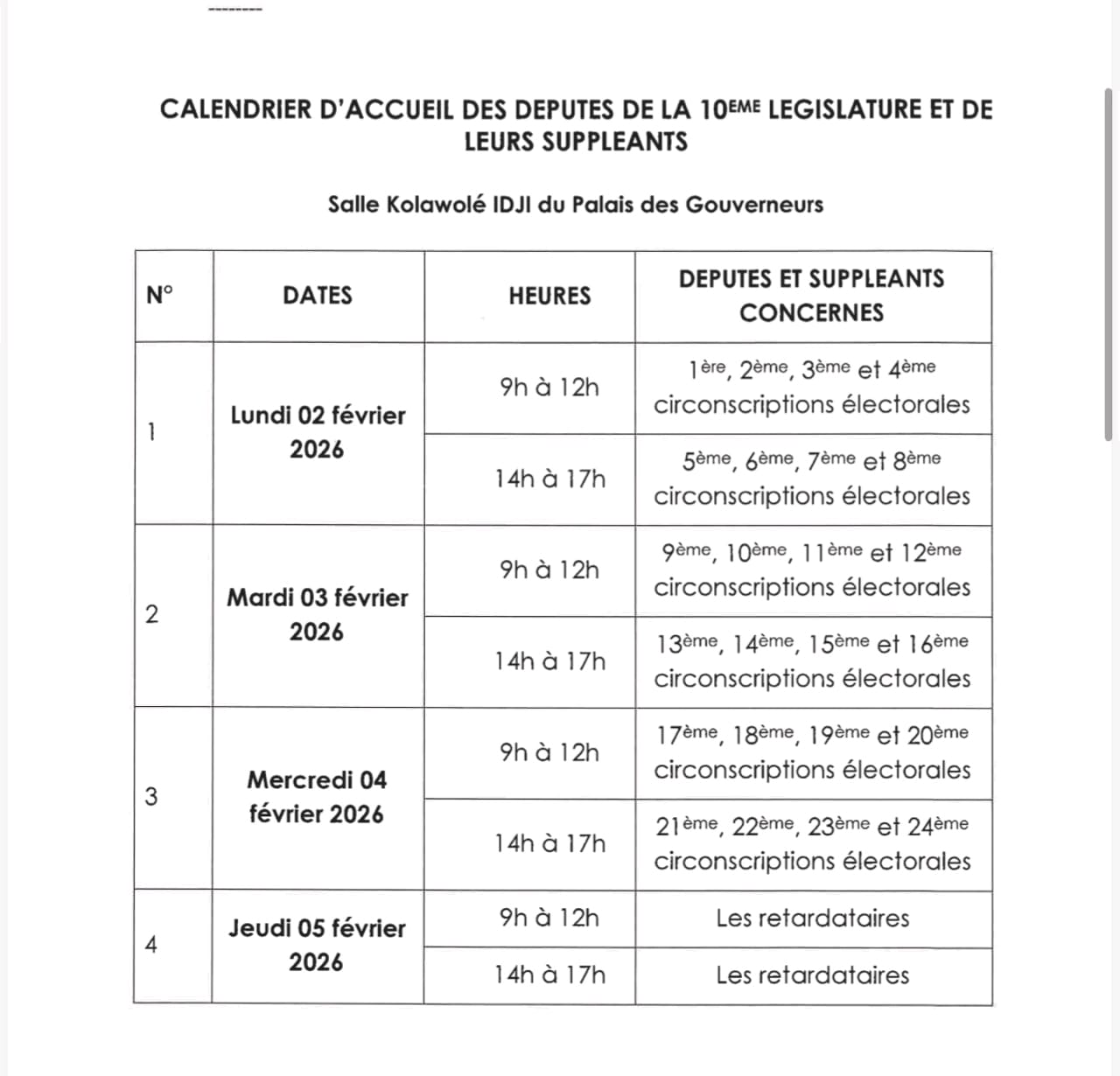
Voici l'agenda d'accueil des députés et leurs suppléants
Le Secrétariat général de l'Assemblée nationale du Bénin a publié le chronogramme officiel de réception des députés de la 10e législature. L'accueil des 109 députés et leurs suppléants se déroulera du 3 au 5 février 2026.
La journée du lundi 2 février est dédiée aux élus des 1ère, 2e, 3e, 4e (9h à 12h), 5e, 6e, 7e et 8e (14h à 17h) Circonscriptions Electorales.
Mardi 3 février, ce sera au tour des députés issus des 9e, 10e, 11e, 12e, 13e, 14e, 15e et 16e circonscriptions.
L'accueil se poursuivra le mercredi 4 février avec les élus des 17e, 18e, 19e, 20e, 21e, 22e, 23e et 24e Circonscriptions.
La journée du jeudi 5 février sera consacrée aux députés retardataires.
Durant cette étape d'accueil, chaque parlementaire devra remplir son dossier administratif et se soumettre à un enregistrement biométrique. C'est également lors de ce passage que les élus reçoivent leurs attributs officiels.
L'installation officielle des 109 députés est prévue pour le 8 février 2026.
Categories: Afrique, European Union
167 nouveaux Assistants déployés dans les Universités publiques (Liste)
Le Ministère de l'Enseignement supérieur et de la Recherche scientifique (MESRS) a rendu publique, ce 02 février 2026, la liste des 167 nouveaux Assistants en position probatoire recrutés au profit des universités publiques du Bénin. Ces nouveaux agents, sélectionnés à l'issue d'un test, sont affectés dans diverses institutions telles que l'Université d'Abomey-Calavi, l'Université de Parakou et l'Université Nationale d'Agriculture pour renforcer l'encadrement académique dans de nombreuses spécialités. LISTE...
Categories: Afrique, European Union
Novo Nordisk Algérie nomme Amine Dahahoui au poste de Directeur général
Novo Nordisk Algérie annonce la nomination du Docteur Amine Dahahoui en qualité de Directeur général. Il succède à Hamza Benharkat, récemment nommé Directeur général de […]
L’article Novo Nordisk Algérie nomme Amine Dahahoui au poste de Directeur général est apparu en premier sur .
Categories: Afrique, Határon túli magyar portálok összesített hírei
Spectacle céleste : un phénomène astronomique exceptionnel illuminera le ciel cette nuit
Les amateurs d’astronomie en Algérie auront rendez-vous avec le ciel dans la nuit de ce lundi à mardi. À 03h50 du matin, heure locale, un […]
L’article Spectacle céleste : un phénomène astronomique exceptionnel illuminera le ciel cette nuit est apparu en premier sur .
Categories: Afrique, Határon túli magyar portálok összesített hírei
Un réseau de trafic de passeports démantelé, 2 policiers écroués
Un réseau de trafic de documents de voyage a été démantelé à l'aéroport Bernardin Gantin de Cotonou. 2 policiers arrêtés.
Plusieurs personnes ont été arrêtées par la Brigade Economique et Financière (BEF). Selon les premiers éléments de l'enquête, les suspects facilitaient contre de l'argent l'obtention de faux passeports notamment au profit des ressortissants de pays asiatiques en proie à des conflits armés ou des crises et inscrits sur la liste rouge du système international.
Parmi les personnes interpellées figurent deux agents de police, identifiés par leurs initiales A. S. et G. B.
Les mis en cause ont été présentés, vendredi 30 janvier 2026, devant la Cour de Répression des infractions économiques et du terrorisme (CRIET). Ils ont été placés sous mandat de dépôt en attendant leur procès.
M. M.
Categories: Afrique, European Union
Venezuela at a Crossroads
Evelis Cano, mother of political prisoner Jack Tantak Cano, pleads with the police for her son’s release outside a detention centre in Caracas, Venezuela, 20 January 2026. Credit: Gaby Oraa/Reuters via Gallo Images
By Inés M. Pousadela
MONTEVIDEO, Uruguay, Feb 2 2026 (IPS)
When US special forces seized Nicolás Maduro and his wife from the presidential residence in Caracas on 3 January, killing at least 24 Venezuelan security officers and 32 Cuban intelligence operatives in the process, many in the Venezuelan opposition briefly dared hope. They speculated that intervention might finally bring the democratic transition thwarted when Maduro entrenched himself in power after losing the July 2024 election. But within hours, those hopes were crushed. Trump announced the USA would now ‘run’ Venezuela and Vice-President Delcy Rodríguez was sworn in to replace Maduro. Venezuela’s sovereignty had been violated twice: first by an authoritarian regime that usurped the popular will, and then by an external power that deliberately violated international law.
A cynical intervention
Under Trump, the USA has abandoned any pretence of promoting democracy. Trump wrapped the intervention in the rhetoric of anti-narcotics operations while openly salivating over Venezuela’s oil reserves, rare earth deposits and investment opportunities. He repeatedly made clear that US regional hegemony is the number one priority. His contempt for Venezuelans’ right to self-determination was explicit: when asked about opposition leader María Corina Machado, Trump dismissed her as lacking ‘respect’ and ‘capacity to lead’. The message to Venezuela’s democratic movement was clear: your struggle doesn’t matter, only our interests do.
Ironically, the US intervention achieved what years of Maduro’s propaganda failed to do, giving anti-imperialist rhetoric a shot in the arm. For decades, Latin American authoritarian regimes have justified repression by pointing to the threat of US intervention, even though this was a largely historical grievance. Not anymore: Trump has handed every Latin American dictator the perfect justification for continuing authoritarian rule.
The global response has been equally revealing. The loudest defenders of national sovereignty are authoritarian powers such as China, Iran and Russia: states that routinely violate their citizens’ rights expressed their ‘solidarity with the people of Venezuela’ and positioned themselves as champions of international law. By blatantly violating a foundational principle of the post-1945 international order, Trump made the leaders of some of the world’s most repressive regimes look like the adults in the room. And across Latin America, the political conversation has now shifted dramatically: the question is no longer how to restore democracy in Venezuela, but how to prevent the next US military adventure in Latin America.
Authoritarianism continues
Meanwhile, Venezuela’s authoritarian regime remains intact. Maduro may be in a New York courtroom, but the structures that kept him in power – the corrupt military, embedded Cuban intelligence, patronage networks and the repressive apparatus – continue unchanged. Rodríguez will likely try to run down the clock, claiming Maduro could return at any moment to avoid calling elections while quietly negotiating oil deals with US companies and reasserting authoritarian control. For both Rodríguez and Trump, democracy seems like an inconvenient obstacle to resource extraction.
For Venezuelan civil society, this creates real dilemmas. As she was sworn in, Rodríguez denounced the operation that put her in charge and vowed that Venezuela would ‘never again be a colony of any empire’. She has wrapped herself in the flag, framing regime continuity as a patriotic stand against western imperialism, and can now easily paint opposition activists who have long demanded international pressure for democracy as treasonous collaborators with foreign powers. This is despite being an insider of a regime that welcomed Cuban intelligence, Iranian oil traders and Russian military advisers, and is now negotiating oil deals with the USA and crossing its own red line by promising legal changes to enable private investment.
A Venezuelan solution for Venezuela
But there may be some cracks in the regime. With Maduro gone, frictions inside the ruling party have become apparent. For instance, there have been obvious disagreements on how to handle the pressure to free Venezuela’s over 800 political prisoners. These may yield opportunities the democracy movement can exploit.
This is the time for the democratic opposition to reclaim the narrative. In the immediate aftermath of the intervention, families of political prisoners mounted vigils outside detention centres, demanding releases the government has only partially delivered. Civil society must amplify these voices, making clear that any transitional arrangement requires the dismantling of the repressive apparatus, not merely a change of faces at the top.
A broad coalition of civil society organisations has issued 10 demands that chart a path to democratic transition. They call for the immediate and unconditional release of political prisoners, the dismantling of irregular armed groups, unfettered access for human rights monitors and humanitarian aid and, crucially, a free and fair presidential election with international observers. These demands deserve international backing, not as conditions for oil contracts, but as non-negotiable requirements for any government that can claim to represent Venezuela.
Venezuela’s democratic forces can either accept marginalisation as Trump and Rodríguez carve up their country’s resources, or use this chaotic moment to advance a genuinely Venezuelan democratic agenda. That means rejecting both Maduro’s authoritarianism and Trump’s intervention, and insisting that any legitimacy Rodríguez’s government claims must come from Venezuelan voters, not US armed forces or oil contracts. Any window of opportunity may however be closing fast. The question is whether Venezuela’s democratic movement can seize it to build the country they have strived for, or whether they will remain spectators while others decide their fate.
Inés M. Pousadela is CIVICUS Head of Research and Analysis, co-director and writer for CIVICUS Lens and co-author of the State of Civil Society Report. She is also a Professor of Comparative Politics at Universidad ORT Uruguay.
For interviews or more information, please contact research@civicus.org
Follow @IPSNewsUNBureau
!function(d,s,id){var js,fjs=d.getElementsByTagName(s)[0],p=/^http:/.test(d.location)?'http':'https';if(!d.getElementById(id)){js=d.createElement(s);js.id=id;js.src=p+'://platform.twitter.com/widgets.js';fjs.parentNode.insertBefore(js,fjs);}}(document, 'script', 'twitter-wjs');
Categories: Africa, Union européenne
Pages
the old site is here



© 2012-2015 Europa Varietas Foundation © 2015-2020 Europa Varietas Association
www.europavarietas.org | info(@)europavarietas(dot)org | Switzerland
This is a GDPR ready site




We are looking for sponsors for the English translation of these books, please contact turkeandras(at)gmail(dot)com