
You are here
Feed aggregator
Myélome et leucémie : tout savoir sur les cancers de la moelle osseuse
Le cancer de la moelle osseuse désigne une prolifération maligne prenant naissance au cœur de nos os. Contrairement à une idée reçue, la moelle n’est […]
L’article Myélome et leucémie : tout savoir sur les cancers de la moelle osseuse est apparu en premier sur .
Categories: Afrique, European Union
Arsène Gbaguidi décroche son Doctorat en Sciences politiques
Arsène Gbaguidi, consultant international est désormais Docteur en Sciences politiques. Il a soutenu sa thèse de doctorat le mardi 3 février 2026, devant un jury présidé par le Professeur Ibrahim Salami.
« La gouvernance interne des partis politiques et consolidation de la démocratie en Afrique : Cas de la République du Benin et de la République centrafricaine », c'est le thème développé par Arsène Gbaguidi, pour sa thèse de doctorat. Il a présenté les résultats de ses recherches lors d'une soutenance mardi 3 février 2026.
Face au jury, l'impétrant expose que la pratique de la démocratie en Afrique a conduit à la restauration du multipartisme intégral dans le processus démocratique. Ce multipartisme renouvelé d'après ses analyses, a consacré la fin du parti unique et du parti d'État, en érigeant les partis politiques au rang d'acteurs principaux de la démocratie, à l'aune des enjeux du processus démocratique retrouvé au lendemain des années 1990. Malgré cela, les partis politiques ne sont pas toujours à la hauteur des attentes.
Sur les cas du Benin et de la Centrafrique, objets de ses recherches, Arsène Gbaguidi a démontré que les partis politiques sont confrontés à plusieurs défis internes dont la confluence ne cesse de se révéler négativement sur la gouvernance politique. L'analyse des partis politiques dans ces deux États laisse apparaitre la nécessité d'une bonne gouvernance à l'intérieur des partis comme condition sine qua non de la gouvernance démocratique en général. Il soutient que le recours à la bonne gouvernance au sein des partis politiques augure également d'une bonne gouvernance politique au sein des États.
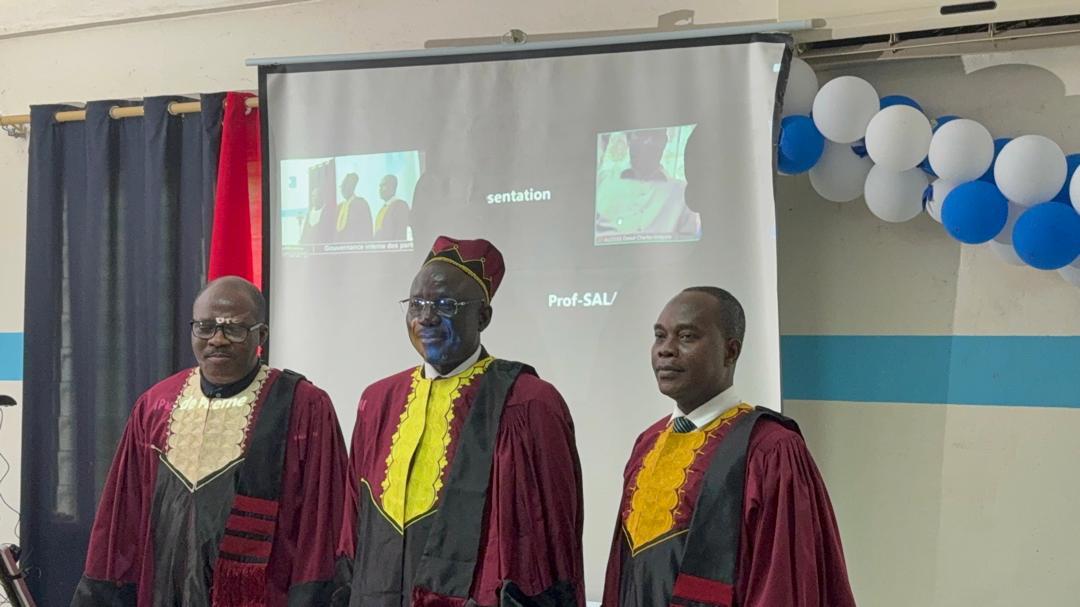
Face à ces constats, le nouveau Docteur propose qu'il faille d'une part, « humaniser la politique pour lui donner un sens ». Chose possible grâce au Droit devenu incontournable dans la construction de la démocratie en Afrique, et dont les partis politiques en sont le vecteur principal. Pour lui, c'est cette évidence qui relie la sécurité juridique et la sécurité politique. « La construction de la démocratie et de l'État de droit suppose que le système juridique impacte le système de gouvernance des partis politiques à travers des valeurs éthiques et morales, afin d'édifier une société politique démocratique et de droit de façon convenable en Afrique », a-t-il clarifié.
Arsène Gbaguidi fait remarquer d'autre part que si la proclamation des principes démocratiques ne pose pas de problème en Afrique subsaharienne, celle-ci a certainement un problème de pratique politique saine et de gouvernance démocratique. En se fondant sur le Bénin et la Centrafrique, il fait observer qu'il y a des « changements constants » dans les alliances entre les dirigeants et les partis, témoignant d'une politique déracinée et désarticulée par rapport aux principes ou à la fidélité aux valeurs de démocratie et de l'État de droit. Les crises de représentation et de légitimité en sont les conséquences immédiates à cause du factionnalisme des partis politiques dits démocratiques souvent aux prises dans l'arène politique africaine depuis les indépendances, a-t-il fait savoir avant d'évoquer la nécessité de démocratiser à nouveau les pratiques politiques au sein des partis politiques démocratiques en vue de perfectionner la gouvernance démocratique en Afrique.
Le jury convaincu des résultats de ses recherches lui décerne la mention Très honorable.
Le nouveau Docteur a assumé pendant près de 30 ans dans les régions d'Afrique de l'Ouest et du Centre, les rôles de leadership dans la formulation de conseils stratégiques à l'intention des hauts responsables de l'ONU et des chefs des opérations de maintien de la paix de l'ONU en ce qui concerne la mise en œuvre globale des résolutions successives du Conseil de sécurité de l'ONU. Il a dirigé avec succès des équipes dans divers domaines en lien avec la paix et la sécurité de l'ONU, y compris les processus de paix et politiques, les élections nationales et la gouvernance démocratique.
F. A. A.
Categories: Afrique
Poulet brésilien à 320 DA/kg : l’État riposte face aux hausses « injustifiées »
Dans une démarche proactive visant à protéger le pouvoir d’achat, l’Office national des aliments de bétail (ONAB) a entamé, ce lundi matin, une opération massive […]
L’article Poulet brésilien à 320 DA/kg : l’État riposte face aux hausses « injustifiées » est apparu en premier sur .
Categories: Afrique, Határon túli magyar portálok összesített hírei
European defence industry
Written by Sebastian Clapp
Facts and figuresThe EU’s defence industry is at a pivotal moment, shaped by Russia’s full-scale invasion of Ukraine, the United States’ shifting priorities, and a renewed drive for strategic autonomy. After years of underinvestment and persistent fragmentation, the EU is now seeking to rebuild military capability and strengthen its defence industrial base. The European defence industry comprises a number of large prime contractors, mid-caps and a large number of small and medium-sized enterprises (SMEs). According to Aerospace, Security and Defence Industries Association of Europe (ASD) data, and the author’s calculations for the EU-27, the EU-based defence industry’s turnover is estimated at around €148 billion in 2024, an increase of more than 60 % since 2021 in nominal terms. Exports amounted to roughly €48 billion in 2024 and direct employment in the EU defence industry amounted to around 500 000 people.
Table 1 – Top EU defence companies by revenue
CompanyCountryRevenue*Global rankingThalesFrance15 900#10LeonardoItaly13 822#13AirbusEuropean12 705#14RheinmetallGerman8 245#18SaabSweden5 542#26MBDAEuropean5 305#27SafranFrance5 198#29Naval GroupFrance4 716#33Source: DefenseNews, 2024. *Revenue from defence in US$ million (2024).
Table 2 – EU defence industry revenue, 2021-2024
Source: ASD data, 2025 and author’s calculations.The EU’s defence industry remains largely concentrated in France, Germany, Italy, Spain and Sweden. However, a report shows that prime producers of the 46 most critical defence items are located across 23 Member States. Thales of France ranked as the largest defence company in the EU by defence revenue in 2024, followed by Italy’s Leonardo. That year, 20 companies headquartered in the EU featured among the world’s top 100 defence firms, including five based in France and four in Germany, together generating defence revenues of approximately US$112 billion, or about €104 billion. By contrast, 48 of the top 100 defence companies were based in the United States, accounting for roughly US$334 billion in defence revenue. Lockheed Martin alone, the leading global defence firm, reported defence revenues of US$68.39 billion. Five of the top 100 were based in China, together accounting for US$355 billion in revenue. The ownership structure of Europe’s leading defence firms underscores the strategic character of the sector.
In many instances, national authorities maintain blocking or controlling shares, which helps safeguard alignment with national priorities and allows for direct public oversight. Across continental Europe, ownership is commonly concentrated either within the state or among family-controlled enterprises. Prominent examples include Dassault (almost 70 % of shares held by the Dassault family’s Groupe Industriel Marcel Dassault), Naval Group (over 60 % of shares are held by the French state), Fincantieri (70 % of shares held by the state-owned Italian sovereign wealth fund, CDP Equity S.p.A.), and Liebherr Group (entirely owned by the Liebherr family). State participation can narrow the scope for cross-border cooperation and industrial consolidation. While mergers between defence firms may deliver economic benefits through economies of scale, they are often treated as strategically sensitive due to their implications for national security and sovereignty. Family-owned firms similarly pursue nationally anchored corporate strategies, reducing their openness to deeper EU-level integration. Golden power rules and the veto capacity of dominant family shareholders further reinforce this structural rigidity. Researchers found that the combined effect is a European defence industrial base that remains fragmented and less competitive than more consolidated markets.
The European defence industry produces a broad range of military equipment and technologies and therefore provides an extensive industrial offering. Its production spans: military aeronautics, including combat, transport and mission aircraft, and helicopters; land capabilities, such as main battle tanks, armoured vehicles across multiple classes, logistics and tactical transport assets, artillery and ammunition of different calibres, alongside individual combat equipment; naval platforms from submarines to surface combatants; space-related defence capabilities; missile systems at both tactical and strategic levels; and defence-specific electronics, information and communication technologies, cyber capabilities and autonomous systems – notably drones, which have experienced a particular boom in production. Despite this breadth, the EU industry does not currently provide domestic solutions in several critical segments, including medium altitude long-endurance unmanned aerial vehicles, tactical ballistic missiles and long-range artillery rockets. These gaps reflect long-term underinvestment and sustained dependence on the United States security guarantee.
Following Russia’s invasion of Ukraine, the rapid availability of military equipment became a key priority for EU governments and armed forces. Firms based outside Europe – benefiting either from larger domestic markets as in the United States or from higher baseline levels of defence readiness as in South Korea – were better positioned to maintain higher production capacity and to deliver or pledge substantial quantities of equipment at speed. By contrast, many European manufacturers were limited by long periods of industrial contraction and underinvestment. This context has evolved markedly since the onset of Russia’s full-scale invasion. EU ammunition production capacity, for example, rose from around 300 000 rounds per year in 2022 to an estimated 2 million by the end of 2025, reflecting a pace of industrial expansion that, according to the Financial Times, exceeds peacetime growth rates by a factor of three.
EU and Member States’ support for the defence industryEU Member States’ defence expenditure has risen sharply since 2021, reflecting a sustained shift towards higher investment in defence. Defence spending reached an estimated €381 billion in 2025, representing a rise of almost 63 % compared to 2020. Expenditure grew from 1.6 % of GDP in 2023 to 1.9 % in 2024 and is expected to reach approximately 2.1 % in 2025. Growth has been driven primarily by investment, which approached €130 billion in 2025. Investment accounted for 31 % of total defence expenditure in 2024, with equipment procurement dominating and exceeding €88 billion. Defence research and development spending also expanded significantly, reaching €13 billion in 2024 and a projected €17 billion in 2025. The EU has introduced several measures to complement and amplify national efforts. These include financial support instruments such as the SAFE loan facility, budgetary flexibility via the national escape clause, and cooperation through the European Peace Facility. In parallel, EU budget instruments such as the European Defence Fund, military mobility funding, the Act in Support of Ammunition Production (ASAP), the European Defence Industry Reinforcement through Common Procurement Act (EDIRPA) and the European defence industry programme (EDIP) aim to reduce fragmentation and strengthen the competitiveness of Europe’s defence industrial base.
European Parliament positionParliament has consistently called for an increase in defence spending and for boosting the EU defence industry. Members welcome rising national defence spending but urge deeper European cooperation to prevent market fragmentation and call for expanded industrial output and greater interoperability.
Read this ‘at a glance’ note on ‘European defence industry‘ in the Think Tank pages of the European Parliament.
‘After Decades of Denial and Silence, the Suffering of Rohingya People Is Being Heard at the World’s Highest Court’
By CIVICUS
Feb 9 2026 (IPS)
CIVICUS discusses the genocide case against Myanmar at the International Court of Justice (ICJ) with Mohammed Nowkhim of the Arakan Rohingya Society for Peace & Human Rights (ARSPHR), a civil society organisation led by Rohingya people born out of refugee camps in Bangladesh to document atrocities, preserve survivor testimony and advocate for accountability and justice.
Mohammed Nowkhim
On 12 January, the ICJ began hearings in the genocide case brought by The Gambia against Myanmar over the military’s treatment of the Rohingya Muslim minority. The Gambia, representing the Organisation of Islamic Cooperation’s 57 members, accuses Myanmar of breaching the Genocide Convention. The Gambia’s justice minister presented evidence of mass killings, sexual violence and village destruction during a government crackdown in 2017 that forced over 700,000 Rohingya people to flee to Bangladesh. Rohingya survivors testified in closed sessions. Myanmar denies genocidal intent, characterising its actions as counterterrorism. A final judgment is expected before the end of the year.What atrocities were committed against Rohingya people and what is being examined in court?
During what were called ‘clearance operations’ in 2017, Myanmar security forces burned entire villages, raped women, killed children and threw them into fires and wells. According to documented reports, over 10,000 people were killed and around 700,000, including me, were forced to flee Myanmar. These were not random acts of violence; they were systematic and targeted attacks aimed at erasing our community.
In 2019, The Gambia, supported by 11 other states, filed a case against Myanmar at the ICJ, accusing it of genocide. Judges are now examining evidence of mass killings, sexual violence, village destruction and forced displacement. They are also reviewing official policies and actions that show intent to destroy Rohingya people as a group, including patterns of violence, coordination by state forces and the systematic denial of basic rights.
This case shows that genocide claims can be examined through law rather than dismissed for political convenience. But for the Rohingya, this is not just a legal process. It represents acknowledgment and a source of hope for present and future generations. After decades of denial and silence, our suffering is being heard at the world’s highest court and recognised in a legal space where truth matters. The hearings can’t erase our wounds, but they can offer some solace and a path towards justice.
What evidence supports the case against Myanmar?
The case was built on years of evidence-gathering. The Gambia relied on extensive material from the Independent Investigative Mechanism for Myanmar and United Nations (UN) fact-finding missions, as well as documentation collected over many years by human rights organisations, including Fortify Rights, Human Rights Watch and Rohingya-led groups.
Civil society played a key role when states failed to act. Even when the world looked away, organisations continued to document the truth and refused to let these crimes be erased or rewritten. Long before any court agreed to listen, groups including the ARSPHR were collecting survivor testimonies, documenting violations and carefully preserving evidence, knowing it might one day be used in court. Without that work, much of what happened would have been lost and perpetrators couldn’t have been challenged.
In a way, civil society became the memory of the Rohingya people. Today, this evidence forms part of the case before the ICJ.
Why is accountability so difficult?
Politics often protects perpetrators. Those with power choose stability over justice and shield those responsible for crimes. Myanmar’s authorities continue to deny wrongdoing and refuse to cooperate, which delays justice.
International law also has its limits. Justice moves slowly because ICJ rulings do not automatically lead to consequences. International courts can establish the truth, but they can’t force states to act. Enforcement depends on political will, often through the UN Security Council, where countries such as China and Russia can block action, even when crimes are clear and well documented.
What must happen to ensure justice?
There must be real action. Perpetrators must be held accountable, Rohingya citizenship must be restored and discriminatory laws that enabled genocide must be removed. Any return of refugees must be voluntary, safe and dignified. It can’t happen without international monitoring and guarantees of protection. People can’t be sent back to the same conditions that forced them to flee.
Ultimately, justice is not only about the past, but also about ensuring that future generations of Rohingya can live with rights, safety and dignity. This case is only the beginning. What happens after the judgment will decide whether justice is real or only symbolic.
CIVICUS interviews a wide range of civil society activists, experts and leaders to gather diverse perspectives on civil society action and current issues for publication on its CIVICUS Lens platform. The views expressed in interviews are the interviewees’ and do not necessarily reflect those of CIVICUS. Publication does not imply endorsement of interviewees or the organisations they represent.
GET IN TOUCH
Website
Facebook
Instagram
LinkedIn
Threads
Twitter
Mohammed Nowkhim/Facebook
Mohammed Nowkhim/LinkedIn
SEE ALSO
Myanmar’s junta tightens its grip CIVICUS Lens 12.Dec.2025
International Court of Justice offers hope of rules-based order CIVICUS Lens 19.May.2025
Myanmar at a crossroads CIVICUS Lens 28.Oct.2024
Follow @IPSNewsUNBureau
!function(d,s,id){var js,fjs=d.getElementsByTagName(s)[0],p=/^http:/.test(d.location)?'http':'https';if(!d.getElementById(id)){js=d.createElement(s);js.id=id;js.src=p+'://platform.twitter.com/widgets.js';fjs.parentNode.insertBefore(js,fjs);}}(document, 'script', 'twitter-wjs');
Categories: Africa, Határon túli magyar portálok összesített hírei
Les robots pollinisateurs à la rescousse des abeilles en déclin en Europe
Certains drones pollinisateurs, plus légers qu'un trombone, pourraient aider à soutenir les ruches.
The post Les robots pollinisateurs à la rescousse des abeilles en déclin en Europe appeared first on Euractiv FR.
Categories: Afrique, Union européenne
Les Pays-Bas vont relever l’âge légal de la consommation de la nicotine à 21 ans
La Lettonie a relevé l'âge légal pour acheter des produits contenant de la nicotine l'année dernière, suivie par l'Irlande et la Finlande.
The post Les Pays-Bas vont relever l’âge légal de la consommation de la nicotine à 21 ans appeared first on Euractiv FR.
Categories: Afrique, Union européenne
L’industrie de la défense suspendue aux décisions des gouvernements européens sur l’usage des 150 milliards d’euros de prêts accordés par l’UE
Les fabricants d'armes ont besoin de clarté avant d'augmenter leur production.
The post L’industrie de la défense suspendue aux décisions des gouvernements européens sur l’usage des 150 milliards d’euros de prêts accordés par l’UE appeared first on Euractiv FR.
Categories: Défense, Union européenne
Transport à Alger : Découvrez le plan spécial Ramadan 2026
Afin de répondre aux besoins de mobilité nocturne durant le mois sacré, la Direction des Transports de la wilaya d’Alger a mis en place un […]
L’article Transport à Alger : Découvrez le plan spécial Ramadan 2026 est apparu en premier sur .
Categories: Afrique, Határon túli magyar portálok összesített hírei
Après les terres rares, l’éolien algérien attire les investisseurs: partenariat inédit avec l’IFC en vue
L’Algérie, longtemps associée aux hydrocarbures, se positionne aujourd’hui comme un acteur majeur des énergies propres dans la région. Alors que le pays a bouclé avec […]
L’article Après les terres rares, l’éolien algérien attire les investisseurs: partenariat inédit avec l’IFC en vue est apparu en premier sur .
Categories: Afrique, Határon túli magyar portálok összesített hírei
L’État modernise l’administration : Lancement de la plateforme nationale de « gouvernance des données »
Sous le slogan « Souveraineté, organisation et transparence », le Premier ministre Sifi Ghrieb a officiellement inauguré ce lundi, au Centre international des conférences (CIC), […]
L’article L’État modernise l’administration : Lancement de la plateforme nationale de « gouvernance des données » est apparu en premier sur .
Categories: Afrique, Határon túli magyar portálok összesített hírei
Fin de la convention aérienne de 2014 : après la décision d’Alger, les Émirats réagissent
A la suite de la décision de l’Algérie de mettre fin à l’accord relatif aux services aériens liant les deux nations, l’Autorité générale de l’aviation […]
L’article Fin de la convention aérienne de 2014 : après la décision d’Alger, les Émirats réagissent est apparu en premier sur .
Categories: Afrique, Határon túli magyar portálok összesített hírei
Debate: Iran and US: can talks prevent war?
Negotiators from the US and Iran held indirect talks in Oman on Friday. Both sides lauded the start of negotiations, but at the same time upped the pressure: US President Donald Trump threatened to impose additional punitive tariffs on countries that do trade with Iran, while Iranian Foreign Minister Abbas Araghchi warned that attacks on his country would be met with attacks on US bases in the region.
Categories: Défense, European Union
Regime change is a slogan, not a plan | Cyprus Mail - Cyprus
Categories: Europäische Union, European Union
Debate: Japan: landslide victory for Takaichi
Japan's national conservative ruling party has secured a resounding election victory: under the leadership of Prime Minister Sanae Takaichi, who has only been in office since October, the Liberal Democratic Party (LDP) has won more than two-thirds of the seats in the parliamentary election - the first time a single party has achieved such a majority in Japan. Takaichi has promised to upgrade Japan's military to create a counterweight to China in the region.
Categories: European Union
Pages
the old site is here



© 2012-2015 Europa Varietas Foundation © 2015-2020 Europa Varietas Association
www.europavarietas.org | info(@)europavarietas(dot)org | Switzerland
This is a GDPR ready site




We are looking for sponsors for the English translation of these books, please contact turkeandras(at)gmail(dot)com