
Vous êtes ici
Agrégateur de flux
Press release - Press conference on updated air passenger rights on Tuesday at 14.00
After the final vote in the European Parliament on Tuesday, key EP negotiators Andrey Novakov and Virginijus Sinkevičius will brief journalists on the EU air passenger rights rules review.
Committee on Transport and Tourism
Source : © European Union, 2026 - EP
Committee on Transport and Tourism
Source : © European Union, 2026 - EP
Catégories: Union européenne
Press release - Press conference on updated air passenger rights on Tuesday at 14.00
After the final vote in the European Parliament on Tuesday, key EP negotiators Andrey Novakov and Virginijus Sinkevičius will brief journalists on the EU air passenger rights rules review.
Committee on Transport and Tourism
Source : © European Union, 2026 - EP
Committee on Transport and Tourism
Source : © European Union, 2026 - EP
Catégories: Europäische Union
Press release - Press conference on updated air passenger rights on Tuesday at 14.00
After the final vote in the European Parliament on Tuesday, key EP negotiators Andrey Novakov and Virginijus Sinkevičius will brief journalists on the EU air passenger rights rules review.
Committee on Transport and Tourism
Source : © European Union, 2026 - EP
Committee on Transport and Tourism
Source : © European Union, 2026 - EP
Catégories: Európai Unió : hírek magyarul
Press release - Press conference on updated air passenger rights on Tuesday at 14.00
After the final vote in the European Parliament on Tuesday, key EP negotiators Andrey Novakov and Virginijus Sinkevičius will brief journalists on the EU air passenger rights rules review.
Committee on Transport and Tourism
Source : © European Union, 2026 - EP
Committee on Transport and Tourism
Source : © European Union, 2026 - EP
Catégories: European Union
Press release - Press conference on updated air passenger rights on Tuesday at 14.00
After the final vote in the European Parliament on Tuesday, key EP negotiators Andrey Novakov and Virginijus Sinkevičius will brief journalists on the EU air passenger rights rules review.
Committee on Transport and Tourism
Source : © European Union, 2026 - EP
Committee on Transport and Tourism
Source : © European Union, 2026 - EP
Catégories: European Union
Discounting Demographic Realities
Rather than adapting to persistent low fertility, population ageing, and slower labor-force growth, many governments continue to pursue policies aimed at reversing these trends and restoring demographic conditions more characteristic of the mid-20th century. Credit: Shutterstock
By Joseph Chamie
PORTLAND, USA, Jul 3 2026 (IPS)
Demographic realities are well documented, and governments have long been aware of the profound demographic changes now underway. Nevertheless, many policymakers continue to discount or ignore these demographic trends.
This reluctance often reflects the tension between short-term political priorities and long-term demographic realities. As a result, governments are frequently unwilling to acknowledge the full scale of the major demographic transformations reshaping their societies.
In some cases, demographic denialism serves to protect entrenched political or economic interests. More often, however, it reflects an unwillingness to confront politically difficult policy choices, such as raising taxes, expanding immigration, increasing retirement ages, or committing additional resources to pensions, healthcare, and other social welfare programs.
Many countries are already experiencing population decline, with deaths exceeding births. In 63 countries, home to about 28% of the world’s population, population size has already peaked. Over the next thirty years, the populations of an additional 48 countries and areas are also expected to reach their peak before entering a period of decline
Because demographic change typically unfolds gradually, politicians often prioritize policies that deliver immediate political or economic benefits over reforms designed to address long-term challenges such as population decline and demographic ageing. Electoral incentives and short-term political considerations often outweigh the need to adapt to evolving demographic realities.
Governments may also downplay demographic trends because doing so enables them to pursue short-term political priorities and ideological objectives while postponing the more difficult fiscal and policy adjustments required by demographic change.
Moreover, some policymakers continue to pursue measures intended to restore the demographic patterns of the recent past, despite the limited likelihood that such efforts will succeed.
The demographic conditions of the 20th century were historically exceptional. Population growth, fertility rates, age structures, declining mortality, and gains in life expectancy all reached unprecedented levels, particularly during the second half of the century. These conditions were the product of a unique combination of historical, economic, technological, and public health factors and are unlikely to be repeated. Rather than attempting to recreate the demographic environment of the past, governments should focus on adapting institutions, policies, and public finances to contemporary demographic realities.
The world’s population nearly quadrupled during the 20th century, rising from 1.6 billion in 1900, to 2.5 billion in 1950, and then to 6.2 billion by 2000.
Today, the global population is approximately 8.3 billion, more than five times its size in 1900. Although the world’s population is expected to continue growing, the rate of growth has slowed dramatically. According to current projections, the global population is expected to peak at approximately 10.3 in the mid-2080s before declining slightly to around 10.2 billion by the end of the century (Table 1).
Source: United Nations.
The world’s population growth rate, which was 1.7% in 1950, rose to a peak of about 2.3% in the early 1960s. By the end of the 20th century, it had declined to about 1.4%. In 2026, the global growth rate is estimated at approximately 0.8% and is projected to continue decreasing, reaching about -0.1% by the end of the century.
Moreover, many countries are already experiencing population decline, with deaths exceeding births. In 63 countries, home to about 28% of the world’s population, population size has already peaked. Over the next thirty years, the populations of an additional 48 countries and areas are also expected to reach their peak before entering a period of decline.
Fertility levels have also fallen dramatically from the relatively high levels of the mid-20th century. The global fertility rate, which averaged more than five births per woman in the late 1950s, had declined to about half that level by the beginning of the 21st century. By 2026, the world’s fertility rate is estimated at approximately 2.2 births per woman. Furthermore, more than half of all countries now have fertility rates below the replacement level of approximately 2.1 births per woman.
Population ageing is another defining demographic trend. In 1950, only about 5% of the world’s population was aged 65 or older. By 2026, that proportion had more than doubled to nearly 11%. The proportion of the population aged 85 and older has increased even more rapidly, rising from just 0.2% in 1950 to about 1% in 2026.
As populations age, people are also living longer than ever before. Global life expectancy at birth has increased substantially, from about 46 years in 1950 to approximately 74 years in 2026.
Life expectancy at age 65 has also risen substantially. Globally, it increased from about 11 additional years in 1950 to approximately 18 additional years by the mid-2020s. In many countries, however, the gains have been greater, with life expectancy at age 65 exceeding 20 years. In Japan and France, for example, a 65-year-old can expect to live approximately 23 additional years (Figure 1).
Source: United Nations.
Rather than adapting to persistent low fertility, population ageing, and slower labor-force growth, many governments continue to pursue policies aimed at reversing these trends and restoring demographic conditions more characteristic of the mid-20th century.
In many low-fertility countries, governments have devoted substantial public resources to pro-natalist measures such as cash transfers, tax incentives, subsidized childcare, and housing assistance. While these policies may ease short-term financial constraints for families, they have generally produced only modest and often temporary increases in fertility rates.
At the same time, despite rising old-age dependency ratios and persistent labor shortages, immigration policy remains politically contentious, and, in some countries, highly restrictive. This has occurred alongside growing fiscal strain on pay-as-you-go pension systems and increasing demand for healthcare and long-term care services.
Although life expectancy continues to increase, especially at older ages, reforms such as gradually raising retirement ages, broadening the tax base, restructuring pension systems, and adapting healthcare financing have often advanced slowly because of political resistance. As a result, fiscal adjustments frequently lag behind demographic change, contributing to mounting budgetary pressures and, in some cases, greater intergenerational tension.
In some countries, political leaders have responded to inconvenient demographic trends by weakening the independence of statistical agencies, reducing funding for demographic research and data collection, firing statisticians, sidelining professional expertise, or publicly questioning well-established demographic evidence. Such actions can make it more difficult for policymakers and the public to assess demographic change accurately, evaluate policy options, and develop effective long-term responses.
Similarly, rather than modernizing public safety nets, diversifying revenue sources, or implementing gradual reforms to retirement and pension systems, many governments postpone difficult policy decisions to minimize electoral backlash. Prolonged delays, however, can undermine the long-term financial sustainability of public programs and increase the likelihood that pension and social insurance trust funds will become insolvent or require abrupt corrective measures.
Another form of political avoidance is the maintenance of restrictive immigration policies despite persistent labor shortages. In many countries, immigration has historically helped offset population decline driven primarily by sustained below-replacement fertility. Without sufficient immigration, population decline and demographic ageing are likely to accelerate in these societies.
The major demographic shifts of the 21st century – including population decline, demographic ageing, sustained below replacement fertility, increasing longevity, migration, refugee movements, and asylum pressures – are well documented and widely recognized. Nevertheless, many governments continue to prioritize efforts to reverse these trends while devoting comparatively less attention to adapting institutions and public policies to long-term demographic realities.
Rather than focusing primarily on restoring the demographic conditions of the recent past, policymakers may benefit from placing greater emphasis on adapting economic, fiscal, and social institutions to the demographic realities of the present and the decades ahead. Such an approach recognizes demographic change not as a temporary departure from historical norms, but as a defining structural feature of the 21st century that requires sustained institutional adaptation rather than attempts at demographic restoration.
Joseph Chamie is a consulting demographer, a former director of the United Nations Population Division, and author of numerous publications on population issues.
Catégories: Africa
Tempo darf kein Ersatz für Demokratie sein
Die EU-Erweiterung auf dem Westbalkan ist strategisch wichtig. Doch wer den Beitrittsprozess beschleunigen will, darf Demokratie und Rechtsstaatlichkeit nicht zur Nebensache machen. Ein Beitrag von Karina Mross.
Catégories: Diplomacy & Defense Think Tank News
Tempo darf kein Ersatz für Demokratie sein
Die EU-Erweiterung auf dem Westbalkan ist strategisch wichtig. Doch wer den Beitrittsprozess beschleunigen will, darf Demokratie und Rechtsstaatlichkeit nicht zur Nebensache machen. Ein Beitrag von Karina Mross.
Catégories: Diplomacy & Defense Think Tank News
Tempo darf kein Ersatz für Demokratie sein
Die EU-Erweiterung auf dem Westbalkan ist strategisch wichtig. Doch wer den Beitrittsprozess beschleunigen will, darf Demokratie und Rechtsstaatlichkeit nicht zur Nebensache machen. Ein Beitrag von Karina Mross.
Catégories: Diplomacy & Defense Think Tank News
Inondations en Côte d'Ivoire : plus de 50 morts, des quartiers submergés et un gouvernement sous pression
Ces nouvelles inondations qui ont frappé la Côte d'Ivoire, avec un bilan de 59 morts, rappellent la vulnérabilité du pays face aux pluies torrentielles exacerbées par les changements climatiques.
Catégories: Afrique
New Report Blames Russia’s Shadow Fleet for Europe Drone Incursions
A report by the International Institute for Strategic Studies (IISS) assesses that it is ‘highly likely’ many of recent drone incidents throughout Europe were ordered by Moscow as part of a wider hybrid campaign against NATO.
The investigation focuses on incidents taking place between August 2024 and February 2026, including incursions into the airspace of thirteen individual countries. All but one of these nations, the exception being Ireland, are members of NATO.
Among the incursions documented in the report are those which targeted U.S. Air Force sites in the UK – which The Aviationist covered in depth across three articles – as well as the incident over the French Navy ballistic missile submarine base at Île Longue.
This report assesses that it is highly likely the Kremlin conducted a coordinated Uninhabited Aerial Vehicle (UAV) campaign over Europe between August 2024 and February 2026, spanning a dozen NATO states and Ireland.
It is also likely that Russian-linked vessels and the shadow… pic.twitter.com/pGRtWRHPtE
— IISS News (@IISS_org) July 2, 2026
By corroborating the various reports of drone incursions with data relating to ships that are known or suspected to belong to Russia’s shadow fleet, the IISS has named several vessels in particular that it believes were responsible for launching and/or directing the drones.
It notes that the cargo vessel Hav Dolphin (IMO 9073854), investigated by both Germany and the Netherlands after drone incursions in the spring of 2025, was in fact docked in Hull, UK, while British and American authorities were dealing with the drone sightings over military sites in November 2024.
Suspected drone carrier / cargo ship HAV DOLPHIN entered Baltic Sea via Kiel kanal, last port Antwerp. Stated destination Vasa, FI
The Russian crewed ship is suspected if being behind drone flights over military installations in NW Germany a few months ago. pic.twitter.com/i4QfsyLyzi
— auonsson (@auonsson) August 24, 2025
At the same time, the tanker Seasons I (IMO 9308950) travelled eastbound through the Straits of Dover and routed approximately parallel to the southern coast of East Anglia where RAF Lakenheath, RAF Mildenhall, and a number of other sensitive U.S. and UK military facilities are located.
Positions of selected Russian shadow-fleet tankers around Germany and the UK, 26 November 2024 | Source: The International Institute for Strategic Studies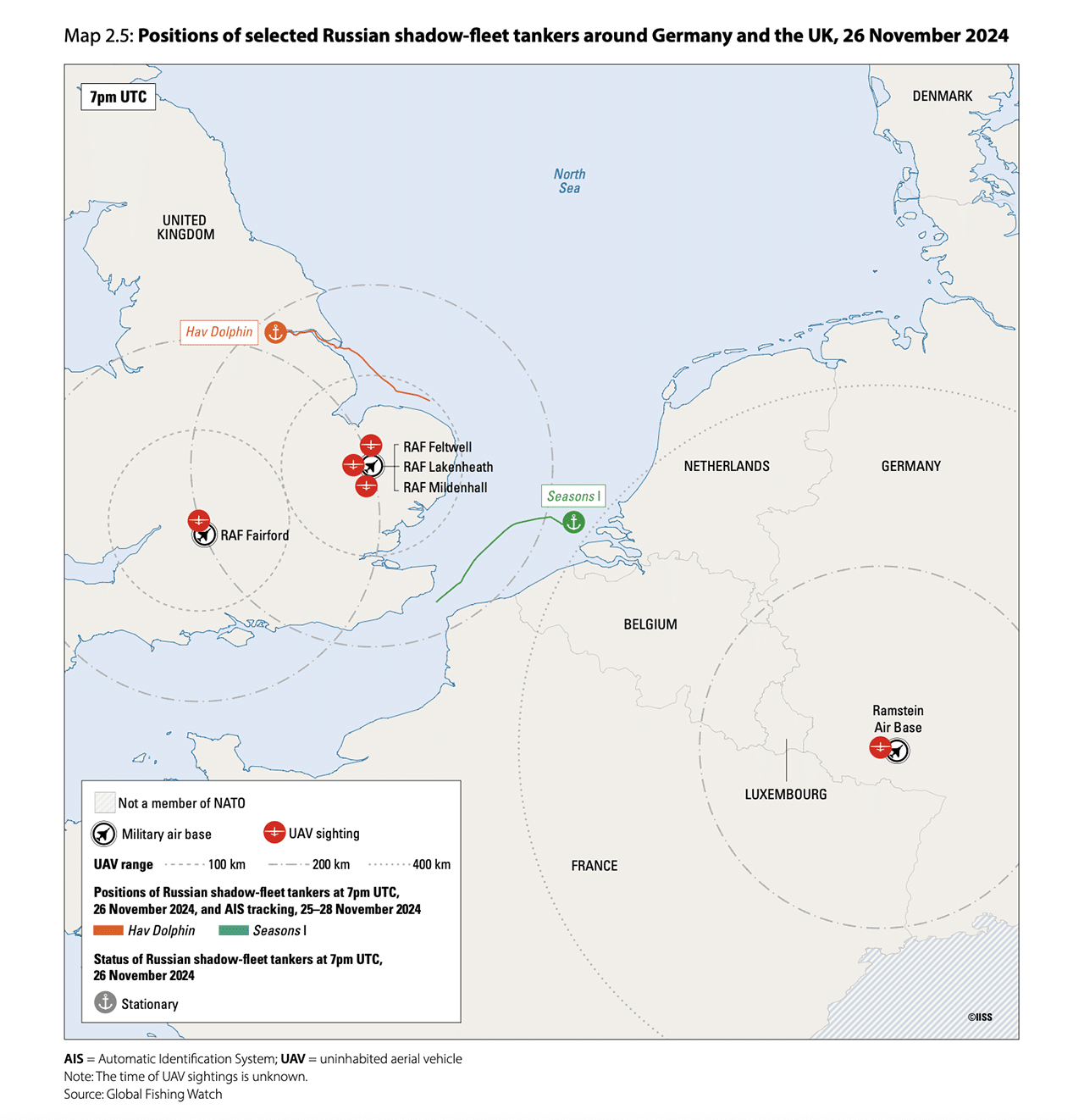
Comment from anonymous U.S. officials at the time of the incursions suggested that the drones were of a sophistication beyond what would be expected for commercially available civilian drones. As we noted, the incursions over these important U.S. bases came just days after then President Joe Biden gave Ukraine the long awaited all-clear to use long range missiles to strike targets deep inside Russian territory.
Selected reported UAV sightings in Europe by location and site, August 2024–February 2026 | Source: The International Institute for Strategic Studies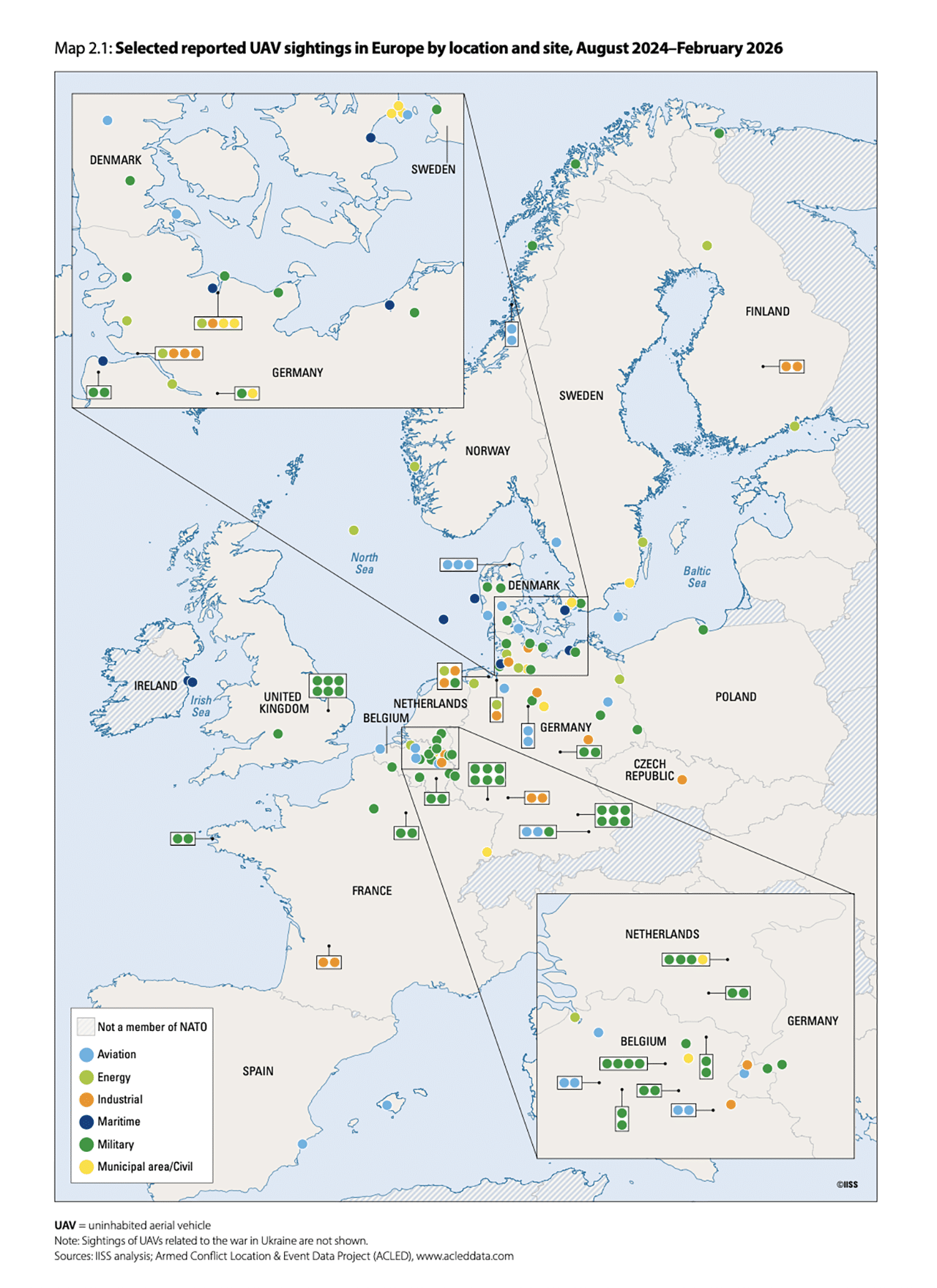
In its executive summary of the lengthy report, the IISS argues that while not every UAV incident during this period is likely to have been linked to Russia, “the aggregate pattern of UAV sightings cannot be adequately explained by misidentification, hobbyist activity or opportunistic harassment alone.”
Careful ScrutinyThere is no smoking gun that definitively proves Russia’s involvement, and none of the nations affected in these drone incursions have yet directly pointed their finger in Russia’s direction, though IISS researchers have suggested that these countries have given their tacit approval of the report. “Every government we spoke to said they would welcome the report being published,” said Charlie Edwards, Senior Fellow for Strategy & National Security.
Without the smoking gun, some have questioned the report’s findings. Dronewatch Europe have said: “The conclusions are striking. However, they also deserve careful scrutiny.”
“The report does not present physical evidence linking any specific drone to any specific vessel. No launch has been observed, no command links have been intercepted, no wreckage has been recovered, no credible video footage was recorded, and no telemetry or forensic data has been released tying a drone to a Russian ship.”
New IISS report revives ‘Russian shadow fleet drone’ theory, but fails to provide evidence https://t.co/aQNZoaX2O3 pic.twitter.com/efG2r4BgCD
— Dronewatch Europe (@DronewatchEU) July 2, 2026
This forensic data is, of course, difficult for a non-state actor to obtain. Primary radar data and advanced intelligence (including the use of electro-optical sensors, signals intelligence (SIGINT), and human intelligence (HUMINT)) capabilities would be of paramount importance to gathering the definitive facts in cases like this.
Whether the capable intelligence agencies – in many cases, world leading – of the nations involved have in fact collected these facts is unclear. While one could argue that the fact no country has stepped forward and set out a comprehensive case for Russia’s involvement, it is also true that doing so could prejudice some of the capabilities and/or sources of intelligence available to them. Proving Russia’s guilt in the public domain might not outweigh the value of these intelligence assets.
The @RoyalAirForce has recently deployed its Counter-Uncrewed Aerial System to Belgium in response to rogue drones interrupting flights at Brussels Airport. This comes just a month after the system was deployed to Denmark.
The RAF’s C-UAS capability is called ORCUS, which is a… pic.twitter.com/bS6buQuCDc
— Leonardo Electronics (@LDO_Electronics) November 11, 2025
Dronewatch’s own investigation into 61 drone sightings across Europe in 2025 found that, in many cases, “reported drones turned out to be perfectly ordinary aircraft, helicopters, stars, planets or other explainable phenomena. In numerous cases there was simply no evidence that a drone had ever been present.”.
The IISS report does touch on these earlier investigations, though it argues that “In an operating environment where European detection capability was demonstrably insufficient to reliably track low-altitude, non-cooperative UAVs, a high non-confirmation rate is the expected outcome regardless of whether the sightings were genuine.”
“A high false-positive rate in public reporting is, if anything, analytically consistent with Russian operational design: engineering an environment of ambiguity in which genuine incursions are difficult to distinguish from noise is itself a feature of the campaign,” the report continues.
Whether any of the drones were in fact linked to Russia or not, the IISS states that Europe’s counter-UAS (C-UAS) strategy has not kept up with the threat now posed by these systems: “detection is uneven, legal authorities are fragmented, response options are often disproportionate, and attribution remains too slow to support timely deterrence.”
Catégories: Defence`s Feeds
Protokoll - Mittwoch, 6. Mai 2026 - Donnerstag, 7. Mai 2026 - PE788.835v01-00 - Ausschuss für Sicherheit und Verteidigung
Quelle : © Europäische Union, 2026 - EP
Catégories: Europäische Union
Minutes - Wednesday, 3 June 2026 - PE789.884v01-00 - Committee on Foreign Affairs
Source : © European Union, 2026 - EP
Catégories: Europäische Union
Minutes - Wednesday, 3 June 2026 - PE789.884v01-00 - Committee on Foreign Affairs
Source : © European Union, 2026 - EP
Catégories: European Union
BERICHT on a European Parliament recommendation to the Council, the Commission and the Vice-President of the Commission / High Representative of the Union for Foreign Affairs and Security Policy on the changing geopolitical situation in East Asia and...
BERICHT on a European Parliament recommendation to the Council, the Commission and the Vice-President of the Commission / High Representative of the Union for Foreign Affairs and Security Policy on the changing geopolitical situation in East Asia and the need for closer cooperation with like-minded partners in the region
Ausschuss für auswärtige Angelegenheiten
Adam Bielan
Quelle : © Europäische Union, 2026 - EP
Ausschuss für auswärtige Angelegenheiten
Adam Bielan
Quelle : © Europäische Union, 2026 - EP
Catégories: Europäische Union
ZWISCHENBERICHT im Hinblick auf das Verfahren der Zustimmung zu dem Abkommen über eine politische, wirtschaftliche und kooperative strategische Partnerschaft zwischen der EU und Mexiko - A10-0182/2026
ZWISCHENBERICHT im Hinblick auf das Verfahren der Zustimmung zu dem Abkommen über eine politische, wirtschaftliche und kooperative strategische Partnerschaft zwischen der EU und Mexiko
Ausschuss für auswärtige Angelegenheiten
Ausschuss für internationalen Handel
Borja Giménez Larraz, Javi López
Quelle : © Europäische Union, 2026 - EP
Ausschuss für auswärtige Angelegenheiten
Ausschuss für internationalen Handel
Borja Giménez Larraz, Javi López
Quelle : © Europäische Union, 2026 - EP
Catégories: Europäische Union
BERICHT über den Bericht 2025 der Kommission über die Ukraine - A10-0172/2026
BERICHT über den Bericht 2025 der Kommission über die Ukraine
Ausschuss für auswärtige Angelegenheiten
Michael Gahler
Quelle : © Europäische Union, 2026 - EP
Ausschuss für auswärtige Angelegenheiten
Michael Gahler
Quelle : © Europäische Union, 2026 - EP
Catégories: Europäische Union
The 2028-2034 Multi-Annual Financial Framework: three scenarios on the potential future of EU financing for global multilateralism
This ETTG policy brief analyses the state of play of EU funding to and cooperation with the United Nations system, before considering future possibilities and challenges in relation to the ongoing negotiations of the next Multi-Annual Financial Framework (MFF, 2028–34), notably the Global Europe Instrument. Although neither the MFF nor the Global Europe Instrument Regulation are expected to include concrete provisions on EU funding to the UN system, they frame the political priorities and define legal boundaries and criteria through which the EU will shape its programming and select its implementation partners. Through these parameters, the question is whether the new MFF will operationalise and ensure the Union’s strategic defence of multilateralism and partnership with the UN, alone and through Team Europe, or if the new rules instead result in a de-facto reduction of the EU’s political and financial support to the UN system.
Catégories: Diplomacy & Defense Think Tank News
The 2028-2034 Multi-Annual Financial Framework: three scenarios on the potential future of EU financing for global multilateralism
This ETTG policy brief analyses the state of play of EU funding to and cooperation with the United Nations system, before considering future possibilities and challenges in relation to the ongoing negotiations of the next Multi-Annual Financial Framework (MFF, 2028–34), notably the Global Europe Instrument. Although neither the MFF nor the Global Europe Instrument Regulation are expected to include concrete provisions on EU funding to the UN system, they frame the political priorities and define legal boundaries and criteria through which the EU will shape its programming and select its implementation partners. Through these parameters, the question is whether the new MFF will operationalise and ensure the Union’s strategic defence of multilateralism and partnership with the UN, alone and through Team Europe, or if the new rules instead result in a de-facto reduction of the EU’s political and financial support to the UN system.
Catégories: Diplomacy & Defense Think Tank News
Pages



© 2012-2018 Europa Varietas Foundation © 2015-2018 Europa Varietas Association
www.europavarietas.org | info(@)europavarietas(dot)org | Switzerland




We are looking for sponsors for the English translation of these books, please contact turkeandras(at)gmail(dot)com