
You are here
Határon túli magyar portálok összesített hírei
Debate: Upshot of the Ukraine peace meeting in London?
At a meeting in London on Monday, Ukrainian President Volodymyr Zelensky, German Chancellor Friedrich Merz, French President Emmanuel Macron and British Prime Minister Keir Starmer discussed how to proceed on the war in Ukraine. The 28-point peace plan presented by the US was shortened to exclude positions that were 'anti-Ukrainian' (Zelensky) and now comprises 20 points. Once the details have been ironed out, the plan will be sent to Washington.
Les inscriptions ouvertes pour le prix Adiaha
La Fondation Ladima annonce l'ouverture des inscriptions pour l'édition 2026 du Prix Adiaha du Meilleur Documentaire réalisé par une Femme Africaine.
Du 10 décembre 2025 au 10 mars 2026, les femmes africaines, vivant et/ou travaillant sur le continent peuvent s'inscrire pour remporter le prestigieux Prix Adiaha du Meilleur Documentaire réalisé par une Femme Africaine.
Les inscriptions sont désormais ouvertes sur Film Freeway.
Le gagnant remportera un prix en espèces de 2 000 $. Pour cette 8e édition du prix, la Fondation Ladima est en partenariat avec Afrikama- Current Cinema From Africa.
Le cinéaste gagnant sera invité à l'événement pour projeter son film et participer à des opportunités de réseautage et médiatiques. Le festival Afrikama s'engage depuis 2007 en faveur du dialogue interculturel entre l'Afrique et l'Allemagne et se considère comme une plateforme permanente de dialogue entre les cinéastes africains et le public berlinois, ainsi qu'un lieu d'échange entre les cinéastes, les producteurs et les distributeurs.
De 2024 à 2027, Afrikama- Current Cinema From Africa se concentre sur des perspectives diverses, inspirantes, novatrices et parfois contradictoires sur les questions sociales et politiques clés du présent et de l'avenir du continent africain, avec ses quatre thèmes principaux : Croire, Changer, Réfléchir et Créer.
Le Prix Adiaha pour les Réalisatrices de Documentaires Africaines a été lancé au Festival International du Film de Zanzibar en 2018 et y a été décerné jusqu'en 2019. Les éditions de 2020 à 2024 du Prix ont été présentées dans le cadre du Festival International du Film Documentaire Encounters, en Afrique du Sud, l'édition de 2025 se déroulant en ligne.
Au fil des années, le Prix Adiaha est devenu une distinction prestigieuse et a vu de nombreux lauréats remporter des prix dans des festivals à travers le monde. Les lauréats précédents incluent Miki Redelinghuys, Pearlie Joubert : Mother City (2025), Zippy Kimundu et Meena Nanji : Our Land, Our Freedom (2024) et Cyrielle Raingou : Le Spectre de Boko Haram (2023).
À PROPOS DE LA FONDATION LADIMA
La Fondation Ladima est une organisation à but non lucratif, fondée en 2018 et enregistrée en Afrique du Sud et en Tanzanie dans le but de contribuer à corriger les déséquilibres majeurs au sein des industries du cinéma, de la télévision et du contenu.
À travers un certain nombre d'initiatives, la Fondation Ladima soutient, forme et encadre les femmes dans divers rôles au sein des industries du cinéma, de la télévision et du contenu.
Grâce à des partenariats et des collaborations dans divers pays, ainsi qu'à des réseaux et interventions panafricains, la Fondation Ladima s'engage à développer des formations, des opportunités de réseautage et des opportunités connexes pour les professionnelles qui démontrent leur sérieux et leur engagement envers leur métier.
La Fondation Ladima se concentre sur un certain nombre d'initiatives clés telles que la formation via l'Académie Ladima, la reconnaissance à travers le Prix Adiaha dans le Film Documentaire, et le réseautage et la communauté via les Panels des Femmes d'Influence et la base de données en ligne et la communauté de l'A-List.
Categories: Afrique, Határon túli magyar portálok összesített hírei
Latest news - Next SEDE meetings - Committee on Security and Defence
The following extraordinary SEDE meetings will take place:
- Thursday, 11 December 2025 from 12:00 - 13:00 in Brussels;
- Monday, 15 December 2025 from 19:45 - 22:30 in Strasbourg,
including SEDE/ENVI/ITRE Committees meeting from 19:45 - 20:00 and SEDE/IMCO Committees meeting from 20:00 - 20:30.
Further information about the SEDE meetings can be found here.
_______________________
SEDE missions 2025:
- Djibouti - 27-29 October 2025
- Greenland - 15-19 September 2025
- Norway - 27-30 May 2025
- Moldova and Ukraine - 14-17 April 2025
- Bosnia and Herzegovina - 24-27 February 2025
- Israel and Palestine - 5-8 February 2025
- United Kingdom - 28-30 October 2024
- Ukraine - 25-26 October 2024
SEDE Committee meetings' calendar 2025
SEDE Committee meetings' calendar 2026
EP calendar 2025
EP calendar 2026
Source : © European Union, 2025 - EP
Une Déclaration adoptée à Rabat sur le Désarmement, la Démobilisation et la Réintégration des enfants soldats
Au terme de la Conférence ministérielle africaine sur le Désarmement, la Démobilisation et la Réintégration (DDR) des enfants soldats, tenue le 20 novembre 2025, une Déclaration a été adoptée à Rabat, au Maroc. Elle a été publiée comme document conjoint du Conseil de Sécurité et de l'Assemblée Générale de l'ONU.
La Déclaration de Rabat a été adoptée lors de la Conférence ministérielle africaine sur le Désarmement, la Démobilisation et la Réintégration (DDR) des enfants soldats, tenue le 20 novembre 2025, sous le thème “Construire des voies durables pour les enfants touchés par les conflits armés”.
Cette rencontre de Haut niveau, qui coïncidait avec la Journée Mondiale de l'Enfance, a permis un engagement collectif en faveur de la protection des droits de l'enfant, la prévention du recrutement et l'utilisation d'enfants par les groupes armés et la promotion de leur réintégration durable dans les communautés locales.
La Déclaration de Rabat constitue un complément africain aux cadres juridiques et institutionnels internationaux existants relatifs à la protection des enfants, tout en soutenant les efforts déployés par les Nations Unies, traduits par des résolutions successives sur la thématique des enfants et des conflits armés.
La Déclaration souligne la détermination des pays africains participants à la Conférence Ministérielle de Rabat de lancer un processus pour l'élaboration d'un instrument africain spécifique, sous la forme d'une Convention sur la Prévention du Recrutement des Enfants-Soldats et leur Intégration. A cet effet, un Groupe des Amis a été lancé pour concrétiser cette ambition.
Cette contribution africaine opportune et importante enrichit les efforts des Nations Unies pour prévenir et lutter sur le plan continental contre le recrutement et l'utilisation d'enfants-soldats et favoriser une coopération internationale visant à renforcer leur protection.
Ce document est le fruit d'un processus multilatéral initié par le Royaume du Maroc en faveur de la lutte contre l'exploitation des enfants dans les conflits armés.
La Déclaration de Rabat sur le Désarmement, la Démobilisation et la Réintégration axée sur les enfants a été publiée dans les 6 langues officielles des Nations Unies, comme document conjoint du Conseil de Sécurité et de l'Assemblée Générale de l'ONU. Ce document a été inscrit sous le point 67 de l'agenda de l'Assemblée Générale intitulé “Promotion et protection des droits de l'enfant”, ainsi que parmi les documents officiels du Conseil de Sécurité des Nations Unies.
Categories: Afrique, Határon túli magyar portálok összesített hírei
Une marge nette de 3,9 % prévue pour 2026
L'Association du transport aérien international (IATA) a publié sa plus récente prévision financière pour l'industrie aérienne mondiale, qui fait état d'une stabilisation de la rentabilité, malgré les problèmes de chaînes d'approvisionnement qui perdurent. Voici les faits saillants de la prévision :
• Les compagnies aériennes devraient réaliser un bénéfice net total combiné de 41 milliards $ (en hausse par rapport aux 39,5 milliards $ de 2025). Tout en établissant un nouveau record, la marge bénéficiaire nette demeurerait inchangée par rapport à 2025, à 3,9 %. Le bénéfice net par passager transporté devrait s'établir à 7,90 $ (moins que les 8,50 $ de 2023, et inchangé par rapport à 2025).
• Le bénéfice d'exploitation en 2026 devrait s'élever à 72,8 milliards $ (en hausse par rapport aux 67,0 milliards $ de 2025), pour une marge d'exploitation nette de 6,9 % (en hausse par rapport à la marge de 6,6 % prévue pour 2025).
• Le rendement du capital investi (RCI) devrait s'établir à 6,8 % (comme en 2025). Malgré le désendettement et l'amélioration de la rentabilité d'exploitation, le RCI devrait demeurer inférieur au coût moyen pondéré du capital (WACC) estimé à 8,2 % en 2026.
• Les recettes totales de l'industrie devraient atteindre 1053 milliards $ en 2026 (en hausse de 4,5 % par rapport aux 1008 milliards $ estimés pour 2025).
• Les coefficients d'occupation devraient continuer de battre des records, et les compagnies aériennes s'attendent à remplir 83,8 % de tous les sièges en 2026.
• Le nombre de passagers devrait atteindre 5,2 milliards en 2026 (en hausse de 4,4 % par rapport à 2025).
• Les volumes de fret devraient s'élever à 71,6 millions de tonnes en 2026 (en hausse de 2,4 % par rapport à 2025).
« Les compagnies aériennes devraient générer une marge nette de 3,9 % et des bénéfices de 41 milliards $ en 2026. Ce sont des nouvelles extrêmement bonnes, considérant les vents contraires que l'industrie affronte, soit les coûts croissants causés par l'engorgement des chaînes d'approvisionnement de l'industrie aérospatiale, les conflits géopolitiques, la stagnation du commerce mondial et le fardeau réglementaire croissant, entre autres. Les compagnies aériennes ont réussi à bâtir une résilience aux chocs au sein de leurs entreprises, et cela permet une rentabilité stable », déclare Willie Walsh, directeur général de l'IATA.
Bien que la forte performance des compagnies aériennes dans un environnement opérationnel changeant et difficile soit impressionnante, le fait que l'industrie aérienne, collectivement, ne génère pas des revenus couvrant le coût du capital demeure un problème à régler. « Les marges au niveau de l'industrie demeurent misérables compte tenu de la valeur que les compagnies aériennes créent en connectant les gens et les économies. Les compagnies aériennes sont au cœur de la chaîne de valeur qui soutient près de 4 % de l'économie mondiale et 87 millions d'emplois. Et pourtant, Apple va gagner plus d'argent en vendant un étui d'iPhone que les 7,90 $ que les compagnies aériennes font en moyenne en transportant un passager. Et même au sein de la chaîne de valeur du transport aérien, les marges des compagnies aériennes sont complètement déséquilibrées, en particulier si on les compare à celles des fabricants de moteurs et d'avionique et à celles de plusieurs de nos fournisseurs de services. Imaginez la puissance additionnelle que les compagnies aériennes pourraient apporter aux économies si nous pouvions rééquilibrer la rentabilité dans la chaîne de valeur, réduire les fardeaux réglementaires et fiscaux, et éliminer les inefficiences », ajoute M. Walsh.
La performance du secteur du fret aérien est particulièrement intéressante, en ce qu'elle déjoue plusieurs prévisions catastrophiques pour s'adapter aux conditions commerciales en rapide évolution. « La résilience du fret aérien a été particulièrement impressionnante. Alors que les flux commerciaux s'adaptent au régime tarifaire protectionniste américain, le secteur du fret aérien a été le héros du commerce mondial, porté en partie par la force du commerce électronique et les envois de semiconducteurs destinés à soutenir le boum des investissements en IA. Notamment, le fret aérien a permis le processus d'anticipation en livrant les produits avant la mise en vigueur des tarifs, et sa souplesse a permis d'accommoder les hausses subites de demande alors que les biens tarifés normalement destinés au marché américain trouvaient de nouveaux marchés. Le rôle critique du fret aérien est primordial alors que l'économie mondiale doit s'ajuster aux nouvelles réalités », selon M. Walsh.
Facteurs de la prévision
Les revenus globaux devraient croître de 4,5 % pour atteindre 1053 milliards $. Cela devrait surpasser la croissance des dépenses d'exploitation qui sera de 4,2 %, atteignant 981 milliards $, c'est-à-dire une amélioration de 1,5 milliard $ de la rentabilité nette de l'industrie en 2026.
Les facteurs macroéconomiques affectant les compagnies aériennes seront mitigés en 2026. Du côté positif, la croissance du PIB devrait être généralement stable à 3,1 % et l'inflation devrait diminuer légèrement, à 3,7 %. Toutefois, la croissance du commerce mondial devrait être anémique, à 0,5 %.
Recettes
• Les recettes provenant des ventes de billets devraient atteindre 751 milliards $ en 2026 (+4,8 % par rapport aux 716 milliards $ de 2025). Cette croissance sera principalement attribuable à l'expansion de 4,9 % du nombre de kilomètres-passagers payants (RPK) de l'industrie prévue en 2026. Les rendements devraient demeurer relativement stables, et le coefficient d'occupation des sièges devrait atteindre un nouveau record, à 83,8 %, alors que les nouveaux aéronefs sont en quantité limitée.
•Les revenus accessoires et autres devraient augmenter de 5,5 % pour atteindre 145 milliards $. Les services accessoires représentent maintenant près de 14 % des recettes totales, en hausse par rapport aux taux prépandémiques de 12 % à 13 %.
• Les recettes du fret aérien devraient s'élever à 158 milliards $ en 2026 (+2,1 % par rapport aux 155 milliards $ de 2025). Cette modeste augmentation est attribuable à la croissance continue des volumes de fret, particulièrement les envois sensibles au facteur temps et ceux liés au commerce en ligne (croissance de + 2,6 % en termes de tonnes-kilomètres de chargement (CTK), un ralentissement en comparaison des + 3,1% en 2025). En combinant ces facteurs aux contraintes de capacité, les rendements du fret devraient demeurer stables (- 0,5 % par rapport à 2025) et élevés (environ 30 % au-dessus des niveaux prépandémiques), malgré le ralentissement général du commerce mondial.
Coûts
Globalement, la prévision des coûts pour 2026 laisse entrevoir un environnement plus équilibré. La baisse des coûts du carburant est contrebalancée par la pression à la hausse sur les coûts non liés au carburant, mais le ralentissement généralisé de l'inflation favorise la stabilisation de la base de coûts.
• Les coûts du carburant devraient fléchir légèrement pour s'établir à 252 milliards $ en 2026 (‐0,3 % par rapport aux 253 milliards $ de 2025). La prévision consensuelle veut que les prix du pétrole brut diminuent pour s'établir à 62 $ par baril de Brent (‐11,0 % par rapport aux prix de 70 $ par baril en 2025). Les prix du carburéacteur devraient diminuer de seulement 2,4 %, passant de 90 $ par baril en 2025 à 88 $ en 2026, avec l'augmentation de la marge de craquage. L'expiration des opérations de couverture plus dispendieuses de 2025 devrait permettre aux compagnies aériennes d'obtenir des prix moyens inférieurs, plus près des prix du marché. Le carburant devrait représenter 25,7 % des dépenses d'exploitation, en baisse par rapport aux 26,8 % de 2025.
Les gains d'efficacité énergétique devraient s'établir à seulement 1,0 %, alors que les problèmes de chaînes d'approvisionnement continuent de freiner le renouvellement de la flotte, ce qui porte l'âge moyen des aéronefs à plus de 15 ans, le plus élevé de tous les temps. Tenant compte de la croissance de l'industrie, la consommation de carburant devrait augmenter à 106 milliards de gallons en 2026 (+2,7 % par rapport aux 103 milliards de gallons de 2025).
Les coûts de conformité au Régime de compensation et de réduction de carbone pour l'aviation internationale (CORSIA) devraient augmenter pour atteindre 1,7 milliard $ en 2026 (en hausse par rapport au montant de 1,3 milliard $ en 2025).Le coût marginal pour l'achat par les compagnies aériennes de carburants d'aviation durables (SAF) devrait atteindre 4,5 milliards $ en 2026, et on s'attend à ce que 2,4 millions de tonnes de SAF soient disponibles (0,8 % de la consommation totale de carburant).
• Les coûts non liés au carburant devraient s'élever à 729 milliards $ (+5,8 % par rapport aux 689 milliards $ de 2025). Les coûts de main-d'œuvre représentent maintenant la composante de coût la plus élevée (28 %), alors que la croissance des salaires continue de surpasser le taux d'inflation, dans un contexte de marché du travail resserré. Malgré la forte embauche, l'industrie aérienne a eu du mal à rétablir le niveau de productivité de l'emploi de 2019, tandis que la croissance rapide de la main-d'œuvre a surpassé les gains de productivité par employé, dans le contexte des problèmes persistants liés aux opérations et à la formation.
Les coûts de maintenance sont en hausse, en raison du vieillissement de la flotte et des perturbations des chaînes d'approvisionnement qui affectent la disponibilité des pièces. Les taux de location ont atteint des records, faisant augmenter les coûts de propriété. Les redevances aéroportuaires et en route continuent elles aussi d'augmenter.
• Un dollar US plus faible devrait favoriser la rentabilité et les marges des compagnies aériennes non basées aux États-Unis en réduisant les coûts libellés en dollars US, comme ceux du carburant, de la location d'aéronefs et de la maintenance. L'IATA estime que 55 % à 60 % des coûts des compagnies aériennes sont libellés en dollars US, contre 50 % à 55 % du côté des recettes. Conséquemment, un affaiblissement de 1 % du dollar US par rapport aux devises mondiales pourrait accroître la rentabilité globale des compagnies aériennes de 1 % et améliorer les marges d'exploitation d'environ 0,05 point de pourcentage.
Risques, contraintes et possibilités
• Les problèmes de chaînes d'approvisionnement continuent de restreindre la capacité des compagnies aériennes de répondre à la demande des consommateurs en matière de transport aérien. Bien qu'on s'attende à certaines améliorations en 2026, le carnet de commandes d'aéronefs devrait encore augmenter. Les coefficients d'occupation élevés et la stabilité des rendements sont en partie attribuables aux enjeux de chaînes d'approvisionnement. Toutefois, les impacts des problèmes de chaînes d'approvisionnement sur la croissance demeurent des obstacles à la rentabilité des compagnies aériennes. Même si on prévoit que les livraisons d'aéronefs vont augmenter de façon substantielle en 2026, le rythme des nouvelles commandes surpasse la production, ce qui provoque des arriérés records et laisse entrevoir que les contraintes d'approvisionnement et leurs impacts financiers vont persister à court terme.
• Le fardeau des coûts réglementaires pour les compagnies aériennes est considérable. Bien qu'une déréglementation substantielle soit en cours aux États-Unis, les agences européennes de réglementation n'ont pas encore donné suite aux recommandations du rapport Draghi portant sur les améliorations importantes de la compétitivité par la réduction du fardeau réglementaire. Un exemple réside dans la tentative de réformer la réglementation européenne sur les droits des passagers (CE 261/2004), rendue moins ambitieuse et plus complexe en proposant de faire des bagages de cabine un droit du passager sans égard au modèle d'affaires de la compagnie aérienne ou aux besoins des consommateurs.
• Les contraintes liées aux infrastructures ne devraient pas s'atténuer en 2026. Toutefois, les plans américains de renouvellement du système de gestion du trafic aérien au cours des prochaines années promettent une amélioration majeure. Alors que les responsables de la réglementation ont réaffirmé les principes de l'Organisation de l'aviation civile internationale concernant les frais d'infrastructures, la plupart ont omis de tenir compte de ces principes pour réaliser des réductions de coûts. On peut donner comme exemple l'aéroport Heathrow de Londres où les coûts potentiels des plans d'expansion pourraient rendre l'aéroport non compétitif sans des réformes importantes.
Les conflits continuent de nuire aux compagnies aériennes en occasionnant des coûts importants. Les fermetures d'espaces aériens, les interférences du GNSS et les déroutements pour des raisons politiques et de sécurité contraignent les opérations et réduisent l'efficience
Aperçu par région
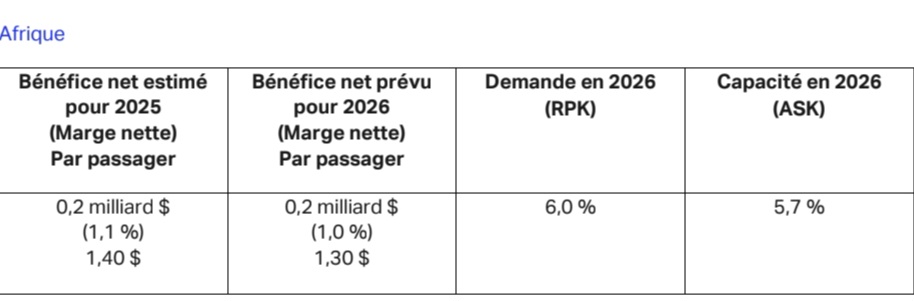
Le faible PIB par personne dans une grande partie du continent limite les dépenses discrétionnaires, ce qui rend les voyages aériens très sensibles aux prix et restreint le potentiel de croissance. La demande est aussi réduite par les restrictions relatives aux visas, les ententes bilatérales restrictives et les droits de passager élevés. De plus, les transporteurs africains ont les coûts unitaires les plus élevés au monde, le coût moyen par ATK étant de presque 140 cents US, soit presque le double de la moyenne de l'industrie. Parmi les nombreux facteurs qui contribuent aux frais d'exploitation élevés en Afrique, on mentionne les coûts élevés du carburant, la fragmentation des marchés, la vieillesse des flottes et le taux d'imposition des sociétés qui se situe en moyenne à 28 % (le plus élevé parmi toutes les régions).
Tant que ces contraintes ne seront pas atténuées, l'industrie aérienne en Afrique va fonctionner avec des marges minces et une résilience limitée, même si l'augmentation du trafic est supérieure à la moyenne mondiale.
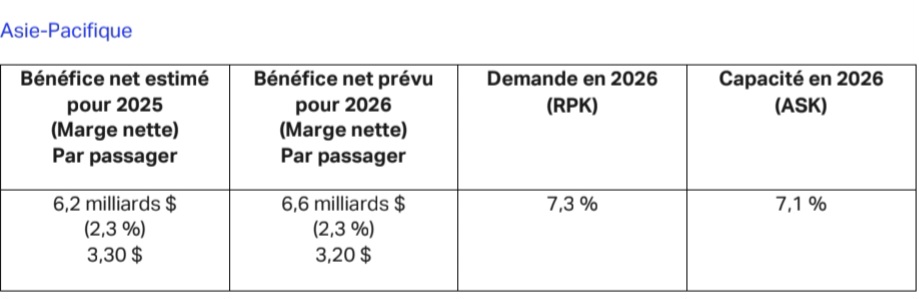
La demande dans le secteur passagers est robuste, la Chine et l'Inde arrivant en tête en termes d'expansion régionale, en raison de l'augmentation de l'activité touristique et de la croissance de la classe moyenne. L'assouplissement des exigences de visa pour les voyages de groupe chinois vers la Corée du Sud et pour les visiteurs qui se rendent en Chine devrait stimuler à court terme la demande de voyageurs entrants, en particulier durant les périodes de pointe des fêtes.
La surcapacité demeure un problème, dans le contexte de la reprise plus lente du trafic international, ce qui met de la pression sur les rendements. Les pressions déflationnistes font aussi fléchir les rendements en Chine. Néanmoins, l'Asie-Pacifique demeure le plus grand contributeur à la croissance du trafic mondial, et les coefficients d'occupation devraient atteindre 84,4 % en 2026, un record pour la région.
Bien que les exportations chinoises vers les États-Unis aient diminué, des effets de substitution ont contribué à compenser les impacts des tensions commerciales, et les biens chinois ont trouvé d'autres marchés.
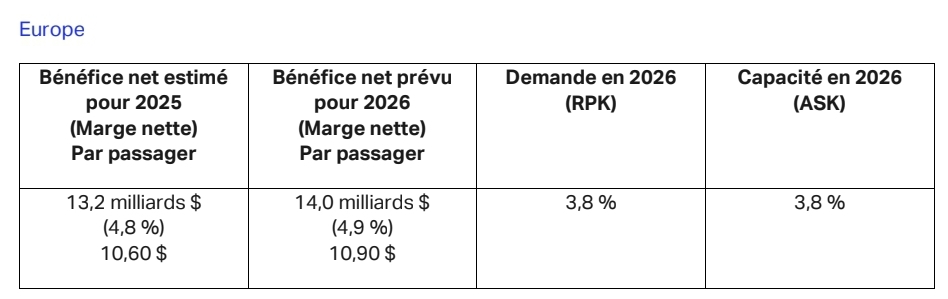
On prévoit que l'Europe réalisera la plus forte performance financière en chiffres absolus, parmi toutes les régions. Les compagnies aériennes européennes gèrent leur capacité avec discipline et obtiennent de forts coefficients d'occupation. Les transporteurs à bas prix performent particulièrement bien, connaissent des croissances dans les deux chiffres et obtiennent des résultats meilleurs que les transporteurs réguliers quant à la marge bénéficiaire nette, en raison de l'intense trafic intra-européen et du marché des loisirs. La croissance du trafic ralentit à mesure que le marché arrive à maturité et dans le contexte des conditions économiques tièdes dans la zone euro où la croissance du PIB tire de l'arrière par rapport à la moyenne mondiale.
Quant aux coûts, la force de l'euro a permis de compenser partiellement les pressions inflationnistes, en particulier pour le carburant et les frais de location, ce qui a aidé les transporteurs à maintenir des marges malgré la volatilité des coûts des intrants.
Le fardeau des coûts réglementaires s'accentue en raison de l'initiative ReFuelEU qui exige à compter de 2025 une proportion de 2 % de SAF dans le carburant dans les aéroports de l'UE. Cela coïncide avec le renforcement des vents contraires sur le plan opérationnel : les conflits de travail, les perturbations associées aux drones et l'engorgement persistant du contrôle du trafic aérien.
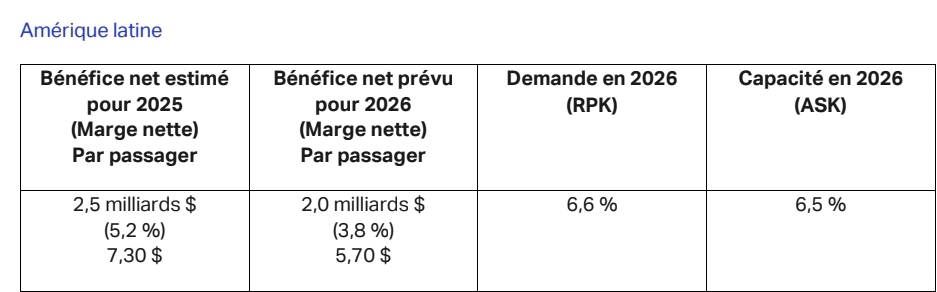
La croissance du trafic demeure robuste, en raison de la stabilité économique et de l'amélioration de la connectivité à l'intérieur de la région. La demande entre les Amériques a fléchi, mais cela a été compensé par les flux régionaux accrus et une solide performance transatlantique, ce qui met en lumière la faculté d'adaptation des transporteurs devant la transformation des schémas de déplacement.
La rentabilité opérationnelle devrait rebondir en 2026, grâce au renforcement graduel des fondamentaux de la région. Toutefois, la fluctuation des devises demeure un obstacle critique. Bien qu'on ait observé en 2025 une atténuation temporaire de l'appréciation des devises, la volatilité devrait continuer à causer des problèmes de gestion des coûts et de rentabilité.
Tandis que plusieurs transporteurs importants de la région constatent les avantages de la restructuration au titre du Chapitre 11, l'environnement de la région est passé de l'état de survie en cas de crise à une étape de reconstruction axée sur l'efficience.
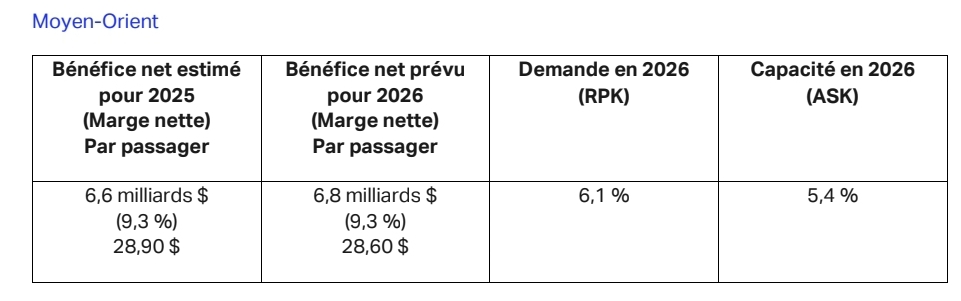
Le Moyen-Orient est la région la plus forte en termes de marge bénéficiaire nette et de bénéfice par passager. Cette performance témoigne de ce qu'on peut accomplir dans un environnement réglementaire positif, et de la position stratégique de la région comme plaque tournante mondiale.
Le trafic de passagers demeure robuste, reposant sur le trafic long-courrier et l'expansion des transporteurs pivots. Les gouvernements et les compagnies aériennes investissent dans les infrastructures pour assurer la croissance à long terme. Bien que les tensions géopolitiques demeurent une caractéristique du paysage régional, elles ne devraient pas affecter négativement la croissance, notamment parce que les efforts de paix se poursuivent.
Les transporteurs du Moyen-Orient atténuent les effets des retards de livraison des aéronefs par des programmes de mise à niveau et l'extension de la vie utile de la flotte, bien que la croissance de la capacité demeure un enjeu à court terme.
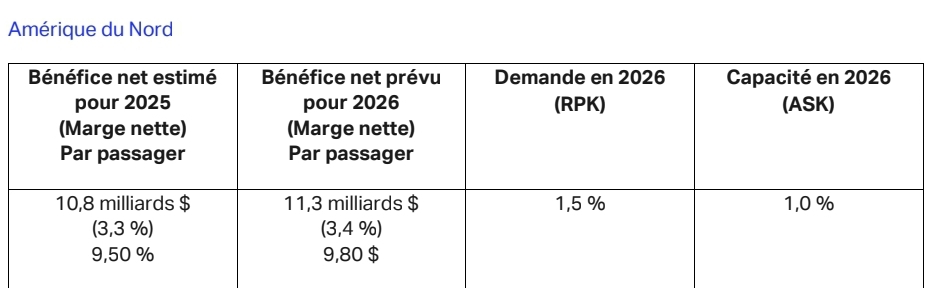
La rentabilité en Amérique du Nord demeure stable, mais en 2025, la région a cédé à l'Europe le titre de région la plus rentable.
Les États-Unis ont connu une croissance globale stagnante et une contraction du marché intérieur en raison de l'incertitude politique entourant les tarifs, du resserrement des lois sur l'immigration qui réduisent le trafic entrant et intérieur, et de la fermeture prolongée du gouvernement. Les contraintes de capacité, la pénurie de pilotes, les problèmes de fiabilité des moteurs et les coûts croissants de la main-d'œuvre continuent de restreindre l'expansion. Malgré ces problèmes, les compagnies aériennes ont réussi à protéger leurs marges en 2025, aidées en cela par les rendements stables et la baisse des prix du carburant. Toutefois, la performance varie selon les modèles d'affaires. Les transporteurs à bas prix sont sous pression, étant confrontés à la contraction du trafic intérieur américain, à la préférence croissante des passagers pour les services premium, et aux inconvénients des flottes monotypes dans le contexte des perturbations des chaînes d'approvisionnement.
Pour 2026, on entrevoit une atténuation de ces problèmes et la possibilité d'une augmentation graduelle de la demande.
Le point de vue des voyageurs
Les voyages aériens continuent d'offrir aux consommateurs une valeur exceptionnelle. Le tarif réel aller‐retour moyen en dollars US de 2025 était inférieur de 34,7 % au tarif de 2015. Et les passagers devraient profiter des gains d'efficience et des forces concurrentielles qui feront probablement en sorte que le tarif aller-retour en 2026 sera inférieur de 36,8 % au tarif de 2015.
Un sondage mené par l'IATA en octobre et novembre 2025 (14 pays, 6500 répondants qui ont pris l'avion au moins une fois durant la dernière année) a révélé que 97 % des voyageurs étaient satisfaits de leur dernière expérience de voyage. De plus, 88 % trouvaient que les voyages aériens rendaient leur vie meilleure, 78 % considéraient que les voyages aériens avaient un bon rapport qualité-prix, et 87 % se souciaient de leur capacité future de prendre l'avion. Les passagers comptent sur une industrie aérienne sécuritaire, durable, efficiente et rentable. Le sondage d'opinion de l'IATA a démontré le rôle important que les voyageurs attribuent à l'industrie aérienne :
• 90 % disent que la connectivité est essentielle à l'économie.
• 88 % disent que les voyages aériens ont un effet positif sur les sociétés.
• 82 % disent que le réseau mondial de transport aérien est un contributeur clé aux objectifs de développement durable des Nations Unies.
• 83 % se préoccupent du succès de l'industrie aérienne.
L'industrie du transport aérien est déterminée à atteindre son objectif d'éliminer les émissions nettes de CO2 d'ici 2050. Les voyageurs se disent hautement confiants de la réussite de cette démarche, et 79 % d'entre eux croient que l'industrie fait preuve d'engagement à travailler ensemble pour atteindre cette cible ambitieuse. Et 77 % pensent que les dirigeants de l'aviation prennent au sérieux le défi climatique.
Categories: Afrique, Határon túli magyar portálok összesített hírei
How Community Radio Is Powering Tanzania’s Climate Resilience
In many villages, people may not have smartphones or internet, but they always have a radio. When forecasts are delivered in the local language, through voices they know, communities understand faster and act immediately. —John Mbise, a senior TMA climatologist
Categories: Africa, Határon túli magyar portálok összesített hírei
The Daunting Tasks Ahead for the New UN Secretary-General
The United Nations Headquarters as seen from First Avenue in New York City. Credit: UN News/Vibhu Mishra
By Kul C Gautam
KATHMANDU, Nepal, Dec 10 2025 (IPS)
The election of the next Secretary-General of the United Nations comes at a highly inopportune moment in 2026, when the UN is being bypassed, and multilateralism—with the UN at its core—is under increasing challenge from some of the world’s most powerful states and leaders.
The new Secretary-General, taking office in 2027, will inherit an unprecedented financial crisis and a pressing need for major institutional reorganization simply to keep the UN afloat. At first glance, this hardly seems like the right moment for a new SG to advance a bold vision—one capable of winning over powerful leaders who appear lukewarm toward strengthening genuine multilateralism and instead prefer a multipolar order where each can guard its own sphere of influence.
Yet history reminds us that some of the boldest ideas have emerged during periods of great upheaval—wars, revolutions, and global crises. It is therefore conceivable that a visionary new UN leader could break new ground, introduce innovative ideas, and help plant the seeds for a rejuvenated, rules-based world order.
Kul Gautam
While many of today’s most powerful leaders may be ambivalent about multilateralism, the world’s general public—especially the digitally savvy younger generation—has a strong sense of global interdependence.They increasingly identify as global citizens, eager to thrive in a borderless world, and are more likely to embrace visionary proposals for UN reform that meet the realities of the 21st century.
A promising starting point would be the election of the first-ever female Secretary-General of the UN. Another essential reform would be restructuring the UN’s financing system to make it more broad-based and less dependent on the whims of a few wealthy, powerful states.
Some consolidation of the UN’s sprawling architecture—much of it underfunded—is already underway through the current SG’s UN80 Initiative. A new SG could accelerate this effort, earning the support of both critics and cynics.
Still, even a dynamic and visionary new SG will require the backing of Member States. At present, leaders of the most powerful states, particularly the veto-wielding P5, seem disinclined to empower the world’s top diplomat as a true global leader.
While many enlightened global citizens—especially Gen Z—hope for a bold, inspiring figure at the helm, the major powers may prefer a more compliant “Secretary” rather than a strong, strategic “General.”
With the rise of the Global South and groupings such as BRICS+ and the G20, the balance of power—especially soft power—is shifting away from the states that founded the UN 80 years ago.
One hopes this evolving landscape will help strengthen the UN and reinvigorate multilateralism, which remains the only viable way to confront such transcendental issues as climate change, war and peace, pandemics, widening inequalities, and the profound opportunities and risks of the AI revolution.
The world urgently needs a more effective UN to address these pressing global challenges—none of which any nation, however rich or powerful, can tackle alone. It is to be hoped that world leaders, attuned to their peoples’ aspirations, will choose a highly capable new Secretary-General and empower her to help build a more peaceful and prosperous world for present and future generations.
Kul Gautam is a former UN Assistant Secretary-General, Deputy Executive Director of UNICEF and author of Global Citizen from Gulmi: My Journey from the Hills of Nepal to the Halls of the United Nations.
IPS UN Bureau
Follow @IPSNewsUNBureau
!function(d,s,id){var js,fjs=d.getElementsByTagName(s)[0],p=/^http:/.test(d.location)?'http':'https';if(!d.getElementById(id)){js=d.createElement(s);js.id=id;js.src=p+'://platform.twitter.com/widgets.js';fjs.parentNode.insertBefore(js,fjs);}}(document, 'script', 'twitter-wjs');
Categories: Africa, Határon túli magyar portálok összesített hírei
Les présidents d'institutions condamnent le coup de force du 07 décembre
Les institutions de la République condamnent avec fermeté la tentative de coup d'Etat déjoué du dimanche 07 décembre 2025. A travers une déclaration solennelle en date du mardi 09 décembre, et signé de l'ensemble des présidents, elles ont salué la bravoure des Forces de défense et de sécurité (FDS), et adressé leur gratitude à la CEDEAO pour la mise en œuvre de la « solidarité régionale ».
Les présidents des institutions ont également exprimé leur « consternation absolue et leur profonde désolation » devant cette violence qui a endeuillé la Nation et failli plonger le pays dans l'abîme.
Au chef de l'Etat, ils ont réaffirmé leur soutien indéfectible.
La déclaration des présidents des institutions de la République
Categories: Afrique, Határon túli magyar portálok összesített hírei
Veszett bűzösborz karmolása végzett két emberrel az USA-ban
Veszettségben halt meg egy michigani férfi, mert egy olyan donortól kapott vesét, aki szintén veszettségben halt meg, miután megkarmolta egy bűzösborz, amikor szerette volna megmenteni előle a macskáját.
Categories: Határon túli magyar portálok összesített hírei, Swiss News
Az EU versenyjogi vizsgálatot indít a Google online tartalmak MI-célú felhasználása miatt
Az Európai Bizottság versenyjogi vizsgálatot indított annak felmérésére, hogy a Google amerikai technológiai vállalat megsérti-e az EU versenyjogi szabályait a webes kiadók és a YouTube tartalmainak mesterségesintelligencia-célú (MI) felhasználásával - közölte a brüsszeli testület kedden.
Categories: Határon túli magyar portálok összesített hírei, Swiss News
23 milliárd dollár értékű mesterségesintelligencia-befektetést jelentett be a Microsoft
A Microsoft mintegy 23 milliárd dollár értékű új mesterségesintelligencia-befektetést jelentett be, amelynek túlnyomó része Indiába irányul.
Categories: Határon túli magyar portálok összesített hírei, Swiss News
Gašpar arról magyarázkodott, miért húzódik a nyitrai balesete kivizsgálása
Pavol Gašpar, a Szlovák Információs Szolgálat (SIS) igazgatója azt állítja, azért húzódik augusztus vége óta a nyomozás a közlekedési balesete ügyében, hogy megkérdőjelezhetetlen legyen a rendőrségi vizsgálat eredménye.
Categories: Határon túli magyar portálok összesített hírei, Swiss News
Kubina: Elutasította a bíróság Šutaj Eštok kontumációs ítélet elleni panaszát
Az ítélet szerint Šutaj Eštoknak bocsánatot kell kérnie a Čurilla-nyomozócsoport tagjaitól, amiért a jogerősen elítélt Mikuláš Černákhoz hasonlította őket. Emellett összesen 90 ezer euró kártérítést kell fizetnie a hat rendőrnek, meg kell térítenie a perköltségeket és késedelmi kamatot kell fizetnie.
Izrael újra megnyitja Jordániával közös határát a Gázába irányuló segélyek előtt
Izrael az Egyesült Államok és Jordánia nyomására újra megnyitja az arab országgal közös határán lévő Allenby-átkelőt a Gázai övezetbe tartó segélyek számára - közölték kedden izraeli kormányzati források.
UN Pact for the Future Requires Global Solidarity and Localized Solutions
H.E. Abdulla Shahid (left), former President of the UN General Assembly, and Collen Kelapile (center), former UN ambassador to Botswana and former vice-president of the UN Economic and Social Council, speak as panelists at the launch event of ICO's flagship report. Credit: John Okyo Nyaku/UN
By Naureen Hossain
UNITED NATIONS, Dec 9 2025 (IPS)
More than one year since its adoption, the UN Pact for the Future is held up as a critical framework for countries to address today’s issues through global cooperation. Its agenda for global governance and sustainable development is ambitious, and it is for this reason the Pact poses implementation challenges when it comes to the direct impact on local communities. It will require the joint efforts of governments, civil society and international organizations to achieve the goals laid out in the Pact.
The efforts of the International Communities Organisation (ICO), a UK-based international NGO, demonstrate what implementing the Pact would look like. Since 2016, ICO has worked to empower minority communities in conflict-affected areas through education and capacity-building opportunities. ICO focuses on directly supporting efforts to build up underrepresented groups’ involvement in community initiatives and diplomatic dialogue and address systemic, societal inequalities.
On December 3, ICO launched its flagship report, For Our Future: Best Practice for the Implementation of the UN Pact for the Future, at the UN Headquarters in New York, presenting a practical framework to support UN member states in advancing the objectives outlined in the Pact for the Future. Several Permanent Missions to the UN, including Bahrain, Guyana, Hungary, Kuwait, Samoa, Singapore, Tajikistan, and Uganda, co-sponsored the event.
The UN Pact for the Future represents a shared set of global commitments to sustainable development, peace and security, and redefining global governance for member states. While its adoption marks a decisive moment of global consensus, there remains the challenge of translating the Pact’s guiding principles into meaningful action at the national and regional levels. Through its ‘Best Practices’ blueprint, the ICO report distills their findings into an adaptable methodology designed to equip policymakers with the tools they need to implement the Pact’s goals effectively.
James Holmes, ICO founder and Secretary General, said, “The Pact reminds us that the strength of nations is measured not only by the power of their armies or the size of their economies, but also by the inclusiveness of their societies and the recognition of all who live within.” “How we treat minority peoples, those who are few in number, vulnerable, or historically marginal, is the true test of our progress and the true test of whether the fact for the future is being successful.”
H.E. Abdulla Shahid, ICO International Ambassador and former President of the 76th United Nations General Assembly, said it was crucial for the world to unite.
“The UN Pact for the Future calls for renewed unity in tackling humanity’s greatest challenges. This report demonstrates that lasting peace is built not only at negotiation tables but also through empowering communities themselves, ensuring that no group is left behind.”
“As UN Secretary-General António Guterres noted at the opening of the ‘Summit of the Future’ in September 2024, ‘21st-century challenges require 21st-century solutions: frameworks that are networked and inclusive and that draw on the expertise of all humanity.’
He added that the ICO’s report embodies this principle, showing how global aspirations can intersect with local action.
Prominent UN diplomats and civil society members were present at the launch event, demonstrating and remarking on their commitment to the Pact for the Future, and specifically to ICO’s work on the ground. Current and former high-ranking UN officials were also in attendance.
“One year after the adoption of the Pact, this discussion is timely,” said Themba Kalua, the UN Director, Pact for the Future Implementation Kalua remarked during the event. “While the world has grown more complex since the adoption of the Pact for the Future, the Pact continues to be central in realizing multilateralism, navigating the current geopolitical complexities and shaping our collective action on the global agenda.”
Kalua noted the efforts made by the UN system towards the Pact, including global panels on the governance of artificial intelligence (AI) and the political declarations that emerged from UN conferences on social development in Qatar and financing for development in Spain. He expressed that the Pact was a “strategic priority” for the UN and its Secretary-General, António Guterres.
“From our side in the UN system and the Secretariat, we are committed to doing our part in supporting the implementation of the Pact,” Kalua told IPS.
Presenting the report, ICO’s UN Programme Manager Mia Sawjani broke down its findings and recommendations. She emphasized that countries would need to empower and promote the agency of local actors. This includes building up their capacity and skills to enact positive change in their communities. Countries must recognize adaptability in assessing situations on the ground, particularly in conflict settings that transform institutions and structures.
“The implementation of the Pact can be tangibly realized for all, but particularly to serve marginalized communities. It’s a transformative opportunity and it is our collective responsibility to follow through,” said Sawjani.
After the event, Holmes was heartened by the outpouring of support for ICO’s work, noting that many more countries had agreed to partner with them for future projects. By maintaining their focus on working with minority communities, ICO can “play a major global role” in implementing the Pact for Future.
“I have a big vision, and I have a lot of ambition for ICO,” Holmes told IPS. “We already have a global team, and I see that growing, and I see us having a bigger and bigger role in helping to implement the Pact.”
The launch event of ICO’s flagship report on the UN Pact for the Future at UNHQ in New York. The event was attended by high-ranking UN diplomats. Credit: John Okyo Nyaku/UN
Local actors and stakeholders, namely governments, academia, the private sector and civil society, would play a key role in implementing the Pact’s agenda. Organizations like ICO could serve as a bridge to translate the issues to the national context.
“The more we are able to bridge communities, the more successful it will be for states to deal with Track I diplomacy,” Shahid said to IPS, referencing the formal channel of diplomacy between governments on international issues.
Implementing the Pact for the Future must also mean recognizing the specific needs and challenges that these countries face. Island states like Samoa and Tonga, for example, are uniquely impacted by climate change, energy, and the global financial structures that need to better serve developing countries.
“For us in the Pacific, progress is measured not by rhetoric, but by real improvements that are felt in our villages, outer islands and vulnerable communities,” said Viliami Va’inga Tōnē, the Permanent Representative of Tonga.
Accountability and transparency will also be crucial to ensure countries follow through on the promises of the Pact. This must be present at all levels. Participants at the event emphasized the need for monitoring mechanisms that would measure progress.
The timing of the report coincides with the ongoing reform negotiations under the UN80 Initiative introduced this year. Discussions around the Pact went hand in hand with recognizing the critical step toward reforming the UN system that will optimize its ability to live up to its founding principles and the Pact’s promises.
If the Pact represents ‘what’ the UN and member states need to achieve in the global agenda, then UN80 represents ‘how’ the UN can implement the agenda.
“The UN80 initiative is really part of the UN response to how it can deliver on the ground,” said Fatumanava-o-Upolu III Dr. Pa’olelei Luteru, the Permanent Representative of Samoa. He said to IPS, “When you look at all the individual actions that need to be taken, these are at the global level, the UN [level], regional level, and national level. They’re all important, because we can’t continue to work in silence. Everything is interconnected now. So we need to make those connections and work together, and you don’t want duplication.”
While New York hosts reform discussions around the UN and its mandates, the organization’s impact will ultimately be felt by local communities across the world.
Dr. Agnes Mary Chimbiri-Molande, Permanent Representative of Malawi, told IPS that the people who serve in multilateral systems like the UN need to “renew or even rebuild trust” with local communities. At a time when people are questioning the UN’s relevance, she said, these discussions must be held and all perspectives need to be respected.
“We need to hear the voices of the local people. Because here we are working for them. We are not working for ourselves,” Chimbiri-Molande said. “So in fact, to be hearing the voices of those peoples, it’s very, very important to inform our work here, whether we are making an impact or we are making differences in the lives of the people in the community.”
Shahid reiterated that the decisions made in the halls of UN Headquarters will affect local communities, adding that the UN’s success is also contingent on its partnerships with civil society and how important it is for civil society to recognize the UN’s relevance.
During his time as President of the General Assembly from 2021-2022, the world was in the midst of the COVID-19 pandemic. His ‘presidency of hope’ championed the progress made by the international system despite the challenges brought on by the pandemic. He also made efforts to promote inclusivity by opening the General Assembly to more participants, including civil society groups.
Shahid invited young diplomats from underrepresented member states to the President’s office to witness international diplomacy firsthand.
Even after his presidency ended, he told IPS, he wanted to continue to deliver on the ideals that defined his tenure.
“I thought that there’s no need to end the presidency of hope after one year. Let us keep delivering the message of hope through other platforms. And ICO provides me the platform, because it is a platform through which I can actually reach out to communities at [the] household level and inspire them not to give up. Keep working, keep aiming to change the status.”
IPS UN Bureau Report
Follow @IPSNewsUNBureau
!function(d,s,id){var js,fjs=d.getElementsByTagName(s)[0],p=/^http:/.test(d.location)?'http':'https';if(!d.getElementById(id)){js=d.createElement(s);js.id=id;js.src=p+'://platform.twitter.com/widgets.js';fjs.parentNode.insertBefore(js,fjs);}}(document, 'script', 'twitter-wjs');
Categories: Africa, Határon túli magyar portálok összesített hírei
Bővíti a megye a zselízi Perla szociális intézmény épületét
Nyitra megye önkormányzata bővíti a zselízi Perla szociális létesítmény (ZSS) épületét, egy kétszintes komplexumot építenének.
Pages
the old site is here



© 2012-2015 Europa Varietas Foundation © 2015-2020 Europa Varietas Association
www.europavarietas.org | info(@)europavarietas(dot)org | Switzerland
This is a GDPR ready site




We are looking for sponsors for the English translation of these books, please contact turkeandras(at)gmail(dot)com