
You are here
Afrique
The impact of global governance networks on social innovation for sustainable development: linking setup, enablers and cooperation results of the Managing Global Governance (MGG) Network
Networks as relational infrastructure play an important role in strengthening cooperative efforts toward sustainable development. This paper analyses the Managing Global Governance (MGG) Network – a transnational, multi-stakeholder network that employs collaborative training, knowledge cooperation and policy dialogue instruments. The network includes members from Brazil, China, the EU, India, Indonesia, Mexico and South Africa. To understand how the implementation of Agenda 2030 through cooperation in networks can be fostered, this paper examines the conditions under which global governance networks create impact.
Using a literature review, external evaluation studies and 27 qualitative interviews, the paper categorises impact across four levels: individual, organisational, network and systemic–institutional. Additionally, it analyses the impact on the network itself – not only as an enabler of impact but also as a subject affected by cooperation within the network. In this context, several types of impact can be distinguished, ranging from improved international cooperation structures to behaviour change and the reorientation of organisational policies.
We conclude that three dimensions of a network’s setup are key to enabling social innovation for sustainable development:
1. the composition of network members
2. the cooperation infrastructure
3. the cooperation culture.
These insights contribute to the ongoing debate on how to link change at the individual level with transformation in more institutionalised structures – particularly in organisations and broader systemic contexts. The paper is especially relevant for scholars engaged in network analysis and development, decision-makers involved in transnational multi-stakeholder networks, and international cooperation actors aiming for sustainable development impact.
Categories: Afrique, Diplomacy & Defense Think Tank News
The impact of global governance networks on social innovation for sustainable development: linking setup, enablers and cooperation results of the Managing Global Governance (MGG) Network
Networks as relational infrastructure play an important role in strengthening cooperative efforts toward sustainable development. This paper analyses the Managing Global Governance (MGG) Network – a transnational, multi-stakeholder network that employs collaborative training, knowledge cooperation and policy dialogue instruments. The network includes members from Brazil, China, the EU, India, Indonesia, Mexico and South Africa. To understand how the implementation of Agenda 2030 through cooperation in networks can be fostered, this paper examines the conditions under which global governance networks create impact.
Using a literature review, external evaluation studies and 27 qualitative interviews, the paper categorises impact across four levels: individual, organisational, network and systemic–institutional. Additionally, it analyses the impact on the network itself – not only as an enabler of impact but also as a subject affected by cooperation within the network. In this context, several types of impact can be distinguished, ranging from improved international cooperation structures to behaviour change and the reorientation of organisational policies.
We conclude that three dimensions of a network’s setup are key to enabling social innovation for sustainable development:
1. the composition of network members
2. the cooperation infrastructure
3. the cooperation culture.
These insights contribute to the ongoing debate on how to link change at the individual level with transformation in more institutionalised structures – particularly in organisations and broader systemic contexts. The paper is especially relevant for scholars engaged in network analysis and development, decision-makers involved in transnational multi-stakeholder networks, and international cooperation actors aiming for sustainable development impact.
Categories: Afrique, Diplomacy & Defense Think Tank News
Hungarian Health Commissioner eyeing EU-wide ‘chips tax’ – though it arguably failed at home
Olivér Várhelyi’s push for a health-focused levy comes as evidence from Hungary casts doubt on its long-term impact
Categories: Afrique, European Union
Macédoine du Nord : décharges en feu, citoyens en colère : Skopje à bout de souffle
Pollution chronique, décharges en feu, mobilisations citoyennes : à Skopje, l'air est devenu irrespirable avant même l'hiver. En pleine campagne pour les élections municipales, entre inaction des autorités et colère populaire, la capitale macédonienne étouffe.
- Articles / Courrier des Balkans, Macédoine du Nord, Politique, Société, Environnement, Une - Diaporama, Balkans pollution atmosphérique
Categories: Afrique, Balkans Occidentaux
Pellegrini többszörös törvényszegés árán kerülhetett az elnöki palotába
Žilinka főügyész megerősítette azt, amire mi a Transparencynél már tavasz óta igyekszünk felhívni a figyelmet. A jelenlegi köztársasági elnök, Peter Pellegrini a törvények többszöri megszegésének köszönhetően nyerhette el az államfői tisztséget – olvasható a Transparency International Slovensko állásfoglalásában.
Categories: Afrique, Határon túli magyar portálok összesített hírei
Albanie : l'assassinat du juge Kalaja, un signal d'alarme pour la justice
L'assassinat du juge Astrit Kalaja en pleine audience a provoqué une onde de choc en Albanie. Le crime met en lumière les graves défaillances du système judiciaire et révèle l'affaiblissement de l'État de droit, incapable de protéger ses institutions face à une violence devenue banale.
- Articles / Une - Diaporama - En premier, Une - Diaporama, Albanie, Défense, police et justice, Société
Categories: Afrique, Balkans Occidentaux
Meteorológiai figyelmeztetés a reggeli köd miatt
A Szlovák Hidrometeorológiai Intézet (SHMÚ) elsőfokú meteorológiai figyelmeztetést adott ki szerdán (10. 8.) 10:00 óráig Közép-Szlovákia több járására (délen a Losonci járásra) a köd előfordulásának a veszélye miatt (50-200 m-es látótávolság). Óvatosan közlekedjenek az útnak indulók!
Categories: Afrique, Határon túli magyar portálok összesített hírei
Metsola’s path to a third term
In today’s edition: Roberta Metsola eyes an unprecedented third run for the European Parliament presidency, Robert Fico stalls progress as EU diplomats meet on the 19th sanctions package against Russia, and Brussels folds Gaza reconstruction into Donald Trump’s peace framework
Categories: Afrique, European Union
VERÁ – The European IT platform for AI-enabled defence and resilience
Categories: Afrique, European Union
Meloni says she has been accused of complicity in genocide at world court
Italy’s prime minister said a complaint filed with the ICC accuses her and several ministers of supporting Israel in its ongoing bombardment of Gaza
Categories: Afrique, European Union
Press briefings - Economic and Financial Affairs Council of 10 October 2025 and Justice and Home Affairs Council of 13 and 14 October 2025
Press briefings ahead of the upcoming Economic and Financial Affairs Council of 10 October 2025 and Justice and Home Affairs Council of 13 and 14 October 2025 will take place on 9 October 2025 at 16.00
Categories: Afrique, European Union
Press briefings - Economic and Financial Affairs Council of 10 October 2025 and Justice and Home Affairs Council of 13 and 14 October 2025
Press briefings ahead of the upcoming Economic and Financial Affairs Council of 10 October 2025 and Justice and Home Affairs Council of 13 and 14 October 2025 will take place on 9 October 2025 at 16.00
Categories: Afrique, Europäische Union
Once, twice, three times? Metsola said to eye another term as EP president
No one has ever run the European Parliament for more than 5 years.
Categories: Afrique, European Union
Chad cuts ties with wildlife charity linked to Prince Harry
The government says the charity African Parks displayed an arrogant and disrespectful attitude.
Hungarian Health Commissioner eyeing EU-wide ‘chips tax’ – though it arguably failed at home
Olivér Várhelyi’s push for a health-focused levy comes as evidence from Hungary casts doubt on its long-term impact
Categories: Afrique, European Union
US groups urge Brussels not to bow to Washington on deforestation law
The letter urges Brussels not to waver under US pressure over forest protection
Categories: Afrique, European Union
INTERVIEW: ‘Take it off the table’: Union chief urges Brussels to protect workers’ rights
The Commission's €2 trillion EU budget proposal is also "too small" and could spell "disaster" for European regions, said Esther Lynch, head of Europe's largest trade union organisation
Categories: Afrique, European Union
'One of the greatest things' - Nigeria's art innovators on display in London
Nigerian Modernism at the Tate spotlights a compelling period in the West African country's history.
At a Glance - The European Parliament's top 10 tools for scrutinising the European Commission - PE 774.675 - Committee on Agriculture and Rural Development - Committee on Employment and Social Affairs - Special committee on the Housing Crisis in the...
The scrutiny powers of the European Parliament, the only directly elected EU institution, are essential to promote democratic oversight of policy actions taken at EU level. Parliament has 10 main tools at its disposal to carry out its scrutiny function over the European Commission, as described below. This overview is a summary of the EPRS study on 'The European Parliament's oversight powers: Tools to scrutinise the European Commission'.
Source : © European Union, 2025 - EP
Source : © European Union, 2025 - EP
Categories: Afrique, Europäische Union
L'Ambassadeur des Émirats arabes unis reçu par Gaston Dossouhoui
L'Ambassadeur des Émirats arabes unis auprès de la République du Bénin s'est entretenu, mardi 7 octobre 2025, avec le Ministre de l'Agriculture, l'Elevage et de la Pêche sur les moyens de renforcer la coopération bilatérale entre les deux pays. L'audience s'est déroulée au cabinet du ministre à Cotonou.
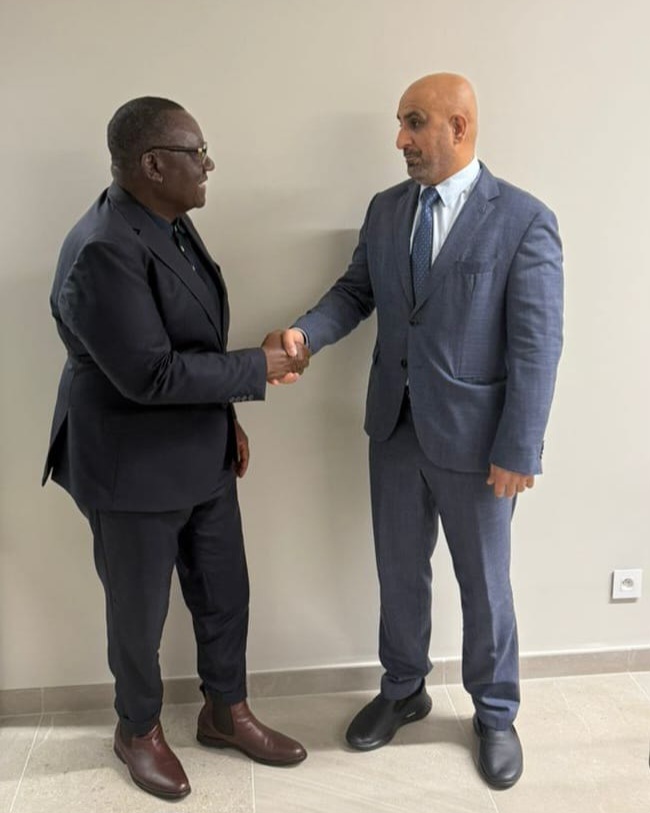
Son Excellence Mohamed Saeed Al Kaabi, Ambassadeur des Émirats arabes unis auprès de la République du Bénin, a rencontré, mardi 7 octobre 2025, Son Excellence Gaston Dossouhoui, Ministre de l'Agriculture, de l'Élevage et de la Pêche de la République du Bénin, à son cabinet à Cotonou.
Les deux parties ont examiné les moyens de renforcer et de développer les relations bilatérales entre les deux pays amis, notamment dans les domaines de l'agriculture, de la pêche maritime et de l'élevage.
Au cours de la rencontre, Son Excellence le Ministre a présenté les programmes et les plans de réforme mis en œuvre par le gouvernement béninois dans ces secteurs stratégiques, tout en exprimant le souhait de son pays d'élargir la coopération avec les Émirats arabes unis et de lancer des projets conjoints. M. Dossouhoui a également manifesté l'intérêt du Bénin à bénéficier de l'expertise émiratie reconnue dans le développement du secteur agricole, de la pêche maritime et de l'élevage.
Pour sa part, Son Excellence l'Ambassadeur Al Kaabi a souligné la profondeur des relations fraternelles qui unissent les deux pays amis, réaffirmant la disponibilité de l'Ambassade à offrir tout le soutien et les facilités nécessaires afin de renforcer la coopération bilatérale et d'élargir le partenariat entre les deux parties. Le diplomate émirien a enfin salué les efforts de développement accomplis par la République du Bénin dans divers domaines.
Categories: Afrique
Pages
the old site is here



© 2012-2015 Europa Varietas Foundation © 2015-2020 Europa Varietas Association
www.europavarietas.org | info(@)europavarietas(dot)org | Switzerland
This is a GDPR ready site




We are looking for sponsors for the English translation of these books, please contact turkeandras(at)gmail(dot)com