
You are here
Afrique
Voitures et smartphones « made in Algeria » : le gouvernement veut mesurer la vraie production locale
Réuni le 21 octobre sous la présidence de Sifi Ghrieb, le Gouvernement a examiné un nouveau mécanisme de calcul du taux d’intégration. Il concerne la […]
L’article Voitures et smartphones « made in Algeria » : le gouvernement veut mesurer la vraie production locale est apparu en premier sur .
Categories: Afrique, Oroszország és FÁK
Chérif Ould Taher, le sulfureux intermédiaire malien derrière les dernières libérations d’otages au Sahel
Enlevées en 2025 par l’Etat islamique au Sahel, une Suissesse et une Autrichienne ont été libérées mercredi 21 octobre. Comme pour un Américain, en août, cet homme d’affaires, considéré comme l’un des principaux narcotrafiquants dans le nord du Mali, a joué un rôle clé.
Categories: Afrique
Voiture électrique en Algérie : quand pourra-t-on utiliser les 1 000 points de recharge ?
Le ministre de l’Énergie, Mourad Adjal, a annoncé le 20 octobre la réalisation de 1 000 points de recharge pour voitures électriques. Ils se trouvent […]
L’article Voiture électrique en Algérie : quand pourra-t-on utiliser les 1 000 points de recharge ? est apparu en premier sur .
Categories: Afrique, Oroszország és FÁK
Ebola au Nigeria: des zones d'ombre sur le parcours de la patiente passée par l'Ouganda
Où la patiente diagnostiquée au Nigeria comme atteinte d'Ebola de souche Bundibugyo a-t-elle contracté le virus ? Deux jours après l'annonce du cas par Abuja, son parcours reste à éclaircir. Les informations de l'Organisation mondiale de la santé (OMS) et de l'Africa CDC diffèrent de celles communiquées par les autorités ougandaises. Des analyses génétiques sont en cours pour rechercher un lien avec l'épidémie régionale.
Categories: Afrique
La Libye et la Turquie signent un accord de délimitation de leurs frontières maritimes
Le Parlement de l'Est libyen contrôlé par le maréchal Haftar a ratifié le texte à travers lequel les deux pays se partagent les eaux de la région, mardi 20 octobre. S'il représente un retournement complet des relations entre les deux parties, l'accord relance aussi les rivalités en Méditerranée orientale puisque celui-ci fait fi des revendications de la Grèce et de l'Égypte...
Categories: Afrique
Sénégal: la grève générale se poursuit, les syndicats se félicitent d'une première journée «bien suivie»
À quelques jours seulement des Jeux olympiques de la jeunesse qui s'ouvriront le 31 octobre dans le pays, le Front syndical pour la défense du travail, une plateforme qui réunit 13 centrales syndicales, appelle les Sénégalais à trois jours de mobilisation pour améliorer leurs conditions de travail dans différents secteurs. Commencé mercredi, le mouvement doit durer jusqu'au vendredi 23 octobre.
Categories: Afrique
Cameroun: la Cour suprême décide de déprogrammer l'affaire Edgar Alain Mebe Ngo'o pour réexamen
Le collège des juges a pris cette décision alors que l'ancien ministre de la Défense devait comparaître, mercredi 21 octobre, devant la haute juridiction dans le cadre de son pourvoi en cassation contre sa condamnation, en 2023, à 30 ans de prison pour détournement de fonds.
Categories: Afrique
Guinée: l'ancien président de la Cour constitutionnelle, Mohamed Lamine Bangoura, condamné à sept ans de prison
L'ex-haut magistrat a été reconnu coupable de corruption, d’enrichissement illicite, de détournement de deniers publics et de blanchiment de capitaux dans une affaire portant sur la gestion de fonds publics alloués à l'institution lorsqu'il en était le dirigeant. Il écope aussi d'une lourde amende et de colossales réparations à verser à l'État guinéen solidairement avec ses deux coaccusés, qui sont en fuite.
Categories: Afrique
Tchad: l'ancien Premier ministre Succès Masra a quitté le pays pour recevoir des soins
Parti dans le 20 octobre en toute discrétion deux mois après sa libération au bénéfice d'une grâce présidentielle, celui-ci doit rejoindre la France après avoir transité par le Cameroun et la Côte d'Ivoire, où se trouve sa famille. « Ce n’est pas un nouvel exil ! », précise l'un de ses collaborateurs.
Categories: Afrique
Kangaba : deux jours de formation pour mieux gérer les coopératives d’orpailleurs
Mali Actu - maliactu.net - Mali Actualités, Les Actus et Informations sur le Mali
Mali Actu
Kangaba : deux jours de formation pour mieux gérer les coopératives d’orpailleurs
À Kangaba, des responsables de coopératives d’orpailleurs ont suivi une formation de deux jours en administration et gestion financière, avec cinq modules et des exercices pratiques.
Kangaba : deux jours de formation pour mieux gérer les coopératives d’orpailleurs
Mali Actu :
Kangaba : deux jours de formation pour mieux gérer les coopératives d’orpailleurs
Categories: Afrique
Les numéros gagnants du DIGITAL 00 H
DIGITAL 00H : Avez-vous tenté votre chance ?
Le tirage DIGITAL 00H N°288 a livré son verdict !
Jeudi 22 Octobre 2026
Avez-vous joué ?
Avez-vous misé sur vos numéros porte-bonheur ?
RÉSULTAT : 35 • 90 • 26 • 79 • 82
Félicitations aux heureux gagnants !
Pas encore cette fois ? Gardez le sourire.
Rendez-vous à 08H pour le prochain tirage.
Jouez dans nos points de vente ou : Tapez *590# ou rendez-vous sur lnbloto.bj
Jouez avec modération et responsabilité. Le jeu doit rester un plaisir.
A TOI DE JOUER #XòGbɔnAlɔkpaVo
#LNBSA #JeuResponsable #LaChanceAvecModération
Categories: Afrique
Guinée: quelles alternatives au sachet d'eau bientôt interdit?
En Guinée, l'interdiction des plastiques à usage unique, dont les sachets d'eau très bon marché, provoque une crise d'accès à l'eau potable. Un moratoire de six mois est accordé pour trouver des alternatives conciliant santé et environnement, tandis que les autorités et les industriels peinent à résoudre l'équation entre besoins essentiels de la population et lutte contre la pollution.
Categories: Afrique
Alerte météo en Algérie : que prévoit le temps ce jeudi 22 octobre ?
La perturbation météorologique se poursuit dans le Sud-Ouest de l’Algérie. Pour ce jeudi 22 octobre, la wilaya de Tindouf reste concernée par une alerte aux […]
L’article Alerte météo en Algérie : que prévoit le temps ce jeudi 22 octobre ? est apparu en premier sur .
Categories: Afrique
«On s'appelle, on s'entraide»: au Sénégal, des malades du cancer du sein unies contre la maladie
À l'occasion d'Octobre rose, mois de mobilisation contre le cancer du sein, rendez-vous au Sénégal, où les malades n'ont pas accès aux soins de support comme un accompagnement psychologique et social pour lutter contre l'isolement, l'anxiété, la dépression. À Dakar, l'association Kinsiba propose des cours de boxe ou encore des séances de henné entre femmes, pour redonner confiance et briser la solitude.
Categories: Afrique, Nyugat-Balkán
Burkina : Face à l'évolution des menaces et à la diversification de la criminalité, la Police nationale appelée à adapter continuellement ses réponses
La sixième conférence annuelle des commissaires de police s'est ouverte ce mercredi 21 octobre 2026 à Ouagadougou, autour du thème : « La Révolution progressiste populaire, levier de réforme de la Police nationale : adaptabilité, défis et perspectives ». Les travaux visent à évaluer les acquis de l'institution et à formuler des recommandations en vue de renforcer l'efficacité de ses services.
À travers cette rencontre, la Police nationale entend poursuivre sa transformation afin de mieux répondre aux exigences de sécurité des populations. Cette conférence constitue un cadre de concertation, de réflexion stratégique et d'évaluation des actions de l'institution. Elle offre aux commissaires de police l'occasion d'examiner les difficultés rencontrées dans l'exercice de leurs missions et de proposer des orientations susceptibles d'améliorer le fonctionnement des services.
« Le thème revêt une importance particulière dans un environnement marqué par l'évolution des menaces, la diversification des phénomènes criminels et la nécessité d'adapter continuellement les réponses institutionnelles aux réalités territoriales », a expliqué le directeur général de la Police nationale, Thierry Dofizouho Tuina, également président du comité d'organisation de cette sixième conférence annuelle des commissaires de police.
Quelques participants de la sixième conférence annuelle des commissaires de police.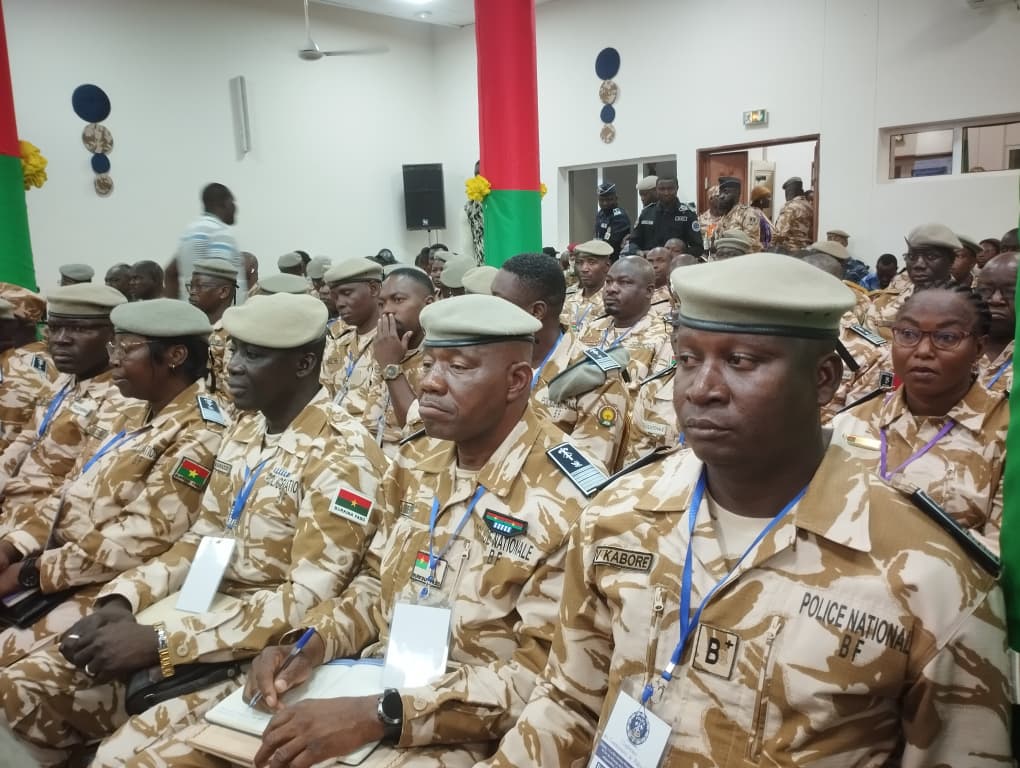
Il a par ailleurs précisé que la rencontre va permettre d'examiner avec lucidité les acquis, les insuffisances et les défis de la Police nationale tout en se fondant sur les idéaux de la révolution tels que déclinés dans le manifeste de la Révolution progressiste populaire (RPP).
Représentant le Premier ministre, patron de la sixième conférence annuelle des commissaires de police, le ministre d'État chargé de l'administration territoriale, Émile Zerbo a rappelé que la sécurité demeure une condition essentielle à la stabilité des institutions, à la protection des populations et au développement des activités économiques et sociales.
Pour lui, la transformation de la Police nationale doit s'appuyer sur trois exigences majeures : l'adaptabilité, la performance et le leadership.
Thierry Dofizouho Tuina, directeur général de la Police nationale.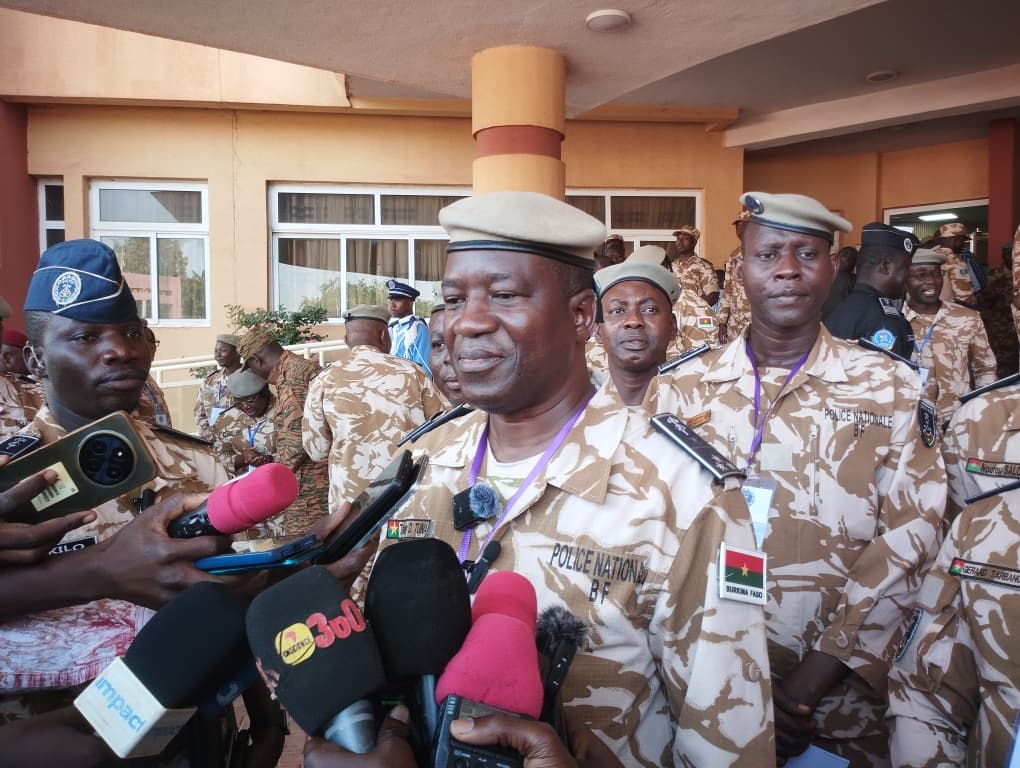
La première concerne la capacité de l'institution à faire face à l'évolution des menaces, à la diversification de la criminalité et à la progression des infractions liées au numérique. Cette adaptation nécessite, entre autres, une meilleure coordination avec les autres forces de défense et de sécurité, une circulation efficace de l'information et une clarification des responsabilités.
La deuxième exigence porte sur la performance des services. Face à la complexification des défis sécuritaires, les responsables de la police sont appelés à adapter leur organisation et leurs pratiques aux besoins des populations. Quant au leadership, il implique un commandement exemplaire, capable de traduire les orientations gouvernementales en directives opérationnelles et de mobiliser efficacement les personnels.
Émile Zerbo, ministre en charge de l'administration territoriale.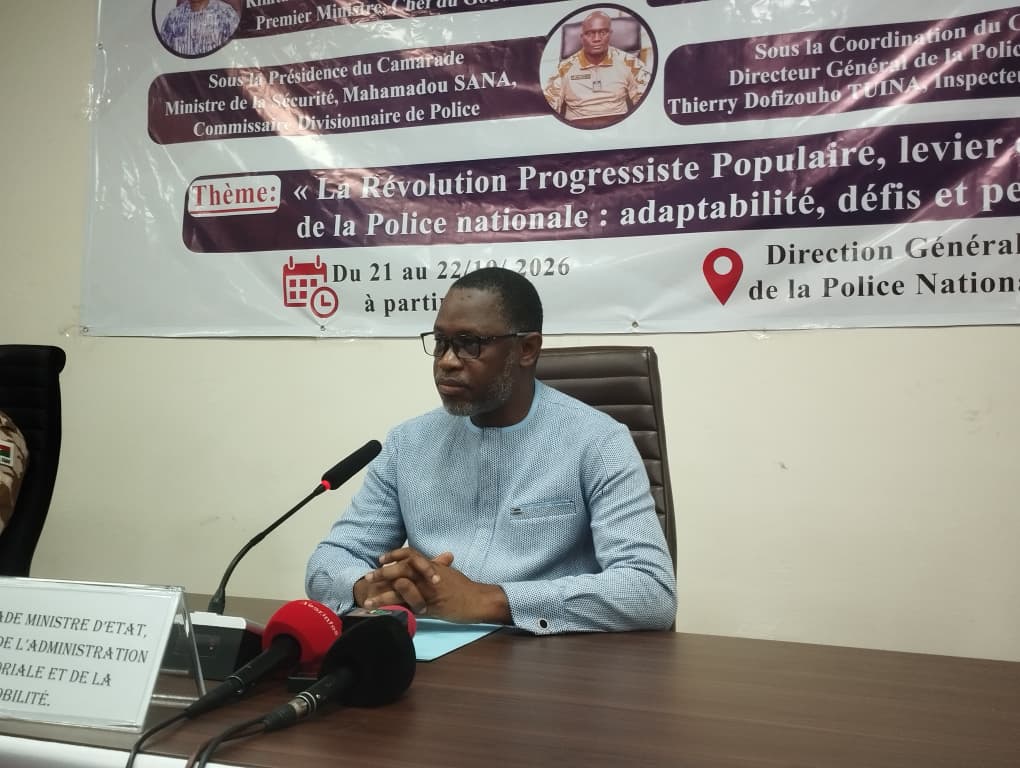
« Le gouvernement attend de vos travaux une évaluation lucide des acquis, un diagnostic objectif des insuffisances et des recommandations précises, réalistes, assorties de modalités de mise en œuvre », a indiqué le ministre en charge de l'administration territoriale, Émile Zerbo.
Pour lui, les institutions sont appelées à repenser leurs méthodes de travail selon la RPP. « La Révolution progressiste populaire nous commande de repenser nos méthodes et de faire de nos institutions des instruments performants au service de la nation. C'est à cette hauteur que le gouvernement attend la Police nationale, et particulièrement ses cadres de commandement. Car la sécurité de nos populations ne se mesure ni aux intentions affichées, ni aux réformes annoncées, mais aux résultats obtenus et à la confiance inspirée », a-t-il indiqué avant de déclarer ouverts les travaux de la sixième conférence annuelle des commissaires de police.
Jean Élysée Nikiéma
Lefaso.net
Categories: Afrique
Le Faso Digital 2026 : Dr Zakaria Sawadogo alerte sur dix risques liés à l'IA qui menacent les organisations
L'intelligence artificielle offre aux entreprises et aux institutions des possibilités inédites en matière de productivité, d'innovation et d'efficacité. Mais derrière ces opportunités se cachent des menaces parfois insoupçonnées, susceptibles de compromettre leurs données, leurs finances et leur réputation. Comment profiter de cette révolution technologique sans exposer son organisation ? C'est autour de cette préoccupation que s'est articulée la masterclass intitulée « IA & Cybersécurité : les 10 risques qui menacent votre organisation et comment les transformer en avantage », animée par Dr Zakaria Sawadogo, dans le cadre de Le Faso Digital.
Un message électronique apparemment envoyé par un directeur général, une instruction urgente de virement, un document confidentiel soumis à un assistant d'intelligence artificielle pour gagner du temps ou encore une application développée en quelques minutes grâce à l'IA. Derrière ces gestes devenus presque ordinaires peuvent se dissimuler des risques majeurs pour les organisations. C'est à travers des situations concrètes que Dr Zakaria Sawadogo, enseignant-chercheur et spécialiste de l'intelligence artificielle et de la cybersécurité, a conduit les participants à sa masterclass dans l'univers des nouvelles menaces numériques. Ses travaux, situés à la croisée de la technologie, des politiques publiques et des enjeux de gouvernance numérique en Afrique, ont nourri une intervention qui invitait autant à comprendre les risques qu'à adopter les bons réflexes.
Modérée par Clémence Tuina, journaliste à la Radiodiffusion télévision du Burkina (RTB), productrice et formatrice, la rencontre a permis d'aborder les vulnérabilités auxquelles sont confrontées les entreprises et les institutions à mesure que l'intelligence artificielle s'intègre dans leurs pratiques professionnelles. Au cœur des échanges, l'idée selon laquelle l'IA ne doit pas être considérée uniquement comme un outil permettant d'aller plus vite. Son adoption doit s'accompagner d'une réflexion sur la sécurité, la responsabilité et la place de l'humain dans les processus de décision.
Quand l'intelligence artificielle devient une arme entre les mains des fraudeurs
Pour illustrer les nouvelles formes de cybercriminalité, Dr Zakaria Sawadogo s'est notamment intéressé aux deepfakes et à la fraude au dirigeant. Grâce à l'intelligence artificielle, les cybercriminels peuvent désormais imiter de manière particulièrement convaincante la voix, l'image ou encore le style rédactionnel d'une personne. Un collaborateur peut ainsi recevoir un message qui semble provenir de son supérieur hiérarchique, lui demandant d'effectuer une opération urgente. Le danger ne se limite d'ailleurs pas aux applications de messagerie instantanée. « Cette façon de faire n'est pas seulement par WhatsApp, même par les mails. Il y a des mails, ça arrive en fait que les collaborateurs reçoivent des mails dans ce sens-là », a expliqué le conférencier. Selon lui, il suffit parfois à un attaquant de disposer d'un ancien message envoyé par un responsable pour en reproduire les caractéristiques à l'aide de l'IA. Le résultat peut être suffisamment crédible pour tromper un employé peu vigilant.
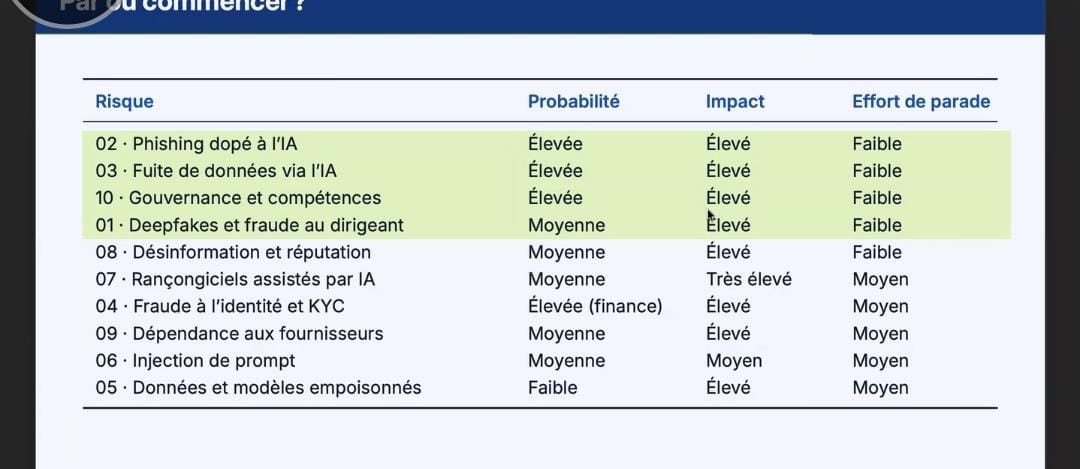
À cette menace s'ajoute le phishing, ou hameçonnage, dont l'efficacité est aujourd'hui renforcée par l'intelligence artificielle et les techniques d'ingénierie sociale. Les cybercriminels peuvent analyser les comportements de leurs cibles, exploiter les informations publiées sur les réseaux sociaux et concevoir des messages personnalisés, sans les maladresses qui permettaient autrefois de repérer certaines tentatives de fraude. Banques, opérateurs de télécommunications, administrations ou responsables d'entreprise peuvent ainsi être imités dans le but d'obtenir des informations confidentielles ou de pousser une personne à accomplir une action frauduleuse. Face à ces pratiques, Dr Sawadogo recommande notamment le renforcement des mécanismes d'authentification, la double validation des opérations sensibles, les campagnes de sensibilisation et les simulations régulières de phishing. Il insiste également sur la nécessité de disposer, au sein des organisations, d'un canal permettant aux collaborateurs de signaler rapidement les messages ou comportements suspects. Car, au-delà des dispositifs techniques, la vigilance humaine demeure une composante essentielle de la cybersécurité.
La fuite des données, un risque au cœur des nouveaux usages
Parmi les dix menaces présentées, la fuite des données à travers les assistants d'intelligence artificielle a particulièrement retenu l'attention. Aujourd'hui, de nombreux professionnels utilisent ces outils pour rédiger des correspondances, analyser des documents, préparer des rapports ou traiter des informations internes. Pour obtenir des réponses pertinentes, ils sont naturellement amenés à fournir du contexte, parfois sans mesurer la sensibilité des informations partagées. Or, comme l'a expliqué Dr Sawadogo, les données introduites dans un assistant externe ne restent pas nécessairement sur l'ordinateur de l'utilisateur. Leur traitement dépend notamment de l'architecture du service, de ses conditions d'utilisation et des paramètres de confidentialité appliqués. Le risque apparaît lorsque des collaborateurs soumettent, sans précaution, des documents stratégiques, des informations personnelles ou des données confidentielles à des outils qui n'ont pas été préalablement évalués et autorisés par leur organisation. Le spécialiste a ainsi invité les entreprises et les institutions à définir clairement les catégories de données pouvant être utilisées avec l'IA et celles qui doivent impérativement rester protégées.
Concernant la fuite de données, le spécialiste a invité les entreprises et les institutions à définir clairement les catégories de données pouvant être utilisées avec l'IA et celles qui doivent impérativement rester protégées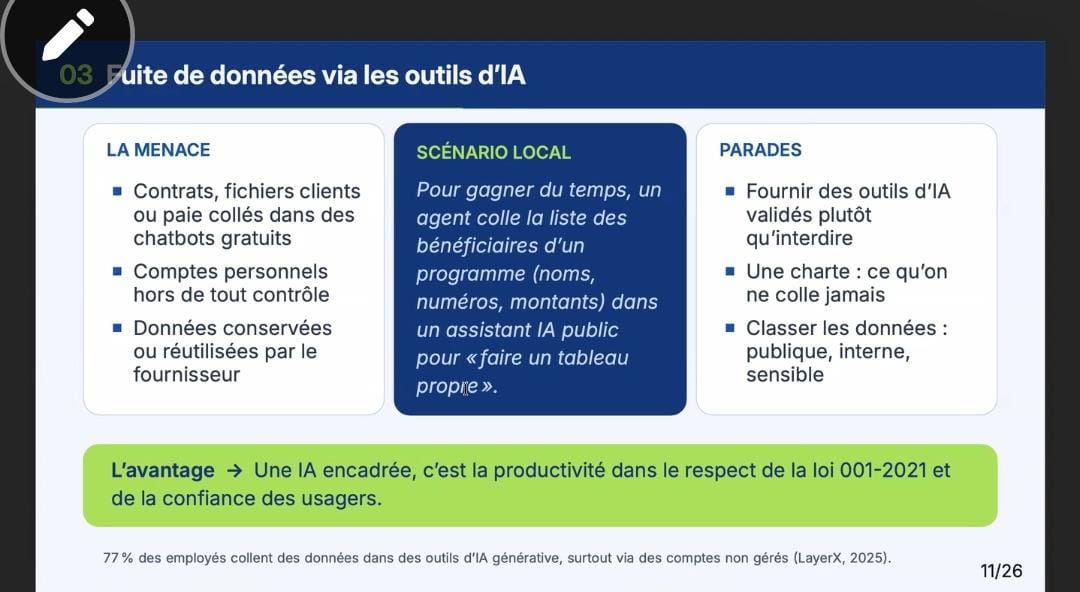
À lire : Le Faso Digital 2026 : Comprendre l'intelligence artificielle pour mieux se l'approprier au Burkina
Autre menace abordée : l'empoisonnement des données et des modèles. Il s'agit, pour un acteur malveillant, d'introduire des informations fausses ou altérées dans les données utilisées par un système afin d'influencer ses résultats. Cette manipulation peut conduire une intelligence artificielle à produire des réponses biaisées ou à orienter certaines décisions dans une direction souhaitée par l'attaquant. Le conférencier a notamment évoqué les enjeux informationnels liés aux conflits internationaux pour illustrer l'importance de cette menace, particulièrement préoccupante lorsque les outils numériques participent à la formation des opinions ou à la prise de décision. La masterclass a également abordé la fraude à l'identité et aux procédures de vérification des clients (KYC), les rançongiciels assistés par IA, les injections de prompt, la désinformation, les atteintes à la réputation et la dépendance aux fournisseurs technologiques. Autant de risques qui montrent que la cybersécurité ne relève plus exclusivement des informaticiens, mais concerne désormais l'ensemble des acteurs d'une organisation.
Des applications qui fonctionnent, mais sont-elles sécurisées ?
Dr Zakaria Sawadogo s'est également attardé sur une pratique qui prend de l'ampleur : la génération de codes informatiques à l'aide de l'intelligence artificielle. Si ces outils permettent de développer rapidement des sites web et des applications, leur utilisation sans connaissances suffisantes en programmation peut exposer les utilisateurs à des vulnérabilités importantes. Le conférencier a notamment attiré l'attention sur les dépendances logicielles proposées par certains assistants, les défauts de sécurité susceptibles de se retrouver dans le code généré ainsi que les fichiers de configuration et métadonnées laissés dans les répertoires des applications. Ces éléments, lorsqu'ils sont mal gérés, peuvent constituer des points d'entrée pour des personnes malveillantes. Le problème, selon lui, réside notamment dans la tendance à privilégier la rapidité de production au détriment des vérifications nécessaires. Une application peut parfaitement fonctionner tout en présentant des failles de sécurité, donc pour éviter de telles situations, Dr Sawadogo recommande une revue complète du code généré, la vérification des dépendances, la suppression des informations sensibles inutiles et la correction des vulnérabilités avant tout déploiement. Cette démarche implique de conserver des compétences humaines capables d'évaluer les productions de l'intelligence artificielle. Le spécialiste a d'ailleurs insisté sur un principe transversal à l'ensemble de sa présentation : la revue humaine ne doit jamais être sacrifiée au nom du gain de temps. Confier systématiquement à une intelligence artificielle la vérification de ce qu'une autre intelligence artificielle a produit, sans contrôle indépendant adapté, reviendrait à déplacer le problème plutôt qu'à le résoudre. L'automatisation doit donc permettre aux professionnels de consacrer davantage de temps à l'analyse, à la vérification et aux décisions qui engagent leur responsabilité.
Dr Sawadogo propose quelques habitudes à tester de 30 à 90 jours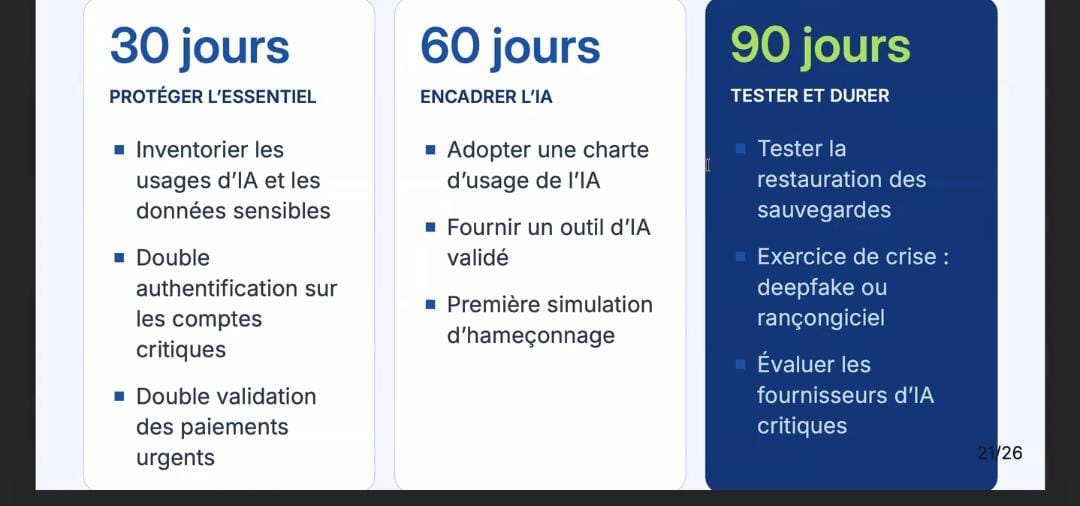
Comment contextualiser les réponses de l'IA sans compromettre les données ?
La question de la protection des informations a également alimenté les échanges avec les participants. Intervenant à cette occasion, Dr Cyriaque Paré, promoteur de Le Faso Digital, a félicité le conférencier et la modératrice pour leur implication dans la réussite de Le Faso Digital. Il a notamment salué la fidélité de Dr Sawadogo à l'événement, après sa participation à une conférence lors de l'édition précédente. Il a ensuite soulevé une préoccupation qui traduit bien le dilemme auquel sont aujourd'hui confrontés les utilisateurs professionnels de l'intelligence artificielle. Comment obtenir des réponses véritablement contextualisées sans communiquer aux assistants numériques des documents institutionnels ou des informations susceptibles d'être compromises ? En effet, plus les données transmises à un assistant sont précises, plus celui-ci dispose d'éléments pour produire un résultat adapté aux besoins de son utilisateur. Mais cette recherche de pertinence peut entrer en contradiction avec les exigences de confidentialité. « Comment concilier cette exigence de devoir nourrir l'IA et en même temps d'éviter de donner à l'IA des données qui peuvent être compromises ? », a interrogé Dr Cyriaque Paré.
En réponse, Dr Zakaria Sawadogo a reconnu toute la complexité de cette problématique. Pour lui, une solution structurelle serait de développer des intelligences artificielles propres aux organisations ou des solutions nationales dont l'hébergement, le traitement et la gouvernance des données seraient maîtrisés. « Je pense que la solution radicale serait que nous construisions nos propres IA. En ce moment, nous pouvons donner nos données parce que nous savons où les données vont. Nous savons où les données sont stockées », a-t-il expliqué. Il a ainsi évoqué la perspective de disposer, au Burkina Faso, d'assistants performants capables de répondre aux besoins locaux tout en offrant une meilleure maîtrise des informations traitées. Et en attendant, le spécialiste recommande de recourir à l'anonymisation des documents avant leur transmission à des assistants externes.
Quelques règles d'usage de l'IA en 7 points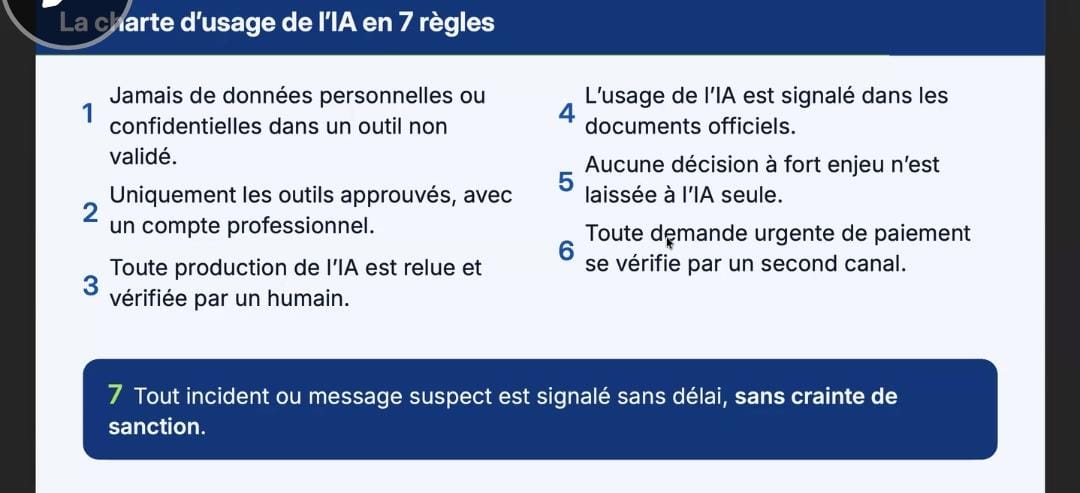
Concrètement, il s'agit de retirer les noms, les informations personnelles et les éléments confidentiels, puis de les remplacer, lorsque cela est possible, par des variables neutres. Une fois le document traité par l'IA, les informations nécessaires peuvent être réintroduites dans un environnement maîtrisé, après vérification. Une méthode qui demande certes un travail supplémentaire, mais qui, selon lui, permet de mieux concilier les impératifs de productivité et de confidentialité. Pour Dr Sawadogo, cette difficulté doit aussi encourager les acteurs africains à investir davantage dans le développement de leurs propres solutions technologiques.
Farida Thiombiano
Lefaso.net
Categories: Afrique
Le Faso Digital 2026 : Wave partage dix réflexes pour sécuriser son argent sur le téléphone
Le téléphone portable est devenu un outil incontournable pour les transactions financières quotidiennes. Transferts d'argent, paiements de factures et réception de fonds s'effectuent désormais en quelques clics. Mais cette facilité d'utilisation expose également les utilisateurs à diverses formes de fraude. C'est autour de cette problématique que s'est tenue une masterclass sur le thème : « Mon argent sur mon téléphone : 10 réflexes pour utiliser les services financiers numériques en toute sécurité ». Une rencontre d'échanges organisée dans le cadre de la deuxième édition de Le Faso Digital, une initiative portée par le média en ligne Lefaso.net.
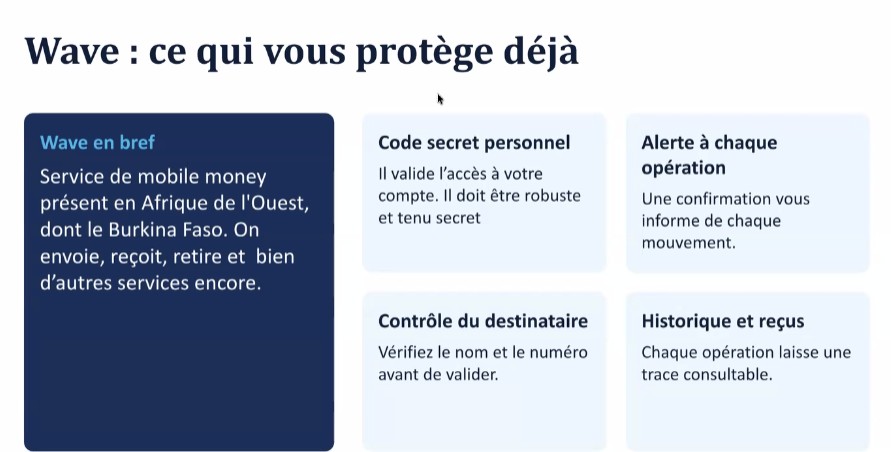
Invité à partager son expertise avec les participants, Brice Koué, responsable des relations publiques en charge du digital chez Wave Mobile Money Group, a expliqué les mécanismes de la fraude numérique et présenté des mesures pratiques pour mieux protéger les comptes de monnaie électronique. Pendant cette session interactive, modérée par Valentin Waongo, consultant et formateur aux métiers du digital, le spécialiste a rappelé que la sécurité financière numérique repose autant sur les dispositifs techniques des opérateurs que sur la vigilance des utilisateurs.
Une sécurité qui engage l'opérateur et le client
De prime abord, le conférencier, Brice Koué, a souligné que le développement des services financiers numériques a considérablement facilité l'accès aux transactions, notamment pour les personnes qui ne disposent pas nécessairement d'un compte bancaire. Cette évolution, qui permet d'envoyer de l'argent à distance ou de régler des factures sans se déplacer, s'accompagne toutefois de nouveaux risques.
« Aujourd'hui, le mobile money n'est plus une révolution sur le continent. C'est une réalité que nous connaissons depuis une quinzaine d'années dans différents pays, avec une adoption de plus en plus importante des services financiers numériques. Mais cette adoption vient aussi avec un certain nombre de problèmes, puisque nous sommes désormais nombreux à utiliser ces services et donc potentiellement exposés aux risques qui y sont liés. Ces risques peuvent néanmoins être réduits grâce à des gestes simples, à condition que chacun comprenne son rôle dans la protection de son argent », a-t-il expliqué.
Pour lui, la sécurité ne peut pas reposer exclusivement sur l'entreprise qui fournit le service. Elle suppose une collaboration entre l'opérateur, responsable de la protection technique de sa plateforme, et le client, qui doit sécuriser son téléphone et préserver la confidentialité de ses informations.
« Il y a d'abord la sécurité de l'infrastructure, qui relève de l'opérateur et concerne notamment la protection de la plateforme, le chiffrement des données et les mécanismes de détection des fraudes. Mais il y a également la sécurité qui relève de l'utilisateur lui-même. Nous avons donc trois niveaux de protection : la plateforme, le téléphone et le client. Pour que l'ensemble fonctionne correctement, chacun doit jouer sa partition. L'opérateur doit sécuriser son application, tandis que l'utilisateur doit protéger son appareil, garder ses codes secrets et faire preuve de vigilance dans ses décisions », a insisté Brice Koué.
L'ingénierie sociale, une menace majeure…
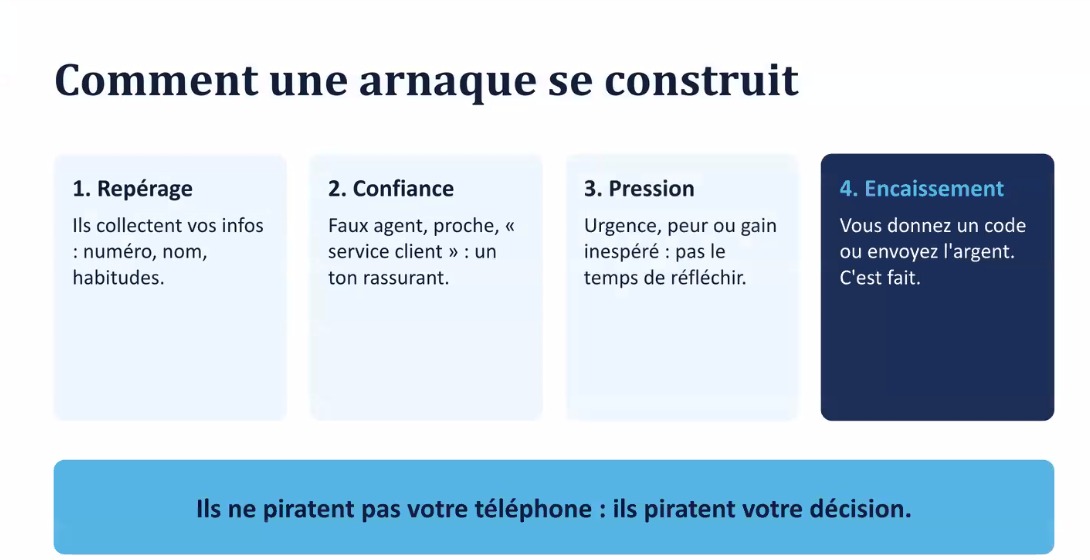
Au cours de son exposé, Brice Koué a particulièrement attiré l'attention sur l'ingénierie sociale, une technique qui consiste à manipuler psychologiquement une personne afin de lui soutirer des informations confidentielles ou de la pousser à effectuer une opération financière.
Contrairement à certaines formes de cyberattaques qui nécessitent l'exploitation d'une faille informatique, cette méthode s'appuie avant tout sur la confiance, la peur, l'urgence ou l'appât du gain.
« Dans beaucoup de situations, le fraudeur n'a pas besoin de pirater techniquement votre application. Il cherche plutôt à pirater votre décision. Il peut vous appeler en utilisant votre nom et votre prénom, se présenter comme un agent du service client, vous expliquer que votre compte doit être sécurisé ou vous annoncer que vous avez gagné un cadeau. Une fois qu'il a établi une relation de confiance avec vous, il crée un sentiment d'urgence pour vous empêcher de réfléchir et vous amener à lui communiquer les informations qui lui permettront d'accéder à votre compte », a-t-il détaillé.
Selon Monsieur Koué, les informations publiées sur les réseaux sociaux peuvent également être exploitées par les fraudeurs pour rendre leurs scénarios plus crédibles. Connaître le nom d'une personne ou certaines de ses habitudes peut suffire à instaurer un climat de confiance, avant de lui demander des données plus sensibles.
Le spécialiste a notamment mis en garde contre les appels de personnes qui prétendent représenter un service financier et demandent un code reçu par SMS pour prétendument débloquer, sécuriser ou vérifier un compte.
« Il faut retenir une règle fondamentale : aucun agent du service client ne doit vous demander de lui communiquer votre code secret ou un code de validation reçu par SMS. Même si la personne connaît votre nom, même si elle maîtrise le vocabulaire du service et même si elle vous met en confiance, cela ne signifie pas qu'elle est réellement un agent de l'opérateur. Dès qu'on vous demande un code confidentiel, vous devez vous arrêter et ne rien communiquer. C'est votre argent qui est en jeu », a-t-il prévenu.
Il a également invité les utilisateurs à se méfier des messages annonçant des gains inattendus, des investissements particulièrement avantageux ou des cadeaux conditionnés au clic sur un lien.
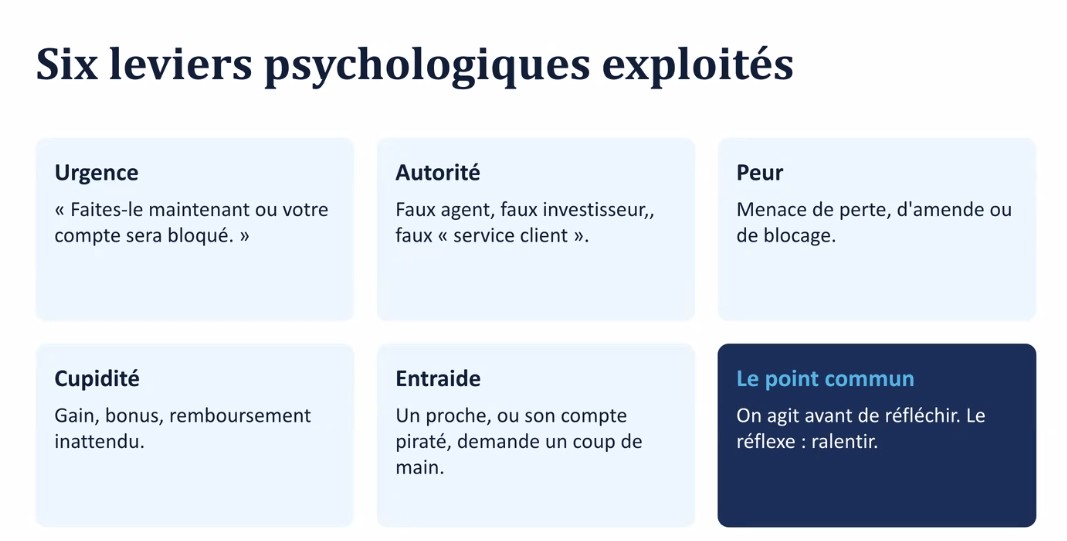
« Nous devons comprendre que les fraudeurs exploitent plusieurs leviers psychologiques : l'autorité, lorsqu'ils se font passer pour des agents ou des responsables ; la peur, lorsqu'ils menacent de bloquer un compte ; l'urgence, lorsqu'ils exigent une réaction immédiate ; mais aussi l'appât du gain et la solidarité, lorsqu'ils prétendent qu'un proche est en difficulté. Le point commun de toutes ces situations, c'est qu'on cherche à nous faire agir avant de réfléchir. Le premier réflexe doit donc être de ralentir », a-t-il conseillé.
Des applications douteuses aux faux transferts d'argent…
Outre les manipulations téléphoniques, le responsable des relations publiques en charge du digital chez Wave Mobile Money Group a alerté sur les dangers liés au téléchargement d'applications provenant de sources non officielles et à l'ouverture de liens suspects.
Certaines applications malveillantes peuvent permettre à des individus mal intentionnés d'accéder à des informations présentes sur le téléphone, voire de surveiller certaines activités de l'utilisateur. Il a donc recommandé de télécharger les applications uniquement depuis les magasins officiels, notamment Google Play Store et l'App Store, de verrouiller systématiquement son appareil et d'effectuer les mises à jour de sécurité.
« Le téléphone est comme une maison dans laquelle se trouvent plusieurs chambres. Les applications de messagerie, les réseaux sociaux et les services financiers sont autant de pièces qui contiennent des informations personnelles. Si vous laissez la porte de la maison ouverte, c'est-à-dire si votre téléphone n'est pas verrouillé, vous facilitez l'accès à ces informations. Et si vous téléchargez une application malveillante, vous risquez de donner à un fraudeur la possibilité de surveiller vos activités. Il faut donc protéger son téléphone avant même de penser à protéger les applications qui s'y trouvent », a-t-il illustré.
Autre scénario abordé : les faux messages de réception d'argent. Dans ce cas, le fraudeur envoie un SMS qui imite une notification de transfert, puis appelle la victime pour lui expliquer qu'il a effectué une transaction par erreur et lui demander de rembourser immédiatement la somme.
Le piège consiste à pousser la personne à transférer son propre argent sans vérifier si les fonds annoncés ont réellement été crédités sur son compte.
« Lorsque quelqu'un vous appelle pour vous dire qu'il vous a envoyé de l'argent par erreur, ne vous précipitez pas pour le lui renvoyer. Ouvrez votre application officielle et vérifiez votre solde ainsi que l'historique des transactions. Un SMS peut être copié et envoyé sans qu'aucun transfert n'ait réellement eu lieu. Même si l'argent apparaît effectivement dans votre compte, vous ne devez pas effectuer vous-même un nouveau transfert pour rembourser la personne. Demandez-lui de contacter le service client de l'opérateur afin que la situation soit vérifiée et que la procédure appropriée soit engagée », a recommandé Brice Koué.
Il a expliqué qu'un remboursement effectué dans la précipitation peut exposer le client à une seconde perte, notamment si le transfert initial est ensuite annulé par son expéditeur lorsque cette fonctionnalité est disponible.
Dix réflexes pour protéger son argent
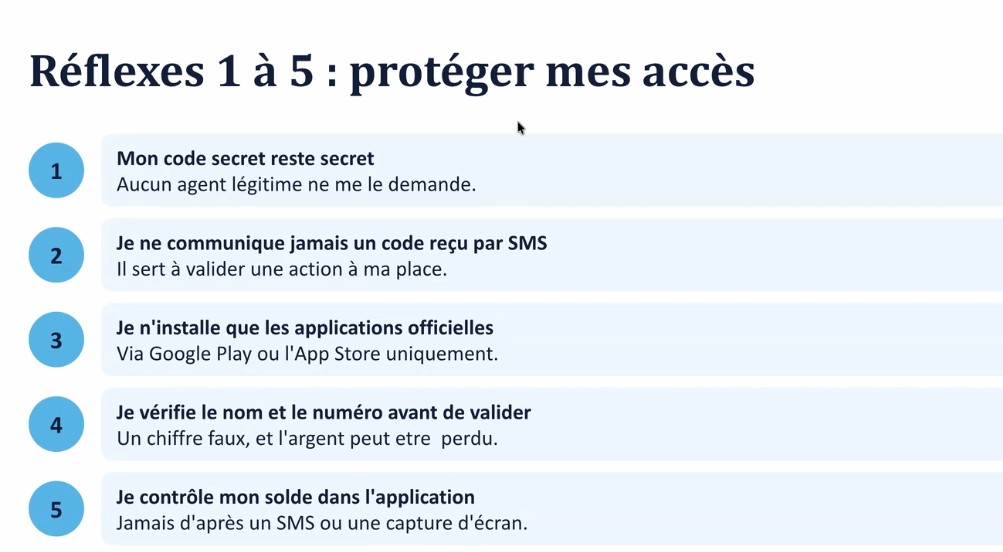
Pour permettre aux participants de retenir les principales mesures de prévention, le spécialiste a résumé les bonnes pratiques à adopter au quotidien. Il a notamment insisté sur la confidentialité des codes, la vérification des destinataires et la prudence face aux sollicitations inhabituelles.
Au cours de la masterclass, dix réflexes essentiels ont été présentés pour renforcer la sécurité des transactions financières sur téléphone. Il s'agit notamment de garder son code secret confidentiel et de ne jamais communiquer un code de validation reçu par SMS, quel que soit le prétexte avancé par l'interlocuteur. Le conférencier a également invité les participants à télécharger uniquement des applications officielles, à vérifier systématiquement le numéro du destinataire avant chaque transfert et à contrôler régulièrement leur solde ainsi que l'historique de leurs opérations.
Il a d'ailleurs insisté sur la nécessité de se méfier des demandes urgentes, des menaces et des promesses de gains inattendus, souvent utilisées par les fraudeurs pour piéger leurs victimes. Il a recommandé de contacter le service client uniquement par les canaux officiels, de verrouiller son téléphone et de maintenir son système à jour. La consultation des notifications et des reçus de transaction permet également de vérifier les opérations effectuées et de conserver des preuves en cas de problème. Enfin, en cas de doute, il est conseillé d'interrompre immédiatement l'échange suspect et de vérifier les informations auprès de l'opérateur avant toute action.
Le spécialiste a également recommandé d'éviter les réseaux Wi-Fi publics lorsqu'ils ne sont pas indispensables, de protéger sa carte SIM et de ne pas choisir un code secret facile à deviner, comme une suite de chiffres, une date de naissance ou les derniers chiffres d'un numéro de téléphone.
« Un code secret doit rester secret et être difficile à deviner. Il ne faut pas choisir une combinaison simplement parce qu'elle est facile à mémoriser, notamment lorsqu'elle correspond à votre année de naissance ou à une date qui peut être connue de votre entourage. Je demande à tous ceux qui utilisent des codes faciles de les modifier dès maintenant. La protection de votre argent commence par ces gestes simples, que vous pouvez effectuer directement depuis votre application », a-t-il souligné.
Que faire en cas de fraude ou de vol du téléphone ?
Les échanges avec les participants ont également permis d'aborder la conduite à tenir lorsqu'un utilisateur soupçonne une fraude, communique accidentellement un code confidentiel ou perd son téléphone.
Brice Koué a recommandé de modifier immédiatement le code secret lorsque cela est possible et de contacter sans délai le service client. En cas de vol de l'appareil, il a précisé que, pour Wave, le client peut exceptionnellement appeler depuis le téléphone d'un proche afin de demander le blocage de son compte, après les vérifications de sécurité nécessaires.
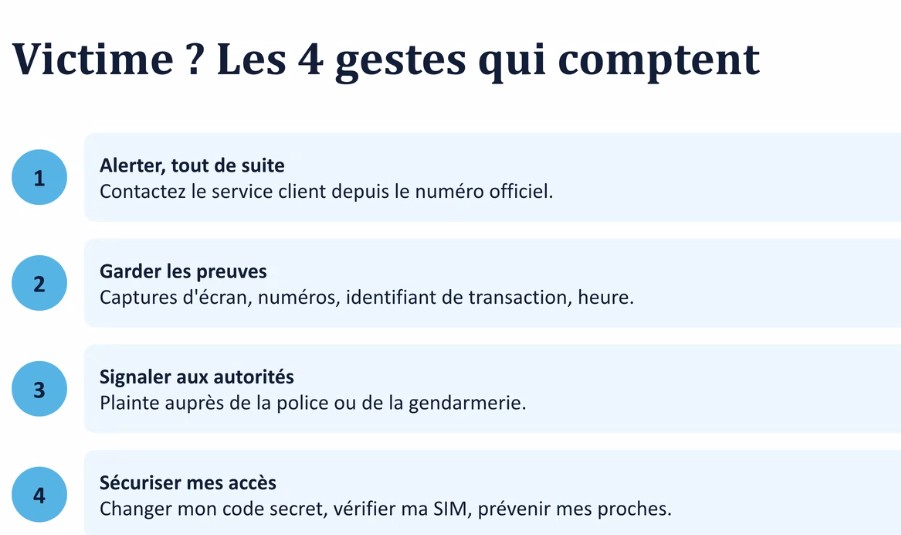
« Si vous pensez avoir été victime d'une arnaque, le premier réflexe n'est pas de publier une vidéo sur les réseaux sociaux pour raconter ce qui s'est passé. Il faut immédiatement contacter le service client. Selon les circonstances, une réaction rapide peut permettre de prendre des mesures de protection avant que les fonds ne soient retirés. Il faut également conserver les preuves, notamment les numéros utilisés, les messages reçus et les références des transactions, puis signaler les faits aux autorités compétentes afin qu'une enquête puisse être menée », a-t-il développé.
Répondant à une question sur les transferts effectués par erreur, il a précisé que certaines fonctionnalités d'annulation peuvent être accessibles directement dans l'application Wave, selon les conditions applicables et le déploiement de la fonctionnalité. Il a toutefois distingué le transfert d'argent entre particuliers du paiement marchand, dont les règles peuvent être différentes.
Au cours des échanges, il a aussi indiqué que les clients se trouvant à l'étranger pouvaient, selon les options disponibles dans l'application, contacter Wave par WhatsApp. Il a invité les utilisateurs à vérifier les coordonnées du service client directement auprès des canaux officiels de l'entreprise.
Une responsabilité partagée pour renforcer la confiance numérique
En conclusion, Brice Koué a rappelé que la sécurité des services financiers numériques ne dépend pas uniquement des dispositifs techniques mis en place par les opérateurs. Elle exige également des comportements responsables de la part des utilisateurs, appelés à faire preuve de prudence dans chacune de leurs opérations.
« Il faut retenir que la sécurité est une responsabilité partagée. L'opérateur doit assurer la protection technique de son infrastructure et de son application, mais le client doit également protéger ses accès, ne jamais communiquer ses codes et éviter de prendre des décisions sous la pression. Quand une personne vous appelle pour vous demander de l'argent, vous annoncer un gain ou vous réclamer un code, prenez le temps de vérifier. Si vous avez un doute, raccrochez et contactez directement le service client. En matière de sécurité numérique, quelques secondes de prudence peuvent vous éviter de perdre votre argent », a-t-il conclu.
Hanifa Koussoubé
Lefaso.net
Categories: Afrique
Burkina : Plus de 1,29 milliard de FCFA prévu pour renforcer la gestion des finances publiques entre 2027 et 2029
Le Comité de pilotage du Plan d'action intégré des réformes de finances publiques (PAIRFP) a adopté trois documents stratégiques ce mercredi 21 octobre 2026, à Ouagadougou. L'objectif est d'améliorer la gestion des finances publiques au Burkina Faso. Cette information est rapportée par le ministère de l'Economie et des finances.
Le projet de plan d'action issu de l'évaluation PEFA 2025, figurant parmi les dossiers à l'ordre du jour, prévoit, souligne-t-il, 90 mesures pour un coût estimatif de 1,29 milliard de francs CFA sur la période 2027-2029.
Réuni en session ordinaire sous la présidence du secrétaire général du ministère de l'Économie et des finances, Vieux Abdoul Rachid Soulama, le Comité a également examiné et adopté le rapport de mise en œuvre du PAIRFP au 30 septembre 2026 et sa programmation pour 2027-2029.
Le rapport fait ressortir des avancées dans plusieurs domaines, notamment la fiabilité des prévisions de recettes, la transparence budgétaire, la production des documents financiers, la modernisation des outils de gestion et le renforcement des mécanismes de contrôle.
Le plan d'action PEFA 2027-2029, qui porte sur 25 indicateurs et 73 composantes ciblées, entend consolider ces acquis et corriger les insuffisances identifiées.
À cet effet, Vieux Abdoul Rachid Soulama a insisté sur la nécessité de privilégier des mesures pertinentes et efficaces, capables de produire des améliorations concrètes et mesurables dans la gestion des finances publiques.
Lefaso.net
Source : Ministère de l'Economie et des finances
Categories: Afrique
Enseignement supérieur : L'USAES dénonce le durcissement des conditions de promotion des enseignants-chercheurs du CAMES
L'Union syndicale africaine de l'enseignement supérieur (USAES) exprime ses inquiétudes face au durcissement des conditions d'évaluation et de promotion des enseignants-chercheurs dans l'espace du Conseil africain et malgache pour l'enseignement supérieur (CAMES). Dans un communiqué publié le 18 octobre 2026, l'organisation syndicale revient sur les préoccupations soulevées lors d'une rencontre avec les responsables du CAMES, le 23 septembre dernier à Ouagadougou.
L'USAES dénonce notamment le manque de transparence dans l'élaboration des grilles d'évaluation, ainsi que la faible implication des représentants des enseignants-chercheurs dans certains États membres. Elle s'inquiète également du durcissement récurrent des critères d'accès aux différents grades académiques, qu'elle juge insuffisamment justifié.
L'organisation syndicale conteste particulièrement l'exigence, à partir de 2027, de publications dans des revues indexées pour les candidats relevant des comités techniques spécialisés (CTS) en lettres et sciences humaines, sciences juridiques et politiques, ainsi qu'en sciences économiques et de gestion. Selon elle, cette nouvelle disposition risque de rendre inéligible une grande partie des candidats concernés dès 2027.
L'USAES émet également des réserves sur l'instauration d'une épreuve orale de présentation des titres et travaux scientifiques pour les candidats aux fonctions de rang magistral. Selon elle, le CAMES justifie cette mesure par la nécessité de limiter l'influence de l'intelligence artificielle sur les productions écrites.
Les représentants syndicaux s'interrogent par ailleurs sur la création d'une académie virtuelle du CAMES et sur le projet d'harmonisation du fonctionnement des écoles doctorales. Ils estiment que ces initiatives pourraient éloigner l'institution de sa mission première d'évaluation et empiéter sur l'autonomie pédagogique et scientifique des universités. La réforme des titres et grades figure également parmi les préoccupations exprimées.
Un mémorandum annoncé pour défendre les carrières universitaires
La rencontre a réuni une délégation syndicale issue de plusieurs pays africains et le secrétaire général du CAMES, le professeur Souleymane Konaté, accompagné de deux responsables de l'institution. Les échanges ont permis aux représentants de l'USAES d'exposer leurs préoccupations concernant la gestion des carrières et les conditions de qualification des enseignants-chercheurs.
Les deux parties ont convenu de poursuivre ce cadre de dialogue. Le Bureau exécutif de l'USAES prévoit également de transmettre au CAMES et aux États membres, un mémorandum détaillant les difficultés rencontrées par les enseignants-chercheurs et les propositions de l'organisation.
L'USAES appelle enfin à l'élaboration de guides d'évaluation transparents, réalistes et applicables dans les différents États membres. Elle prévient qu'un durcissement injustifié des conditions de promotion pourrait entraîner une pénurie artificielle d'enseignants-chercheurs qualifiés.
L'organisation réaffirme néanmoins sa disponibilité à poursuivre la coopération avec le CAMES pour contribuer au développement et au rayonnement de l'enseignement supérieur en Afrique francophone.
Hamed Nanéma
Lefaso.net
Categories: Afrique
École polytechnique de Ouagadougou : L'ingénierie au cœur de la valorisation scientifique et du développement industriel
L'École polytechnique de Ouagadougou (EPO) tient, les 21 et 22 octobre 2026, à Ouagadougou, la 5ᵉ édition de ses Journées scientifiques. Placée sous le thème « Recherche et déploiement industriel : l'ingénierie au cœur de la valorisation scientifique et de la maîtrise technique », cette rencontre met l'accent sur le renforcement des liens entre la recherche scientifique, la formation des ingénieurs et le développement industriel. Cette 5ᵉ édition se tient sous le parrainage du directeur général de la police, Thierry Dofizouho Tuina.
À travers cette initiative, l'EPO entend mettre en lumière le rôle stratégique de la science, de la technologie et de l'ingénierie dans la transformation des économies. Le thème retenu souligne notamment la nécessité de rapprocher davantage les résultats de la recherche scientifique des besoins du secteur industriel, afin de favoriser l'innovation, la maîtrise technique et la création de valeur. Pour le directeur général de l'EPO, Mohamed Seynou, cette thématique est en parfaite adéquation avec les défis auxquels les sociétés contemporaines sont confrontées. Elle invite, selon lui, à repenser la place de la recherche et de l'ingénierie dans la construction d'économies plus performantes et capables de valoriser leurs propres ressources et compétences.
Dans son intervention, Mohamed Seynou a insisté sur l'importance de construire une articulation plus forte entre la production des connaissances scientifiques, la formation des compétences et la création de valeurs économiques et sociales. « Nous ne pouvons pas durablement ambitionner un développement industriel solide sans une recherche scientifique dynamique, sans des ingénieurs bien formés et sans une capacité réelle à maîtriser les procédés et les technologies. La recherche permet d'explorer, de comprendre et d'innover. L'ingénierie permet de concevoir, de dimensionner, d'expérimenter et d'optimiser. L'industrie permet de déployer les solutions, de produire à une échelle pertinente et de créer de la valeur économique et sociale », a-t-il souligné.
Le directeur général de l'EPO, Mohamed Seynou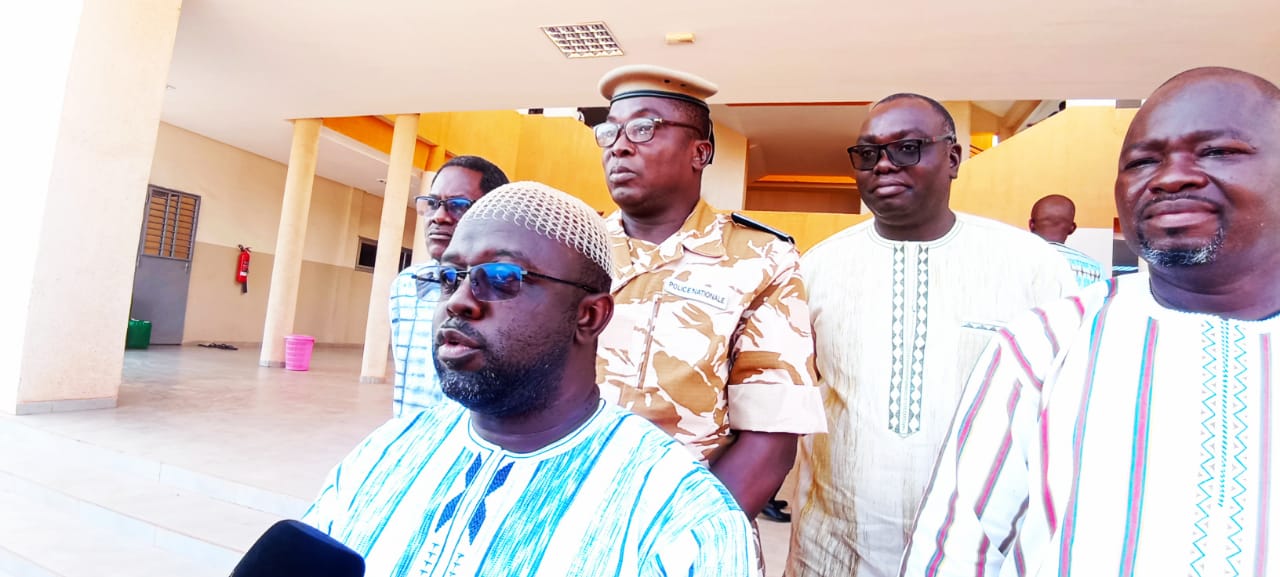
Le premier responsable de l'EPO met en évidence trois leviers essentiels au développement industriel. La recherche scientifique permet d'explorer de nouvelles pistes, de comprendre les phénomènes et de faire émerger des innovations. L'ingénierie, quant à elle, transforme les connaissances en solutions concrètes, grâce à la conception, au dimensionnement, à l'expérimentation et à l'optimisation. Enfin, l'industrie assure le déploiement de ces solutions à une échelle adaptée, tout en contribuant à la production de richesses et à la création d'emplois.
Pour le directeur général de l'EPO, ces trois dimensions ne doivent pas être envisagées séparément, mais comme les composantes d'un même processus de développement. « Nous devons former des ingénieurs qui comprennent les réalités de nos territoires, maîtrisent les fondamentaux scientifiques, savent travailler en équipe et possèdent la capacité d'innover face à des situations complexes.
Le représentant du parrain, Lassina Ouédraogo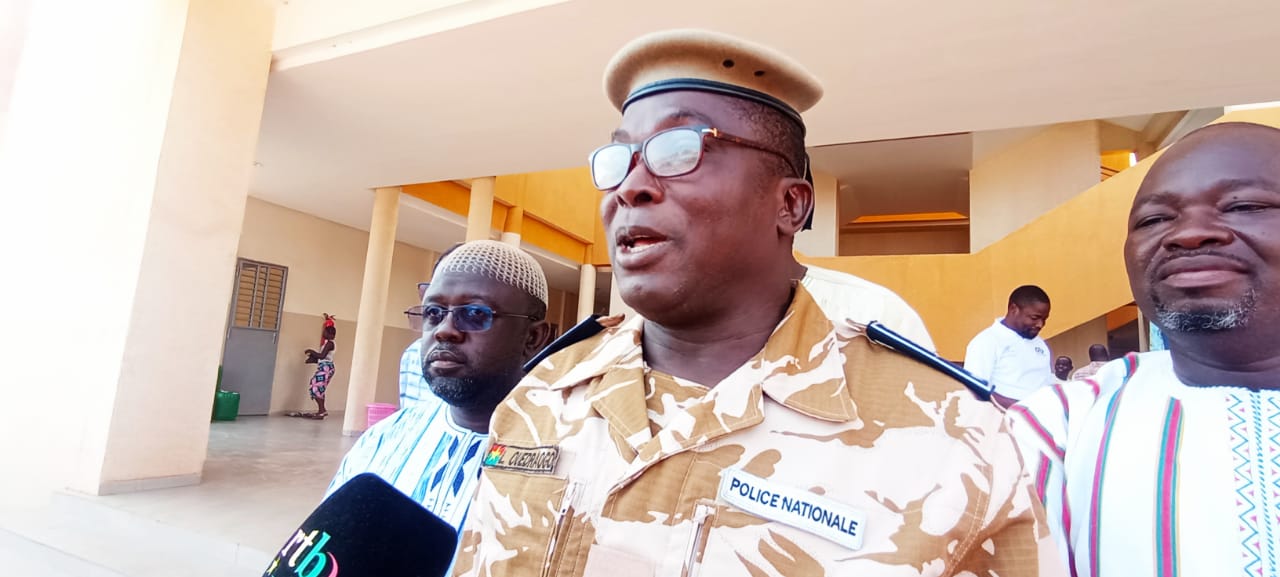
Mais cette ambition ne peut se réaliser pleinement sans une articulation étroite entre la formation, la recherche et le monde industriel. La valorisation de la recherche constitue aujourd'hui un enjeu majeur pour notre pays. Nous ne devons pas nous satisfaire de produire des connaissances sans nous interroger suffisamment sur les conditions de leur transformation en solutions utiles à nos populations. Cette continuité suppose des moyens adaptés, des infrastructures de recherche, des équipements performants, des mécanismes de financement et des partenariats durables. L'École polytechnique de Ouagadougou entend prendre toute sa place dans cette dynamique, en contribuant, dans le cadre de ses missions et de ses moyens, au développement des compétences scientifiques et techniques nécessaires à notre pays », a indiqué le directeur général de l'EPO. Il a terminé en souhaitant que ces Journées scientifiques soient un espace de dialogue, de réflexion et de construction de perspectives nouvelles.
Une vue des participants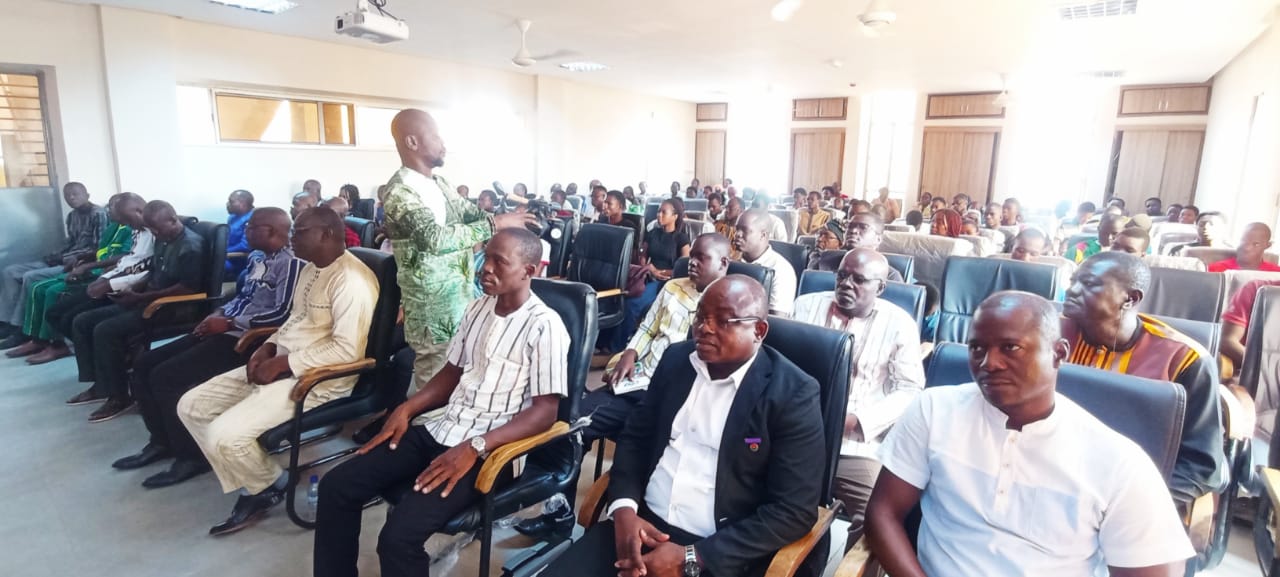
« Les missions de la Police nationale s'exercent dans un environnement en constante mutation, marqué notamment par la transformation numérique, l'évolution des formes de criminalité et la nécessité de mieux coordonner les moyens humains et techniques. Dans ce contexte, les progrès scientifiques et technologiques peuvent contribuer à améliorer la prévention, la détection, l'investigation, la gestion des informations et la protection des personnes et des biens. Cependant, l'acquisition de technologies ne saurait constituer une fin en soi. Encore faut-il disposer des compétences nécessaires pour les exploiter, les entretenir, les adapter à nos réalités et en évaluer les performances. C'est là que la question de la maîtrise technique prend toute son importance. Il existe un lien organique et indissociable entre la sécurité d'une nation et sa maîtrise scientifique et technologique. Un environnement sécurisé favorise les investissements, soutient les activités économiques et permet aux entreprises de se développer. En retour, une économie plus productive, une jeunesse mieux formée et un tissu industriel dynamique contribuent à renforcer la stabilité et les capacités de développement de la nation. La recherche scientifique et l'innovation peuvent ainsi participer, chacune dans leur domaine, à la construction d'un environnement plus sûr et plus prospère. Il est donc important que les institutions de sécurité, les universités, les écoles d'ingénieurs, les centres de recherche et les entreprises puissent développer des relations de coopération adaptées à leurs missions respectives. Valoriser la recherche et la déployer industriellement, c'est garantir au Burkina Faso son autonomie technique. C'est donner à nos institutions les outils conçus par des Burkinabè et des frères africains pour répondre à nos réalités », a notifié Lassina Ouédraogo, contrôleur général de la police, représentant du parrain de la cérémonie. Il a terminé en invitant les participants à des travaux fructueux, à des échanges enrichissants et à des résultats à la hauteur des ambitions collectives.
Rama Diallo
Lefaso.net
Categories: Afrique
Pages



© 2012-2018 Europa Varietas Foundation © 2015-2018 Europa Varietas Association
www.europavarietas.org | info(@)europavarietas(dot)org | Switzerland




We are looking for sponsors for the English translation of these books, please contact turkeandras(at)gmail(dot)com