
Vous êtes ici
Agrégateur de flux
New Working Group Seeks Justice for Critical Mineral Mining Communities
ACSEA's Dr Augustine Njamnshi. Credit ACSEA
By Isaiah Esipisu
ANTALYA, Türkiye, Nov 16 2026 (IPS)
A coalition of African civil society organisations, representatives from the Africa Institute of Resilience Studies (an independent organisation working in research, policy, training and capacity development), and representatives from the Bank–Civil Society Coalition, which brings together seven major regional networks and civil society organisations working on climate and energy, have launched the African Non-State Actors Working Group on Critical Minerals on the sidelines of COP 31 in Antalya, Türkiye.
The launch comes amid growing concerns over environmental degradation and social suffering among communities living in energy-transition mineral-rich areas in Africa, where people bear the burden of forced displacement, loss of livelihoods and human rights abuses, with very limited or sometimes no benefits at all.
“Our shared purpose is to advance accountable, people-centred and nature-positive critical mineral development in Africa, with decent work at its core,” said Dr Augustine Njamnshi, the Executive Director at the African Coalition for Sustainable Energy and Access (ACSEA).
“Africa’s mineral wealth must create lasting value within Africa through local processing, refining, manufacturing and regional value chains that strengthen productive capabilities, support African ownership and improve community wellbeing,” he told delegates attending the UN climate summit in Antalya (COP31).
From cobalt, copper, coltan, lithium and other strategic minerals in the Democratic Republic of Congo (DRC) and parts of Zambia, to lithium projects in Zimbabwe and graphite in Mozambique, communities in mining areas continue to face poverty, environmental damage, unsafe working conditions, displacement, conflict and limited participation in decisions affecting their land and livelihoods.
“I believe the new working group will bring additional energy if it places affected communities, Indigenous Peoples, artisanal miners and African civil-society organisations at the centre,” said Appolinaire Zagabe, the Executive Director at the DRC Climate Change Network (Réseau sur le Changement Climatique RDC – RCCRDC).
The working group committed to building an all representative and action-orientated platform for collective engagement, bringing together organised labour, frontline communities, women and youth organisations, researchers, environmental movements and other African non-state actors.
“We will organise our work around four connected functions based on ideas and evidence, policy and advocacy, accountability, and voice and participation,” said Njamnshi. “Our goal is to advance freedom of association and collective bargaining, living wages, safe workplaces, social protection, skills development and the inclusion of artisanal and small-scale miners,” he told the delegates in Antalya.
According to Philip Kilonzo, the Head of Policy, Advocacy and Communication at the Pan African Climate Justice Alliance (PACJA), the working group will help bridge existing gaps in evidence and coordinated advocacy on critical minerals and a just energy transition.
“It will strengthen our collective efforts to promote accountable governance of Africa’s critical mineral resources, ensuring that their exploitation contributes meaningfully to the development and well-being of African people,” he told IPS.
To kick off, the working group will begin by developing shared evidence and priorities through an African Critical Minerals Issues Paper, wider consultations and a common African Non-State-Actor’s position.
“We will explore a Labour and Just Transition Brief and an accountability framework or scorecard examining decision-making, ownership, working conditions, the distribution of benefits and responsibility for risks,” said Njamnshi. “These products will be developed through consultation and are not presented as completed instruments at this launch.”
Interested organisations and constituencies, including African civil society organisations, trade unions, mining-affected communities, Indigenous Peoples and local communities, women’s and youth organisations, researchers and other non-state actors have also been invited to contribute their knowledge, experience and proposals through the ACSEA secretariat.
At the same time, RCCRDC, as a national civil-society platform in DRC and an accredited observer to the UNFCCC and UNEP, has raised community concerns in climate and energy-transition discussions at COP 31.
“We advocate for early community participation, transparent mineral governance, environmental protection, decent employment, local value addition and enforceable benefit-sharing,” said Zagabe. “We have also proposed a legally binding one percent contribution on final products linked to critical and energy transition minerals to go to community development,” he told IPS.
So far, the DRC Mining Code provides for community development agreements and an annual allocation of 0.3% of mining companies’ turnover for community development. However, according to Zagabe, implementation, transparency and community oversight have always been inconsistent.
“Our central message is clear, that the global energy transition must not reproduce exploitation, conflict and inequality in mineral-producing countries,” he said. “Communities must have decision-making power, legal protection and a fair share of the wealth generated from their resources.”
As the world transitions to clean energy while reducing dependence on fossils, demand for critical energy transition minerals is growing every day, and Africa holds a significant share of them.
However, the continent constantly exports raw materials and semi-finished products to the developed world, while receiving very little share of the massive wealth created from the sector. According to a UN report, countries and mining communities are often left with degraded landscapes, limited services, a few lasting economic opportunities and very little to show from the harnessing of their mineral resource wealth.
And now, at COP 31, African leaders and civil society representatives say that it is time for Africa to take charge. “As Africa, the way to go is to ensure that we don’t just release our critical resources to the developed world, who eventually leave us with problems,” said Dr Benjamin Mandewere, the Principal Climate Change Adaptation Officer in the Ministry of Environment, Climate and Wildlife in Zimbabwe.
“We also have to ensure that environmental and social impact assessments not only look at particular places but also take local communities on board to ensure that their voices are heard and they also benefit from these resources,” he told the delegates in Antalya.
IPS UN Bureau Report
Related Articles
Catégories: Africa
Sommet de l'OIF : la Francophonie c'est quoi ?
Le sommet de l'Organisation internationale de la Francophonie (OIF) prend place tous les deux ans. L'objectif principal : promouvoir la langue française et son apprentissage. Les chefs d'État et de gouvernement des 90 membres de l'organisation, parmi lesquels le président français et le Premier ministre canadien Mark Carney, sont donc réunis depuis le 15 novembre jusqu'à ce lundi 16 au soir, à Phnom Penh, au Cambodge.
Catégories: Afrique, Diplomacy & Defense Think Tank News
Sommet de l'OIF : le président Macron appelle à "l'unité" et au "consensus"
Dans notre couverture du 20e Sommet de la Francophonie à Phnom Penh, nous avons présenté par erreur le Dr Coumba Bâ, candidate de la Mauritanie au poste de secrétaire générale de l'Organisation internationale de la Francophonie, comme étant âgée de 70 ans et grand-mère. Ces informations étaient inexactes. Le Dr Coumba Bâ est âgée de 56 ans.
Médecin de formation, elle a occupé plusieurs portefeuilles ministériels dont la Jeunesse et les sports ou la fonction publique, Ministre conseillère auprès de la présidence de la République, elle est également Envoyée spéciale auprès de l’Organisation internationale de Francophonie, elle est candidate à la tête de l'OIF, dont l'élection a été reportée d'un an lors du sommet.
France 24 présente ses excuses au Dr Coumba Bâ ainsi qu'à ses téléspectateurs et lecteurs pour cette erreur.
Catégories: Afrique, Diplomacy & Defense Think Tank News
À quoi sert la Politique étrangère et de sécurité commune de l’Union européenne ?
Les Européens ont finalement tranché : les émissaires chargés de les représenter à la table d’éventuelles négociations sur la guerre en Ukraine seront au nombre de sept. Quatre États membres de l’Union européenne (la France, l’Allemagne, l’Italie et la Pologne), deux représentants des institutions communes (l’un du Conseil, l’autre de la Commission), ainsi que le Royaume-Uni, seront associés aux pourparlers de paix, selon des modalités et des conditions qui leur seront communiquées par Donald Trump et Vladimir Poutine. Ceux qui espéraient voir les pays de l’UE afficher leur unité – et donc leur force – en désignant un représentant unique face à Trump et à Poutine sont, une fois de plus, restés sur leur faim.
Il est vrai qu’imaginer que les institutions et les procédures péniblement mises en place par l’UE pour assurer sa représentation sur la scène internationale puissent réellement servir à quelque chose relevait de l’utopie, voire de la naïveté. Comment pouvait-on sérieusement croire que la Politique étrangère et de sécurité commune (PESC), qui englobe la Politique de sécurité et de défense commune (PSDC), permettrait de représenter les Européens à la table des négociations ? Quelle naïveté, également, que de penser que les traités de Maastricht, d’Amsterdam, de Nice et, enfin, de Lisbonne, négociés au prix de longues années d’efforts, avaient véritablement vocation à servir un jour à quelque chose de sérieux.
Ces traités avaient pourtant progressivement doté l’Union d’institutions et de fonctions destinées à assurer sa représentation dans le monde. C’est notamment le cas de la présidence du Conseil européen, aujourd’hui occupée par António Costa, et du poste de haut représentant de l’Union pour les affaires étrangères et la politique de sécurité, aujourd’hui occupé par Kaja Kallas. Ils avaient également créé un organe, le Comité politique et de sécurité (COPS), composé de vingt-sept ambassadeurs des États membres, chargé de représenter leurs gouvernements spécifiquement sur les questions de politique étrangère et de sécurité. Ils avaient aussi mis en place une administration, le Service européen pour l’action extérieure (SEAE), ainsi que d’innombrables autres organes et structures, au sein de celui-ci ou dans d’autres institutions européennes.
Mais, malgré cette complexité procédurale et administrative, malgré tous ces efforts et ces compromis, les États membres avaient soigneusement pris soin d’exclure de leurs réformes la seule qui aurait véritablement pu changer la donne : celle relative à la manière dont sont prises les décisions, afin de surmonter ou, à tout le moins, de contourner le principe de l’unanimité. Incontestablement, dans ce contexte, l’idée de désigner un négociateur unique, à la tête d’une équipe multinationale chargée de l’accompagner, relevait de la chimère.
Paradoxalement, au cours de ces quatre interminables années de guerre, les Européens, et tout particulièrement l’UE, étaient pourtant parvenus à peser sur le cours de la crise, en maintenant tant bien que mal une certaine unité. Sans leur soutien financier, l’Ukraine ne serait probablement plus là aujourd’hui.
Le problème, c’est que l’UE, puissance économique notoire mais nain politique encore plus notoire, semble incapable d’aller au-delà de l’aide financière, aussi importante soit-elle sur le plan stratégique, notamment lorsqu’elle se traduit par des transferts d’armes. Dès lors qu’il s’agit d’investir le terrain militaro-diplomatique, de montrer les muscles, d’élaborer des stratégies, d’arrêter des positions communes, de négocier, de menacer, puis de trouver des compromis, l’UE s’efface presque automatiquement, laissant le champ libre aux États membres, à leurs divisions et à leurs illusions sur la souveraineté nationale.
L’UE a toujours été un sponsor stratégique sans jamais parvenir à devenir un véritable acteur stratégique. Cette fois encore, elle financera donc des décisions que les capitales européennes auront eu l’illusion de prendre, mais dont le sort aura, en réalité, été décidé à Washington, à Moscou et peut-être même à Pékin.
L’article À quoi sert la Politique étrangère et de sécurité commune de l’Union européenne ? est apparu en premier sur IRIS.
Catégories: Diplomacy & Defense Think Tank News
Wir müssen Leistung neu definieren
Viele Menschen wählen antidemokratisch, weil ihre Lebensleistung keinen Respekt findet. Es ist Zeit, Leistung anders zu bewerten., Der Erfolg rechtsextremer und antidemokratischer Kräfte prägt weiterhin viele Demokratien. Die diesjährigen Wahlen in Ungarn, Serbien und den USA haben aber gezeigt: Ihr Aufstieg ist nicht unaufhaltbar. Wenn wirtschaftliche Sorgen und Kritik an politischen Eliten zusammenkommen, können Wähler*innen ...
Catégories: Diplomacy & Defense Think Tank News
L’élection du secrétaire général de l’Organisation internationale de la francophonie reportée d’un an
Ce report a lieu dans le contexte d’un bras de fer entre la RDC et le Rwanda. La sortante rwandaise, Louise Mushikiwabo, candidate à un troisième mandat, restera en poste jusqu’à la tenue du nouveau scrutin, pour lequel le Rwanda ne présentera pas de candidat.
Catégories: Afrique
The Legal Path to Autocracy
UK-based Zimbabweans protest against the Constitution of Zimbabwe Amendment (No. 3) Bill outside the Zimbabwe Embassy in London, UK, on 18 April 2026. Credit: Maynard Manyowa/News Images/NurPhoto via AFP
By Inés M. Pousadela
MONTEVIDEO, Uruguay, Nov 16 2026 (IPS)
Zimbabwe’s President Emmerson Mnangagwa, who took over when a miliary coup ended Robert Mugabe’s 37 years in power, has made clear he has no intention of limiting himself to a decade at the top. In July, he signed a constitutional amendment that lengthened the terms of the sitting president and parliament from five to seven years and pushed the next general election back from 2028 to 2030.
Zimbabwe is not alone. In several African countries and beyond, presidents are using constitutional amendments, courts and parliaments to stay in power beyond the original limits. They are extending terms, abolishing term and age limits, writing rivals out of the race and, in the boldest cases, removing voters from the equation altogether, while repressing those who stand up for democracy. These moves can achieve much the same outcome as a coup, but their legal veneer spares those behind them the consequences. A military takeover can get a country suspended from the African Union (AU), while presidents who rewrite the rules have so far faced no penalties at all.
Limits erased
In Djibouti, President Ismaïl Omar Guelleh has ruled since 1999. In October 2025, parliament voted unanimously to scrap the presidential age limit of 75, which Guelleh had already exceeded. In April 2026, he claimed a sixth term on an implausible 97.8 per cent in an election most opposition parties boycotted.
In Chad, where Mahamat Idriss Déby took power in 2021 after his father’s death and won a disputed election in 2024, parliament abolished presidential term limits in October 2025 and lengthened terms from five to seven years. The Republic of the Congo shows where this road leads. A decade after a referendum removed term and age limits that would have stopped Denis Sassou Nguesso running again, the 82-year-old claimed a fifth term in March 2026, on an official 94.82 per cent.
The Democratic Republic of the Congo (DRC) may be next. President Félix Tshisekedi is constitutionally barred from a third term, but he has floated a constitutional revision and a possible delay to the 2028 election. On 23 October, the National Assembly passed a law allowing a referendum to be triggered by a ‘major dysfunction’ of state institutions and sent it to the Senate. The constitution still forbids any change to term limits, but civil society and the opposition see this law as a step towards indefinite rule.
Africa has no monopoly on this tactic. In El Salvador, Nayib Bukele used his party’s supermajority to purge the Supreme Court’s Constitutional Chamber, whose new judges reinterpreted the constitutional ban on consecutive re-election to clear his way to a second term in 2024. In July 2025, the Legislative Assembly abolished presidential term limits altogether.
Rivals off the ballot
Once limits are out of the way, rivals are next. In Côte d’Ivoire, President Alassane Ouattara argued that the 2016 constitution had reset his term count to zero. The Constitutional Council agreed, clearing him for a fourth term at 83, and struck several challengers off the ballot seven weeks before the October 2025 vote. With no viable contenders left, he won with around 90 per cent.
In Nicaragua, Daniel Ortega jailed every viable challenger ahead of the 2021 election. In July, he declared that the country would hold no more elections, and now he’s writing political exclusion into the constitution. An amendment approved on first reading in September, pending a second vote in January 2027, would permanently bar anyone accused of being a ‘traitor to the homeland’ or of supporting foreign sanctions from standing for public office.
Voters written out
The ultimate way to entrench power is to deprive voters of their say. Once Zimbabwe’s amendment has kept the 84-year-old Mnangagwa in office until 2030, a parliament his party dominates could renew his mandate indefinitely, without voters having any say.
In Cameroon, President Paul Biya, 93 and in power since 1982, claimed an eighth term in October 2025. In April, parliament voted 200 to 18 to reintroduce the vice-presidency, a post the president appoints and dismisses, whose holder would serve out any unfinished term, even though the constitution requires a fresh election. The law effectively hands Biya the power to choose his own successor. Opposition leader Maurice Kamto called it a ‘constitutional coup’.
Ongoing repression
Legal manipulation relies on repression. In Zimbabwe, police shut down the inaugural meeting of the Constitutional Defenders Forum and Human Rights Watch documented seven attacks on student leaders campaigning against the amendment, some of whom were abducted, tortured and handed to police. Ruling-party loyalists trapped journalists covering parliamentary hearings and forced them to delete footage of violence against activists.
In Chad, opposition leader Succès Masra was sentenced to 20 years in prison two months before term limits were removed. In Côte d’Ivoire, authorities banned protests and public meetings other than campaign events. In the DRC, police fired teargas at people marching against the referendum law and arrested dozens, and clashes in Kinshasa left an opposition politician dead.
An outdated rulebook
When soldiers removed Gabon’s president in August 2023, the AU suspended the country the next day. None of the presidents rewriting the rules to stay in power have faced anything comparable. The AU has the tools. Its African Charter on Democracy, Elections and Governance provides for sanctions when governments amend constitutions or legal instruments to stay in power, just as it does for a coup.
Yet the AU has only ever suspended states after military takeovers or, as in Côte d’Ivoire in 2010, when a defeated incumbent refused to leave, and never for rewriting a constitution. It did not even suspend Chad in 2021, when the army installed the younger Déby in breach of succession rules, the first step in a process that ended with the abolition of term limits.
Each manoeuvre that goes unanswered lowers the cost of the next one. As long as rewriting the rules brings no consequences, presidents determined to stay will keep doing it, and those who resist will keep paying the price.
Inés M. Pousadela is CIVICUS Head of Research and Analysis, co-director and writer for CIVICUS Lens and co-author of the State of Civil Society Report. She is also a Professor of Comparative Politics at Universidad ORT Uruguay.
For interviews or more information, please contact research@civicus.org.
Catégories: Africa
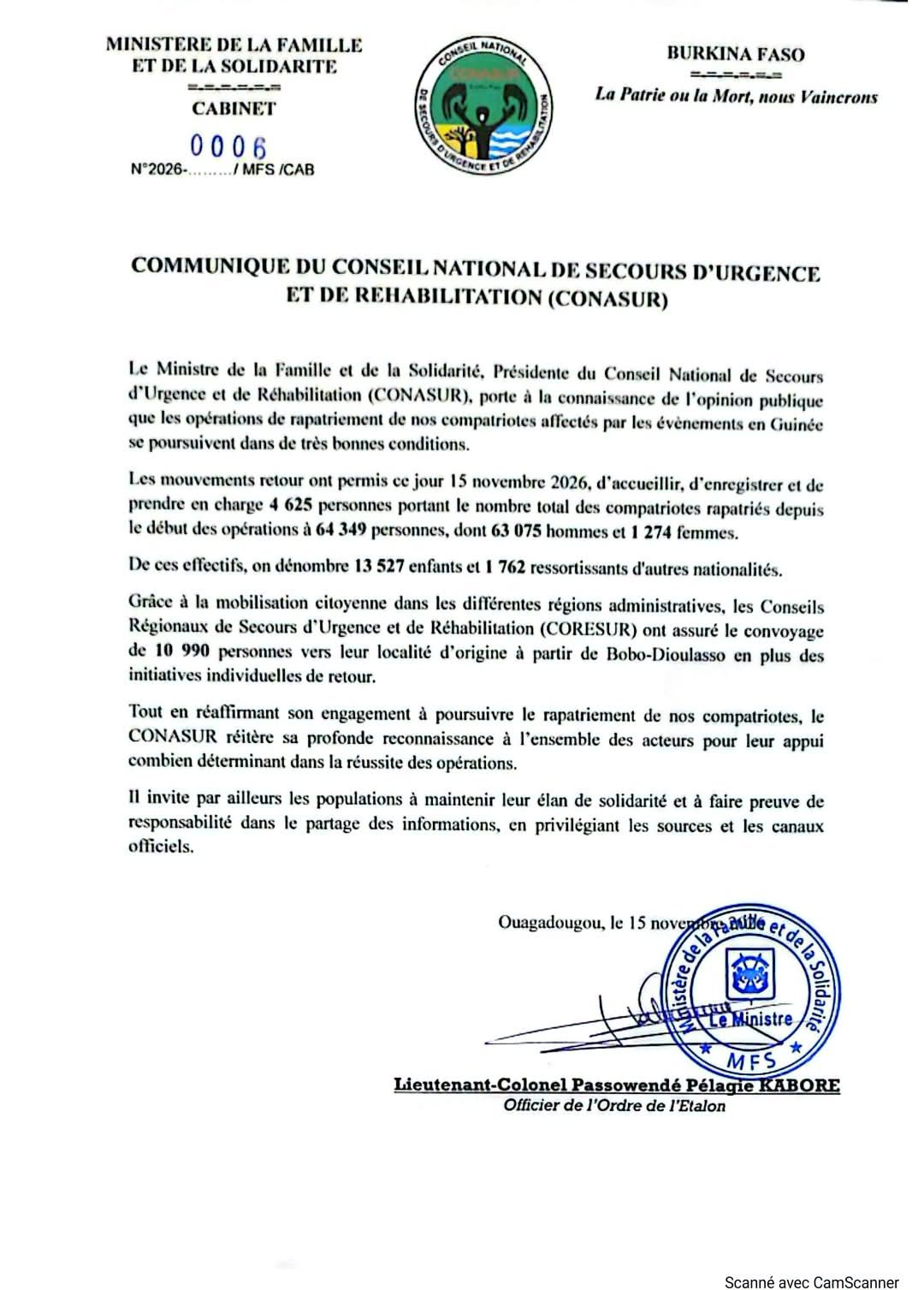
Rapatriement des Burkinabè de Guinée : 4 625 personnes accueillies le 15 novembre 2026
Les opérations de rapatriement des Burkinabè affectés par les événements survenus en Guinée se poursuivent. À la date du 15 novembre 2026, les opérations ont permis d'accueillir, d'enregistrer et de prendre en charge 4 625 personnes, selon un communiqué du Conseil national de secours d'urgence et de réhabilitation (CONASUR). Depuis le début de ces opérations, le bilan global fait état de 64 349 personnes rapatriées, dont 63 075 hommes et 1 274 femmes. Parmi ces personnes figurent également 13 527 enfants et 1 762 ressortissants d'autres nationalités.
Des actions sont menées pour faciliter le retour des personnes rapatriées dans leurs localités d'origine. À ce titre, les Conseils régionaux de secours d'urgence et de réhabilitation (CORESUR), grâce à la mobilisation citoyenne dans les différentes régions administratives, ont assuré le convoyage de 10 990 personnes au départ de Bobo-Dioulasso. Ces déplacements viennent s'ajouter aux initiatives individuelles de retour. Le CONASUR réaffirme son engagement à poursuivre les opérations de rapatriement et exprime sa reconnaissance à l'ensemble des acteurs ayant contribué à leur déroulement.
L'institution appelle par ailleurs les populations à maintenir leur élan de solidarité et à faire preuve de responsabilité dans le partage des informations, en privilégiant les sources et les canaux officiels.
Lefaso.net
Catégories: Afrique
BIZTONSÁG ÉS HATÉKONYSÁG
A HungaroControl több mint kétszáz légiforgalmi irányítója közül a VINCI Airports hálózat részeként üzemelő budapesti Liszt Ferenc Nemzetközi Repülőtér forgalmáért nagyjából negyven fő felel. Nemcsak a repülőtér körüli irányítói körzetben zajló induló és érkező forgalmat menedzselik, hanem a földi munkaterületen zajló tevékenységet is. A közeljövő változást tartogat számukra, de munkahelyük ma még a repülőtér ikonikus irányítótornya.
Fent, a kabinban
Miután képzeletben fellifteztünk az irányítótorony legfelső szintjére, lépjünk be a toronyirányítók birodalmába, a 46 méter magasságban álló, körkörös kilátást biztosító kabinba. A csendes munkakörnyezetben, különböző beosztásokban egy mindössze ötfős csapat dolgozik itt a forgalom biztonságos és hatékony lebonyolításán. A nyilvánosság számára, ha máshonnan nem, a filmekből bizonyára a legismertebb pozíció a toronyirányítóé (ADC – Aerodrome Controller). Ő tartja a repülőgépekkel a kétoldalú rádiókapcsolatot, ő engedi fel a gépeket a futópályára, kiadja a fel- és leszállási engedélyeket és hozzá tartoznak a repülőtéri irányítói körzetben (CTR – Control Zone) átrepülő légijárművek is 3500 láb (1060 méter) magasságig. Ezek lehetnek kisgépek vagy a Liszt Ferenc Nemzetközi Repülőtérről üzemelő rendőrségi helikopterek, de a CTR-t gyakran használják a légimentők Budaörsről induló vagy oda tartó forgószárnyasai is. Utóbbinak éles mentési feladat esetén elsőbbsége van, de ez nem azt jelenti, hogy „csak úgy” átrepülhet, kizárólag a toronyirányító jóváhagyásával és irányításával teheti ezt meg.
Catégories: Biztonságpolitika
Guerre en Ukraine : l'Europe sera-t-elle enfin à la table des négociations?
L'Allemagne, la France, l’Italie, la Pologne et le Royaume-Uni pourraient rejoindre les prochaines négociations entre l’Ukraine et la Russie. C’est, en tout cas, ce qu’assurent les émissaires américains Jared Kushner et Steve Witkoff qui affirment que Vladimir Poutine a donné son accord à la présence des Européens. Mais à Moscou, aucune confirmation pour l’instant. Comment expliquer ces déclarations ? S’agit-il d’une réelle ouverture de la Russie ?
Catégories: Union européenne
Nicéphore Soglo rend grâce à Dieu après son séjour médical à Paris
Après plusieurs semaines passées en France pour des raisons médicales, l'ancien président de la République, Nicéphore Dieudonné Soglo, a regagné le Bénin. Pour marquer ce retour, une messe d'action de grâce a été célébré, jeudi 12 novembre 2026, à la chapelle Notre-Dame de la Miséricorde de la paroisse Saint-Michel de Cotonou.
Nicéphore Soglo est reconnaissant envers Dieu pour sa santé. Il l'a exprimé à travers une messe ayant réuni les membres de sa famille, des personnalités politiques, des sénateurs, des députés, des acteurs de la société civile ainsi que plusieurs proches et amis. Tous sont venus partager avec lui ce moment de prière et de retrouvailles.
L'initiative de cette messe intervient au terme d'une période consacrée aux soins et à la convalescence. Pour l'ancien président de la République, il s'agissait avant tout de témoigner sa reconnaissance à Dieu pour la vie et pour le retour au pays après cette étape de son parcours.
Dans son homélie, l'abbé Modeste Vodounondjègni a mis en avant la portée spirituelle de cette démarche. Le célébrant a invité les fidèles à ne pas oublier de se tourner vers Dieu dans les moments difficiles, mais également à lui rendre grâce lorsque les épreuves sont surmontées.
Il a insisté sur la place de la reconnaissance dans la vie chrétienne. Selon lui, les périodes d'épreuve, notamment celles liées à la santé, peuvent aussi être l'occasion de renforcer sa foi et de mesurer l'importance de la miséricorde divine.

La cérémonie a donné lieu à un important moment de proximité avec l'ancien président. À l'issue de la messe, Nicéphore Soglo, installé devant l'autel, a pris le temps de saluer individuellement les participants venus lui témoigner leur affection et leur soutien.
À travers cette messe, Nicéphore Soglo a choisi de placer son retour sous le signe de la foi et de la gratitude. Une manière pour le patriarche de la vie politique béninoise de célébrer le retour au pays et de confier la suite de son parcours à Dieu.


Catégories: Afrique
China Doesn’t Want a Nuclear Arms Race
America can avert an unnecessary rivalry.
Catégories: Diplomacy & Crisis News
Why Israel Is Losing America
The country must change course—or lose America.
Africa Makes Some Gains but Faces Major Setbacks at COP31
Activists protesting against use of fossil fuels at COP31 in Antalya, Turkey. Credit: Farai Shawn Matiashe/IPS
By Farai Shawn Matiashe
ANTALYA, Türkiye, Nov 16 2026 (IPS)
Today (November 15) marks the second week of negotiations at the United Nations climate summit in the resort city of Antalya, Turkey.
This two-week Conference of the Parties, or COP31, comes as scientists have warned that the world is approaching the 1.5C warming limit set by the Paris Agreement in 2015.
Although scientists measure the target over decades, not individual years, they found that the planet crossed that threshold for the first time over a full year in 2024.
Scientists predict that sustained breach of 1.5°C is now unavoidable, and existing policies could drive warming to 2.8°C this century, increasing the risk of extreme heat, floods and droughts, according to the UN Environment Programme (UNEP).
For the temperatures to fall back below 1.5C, much bigger cuts in emissions and removing large amounts of carbon dioxide from the atmosphere are required.
The latest climate plans would cut global emissions by just 6 percent by 2035 compared with 2019 levels – far short of what is needed, according to the UN’s climate change body.
With negotiations in the Mediterranean country in the second week, Africa made some progress but also lost some critical issues it was pushing.
Africa’s Wins
On the first day of COP31, negotiators from Africa and other developing countries secured a formal place for the Climate Finance Work Programme (CFWP) on the official agenda.
The CFWP matters to African countries because it focuses on scrutinising developed nations’ legal obligations under Article 9.1 of the Paris Agreement to provide public and concessional climate finance to developing countries.
Wealthy nations did not want to establish a dedicated space to discuss climate finance.
For African nations, the CFWP helps press for concrete financial accountability, particularly on pledges such as the $300bn annual climate finance by 2035 agreed at COP29 in Baku, Azerbaijan.
During COP31, the Leaf Coalition, a public-private global initiative designed to halt tropical deforestation by mobilising large-scale financial support for forest-protecting jurisdictions, announced that Ghana would be the first country to access finance for a carbon credit project.
Ghana will get millions of dollars as buyers transact credits. The REDD+ program covers approximately 2.5 million hectares of forest across 10 regions in southern and central Ghana, where forests are under threat from agricultural expansion, illegal logging and mining.
Climate activists have criticised the initiative as a false climate solution and greenwashing, saying it delays actual decarbonisation while allowing high-emitting companies to keep polluting.
Major Setbacks
Africa’s bid to create a dedicated, standalone agenda item for tripling adaptation finance did not make it to this year’s COP agenda after wealthy nations opposed it. This was a tremendous blow to African countries. Parties agreed to triple adaptation finance at COP30 in Belém, with a target year of 2035.
However, the agreement did not settle the critical questions such as scope, baseline, delivery timelines, milestones and accountability arrangements. The African Group of Negotiators (AGN) wanted the issue to be at the centre of COP31. Without clarity on these elements, tripling risks becoming another political promise without a practical mechanism for implementation.
It is unclear what the baseline for the tripling is. If it is tripling from the US$40bn agreed at COP26 in Glasgow, developed countries will triple adaptation finance to US$120bn annually by 2035.
This issue is important because African countries lose an average of 2% to 5% of their Gross Domestic Product (GDP) every year because of climate extremes. Yet governments in Africa spend up to 9% of their annual budgets on unplanned disaster relief and climate response.
Now, Africa is pushing for adaptation finance to be discussed under the Global Goal on Adaptation (GGA). Anchoring tripling of adaptation finance in the GGA discussions would ensure that finance is driving clear implementation, including addressing the growing adaptation needs of developing countries, strengthening climate resilience and improving access to finance.
Another setback for Africa is the Belém Action Mechanism (BAM) – a global climate mechanism established to guide, coordinate, and support a just transition for workers, unions, and vulnerable communities as the world shifts to a low-carbon economy. It was a big win for the continent at COP30 in Belém, Brazil.
Parties should agree on its operational details at COP31.
The latest draft negotiating text on BAM does not show that it can deliver practical support for just transitions. Wealthy nations want the already overstretched UN climate secretariat and external institutions, including development banks, to take responsibility. Africa does not want another bureaucratic process.
IPS UN Bureau Report
Related Articles
Catégories: Africa
Les numéros qui ont fait des heureux à 08 H
DIGITAL 08H : Avez-vous tenté votre chance ?
Le tirage DIGITAL 08H N°364 a livré son verdict !
Lundi 16 Novembre 2026
Avez-vous joué ?
Avez-vous misé sur vos numéros porte-bonheur ?
RÉSULTAT : 04 • 18 • 80 • 16 • 15
Félicitations aux heureux gagnants !
Pas encore gagné ? Gardez le sourire !
Rendez-vous au prochain tirage de 11H pour une nouvelle chance.
Jouez dans nos centres de jeux ou en ligne : Tapez 590# ou lnbloto.bj
Jouez avec modération et responsabilité. Le jeu doit rester un plaisir.
A TOI DE JOUER #Akaxòa
#LNBSA #XòGbɔnAlɔkpaVo #JeuResponsable #LaChanceAvecModération
LA CROIX DU JOUR

Catégories: Afrique
Décès de DIANOU DAYÉRI DANNY DIEUDONNÉ : Remerciements
« Un père est un phare éternel, son amour est une lumière qui ne s'éteint jamais »
Repose en paix papa chéri !
Repose en paix papa chéri !
Reo<
Jérémie 31 : 13 « Je changerai leur deuil en allégresse et je les consolerai, je leur donnerai de la joie après leurs chagrins ».
Le Chef de Banikidi ;
La Grande Famille DIANOU à Banikidi, Bogandé, Tambiri, Gayéri, Ouagadougou, Paris et Givet ;
La Grande Famille TOGUIYENI à Louargou, Tiankiaka et Fada ;
Les Familles alliées GUITANGA, TINDANO, YARGA, LANKOANDÉ, KIEMA, ZAGRÉ, SANOU, OUÔBA, OUALI, SININY, TENKOANO, BOURGOU, KASSÉRI, GUIBOUGOU, MANO, HARO, GNINGUILGOU, TINTO, KENNEDY, DAH et YAMEOGO ;
La veuve DIANOU née TOGUIYÉNI Célestine ;
Les enfants et les petits enfants ;
Vous renouvellent leurs sincères remerciements et leur profonde gratitude pour les nombreuses marques d'amitié, de sympathie, de compassion et les soutiens multiformes (spirituel, moral, matériel et financier) lors des Funérailles Chrétiennes le Vendredi 06 et le Samedi 07 Novembre 2026 à Ouagadougou de notre époux, père, grand-père, frère, cousin, oncle, beau-père ;
DIANOU DAYÉRI DANNY DIEUDONNÉ,
Précédemment professeur certifié des lycées et collèges à la retraite.
Votre présence bienveillante à nos côtés lors de ce douloureux évènement nous a apporté force, consolation et réconfort.
Les remerciements vont à l'endroit :
Des Autorités administratives, politiques, religieuses et coutumières ;
De la paroisse Saint Jean-Marie Vianney de Tampouy ;
De la CCB Sainte Thérèse de l'enfant Jésus ;
De la CCB Saint Joseph ;
Des anciens élèves Officiers du Prytanée Militaire du Kadiogo ;
Des parents, amis et connaissances des familles ;
Des voisins du quartier ;
Des collègues et partenaires professionnels des membres de la famille ;
De tous ceux qui, de près ou de loin, se sont associés à cette douloureuse épreuve.
Que le Seigneur dans sa grande miséricorde rende à chacun de vous le centuple de ses bienfaits et protège vos familles !
Union de prière pour le repos de son âme !
Catégories: Afrique
ROME BRÛLE
17 novembre 1892. Abomey tombe. En début d'après-midi, la colonne expéditionnaire entre dans la cité royale ravagée en partie par le feu. La longue file de légionnaires blancs, de tirailleurs casamançais, gabonnais, haoussa et de porteurs hollis atteint l'esplanade du palais de Singbodji. Le drapeau tricolore est hissé sur le bâtiment à étage encore fumant. Le clairon tonne.
Le Général Dodds, malmené par un paludisme, n'a pas pu faire l'entrée théâtrale à cheval dont il rêvait. Qu'à cela ne tienne, il a encore assez de force pour prononcer d'une voix chevrotante, la déchéance de l'ennemi si redouté. Behanzin, désormais le maquis, tente de changer la nature du conflit. "Ouanilo Gbêhanzin, prince de Djimè." Disponible en librairie.
Tiburce
Catégories: Afrique
L'Ukraine frappe le pont reliant la Russie à la Crimée annexée par Moscou
L'Ukraine a « frappé » le pont reliant la Russie à la péninsule de Crimée annexée par Moscou en 2014, restreignant la circulation sur cet ouvrage stratégique, a annoncé lundi 16 novembre le chef des autorités locales nommé par Moscou.
Catégories: Union européenne
Des candidats au parcours VAE soutiennent leurs dossiers de preuves à la CCI Bénin
Cinq professionnels ayant suivi le parcours de Validation des Acquis de l'Expérience (VAE), mis en œuvre par l'IRAE-CCI Bénin (Institut spécialisé de la CCI Bénin pour l'accompagnement entrepreneurial), ont soutenu leurs dossiers de preuves, vendredi 13 novembre 2026. L'étape de soutenance marque l'aboutissement d'un processus destiné à faire reconnaître officiellement les compétences acquises au cours de leur expérience professionnelle.
Mis en œuvre en collaboration avec Smart Campus Dijon dans le cadre de l'accord de partenariat entre la CCI Bénin et son homologue de la métropole de Bourgogne, le programme VAE vise à offrir aux professionnels des entreprises, la possibilité de faire valider leurs compétences et leur savoir-faire, développés au fil des années en entreprise, en vue de l'obtention d'un diplôme.
Selon Hyppolite CAPO CHICHI, Vice-Président de la Commission Formation de la CCI Bénin, représentant le Président du Conseil Pédagogique de l'IRAE-CCI Bénin, la Validation des acquis de l'expérience est un dispositif de certification destiné aux personnes qui maîtrisent un métier grâce à leur parcours professionnel, mais qui ne disposent pas nécessairement d'un diplôme correspondant à leurs compétences. « C'est un parcours de diplôme qui permet à des professionnels qui ont acquis de l'expérience dans leur vie professionnelle de pouvoir la faire reconnaître officiellement et d'être certifiés ou diplômés », a-t-il expliqué. Il considère cette démarche comme un moyen de valoriser le capital humain des entreprises, en donnant une reconnaissance formelle aux compétences de leurs collaborateurs.

Les cinq candidats de la promotion 2026 ont ainsi présenté leurs preuves afin de démontrer leur maîtrise des métiers qu'ils exercent. À l'issue du processus, le diplôme qui leur sera délivré sera un diplôme français, a précisé le Vice-Président de la Commission.
Le Président du jury, Olivier DALLA PIAZZA, directeur de SmartCampus Dijon, a indiqué que l'évaluation des candidats repose principalement sur leurs compétences professionnelles. Le jury prend également en considération leur aptitude à fédérer des équipes, à conduire des projets en entreprise, à s'approprier les valeurs de leur organisation et à contribuer à son développement économique.
Parmi les candidats, figure Roméo SETON, chargé des affaires cash management dans une banque. Après quinze années d'expériences professionnelles dans différents établissements bancaires et à plusieurs postes de responsabilité, il a présenté des éléments de preuves retraçant les compétences et les connaissances acquises au cours de son parcours pour le diplôme de Bachelor Responsable Développement Commercial (RDC).
Satisfait de cette expérience, il a salué le sérieux du dispositif ainsi que la qualité de l'accompagnement dont il a bénéficié tout au long du processus, notamment pour la préparation et la mise en cohérence des éléments de preuves avec les blocs de compétences du référentiel RDC. Il a également exprimé sa reconnaissance à l'Institut pour le Renforcement et l'Accompagnement Entrepreneurial (IARE) de la CCI Bénin et à SmartCAMPUS de Dijon (France) pour leur soutien durant le parcours.
Pour Roméo SETON, la VAE constitue une opportunité de valoriser ses compétences acquises par l'expérience et de retrouver une nouvelle dynamique dans son travail avec plus de confiance dans sa carrière.
À travers la VAE, la CCI Bénin entend contribuer à la reconnaissance des compétences professionnelles, tout en favorisant le développement du capital humain et le renforcement des performances des entreprises.
F. A. A.
Catégories: Afrique
Dans « L’Hospitalité », le philosophe Souleymane Bachir Diagne rappelle le devoir d’accueillir, contre l’« idéologie anti-empathie »
S’opposant au repli identitaire, le philosophe fait l’éloge de l’hospitalité et esquisse une politique de l’empathie.
Catégories: Afrique
Pages


© 2012-2018 Europa Varietas Foundation © 2015-2018 Europa Varietas Association
www.europavarietas.org | info(@)europavarietas(dot)org | Switzerland
We are looking for sponsors for the English translation of these books, please contact turkeandras(at)gmail(dot)com