
You are here
Feed aggregator
Cette année Moov Africa vous embarque pour des Vacances Manvo Manvo du 22 juin au 16 août
Categories: Afrique
Orientations de la coopération franco-coréenne pour la formation des personnels des sous-marins à propulsion nucléaire
À télécharger
Cette note a été initialement publiée en anglais sur le site du Sejong Institute sous la forme d’un Sejong Focus le 21 juillet 2026. Elle fait suite à la note IRIS du même auteur en date du 1er juillet 2026 et sa proposition de développer une « Coopération franco-coréenne pour la construction du sous-marin à propulsion nucléaire (SNA) sud- coréen ». Elle propose également de renforcer la coopération bilatérale entre la France et la Corée du Sud dans le cadre du futur programme de SNA en abordant la question de la formation du personnel sud-coréen navigant et technique destinée à servir dans le cadre de ce programme très important pour Séoul.
Ces deux papiers complémentaires s’inscrivent dans la perspective de la visite du président sud-coréen Lee Jae-myung en France les 7 et 8 septembre 2026 avec le souhait d’approfondir la coopération stratégique entre les deux pays dans un domaine structurant.
L’article Orientations de la coopération franco-coréenne pour la formation des personnels des sous-marins à propulsion nucléaire est apparu en premier sur IRIS.
Categories: Diplomacy & Defense Think Tank News
Gabon : Libreville sous état d'urgence hydrique depuis plus d'un mois
À Libreville, la capitale gabonaise, l'eau se fait rare. Alors que le gouvernement a décrété l'état d'urgence hydrique depuis un mois avec une promesse de distribution d'eau dans les zones touchées, le précieux liquide se paye toujours au prix fort. Chaque jour, des milliers de familles se livrent une bataille pour quelques litres.
Categories: Afrique
Félix Tshisekedi, 30 jours sur les routes du Congo : les coulisses d'une campagne marathon
En trente jours de campagne électorale, le président-candidat a multiplié les déplacements, les meetings et les discours à travers un territoire vaste comme l'Europe de l'Ouest.
Categories: Afrique, European Union
Israel is knocking off Iranian leadership with a quickness while we're trying to negotiate an end to the war. MAKE IT MAKE SENSE!!!!
If you're paying attention to the war in Iran (and many Americans ain't) then you heard that Israel hit the Islamic Republic's leadership while they were attempting to elect a new Ayatollah.
Meanwhile Trump was trying to push forward on another negotiated settlement to the war.
MAKE IT MAKE SENSE!
How can we expect a country to negotiate an end to hostilities if we (the US & Israel) keep knocking off their leaders?
You can't!
You can't negotiate with yourself and unless the other side has leaders then that is what you're in essence doing!
To add a twist to this mystery, Trump was promising devastating strikes to Iran's energy producing sector!
All while supposedly pushing said peace plan.
Someone explain it to me. I just don't understand the thinking here. What I do know is that the "Art Of The Deal" does not translate to the international stage.
Another thing.
I'm all for optimism. Optimism is good. But entering into somethings you need more than optimism. You need plans readily available if sugar turns to shit.
This war turned to shit and its obvious that our planning is/was lacking. We apparently only planned for best case scenarios and now that that is out the door we're in a hurtlocker.
Last thing.
We have had several cautionary tales about "allied" warfare. This is the most stark in my lifetime.
If allies are not united in goals and how those goals are to be accomplished, and if we're not willing to shoulder the entire war solo then the war should not be fought.
Categories: Defence`s Feeds

A Saudi-Emirati Thaw Can Help Contain Iran
The Gulf needs a joint front on deterrence, engagement, and freedom of navigation.
Categories: Diplomacy & Crisis News
Crise migratoire: «L'extrême droite se nourrit de cette actualité pour se développer»
L'afflux de dizaines de milliers de migrants dans l'enclave espagnole de Ceuta a fait réagir la droite européenne sur les contrôles aux frontières et soulève des questions sur l'attitude des autorités marocaines. L'Italie a annoncé ne plus appliquer, provisoirement, les règles de l'espace Schengen vis-à-vis de l'Espagne, et les ministres de l'Intérieur des pays de l'UE échangeront, mardi 4 août, en visioconférence sur la crise migratoire et les tensions diplomatiques qui ont suivi. Benjamin Biard, chargé de recherche au Centre de recherche et d'information socio-politiques à Bruxelles et enseignant à l’Université catholique de Louvain, livre son analyse.
Categories: Union européenne
We're making squad "gear" carriers unmanned vehicles too hard a nut to crack
Why are we making unmanned squad "gear" carriers so hard? The above video shows a commercial model being marketed on Instagram to HOMEOWNERS and corporations to carry/move stuff from area to area. Yeah it operates off a playstation controller (just like freaking NMESIS) so its not ideal but what happened to rapid prototyping and getting stuff out to the troops to test~!
It ain't that hard we did it during the 50's with no fanfare. We even put several models of different systems into active duty and retired it shortly thereafter.
If China IS the big threat then we need to walk/run/sprint with haste. Get out of the legacy procurement cycle and charge forward.
Our troops aren't the problem.
The problem is our BUREAUCRACY!
The problem is the military industrial complex~~!
Either we fix both with a quickness or a leadership more interested in protecting itself AND making money will have us losing another war!~
Categories: Defence`s Feeds
« Mettre le feu, c’est le moyen le plus rapide d’être renvoyé chez soi » : au Kenya, le système des internats au bord de l’implosion
Au début du mois de juin, le ministère de l’éducation kényan recensait 204 établissements touchés par des dégradations de la part d’élèves scolarisés. Ces derniers déplorent des conditions de vie trop strictes, des infrastructures vétustes et des punitions physiques. Fin mai, 16 pensionnaires sont morts dans l’incendie de leur dortoir.
Categories: Afrique
Ituri : des agents de la riposte Ebola manifestent à Mongbwalu pour réclamer trois mois d’arriérés de salaires
Des infirmiers, personnel d’entretien et autres agents de santé engagés contre la maladie à virus Ebola, ont protesté ce lundi 3 août à l'Hôpital général de référence de Mongbwalu en territoire de Djugu en Ituri. Ils réclament le paiement de leurs salaires des mois de mai, juin et juillet.
Categories: Afrique
« Je n’ai pas le profil d’une prise de guerre, je trace ma route » : le pari de Xavier Bertrand pour s’imposer comme candidat de la droite et du centre
RÉCIT - Alors que certains espèrent son ralliement, le président de Nous France se laisse jusqu’à la fin de l’année pour « tester ses idées » et s’imposer dans la campagne présidentielle.
Categories: France
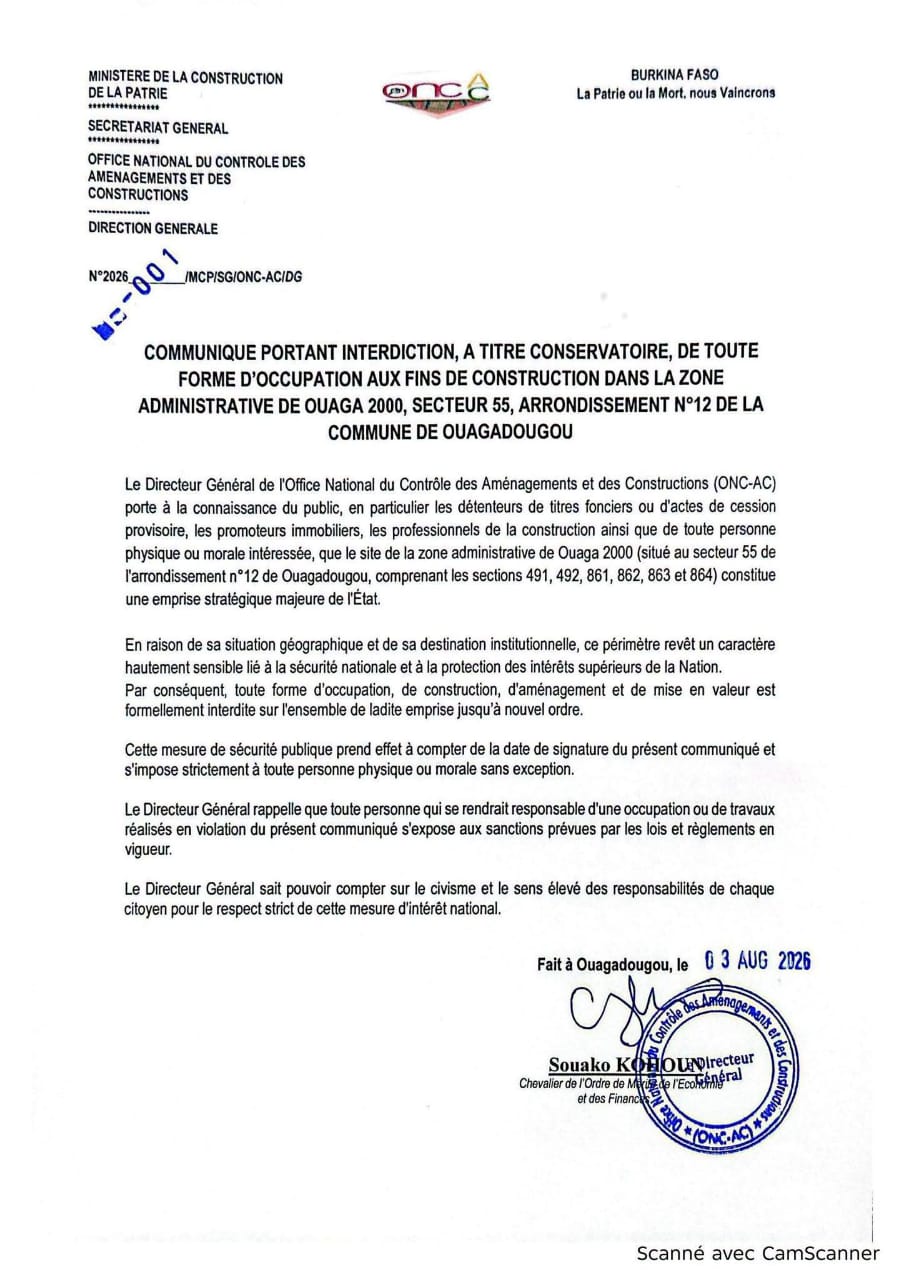
Zone administrative de Ouaga 2000 : Interdiction formelle d'occupation, construction, aménagement et de mise en valeur jusqu'à nouvel ordre
Le ministère de la construction de la patrie informe le public que le site de la zone administrative de Ouaga 2000 (situé au secteur N°55, dans l'arrondissement N°12 de Ouagadougou et comprenant les sections 491, 492, 861, 862, 863 et 864) constitue une emprise stratégique majeure de l'Etat. De ce fait, toute forme d'occupation, de construction, d'aménagement et de mise en valeur est formellement interdite jusqu'à nouvel ordre. Plus de détails dans le communiqué signé du 3 août 2026 et ci-joint.
Lefaso.net
Categories: Afrique
Côte d’ivoire : la fête des générations en pays Ebrié
Au cœur du village de Blokoss, à Abidjan, en Côte d'Ivoire, une tradition ancestrale continue de faire vivre l'identité du peuple Atchan. À l'occasion de la Fête des Générations, les Ébriés célèbrent le passage de témoin entre les différentes classes d'âge, perpétuant un héritage culturel qui résiste au temps et à l'urbanisation grandissante de la capitale.
Categories: Afrique
Afrique : Plus de la moitié des cyber-attaques reposent désormais sur l'IA
L'intelligence artificielle est désormais impliquée dans 55 % des cyber-crimes signalés en Afrique, où elle accélère et industrialise les attaques numériques, selon le rapport d'évaluation des cybermenaces en Afrique 2026 rendu public ce lundi 3 août 2026 par INTERPOL (Organisation internationale de la police criminelle).
En clair, plus d'une cyber-attaque sur deux recensée en Afrique repose désormais sur l'intelligence artificielle, révèle INTERPOL, qui précise que le rapport s'appuie sur des données d'enquêtes provenant de 36 pays membres africains. « La sextorsion numérique et le harcèlement en ligne, souvent facilités par des deepfakes générés par l'IA et des médias synthétiques, sont restés omniprésents, avec environ 600 000 détections de sextorsion enregistrées par TrendAI, l'un des nombreux partenaires travaillant avec INTERPOL.
De même, la sophistication des schémas de compromission des e-mails professionnels (BEC) a considérablement augmenté, l'IA étant utilisée pour générer une correspondance par e-mail très convaincante, les acteurs malveillants basés en Afrique ciblant les victimes en Europe et en Amérique du Nord via des infrastructures réparties dans plusieurs juridictions. Le rapport révèle que l'absence de partage de données inter-agences en temps réel entre banques, télécoms et forces de l'ordre crée un angle mort dangereux dans les efforts de lutte contre la fraude financière.
Cette vulnérabilité est exploitée par des criminels qui sont allés au-delà du simple vol de références existantes pour créer des identités entièrement synthétiques. En combinant des données personnelles réelles avec des éléments fabriqués, ces personages numériques générés par IA peuvent contourner même les systèmes avancés de vérification biométrique et ont été utilisés pour ouvrir des comptes bancaires, sécuriser des prêts mobiles et enregistrer des cartes SIM sous de faux noms », détaille l'organisation internationale de la police criminelle, INTERPOL.
L'Afrique de l'Est est, selon l'enquête, devenue un centre de fraude à l'argent mobile et de ransomwares ciblant les infrastructures. Les arnaques de compromission par email et de romance pour entreprises, ciblant à la fois des victimes d'entreprises et individuelles, étaient très fréquentes en Afrique centrale et ouest, révèle INTERPOL, ajoutant que la connectivité ultra-élevée de l'Afrique australe en fait un aimant pour les acteurs de menace mondiaux cherchant un maximum de perturbations.
« Le coût financier de la cyber-criminalité en Afrique est important. Depuis 2024, les pertes liées à la cyber-criminalité ont plus que doublé, passant de 192 millions à 484 millions USD, principalement grâce aux arnaques facilitées par l'IA, à la collecte de diplômes et aux campagnes d'ingénierie sociale automatisée. Selon le rapport, en 2025, les arnaques en ligne ont continué d'être le type de cybercriminalité le plus signalé, les attaquants exploitant les plateformes d'argent mobile, les réseaux sociaux et l'IA pour atteindre leurs cibles. Notamment, 72 % des pays interrogés ont signalé la présence de centres frauduleux, avec la plus forte concentration en Afrique australe et ouest », présente le rapport.
A en croire l'organisation, la cybercriminalité est devenue l'une des menaces criminelles les plus importantes pour la région et l'IA automatise chaque étape d'une cyber-attaque, de la reconnaissance et du phishing à l'extorsion et à l'évasion.
Le rapport recommande des capacités standardisées en criminalistique numérique, une coopération transfrontalière renforcée, l'investissement dans la littératie IA parmi les forces de l'ordre et un partenariat formel-public-privé pour soutenir une prévention, une détection et une réponse efficaces.
Lefaso.net
Categories: Afrique
Ceuta : anatomie d’une crise
Les 30 et 31 juillet, un afflux important de migrants est entré dans l’enclave espagnole de Ceuta. Environ 50 000 à 60 000 personnes, majoritairement des hommes, dont de nombreux mineurs, ont traversé la frontière à la nage depuis la ville de Fnideq. Cet afflux d’une ampleur inédite a provoqué une crise humanitaire et diplomatique. Si la situation a été maîtrisée rapidement et que la majorité des personnes ont été reconduites au Maroc, plusieurs personnes ont perdu la vie lors de cette traversée. Située sur le continent africain, à la frontière avec le Maroc et à une quinzaine de kilomètres des côtes espagnoles, Ceuta est un territoire sous souveraineté espagnole, mais revendiquée par le Maroc. Cette situation réanime le débat autour de l’enclave et des relations entre l’Espagne et le Maroc.
Le Premier ministre espagnol, Pedro Sánchez, a été critiqué pour son manque de communication face à cette crise et certains pays européens, comme l’Italie et le Danemark, sont même allés jusqu’à remettre en question les accords de Schengen sur la libre circulation des personnes. Ces prises de position interrogent sur la solidarité européenne pourtant prônée par ces pays sur les questions des gestions des migrations. L’Espagne cherche à préserver ses relations diplomatiques avec le Maroc, les deux pays ayant signé un traité d’« amitié, de bon voisinage et de coopération » en 1991. De même, cette volonté de maintenir le dialogue est importante puisque l’Espagne, le Maroc et le Portugal organiseront conjointement la Coupe du monde de football masculine en 2030.
Comment expliquer l’afflux d’un aussi grand nombre de personnes vers l’enclave de Ceuta ? En quoi cette crise révèle-t-elle des difficultés plus profondes de la société marocaine ? Dans quelle mesure cette situation peut-elle affecter les relations entre l’Espagne et le Maroc ?
L’article Ceuta : anatomie d’une crise est apparu en premier sur IRIS.
Categories: Diplomacy & Defense Think Tank News
Xi Jinping’s AI Vision
Xi’s speech addressed the attendees at the World Artificial Intelligence Conference, but his real audience was the international community, and of course the United States.
Categories: Diplomacy & Crisis News
Ein harter Schlag gegen die Schattenflotte
Sie ist die Lebensader der russischen Wirtschaft: die Schattenflotte, mit der das russische Regime sein Rohöl in die Abnehmerländer exportiert. Doch im Moment ist diese Flotte geschwächt. Von der Ukraine werden ihre Tanker beschossen und zerstört, von immer mehr europäischen Ländern bei der Durchfahrt durch Nord- und Ostsee aufgehalten. Und dabei ginge noch mehr.
Categories: Diplomacy & Defense Think Tank News
Protokoll - Mittwoch, 3. Juni 2026 - Donnerstag, 4. Juni 2026 - PE789.973v01-00 - Ausschuss für Sicherheit und Verteidigung
Quelle : © Europäische Union, 2026 - EP
Categories: Europäische Union
Pages



© 2012-2018 Europa Varietas Foundation © 2015-2018 Europa Varietas Association
www.europavarietas.org | info(@)europavarietas(dot)org | Switzerland




We are looking for sponsors for the English translation of these books, please contact turkeandras(at)gmail(dot)com