
You are here
Feed aggregator
Statement on Hong Kong Alliance guilty verdicts
"The Australian Government is deeply concerned by the guilty verdicts handed down today in Hong Kong to Ms Chow Hang-tung and Mr Lee Cheuk-yan, former leaders of the Hong Kong Alliance in Support of Patriotic Democratic Movements of China."
Categories: Defence`s Feeds
Hong Kong: Statement by the Spokesperson on the verdict in the 'Hong Kong Alliance' case
The conviction under the National Security Law of the Hong Kong Alliance in Support of Patriotic Democratic Movements of China and two of its former leaders, Lee Cheuk-yan and Chow Hang-tung, on 21 August confirms the continuing deterioration of the freedoms of expression and assembly and a further shrinking of the space for independent civil society in Hong Kong. A third defendant, former lawmaker Albert Ho, had pleaded guilty in January.
Categories: Defence`s Feeds
Joint Statement by the spokespeople for the Foreign Ministries of France and Germany concerning the verdict against Chow Hang-tung, recipient of the Franco-German Human Rights Award in 2023
No description
Categories: Defence`s Feeds
Response to the Hong Kong Alliance leaders' national security law verdict
FCDO Indo-Pacific Minister Baroness Winterton of Doncaster responds to the guilty verdict against Lee Cheuk-yan and Chow Hang-tung in Hong Kong.
Categories: Defence`s Feeds
'Hong Kong Alliance' found guilty of inciting subversion; verdict clarifies boundaries between free speech and national security
The anti-China group "Hong Kong Alliance in Support of Patriotic Democratic Movements of China", along with its former chairman and vice-chairpersons Lee Cheuk-yan, Albert Ho Chun-yan and Chow Hang-tung, were charged with inciting others to subvert state power and have been remanded in custody since then. The local court in Hong Kong found two defendants guilty on Friday, and Ho pleaded guilty before the trial began, local media reported.
Categories: Defence`s Feeds
NORFORCE heads into Canadian wilderness
North-West Mobile Force (NORFORCE) soldiers are preparing for a unique international deployment that will see them travel halfway around the world to train alongside the Canadian Rangers in some of North America's most remote wilderness.
Categories: Defence`s Feeds
New White House Helipad Shown Off to Reporters Ahead of Completion
President Trump toured the ornate, granite helipad under construction on the White House South Lawn with reporters, adding his signature to a piece of the stonework that could see use as soon as next month.
Commissioned following the long, highly publicized drama of the new VH-92A Patriot helicopters being unable to land at the White House without scorching the manicured grass lawn, the new helipad will be used for all helicopter movements in and out of the President’s official residence as well as for hosting events and press conferences.
It is constructed of four inch thick Californian granite and inlaid with the Presidential seal. The $5-6 million bill is reportedly being funded by Sikorsky, who manufactures the VH-92 aircraft, alongside personal donations including from President Trump.
President Trump on new White House helipad. pic.twitter.com/X1611DW4yc
— CSPAN (@cspan) August 19, 2026
“This is a helipad at the highest level. It can land any helicopter in the world, no matter how big, no matter how powerful, no matter how strong,” the President told reporters. Presumably, this means it could also accommodate the V-22 Osprey, as flown in a support role by HMX-1. The Osprey is also well known for its hot exhaust causing scorch marks and even fires on grass landing sites, and its particularly strong downdraft has destroyed less substantial helipads. While HMX-1’s V-22s do not carry the President, the ability for the type and those like it to land safely at the White House is arguably a good contingency measure for emergency scenarios.
Construction workers wait on the new helipad for President Trump to tour the new site which is under construction on the South Lawn of the White House. @POTUS pic.twitter.com/dhDMTiC5QZ
— Doug Mills (@dougmillsnyt) August 19, 2026
Used for decades to land the legacy fleet of HMX-1 helicopters and their predecessors, the White House’s South Lawn has seen a wide variety of occasions through the years. Frequently used for ceremonial occasions, most recently it controversially hosted a massive, temporary stage for the UFC Freedom 250 event. This was widely accused of causing significant damage to the lawn, though as we now know this was partially mitigated by plans for the helipad’s construction immediately afterwards. Off to the sides of the South Lawn are Presidential amenities, including a putting green, tennis courts, and swimming pool.
The grass is usually protected from damage by circular aluminium panels that could be placed on the grass ahead of a helicopter’s arrival. The skilled pilots of HMX-1 would then land the helicopter on these red dots, so that the landing gear did not damage the turf or – in wetter weather – sink into the ground.
President Barack Obama and First Lady Michelle Obama arrive on the South Lawn of the White House following their trip to Fort Bragg, N.C., Dec. 14, 2011. | Source: Official White House Photo by Chuck Kennedy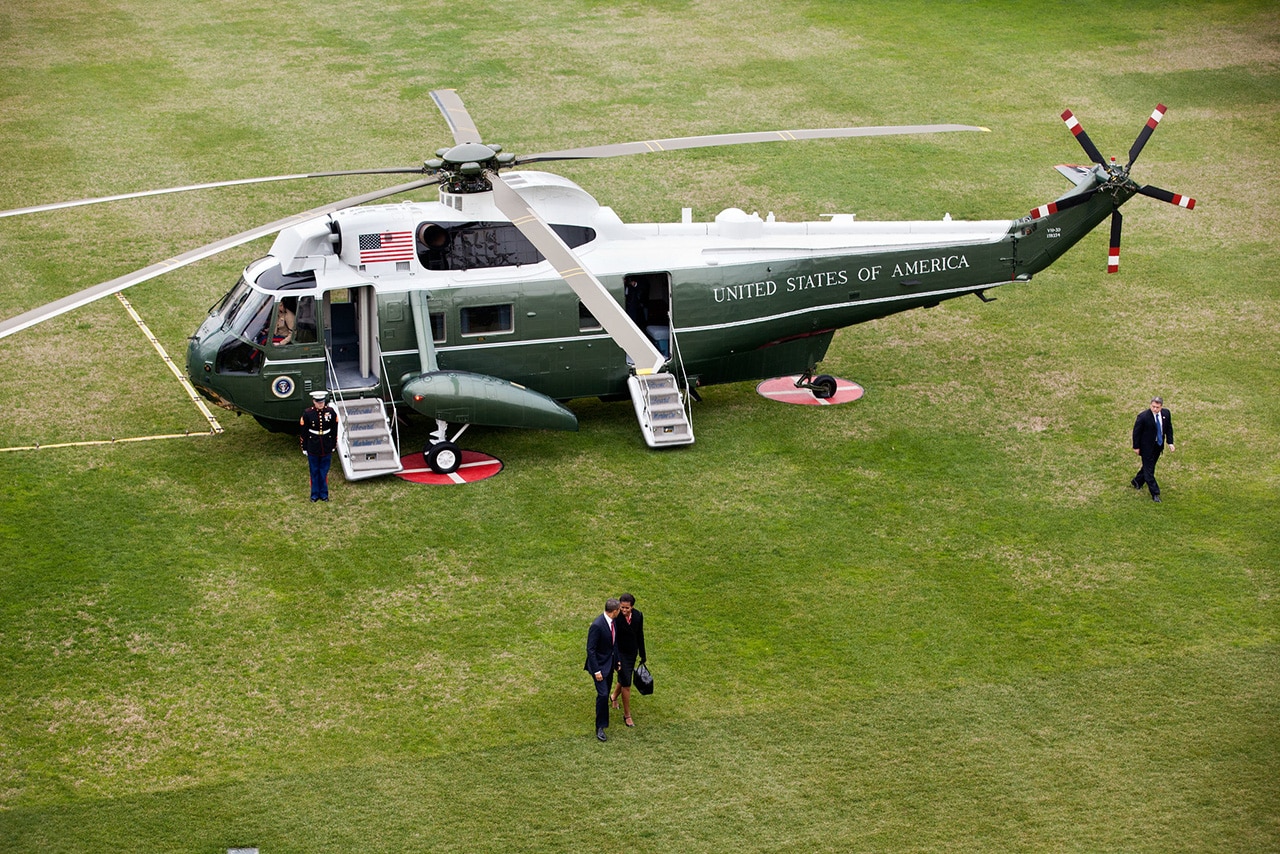
Heat damage is a newer concern, caused by the VH-92’s exhaust gases from the main engines and the auxiliary power unit (APU). While the VH-92 commenced Presidential service during President Biden’s term in office, this issue meant that helicopter transport to and from the White House itself was still primarily handled by the VH-3D Sea King and VH-60N White Hawk.
Completion of the new helipad could be achieved as soon as next month, ahead of Chinese President Xi Jinping’s visit to the White House on Sept. 24. Construction was apparently delayed after initial construction began when President Trump pushed for a redesign that involved additional ground work.
Exclusive: President Trump has directed contractors to redo weeks of work on his planned White House helipad, according to people who spoke on the condition of anonymity.
Trump has made the helipad a priority, but was dissatisfied with the results. https://t.co/Tu3Qv4DvR8 pic.twitter.com/cZC1htx0hd
— The Washington Post (@washingtonpost) August 5, 2026
Trump claims that attempts to build a dedicated helipad at the White House had been made for decades but had not made progress until now. Most Presidents assume a role closer to a caretaker when occupying the White House, and are reluctant to make significant permanent changes to the structure or the grounds unless absolutely necessary. President Trump, however – at least in his current, second term – has appeared to feel much less bound to such traditions.
WASHINGTON (AP) — The entire White House East Wing has been demolished as Trump moves forward with ballroom construction, AP photos show.
AP Photo/Jacquelyn Martin pic.twitter.com/MzV00mTN2V
— philip lewis (@Phil_Lewis_) October 23, 2025
With the covering over of the famous Rose Garden early in his term, as well as the complete demolition of the White House’s East Wing in favor of a lavish, controversial new ballroom (and, underneath, a new Presidential bunker), the addition of a granite helipad is certain to be one of the less unpopular changes. As Trump remarked of the solid stone pad, “this will be here long after we’re gone, no matter what happens with the world, this is not moving.”
Categories: Defence`s Feeds
Nepal’s Tibet Conference Controversy Is About More Than Chinese Pressure
The cancellation of the in-person event also reflects Nepal’s lack of confidence in its ability to manage politically sensitive events.
Categories: Diplomacy & Crisis News
Moins de sel, de sucre et de colorants... la grande distribution promet des recettes plus saines
De nombreuses enseignes de la grande distribution en France disent œuvrer à proposer des recettes plus saines pour leurs marques de distributeurs, en vogue en période d'inflation car moins chères. Une bonne nouvelle pour nos assiettes ou de simples coups de communication ?
Categories: France
The inside story of how Trabzonspor pulled off Salah deal
Mohamed Salah was expected to move to Saudi Arabia or the United States after leaving Liverpool, but Turkish side Trabzonspor pulled off one of the coups of the transfer window.
Categories: Africa
What Asia’s Industrialization Lessons Can Teach Fragmented States
Political differences do not have to disappear before economic interdependence can deepen.
Categories: Diplomacy & Crisis News
New Emergency Care Skills Help Tanzania’s Frontline Doctors Save Lives
Traffic police take statements from road crash victims at a health facility in Morogoro Region, Tanzania. The country's Basic Emergency Care (BEC) programme is strengthening the capacity of frontline health workers to provide life-saving treatment during the critical moments following serious injuries. Credit: Muhidin Issa Michuzi
By Kizito Makoye
DAR ES SALAAM, Tanzania, Aug 21 2026 (IPS)
The 14-year-old girl arrived at the hospital fighting for her life. After a tragic hit-and-run car accident, she was rushed into the emergency department with serious abdominal injuries. Every passing minute brought her closer to death.
“There was internal bleeding,” recalls Dr Iddi Muhammad Juma, a surgeon at Tanzania’s Same District Hospital. “We performed an ultrasound and took her to theatre immediately,” he tells IPS.
When surgeons opened her abdomen, they found a ruptured spleen floating inside the abdominal cavity.
Applying the structured emergency approach taught in the World Health Organisation’s Basic Emergency Care course, the team stopped the bleeding and removed the ruptured spleen. The girl survived.
For Juma, the case illustrates how a systematic response to an emergency saves lives.
“If we had delayed, she could have died. Because of the BEC training, we acted quickly to save her life,” he says.
His experience highlights changes across Tanzania as the government improves emergency care in rural hospitals to save the lives of the injured and critically ill patients.
Tanzania has expanded access to healthcare over the past two decades, but emergency care remains weak. Many district hospitals lack trained staff, equipment and essential supplies, while clinicians — especially in rural areas where patients often travel hours for treatment — have had little practical training in rapidly assessing and handling life-threatening emergencies with limited resources.
To address the problem, the Ministry of Health, in partnership with the Emergency Medicine Association of Tanzania (EMAT) with support from WHO, has launched the Accelerating Community and Transformative Learning for Basic Emergency Care (ACTxBEC) initiative to train health workers in 250 hospitals countrywide to manage medical emergencies using evidence-based practices designed for resource-limited settings.
Michael Kiremeji, an official at the Ministry of Health, says the initiative aims to strengthen emergency and critical care at district hospitals where most patients first seek treatment.
“We want to ensure that timely and quality life-saving emergency care is accessible to every patient regardless of where they live,” he tells IPS
He says many deaths and disabilities caused by trauma, obstetric emergencies and severe infections can be prevented if health workers have the skills to rapidly assess, stabilise and manage critically ill patients.
Doctors say the training has improved teamwork, confidence and decision-making during emergencies, showing that life-saving care depends more on skilled, decisive action than on advanced technology.
Perched on a wind-swept highway linking Tanzania’s commercial capital, Dar es Salaam, with the northern Kilimanjaro region, Same District Hospital has long grappled with a steady flow of road crash victims, especially during holidays when travel peaks, doctors say.
Before the BEC training, the hospital could only stabilise patients with severe chest, abdominal or pelvic injuries before referring them to Kilimanjaro Christian Medical Centre (KCMC), about 100 kilometres away.
“We learned how to quickly identify air or blood in the chest and insert life-saving chest tubes. We also mastered simple airway techniques like the chin lift and jaw thrust—basic life-saving skills.” Dr Juma tells IPS.
Hundreds of kilometres away at Tumbi Regional Hospital in Tanzania’s Coast Region, Dr Sami Kyaruzi says the BEC course has simplified doctors’ responses to emergencies.
He recalls a 45-year-old man with stab wounds who arrived at the emergency room alert and breathing normally. A chest X-ray showed blood and air trapped in the chest, but his condition initially appeared stable.
Within minutes, however, his breathing became laboured, his blood pressure dropped and one side of his chest bulged unevenly. While the sudden decline could have puzzled many clinicians, Kyaruzi recognised the signs.
“We immediately relieved the pressure in his chest with a needle, then inserted a chest tube,” Kyaruzi tells IPS. “His condition improved quickly, and he was later discharged.”
Despite his emergency medicine background, Kyaruzi says the hands-on demonstration during the course changed how he puts that knowledge into practice.
“We learned how to assess trauma patients, stabilize the neck and spine, support breathing, and deliver oxygen correctly.”
He believes Tanzania should invest in simulation laboratories where clinicians can hone their life-saving skills before facing real emergencies.
“Investing in emergency care training is a necessity,” he says. “Strengthening capacity at the district hospitals will save many lives.”
At Bagamoyo District Hospital on the Indian Ocean coast, Dr Makubi Gyalisi says the change brought by the BEC programme has improved his confidence.
Now head of the hospital’s emergency department, Gyalisi oversees critically ill and injured patients. But before attending the training, he says managing life-threatening emergencies was hard.
“The training changed the way I handle emergencies. I now approach critically ill patients with confidence and follow a systematic process,” he says.
That confidence was tested when a young man arrived after a grisly car crash. His right leg had been chopped, he sustained severe head injuries and was terribly shocked.
The emergency team adeptly followed the structured approach taught during the BEC course.
“We assessed his airway and breathing, treated his shock with IV fluids, immobilised his neck and prepared him for blood transfusion before referral,” Gyalisi says.
Doctors contacted orthopaedic specialists in Dar es Salaam to explain his condition and the treatment already provided.
“They really appreciated the steps we had taken,” he says.
For Gyalisi, the case demonstrated that survival often depends less on where a patient is treated than on how quickly and systematically care begins. “The training improved my confidence and skills to manage emergency cases in an organised and systematic way,” he says
Across Tanzania, life-threatening emergencies continue to strain district hospitals, often the first point of care for critically ill patients.
From Kilimanjaro to Bagamoyo and Kibaha, district hospitals face a shortage of staff, medicines and equipment to handle emergencies.
As Tanzania expands the ACTxBEC initiative to more health facilities, frontline doctors hope those transferable skills will help provide timely life-saving care to patients before it is too late.
IPS UN Bureau Report
Follow @IPSNewsUNBureau
!function(d,s,id){var js,fjs=d.getElementsByTagName(s)[0],p=/^http:/.test(d.location)?'http':'https';if(!d.getElementById(id)){js=d.createElement(s);js.id=id;js.src=p+'://platform.twitter.com/widgets.js';fjs.parentNode.insertBefore(js,fjs);}}(document, 'script', 'twitter-wjs');
Categories: Africa
SOEPcampus@DIW Berlin: Präsenzworkshop am 6. + 7. Oktober 2026
Am 6. und 7. Oktober 2026 organisieren wir einen zweitägigen Präsenzworkshop zur Arbeit mit den Daten des Sozio-oekonomischen Panels (SOEP) am DIW Berlin. Neben Vorträgen zu Aufbau, Datenstruktur, Ziehungsdesign und Gewichtungsstrategie bieten hands-on Sessions eine praxisorientierte Annäherung ...
Categories: Diplomacy & Defense Think Tank News
Would Marmoush joining Tottenham be a masterstroke or risk?
Tottenham are working on a deal for Omar Marmoush, but what could the Man City forward bring to the north London team?
Categories: Africa
Cockroach Insult Unleashes Biggest Challenge yet to Modi’s Repressive Rule
Supporters of the Cockroach Janta party rally against the Minister of Education in Kolkata, India, 24 July 2026. Credit: Debarchan Chatterjee/NurPhoto via AFP
By Andrew Firmin
LONDON, Aug 21 2026 (IPS)
India’s strongman leader, Narendra Modi, has just been forced to do the thing he likes least: making concessions in response to protests.
It all started on 15 May, when the country’s Chief Justice, Surya Kant, told a courtroom that unemployed young people who protest and speak out on social media are like cockroaches. The remark, revealing the establishment’s contempt for the country’s young people, spectacularly backfired. Within days it had spawned a nationwide movement, the Cockroach Janta Party. Its central protest demand was the resignation of Education Minister Dharmendra Pradhan. Pradhan quit on 25 July. But that may not be enough to satisfy the demand for change the movement has unleashed.
Birth of a movement
India has more Gen Z people than any other country. Around 407 million Indians, some 30 per cent of the population, are aged 14 to 29. They face extraordinary competition to access education and struggle to find jobs.
Kant’s remark sparked a fire. Communications strategist Abhijeet Dipke asked on social media: what if all the cockroaches came together? That question kickstarted a viral movement under a name, the Cockroach Janta Party, that playfully echoes that of the ruling Hindu nationalist party, the Bharatiya Janata Party (BJP). What began as a satirical website quickly became a movement. Within two weeks, it had 22 million Instagram followers.
The cockroach movement fits into a broader global pattern. Recent years have seen Gen Z mobilise in numbers in many countries where governments are demonstrably out of touch and economies and political systems fail young people. Movements are characterised by collective leadership, mass protests and strategic use of social media. India’s time to join the wave had come.
The movement soon found its galvanising cause. India’s education system relies on make-or-break entrance exams, with results deciding the career prospects of millions. In the medical college exam, some 2.2 million students compete for 130,000 places. Families make sacrifices and students spend years preparing. But corruption means questions are often leaked in return for bribes. Two weeks before Kant’s outburst, the national medical college entrance exam paper was leaked and the exam was cancelled. Students despaired. Then they got angry.
Protest prevails
Protesters camped out for weeks in central Delhi, demanding Pradhan’s resignation. Volunteers supplied food, water, medicines and camping equipment. The movement broadened well beyond Gen Z, with people of all ages joining. Sonam Wangchuk, an environmental and education reform activist previously jailed for protesting, further raised the protest’s profile with a weeks-long hunger strike.
For seven weeks the government tried ignoring the protesters, and when that failed, it turned to violence. After authorities forcibly hospitalised Wangchuk, thousands of protesters marched from the protest site to parliament. Security forces responded with pellet guns and teargas, beat protesters and bystanders with batons and wooden sticks and detained many. The violence, widely documented on social media, was shocking for a country that prides itself on being the world’s biggest democracy. It was impossible to ignore, sparking protests in other towns and cities. The government was finally forced to hold talks.
Looking ahead
The government has promised fast-track courts for exam leakers and a review of the exam and education systems. In return, the movement called off the protests, having also secured a promise that no protester would face repercussions. But that’s not the way of a government that has long repressed dissent. Modi’s administration has a track record of detaining activists, using force against protests, censoring critical voices and passing restrictive laws. India has recently been added to the CIVICUS Monitor Watchlist because of its deteriorating civic space. Since the cockroach protests ended, police have detained and harassed hundreds of students and reportedly targeted their families.
Pradhan’s resignation was a remarkable event. The government had never before responded to pressure by sacking an unpopular minister. But the BJP doesn’t appear to have learned much. During a recent by-election campaign, its national president, Nitin Nabin, described protesters as ‘a virus and a cockroach gang devoted to breaking the country’.
Modi may have bought breathing space, but the underlying problems remain. The causes are both economic, with high youth unemployment and evident inequality, and political, with a high-handed government that doesn’t listen to young people or respect their right to dissent. Further protests look likely. One, sparked by similar corruption complaints over a civil service entry exam, has mobilised in Jharkhand state.
This isn’t the first time Modi’s government has bent to pressure. In 2021, sustained farmers’ protests forced it to drop farming law changes. Modi’s support fell in the 2024 general election, forcing him to rely on coalition partners. More recently, his party looked to be on the up again, winning power in West Bengal state for the first time in April following controversial changes to the electoral roll that removed over nine million names, disproportionately Muslim voters and others less likely to support the BJP. But it has just lost the by-election where Nitin Nabin repeated the cockroach slur.
The cockroach movement may present Modi’s biggest challenge to date, because it cuts across class, party and religious divides, making it much harder to dismiss. The BJP built its base among Hindus by vilifying Muslims, yet at the Delhi protest, people from both religions prayed side by side. The movement’s social media cut-through is also significant. It bypassed a conventional media largely co-opted by the BJP that typically parrots its lines and downplays other viewpoints.
The government should read the room, but there’s every chance it will learn the wrong lesson and go after protest leaders. That will be a recipe for further protests and a repeated cycle of state violence and criminalisation. If India is to live up to its promise as the world’s biggest democracy, it must deepen democratic freedoms, recognise the value of dissent and acknowledge that the young people it branded cockroaches have much to contribute to their country’s future.
Andrew Firmin is CIVICUS Editor-in-Chief, co-director and writer for CIVICUS Lens and co-author of the State of Civil Society Report.
For interviews or more information, please contact research@civicus.org
Follow @IPSNewsUNBureau
!function(d,s,id){var js,fjs=d.getElementsByTagName(s)[0],p=/^http:/.test(d.location)?'http':'https';if(!d.getElementById(id)){js=d.createElement(s);js.id=id;js.src=p+'://platform.twitter.com/widgets.js';fjs.parentNode.insertBefore(js,fjs);}}(document, 'script', 'twitter-wjs');
Categories: Africa
The Last Breath of Rayong
Planned LNG projects and land reclamation operations in the eastern Thai province are taking a toll on its fishing communities.
Categories: Diplomacy & Crisis News
UNAIDS Framework Pushes for the Protection and Integration of HIV Care
Winnie Byanyima, Executive Director of UNAIDS, addresses the General Assembly 2026 high-level meeting on HIV/AIDS. The meeting discussed the implementation of the Declaration of Commitment on HIV/AIDS and the political declarations on HIV/AIDS. Credit: UN Photo/Manuel Elías
By Shuli Wong
UNITED NATIONS, Aug 21 2026 (IPS)
As the global HIV response shifts toward sustainable, nationally led, and rights-based care, a new UNAIDS framework published this week argues that integration must start with a country’s readiness.
The report — Operationalizing HIV Integration —published on August 17th, introduces the concept of “protective verticality”, which recognizes that countries begin integrating HIV care at different starting points; therefore, integration should begin according to a country’s readiness, epidemiological patterns, financing realities, and health system capacity.
The report paid particular attention to how in active conflict, fragile settings and outbreak zones, countries need to focus on the deliberate preservation of dedicated and stand-alone HIV infrastructure. “Protective verticality” comes into play because integrating this type of care into national health systems can be dangerous when these systems are themselves on the brink of collapse. The core principle is not a “rapid merger of HIV functions into weak or unstable platforms, but protection of essential services while progressively strengthening the systems, partnerships, financing arrangements and safeguards needed for integration,” the report stated. The focus is on protecting before integrating.
To accomplish this, the report put forth a three-phase approach to show that countries should only move forward in integrating HIV care once they have met the minimum safeguards and proven the health systems’ readiness:
- 1. ‘Stabilization’; to protect HIV service continuity,
2. ‘Connection”; to strengthen health care and community relationships,
3. ‘Embed’; to align HIV functions with national planning integration when ready.
The focus on HIV integration comes at a time of one of the largest reductions to international funding in decades. In July, UNAIDS reported that international HIV financing fell 18 percent in 2025, from USD 8.8 billion in 2024 to USD 7.3 billion in 2025, marking the lowest level of funding in over two decades.
“The era of relying on international aid is over,” said Winnie Byanyima, Executive Director of UNAIDS.
In 2025, 1.2 million people became infected with HIV, and 570,000 people died of AIDS-related illnesses. The reduction in international funding combined with the already fragile HIV response is exactly what the Operationalizing HIV Integration framework is designed to navigate.
The HIV and Ebola crisis across the eastern Democratic Republic of the Congo (DRC) showcases the importance of this framework. In May, as the Ebola outbreak surged across the Ituri, North Kivu and South Kivu provinces, UNAIDS reported that fear of Ebola exposure in health facilities drove some people living with HIV to avoid community antiretroviral therapy distribution points and miss clinic appointments.
In response, UNAIDS helped integrate HIV protections directly into the DRC’s National Ebola Preparedness and Response Plan. UNAIDS also supported the development of an HIV Mitigation Plan to support the continuity of treatment across the affected regions and protect people living with HIV. These actions highlight a real-world example of the “stabilize” and “connect” phases the Operationalizing HIV Integration framework covers.
Sudan illustrates a longer-running version of the same crisis. When war broke out in April 2023, medical supply chains were cut off, and 75 percent of hospitals in conflict areas closed down, disrupting HIV treatment for thousands of people. In January, more than 1,000 days into the conflict, the UN Development Programme (UNDP) reported on its work with the Global Fund and the National Medical Supply Fund to maintain HIV treatment for patients in hard-to-reach settings. The response included setting up mobile primary health facilities to provide HIV testing and establishing cross-border access routes to deliver HIV medicines into Darfur. Due to the years of conflict, displacement, and medical supplies and personnel shortages, Sudan’s health system remains severely damaged. The conditions across Sudan highlight the importance of “protective verticality,” as any rapid and uniform integration of HIV care into the national health system remains difficult without Sudan’s readiness.
These cases highlight why the Operationalizing HIV Integration framework does not treat integration as a global uniform model. Dismantling HIV infrastructure in settings where health systems are actively under siege for integration purposes risks reversing fragile HIV progress. Sustainability and protection need to be examined, as the report argued integration should not be seen as the automatic absorption of all HIV services or systems into broader platforms. Strategic system transformation is needed.
IPS UN Bureau Report
Follow @IPSNewsUNBureau
!function(d,s,id){var js,fjs=d.getElementsByTagName(s)[0],p=/^http:/.test(d.location)?'http':'https';if(!d.getElementById(id)){js=d.createElement(s);js.id=id;js.src=p+'://platform.twitter.com/widgets.js';fjs.parentNode.insertBefore(js,fjs);}}(document, 'script', 'twitter-wjs');
Categories: Africa
Désormais incontournable, le RN entre présidentialisation et refus de l’État de droit (3/3)
De la dédiabolisation à la présidentialisation du RN (3/3). Fort de nombreux députés élus à l’Assemblée nationale, le RN influence de plus en plus la vie politique française. Sa participation à la marche contre l’antisémitisme après les attaques du 7-Octobre en Israël marque une étape décisive dans sa stratégie de dédiabolisation. Mais la justice, qui a mis un coup d’arrêt à l’ascension de Marine Le Pen, contraint cette dernière à reprendre son discours antisystème.
Categories: France
Pages



© 2012-2018 Europa Varietas Foundation © 2015-2018 Europa Varietas Association
www.europavarietas.org | info(@)europavarietas(dot)org | Switzerland




We are looking for sponsors for the English translation of these books, please contact turkeandras(at)gmail(dot)com