
You are here
Feed aggregator
Sector warns of blood bag supply risks from new proposal
The bags would be classified differently then the substances that keep blood stable during storage
Categories: European Union
Brussels plans to green much-mocked Schuman roundabout
The regional government approved a 'canopy plan' to create shade on the concrete expanse
Categories: European Union
‘Fur missile’: The rise of the Belgian shepherd for police and militaries
How the Malinois became the go-to dog for security forces around the world
Categories: European Union
Formation de 60 relais communautaires pour prévenir les incendies à Bukavu
Face aux incendies récurrents qui ravagent plusieurs quartiers de Bukavu, l’ONG Appui aux femmes démunies et enfants marginalisés (AFEDEM), avec l’appui de Start Network, a organisé une formation de deux jours pour 60 relais communautaires de la zone de santé d’Ibanda.
Categories: Afrique
« Le pays est sous-coté » : en Ethiopie, les touristes de plus en plus nombreux, malgré l’insécurité
En neuf mois, le nombre de visiteurs étrangers dans le pays a bondi de 15 %, soit la croissance la plus forte du continent africain. Des chiffres savamment mis en avant par le gouvernement, qui a fait du secteur l’un des piliers de son économie malgré les dangers dans certaines régions.
Categories: Afrique
Philippine Marine Injured in Clash With China Coast Guard at Disputed South China Sea Shoal
The two sides traded accusations over the confrontation at Second Thomas Shoal, a long-standing focus of maritime tensions between Manila and Beijing.
Categories: Diplomacy & Crisis News
State Department Frames Cuba as Major Threat via Left-Wing Groups
The report comes amid growing U.S. efforts to overturn Cuba’s government.
Categories: Diplomacy & Crisis News
Mbuji‑Mayi : retour des jeunes délinquants dans la commune de Diulu
Après plusieurs mois d’accalmie, les jeunes délinquants connus sous le nom de Zabalo ont refait surface dans le quartier Masengu Kanyinda, commune de Diulu à Mbuji‑Mayi. Leur retour ravive la peur des habitants, particulièrement des femmes revenant du marché, souvent ciblées pour le vol de sacs, téléphones et autres biens.
À la tombée de la nuit, les Zabalo occupent certaines rues. Les victimes ciblées : femmes, jeunes filles, personnes âgées et passants porteurs d’objets de valeur.
Categories: Afrique
L'Union européenne sanctionne AliExpress d'une amende record de 550 millions d'euros
La Commission européenne a infligé, lundi 20 juillet, à AliExpress une amende de 550 millions d'euros, la plus importante jamais prononcée dans le cadre du règlement sur les services numériques (DSA). L'exécutif européen reproche à la plate-forme chinoise d'avoir vendu des produits illégaux, notamment des vêtements contrefaits et des jouets dangereux, sans avoir correctement évalué ni atténué les risques.
Categories: Union européenne
Distribution de semences à Lubero pour relancer l’agriculture des déplacés
Plus d’une centaine de ménages déplacés et de familles d’accueil ont reçu depuis vendredi des semences agricoles à Lubero‑Centre, grâce à un projet financé par le Fonds humanitaire de la RDC. Cette initiative vise à relancer les activités agricoles et à renforcer la sécurité alimentaire des populations affectées par les violences.
Categories: Afrique
Houthis Declare a Naval Blockade on Saudi Arabia
The move could increase pressure on already-strained global energy markets.
Categories: Diplomacy & Crisis News
Leonardo and Baykar Share Details of K-SWARM Test with M-346F and Kizilelma UCAV
Following the recent tests, Leonardo and Baykar shared more details about the Crewed/UnCrewed Teaming (CUC-T) that saw the M-346F light fighter aircraft take control of the Kizilema UCAV.
In a briefing at this year’s edition of the Farnborough International Airshow, Leonardo and Baykar shared additional details about the recent tests as part of the K-SWARM program. The testing, meant to demonstrate the ‘loyal wingman’ concept, saw an M-346F – the light-fighter variant of the M-346 trainer – take control of two Kizilelma uncrewed fighter aircraft.
The testingThe flight campaign was conducted in May 2026, although only announced in June, at Baykar’s flight and test center in Çorlu, Turkey. The two companies said this represents only the first phase of the live testing, setting a major milestone in the development of Crewed/UnCrewed Teaming (CUC-T) capabilities.
At the @FIAFarnborough Airshow 2026, #Leonardo and @BaykarTech provided a comprehensive overview of the Crewed-Uncrewed Teaming testing recently carried out in Turkey, involving the #M346 and #KIZILELMA aircraft. The partners illustrated the development of the algorithms required… pic.twitter.com/0v3sXYSQoy
— Leonardo (@Leonardo_live) July 20, 2026
Two M-346s were flown from Italy to Turkey, including a company-owned M-346F and an Italian Air Force T-346A which acted as safety chase aircraft. Baykar employed two Kizilelma aircraft.
Before the live testing, the two companies worked together also in the lab to prepare software and hardware and simulate the CUC-T operations. Specifically, Baykar integrated advanced Smart Fleet Autonomy capabilities into the CUC-T algorithms while Leonardo assessed algorithms and procedures in its Avionic, Flight Control Innovation Labs and product capability and concept laboratory (PC2LAB) linked with an M-346 Full Mission Simulator.
A Kizilelma takes off to rejoin the M-346F for a Crewed-Uncrewed Teaming test mission. | Source: Leonardo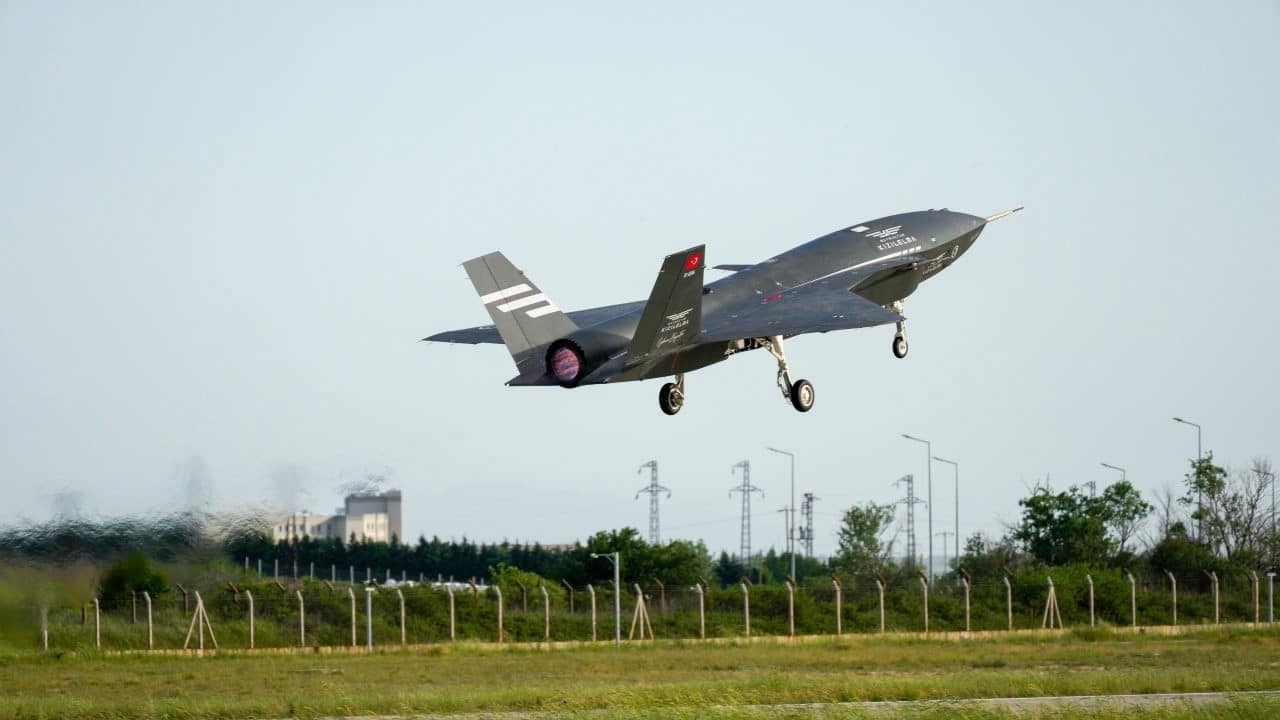
Leonardo says the build up approach adopted for the CUC-T development and testing was based on step-by-step criteria, with a progressive risk reduction through simulation-based validation, an assessment of safety-critical scenarios, including link-loss separation manoeuvres. This allowed a seamless transition from virtual to live operations with both crewed and uncrewed aircraft.
An unspecified number of live flights were then conducted, putting to the test several months of work by pilots and technicians of the Leonardo and Baykar teams. This was also made possible by an advanced radio frequency data exchange system allowed for the synchronization of all data shared between the M-346 and Kizilelma platforms, with the NATO Standard Interface for Manned-Unmanned assets enabling communications.
The datalink was protected by Leonardo’s Tactical Cybersec Platform, a proprietary cyber defense platform built on multi-agentic AI architecture which protects and monitors systems in real time. Cyber security is considered as an important part of the CUC-T operations to prevent disconnection of the uncrewed platforms and spoofing by an adversary.
During the live testing, Kizilelma autonomously conducted taxi, take-off and rejoin thanks to Smart Fleet Autonomy algorithms developed by the Baykar’s Hardware-in-the-Loop (HIL) Laboratory. Then, upon Ground Control Station approval, the M-346F assumed full control of the uncrewed Kizilelmas.
The M-346 light fighter variant during a test flight. | Source: Leonardo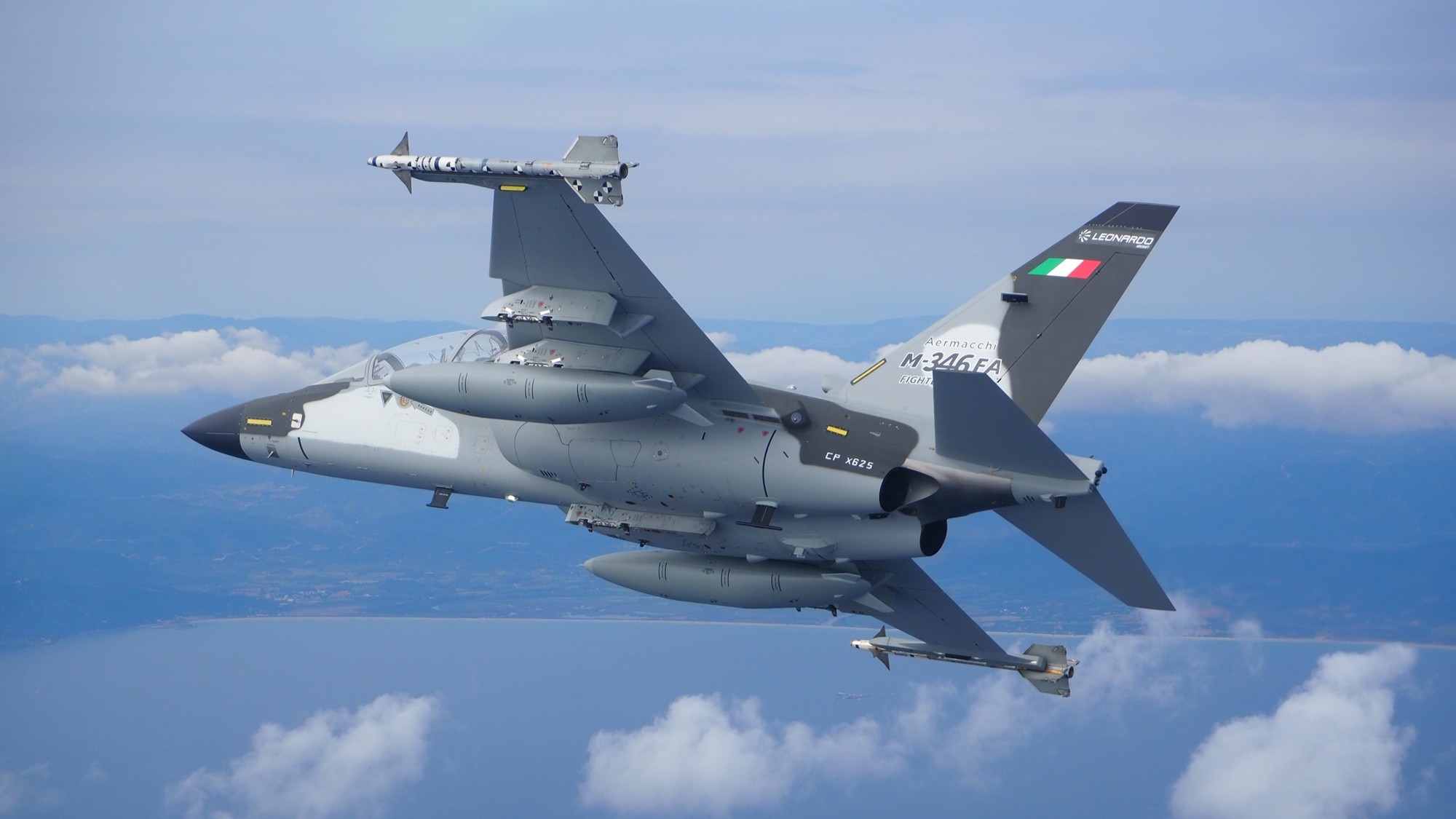
The test pilots aboard the M-346F used a ‘newly developed fully integrated onboard avionic suite’, said the joint press release. Leonardo further detailed that the dedicated user interface was integrated into the M-346F’s avionics and also featured HMI enhancements.
An image shared during the briefing provided a glimpse into the user interface, with the datalink providing the positions of the UCAVs on the Multi-Function Display’s Horizontal Situation Display (HSD) screen, while the two other MFDs were used for the selection of the formation and the training scenario, respectively. The modifications allowed full command and control of uncrewed assets, continuous situational awareness, reduced pilot workload and an effective human oversight of autonomous operations.
The M-346’s pilots were able to command different formations, which were autonomously executed by the Kizilelma. Additional maneuvers included position changes, separations and rejoins.
FutureLeonardo and Baykar say that data and analysis gathered have been crucial in defining the next steps in the K-SWARM program. The two companies are now planning to move into more complex operations “requiring greater situational awareness and assets working together ‘as one’ towards mission objectives.”
The Kizilelma taking off with a TEBER-82 guided bomb for its first live-fire test in 2025. | Source: Baykar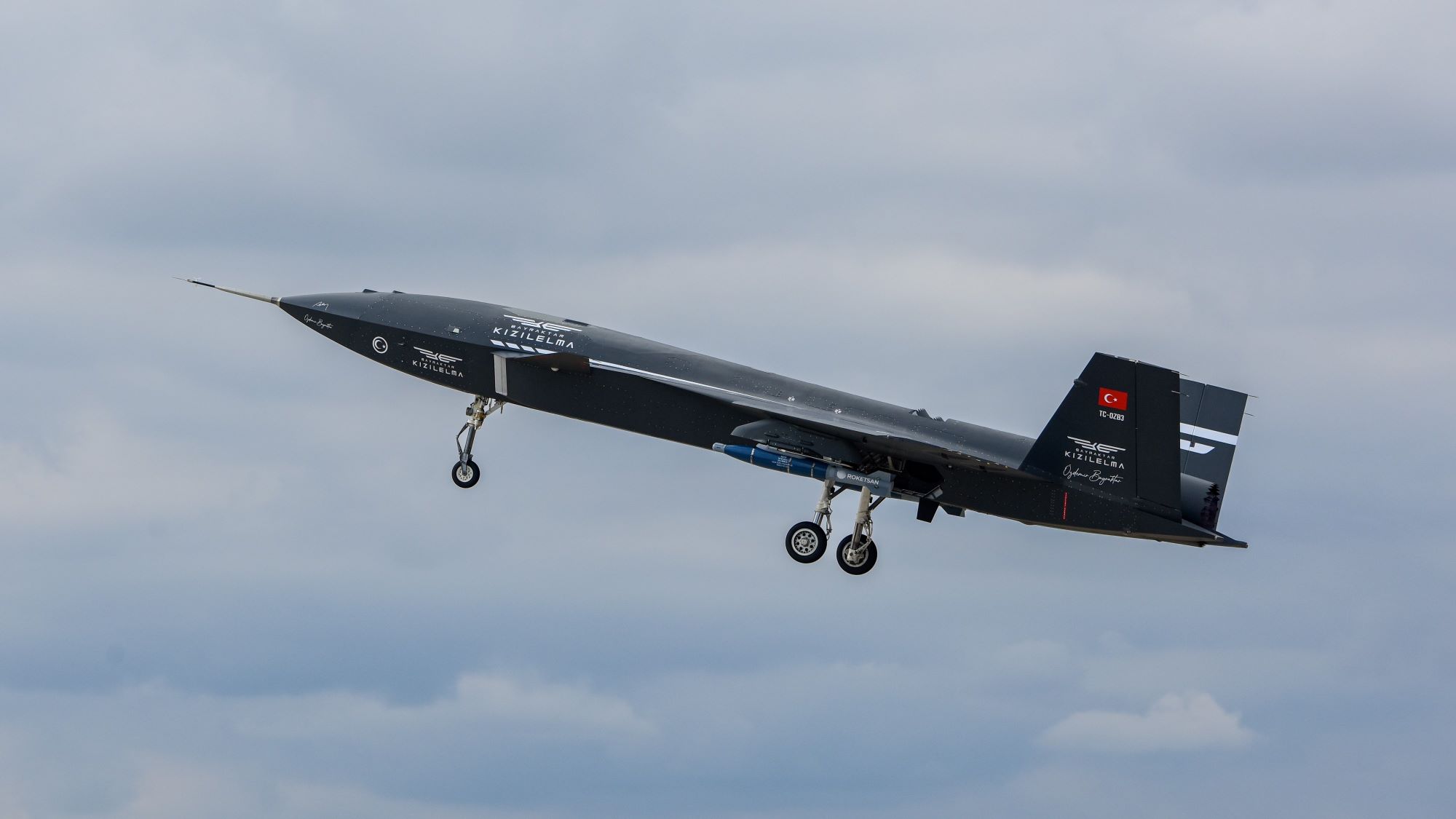
These activities have also been linked to the Global Combat Air Programme (GCAP) and its Collaborative Combat Aircraft (CCA), which already sees the involvement of Leonardo. The vision is for a high number of aircraft, currently as many as six but possibly more, to be assigned to each crewed aircraft.
The joint press release notes that this “refinement and maturity of AI technology, algorithms and collaborative procedures will enable the uncrewed systems to incrementally shift from remote piloting to autonomy, with the aim of reducing pilot workload and increasing mission efficiency while maintaining full control and decision-making.”
New tests are now planned in the coming months, with increasing complexity and additional functions. It is unclear if Leonardo plans to include in the activities also other aircraft such as the Eurofighter Typhoon.
The Aviationist’s contributors Kai Greet and James Gray helped in the preparation of this article.
Categories: Defence`s Feeds
Haut-Katanga : la police rappelle à l'ordre les sociétés privées de sécurité sur l'utilisation des armes à feu
Lors d’une rencontre avec les responsables des sociétés de gardiennage à Lubumbashi, le commissaire provincial de la police du Haut‑Katanga, le commissaire divisionnaire adjoint Blaise Kilimbalimba, a rappelé le cadre légal régissant les activités des sociétés privées de sécurité en RDC.
Categories: Afrique
Le président gabonais Brice Oligui Nguéma entame une visite d'état de 3 jours en France
Le président Brice Oligui Nguéma entame une visite d’état de trois jours en France. L'Elysée a sorti le grand jeu pour recevoir le président du Gabon, un pays qui entretient depuis toujours une relation privilégiée avec l’Hexagone. Antoine Glaser était notre invité pour décrypter les enjeux de cette visite
Categories: Afrique
Le combat des soldats ukrainiens contre les drones
Depuis le printemps, l’Ukraine subit une campagne d’usure par saturation aérienne : Moscou tire de plus en plus de drones, souvent accompagnés de missiles balistiques ou de croisière, pour saturer les radars, épuiser les stocks ukrainiens de missiles antiaériens et maintenir une pression psychologique permanente sur les villes et les civils. La défense aérienne ukrainienne joue un rôle vital : elle abat ou brouille une grande partie des drones.
Categories: Union européenne
Le Sénégal change d'avis et soutient la candidature à l'ONU de son ex-président Macky Sall
Longtemps opposé à la candidature à l'ONU de Macky Sall, président du Sénégal de 2012 à 2024, son successeur Bassirou Diomaye Faye a changé d'avis pour finalement annoncer, lundi, le "plein soutien" du Sénégal à cette candidature et celui de "l'ensemble du réseau diplomatique sénégalais". "Une décision qui m'honore", a réagi, mardi, Macky Sall, exprimant sa "gratitude" à son successeur.
Categories: Afrique
L'Algérie toujours sous le choc après le drame de l'orphelinat
En Algérie, les funérailles des 11 victimes de l'incendie qui a ravagé un orphelinat de Mohammadia, près d'Alger, ont eu lieu jeudi. Les enquêteurs privilégient la piste d'un dysfonctionnement électrique. Le pays est toujours sous le choc.
Categories: Afrique
Fin du mondial 2026 : neuf des dix équipes africaines engagées ont franchi le premier tour
La 23ᵉ édition de la Coupe du monde de football, disputée aux États‑Unis, au Canada et au Mexique, a marqué un tournant : pour la première fois, 10 nations africaines étaient présentes, et 9 d’entre elles ont franchi le premier tour.
Categories: Afrique
Repatriation without Rehabilitation? The Case of North Macedonian Foreign Fighters
Introduction
North Macedonia is a small country of 1.8 million people in the Western Balkans, a region that has proven to be an important source of foreign fighters joining the ranks of the Islamic State, often taking their families with them. It is also one of the few places, where governments have actively repatriated their citizens following the end of the Caliphate. Amongst the Western Balkan states, North Macedonia and Kosovo stand out as they have not only allowed women and children to return but men too, and in some cases actively brought them home, a step considered socially and politically unfeasible in most European countries. However, North Macedonia suffers deep socio-economic divides along ethnic and religious lines, combined with weak and underfunded governmental institutions often not equipped to carry out adequate rehabilitation and reintegration. These conditions can bring about a number of challenges that can have long-term social and security implications regarding repatriated, but not adequately rehabilitated and reintegrated returnees. These challenges are explored below.
North Macedonians in Syria and Iraq
It is estimated that between 143-150 North Macedonians travelled to Syria and Iraq to join the Islamic State and possibly other terrorist groups. Most of these were men, but at least ten women have also left. As with most European countries, return was possible to North Macedonia at the start of the conflict, before the official establishment of the Caliphate in June 2014, without legal consequences. In line with European practice, North Macedonia criminalized people participating in conflicts outside of the country’s territory with a change in the country’s Criminal Code in September 2014. Since then, this charge brings with it a prison sentence of at least five years.
However, it does not seem to apply for women, as their participation in any conflict would be difficult to prove given their role being restricted once in Syria. In other European states, such as the Netherlands, Germany, France or Belgium, alternatively, women were charged with recruitment, providing financial support, inciting others to travel or simply being members of a terrorist organisation. In some cases, women who joined the Islamic State were subject to cumulative prosecution, whereas they were prosecuted for core international crimes, including for their involvement in (sexual) slavery as a crime against humanity.1 Despite these alternative possibilities and examples of other countries, women have not been prosecuted in North Macedonia for their affiliation with and travel to the Islamic State.
A policy of repatriation, rehabilitation and reintegration
The North Macedonian government adopted its National Plan for Reintegration, Resocialization and Rehabilitation of Returnees for Foreign Armies and Members of their Families (Women and Children) in June 2020. In line with its obligations stemming from this National Plan, the government has taken an active role in repatriating its citizens from Syria and Iraq. Contrary to most European states, North Macedonia has actively brought back not only women and children, but men too. In addition to those who returned voluntarily at the beginning of the conflict, the government has carried out three separate waves of repatriation between August 2018 and July 2021, resulting in the return of 11 men, eight women and 14 children. Together with those who returned voluntarily, the total number of returnees as of 2025 was 102, according to governmental sources.
Based on the North Macedonian government’s own reporting, as of 2025, 76 returnees (it is assumed that all are men) have been prosecuted, while 11 men were at that point still incarcerated (four of whom have since likely been released). The minimum prison sentence handed down for participating in a foreign conflict is five years, the maximum sentence received by a foreign fighter returnee was, as of 2023, 18 years: a combined sentence of eight years for spreading Islamic State propaganda in addition to a ten-year prison sentence for participation in a foreign army and recruitment. Nine men who were released during the course of 2023/2024, and an additional 26 women and their family members have undergone rehabilitation and reintegration by the end of 2025.
Women, as they do not face prosecution, have the possibility to enter rehabilitation and reintegration upon arrival. However, this is voluntary. Rehabilitation and reintegration, of both men and women, is led by the Centres for Social Work (CSW) together with members of civil society. There are 30 CSWs, one in most cities, working under the Ministry of Social Policy, Demography, and Youth. They are responsible for carrying out services of social protection, including assisting with the rehabilitation and reintegration of not only those returning from Syria and Iraq, but also of those formerly incarcerated. The CSWs, in partnership with civil society organisations (CSOs), carry out home visits, psychological assessments and aid in a wide range of everyday tasks, such as informing returnees of their rights, assisting with finding housing or work, and maintaining contact with the schools of the children.
Civil society organisations, such as the Macedonian Center for International Cooperation (MCIC), take on additional responsibilities in the rehabilitation and reintegration or returnees. They work not just with the returnees themselves, whether still incarcerated or post-release, but also their family members, as well as those who have never left for Syria and Iraq. Civil society actors provide a safe space for individuals who might be untrusting of state institutions, and act as a bridge between those undergoing rehabilitation and state services. Though women are not prosecuted and therefore in the eyes of the law are considered innocent, it does not mean that they do not constitute a risk to both society and those who work with them. Returnees are therefore monitored by the Agency for National Security, as well as the police who carry out risk assessments to determine the possible risk they pose.
Challenges
1. Returnees and those who have never returned
Due to the government’s commitment to the repatriation of fighters and their family members, there are relatively few North Macedonians who remain in the former territories of the Caliphate, whether actively fighting, imprisoned or in detention camps. According to latest estimates by the government, five North Macedonian men remain actively fighting in the region, while another four are imprisoned in Syria. In addition, approximately four adults (likely all women) remain in camps with an unknown number of children. Interestingly, one North Macedonian has also risen to the rank of Colonel in Syria’s new army: Abdul Samrez Jashari is a designated terrorist and previously was the leader of Xhemati Alban, a predominantly ethnic Albanian militant group that played a role in overthrowing Syrian President Bashar al-Assad’s regime in December 2024.
While the risks associated with possible unwanted returnees entering the country undetected are therefore low, those who have been repatriated and have served their sentences in the past couple of years remain a threat if not rehabilitated properly. As mentioned earlier, participation in rehabilitation and reintegration programmes while in prison and after release is entirely voluntary, and state capacity to carry out these services and to monitor all returnees and their family members is limited. While repatriation is commendable, as it assumes the state takes responsibility for its own citizens, without compulsory, structured and sustained rehabilitation efforts, returnees will continue to pose a security risk at home.
The ideology of the Islamic State remains popular and continues to inspire the formation of cells who actively aim to recruit new members and plan to carry out attacks. Recently, a group of five residents of the capital, Skopje have been charged with publicly calling for and encouraging the formation of a terrorist group based on the ideology of the Islamic State. Previously, a similar cell in the city of Gostivar has also been dismantled. Members of this group planned to carry out terrorist acts against civilian targets and public facilities.
2. Connections to international networks in the region and beyond
Enabling the formation of these cells is the interconnectedness of North Macedonian groups with those of its neighbouring countries. Albania and Kosovo both gave home to a high number of foreign fighters in Syria and Iraq, with around 140 Albanians and between 355-446 Kosovars leaving to fight for the Islamic State. While Albania has only repatriated women and children, Kosovo has been actively repatriating all its citizens. The number of returnees, as well as the religious, ethnic and linguistic overlaps between these countries allow for the quick spread of ideas and people.
One of the most prominent North Macedonian recruits, militant leader turned Salafi2 imam, Rexhep Memishi, who fought in Syria and was arrested in 2016 and sentenced to seven years for recruiting for the Islamic State, has a strong influence across the region. Prior to his arrest, Memishi lectured in Kosovo, from where he was eventually banned due to his radical teachings. Freed in 2023 after serving his sentence, the Albanian ethnic has built up a sizeable social media following not only in his home country, but across other Albanian speaking communities in Albania and Kosovo. Though he is not allowed to actively preach in North Macedonia, other imams in his orbit could likely be influenced by his radical teachings.
Finally, segregation between different ethnic groups (Macedonians and Albanians in the case of North Macedonia) and by extension Christians and Muslims, continues to fuel ethno-nationalist sentiments as well as resentment towards one another, easily exploited by radical groups regardless of the ideology. These tensions as well as the difficult socio-economic situation of some disadvantaged groups make it easier for foreign influence to set foot. Concerns regarding the growing influence of “foreign strains” of Islam, such as political Islam spread by Turkey or the Wahhabi strain3 of Islam exerted by Saudi religious, cultural and social institutions have been present since the 1990s and have grown in recent years.
3. Women who remain radicalised and their children
As mentioned earlier, in North Macedonia, and across the region with a few exceptions, women have not been prosecuted for travelling to Syria and Iraq, for joining the Islamic State, for potentially recruiting other women to do so or for carrying out other activities in the name of the Caliphate influenced by its ideology. Contrary to other European countries, they have also not been subjected to cumulative prosecution for core international crimes or for domestic offences such as child neglect for taking their children to an active war zone. Women returning to North Macedonia are therefore not only under less scrutiny than those who return to Western Europe, but have fewer opportunities to engage in organised rehabilitation and reintegration, as participation in those options presented to them remain voluntary.
This approach fails to acknowledge the multi-dimensional role women can have from harmless victims to willing perpetrators, offenders or even potential security threats. Though returning women are monitored by state services, a lack of state-led, compulsory, long-term rehabilitation programmes for women would enable a better control over the future of returnees. The lack of such programming for women has far-reaching implications for their children as well. Without adequate long-term assistance it is difficult to assess not only whether women remain radicalised (or even actively recruiting), but also to evaluate the environment their children grow up in. Children are rightly so considered victims of this situation, but without adequate programming can turn into perpetrators in the future.
4. Lack of sustainable government investment in P/CVE
In North Macedonia, a strong network of CSOs exists that carry out preventing and countering violent extremism (P/CVE) programming, among them rehabilitation and reintegration. In lieu of adequate national and local state-led programming, often these organisations assume responsibilities for which they might not have the adequate capacity, funding and legal obligation to do so. Many of these CSOs are active in all three stages of P/CVE4 and carry out a wide range of activities with limited capacity. Due to the lack of governmental support, these organisations are heavily dependent on foreign funding, which not only runs out at the end of each project cycle, hampering sustainability and forward planning, but can be guided by foreign interests. Local government at the same time remains underfunded and understaffed to carry out such activities and to build up experience for future P/CVE programming, such as rehabilitation and reintegration.
Conclusions
Contrary to many other European states, the North Macedonian government has recognised its responsibility in repatriating all its citizens from the battlefields of Syria and Iraq, not just women and children. As a result, very few North Macedonian’s remain in the former territory of the Islamic State and in detention camps where conditions are dire, as most have returned to their home country. While men face prosecution, women are encouraged to enter rehabilitation and reintegration programmes, the participation in which remains voluntary. Such programmes are also heavily reliant on civil society involvement and foreign funding, with most national and local governmental actors lacking the commitment and resources to actively engage with this vulnerable group of individuals. Repatriation, while a step in the right direction, is only efficient as long as it is followed up by sustainable efforts of state-led rehabilitation and reintegration programming. It is not enough to bring people home, if then there is no follow-up plan to make sure they return to society, and do not constitute a security threat in the future.
Footnote
1 Cumulative prosecution or cumulative charging refers to (a) charging multiple distinct crimes based on the same underlying act(s), with the charges presented cumulatively rather than alternatively; (b) prosecuting various acts separately as terrorist offences, core international crimes and other national offences (e.g. travelling to the conflict zone for the purpose of terrorism and the war crime of pillaging or outrages upon personal dignity). Genocide Prosecution Network (2025), p. 8.
2 Salafism is an ultra-conservative, puritanical movement within Sunni Islam that advocates for the return to a pure, unadulterated form of Islam, whose authenticity is exclusively located in the Qur’an, the Sunna and the example of the salaf (early ancestors). Salafism seeks to decontaminate Islam from culture and politics and provides a univocal manual to live one’s life according to strictly defined Islamic principles. Inge, A. (2016)
3 Wahhabism is a religious ideology and movement stemming from the 18th century territory of what is today Saudi Arabia, where it remains the most prominent form of Islam practiced. Wahhabism is considered to adhere to the original, therefore correct interpretation of the general Islamic doctrine, therefore it is often characterized as the most extreme or conservative strain of Sunni Islam. In the literature, the terms Wahhabi and Salafi are often used interchangeably as synonyms, but Wahhabis are also considered a „special orientation within Salafism”, the form Salafism has taken in Saudi Arabia. Its main difference from Salafism relates to legal matters. Inge, A. (2016) and Iliev, A. et al. (2022), p. 190.
4 P/CVE efforts can generally be divided into three main stages: primary, secondary and tertiary. Primary prevention is targeted at eliminating the “breeding grounds” for radicalisation and addressing its root causes. These measures are generally aimed at those at risk of radicalisation, i.e. those who might not be radicalised yet. Secondary prevention is more individually oriented and is focused on the individuals already radicalised or on the verge of radicalising, but who have not yet committed an offence. Finally, tertiary prevention targets the violent behaviour itself, aimed at individuals who have gone down the road of radicalisation and have possibly committed a criminal offence as well. The objective of this stage is disengagement from violent behaviour and rehabilitation and reintegration into society. Gielen, A. (2020), p. 67.
Additional readings
Foreign Terrorist Fighters Knowledge Hub
Genocide Prosecution Network (2025). Cumulative prosecutions of foreign terrorist fighters for core international crimes and terrorism-related offences: An analysis of selected jurisprudence, Eurojust. https://www.eurojust.europa.eu/publication/cumulative-prosecutions-foreign-terrorist-fighters-core- international-crimes-terrorism-related-offences
Gielen, A. (2020). Cutting through Complexity, Evaluating Countering Violent Extremism (CVE), Amsterdam University Press, Amsterdam
Herbach, M., Mehra, T., Renard, T. (2024). Female Jihadis Facing Justice: Comparing Approaches in Europe – Managing Female Violent Extremist Offenders in Europe: A Data-driven Comparative Analysis, International Centre for Counter-Terrorism (ICCT). https://icct.nl/sites/default/files/2024- 02/Female%20Jihadis%20Facing%20Justice.pdf
Iliev, A., Grizhev, A., Petrovski, A. (2022). Ideology of modern Wahhabism. Security Horizons, 3(7), 189- 200.https://www.researchgate.net/publication/372376133_IDEOLOGY_OF_MODERN_WAHHABISM
Inge, A. (2016). The making of a Salafi Muslim woman: Paths to conversion, Oxford University Press USA
Kursani, S. (2018). Salafi pluralism in national contexts: the secular state, nation and militant Islamism in Kosovo, Albania, and Macedonia, Southeast European and Black Sea Studies, 18(2), 301–317. https://www.tandfonline.com/doi/full/10.1080/14683857.2018.1474548
Shtuni, A. (2022). The Western Balkans: Repatriated Foreign Terrorist Fighters, Sentencing Trends, and Security Considerations, Program on Extremism at George Washington University. https://extremism.gwu.edu/sites/g/files/zaxdzs5746/files/Western-Balkans- Repatriation_Shtuni_September-2022.pdf
A Repatriation without Rehabilitation? The Case of North Macedonian Foreign Fighters bejegyzés először Biztonságpolitika-én jelent meg.
Categories: Biztonságpolitika
Royaume-Uni: «La décentralisation fait partie des grands projets d'Andy Burnham»
L'ancien maire de l'agglomération de Manchester, Andy Burnham, a pris officiellement ses fonctions de chef du gouvernement britannique ce lundi 20 juillet. Il succède à Keir Starmer après la démission de ce dernier. Entretien avec Thibaud Harrois, maître de conférences en Civilisation britannique contemporaine à l'université Sorbonne Nouvelle, co-auteur avec Pauline Schnapper de From Cool Britannia to Brexit (éditions Routledge).
Categories: Union européenne
Pages



© 2012-2018 Europa Varietas Foundation © 2015-2018 Europa Varietas Association
www.europavarietas.org | info(@)europavarietas(dot)org | Switzerland




We are looking for sponsors for the English translation of these books, please contact turkeandras(at)gmail(dot)com