
Vous êtes ici
Agrégateur de flux
Why Is Brazil So Interested in ASEAN?
With its traditional markets less reliable, Brazil sees immense potential in Southeast Asia's growing economies.
Catégories: Diplomacy & Crisis News
A Stronger Future for Coffee Starts Where It Is Grown
A stronger future for coffee starts by strengthening the places and communities where that journey begins. Credit: Edgardo Ayala/IPS
By Boubaker Ben Belhassen
ROME, Sep 30 2026 (IPS)
Imagine your morning coffee. You smell the aroma as steam rises from the cup. It wisps and swirls, thins, then disappears. You lift the cup to your mouth. The first pure joy of the day.
That coffee may have begun beneath shade trees in Ethiopia, on a Colombian hillside, in Viet Nam’s highlands or among the coffee farms of Brazil. Long before it reached your cup, someone planted and tended the trees from which it came. Then came the harvest. Ripe cherries were picked with care, and the coffee began a journey that would carry it far from the place where it was grown.
Building a stronger future for coffee therefore begins where coffee itself begins: with productive and resilient farms, open and transparent markets, and greater economic opportunity in producing countries
Few agricultural products connect people across such long distances. Coffee is among the world’s most widely traded commodities. Coffee supports the livelihoods of up to 25 million farmers worldwide, while millions more people participate in the economic activity created along the coffee value chain.
Coffee’s extraordinary global reach has created livelihoods and economic opportunities across continents. It has also connected millions of small producers to a market in which shocks can propagate quickly. Building a stronger future for coffee therefore begins where coffee itself begins: with productive and resilient farms, open and transparent markets, and greater economic opportunity in producing countries.
International Coffee Day is a moment to celebrate what coffee has made possible. It is also a moment to ask what its future will require.
Recent years have shown why. International coffee prices have experienced large fluctuations as weather has affected production in major producing countries and supplies have tightened. Droughts, frosts and excessive rainfall can disrupt harvests, while pests, diseases, rising costs, geopolitical tensions and shipping delays can add further pressure.
That exposure is amplified by the concentration of production in relatively few places. Brazil and Viet Nam together account for nearly half of global coffee production, while five countries supply around 70 percent of global coffee bean exports. With such concentration, a shock in one major producing region can quickly reverberate far beyond it.
Those shocks are transmitted unevenly through coffee value chains, with producers generally more directly exposed to fluctuations in international prices. The answer is not to prevent prices from moving. Markets respond to changes in supply and demand, and prices will inevitably rise and fall. Greater resilience therefore depends on strengthening the capacity of producers and producing countries to adapt and respond when conditions change.
The first priority is production itself. Coffee farming must remain productive and competitive while adapting to changing conditions. More resilient farming systems, innovation and technology, effective management of pests and diseases, and better tools for managing risk can help stabilize production and incomes and boost investment in the future of the crop.
Transparent markets and timely information are essential. Better and timely information on crop conditions, stocks, trade flows and prices reduce uncertainty and help producers, governments and businesses understand changing market conditions and adjust sooner. At a time when disruption in one major producing region can affect markets around the world, international cooperation and greater transparency become even more important.
Stronger production and better markets provide the foundation. But there is also an opportunity to create more economic value from the coffee that producing countries already grow.
The bean’s economic journey is far from finished when it is harvested. Coffee is processed and transported, then may be roasted, packaged, branded, distributed and eventually sold to consumers. Each stage requires investment, expertise and enterprise, while creating opportunities to generate additional economic value.
Much of the coffee produced in low- and middle-income countries is exported in raw form as green beans for processing and distribution elsewhere. Coffee therefore often enters international trade relatively early in its economic journey, leaving opportunities for producing countries to develop more economic activity around the later stages of the value chain.
Where commercially viable, improvements in quality can help producers reach different and potentially higher-value markets. Processing can create additional economic activity, while certification and branding can provide further scope for upgrading within coffee value chains. The opportunities will vary across countries, and investments should focus on areas in which producers and businesses can compete successfully.
Greater resilience in coffee production and greater economic opportunity around what happens after it is produced are complementary ambitions. Productivity, innovation and risk management can strengthen the productive foundation of the sector. Transparent markets can help participants respond to changing conditions. And commercially viable upgrading can broaden the economic opportunities created around the crop.
Realising these opportunities requires cooperation across the coffee value chain. Producers, traders, processors, roasters, retailers and governments perform different roles in moving coffee from the tree to the consumer. International cooperation, market transparency, innovation and investment can strengthen those connections and support a coffee sector that is more productive, competitive, resilient and sustainable.
Coffee already demonstrates what international trade can achieve. A crop grown by millions of farmers, predominantly in low- and middle-income countries, reaches consumers across the world and sustains economic activity throughout its journey. The next opportunity not to miss is to strengthen this connection while creating more economic possibilities in the places where coffee is grown.
Tomorrow morning, the journey begins again. Steam will rise from your cup. Somewhere far away, coffee trees will be tended and another harvest prepared.
The journey from crop to cup already connects millions of people around the globe. A stronger future for coffee starts by strengthening the places and communities where that journey begins.
Boubaker Ben-Belhassen is Director of the Markets and Trade Division at the Food and Agriculture Organization of the United Nations (FAO)
Excerpt:
Stronger farms and better markets can build a more resilient coffee economy
Catégories: Africa
Vers la route de la CAN U20 : le tirage au sort du tournoi UFOA-A s’ouvre ce jeudi à Bamako
Mali Actu - maliactu.net - Mali Actualités, Les Actus et Informations sur le Mali
Mali Actu
Vers la route de la CAN U20 : le tirage au sort du tournoi UFOA-A s’ouvre ce jeudi à Bamako
L’effervescence monte dans la capitale malienne à la veille d’un rendez-vous continental majeur pour les sélections de jeunes. Ce jeudi 1er octobre 2026, l’hôtel Radisson…
Vers la route de la CAN U20 : le tirage au sort du tournoi UFOA-A s’ouvre ce jeudi à Bamako
Mali Actu :
Vers la route de la CAN U20 : le tirage au sort du tournoi UFOA-A s’ouvre ce jeudi à Bamako
Catégories: Afrique
RDC-Rwanda: à l'ONU, Kinshasa et Kigali exposent leurs griefs
Kinshasa et Kigali restent engagés dans le processus de Washington, mais leurs désaccords dépassent la seule question des FDLR. Mardi 29 septembre, au Conseil de sécurité de l'ONU, lors de la présentation du rapport périodique de la Monusco, les deux pays ont exposé leurs griefs sur le désarmement, les présences militaires, le cessez-le-feu et la protection des populations.
Catégories: Afrique
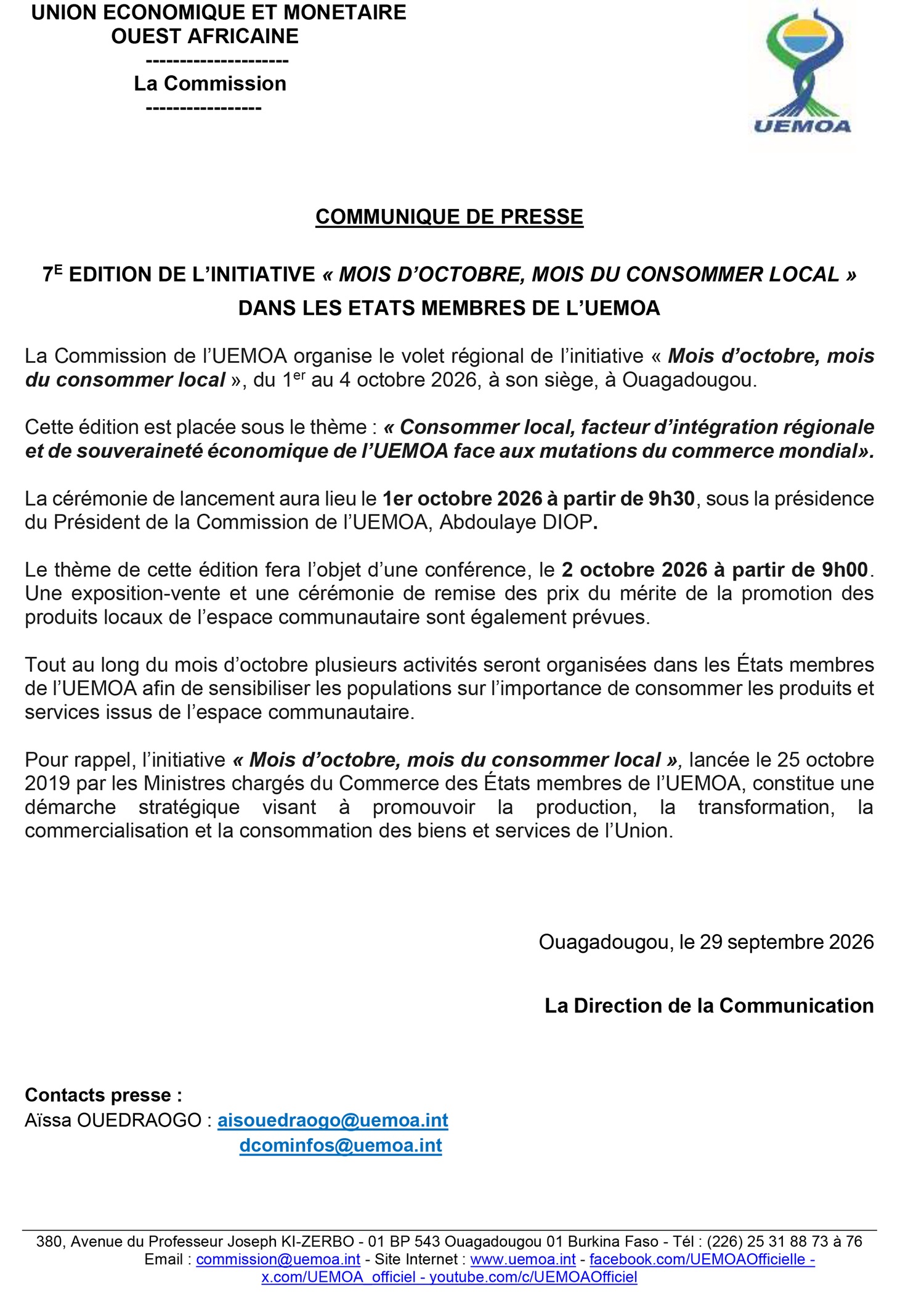
UEMOA : Le volet régional du « Mois du consommer local » prévu du 1er au 4 octobre 2026 à Ouagadougou
La Commission de l'UEMOA annonce via un communiqué, l'organisation du volet régional de la 7e édition de l'initiative « Mois d'octobre, mois du consommer local ». L'évènement se tiendra du 1er au 4 octobre 2026 à Ouagadougou.
Placée sous le thème « Consommer local, facteur d'intégration régionale et de souveraineté économique de l'UEMOA face aux mutations du commerce mondial », cette édition s'ouvrira ce 1er octobre sous la présidence du président de la Commission de l'UEMOA, Abdoulaye Diop.
Le programme prévoit notamment une conférence sur le thème de l'édition, le 2 octobre, ainsi qu'une exposition-vente et une cérémonie de remise des prix du mérite destinés à promouvoir les produits locaux de l'espace communautaire.
Tout au long du mois d'octobre, plusieurs activités seront également organisées dans les États membres de l'UEMOA afin de sensibiliser les populations à l'importance de consommer les biens et services produits dans l'espace communautaire.
Lancée en 2019 par les ministres chargés du Commerce des États membres, l'initiative vise à soutenir la production, la transformation, la commercialisation et la consommation des biens et services de l'Union. À travers cette 7e édition, l'UEMOA entend ainsi faire de la consommation locale, un levier d'intégration régionale et de souveraineté économique.
Ci-dessous le communiqué.
Lefaso.net
Catégories: Afrique
What Will Indonesia Do With Its New Aircraft Carrier?
The KRI Sriwijaya is a small aircraft carrier and may be better understood as an amphibious support ship.
Catégories: Diplomacy & Crisis News
« Dès le 1er octobre » : Algérie Télécom dévoile ses nouveaux horaires d’ouverture
Les guichets d’Algérie Télécom adoptent un nouveau tempo. L’opérateur public a fait savoir, ce mercredi, que l’accueil du public dans ses agences commerciales obéira désormais […]
L’article « Dès le 1er octobre » : Algérie Télécom dévoile ses nouveaux horaires d’ouverture est apparu en premier sur .
Catégories: Afrique
Goodbye, ‘China Plus One’: The Real Change in US China Policy
Beneath the pageantry, here's the change that matters: Washington has stopped talking about leaving China.
Catégories: Diplomacy & Crisis News
Gouvernance au Mali : Assimi Goïta pointe du doigt les dysfonctionnements administratifs
Mali Actu - maliactu.net - Mali Actualités, Les Actus et Informations sur le Mali
Mali Actu
Gouvernance au Mali : Assimi Goïta pointe du doigt les dysfonctionnements administratifs
Le Palais de Koulouba a accueilli, ce mardi 29 septembre 2026, la remise officielle du rapport annuel 2025 du Médiateur de la République par Mme…
Gouvernance au Mali : Assimi Goïta pointe du doigt les dysfonctionnements administratifs
Mali Actu :
Gouvernance au Mali : Assimi Goïta pointe du doigt les dysfonctionnements administratifs
Catégories: Afrique
Un épisode "exceptionnel" : de fortes pluies s'abattent sur le Gard et l'Hérault
Les départements du Gard et de l'Hérault ont été placés en vigilance rouge "pluie-inondation" par Météo-France, à la suite de fortes pluies qui se sont abattues mercredi. Les transports et les écoles ont été perturbés, mais les dégâts matériels sont pour l'heure limités.
Catégories: France
"Une ampleur absolument colossale" : la rafle du Vieux-Port reconnue comme crime contre l'humanité
La justice française a qualifié mercredi de "crime contre l'humanité" les rafles menées à Marseille dans le quartier du Vieux-Port en janvier 1943, une reconnaissance réclamée de longue date par des survivants et leurs descendants.
Catégories: France
Trois décès liés au choléra signalés en une semaine à Fizi
La Division provinciale de la santé du Sud-Kivu confirme ce mercredi 30 septembre, la présence du choléra dans plusieurs localités du territoire de Fizi. Elle rapporte trois décès liés à la maladie entre le 14 et le 20 septembre 2026.
Catégories: Afrique
Botswana condemned for slaughtering 23 elephants for independence celebrations
The government authorises the hunting of elephants and dozens of other wild animals for independence day feasts.
Catégories: Africa
Handball : l’USFAS confirme sa suprématie avec un doublé en Coupe du Mali
Mali Actu - maliactu.net - Mali Actualités, Les Actus et Informations sur le Mali
Mali Actu
Handball : l’USFAS confirme sa suprématie avec un doublé en Coupe du Mali
L’USFAS a frappé fort en finale de la Coupe du Mali de handball 2026 en remportant les trophées féminin et masculin, dimanche 27 septembre au…
Handball : l’USFAS confirme sa suprématie avec un doublé en Coupe du Mali
Mali Actu :
Handball : l’USFAS confirme sa suprématie avec un doublé en Coupe du Mali
Catégories: Afrique
L’Egypte hausse le ton face à l’Ethiopie sur le partage des eaux du Nil
Alors qu’Addis-Abeba s’enfonce à nouveau dans la guerre civile, Le Caire s’emploie à isoler diplomatiquement son voisin pour l’empêcher de contrôler unilatéralement le fleuve, dont l’Egypte dépend presque uniquement pour son approvisionnement.
Catégories: Afrique
NZDF contributes to Humanitarian Assistance and Disaster Relief exercise in Indonesia
A multinational exercise in Indonesia has shown how military capabilities can come together to assist communities in the event of a large-scale natural disaster.
Catégories: Defence`s Feeds
Israeli attacks kill six Palestinians in Gaza as ceasefire violations mount
At least six Palestinians have been killed and several others, including children, been injured in Israeli attacks across the Gaza Strip, medical sources reported amid continued violations of a 2025 ceasefire.
Catégories: Defence`s Feeds
Iraqi resistance group rejects disarmament, vows to maintain support for Lebanon
Iraqi anti-terror resistance group Kata'ib Sayyid al-Shuhada has rejected any surrender of its weapons, with its spokesman stressing that resistance would continue despite pressure and that Iraqi resistance fighters would sustain their support for their fellow fighters in Lebanon.
Catégories: Defence`s Feeds
Press Statement of Kim Yo Jong, Department Director of C.C., WPK
Kim Yo Jong, department director of the Central Committee of the Workers' Party of Korea, issued the following press statement titled "Ringleaders of provocation should be prepared for paying price for the farce of their own making" on Sept. 29:
Catégories: Defence`s Feeds
Pages



© 2012-2018 Europa Varietas Foundation © 2015-2018 Europa Varietas Association
www.europavarietas.org | info(@)europavarietas(dot)org | Switzerland




We are looking for sponsors for the English translation of these books, please contact turkeandras(at)gmail(dot)com