
You are here
Feed aggregator
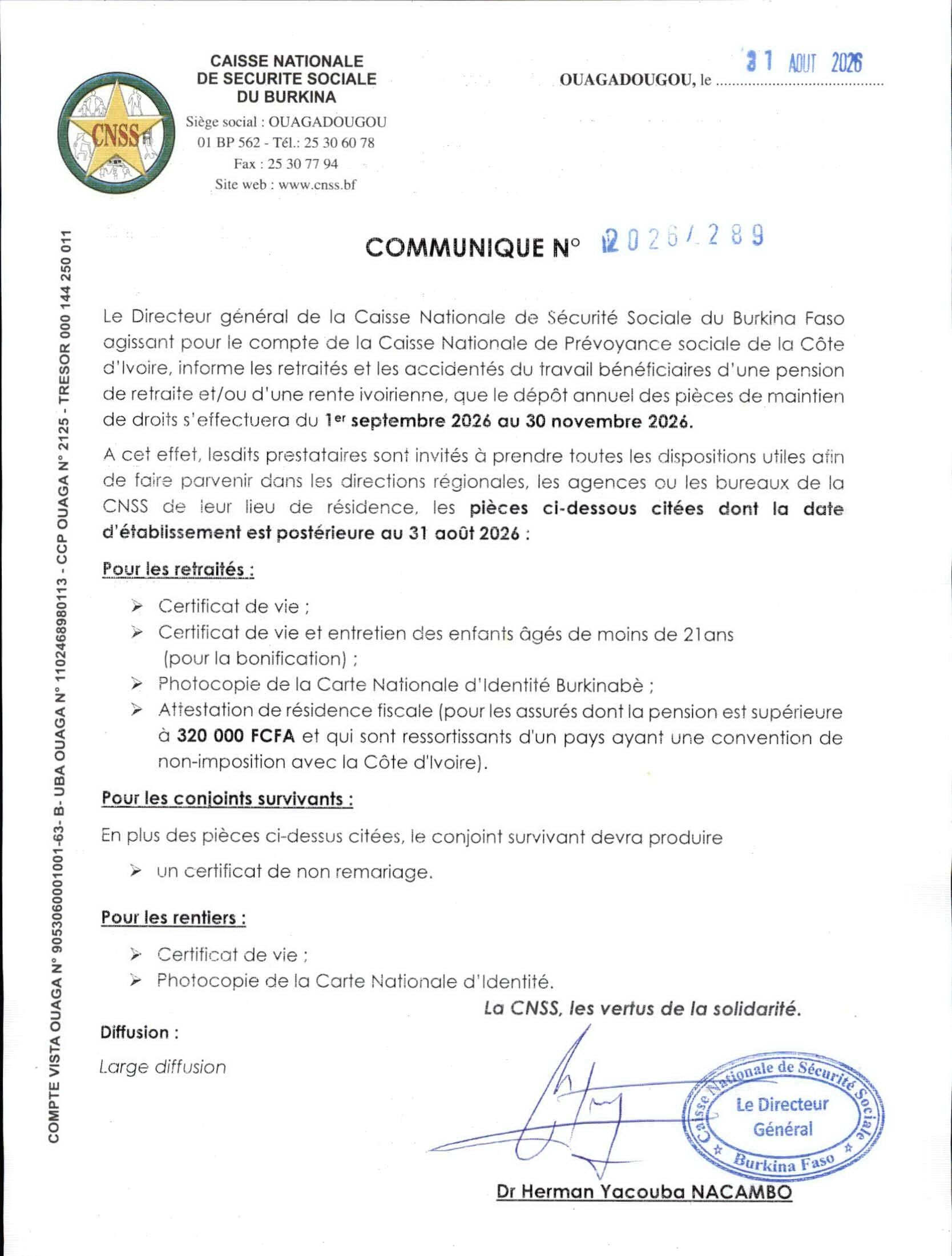
CNSS : Le dépôt annuel des pièces de maintien des droits prévu du 1er septembre au 30 novembre 2026
Categories: Afrique
Décès de WANGRAOUA/OUYA Carine Alix : Faire-part
Les grandes familles WANGRAOUA, TAPSOBA et OUEDRAOGO, à Nacobtenga (Commune d'Ipelcé), Ouagadougou, Côte d'Ivoire, Sénégal, Madagascar et République Démocratique du Congo (RDC) ;
La famille alliée OUYA à Ouagadougou, Bologo (commune de Siglé).
Le veuf, Dr Marcel WANGRAOUA
Les enfants : WANGRAOUA Alixia Marciane Pawelgdba et WANGRAOUA Wendrabnonma Ariella Maëlys.
Ont la profonde douleur de vous annoncer le décès de leur épouse, sœur, fille, tante, belle-fille et parente,
La Camarade WANGRAOUA/OUYA Carine Alix
Précédemment Infirmière au service de Neurologie à l'hôpital de TENGANDOGO
Décès survenu le samedi 29 août 2026 au CHU de TENGANDOGO.
En cette douloureuse circonstance, les familles vous prient de bien vouloir vous unir à elles par vos prières et vos pensées afin de les accompagner dans cette épreuve.
PROGRAMME DES OBSÈQUES
LUNDI 31 AOÛT 2026
16h00 : Levée du corps
À la morgue du CHU de Tengandogo
20h00 : Veillée de prières
Au domicile familial à Tengandogo
MARDI 01 SEPTEMBRE 2026
08h00 : Départ du domicile
Pour l'église de Tengandogo
09h00 : Messe d'absoute
À l'église de Tengandogo
Suivie de funérailles chrétiennes au domicile familial de Tengandogo
Puis inhumation Au Cimetière de Nagrin, route de Saponé
Que Dieu, dans sa miséricorde infinie, accueille l'âme de notre chère disparue dans son Royaume et console tous ceux qui l'ont aimée.
Paix à son âme.
La famille vous remercie par avance pour vos prières, vos marques de compassion et votre soutien.
Categories: Afrique
10 Afrodescendants deviennent Béninois
Dix Afrodescendants ont reçu, samedi 29 août 2026, leurs attestations de nationalité béninoise, lors d'une cérémonie organisée au Complexe judiciaire de Cotonou.
En présence du ministre de la Justice, Yvon Détchénou, et du Secrétaire général du ministère des Affaires étrangères, dix Afrodescendants ont reçu leurs attestations de nationalité béninoise le samedi 29 août 2026 à Cotonou.
Les bénéficiaires voient cette démarche comme une reconnexion officielle avec la terre de leurs ancêtres. Pour l'un d'eux, originaire de Guadeloupe et vivant en France, c'est l'émotion. « Aujourd'hui, c'est un grand jour pour moi. Je suis vraiment fier d'être Béninois », a-t-il déclaré, remerciant les autorités et le peuple béninois pour cette possibilité « d'honorer » leurs ancêtres. « Par ma présence, c'est toute ma famille, tous mes ancêtres qui sont représentés aujourd'hui au Bénin », a-t-il ajouté.
M. M.
Categories: Afrique
Décès de Madame Sawadogo Filiga Christine : Remerciements et faire-part
« Je suis la résurrection et la vie, celui qui croit en moi, même s'il meurt, vivra » (Jean 11.25)
Le Zitenga Nabla tigré chef de canton de Ziteng-gasongo
Le baloum naba de Tikaré
La grande famille Sawadogo à Tikaré, Ouagadougou, Reims et Paris
La grande famille Diarra à Tang sèghin (Boussé)
Les familles alliées et amies : Diasso, Ouédraogo, Rasolofosaon, Bamas, Nana, Dembélé, Yaméogo, et Nikiéma
Les enfants : Paul Marie, Marie Madeleine, Louis Mathias, Adélaïde, Geneviève, Apollon, Denise, Valérie et Renée.
Les petits-enfants et arrière-petits-enfants
Expriment aux parents et amis leurs vifs remerciements pour les prières, la compassion et l'aide précieuse lors des obsèques de leur sœur, mère, tante, belle-sœur, belle-mère, grand-mère, arrière-grand-mère.
Diarra Filiga Christine épouse de Feu Félix Payadé Sawadogo
Décédée le 1er juin 2026 à Ouagadougou
Des messes seront dites pour la défunte suivant le calendrier ci-après :
Union de prières
Categories: Afrique
Le directeur d'école qui a sauvé 900 élèves des inondations au Népal
Rajendra Dawadi a immédiatement réagi après avoir reçu des avertissements concernant les eaux qui se dirigeaient vers son école.
Categories: Afrique
L’Union sacrée réclame la fermeture de l’assemblée provinciale et la révocation du gouverneur de la Mongala
Les partis politiques membres de l’Union sacrée de la nation de la province de la Mongala demandent la fermeture de l’assemblée provinciale et la révocation du gouverneur Jean-Colin Makaka. Dans une déclaration faite le week-end dernier, leurs responsables dénoncent ce qu’ils considèrent comme une mauvaise gouvernance et une crise institutionnelle persistante dans la province.
Categories: Afrique
4 Béninois pour officier le match Durban City-Rukinzo
Le sifflet béninois sera à l'honneur le 6 septembre en Afrique du Sud, à l'occasion du premier tour préliminaire de la Coupe de la Confédération Africaine de Football.
La Confédération Africaine de Football (CAF) a désigné une équipe arbitrale entièrement béninoise pour diriger le match entre Durban City FC d'Afrique du Sud et Rukinzo FC du Burundi, comptant pour le premier tour préliminaire de la Coupe de la Confédération 2026-2027.
L'arbitre international béninois Dedjinanchi Tanisla Ahomlanto sera au centre de la rencontre.
Il sera assisté par Detondji Joe Cortel Dodometin et Lucien Todégnon Hontonnou, tandis que Djindo Louis Houngnandande officiera comme quatrième arbitre.
La rencontre est programmée dimanche 6 septembre à 15h00 heure locale, soit 13h00 au Bénin, au Moses Mabhida Stadium de Durban. Il s'agira d'une affiche particulière pour Durban City FC, qui s'apprête à effectuer ses débuts dans une compétition interclubs de la CAF. Le club sud-africain a obtenu sa qualification après avoir remporté la Nedbank Cup lors de la saison 2025-2026.
Cette confrontation constitue la manche aller du premier tour préliminaire. La CAF a programmé les matches aller de cette phase du 4 au 6 septembre, avant les rencontres retour du 11 au 13 septembre. Durban City recevra donc Rukinzo avant de se déplacer au Burundi pour la seconde manche.
Les matches aller sont programmés du 16 au 18 octobre et les retours du 23 au 25 octobre.
Cette édition de la Coupe de la Confédération réunit 56 clubs.
M. M.
Categories: Afrique
Les pépites du sport béninois se dévoilent à Abomey
La 2e édition de la Ligue Nationale Scolaire s'est achevée samedi 29 août 2026 à Abomey après huit jours de compétition dans cinq disciplines.
Des performances individuelles ont particulièrement retenu l'attention au cours de la deuxième édition de la Ligue Nationale Scolaire.
Au handball, une joueuse U16 de l'Atlantique a inscrit 10 buts dans une seule rencontre.
En basketball, OGOUVIDE Babel, des Collines, a réalisé un match à 58 points.
Sur les terrains de football, les 48 rencontres disputées ont également permis d'observer une meilleure maîtrise technique et une progression dans l'approche tactique.
Au volley-ball, plus de 2.200 points ont été inscrits durant la compétition, avec une présence remarquée au bloc.
L'athlétisme a aussi livré ses révélations. ADONON Anne, du Zou, a signé un chrono de 58''7 au 400 mètres, tandis qu'OGBONI Stanislas, des Collines, a réalisé 52''9.
Vers un parcours mieux structuré
Le ministre des Sports et de l'Engagement civique, Benoît Dato, a défendu la mise en place de championnats par catégories d'âge afin d'assurer une progression entre détection, formation et accès au haut niveau. Cette orientation vise notamment à éviter que les jeunes talents repérés dans le cadre scolaire ne s'arrêtent au terme des compétitions scolaires. Les centres d'excellence de formation et les clubs doivent prendre le relais pour accompagner leur progression.
A la clôture, le directeur général de l'OBSSU, Victor Lawin, a également dressé le bilan de cette édition, qui s'est déroulée du 22 au 29 août à Abomey.
Les meilleurs jeunes athlètes repartent avec des médailles et des bourses d'études, mais aussi avec la perspective de poursuivre leur formation.
M. M.

Categories: Afrique
Du programme impérial à l’âge post-JCPoA : une chronologie du nucléaire iranien
L’article Du programme impérial à l’âge post-JCPoA : une chronologie du nucléaire iranien est apparu en premier sur IRIS.
Categories: Diplomacy & Defense Think Tank News
LOTO FORTUNE : les cinq numéros tirés ce lundi à 11H
LES RÉSULTATS LOTO FORTUNE SONT LÀ !
TIRAGE N°139/26
Lundi 31 août 2026 (11H)
49 • 54 • 34 • 47 • 78

Félicitations aux heureux gagnants !
Pas encore gagné ? Gardez le sourire !
Rendez-vous au prochain tirage de 14h pour une nouvelle chance.
Jouez dans les centres de jeux de la LNB ou en ligne : Tapez 590# ou lnbloto.bj
Jouez avec modération et responsabilité. Le jeu doit rester un plaisir.
A TOI DE JOUER
Categories: Afrique
Expanded EU carbon border tax is not a reaction to US tariffs
Categories: Diplomacy & Defense Think Tank News
Zambia: An Uneven Contest, an Easy Win
Partial presidential election results are displayed on a screen at the Zambian Elections results center in Lusaka on 17 August 2026. Credit: Gianluigi Guercia/AFP
By Andrew Firmin
LONDON, Aug 31 2026 (IPS)
On 24 August, police sealed off access to Zambia’s courts, closed the day before the deadline for petitions to challenge the results of the 13 August presidential election. The judiciary’s top official cited security reasons, but the timing left little doubt that authorities meant to block the defeated candidate’s legal challenge.
Official results gave the incumbent, Hakainde Hichilema, 60.49 per cent of the vote, comfortably ahead of challenger Brian Mundubile’s 37.87 per cent. Some results from the concurrent National Assembly vote remain pending, but Hichilema’s United Party for National Development (UPND) has also won a commanding majority over Mundubile’s National Reconciliation Party for Unity and Prosperity, part of the opposition’s Tonse Alliance.
Mundubile rejected the presidential election result and vowed to contest it in court, but an election night police raid forced him into hiding. Officers killed former minister Mutotwe Kafwaya and arrested 11 other opposition figures, blaming an exchange of gunfire and accusing Mundubile’s party of possessing weapons and planning an insurgency.
Hichilema came to power in 2021 by comfortably defeating President Edgar Lungu, whose crackdown on civic freedoms led to a polarised and violent campaign. Hichilema promised democratic renewal, pledging to strengthen human rights and the rule of law. However, after some initial positive changes, he’s overseen a slide back to the kind of practices he once campaigned against.
Pre-election crackdown
Hichilema’s margin of victory suggests he’d likely have won anyway, but the ruling party stacked the odds further in its favour while penalising the opposition. European Union observers described an ‘uneven playing field’, with misuse of state resources in favour of the UPND, voter inducements including cash handouts, heavy pro-government bias in state media, self-censorship driven by restrictive laws and police restrictions on campaign events. They also flagged a heavy and intimidating military presence at counting locations, weak security in vote tabulation and counting and a six-hour suspension of counting on election night, after which local officials appeared to be taking instructions from Electoral Commission headquarters before announcing results.
Civil society had already raised concerns about the make-up of the Electoral Commission, believing some of its members were UPND supporters, and judicial independence, after Hichilema appointed numerous new judges from UPND stronghold regions.
In December, parliament approved a law changing the electoral system. It expanded the number of constituencies and introduced a more proportional system with reserved seats for women, young people and people with disabilities. Civil society’s objections centred on the lack of consultation and the speed of these major constitutional changes, which raised suspicions they were intended to benefit the UPND.
As the vote got closer, authorities blatantly targeted opposition politicians, including by using the draconian Public Order Act. Last October, police arrested 12 people, including an opposition member of parliament, when they took part in a meeting Mundubile was expected to attend at a private home, charging them with conduct likely to cause a breach of the peace and participation in an unlawful assembly. In February, police arrested 16 Tonse Alliance members on the same unlawful assembly charge.
Opposition politicians also faced arrest for what would once have counted as the normal cut and thrust of political debate. One of the weapons authorities used was the 2025 Cyber Security Act, which expanded their power to criminalise online commentary and criticism.
In January, police arrested opposition member of parliament Miles Sampa after he alleged by-election fraud. In February, they arrested National Democratic Congress leader Mambwe Zimba over a Facebook post depicting Hichilema in a coffin. In March, they arrested Socialist Party leader Fred M’membe over radio comments about Hichilema and the political controversy over funeral plans for Lungu, who died in 2025. All three spent time in detention before being released on bail.
The crackdown even reached an event that should have showcased Zambia for the right reasons. In April, just days before RightsCon, the world’s largest gathering on digital rights, was due to open in the capital, Lusaka, the government effectively cancelled it. They postponed it at too short notice for rescheduling. Over 2,600 people had planned to attend and some were already on their way. Authorities cited unspecified concerns about some speakers’ clearances and demanded more information on discussion topics. The government evidently didn’t want debate about issues it deemed controversial, including its human rights record. Zambian officials were also reportedly pressured by China, a key investor, over the planned participation of Taiwanese civil society representatives.
Time to restore freedoms
Zambians remain proud of their democracy, which has seen three peaceful handovers since multiparty elections returned in 1991. Hichilema should get democracy back on track by restoring all the freedoms that have been compromised. That starts with reversing regressive laws typically rushed through parliament with little consultation, including the Cyber Crimes Act and others that restrict online speech. The government must also commit to respecting media freedoms and letting the political opposition play its proper democratic role.
The government should replace the colonial-era Public Order Act. Hichilema vetoed its proposed replacement, the Public Gatherings Bill, passed by parliament in May. Civil society had raised concerns about the bill’s broad granting of discretionary powers to law enforcement officers and imposition of criminal sanctions. Zambia needs a law that allows peaceful protests and doesn’t criminalise organisers and participants. Civil society has also raised concerns about an NGO Bill that would grant the government extensive powers to regulate, suspend and dissolve civil society organisations. This bill must advance no further.
Three decades of peaceful transitions made Zambia a regional democratic beacon. Keeping it one requires a government that respects dissent, and a civil society free enough to make sure it does.
Andrew Firmin is CIVICUS Editor-in-Chief, co-director and writer for CIVICUS Lens and co-author of the State of Civil Society Report.
For interviews or more information, please contact research@civicus.org
Follow @IPSNews
!function(d,s,id){var js,fjs=d.getElementsByTagName(s)\\\[0],p=/^http:/.test(d.location)?'http':'https';if(!d.getElementById(id)){js=d.createElement(s);js.id=id;js.src=p+'://platform.twitter.com/widgets.js';fjs.parentNode.insertBefore(js,fjs);}}(document, 'script', 'twitter-wjs');
Categories: Africa
Article - State of the European Union 2026: Follow the debate
MEPs will review current challenges and plans to tackle them with Commission President Ursula von der Leyen on 16 September 2026.
Source : © European Union, 2026 - EP
Source : © European Union, 2026 - EP
Categories: European Union
Africa’s Pastoralists Need More Than COP17’s $1.2 billion Rangelands Pledge
Closing plenary at UNCCD COP17 in Ulaanbaatar, Mongolia. Credit: Anastasia Rodopoulou/ENB-IISD
By Kizito Makoye
DAR ES SALAAM, Aug 31 2026 (IPS)
When the rains fail across Tanzania’s northern Maasai Steppe, herders drive their cattle farther in search of pasture and water.
Boreholes run low. Cattle lose weight, milk yields fall and families begin selling cows, often their main source of livelihood. If the dry spell persists, herds can die, leaving families facing hunger.
What is happening on the Maasai Steppe is part of a wider debate over how the world’s rangelands should be restored. At the UN desertification summit in Ulaanbaatar, Mongolia, governments backed a $1.2 billion programme to restore rangelands, alongside measures to repair degraded land and prepare for drought.
For African pastoralists, the question is whether that money will reach them before the next drought.
Governments, meanwhile, failed to seal a global drought agreement, pushing the dispute into another round of negotiations in Egypt in 2028.
The consequences are particularly serious in Africa, where millions depend on livestock for food and income. Restoring pasture could help pastoralists survive dry years, but it will not solve the problem if grazing routes disappear, drought warnings arrive too late or funds fail to reach the people managing the land.
“The $1.2 billion Rangelands Flagship Initiative is an important recognition that rangelands are not wastelands or marginal areas,” said Ephraim Mtengeti, Professor of Range Sciences at Sokoine University of Agriculture.
“They are productive ecosystems that support millions of people, livestock, biodiversity and important ecological functions. For Africa, where pastoralism remains central to rural livelihoods, giving these landscapes greater financial and political attention is long overdue.”
The 45 projects sit within a wider $1.3 billion programme covering land restoration and drought measures in 23 countries. About $644.5 million is new finance, while another $216 million had already been confirmed.
The pledge is substantial, but it is small compared with the scale of the funding gap. The UN Convention to Combat Desertification estimates that about $355 billion a year will be needed until 2030 to meet global land-restoration commitments. Current investment is about $77 billion.
That leaves a shortfall of roughly $278 billion a year.
Private finance accounts for only about 6% of restoration investment. Governments and development agencies are therefore looking to blended finance, using public money to make projects that might otherwise appear too risky more attractive to private investors.
Many of the benefits of restoring rangelands, however, are difficult to turn into financial returns.
Peter Bakker, president and chief executive of the World Business Council for Sustainable Development, said companies were willing to invest but needed projects that could make money.
“Business does not lack appetite for resilient supply chains, secure water and productive soil – it lacks bankable projects, credible data and a fair share of the early risk,” he said.
Mtengeti agreed that private investment was needed but warned against judging restoration solely by the returns it could generate.
“The financing gap is enormous, so it is understandable that COP17 is looking towards private capital and blended finance,” he said.
“But investors will naturally look for financial returns, whereas many of the most important benefits of rangeland restoration — water security, biodiversity, carbon storage, food security and social stability — are public goods.”
Rangelands as Economic Infrastructure
Rangelands cover about 54% of the Earth’s land surface and support roughly 2 billion people, including 500 million pastoralists. They provide pasture for livestock while storing carbon, supporting biodiversity and helping regulate water.
Restoration could generate $4 to $6 for every dollar invested, rising to as much as $36 when wider public benefits are included.
Restoring rangelands in Africa cannot simply mean fencing off land or imposing farming models designed for settled communities.
Pastoralism depends on mobility. Herders move livestock as pasture and water shift, sometimes crossing national borders.
“Rangelands cannot be restored effectively by treating them like a conventional agricultural field,” Mtengeti said.
“These are dynamic ecosystems, and pastoral mobility is one of the mechanisms through which livestock production adapts to variable rainfall and pasture availability.”
The pressure on grazing land is also increasing. Farms, roads, conservation areas and settlements are taking up more dryland, leaving less room for herders. During drought, the pressure becomes acute as people and livestock crowd around the few remaining sources of grass and water.
“Drought does not respect political boundaries,” Mtengeti said. “Pastoral systems in East Africa are interconnected, and livestock movements often respond to ecological conditions rather than national borders.”
Who Gets the Money?
COP17 also highlighted a shift towards larger, landscape-wide projects rather than small, isolated conservation schemes.
They include Kenya’s TWENDE programme, locally led adaptation financing across Africa, the $35 million Herding for Health initiative and a $100 million African Development Bank programme covering the Zambezi River Basin.
Scale alone, however, will not guarantee better results. Money can still go astray when land rights are disputed, local authorities are weak or communities struggle to gain access to funds.
“Communities should not be treated merely as beneficiaries of projects designed somewhere else,” Mtengeti said.
“They have knowledge of their landscapes, their grazing patterns and how ecosystems respond to climatic variability. That knowledge must inform the design and implementation of restoration programmes.”
Access to international finance presents another obstacle.
“If international finance remains locked behind complicated procedures that local organisations cannot access, then some of the people most exposed to drought will continue to receive the least support,” Mtengeti said.
The Drought Gap
The failure to agree on a global drought agreement was one of COP17’s biggest setbacks. The issue had already been left unresolved at COP16. Governments remained divided over whether such an agreement should be legally binding, leaving the decision until 2028.
“The postponement of a global drought instrument is disappointing because drought is no longer an occasional shock that communities can simply recover from,” Mtengeti said.
“In many dryland areas, repeated droughts are eroding livestock assets, weakening household incomes and undermining the ecological foundation on which pastoral livelihoods depend.”
Governments do not have to wait for a global agreement. More than 70 countries now have national drought plans, compared with only three in 2013.
COP17 also launched the Drought Resilience Investment Facility, which aims to raise up to $400 million from public and private sources.
Finance will also have to be matched by preparedness. Early-warning systems, reliable data, functioning institutions and water infrastructure are crucial, as is acting before drought develops into a humanitarian emergency.
“Countries should not wait for a global instrument before strengthening their own drought preparedness and investing in anticipatory action,” Mtengeti said.
The deadlock over drought came despite progress elsewhere at the summit.
Joao Campari, global food and agriculture leader at WWF, said the summit had given greater prominence to rangelands, grasslands and nature-positive farming.
“Yet hope alone will not protect nature, limit climate change or put food on the table. COP17 has laid strong foundations, but the focus must now shift to implementation on the ground and supporting local communities to deliver lasting benefits for all,” he said.
Where Will the Money Come From?
Closing the funding gap will also require governments to change policies that continue to undermine land resilience.
The UNCCD estimates that about $2.4 trillion in public finance supports environmentally harmful subsidies. Redirecting even part of that money could dwarf many of the commitments announced in Ulaanbaatar.
Governments must also protect grazing corridors, strengthen community land rights and ensure that the people managing the land receive a meaningful share of investment.
“Healthy rangelands are economic infrastructure,” Mtengeti said.
“They support livestock production, food security, employment, water systems and biodiversity. When these landscapes degrade, the costs are eventually borne by households and governments through livestock losses, food insecurity, humanitarian assistance and environmental damage.”
For pastoralists, the outcome of COP17 points to a basic reality: rangelands cannot be treated as empty land waiting for a more profitable use. They are part of the economic infrastructure on which food supplies, livelihoods and climate resilience depend.
Mtengeti said the summit had moved rangelands higher up the international agenda but that the commitments would need to be followed by action in pastoral areas.
“COP17 should therefore be seen as a step forward, but not as a solution,” he said. “The financing commitments are encouraging, and the greater attention to rangelands is important. But Africa’s dryland communities need action that is predictable, locally grounded and delivered before drought becomes a crisis.”
When governments meet again in Egypt in 2028, the value of the Mongolian pledges will be judged by what has happened in the drylands: whether pasture has recovered, livestock can move safely, communities have gained access to finance and drought losses are falling.
For pastoralists, the pledges will ultimately be measured during the next drought, when they need pasture, water and support to keep their herds alive.
IPS UN Bureau Report
Follow @IPSNewsUNBureau
!function(d,s,id){var js,fjs=d.getElementsByTagName(s)[0],p=/^http:/.test(d.location)?'http':'https';if(!d.getElementById(id)){js=d.createElement(s);js.id=id;js.src=p+'://platform.twitter.com/widgets.js';fjs.parentNode.insertBefore(js,fjs);}}(document, 'script', 'twitter-wjs');
Categories: Africa
Kasaï-Central : le nouveau pont Kaluebo sécurise le trafic sur la RN1 et facilite les échanges avec le Kasaï
Le nouveau pont Kaluebo, sur la Route nationale N°1 (RN1), améliore les conditions de circulation entre le Kasaï et le Kasaï-Central. Des sources concordantes rapportent que sa mise en service met fin aux difficultés liées à l’état de délabrement de l’ancien ouvrage, qui exposait les usagers à des risques lors de la traversée.
Categories: Afrique
En Suède, Emmanuel Macron scelle une vente de frégates pour 4,3 milliards d'euros
Emmanuel Macron s'est rendu lundi 31 août en Suède, où il a rencontré le Premier ministre suédois Ulf Kristersson. Le président de la République a scelle une vente majeure de frégates françaises. Mais ce déplacement doit surtout consacrer un rapprochement militaire accéléré par la guerre en Ukraine et la menace russe dans le nord de l’Europe.
Categories: Union européenne
Le slam béninois veut célèbrer ses talents
Une cérémonie inédite entend célébrer les voix du slam béninois, distinguer les figures qui ont contribué à son essor et offrir une nouvelle visibilité à une scène artistique qui progressivement gagne ses lettres de noblesse. Des prix, des trophées, des enveloppes financières, mais surtout une ambition : inscrire le slam dans une histoire plus large que celle qu'on lui connaît.
Après avoir longtemps existé dans les interstices (scènes ouvertes, festivals, concours, soirées culturelles, événements institutionnels, performances plus ou moins confidentielles), le milieu du slam s'offre une cérémonie de récompenses. Les Benin Slam Awards veulent distinguer les voix qui valorisent, portent, bâtissent aujourd'hui cette discipline au Bénin, mais aussi celles et ceux qui ont contribué à la faire émerger.
L'initiative portée par Ezéchiel Akomowo se présente comme une cérémonie consacrée aux voix et voies du slam béninois. Mais derrière les trophées se joue quelque chose d'un peu plus important qu'une remise de prix. Car récompenser une scène artistique, c'est aussi reconnaître qu'elle constitue désormais un écosystème structurant suffisamment installé pour être observé, comparé, archivé et célébré. Et c'est précisément là que les Benin Slam Awards prennent leur intérêt.
Du micro aux trophées
Le slam béninois a fait du chemin. Une vingtaine d'années environ à son compteur. Il n'est plus tout à fait cette pratique que l'on pourrait réduire à quelques curieux venus compétir à l'instinct ni à des artistes armés d'un texte et d'un micro. Au fil des années, le mouvement s'est diversifié : albums, singles, clips, livres, événements, collectifs, performances, hybridités, et nouvelles figures ont contribué à élargir son territoire.
Les catégories retenues par les Benin Slam Awards racontent d'ailleurs cette transformation. Onze distinctions sont annoncées pour cette première édition : Meilleur album slam, Meilleur clip slam, Meilleur événement slam, Meilleur groupe Slam 229, Meilleur livre slam, Meilleur single, Meilleur slameur, Meilleur.e ambassadeur·drice du slam, Meilleure slameuse, Révélation féminine slam et Révélation masculine slam.
Ce choix dit que le slam existe désormais aussi bien autour de la performance de scène qu'à travers une production, une diffusion, des œuvres et des rendez-vous qui participent eux aussi à la vitalité de la discipline.
En distinguant un album comme un clip, un livre comme un événement, ou encore une révélation comme une figure d'ambassadeur, les Benin Slam Awards dessinent donc, presque malgré eux, une cartographie de la scène slam béninoise.
Récompenser les artistes, mais aussi une histoire
L'une des singularités annoncées de cette initiative tient toutefois à ce qui se passe en dehors de la compétition. Les Benin Slam Awards prévoient en effet de distinguer des figures d'honneur, en faisant une place à celles et ceux qui ont contribué à l'essor du slam au Bénin. Une manière de ne pas laisser l'actualité effacer la mémoire.
La première personnalité dévoilée est Yolande Sego, présentée par l'organisation comme « la mère des Slameuses » et comme la première femme à avoir pratiqué le slam au Bénin. Une reconnaissance qui renvoie à une époque où la discipline cherchait encore ses espaces, ses codes et son public.
Puis vient Sergent Markus, présenté comme « le soldat immortel des Slameurs », figure dont la plume et l'engagement artistique sont édifiants.
Deux noms, deux parcours, deux manières d'avoir participé à une histoire commune. Et surtout une volonté affichée par les organisateurs : rassembler les générations actuelles et celles qui les ont précédées.
Cette dimension mémorielle est d'ailleurs l'un des aspects les plus intéressants du Bénin Slam Awards. Une scène artistique qui ne connaît pas ses prédécesseurs risque toujours de donner l'impression d'être née la veille. Or, célébrer les aînés revient aussi à rappeler que les succès présents ont une généalogie.
Faire plus qu'une remise de prix
Le Benin Slam Awards arrive à un moment où le slam béninois semble suffisamment mûr pour commencer à regarder derrière lui tout en se demandant ce qu'il veut devenir. Il ne s'agit plus seulement de prouver que le slam existe. Il faut désormais se demander comment il peut se développer, se professionnaliser, transmettre et laisser des traces.
Ces Awards peuvent y contribuer, en devenant un rendez-vous de référence pour la scène slam béninoise : un espace de découverte pour les nouvelles voix, un moteur de professionnalisation pour les artistes, une vitrine d'exposition pour les œuvres, un lieu de rencontre entre générations et, surtout, un outil de mémoire pour une discipline dont l'histoire reste encore largement racontée par fragments.
Les Benin Slam Awards auront donc plusieurs choses à prouver lors de cette première édition. Leur capacité à distinguer les meilleurs, bien sûr. Leur impartialité, aussi. Mais surtout leur aptitude à faire de la récompense autre chose qu'un trophée que l'on pose sur une étagère. Car le véritable prix d'une scène artistique va au-delà du nombre de trophées distribué. Ce qui compte davantage, c'est l'impact dans l'imagerie, dans la portée, dans la crédibilité du milieu du slam qu'elle finit par apporter et occuper dans la mémoire collective.
Categories: Afrique
Trump Has Peaked
The U.S. president will remain disruptive on the global stage, but he is losing his coercive powers.
Categories: Diplomacy & Crisis News
Le Parlement des étudiants exige l’amélioration de la qualité des services de télécommunications à Kinshasa
Le Parlement des étudiants exige l'amélioration de la qualité des services de télécommunications à Kinshasa. À l’issue d’un contrôle citoyen mené au cours du mois d’août auprès de l’Autorité de régulation de la poste et des télécommunications du Congo (ARPTC) et des principaux opérateurs, cette structure appelle à des réponses concrètes aux problèmes de connexion, d’appels et de stabilité des réseaux.
Categories: Afrique
Ceuta : pourquoi Madrid peine à renvoyer les migrants arrivés en juillet ?
Un mois après l’arrivée de quelques 72 000 migrants à Ceuta en seulement 24 heures, entre 3 500 et 7 000 personnes se trouveraient encore dans l’enclave espagnole, dont des milliers de mineurs isolés. La plupart des autres migrants ont été renvoyés au Maroc quelques heures seulement après leur arrivée. Alors, qu’est-ce qui empêche le renvoi de ceux qui sont toujours à Ceuta ? Pourquoi l’application du « pacte asile et migration » fait-elle débat en Espagne ?
Categories: Union européenne
Pages



© 2012-2018 Europa Varietas Foundation © 2015-2018 Europa Varietas Association
www.europavarietas.org | info(@)europavarietas(dot)org | Switzerland




We are looking for sponsors for the English translation of these books, please contact turkeandras(at)gmail(dot)com