
You are here
Feed aggregator
J-16 fighters debut in China-Egypt joint drills in Africa, showcasing strong overseas deployment capability: expert
Multiple types of aircraft and personnel from the Chinese People's Liberation Army (PLA) Air Force participating in the China-Egypt Eagles of Civilization 2026 joint training arrived at an air base in Egypt early Friday morning after an intercontinental deployment, according to an official release from the PLA Air Force.
Categories: Defence`s Feeds
China-Thailand "Falcon Strike-2026" joint air force training concludes
The closing ceremony of the China-Thailand "Falcon Strike-2026" joint air force training was held on the morning of August 20 at Udorn Royal Thai Air Force Base.
Categories: Defence`s Feeds
Chinese defense minister meets with Indonesian counterpart
Chinese Defense Minister Admiral Dong Jun met with Indonesia's Defense Minister Sjafrie Sjamsoeddin while attending the Second Ministerial Meeting of China-Indonesia Joint Foreign and Defense Ministerial Dialogue in Jakarta on August 21.
Categories: Defence`s Feeds
China, UAE to hold joint air force training
The air forces of China and the United Arab Emirates (UAE) will hold the "Falcon Shield 2026" joint training in Hotan, northwest China's Xinjiang Uygur Autonomous Region, the Chinese Ministry of National Defense said on Friday.
Categories: Defence`s Feeds
Foreign Ministry Spokesperson Lin Jian's Regular Press Conference on August 21, 2026
No description
Categories: Defence`s Feeds
Statement on Hong Kong Alliance guilty verdicts
"The Australian Government is deeply concerned by the guilty verdicts handed down today in Hong Kong to Ms Chow Hang-tung and Mr Lee Cheuk-yan, former leaders of the Hong Kong Alliance in Support of Patriotic Democratic Movements of China."
Categories: Defence`s Feeds
Hong Kong: Statement by the Spokesperson on the verdict in the 'Hong Kong Alliance' case
The conviction under the National Security Law of the Hong Kong Alliance in Support of Patriotic Democratic Movements of China and two of its former leaders, Lee Cheuk-yan and Chow Hang-tung, on 21 August confirms the continuing deterioration of the freedoms of expression and assembly and a further shrinking of the space for independent civil society in Hong Kong. A third defendant, former lawmaker Albert Ho, had pleaded guilty in January.
Categories: Defence`s Feeds
Joint Statement by the spokespeople for the Foreign Ministries of France and Germany concerning the verdict against Chow Hang-tung, recipient of the Franco-German Human Rights Award in 2023
No description
Categories: Defence`s Feeds
Response to the Hong Kong Alliance leaders' national security law verdict
FCDO Indo-Pacific Minister Baroness Winterton of Doncaster responds to the guilty verdict against Lee Cheuk-yan and Chow Hang-tung in Hong Kong.
Categories: Defence`s Feeds
'Hong Kong Alliance' found guilty of inciting subversion; verdict clarifies boundaries between free speech and national security
The anti-China group "Hong Kong Alliance in Support of Patriotic Democratic Movements of China", along with its former chairman and vice-chairpersons Lee Cheuk-yan, Albert Ho Chun-yan and Chow Hang-tung, were charged with inciting others to subvert state power and have been remanded in custody since then. The local court in Hong Kong found two defendants guilty on Friday, and Ho pleaded guilty before the trial began, local media reported.
Categories: Defence`s Feeds
NORFORCE heads into Canadian wilderness
North-West Mobile Force (NORFORCE) soldiers are preparing for a unique international deployment that will see them travel halfway around the world to train alongside the Canadian Rangers in some of North America's most remote wilderness.
Categories: Defence`s Feeds
New White House Helipad Shown Off to Reporters Ahead of Completion
President Trump toured the ornate, granite helipad under construction on the White House South Lawn with reporters, adding his signature to a piece of the stonework that could see use as soon as next month.
Commissioned following the long, highly publicized drama of the new VH-92A Patriot helicopters being unable to land at the White House without scorching the manicured grass lawn, the new helipad will be used for all helicopter movements in and out of the President’s official residence as well as for hosting events and press conferences.
It is constructed of four inch thick Californian granite and inlaid with the Presidential seal. The $5-6 million bill is reportedly being funded by Sikorsky, who manufactures the VH-92 aircraft, alongside personal donations including from President Trump.
President Trump on new White House helipad. pic.twitter.com/X1611DW4yc
— CSPAN (@cspan) August 19, 2026
“This is a helipad at the highest level. It can land any helicopter in the world, no matter how big, no matter how powerful, no matter how strong,” the President told reporters. Presumably, this means it could also accommodate the V-22 Osprey, as flown in a support role by HMX-1. The Osprey is also well known for its hot exhaust causing scorch marks and even fires on grass landing sites, and its particularly strong downdraft has destroyed less substantial helipads. While HMX-1’s V-22s do not carry the President, the ability for the type and those like it to land safely at the White House is arguably a good contingency measure for emergency scenarios.
Construction workers wait on the new helipad for President Trump to tour the new site which is under construction on the South Lawn of the White House. @POTUS pic.twitter.com/dhDMTiC5QZ
— Doug Mills (@dougmillsnyt) August 19, 2026
Used for decades to land the legacy fleet of HMX-1 helicopters and their predecessors, the White House’s South Lawn has seen a wide variety of occasions through the years. Frequently used for ceremonial occasions, most recently it controversially hosted a massive, temporary stage for the UFC Freedom 250 event. This was widely accused of causing significant damage to the lawn, though as we now know this was partially mitigated by plans for the helipad’s construction immediately afterwards. Off to the sides of the South Lawn are Presidential amenities, including a putting green, tennis courts, and swimming pool.
The grass is usually protected from damage by circular aluminium panels that could be placed on the grass ahead of a helicopter’s arrival. The skilled pilots of HMX-1 would then land the helicopter on these red dots, so that the landing gear did not damage the turf or – in wetter weather – sink into the ground.
President Barack Obama and First Lady Michelle Obama arrive on the South Lawn of the White House following their trip to Fort Bragg, N.C., Dec. 14, 2011. | Source: Official White House Photo by Chuck Kennedy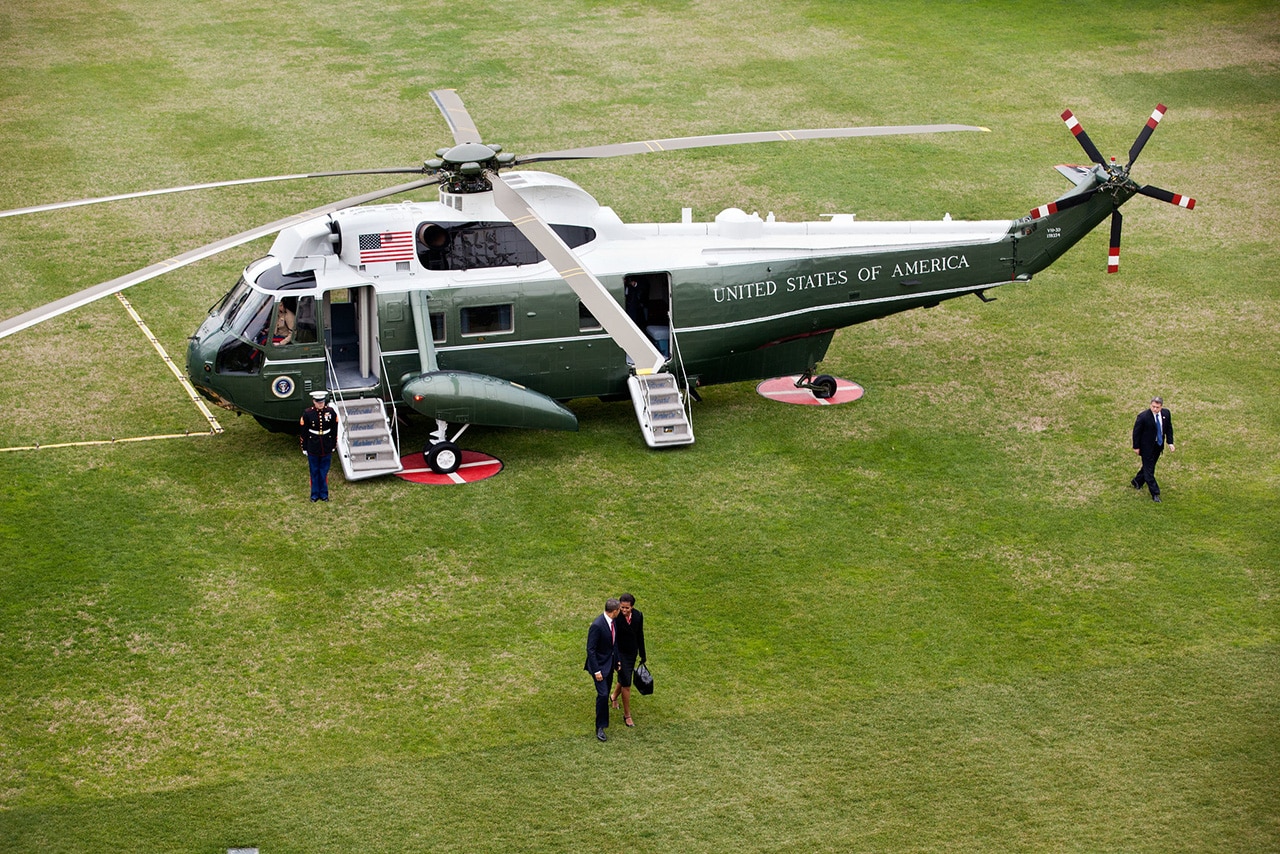
Heat damage is a newer concern, caused by the VH-92’s exhaust gases from the main engines and the auxiliary power unit (APU). While the VH-92 commenced Presidential service during President Biden’s term in office, this issue meant that helicopter transport to and from the White House itself was still primarily handled by the VH-3D Sea King and VH-60N White Hawk.
Completion of the new helipad could be achieved as soon as next month, ahead of Chinese President Xi Jinping’s visit to the White House on Sept. 24. Construction was apparently delayed after initial construction began when President Trump pushed for a redesign that involved additional ground work.
Exclusive: President Trump has directed contractors to redo weeks of work on his planned White House helipad, according to people who spoke on the condition of anonymity.
Trump has made the helipad a priority, but was dissatisfied with the results. https://t.co/Tu3Qv4DvR8 pic.twitter.com/cZC1htx0hd
— The Washington Post (@washingtonpost) August 5, 2026
Trump claims that attempts to build a dedicated helipad at the White House had been made for decades but had not made progress until now. Most Presidents assume a role closer to a caretaker when occupying the White House, and are reluctant to make significant permanent changes to the structure or the grounds unless absolutely necessary. President Trump, however – at least in his current, second term – has appeared to feel much less bound to such traditions.
WASHINGTON (AP) — The entire White House East Wing has been demolished as Trump moves forward with ballroom construction, AP photos show.
AP Photo/Jacquelyn Martin pic.twitter.com/MzV00mTN2V
— philip lewis (@Phil_Lewis_) October 23, 2025
With the covering over of the famous Rose Garden early in his term, as well as the complete demolition of the White House’s East Wing in favor of a lavish, controversial new ballroom (and, underneath, a new Presidential bunker), the addition of a granite helipad is certain to be one of the less unpopular changes. As Trump remarked of the solid stone pad, “this will be here long after we’re gone, no matter what happens with the world, this is not moving.”
Categories: Defence`s Feeds
Nepal’s Tibet Conference Controversy Is About More Than Chinese Pressure
The cancellation of the in-person event also reflects Nepal’s lack of confidence in its ability to manage politically sensitive events.
Categories: Diplomacy & Crisis News
Moins de sel, de sucre et de colorants... la grande distribution promet des recettes plus saines
De nombreuses enseignes de la grande distribution en France disent œuvrer à proposer des recettes plus saines pour leurs marques de distributeurs, en vogue en période d'inflation car moins chères. Une bonne nouvelle pour nos assiettes ou de simples coups de communication ?
Categories: France
The inside story of how Trabzonspor pulled off Salah deal
Mohamed Salah was expected to move to Saudi Arabia or the United States after leaving Liverpool, but Turkish side Trabzonspor pulled off one of the coups of the transfer window.
Categories: Africa
What Asia’s Industrialization Lessons Can Teach Fragmented States
Political differences do not have to disappear before economic interdependence can deepen.
Categories: Diplomacy & Crisis News
New Emergency Care Skills Help Tanzania’s Frontline Doctors Save Lives
Traffic police take statements from road crash victims at a health facility in Morogoro Region, Tanzania. The country's Basic Emergency Care (BEC) programme is strengthening the capacity of frontline health workers to provide life-saving treatment during the critical moments following serious injuries. Credit: Muhidin Issa Michuzi
By Kizito Makoye
DAR ES SALAAM, Tanzania, Aug 21 2026 (IPS)
The 14-year-old girl arrived at the hospital fighting for her life. After a tragic hit-and-run car accident, she was rushed into the emergency department with serious abdominal injuries. Every passing minute brought her closer to death.
“There was internal bleeding,” recalls Dr Iddi Muhammad Juma, a surgeon at Tanzania’s Same District Hospital. “We performed an ultrasound and took her to theatre immediately,” he tells IPS.
When surgeons opened her abdomen, they found a ruptured spleen floating inside the abdominal cavity.
Applying the structured emergency approach taught in the World Health Organisation’s Basic Emergency Care course, the team stopped the bleeding and removed the ruptured spleen. The girl survived.
For Juma, the case illustrates how a systematic response to an emergency saves lives.
“If we had delayed, she could have died. Because of the BEC training, we acted quickly to save her life,” he says.
His experience highlights changes across Tanzania as the government improves emergency care in rural hospitals to save the lives of the injured and critically ill patients.
Tanzania has expanded access to healthcare over the past two decades, but emergency care remains weak. Many district hospitals lack trained staff, equipment and essential supplies, while clinicians — especially in rural areas where patients often travel hours for treatment — have had little practical training in rapidly assessing and handling life-threatening emergencies with limited resources.
To address the problem, the Ministry of Health, in partnership with the Emergency Medicine Association of Tanzania (EMAT) with support from WHO, has launched the Accelerating Community and Transformative Learning for Basic Emergency Care (ACTxBEC) initiative to train health workers in 250 hospitals countrywide to manage medical emergencies using evidence-based practices designed for resource-limited settings.
Michael Kiremeji, an official at the Ministry of Health, says the initiative aims to strengthen emergency and critical care at district hospitals where most patients first seek treatment.
“We want to ensure that timely and quality life-saving emergency care is accessible to every patient regardless of where they live,” he tells IPS
He says many deaths and disabilities caused by trauma, obstetric emergencies and severe infections can be prevented if health workers have the skills to rapidly assess, stabilise and manage critically ill patients.
Doctors say the training has improved teamwork, confidence and decision-making during emergencies, showing that life-saving care depends more on skilled, decisive action than on advanced technology.
Perched on a wind-swept highway linking Tanzania’s commercial capital, Dar es Salaam, with the northern Kilimanjaro region, Same District Hospital has long grappled with a steady flow of road crash victims, especially during holidays when travel peaks, doctors say.
Before the BEC training, the hospital could only stabilise patients with severe chest, abdominal or pelvic injuries before referring them to Kilimanjaro Christian Medical Centre (KCMC), about 100 kilometres away.
“We learned how to quickly identify air or blood in the chest and insert life-saving chest tubes. We also mastered simple airway techniques like the chin lift and jaw thrust—basic life-saving skills.” Dr Juma tells IPS.
Hundreds of kilometres away at Tumbi Regional Hospital in Tanzania’s Coast Region, Dr Sami Kyaruzi says the BEC course has simplified doctors’ responses to emergencies.
He recalls a 45-year-old man with stab wounds who arrived at the emergency room alert and breathing normally. A chest X-ray showed blood and air trapped in the chest, but his condition initially appeared stable.
Within minutes, however, his breathing became laboured, his blood pressure dropped and one side of his chest bulged unevenly. While the sudden decline could have puzzled many clinicians, Kyaruzi recognised the signs.
“We immediately relieved the pressure in his chest with a needle, then inserted a chest tube,” Kyaruzi tells IPS. “His condition improved quickly, and he was later discharged.”
Despite his emergency medicine background, Kyaruzi says the hands-on demonstration during the course changed how he puts that knowledge into practice.
“We learned how to assess trauma patients, stabilize the neck and spine, support breathing, and deliver oxygen correctly.”
He believes Tanzania should invest in simulation laboratories where clinicians can hone their life-saving skills before facing real emergencies.
“Investing in emergency care training is a necessity,” he says. “Strengthening capacity at the district hospitals will save many lives.”
At Bagamoyo District Hospital on the Indian Ocean coast, Dr Makubi Gyalisi says the change brought by the BEC programme has improved his confidence.
Now head of the hospital’s emergency department, Gyalisi oversees critically ill and injured patients. But before attending the training, he says managing life-threatening emergencies was hard.
“The training changed the way I handle emergencies. I now approach critically ill patients with confidence and follow a systematic process,” he says.
That confidence was tested when a young man arrived after a grisly car crash. His right leg had been chopped, he sustained severe head injuries and was terribly shocked.
The emergency team adeptly followed the structured approach taught during the BEC course.
“We assessed his airway and breathing, treated his shock with IV fluids, immobilised his neck and prepared him for blood transfusion before referral,” Gyalisi says.
Doctors contacted orthopaedic specialists in Dar es Salaam to explain his condition and the treatment already provided.
“They really appreciated the steps we had taken,” he says.
For Gyalisi, the case demonstrated that survival often depends less on where a patient is treated than on how quickly and systematically care begins. “The training improved my confidence and skills to manage emergency cases in an organised and systematic way,” he says
Across Tanzania, life-threatening emergencies continue to strain district hospitals, often the first point of care for critically ill patients.
From Kilimanjaro to Bagamoyo and Kibaha, district hospitals face a shortage of staff, medicines and equipment to handle emergencies.
As Tanzania expands the ACTxBEC initiative to more health facilities, frontline doctors hope those transferable skills will help provide timely life-saving care to patients before it is too late.
IPS UN Bureau Report
Follow @IPSNewsUNBureau
!function(d,s,id){var js,fjs=d.getElementsByTagName(s)[0],p=/^http:/.test(d.location)?'http':'https';if(!d.getElementById(id)){js=d.createElement(s);js.id=id;js.src=p+'://platform.twitter.com/widgets.js';fjs.parentNode.insertBefore(js,fjs);}}(document, 'script', 'twitter-wjs');
Categories: Africa
SOEPcampus@DIW Berlin: Präsenzworkshop am 6. + 7. Oktober 2026
Am 6. und 7. Oktober 2026 organisieren wir einen zweitägigen Präsenzworkshop zur Arbeit mit den Daten des Sozio-oekonomischen Panels (SOEP) am DIW Berlin. Neben Vorträgen zu Aufbau, Datenstruktur, Ziehungsdesign und Gewichtungsstrategie bieten hands-on Sessions eine praxisorientierte Annäherung ...
Categories: Diplomacy & Defense Think Tank News
Would Marmoush joining Tottenham be a masterstroke or risk?
Tottenham are working on a deal for Omar Marmoush, but what could the Man City forward bring to the north London team?
Categories: Africa
Pages



© 2012-2018 Europa Varietas Foundation © 2015-2018 Europa Varietas Association
www.europavarietas.org | info(@)europavarietas(dot)org | Switzerland




We are looking for sponsors for the English translation of these books, please contact turkeandras(at)gmail(dot)com