
Vous êtes ici
Agrégateur de flux
Procès Esfandiari : l'Iranienne cautionne les attaques du 7-Octobre
Jugée à partir de mardi à Paris pour apologie du terrorisme, l'Iranienne Mahdieh Esfandiari pourrait servir de monnaie d'échange avec Téhéran contre les Français Cécile Kohler et Jacques Paris, toujours bloqués à l'ambassade de France dans la capitale iranienne.
Catégories: France, Határon túli magyar portálok összesített hírei
VOLTAGE: Mandatory monitoring of PFAS in drinking water kicks in
In today's edition: PFAS watch, Czech intrigue, luggage rules
Catégories: European Union
FIREPOWER: Vilnius puts trust in NATO to keep Belarus balloons at bay
Plus SAFE plans, Kallas in Berlin, & the Auditors want space
Catégories: European Union
THE HACK: Digital sovereignty in focus
In today's edition: VDL attacks Grok, Cloudfare and Italy
Catégories: European Union
Eine Abschiebeoffensive wäre ökonomischer Unsinn
Die CSU will Hunderttausende abschieben. Das wäre ein Wohlstandsrisiko. Flüchtlinge arbeiten oft in systemrelevanten Berufen und stabilisieren die Sozialkassen. , Die CSU hat eine Abschiebeoffensive vorgeschlagen – mit Linienflügen nach Afghanistan und Syrien. Das wäre für Deutschland ein ökonomisches Eigentor und ein gesellschaftlicher Rückschritt. Der CSU-Vorschlag ist reiner Populismus. Er widerspricht dem Kern des deutschen Asylrechts und ignoriert die ...
Catégories: Diplomacy & Defense Think Tank News
FIRST AID: MEPs grill Várhelyi
In today's edition: AI and health, rare diseases, drug pricing
Catégories: European Union
Maroc : le roi Mohammed VI, ses « douleurs » et son absence à la CAN
Le souverain marocain n’a pas fait la moindre apparition publique depuis le début de la compétition continentale de football qui se tient dans le royaume jusqu’à la mi-janvier. Une absence due à des douleurs au dos, a communiqué son médecin personnel.
Catégories: Afrique
Roots of Evil: Ethnic cleansing in Europe and the U.S.
Refugees by Honoré Daumier (1808-1879)
By Jan Lundius
STOCKHOLM, Sweden, Jan 13 2026 (IPS)
At the moment, ICE’s advancement in the U.S. is apparently dividing the nation’s population into desired and undesirable elements. The Immigration and Customs Enforcement (ICE) was born after the September 11, 2001 attacks on the Twin Towers and intended to be a response to terrorism. However, with Donald Trump’s return to the White House, federal immigration agents have become the president’s praetorian guard, implementing his immigration politics.
ICE has currently 22,000 employees, a number destined to grow thanks to new recruits. Its budget is USD 30 billion a year. During 2025, the agency’s spending on fire arms has grown 600 percent. Its agents generally act with their faces covered, and move around heavily armed, in unmarked vehicles.
ICE agent, photo from Huffington Post
In 2025, US deportations did last year surge with over 622,000 official removals and an additional 1.9 million self-deportations, totalling over 2.5 million people leaving the U.S. This forced migration has been likened to ethnic cleansing, i.e. the systematic forced removal of ethnic, racial, or religious groups from a given area, with the intent of making a society ethnically homogenous. An interpretation which appears not to be entirely unreasonable considering President Trump’s constantly repeated rhetorics. Politics that might be compared to similar xenophobic statements from a number of so-called patriotic parties in Europe.This while it has been indicated that between 900,000 and 1.6 million Ukrainians on Russian-occupied territories have been deported to Russia, including 260,000 children. Outside of Europe similar activities are taking place in several other areas. For example, in Gaza where from the beginning of the Gaza war on 13 October 2023, the Israel Defence Forces (IDF) forced the evacuation of 1.1 million people from Northen Gaza, while the land strip has been bombed and destroyed.
We have to admit that after reaching catastrophic dimensions during the last century the phenomenon of ethnic cleansing is still with us. As the herd animals that we are, we humans have become afflicted with the unfortunate trait of dividing individuals into groups, which we judge and treat according to broad generalizations based on people’s group affiliation, regardless of their unique personality.
Given the xenophobic storms now raging in both in the U.S. and Europe, it may be appropriate to recall the human disasters that such behaviour has caused on their continents. The genocide that the indigenous people of the U.S. were subjected to is well known, and also when during World War II U.S. forcibly relocated and incarcerated about 120,000 U.S, citizens of Japanese descent in various concentration camps. Lesser known is probably the forced deportation of between 300,000 and 2 million Mexicans and Mexican-Americans during the Great Depression between 1929 and 1939, forty to sixty percent of them were U.S, citizens and overwhelmingly children.
The European 20th century history of mass deportations and human slaughter is even darker. It began at the outskirts of the continent when Russian forces between 1863 and 1878 invaded Circassia by the Black Sea, systematically killing and deporting 95 to 97 percent of its population, resulting in the deaths of between 1 and 1.5 million. This was followed by the pogroms, i.e. mass killings of Jews, in for example Odessa (1881), Kishinev (1903), Kiev (1905), and Bialystok (1906), leaving more than 2,000 dead and resulting in a mass migration of Jews from the affected areas, worsened during the following civil war when 35,000 to 250,000 Jews were massacred between 1918 and 1920. At the same time the Bolshevik regime killed and/or deported an estimated 300,000 to 500,000 Don Cossacks.
After World War I between 90,000 and 300,000 Albanians were deported from Yugoslavia and up to 80,000 were killed during this new nation’s colonization of Kosovo. The expulsion and genocide of Armenians and Greeks which occurred in Turkish Anatolia both during and after World War I resulted in mass migrations and between 2 and 3 million Armenians, Greeks and Assyrians were killed. Over 1.2 million ethnic Greeks were expelled from Turkey in 1922-1924, while the Greeks expelled 400,000 Muslims.
Even worse was to come. Between 1935 and 1945, Nazi Germany systematically killed an estimated 130,500 Roma and Sinti people and between 1938 and 1945 more than 6 million Jews. During the same period Nazi German forces killed 3 million Ukrainians, 1,6 million Poles, 1,6 million Russians, 1,4 million Byelorussians. The German allies in Croatia massacred between 200,000 and 500,000 Serbs, as well as approximately 25,000 Roma/Sinti and 30,000 Jews. Their adversaries, the Serbs, killed 32,000 Croats and 33.000 Bosniaks.
The overwhelming part of all these victims were civilians, not combatants, and the estimations above are only some examples of massacres and deportations that occurred all over Europe during World War II.
In the Soviet Union (USSR), Stalin ordered the resettlement of more than 3,5 million ethnic minorities – Ukrainians, Volga Germans, Chechens, Balts, Kalmyks, Crimean Tatars, Balkars, Karachays, Turks, and Ingush. Many of them never returned to their homelands and up to 400,000 deaths due to these expulsions were archived by Soviet authorities.
Before that the Holodomor, a massive man-made famine from 1932 to 1933 had killed 3.5 to 5 million in Ukraine, as well as 62,000 in the Kuban area, while over 300,000 Ukrainians were deported to Kazakhstan, where many died.
All these numbers are just estimations and they might be higher or lower. However, we have to keep in mind that behind every single number we find cruelty and unimaginable suffering.
At the conclusion of World War I, it was borders that were invented and adjusted, while people were on the whole left in place, but during and after World War II what happened was rather the opposite – boundaries remained broadly intact (though USSR significantly expanded its territory) and people were moved instead … millions of them.
For example, 1.6 to 2 million Poles were by the invading Germans expelled from their lands, not counting millions of slave workers deported from Poland to the German Reich. At the same time the USSR transferred 380,000 Poles from their home territories, while 410 000 Finns had to leave Karelia, ceded to the USSR.
On top of that, losses on the battle fields were enormous – Soviet Union lost 6 million soldiers, Germany 4 million, Italy 400,000, and Romania 300,000. If combining military and civilian losses Poland lost one person in 5 of her pre-war population, Yugoslavia one in 8 and Greece one in 14, compared with one in 15 in Germany and 1one in 77 in France.
Nazi Germany captured 5.5 million Soviet soldiers and out of them 3.3 million died in the camps, of the 750,000 German soldiers captured by USSR 20,000 survived.
All this cruelty continued after the war and it was now members of ethnic groups connected with loosing nations who were lumped together into one unit, where individuals came to suffer, both the guilty and the innocent ones.
At the Potsdam Conference from 17 July to 2 August 1945 the heads of the leading Allies – the USSR, the United Kingdom, and the U.S. – agreed upon “orderly and humane” expulsions of the “German populations” from Poland, Czechoslovakia and Hungary, but not Yugoslavia and Romania. As a result, between 13,5 and 16.5 million “ethnic Germans” were expulsed from Central and Eastern European countries.
Estimates of the number of those who died during this process are being debated and range from a half to 3 million. As an example, investigations by a joint German and Czech commission of historians did in 1995 established that 2.1 million ethnic Germans were deported from Czechoslovakia to Germany. The death toll was at least 15,000 persons, but it could range up to a maximum of 30,000 dead, if one assumes that many deaths were not reported.
Yugoslavia was a particularly horrifying example of ethnic cleansing both during and after World War II. As mentioned above Croats and Serbs constantly massacred each other. During the so called foibe massacres (foibes are sink holes common in the region and many victims were thrown into them) ethnic Italians were killed by Communist partisans. During and after the war these crimes caused an exodus amounting to between 230,000 and 350,000 “ethnic Italians”, estimates of massacred victims range from 3,000 to 11,000.
These are just a few examples of expulsions and massacres of some Europeans, without mentioning the horrible fate of many Greeks, Albanians, Bulgarians, Hungarians, Turks, and many others who happened to be minorities in countries where they had lived for centuries. While considering this often forgotten, or at least unmentioned, history of millions of unwelcomed victims and refugees criss-crossing a bombed out and miserable Europe it is difficult to comprehend that so many descendants of these suffering people are now gathering around xenophobic parties which make refugeeism, whether for one’s life, or due to general misery, a crime.
Contemplating the heavily armed ICE agents in the U.S. “liberating” their nation from “foreign elements” you might easily evoke images of equally armed SS troopers, Soviet NKVD agents, Romanian Iron Guards, Croatian Ustaše and many similar units who expelled, and often killed, ethnic groups all over Europe.
Main sources: Judt, Tony (2005) Postwar: A History of Europe since 1945. London: Vintage. Lieberman, Benjamin (2013) Terrible Fate: Ethnic Cleansing in the Making of Modern Europe. Lanham MD: Rowman & Littlefield. Totten, Samuel et al., eds. (1997) Century of Genocide; Eyewitness Accounts and Critical Views. New York: Garland Publishing.
IPS UN Bureau
Follow @IPSNewsUNBureau
!function(d,s,id){var js,fjs=d.getElementsByTagName(s)[0],p=/^http:/.test(d.location)?'http':'https';if(!d.getElementById(id)){js=d.createElement(s);js.id=id;js.src=p+'://platform.twitter.com/widgets.js';fjs.parentNode.insertBefore(js,fjs);}}(document, 'script', 'twitter-wjs');
Catégories: Africa
Richest 1% have Blown Through their Fair Share of Carbon Emissions for 2026 –in just 10 Days
Credit: Oxfam
By Oxfam
LONDON, Jan 13 2026 (IPS)
The richest 1% have exhausted their annual carbon budget – the amount of CO2 that can be emitted while staying within 1.5 degrees of warming – only ten days into the year, according to new analysis from Oxfam. The richest 0.1% already used up their carbon limit on the 3rd January.
This day – named by Oxfam as ‘Pollutocrat Day’ – highlights how the super-rich are disproportionately responsible for driving the climate crisis.
The emissions of the richest 1% generated in one year alone will cause an estimated 1.3 million heat-related deaths by the end of the century. Decades of over consumption of emissions by the world’s super rich are also causing significant economic damage to low and lower-middle income countries, which could add up to $44 trillion by 2050.
To stay within the 1.5 degrees limit, the richest 1% would have to slash their emissions by 97% by 2030. Meanwhile, those who have done the least to cause the climate crisis – including communities in poorer and climate-vulnerable countries, Indigenous groups, women and girls – will be the worst impacted.
“Time and time again, the research shows that governments have a very clear and simple route to drastically slash carbon emissions and tackle inequality: by targeting the richest polluters.
By cracking down on the gross carbon recklessness of the super-rich, global leaders have an opportunity to put the world back on track for climate targets and unlock net benefits for people and the planet,” said Oxfam’s Climate Policy Lead Nafkote Dabi.
On top of their lifestyle emissions, the super-rich are also investing in the most polluting industries. Oxfam’s research finds that each billionaire carries, on average, an investment portfolio in companies that will produce 1.9 million tonnes of CO2 a year, further locking the world into climate breakdown.
The wealthiest individuals and corporations also hold disproportionate power and influence. The number of lobbyists from fossil fuel companies attending the recent COP summit in Brazil, for example, was more than any delegation apart from the host nation, with 1600 attendees.
“The immense power and wealth of super-rich individuals and corporations have also allowed them to wield unjust influence over policymaking and water down climate negotiations.” Dabi added.
Oxfam calls on governments to slash the emissions of the super-rich and make rich polluters pay through:
Increase taxes on income and wealth of the Super-rich and proactively support and engage on the negotiations for the UN Convention of International Tax Cooperation to deliver a fairer global architecture.
Excess profit taxes on fossil fuel corporations. A Rich Polluter Profits Tax on 585 oil, gas and coal companies could raise up to US $400 billion in its first year, equivalent to the cost of climate damages in the Global South.
Ban or punitively tax carbon-intensive luxury items like super-yachts and private jets. The carbon footprint of a super-rich European, accumulated from nearly a week of using super yachts and private jets, matches the lifetime carbon footprint of someone in the world’s poorest 1 percent
Build an equal economic system that puts people and planet first by rejecting dominant neoliberal economics and moving towards an economy based on sustainability and equality.
The International Court of Justice (ICJ), the world’s highest court, has confirmed that countries have a legal obligation to reduce emissions enough to protect the universal rights to life, food, health, and a clean environment.
IPS UN Bureau
Follow @IPSNewsUNBureau
!function(d,s,id){var js,fjs=d.getElementsByTagName(s)[0],p=/^http:/.test(d.location)?'http':'https';if(!d.getElementById(id)){js=d.createElement(s);js.id=id;js.src=p+'://platform.twitter.com/widgets.js';fjs.parentNode.insertBefore(js,fjs);}}(document, 'script', 'twitter-wjs');
Catégories: Africa
Benjamin Deguénon expose la sagesse des ancêtres à Ouidah
La Maison de la Culture de Ouidah accueille depuis ce jeudi 8 janvier 2026 l'exposition « Territoires croisés, Sagesse des ancêtres » de l'artiste plasticien béninois Benjamin Deguénon, dans le cadre des Vodun Days. Le vernissage a eu lieu en présence de la Conseillère technique aux Arts au Ministère du Tourisme, de la Culture et des Arts, de l'Ambassadeur du Royaume des Pays-Bas près le Bénin, ainsi que de nombreux invités et acteurs du monde culturel.
« Territoires croisés, Sagesse des ancêtres » est l'aboutissement d'un projet artistique initié dans le cadre des Vodun Days et mûri au cours d'une résidence de trois (03) mois au European Ceramic Workcentre aux Pays-Bas. Une expérience rendue possible grâce au soutien de l'Ambassade du Royaume des Pays-Bas près le Bénin, qui a accompagné l'artiste Benjamin Deguénon dans cette démarche de création et d'expérimentation.
À travers ses œuvres, l'artiste met en scène la parole et le dialogue des ancêtres. « L'exposition “Territoires croisés, Sagesse des ancêtres” parle de rencontres culturelles, de mémoire, du chemin que nous faisons aujourd'hui. J'ai fait dialoguer le passé et le présent pour rappeler que la sagesse des ancêtres n'est pas oubliée, qu'elle est encore vivante et qu'elle doit nous inspirer pour une meilleure continuité », a-t-il confié.
Dans son discours, l'Ambassadeur du Royaume des Pays-Bas près le Bénin, Joris Jurriëns, s'est réjoui de la vitalité de la diplomatie culturelle entre les deux pays.
« Notre focus est de construire et d'élargir les liens culturels existants entre le Bénin et le Royaume des Pays-Bas de manière équilibrée. Ces liens sont fondés sur notre histoire commune de l'esclavage », a-t-il déclaré.
Le Vodun, souligne l'ambassadeur, constitue un élément central de ces liens, avec une influence importante sur la culture et les rites. Pour lui, le projet de Benjamin Deguénon incarne parfaitement le dialogue interculturel entre le Bénin et les Pays-Bas dans le domaine de la création artistique contemporaine. « Dans les œuvres de Benjamin, on retrouve les cultures historiques des deux pays, les traditions vodun du Bénin et les techniques du Bleu de Delft des Pays-Bas, combinées dans l'art contemporain », a-t-il indiqué.
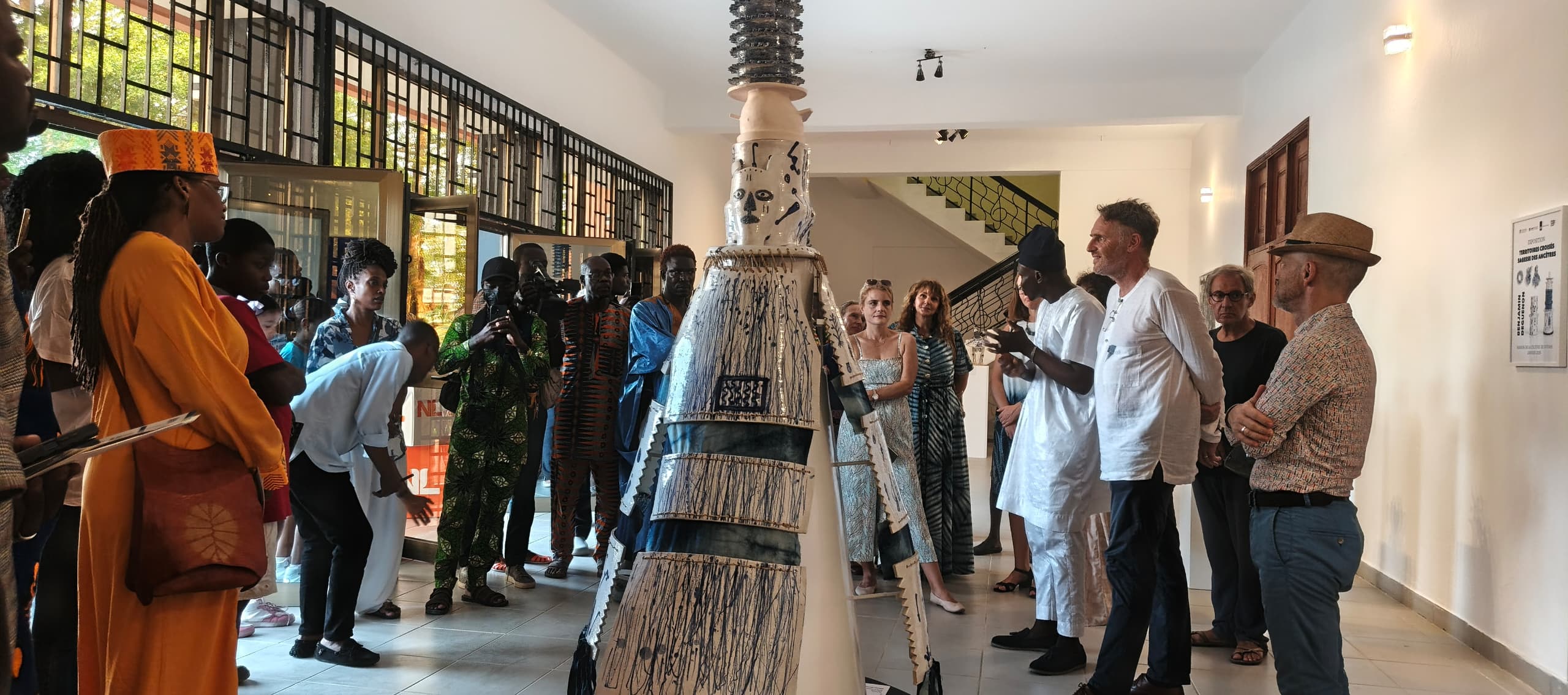
« Silence des ancêtres » est l'une des œuvres phares de cette exposition. Benjamin Deguénon décrit cette pièce comme un hommage aux ancêtres maltraités durant la colonisation. « Si les ancêtres devaient punir toute la barbarie qui a eu lieu dans le temps, nous ne pourrions pas accepter le brassage des cultures aujourd'hui. Ce silence parle. Il nous rappelle le pardon, la nécessité de savoir pardonner, de laisser derrière nous certaines choses pour avancer », confie l'artiste.
La Conseillère technique aux Arts au Ministère du Tourisme, de la Culture et des Arts, Carole Borna, a relevé la profondeur symbolique de l'exposition : « Cette exposition nous propose bien plus qu'un simple accrochage d'œuvres. Elle nous invite à une traversée de l'histoire, de la mémoire et de l'intime ».
Selon elle, l'art de Benjamin Deguénon se construit par strates, à l'image de la mémoire elle-même. « Plastiquement, l'artiste travaille la matière avec une grande liberté, convoquant peinture, dessin et texture pour produire des œuvres où rien n'est décoratif, où chaque marque fait signe, où chaque dessin devient sens », a-t-elle souligné.
Carole Borna a salué la collaboration entre le Ministère du Tourisme, de la Culture et des Arts et l'Ambassade des Pays-Bas, permettant aux artistes de s'inscrire dans la durée, d'expérimenter et de contribuer pleinement à une économie créative dynamique. « Soutenir l'art contemporain, ce n'est pas seulement exposer des œuvres, c'est soutenir des parcours, des imaginaires, des filières entières », a-t-elle affirmé.
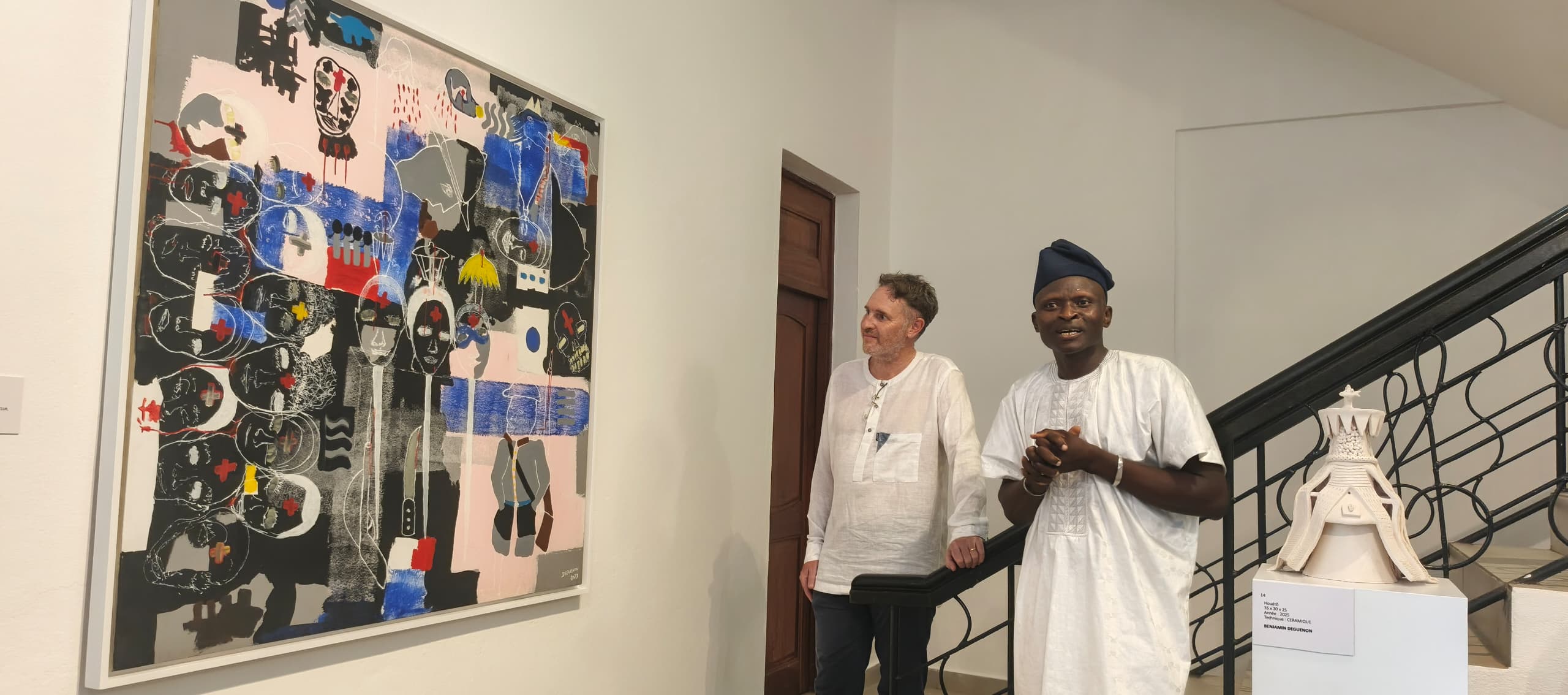
L'exposition « Territoires croisés, Sagesse des ancêtres » est accessible au public à la Maison de la Culture de Ouidah durant tout le mois de janvier. Elle offre aux visiteurs une immersion sensible dans un univers où mémoire, histoire et création contemporaine se rencontrent pour mettre en lumière la sagesse des ancêtres.
A.A.A
Catégories: Afrique
Lituanie: il y a 35 ans, l'armée soviétique attaquait la tour de télévision et le Parlement
La Lituanie commémore, depuis le 12 janvier au soir, les affrontements meurtriers qui ont fait quatorze morts quand les Lituaniens ont voulu défendre la tour de télévision, le Parlement et le siège de la radio contre les militaires soviétiques. Trente-cinq ans plus tard, l’heure est au recueillement, mais dans la foule, les Lituaniens ne peuvent oublier le conflit en Ukraine et les menaces russes alors que leur pays est limitrophe de la Russie de Vladimir Poutine.
Catégories: Union européenne
Is the US Moving Towards the UN’s Exit Door?
Credit: United Nations
By Thalif Deen
UNITED NATIONS, Jan 13 2026 (IPS)
Judging by the mass US withdrawal from 66 UN entities, including UN conventions and international treaties, is it remotely possible that the unpredictable Trump administration may one day decide to pull out of the UN, and force the Secretariat out of New York– despite the 1947 UN-US headquarters agreement?
Besides the 66, the withdrawals also include the pullouts from the Human Rights Council, the WHO, UNRWA and UNESCO– while imposing drastic reductions in funding for the remaining UN entities the US has not yet formally exited.
So, will the United Nations, which has come under heavy fire, be far behind?
That possibility is strengthened by the critical views of the UN both by President Trump and senior US officials.
Dr Stephen Zunes, Professor of Politics, University of San Francisco, who has written extensively on issues relating to the United Nations, told IPS even the U.S. presidents most hostile to the United Nations– like Ronald Reagan and George W. Bush– recognized the importance of the world body in terms of advancing U.S. interests, including understanding the importance of maintaining the UN system as a whole, even while violating certain legal principles in particular cases.
Similarly, he pointed out, the United States was willing to participate in various UN bodies in an effort to wield influence, even while disagreeing with some of their policies or even their overall mandates.
“The Trump administration, however, appears to be rejecting the post-WWII international legal system as a whole. His statements, particularly since the attack on Venezuela, appear to be a throwback to the 19th-century imperial prerogatives and a rejection of modern international law.”
“As a result, it is possible that Trump could indeed pull the United States out of the United Nations and force the UN out of New York”, declared Dr Zunes.
Addressing the General Assembly last September, Trump remarked, “What is the purpose of the United Nations? It’s not even coming close to living up to [its] potential.”
Dismissing the U.N. as an outdated, ineffective organization, he boasted, “I ended seven wars, dealt with the leaders of each and every one of these countries, and never a phone call from the United Nations offering to help in finalizing the deal.”
Martin S. Edwards, Associate Dean of Academic and Student Affairs, School of Diplomacy and International Relations at Seton Hall University, told IPS “this is dubious language about cutting inefficiency and fighting diversity wrapped up in red meat to feed President Trump’s base”.
It’s a ploy to use foreign affairs to distract voters for whom he has yet to deliver. The fact that the actual follow-up documents haven’t been received by the Secretary General tells you everything here. It fits a pattern of the President carving out maximalist positions and then getting very little in the end, he pointed out.
But it’s a bigger challenge, he said, on two fronts:
1. This is going to continue to REDUCE US influence at the UN rather than increase it. Stable foreign relations are based on credibility. The US continues to squander its reserves, and other countries will step into the vacuum.
2. This policy might have been a good social media post for voters, but makes little sense in practice. What the White House wants is a line-item veto over every single aspect of UN operations. But assessed contributions are not an ala carte menu, declared Edwards.
Mandeep S. Tiwana, Secretary General, CIVICUS, a global alliance of civil society organizations, told IPS retreat from international institutions by the Trump Administration is an attack on the legacy of President Franklin D. Roosevelt who gave the people of the United States the New Deal and envisioned a bold framework for the establishment of the UN to overcome the horrors of the Second World War.
“Many of the impacted international institutions were built through the blood, sweat and tears of Americans. Pulling out of these institutions is an affront to their sacrifices and reverses decades of multilateral cooperation on peace, human rights, climate change and sustainable development,” he said.
Meanwhile, the attacks on the UN have continued unabated.
In an interview with Breitbart News, U.S. Representative to the United Nations Ambassador Mike Waltz said, “A quarter of everything the UN does, the United States pays for”.
“Is there money being well spent? I’d say right now, no, because it’s being spent on all of these other woke projects, rather than what it was originally intended to do, what President Trump wants it to do, and what I want it to do, which is focus on peace.”
Historically, the United States has been the largest financial contributor, typically covering around 22% of the UN’s regular budget and up to 28% of the peacekeeping budget.
Still, ironically, the US is also the biggest defaulter. According to the UN’s Administrative and Budgetary Committee, member states currently owe $1.87 billion of the $3.5 billion in mandatory contributions for the current budget cycle.
The former US House Republican Conference Chair Elise Stefanik of New York, a one-time nominee for the post of US Ambassador to the UN, was quoted as saying, “In the UN, Americans see a corrupt, defunct, and paralyzed institution more beholden to bureaucracy, process, and diplomatic niceties than the founding principles of peace, security, and international cooperation laid out in its charter.”
Meanwhile, in a veiled attack on the UN, Secretary of State Marco Rubio said, “What we term the “international system” is now overrun with hundreds of opaque international organizations, many with overlapping mandates, duplicative actions, ineffective outputs, and poor financial and ethical governance.”
Even those that once performed useful functions, he pointed out, have increasingly become inefficient bureaucracies, platforms for politicized activism or instruments contrary to our nation’s best interests, he said.
“Not only do these institutions not deliver results, they obstruct action by those who wish to address these problems. The era of writing blank checks to international bureaucracies is over,” declared Rubio
IPS UN Bureau Report
Follow @IPSNewsUNBureau
!function(d,s,id){var js,fjs=d.getElementsByTagName(s)[0],p=/^http:/.test(d.location)?'http':'https';if(!d.getElementById(id)){js=d.createElement(s);js.id=id;js.src=p+'://platform.twitter.com/widgets.js';fjs.parentNode.insertBefore(js,fjs);}}(document, 'script', 'twitter-wjs');
Catégories: Africa
Assassinat d'Alain Orsoni : "Ce que l'on tolère devient ce qui nous définit"
A la Une de la presse, ce mardi 13 janvier, l’assassinat, hier, en Corse, du nationaliste Alain Orsoni. L’ex-président de l’AC Ajaccio était soupçonné d’être un "chef de clan" lié à la criminalité corse, dont le rôle est questionné, par ailleurs, dans l’incendie d’un bar de Crans-Montana, en Suisse, qui a fait 40 morts. Les condamnations, hier, dans le procès anti-mafia "Hydra", en Italie. La nouvelle ambassade chinoise à Londres. Et une appli pour ne pas mourir dans l’ignorance générale.
Catégories: France, Határon túli magyar portálok összesített hírei
Drogues : quels liens entre les filières balkaniques de la cocaïne et le Venezuela ?
Le Venezuela est bien un lieu de transit pour les cartels sud-américains et balkaniques de la cocaïne, mais son rôle est mineur par rapport à celui de pays voisins comme la Colombie, le Guatemala ou encore l'Équateur.
- Articles / Monténégro, Serbie, Croatie, drogues, Défense, police et justice, Courrier des Balkans
Catégories: Balkans Occidentaux
Drogues : quels liens entre les filières balkaniques de la cocaïne et le Venezuela ?
Le Venezuela est bien un lieu de transit pour les cartels sud-américains et balkaniques de la cocaïne, mais son rôle est mineur par rapport à celui de pays voisins comme la Colombie, le Guatemala ou encore l'Équateur.
- Articles / Monténégro, Serbie, Croatie, drogues, Défense, police et justice, Courrier des Balkans
Catégories: Balkans Occidentaux
Drogues : quels liens entre les filières balkaniques de la cocaïne et le Venezuela ?
Le Venezuela est bien un lieu de transit pour les cartels sud-américains et balkaniques de la cocaïne, mais son rôle est mineur par rapport à celui de pays voisins comme la Colombie, le Guatemala ou encore l'Équateur.
- Articles / Monténégro, Serbie, Croatie, drogues, Défense, police et justice, Courrier des Balkans
Catégories: Balkans Occidentaux
Drogues : quels liens entre les filières balkaniques de la cocaïne et le Venezuela ?
Le Venezuela est bien un lieu de transit pour les cartels sud-américains et balkaniques de la cocaïne, mais son rôle est mineur par rapport à celui de pays voisins comme la Colombie, le Guatemala ou encore l'Équateur.
- Articles / Monténégro, Serbie, Croatie, drogues, Défense, police et justice, Courrier des Balkans
Catégories: Balkans Occidentaux
Russian official found dead at embassy in Cyprus
Cypriot authorities "appear to have been informed of the incident with a delay of several hours".
Catégories: European Union
Kosovo : la levée annoncée des sanctions européennes
Les sanctions européennes qui frappaient le Kosovo depuis l'été 2023 vont être totalement levées ce mois de janvier, annonce la Commission. Une conséquence du bon déroulement des élections locales d'octobre et des législatives de décembre, mais qui croit encore en la relance du « dialogue » avec Belgrade ?
- Le fil de l'Info / Kosovo Vetëvendosje, Kosovo, Questions européennes, Courrier des Balkans, dialogue Kosovo Serbie, Tensions Nord Kosovo
Catégories: Balkans Occidentaux
Pages



© 2012-2018 Europa Varietas Foundation © 2015-2018 Europa Varietas Association
www.europavarietas.org | info(@)europavarietas(dot)org | Switzerland




We are looking for sponsors for the English translation of these books, please contact turkeandras(at)gmail(dot)com