
You are here
Feed aggregator
South Korea’s Renewed Strategic Pivot to India
For the past decade, India-South Korea interactions have been limited. President Lee’s upcoming visit is set to change that.
Categories: Afrique, Diplomacy & Crisis News
Gaza Crisis Deepens as Aid Restrictions and Ongoing Strikes Strain Humanitarian Operations
A view of the rubble in Jabalia, northern Gaza, after heavy Israeli bombardment. Credit: UNICEF/Rawan Eleyan
By Oritro Karim
UNITED NATIONS, Apr 17 2026 (IPS)
Roughly six months after the ceasefire in the Occupied Palestinian Territory went into effect, the humanitarian situation in Gaza remains precariously fragile, despite a relative decline in hostilities. The crisis, marked by ongoing Israeli airstrikes and shelling, continued blockades on humanitarian aid, and widespread displacement, has pushed the majority of Palestinians in Gaza to the brink. Amid the vast scale of needs, basic services are increasingly strained, and humanitarian experts warn that the situation could deteriorate further in the coming months unless sustained aid and funding are secured.
A new report from the United Nations Relief and Works Agency for Palestinians in the Near East (UNRWA) on the current conditions in Gaza confirmed a continuation of airstrikes, shelling, and gunfire across multiple areas, including Beit Lahia, Jabalia, Deir al Balah, Khan Younis, Rafah, and Bureij. The Office for the Coordination of Humanitarian Affairs (OCHA) estimates that since the eruption of hostilities on October 7, 2023, approximately 72,315 Gazans have been killed and another 172,137 injured.
“The scale and pattern of these actions, occurring alongside mass displacement of Palestinians from their homes and land in Gaza shows once again the ongoing broader policy of ethnic cleansing across the occupied Palestinian territory,” said a group of United Nations (UN) experts on April 13. “This cycle of displacement, terror, and targeted attacks serves an ultimate purpose: to make life unbearable for Palestinians and permanently force them from their land…Targeting areas known to shelter displaced civilians is a grave breach of international humanitarian law and is a grim reminder of the urgent need for international action and accountability.”
According to Palestine’s Ministry of Health, at least 32 Gazans have been killed by Israeli forces in early April alone. Airstrikes, gunfire, and shelling are daily occurrences, with women, children, disabled persons, humanitarian workers, and journalists being routinely targeted. On April 9, a young girl was killed by Israeli gunfire in a crowded classroom-turned-makeshift encampment.
“For the past 10 days, Palestinians are still being killed and injured in what is left of their homes, shelters, and tents of displaced families, on the streets, in vehicles, at a medical facility and in a classroom,” said United Nations High Commissioner for Human Rights Volker Türk. “Movement itself has become a life-threatening activity. Incidents of Palestinians killed by Israeli forces while walking, driving, or standing outside are recorded nearly every day.”
The Office of the High Commissioner for Human Rights (OHCHR) also confirmed that there have been increasing cases of Israeli forces killing Palestinians based on their proximity to the “yellow line”, a line of demarcation that divides the Palestinian-controlled areas of Gaza and the Israeli-controlled areas. “Targeting civilians not taking direct part in hostilities is a war crime, regardless of their proximity to deployment lines,” said Türk
On April 6, Israeli forces shot at vehicles from the World Health Organization (WHO), killing a driver. Two days later, Israeli drone strikes killed Al Jazeera journalist Mohamed Washah in Gaza City, marking the 294th Palestinian journalist to be killed by Israeli forces since October 7, 2023. Additionally, Israel has continued to ban international journalists from accessing Gaza, further compounding the regional decline of journalistic freedom.
“The number of journalists and humanitarian personnel killed in Gaza is unprecedented, and further compounds civilian harm as it makes reporting on the situation and responding to its humanitarian implications life-threatening,” added Türk.
Internal displacement is particularly rampant, with OCHA estimating that routine evacuation orders and bombardment have affected roughly 92 percent of all housing across the enclave, with the vast majority of affected communities having been displaced multiple times. Civilians residing in overcrowded, makeshift encampments are disproportionately affected by insecurity, freezing temperatures, building collapse, and a severe shortage of humanitarian aid and basic services.
Humanitarian movement remains severely constrained, with all UNRWA staff banned from accessing the entire Occupied Palestinian Territory since March 2025. The agency, which has long acted as a critical lifeline for Palestinians, has pre-positioned food parcels, flour, and shelter supplies at Gaza’s borders, which could help hundreds of thousands of Gazans.
Thousands of Palestinians across the enclave are in urgent need of medical care as Gaza’s health system nears the brink of collapse, facing severe shortages of supplies amid an influx of injured and ill patients. Medications are critically short in supply, and UNRWA has reported a sharp uptick in cases of ectoparasitic infections such as scabies and fleas, as well as chickenpox and other skin diseases, which have been linked to disrupted water and hygiene (WASH) services, overcrowding, and pests.
Despite these challenges, humanitarian experts have expressed optimism that the situation in Gaza could improve as access constraints begin to fade. Following nearly 40 days of closure, the critical Zikim crossing reopened in early April, allowing nutritional and health supplies to reach northern Gaza directly. UNRWA is currently supporting over 67,000 displaced individuals across 83 collective emergency shelters, with over 11,000 personnel providing lifesaving care.
UNRWA, in collaboration with WHO, the United Nations Children’s Fund (UNICEF), and Palestine’s Ministry of Health, reached almost 2,100 children under three years of age with vaccinations between April 5 and 9. WHO and its partners have also been facilitating dozens of medical evacuations through the Rafah border crossing and providing access to medical care, food, water, and psychosocial services to returning Gazans.
The UN experts stressed that a definitive end to hostilities, an expansion of protection services, and the unimpeded delivery of humanitarian aid are crucial in coordinating an effective return to stability in Gaza. Additionally, the experts called on Israeli authorities to ensure a safe and dignified return to Gaza for displaced individuals, as well as the lifting of restrictions for UNRWA operations.
“We reiterate our call on States to bring Israel’s unlawful occupation to an end and ensure the immediate protection of civilians sheltering in displacement sites across the Gaza Strip, including by scaling up vital humanitarian assistance,” the experts said. “States must comply with their legal obligations. They must bring Israel’s unlawful occupation to an end, refrain from recognising it and withhold assistance to it, and take effective measures to ensure investigations and accountability for grave violations of international law in the occupied Palestinian Territory.”
IPS UN Bureau Report
Follow @IPSNewsUNBureau
!function(d,s,id){var js,fjs=d.getElementsByTagName(s)[0],p=/^http:/.test(d.location)?'http':'https';if(!d.getElementById(id)){js=d.createElement(s);js.id=id;js.src=p+'://platform.twitter.com/widgets.js';fjs.parentNode.insertBefore(js,fjs);}}(document, 'script', 'twitter-wjs');
Categories: Africa, European Union
Guerre au Moyen-Orient : 100 euros de plus sur les billets d'avion
Le conflit au Moyen-Orient a des répercussions dans les Outre-mer. Les prix des billets d'avion s'envolent en raison de l'augmentation du cours du kérosène. Une mission gouvernementale a été confiée à un député ultramarin pour freiner la hausse des prix.
Categories: European Union, France
La dissolution ''préoccupante'' d'associations des droits de l'homme au Burkina Faso
Le Burkina Faso annonce la dissolution d'une centaine d'organisations de défense des droits de l'homme. Amnesty International se dit ''alarmée'' et ''préoccupée par cette ''atteinte flagrante au droit à la liberté d'association''.
Categories: Afrique, Swiss News
La dissolution ''préoccupante'' d'associations des droits de l'homme au Burkina Faso
Le Burkina Faso annonce la dissolution d'une centaine d'organisations de défense des droits de l'homme. Amnesty International se dit ''alarmée'' et ''préoccupée par cette ''atteinte flagrante au droit à la liberté d'association''.
Categories: Afrique, European Union
The Deepening Deterioration of Public Sentiment Between Japan and China
What do Japanese and Chinese think about each other’s countries? Let’s look at the numbers.
Categories: Afrique, Diplomacy & Crisis News
What next for South African opposition firebrand Malema after his five-year prison sentence?
The sentence raises huge questions marks over the political future of one of South Africa's most controversial politicians.
Categories: Africa, European Union
BRICS: Can India Lead a Bloc Without a Cause?
BRICS appears to be more riddled with internal conflicts than most multilateral groups.
Categories: Afrique, Diplomacy & Crisis News
UN Adopts Resolution Condemning North Korea Human Rights Abuses; South Korea Co‑Sponsors Amid a Compromising Shift From CVID‑Focused Denuclearization
Amid turbulence in the international order, will international society remain capable of countering totalitarian heresies?
At the 61st session of the United Nations Human Rights Council in Geneva on March 30, 2026, South Korea reaffirmed its position on human rights in North Korea, joining 50 countries as a co-sponsor of the council’s annual resolution. The move marked Seoul’s first such participation since the inauguration of President Lee Jae-myung, a former human rights lawyer. The resolution, adopted for the 24th consecutive year since 2003, passed again by consensus without a vote.
The measure condemns “in the strongest terms” what it calls “systematic, widespread and gross” violations in North Korea, citing crimes against humanity that include forced labor used to support nuclear and missile programs, the operation of political prison camps, torture, public executions and what it describes as a “pervasive culture of impunity.” It urges Pyongyang to take “immediately all steps” necessary to end such crimes, including the closure of prison camps, the release of detainees and sweeping legal and institutional reforms.
Compared with last year’s text, the 2026 resolution makes only modest adjustments but places clearer emphasis on dialogue. It highlights the “importance of dialogue and engagement to improve the human rights situation in North Korea, including inter-Korean dialogue,” signaling a subtle shift from earlier iterations that focused more heavily on the severity of abuses.
The resolution also offers limited acknowledgment of North Korea’s recent engagement with international mechanisms. It “welcomes” the country’s compliance with certain human rights obligations and its participation in the fourth cycle of the Universal Periodic Review, including a United Nations review on disability rights in Geneva in August last year and its appearance in the U.P.R. process in November 2024.
As various assessments have noted, however, North Korea’s normalization in the international community is unlikely to be realized without parallel progress on both denuclearization and human rights. From this perspective, human rights should not be treated as a secondary or downstream issue, but rather as a form of leverage operating alongside CVID‑style denuclearization—jointly shaping the conditions under which meaningful engagement, and ultimately normalization, can occur.
Despite the strategic importance of such parallel progress, South Korea’s new Lee administration marks a departure from the previous government’s policy emphasis, weakening its leverage to nudge North Korea onto a path toward normalization. Under the previous Yoon administration, former Vice Foreign Minister Kang In‑sun explicitly linked human rights pressure with denuclearization objectives. At the 2025 high‑level segment of the Conference on Disarmament in Geneva, she called on North Korea to abandon all nuclear and missile programs in a “complete, verifiable, and irreversible manner,” directly invoking the CVID framework.
By contrast, at the 2026 session of the same forum, Jeong Yeon‑du—serving as a senior official overseeing strategic affairs and North Korea policy at the Ministry of Foreign Affairs—outlined a phased approach centered on “halt, reduction, and dismantlement,” while emphasizing dialogue, coordination, and a return to negotiations. Notably, his remarks did not include any reference to CVID.
Taken together, the shift from an explicit CVID formulation to a phased, open‑ended sequence narrows the gap between pressure and process, but at the cost of blurring the intended end‑state of denuclearization.
On March 26th, 2026—the 16th spring since ROKS Cheonan (PCC-772), a Pohang-class corvette comparable to the US Navy’s Cyclone-class PC-1, sank after North Korean torpedoes struck in 2010—this waterside memorial gathering honors the 46 sailors whose sacrifice still weighs heavy on their families and the Republic of Korea Navy 2nd Fleet Command (Photo credit: RoK Navy).
China’s Gray Shadow Still Looms Over Defectors
On the issue of North Korean defectors, the resolution again addresses China indirectly by reaffirming the principle of non-refoulement, urging all states to ensure that no one is forcibly returned to North Korea. The wording closely mirrors that of resolutions adopted from 2023 through 2025, reflecting a continued effort to preserve consensus by avoiding explicit reference to Beijing — a choice that, critics say, comes at the cost of diminishing attention to the plight of defectors.
While the resolution maintains general language on forced repatriation, it stops short of expanding or sharpening scrutiny on the issue, even as reports of ongoing detentions and returns persist. The relative lack of new emphasis has drawn criticism from experts, who warn it risks signaling reduced urgency at a time when conditions for North Korean escapees in China remain severe. Ahn Chang-ho, chairperson of South Korea’s National Human Rights Commission, said that “some core elements were reduced or deleted,” including protections related to North Korean defectors, expressing concern that attention to the issue had been weakened.
Even so, criticism of China persists. Advocates argue that Beijing continues to fall short of its obligations under international law, including the Convention against Torture and the 1951 Refugee Convention, both of which prohibit returning individuals to countries where they face a risk of torture. This concern is underscored by a particularly telling latest case from March 2026 documented by Human Rights Watch: a North Korean woman in China who helped her son survive a border crossing is now facing forced repatriation. If returned, she is at high risk of torture, forced labor, sexual violence, and enforced disappearance—abuses that the 2014 UN Commission of Inquiry on North Korea identified as potentially amounting to aiding and abetting crimes against humanity when carried out in cooperation with another state. Human Rights Watch stresses that, even as a party to these core treaties, China’s ongoing pattern of forcibly returning North Koreans, exemplified by this recent case, continues to erode the fundamental principle of non-refoulement.
Estimates suggest that roughly 2,000 North Korean defectors are being held in China without access to asylum procedures, often in undisclosed facilities or border detention centers, prior to being repatriated. Those who are returned face a high risk of torture, enforced disappearance, or execution.
Categories: Afrique, Diplomacy & Crisis News
Liban : nouvel affront israélien à la France
Jeudi soir, Donald Trump a annoncé un cessez-le-feu de 10 jours entre Israël et le Liban, deux jours à peine après l’ouverture de négociations directes à Washington. Une annonce qui intervient alors qu’Israël continue d’occuper le sud du pays.
Mais c’est un autre fait qui retient l’attention : Benjamin Netanyahou a exigé l’exclusion de la France de ces négociations, allié historique du Liban, alors qu’elles sont elles-mêmes conduites par les États-Unis, principal allié d’Israël.
Cette exigence israélienne pose une question de fond : que reste-t-il de la relation franco-israélienne ? Elle apparaît aujourd’hui profondément déséquilibrée et unilatérale ; Israël exige, la France cède, ou se contente de condamnations verbales qui n’ont jamais infléchi la moindre décision de Tel-Aviv.
Est-ce le signe d’une fin définitive de l’amitié franco-israélienne, ou simplement l’aboutissement d’un affaiblissement diplomatique français ?
L’article Liban : nouvel affront israélien à la France est apparu en premier sur IRIS.
Categories: Afrique, Diplomacy & Defense Think Tank News
Comment Jeffrey Epstein a tissé sa sinistre toile en France
Pourquoi la France était-elle le seul autre pays au monde où Jeffrey Epstein possédait une propriété immobilière en dehors des États-Unis ? Était-ce par amour du pays… Ou parce qu'il y trouvait de quoi servir ses intérêts ? Dans les années 90, Paris est la capitale de la mode, et celle des agences de mannequins. Elles recrutent de très jeunes filles venues du monde entier, parfois mineures, souvent isolées… Des proies faciles pour le criminel sexuel américain.
Categories: European Union, France
Japan’s Constitutional Theater: Revising Article 9 Would Be a Mistake
A constitutional revision solves the wrong problem – and creates new complications.
Categories: Afrique, Diplomacy & Crisis News
Blog • L'isolement numérique de Čedomir Stojković : comment Vučić transforme l'assignation à résidence en « mort civile »
Dans un précédent article, j'examinais comment le régime d'Aleksandar Vučić avait fait du droit pénal un instrument de pression politique, en visant l'avocat Čedomir Stojković. Ce cas constituait déjà un signal préoccupant pour les défenseurs des droits humains. Pourtant, les événements du printemps 2026 révèlent une évolution plus profonde — et, dans un sens presque kafkaïen, plus subtile — du dispositif répressif serbe.
Ce que les médias proches du pouvoir présentent comme une « mesure (…)
Categories: Balkans Occidentaux, European Union
The Geopolitical Importance of India’s Shrinking ‘Red Corridor’
India has turned the corner in its battle against Naxalism – and effectively governing its own margins is an essential step toward global power status.
Categories: Afrique, Diplomacy & Crisis News
Italie : Mme Meloni stoppée par le référendum
Les 22 et 23 mars 2026, les électeurs italiens ont rejeté, par 54 % des voix pour le non contre 46 % pour le oui, le projet de réforme constitutionnelle de la magistrature porté par la présidente du Conseil, Giorgia Meloni. Avec une participation proche de 60 %, un taux exceptionnellement élevé (…)
/ Fascisme, Droit, Italie, Justice
Kubilius propose un nouveau traité visant à créer une union européenne de la défense
Selon le chef de la défense de l'UE, un pacte de type Schengen pourrait être ouvert au Royaume-Uni, à la Norvège et à l'Ukraine
The post Kubilius propose un nouveau traité visant à créer une union européenne de la défense appeared first on Euractiv FR.
Skunk Works Is Looking for a U-2 Pilot
Despite being one of the oldest aircraft still flying in U.S. service, the U-2 remains relevant enough for Skunk Works to seek a qualified pilot in Palmdale.
Skunk Works, the legendary Lockheed Martin’s secretive advanced projects division, is hiring a U-2 pilot in Palmdale, California.
The job posting, that you can find here, calls for an onsite, full-time, first-shift position in Test Engineering for an experienced professional pilot, with a 4x10h schedule and possible relocation, and it is clearly framed as a test-oriented role rather than routine operational flying: according to the listing, the pilot would conduct engineering flight tests, production-acceptance flights, and flight-test support, help verify aircraft compliance and operational suitability, coordinate flight-operations efforts, approve cockpit configuration, and, if needed, perform demonstration flights for customers and government officials.
The ad, published on Apr. 6, 2026, says applicants must be no more than two years outside qualification on the U-2S Dragon Lady, hold a current FAA Class I or II medical, and possess either a suitable FAA Commercial Pilot certificate for multi-engine land and instrument airplane or an ATP (Airline Transport Pilot), while also being willing to travel, holding a valid U.S. passport, and arriving with an active Top Secret clearance.
Among the desired qualifications are 1,000 flight hours, graduation from a formal Test Pilot School, background in flight-test disciplines such as weapons, avionics and flight sciences, as well as instructor/training, communication, organizational and leadership or program-integration experience.
The posted compensation is a California salary range of $156,400 to $275,655 outside most major metro areas and $179,800 to $311,650 in most major metro areas, although the final offer depends on factors such as experience, training, skills, scope and business considerations; listed benefits include medical, dental, vision, life insurance, short- and long-term disability, flexible spending accounts, parental leave, paid time off, holidays, education assistance, and incentive-plan eligibility.
U-2 pilot. | Source: USAF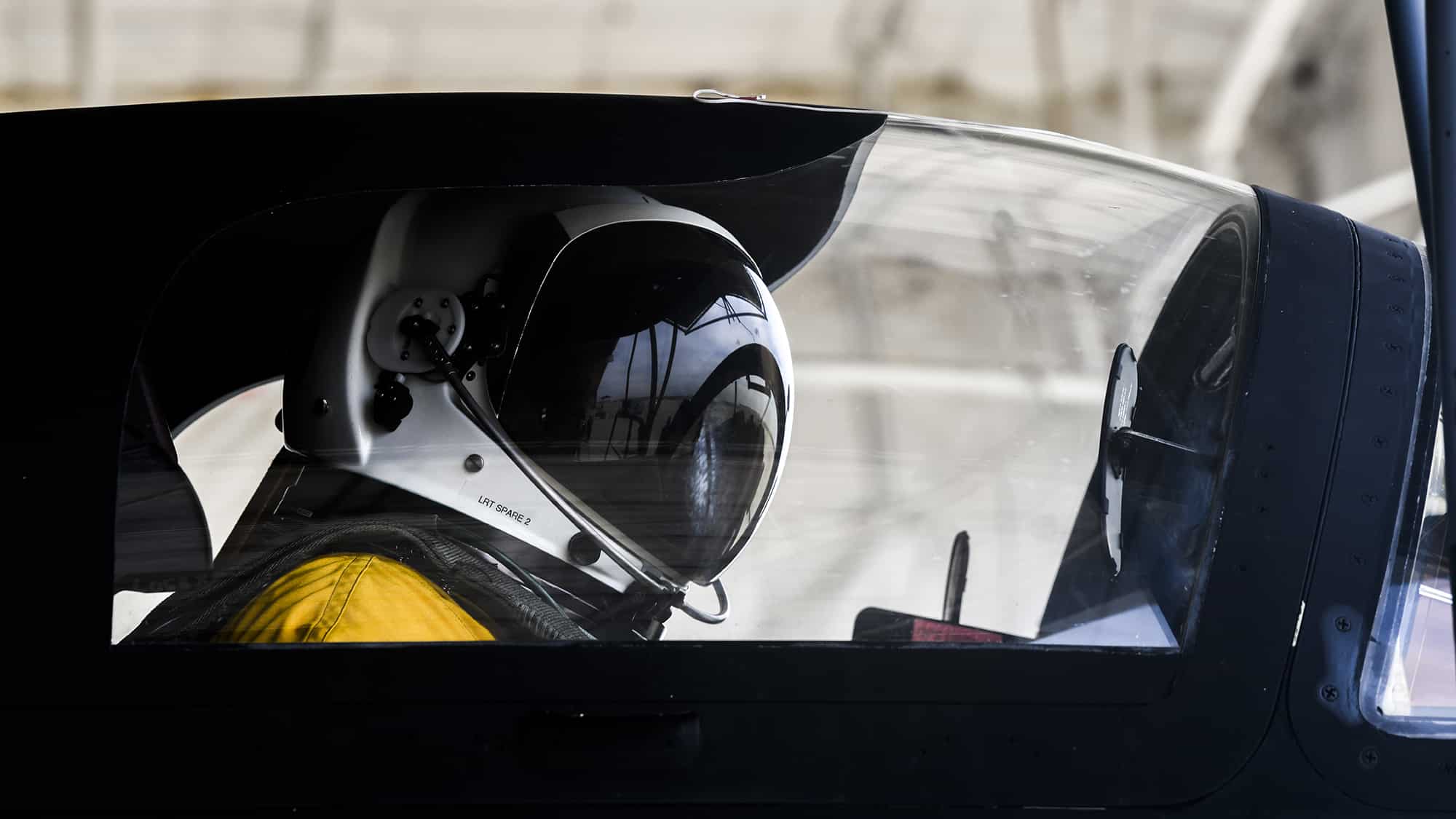
The emergence of the job posting is quite interesting, considering the iconic Dragon Lady was slated for retirement from U.S. Air Force service this year. However, while some U-2s have already been withdrawn from active service, the aircraft’s retirement date is far from settled, and the sundown of the type remains under intense congressional scrutiny.
In fact, U-2s are still flying active intelligence, surveillance, and reconnaissance (ISR) missions on a daily basis from forward operating locations, and there is little sign of that activity slowing down at least for now. USAF U-2s are home based at the 9th Reconnaissance Wing, Beale Air Force Base, California, but are rotated to operational detachments worldwide, including RAF Fairford, UK; Osan Air Base, South Korea, and RAF Akrotiri, Cyprus. The latter sustained damage from an Iranian kamikaze drone launched in retaliation for the U.S. and Israeli air strikes, last month.
In line with such continuous postponement of its retirement, in 2023 Lockheed Martin announced the first flight of the U-2 Avionics Tech Refresh (ATR), carried out by Skunk Works in partnership with the U.S. Air Force. The company said the flight tested an updated avionics suite, new cockpit displays and a mission computer designed to the Air Force’s open mission systems standard, with further testing planned to mature the software baseline before more mission systems were added.
More recently, BAE Systems was awarded a contract to support and sustain the U-2’s AN/ALQ-221 Advanced Defensive System (ADS), another sign that the aircraft is still receiving updates and meaningful attention rather than simply being allowed to age out quietly.
As for Palmdale, Plant 42 remains a hub for major activity involving the type, and the job posting seems to suggest Lockheed Martin expects the Dragon Lady to continue generating the kind of work that may require highly specialized pilot support for quite some time.
A U-2 Dragon Lady takes off for the first flight of the Avionics Tech Refresh program in Palmdale, California. | Source: Lockheed Martin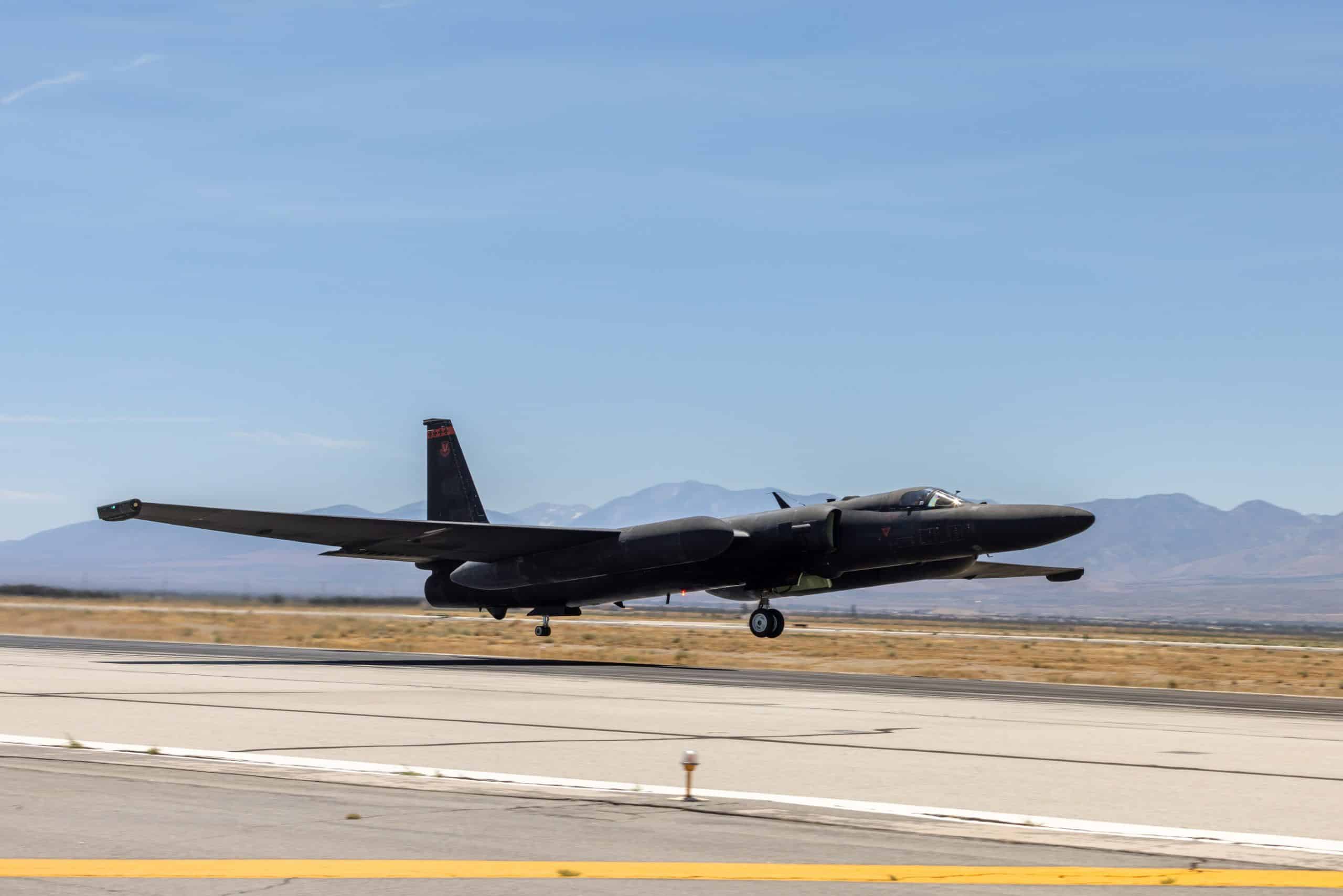
Eventually, it should not be forgotten that, beyond its operational role, the U-2 is still valued as a high-altitude testbed. Testing campaigns conducted over the last five years have leveraged the aircraft’s open architecture and its ability to integrate new technology quickly. The U-2 has been involved in containers and AI/ML experimentation, open-mission-systems integration, and gateway or data-sharing roles between different platforms. A Skunk Works pilot current on the U-2 would be useful if Lockheed is using the aircraft to trial payloads, communications systems, sensors, or battle-management concepts that may feed current and future programs.
Another (even more speculative) possibility is that Lockheed could employ a U-2 pilot as part of work on or around future classified ISR aircraft, using the Dragon Lady as a surrogate, a risk-reduction platform, or a bridge capability. With the RQ-180 spy drone slowly beginning to emerge from the shadows of black programs, there is a chance Skunk Works is maturing new manned or unmanned ISR concepts. In that context, having a U-2 pilot with a test background could make sense for comparative flying, sensor work, or manned-ISR experimentation.
Whatever, if you are interested and your profile fits the requirements, you’d better hurry: you have less than a month to apply, as the deadline is May 15, 2026.
Categories: Defence`s Feeds, European Union
L'essentiel du procès libyen en appel de Nicolas Sarkozy : "Claude, voyez cela"
Le procès en appel de l'affaire du financement libyen de la campagne présidentielle de Nicolas Sarkozy de 2007 se tient à Paris depuis le 16 mars. Condamné en première instance à 5 ans de prison, il avait été détenu 20 jours à l'automne. Résumé de la cinquième semaine d'audience, au cours de laquelle Claude Guéant, représenté par son avocat, a mis en difficulté la défense de l'ancien président.
Categories: European Union, France
China Was Once Buying Up Sri Lankan Ports. Now It’s India’s Turn.
The Indian Ocean has no shortage of distressed strategic assets: financially stressed yards, ports, and logistics infrastructure in small states that cannot sustain them independently.
Categories: Afrique, Diplomacy & Crisis News
Move Over, Hungary: Spain Is China’s New Best Friend in the EU
With Viktor Orban’s election loss, Pedro Sanchez is now Beijing’s most useful European leader.
Categories: Afrique, Diplomacy & Crisis News
Pages



© 2012-2018 Europa Varietas Foundation © 2015-2018 Europa Varietas Association
www.europavarietas.org | info(@)europavarietas(dot)org | Switzerland




We are looking for sponsors for the English translation of these books, please contact turkeandras(at)gmail(dot)com