
You are here
Feed aggregator
NASA’s X-59 QueSST Goes Supersonic
NASA’s X-59 QueSST flew faster than the speed of sound for the first time, expanding into the supersonic portion of its flight envelope.
NASA’s experimental X-59 QueSST (Quiet SuperSonic Technology) conducted its first supersonic flight on June 5, 2026, reaching a top speed of approximately Mach 1.1 (713 mph) and altitude of 43,400 feet. The milestone arrived as the aircraft continues to expand its flight envelope following the first flight in October 2025.
Going SupersonicFor this test flight, the aircraft was piloted by NASA test pilot Jim “Clue” Less. Less took off from Edwards Air Force Base, California, at 11:08 a.m. PDT, landing again after 81 minutes with new data on flying qualities at both subsonic and then supersonic speeds.
Step one: break the sound barrier.
The X-59 has officially flown at supersonic speeds for the first time, marking a major step forward on the path to quieting the sonic boom. Even faster and quieter flights are coming soon. pic.twitter.com/Ngia5oHXNn
— Lockheed Martin (@LockheedMartin) June 5, 2026
During the flight, the X-59 was supported by a NASA F-15 as safety chase aircraft. The agency said “the loud sonic booms from the F-15 obscured any sound made by the X-59,” which has been designed to create “only a quiet thump instead of a loud sonic boom” while flying at supersonic speed.
”X-59 is getting ready for its quiet supersonic debut,” said NASA Administrator Jared Isaacman. “Since the aircraft’s first flight on Oct. 28, 2025, the team has made tremendous progress, flying 16 times in the last 90 days and getting into a steady test rhythm. In the coming days, we expect to take the next step and push to Mach 1.4.”
JUST IN: The X-59 has gone supersonic!
The X-59 achieved supersonic speeds for the first time ever today — a major milestone for NASA’s Quesst mission and an important step toward upcoming flights that will demonstrate its quiet supersonic technology ahead of future… pic.twitter.com/mwblICs4vN
— NASA Aeronautics (@NASAaero) June 5, 2026
In the press release, NASA said this new milestone will be reached “in just days,” and it will be “even more critical to the mission.” In fact, this has been defined as a “mission conditions” flight, reaching a cruising speed of Mach 1.4 (925 mph) and altitude of approximately 55,000 feet.
These are the same conditions that will be used during the X-59 over several communities to gather data about how people may perceive its quiet thump. The data will be used to help regulators establish new noise standards in an effort to enable supersonic commercial flight over land.
Envelope ExpansionIn the last months, following the first flight on Oct. 28, 2025, the X-59 conducted a series of flight to expand the flight envelope, which saw the aircraft flying at a wide range of speeds and altitudes. NASA says the first phase of the X-59’s flight testing is dedicated to the envelope expansion, and upon completion it will move to the acoustic validation focused on the sound profile, aiming to complete it by the end of 2026.
NASA’s X-59 quiet supersonic research aircraft flies above Palmdale and Edwards, California, on its first flight Tuesday, Oct. 28, 2025, accompanied by a NASA F-18 research aircraft. | Source: NASA/Jim Ross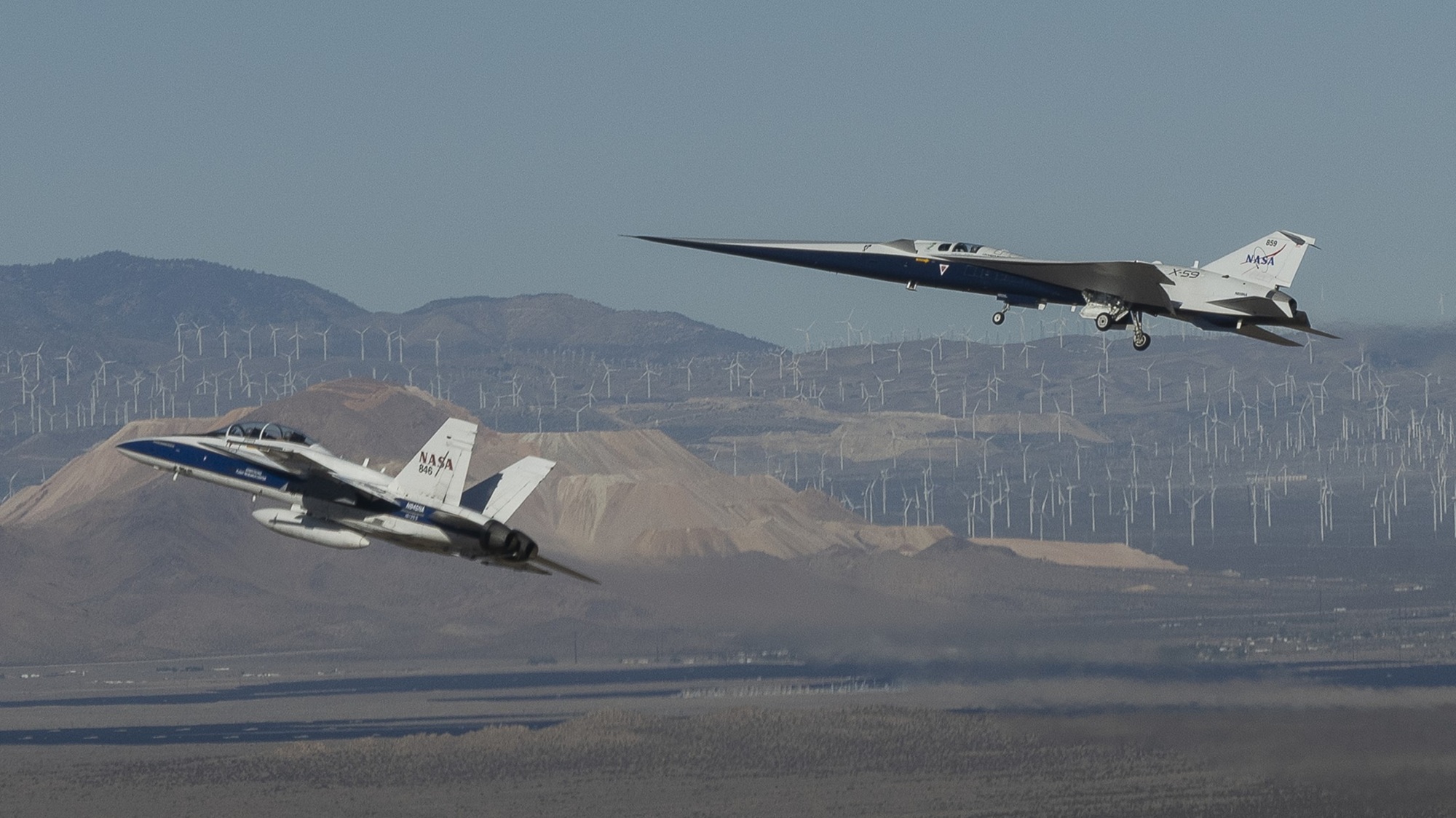
Other factors that are being looked at are the performance of its controls, loads and structural dynamics, and subsystems including hydraulics, fuel, avionics, landing gear, among the others. NASA additionally said it is monitoring the performance of the eXternal Vision System, the system of cameras which replaced the traditional forward windscreen because of the X-59’s long nose.
NASA also described some of the X-59’s maneuvers during its first block of test flights:
-
A rollercoaster maneuver involves a sequence of pitching the aircraft up and down to better understand aerodynamic forces and characterize stability and control.
-
A bank‑to‑bank maneuver is when an aircraft gently rolls from one side to the other, such as tipping its wings right, then smoothly rolling back through level and over to the left.
-
A flutter excitation maneuver introduces deliberate vibrations into the aircraft’s structure during flight to ensure the aircraft’s flutter boundaries are well understood and that its structure maintains safe margins across the flight envelope.
-
A wings-level push maneuver is a controlled, wings-level pitch-down movement used to evaluate the aircraft’s longitudinal stability, pitch response, and trim characteristics at a given test condition.
-
A gear-extend maneuver includes extending the aircraft’s landing gear at a controlled airspeed and configuration so engineers can measure the aerodynamic, structural, and handling qualities of the gear deployment, which can cause sudden changes in drag, pitch, vibration, and airflow. The landing gear retraction was tested as part of X-59’s first block of envelope expansion test flights.
The X-59 Quesst (Quiet SuperSonic Technology) is an experimental supersonic aircraft developed at Skunk Works for NASA’s Low-Boom Flight Demonstrator project. The technologies used on the jet are meant to influence future generations of quiet supersonic aircraft as part of the effort to reintroduce supersonic commercial flight.
The X-59 is, in fact, designed to generate a quieter sonic boom which should be within acceptable noise levels to help the FAA to lift the ban on commercial supersonic travel over land imposed in 1973. According to NASA, the sonic boom generated by the new aircraft will be less than 75 perceived dB on the ground, about a third less than the Concorde, which was reported around 100-110 dB.
A key feature of the aircraft which will allow to achieve this goal is the long tapered nose, which accounts for almost a third of the X-59’s length. The nose is designed to break up the shock waves that would ordinarily result in a supersonic aircraft causing a sonic boom.
NASA’s X-59 quiet supersonic research aircraft flies over the Mojave Desert in California on April 14, 2026. | Source: NASA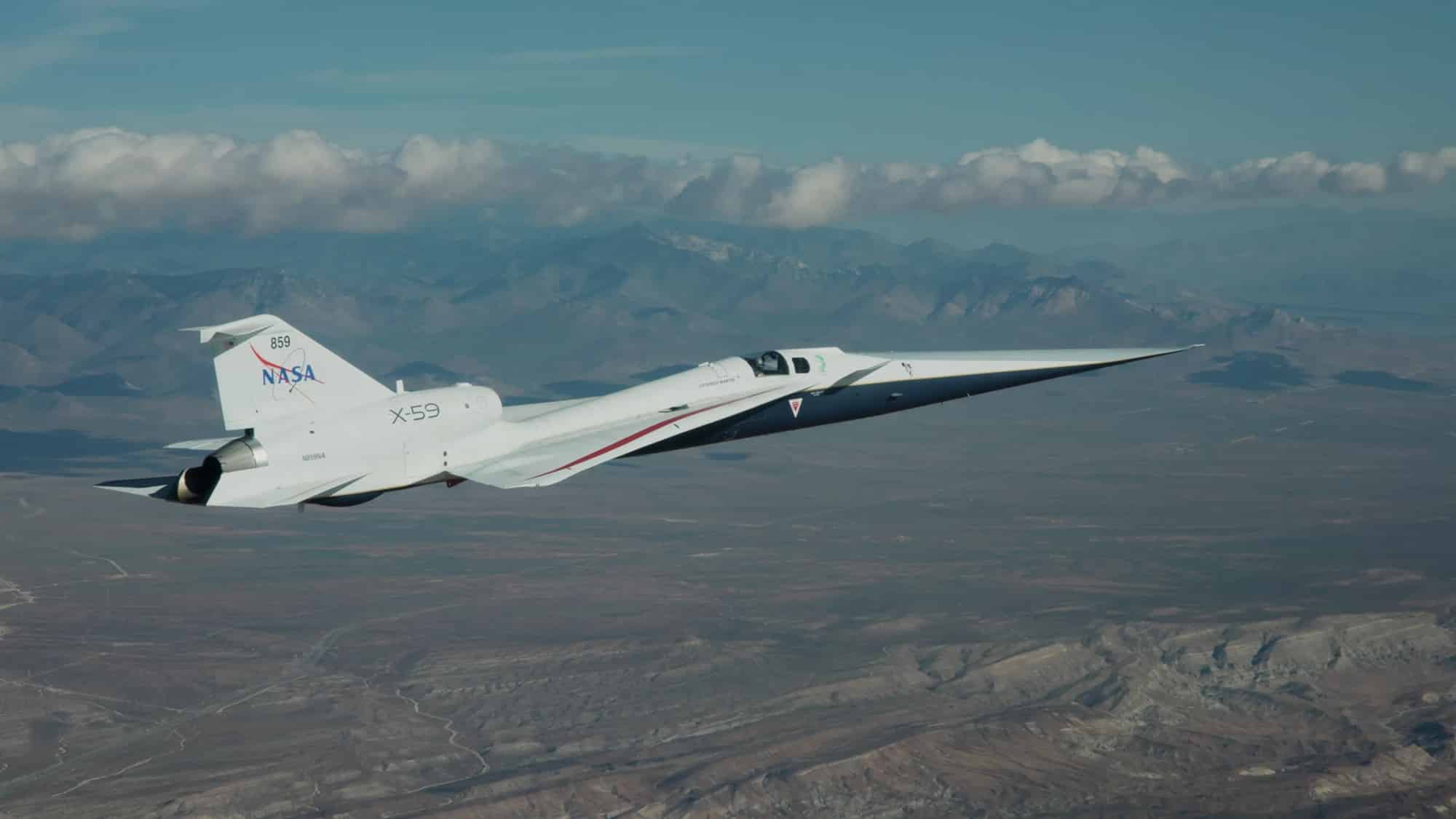
Due to this configuration, the cockpit is located almost halfway down the length of the aircraft, a solution which however does not allow the presence of a traditional windshield. Instead, NASA developed the eXternal Vision System, a series of high-resolution cameras feeding a 4K monitor in the cockpit.
The X-59 is powered by a F414-GE-100 engine with 22,000 pounds of thrust, modified from the F414 used by the F/A-18 Super Hornet. The engine is unusually placed on top of the aircraft to give it a smooth underside, which helps keep shockwaves from merging behind the aircraft and causing a sonic boom.
The X‑59 is equipped with multiple systems designed specifically to protect the pilot, including a life support system to deliver oxygen to the pilot while also powering the g‑suit. As another safety layer, the aircraft features an ejection seat and canopy adapted from a U.S. Air Force T‑38 trainer, outfitted with essentials such as a first aid kit, radio, and water.
Categories: Defence`s Feeds, Kelet-Közép-Európa
China/North Korea/South Korea : Xi-Kim summit: Seoul backs down on denuclearisation
Chinese President Xi Jinping's decision to visit Pyongyang in person for a two-day summit on 8-9 June is revealing of [...]
Categories: Defence`s Feeds
Les chiffres de la "Coupe du monde la plus polluante"
La Coupe du monde 2026, organisée dans toute l'Amérique du Nord et réunissant jusqu'à 48 équipes, devrait générer des distances à parcourir et des émissions sans précédent. Certains fans sont prêts à produire plusieurs tonnes de CO2 simplement en suivant leurs équipes. Le tournoi pourrait atteindre environ 9 millions de tonnes de CO2, ce qui en ferait potentiellement la Coupe du monde la plus polluante à ce jour.
Australia’s Rare Earth Sector
Opportunity, risk and the commitment gap
Categories: Diplomacy & Crisis News, France
Plus d'un Italien sur deux passera ses vacances d'été dans son pays en raison de la crise énergétique
Opter pour la proximité, renoncer à tout ou faire des sacrifices au nom des sacro-saintes vacances estivales ? Selon l’institut de sondage Piepoli, 80 % des Italiens se sont posé ces questions avant de penser leurs projets de vacances. La principale cause de leurs doutes sur la possibilité de s’offrir un temps de répit, loin du quotidien, est due à la perte du pouvoir d’achat liée à la guerre au Moyen-Orient. Le conflit fait flamber le coût de l’énergie en particulier en Italie. Sans nucléaire civil, depuis 1987 et avec un gouvernement plutôt hostile aux énergies renouvelables, ce pays est particulièrement dépendant des importations de gaz et de pétrole.
Categories: Afrique, Union européenne
The West Asia Crisis Realigns Regional Trade Through Pakistan
Cargo-laden trucks are already plying six new overland routes linking its major ports to the Iranian border and onward to Central Asia.
Categories: Diplomacy & Crisis News, Swiss News
RDC : la riposte Ebola face à l’instabilité politique et sécuritaire
Le 17 mai 2026, l’OMS a déclaré que l’épidémie d’Ebola sévissant dans l’est de la République démocratique du Congo et se maintenant en Ouganda représente « une urgence de santé publique de portée internationale », suivie le lendemain par l’Africa CDC (Center for Disease Control and Prevention). Le 5 juin, les deux institutions ont lancé un plan conjoint de riposte de six mois et un appel à mobiliser 518 millions de dollars. Causée par la rare souche Bundibugyo, sans vaccin ni traitement homologué, cette 17ᵉ épidémie frappe une région ravagée par les conflits et déstabilisée par la recomposition de l’aide américaine. Cette crise intervient dans un contexte déjà marqué par une forte instabilité dans le pays dû à la présence de nombreux groupes armés et des violences persistantes. Comment cette épidémie risque-t-elle d’aggraver les fragilités sécuritaires et humanitaires de l’est de la RDC et de compliquer l’accès aux soins des populations ? Quels risques fait-elle peser sur les équilibres régionaux en Afrique centrale ? Enfin, que révèle la résurgence d’Ebola des capacités actuelles de la communauté internationale à répondre aux crises sanitaires majeures ? Le point avec Fatou Élise Ba, chercheuse à l’IRIS, en charge du Programme Sécurité humaine.
Dans un contexte marqué par les conflits armés, l’instabilité politique ainsi qu’une forte fragilité économique et sociale, notamment dans l’est de la République démocratique du Congo, comment l’épidémie d’Ebola affecte-t-elle la stabilité interne des zones touchées et complique-t-elle la mise en place de dispositifs sanitaires garantissant l’accès des populations aux soins ?
Cette nouvelle vague d’Ebola arrive dans une zone de crise multiple et structurelle. Touchant principalement la République démocratique du Congo, il s’agit de la 17ᵉ épidémie depuis 1976 (première identification du virus, à Yambuku), et cette fois de la souche Ebola Bundibugyo. À l’heure actuelle, même si des traitements font l’objet de tests, il n’existe ni vaccin ni traitement homologué contre cette souche, qui peut tuer une personne sur deux infectées. Les régions de l’est de la RDC, le Nord et le Sud-Kivu ainsi que l’Ituri, sont particulièrement vulnérables à la propagation des épidémies. L’année dernière, l’ONU a signalé l’une des plus graves épidémies de choléra depuis 25 ans. Par ailleurs, depuis 2020, la propagation du Mpox y est particulièrement massive depuis septembre 2023. L’Ituri, épicentre de l’épidémie, est l’une des provinces les plus troublées de la RDC, mal desservie par les routes, en proie aux violences de groupes armés, et où près d’un million de déplacés s’entassent dans des camps. La crise sanitaire se superpose donc à une crise humanitaire et sécuritaire préexistante. Cela s’explique par un contexte d’instabilité et de conflit endémique, particulièrement intense depuis l’offensive du M23 en 2023. Les populations locales sont plongées dans un climat d’instabilité au quotidien, marqué par des déplacements internes réguliers et des conditions de promiscuité dans des camps totalement surpeuplés. Réunies, ces conditions favorisent la résurgence d’agents pathogènes et leur propagation rapide. Par ailleurs, la situation de crise complexe que traverse l’est de la RDC, avec quelques rares périodes d’accalmie, a fortement fragilisé le tissu social et les services de santé, qui ne peuvent à l’heure actuelle répondre aux besoins vitaux des populations locales, ce qui induit une logique de dépendance structurelle à l’aide étrangère occidentale. À noter que la violence systémique impulsée par les vagues de conflits qu’a connues la zone Est de la RDC a participé à déprioriser la santé et à systématiser la violence, particulièrement envers les femmes et les enfants. Un contexte précaire dans lequel une épidémie de grande envergure vient se superposer et aggraver la crise, dans un climat d’effondrement sécuritaire.
Le ministre de la Santé congolais, Samuel-Roger Kamba Mulamba, a déclaré qu’« Ebola était une urgence absolue ». Selon les données nationales, au 31 mai 2026, on dénombrait 282 cas confirmés dont 42 décès, après l’enregistrement de 19 nouveaux tests positifs. De son côté, l’OMS indiquait au 1ᵉʳ juin que 349 cas suspects étaient sous surveillance, en attente de résultats, principalement dans la province de l’Ituri, et plus précisément dans les zones sanitaires de Bunia, Rwampara et Mongbwalu. L’hôpital de Bunia s’est rapidement trouvé en situation de débordement, contraignant à monter des centres d’accueil en périphérie et en zone rurale. Néanmoins, le rétablissement de quatre soignants infectés offre une lueur d’espoir. Au 5 juin 2026, la pression sur le système de soins s’est encore accentuée, selon certaines sources locales, environ six centres de santé de Bunia ont été temporairement fermés pour désinfection. Une mesure qui réduit d’autant la capacité d’accueil de la ville et inquiète notamment les femmes enceintes venues consulter, certains malades souffrant d’autres pathologies n’ayant reçu que des soins minimaux avant d’être réorientés ou renvoyés chez eux. De surcroît, face à la propagation d’Ebola, les services de santé, devant s’adapter rapidement, se voit désorganisé et restreignant aussi l’accès aux soins courants.
Ce qui pose véritablement problème, c’est le manque de riposte coordonnée de la part de Kinshasa, dans une zone partiellement occupée par le proxy rwandais qu’est le M23 et où de nombreux groupes armés prolifèrent pour des raisons extractives. On retrouve ici un même problème récurrent, celui du contrôle de l’unité nationale dans un pays de près de 100 millions d’habitants et de l’efficacité des services sociaux et sanitaires de base. Dans les zones contrôlées par le M23, plusieurs cas ont également été décomptés. Dans la mesure où le gouvernement congolais n’a pas coordonné la riposte sanitaire avec les groupes armés occupant illégalement le territoire, le risque de propagation épidémique reste entier. Si des négociations sont possiblement en cours selon certaines informations, elles n’ont pas encore permis d’instaurer le cadre de coordination sanitaire nécessaire à une riposte efficace sur la zone. La fragmentation territoriale à l’Est empêche une réponse unifiée. Deux centres de traitement Ebola seraient en cours d’installation à Goma, chef-lieu tenu par le M23/AFC, avec des capacités d’accueil limitées, et le groupe armé affirme avoir pris la mesure de la situation et mis en place des plans de contingence sanitaire. L’épidémie progresse donc aussi dans des zones tenues par la rébellion. Alorsqui pilote la santé publique quand l’État n’a plus le monopole territorial ?
À cela s’ajoutent les résistances communautaires, comme lors des épisodes de 2018-2020, l’acceptation de la riposte est loin d’être acquise. Une manifestation anti-riposte à Rwampara a dégénéré jusqu’à l’incinération du corps d’un cas suspect. Méfiance et hostilité envers les équipes médicales sont des variables de stabilité à part entière. Les résistances communautaires s’inscrivent dans une logique culturelle. Le refus des autorités sanitaires de restituer les corps des personnes décédées d’Ebola à leurs familles est vécu comme une violence symbolique insupportable. Dans les sociétés de l’est de la RDC, les rituels funéraires, notamment la toilette mortuaire et le contact physique avec le défunt, constituent un impératif spirituel. Or ce sont précisément ces pratiques qui représentent l’un des principaux vecteurs de transmission du virus Ebola.
Le ressentiment des populations de l’Ituri et du Kivu s’enracine dans une suspicion structurelle, héritée de décennies de violence, d’abandon étatique et d’interventions extérieures perçues comme prédatrices. Ainsi, la riposte sanitaire est facilement assimilée à une nouvelle forme de contrôle imposé, alimentant rumeurs et conspirationnisme.
L’épidémie d’Ebola peut-elle avoir des conséquences durables sur les relations entre la RDC et ses pays voisins ? Dans quelle mesure cette crise risque-t-elle de fragiliser la stabilité régionale en Afrique centrale ?
D’emblée, on se situe dans une situation de forte tension et de concurrence extractiviste entre la RDC et ses pays limitrophes à l’est, notamment le Rwanda, mais pas uniquement, avec des relations parfois en dents de scie avec l’Ouganda. Aussi, lorsqu’une épidémie de ce type se propage dans un État dont une partie du territoire échappe au contrôle central, rendant difficile une riposte coordonnée à l’échelle nationale, la réponse doit être transrégionale, voire continentale. À l’heure actuelle, l’Africa CDC (Center for Disease Control and Prevention), bras opérationnel sanitaire de l’UA en matière d’identification des foyers épidémiologiques, a indiqué qu’une dizaine de pays vulnérables pourraient être touchés par l’épidémie, à savoir le Soudan du Sud, le Rwanda, le Kenya, la Tanzanie, l’Éthiopie, le Congo-Brazzaville, le Burundi, l’Angola, la Centrafrique et la Zambie, en plus de la République démocratique du Congo et de l’Ouganda, déjà touchés avec sept cas. Il faut toutefois noter que la capacité de riposte est très hétérogène d’un pays à l’autre. Le Kenya et l’Éthiopie disposent de systèmes de santé et de surveillance relativement plus solides, le Kenya ayant d’ailleurs commencé à installer des structures de quarantaine dédiées, tandis que la Centrafrique reste l’un des États les plus fragiles du continent et largement dépendante de l’aide extérieure. Quant au Soudan du Sud, il cumule une grave crise interne et les répercussions de la guerre au Soudan voisin.
Par définition, une épidémie ne connaît pas les frontières artificielles, elle touche les êtres vivants, quel que soit leur statut. Certains sont plus vulnérables que d’autres, notamment les plus pauvres, et tout particulièrement dans des conditions où les frontières sont extrêmement poreuses. Selon l’OMS, des cas importés de l’Ituri ont gagné le Nord-Kivu ainsi que Kampala, en Ouganda, où deux voyageurs revenant de RDC ont été confirmés positifs, dont l’un est décédé. Un cas a par ailleurs été signalé au Sud-Kivu, d’après le porte-parole du M23, le malade venait de Kisangani, dans la province de la Tshopo. Cette dynamique s’accompagne de fermetures de frontières et de tensions diplomatiques, sans parler des conséquences économiques qui risquent d’être majeures. Face au risque, l’Ouganda a suspendu les vols et le transport de passagers avec la RDC le 21 mai 2026. Le Rwanda a fermé sa frontière avec Goma. Ces mesures, prises unilatéralement, viennent percuter des relations bilatérales avec la RDC déjà extrêmement tendues.
S’y ajoute l’enchevêtrement avec le conflit à l’Est, qui participe directement à la diffusion de l’épidémie. Celle-ci progresse dans des zones comme Goma, prise fin janvier 2025, et Bukavu, tombée en février 2025, fait redouter un embrasement régional. La santé devient ainsi un terrain supplémentaire de la rivalité Kinshasa-Kigali, le M23 s’imposant comme acteur de santé publique de facto dans les territoires qu’il contrôle. Face à ce risque transfrontalier, la Communauté d’Afrique de l’Est a appelé ses États membres à activer leurs réseaux de laboratoires et à renforcer la surveillance aux frontières, et a tenu une réunion ministérielle extraordinaire de ses ministres de la Santé les 1er et 2 juin 2026. Selon les sources officielles, à l’issue de cette réunion, les ministres se sont engagés à harmoniser les contrôles sanitaires aux points d’entrée, sans fermer les frontières, de créer un groupe de travail technique régional pour coordonner la surveillance, et de renforcer les capacités de diagnostic et la protection des soignants.
Les crises sanitaires comme Ebola révèlent-elles les limites actuelles du système international d’aide humanitaire, notamment à la suite de la suppression des financements de l’USAID ? Quel rôle jouent aujourd’hui les organisations internationales, comme l’OMS et les ONG, dans la gestion de cette crise ?
Ajouté à un contexte d’instabilité régionale, il s’agit d’une épidémie qui intervient dans un contexte où la riposte risque d’être affaiblie en amont par la recomposition de l’architecture de l’aide étatsunienne. Les coupes spécifiquement sur l’aide sanitaire, ont été « quadripartites » à partir de janvier 2025 : retrait de l’OMS, dissolution de l’USAID, réductions au CDC, et baisse de l’aide sanitaire à la RDC et à l’Ouganda, affaiblissant les systèmes vitaux pour répondre à de telles flambées épidémiques. Des experts estiment même que ces coupes ont pu retarder la détection de l’épidémie.
Aujourd’hui, la RDC a conclu un accord bilatéral avec les États-Unis (tout comme le Rwanda et l’Ouganda), dans une logique « America First » assumée. Une partie des financements santé a été transférée au Département d’État via ce nouvel accord, qui promet 900 millions de dollars sur cinq ans, dans une dynamique de conditionnalité extractive et une bascule du multilatéralisme vers le bilatéralisme transactionnel entre les États-Unis et la RDC. Plus précisément, cette recomposition, portée par le nouveau positionnement américain, n’est pas pleinement maîtrisée, puisque face à cette résurgence d’Ebola, la réponse américaine s’avère tardive et hors cadre onusien. Par ailleurs, on observe une dépriorisation des principes humanistes et solidaires dans la manière d’appréhender la riposte à cette épidémie. L’objectif est d’abord de protéger les Américains. Le Département d’État a mobilisé 23 millions de dollars d’urgence et annoncé le financement de jusqu’à 50 cliniques, mais, du fait du retrait de l’OMS, il n’a pas indiqué vouloir soutenir une riposte pilotée par l’OMS, en rupture avec les pratiques passées. Les États-Unis s’étant retirés de l’OMS, le fonds d’urgence de l’Organisation (CFE) est donc fragile opérationnellement, les autres donateurs ne parvenant pas à combler le vide laissé par le retrait américain.
Dans ce contexte, la riposte doit être activée par les institutions nationales des pays les plus touchés, avec un appui de l’OMS et des organisations non gouvernementales, vu le niveau de propagation du virus, alors même que leurs moyens ont été réduits par le retrait américain et qu’elles opèrent dans un environnement sécuritaire hostile. L’OMS, dont c’est le mandat, a déclaré l’épidémie urgence de santé publique de portée internationale (USPPI) et coordonne la réponse ; le Centre européen de prévention et de contrôle des maladies (ECDC), l’agence sanitaire de l’Union européenne, a publié une évaluation des risques, pour appuyer la coordination de la riposte, notamment auprès de l’Africa CDC. Sur le terrain, les ONG médicales telles que Médecins sans frontières ou encore ALIMA (The Alliance for International Medical Action) ont déployé des équipes de soins. Enfin, la Croix-Rouge de la RDC mobilise ses volontaires pour les enterrements dignes et sécurisés, la communication sur les risques et l’engagement communautaire. Néanmoins, la réponse humanitaire demeure bien trop limitée pour endiguer l’épidémie.
Du côté de la réponse continentale, l’Africa CDC et l’OMS ont annoncé le 5 juin 2026 un plan conjoint de riposte de six mois, couvrant la période de juin à novembre 2026, et lancé un appel à mobiliser 518 millions de dollars pour soutenir les pays africains dans la détection précoce, la prévention et la lutte contre la maladie. Articulé autour du principe opérationnel « un plan, un budget, une équipe » défendu par le directeur général de l’OMS, Tedros Adhanom Ghebreyesus, ce plan se veut une réponse coordonnée, placée sous la direction des pays touchés. Il s’agit d’un appel de fonds reposant sur l’OMS, l’Africa CDC et leurs partenaires (UNICEF, HCR, PAM, IFRC, FIND), les agences onusiennes, les gouvernements africains et les bailleurs internationaux. Pour l’instant, seuls 315,8 millions ont été promis, en deçà même de l’objectif de mettre un seul plan coordonné.
De plus, si ce plan co-coordonné montre que des premiers éléments de réponse semblent pilotés à l’échelle continentale, elle met aussi structurellement en évidence une stratégie hybride de plusieurs États africains. D’un côté, les pays signent des accords bilatéraux, notamment avec les États-Unis, sous forme d’aide conditionnée par les bailleurs, pour soutenir leurs systèmes de santé et lutter contre les maladies infectieuses ; de l’autre, ils démontrent leur capacité à se coordonner face à une crise majeure à travers des mécanismes multilatéraux. L’avenir dira si cette articulation portera ses fruits sur la durée.
L’article RDC : la riposte Ebola face à l’instabilité politique et sécuritaire est apparu en premier sur IRIS.
Categories: Diplomacy & Defense Think Tank News, Europäische Union
L'Arménie, le petit pays qui intéresse les grandes puissances
En Arménie, le Premier ministre sortant Nikol Pachinian revendique la victoire aux élections législatives qui se sont déroulées dimanche. Mais l'opposition conteste cette victoire et les résultats se resserrent au fil des heures. La campagne a été fortement marquée par le contexte géopolitique. Car si le pays est petit par la taille et ne compte que trois millions d'habitants, il suscite un grand intérêt des puissances environnantes.
Categories: Afrique, Union européenne
Protokoll - Montag, 20. April 2026 - PE787.722v01-00 - Ausschuss für auswärtige Angelegenheiten
Quelle : © Europäische Union, 2026 - EP
GAZA: ‘If Civilians Can Get This Close to Establishing a Humanitarian Corridor, Then Governments Can Do It’
By CIVICUS
Jun 8 2026 (IPS)
CIVICUS discusses the interception of the Global Sumud Flotilla on its mission to bring humanitarian aid to Palestinians in Gaza with Musa Roshdy, a humanitarian activist who took part in the flotilla.
Musa Roshdy
On 15 April, the flotilla set sail from Barcelona, Spain. Israeli forces intercepted it in international waters on 29 April and detained 180 activists, holding them in a makeshift prison on a military ship for around 40 hours before leaving all but two of them in Crete, Greece. Two people on the Global Sumud Flotilla steering committee, Saif Abukeshek and Thiago Ávila, were taken to Israel and imprisoned until being deported on 10 May. The remaining boats regrouped and were joined by additional vessels. On 14 May, over 50 boats carrying 428 people set off from Marmaris, Turkey. The Israeli military intercepted the flotilla on 18 and 19 May, abducting all on board and taking them to Israel. Videos released on 20 May by far-right National Security Minister Itamar Ben-Gvir, showing zip-tied detainees as he taunted them, triggered a global backlash. After being processed through Ketziot Prison, most activists were deported to Turkey on 21 May.What’s the Global Sumud Flotilla and why is it important?
The Global Sumud Flotilla was the second civilian maritime mission launched by a coalition of Palestinian solidarity organisations advocating for aid delivery to Palestinians in Gaza and the end of Israel’s illegal siege of Gaza. While it was the Global Sumud Flotilla’s second mission, this was the 39th sea-based attempt to break Israel’s illegal blockade. The Spring 2026 flotilla was organised in direct response to a call for aid put out by civil society organisations on the ground in Palestine.
On 15 April, we sailed from Barcelona with several hundred activists from dozens of countries including Brazil and Spain, determined to deliver aid to Palestinians facing severe deprivation. Our mission highlighted a crucial reality: if everyday civilians from all over the world can mobilise and get this close to establishing a humanitarian corridor, then governments can certainly do it. What’s missing is not ability or infrastructure, but political will. The flotilla represents civilian solidarity with Palestinians and a direct challenge to the illegal blockade. We were prepared for interception after Israel arrested the previous flotilla last year, but not for the scale of violence that followed.
How were you kidnapped?
I was kidnapped by the Israeli navy in the interception that occurred on 29 April, when we were sailing in international waters over 600 miles from occupied Palestine, off the coast of Crete. They attacked us in the middle of the night. We had little warning before military motorboats approached us at high speed. They pointed rifles at us and announced on a megaphone that they were the Israeli navy, they were boarding our vessel and we needed to go inside immediately or they would shoot us.
That night, the Israeli military stopped 22 of the 54 boats in the flotilla en route to Gaza. There’s no legal precedent for military action so far from Israel’s sea borders. We were in the European Union’s search-and-rescue zone, under Greek jurisdiction. But instead of protecting us, Greek coastguard ships observed Israel’s raid and then received us after we were tortured for two days.
Israel’s legal claims were absurd. They accused us of illegal entry into Israel when we were sailing to Gaza and were kidnapped en route. Most of the 180 activists were released in Greece, but two of us were abducted and brought before Ashkelon Magistrate’s Court in Israel on charges with no legal basis.
This violated fundamental principles of international law. You cannot take military action in international waters so far from your territory. You cannot abduct foreign nationals without due process. You cannot torture detainees. Yet all this happened.
Israel acts with impunity because the international community has failed to hold it accountable.
What did you endure in detention?
It was clear from the start they were trying to denigrate us for standing with Palestinians. I was forced onto my hands and knees and held in uncomfortable positions for hours. Soldiers stole my shoes, then stomped on my feet with their combat boots. I was left in just leggings and a tank top. We were held in makeshift prisons built from shipping containers. The soldiers deliberately manipulated the temperature, wetting the floor to freeze us at night, then forcing us outside under intense heat during the day. I experienced hypothermia both nights, as confirmed by a doctor who was imprisoned with me. When comrades tried to give me sweaters, soldiers took them away. At one point, a soldier pointed a rifle at my comrade and threatened to kill him for offering me a jacket in the cold.
Soldiers banged on containers and shone huge lights while we slept to keep us awake. They threw flashbangs and used force to drag people into solitary confinement. On the last day, they shot activists at point-blank range with rubber bullets. They took photographs and videos that showed us collecting our medications when they kidnapped us, but then denied us access to our medications once we were on the prison boat. Sixty-one people went on hunger strike. The food they provided, mostly bread, was insufficient to feed the rest of us, even with a third of us not eating. This cruelty is consistent with what Palestinians experience in Israeli detention, though what we experienced pales in comparison with the cruelty they face.
The Israeli military intended to deter the humanitarians sailing to deliver aid to the people of Gaza, but they were unsuccessful. People around the world recognise that Palestinians in Gaza still have an overwhelming need for aid, legal protection and solidarity. Many activists who were detained with me on 29 April set sail again a few weeks later on 14 May and were intercepted off Cyprus just days later on 18 and 19 May.
What must change internationally?
What governments must do is clear but consistently absent. They must condemn the kidnapping of their citizens. They must impose targeted sanctions against Israeli officials, not humanitarian activists. They must denormalise diplomatic relations with Israel. For instance, Croatia’s leader just refused to approve Israel’s new ambassador to Croatia due to Israel’s current policies.
The most fundamental step is an arms embargo. If we stop supplying weapons to Israel, it cannot do what it is doing. Last year, civil society in Belgium won a court case preventing the transit of military equipment to Israel. France recognises Palestine but still supplies weapons. Governments know these mechanisms exist but lack the political will to prioritise Palestinian lives over strategic interests.
Western states are also complicit in other ways. Some of our torturers had US accents. Another had a German accent. Western governments allow their citizens to join the Israeli military, which commits war crimes and kidnaps and tortures their nationals, then lets them return home without consequence.
Instead of holding Israel accountable, many western states are restricting the space for pro-Palestinian activism. In the UK, Palestine Action faced an absurd terrorism designation for blocking weapons manufacturing. In Germany, authorities banned the watermelon symbol as antisemitic.
On 19 May, as the Israeli military was kidnapping humanitarians in international waters, the United States Department of the Treasury sanctioned four leaders of the Global Sumud Flotilla, calling humanitarian aid delivery ‘pro-terror’, and blocking all access to financial institutions in the USA. The mechanism used by the USA to sanction humanitarian activists was recently deemed illegal by a federal judge when applied to Francesca Albanese, the United Nations Special Rapporteur on the Occupied Palestinian Territories. It criminalises support for Palestine and conflates it with support for terrorism.
What lies ahead for activism for Palestinian rights?
Our detention and torture were intended as a deterrent, but they failed. In practice, they had the opposite effect. Frontline work exacts a real human cost and people need time to recharge. But activism will continue because Palestinians in Gaza are still facing genocide.
What this moment teaches is that rights exist because we enact them. When everyday people learn from Palestinian courage how to stand up, call atrocities atrocities, and demand basic decency and access to life itself, movements spread across borders. People will continue to pursue humanitarian work, join future flotillas and resist authoritarian restrictions on civic space. Tactics will adapt, new symbols will emerge – as when the watermelon was adopted because Palestinians couldn’t display their flag – but the work won’t stop.
Credit: D.V. Bakke
CIVICUS interviews a wide range of civil society activists, experts and leaders to gather diverse perspectives on civil society action and current issues for publication on its CIVICUS Lens platform. The views expressed in interviews are the interviewees’ and do not necessarily reflect those of CIVICUS. Publication does not imply endorsement of interviewees or the organisations they represent.
GET IN TOUCH
Global Sumud Flotilla/Instagram
Humans of the Global Sumud Flotilla/Instagram
Musa Roshdy/Instagram
SEE ALSO
USA: sanctions weaponised against human rights CIVICUS Lens 01.Jun.2026
Gaza: ceasefire an illusion CIVICUS Lens 16.Mar.2026
Palestine: ‘The EU cannot position itself as a defender of human rights while being one of Israel’s primary arms markets’ CIVICUS Lens | Interview with 7amleh 26.Mar.2026
Follow @IPSNewsUNBureau
!function(d,s,id){var js,fjs=d.getElementsByTagName(s)[0],p=/^http:/.test(d.location)?'http':'https';if(!d.getElementById(id)){js=d.createElement(s);js.id=id;js.src=p+'://platform.twitter.com/widgets.js';fjs.parentNode.insertBefore(js,fjs);}}(document, 'script', 'twitter-wjs');
Categories: Africa, Balkans Occidentaux
Wenn es den Kindern nicht gut geht, geht es dem Land bald schlecht
Wer in die Gesundheit von Kindern investiert, spart langfristig Milliarden. Denn psychisch und körperlich gesunde Kinder sind eine Wirtschafts- und Standortfrage, Deutschland diskutiert seit Jahren über seine Wettbewerbsfähigkeit, den Fachkräftemangel und die Zukunft des Sozialstaats. Doch auf das, was dafür nötig ist, wird selten geschaut: dass es den nachfolgenden Generationen gut geht, dass unsere Kinder gesund sind und wohlbehalten aufwachsen, damit die ...
Thailand Says It Will Join UN-Backed Conciliation on Maritime Dispute With Cambodia
Thai Foreign Minister Sihasak Phuangketkeow said that Bangkok will cease all other bilateral talks while mediation is in progress.
Categories: Diplomacy & Crisis News
Affaire Lyhanna : Bruno Retailleau propose une cour disciplinaire de la justice
Le président des Républicains défend la création d’une autorité indépendante, responsable devant la société et impartiale. Pour en finir avec les «dysfonctionnements» et «l’irresponsabilité» de la chaîne judiciaire.
Categories: France
Guillaume Tabard : «Après la mort de Lyhanna, une justice sommée de rendre des comptes»
CONTRE-POINT - Déplorer les failles d’un « système » revient à plaider la fatalité et à dédouaner les acteurs de toute responsabilité personnelle. Ce qui est la faute de tout le monde n’est la faute de personne.
Categories: France
Downfall of a Superstar
Picture alliance/Anadolu/Selcuk Acar. Annalena Baerbock, President of the UN General Assembly and former German Foreign Minister.
Germany’s humiliating defeat in the race for a UN Security Council seat reveals the price of a foreign policy increasingly seen as hypocritical abroad.
The United Nations General Assembly on Wednesday elected Austria, Kyrgyzstan, Portugal, Trinidad and Tobago and Zimbabwe to the 15-member U.N. Security Council for two-year terms starting on January 1, 2027.
Germany, which had lobbied hard for a seat, came third for the two places contested by the Western European and Others Group, with 104 votes, against 134 for Portugal and 131 for Austria.-- Reuters
By Marcus Schneider
BEIRUT, Lebanon, Jun 8 2026 (IPS)
This is the downfall of a diplomatic superstar. Germany’s defeat in the election to the UN Security Council is the consequence of a foreign policy that has proven disastrous in recent times, failing to uphold either the values or the interests of the Federal Republic.
The fact that the second-largest contributor to the UN has been punished so severely by Portugal and Austria highlights a global loss of trust that had not yet been fully realised in political Berlin.
‘We are seen as someone who defends the rules-based order; as an advocate of international law’, Foreign Minister Johann Wampold lectured just hours before the election. And in doing so, he revealed the gulf between Germany’s self-perception and the way it is perceived internationally. It is quite clear that on this very issue – the extent to which the Federal Republic actually stands up for binding rules and international law – there has been massive damage to its reputation, which is now, for the first time, resulting in political consequences.
International law à la carte
Germany’s global alienation can be traced very precisely to the Israeli war in Gaza, which stirred up international passions like hardly any other conflict. The problem here is not merely the stance perceived as highly one-sided in large parts of the world.
It is the palpable discrepancy with Germany’s conduct in Ukraine and with the general self-image of a country that likes to parade through the world with a particularly raised moral finger.
If in one instance – quite rightly – one loudly condemns war crimes and calls on the whole world even more loudly to do the same, yet in the other case remains silent, grants the perpetrators diplomatic and political cover, and even supplies them with weapons (even though the crimes are far more serious by all objective standards), it is hardly surprising to be accused of double standards and hypocrisy.
The damage to Germany’s reputation is all the more severe because the country was regarded for decades as a safe bet in foreign policy. Like hardly any other state, the Federal Republic stood for strengthening multilateral institutions.
First, the former capital of West Germany, Bonn, then Berlin, supported the development of an international judiciary. Precisely as a lesson from its own history and in its own well-understood interest as a country at the heart of a continent once ravaged by war, Germany committed itself with vigour and generosity to peace and the balancing of interests.
It is only in recent times that the ‘reason of state’, now invoked like a mantra, has emerged, towering above all else as a foreign-policy creed imbued with an almost sacred significance.
For a long time, incidentally, it was possible to adopt a stance on the Middle East conflict that did justice both to Germany’s historical responsibility towards Israel and to the legitimate concerns of the Palestinians and Arabs. It is only in recent times that the ‘reason of state’, now invoked like a mantra, has emerged, towering above all else as a foreign-policy creed imbued with an almost sacred significance.
Foreign countries in particular, which do indeed take note of the largely self-referential German discourse, may well ask: does this raison d’état actually have any moral limits? Or does it also cover up war crimes, ethnic cleansing and what even highly reputable experts and institutions describe – to put it mildly – as genocidal conditions?
For the raison d’état is, after all, not a product of realpolitik interests, but is proclaimed as a kind of higher morality, and thus as a lesson from German history that other countries should, please, understand. Many there see rather a German failure to draw universal lessons from its own history, possibly even a kind of unwelcome historical continuity.
The self-portrayal as a ‘champion of international law’ – which was, after all, the main argument put forward for the now-failed German campaign for a seat on the UN Security Council – also seems rather odd in light of a series of statements made by the Chancellor. For instance, Friedrich Merz thanked Israel for doing the ‘dirty work’ with regard to the war of aggression against Iran — which, according to the overwhelming majority of legal opinion, is illegal under international law.
He described the legal assessment of the kidnapping of the Venezuelan head of state as ‘complex’, whilst explicitly refraining from offering lectures on international law regarding the recent Israeli-American war of aggression against Iran. As opposition leader, he had expressed outrage over the arrest warrant for the alleged Israeli war criminal Netanyahu, who is accused of serious crimes against humanity. After all, he claimed, the International Criminal Court had supposedly been established solely to ‘hold despots and authoritarian leaders to account’.
One gets the impression of a Chancellor who – speaking for a significant portion of the country’s political and media elites – seeks to replace the rule of law with a kind of higher moral order. Under this system, the supposedly ‘good’ – that is, ourselves and our democratic allies – are effectively permitted to do anything. They are no longer bound by any rules.
It is international law, if it exists at all, à la carte. Above all, it marks a departure from Germany’s decades-long belief in the civilising of international relations through their codification. From the perspective of many states that have withheld their vote from Berlin, the Federal Republic is now too unreliable a partner for the highest body of the global legal order.
Time for a reassessment
The election defeat is not merely a humiliation; it is accompanied by a real loss of influence and prestige for what is, after all, the largest and economically strongest country in the European Union. In future international crises, Berlin will now find itself at the back of the room. For Germany, this should be a moment of self-reflection at best.
What values and interests should guide our policy? In a phase of extreme geopolitical upheaval, the rise of the Global South and the US distancing itself from the world order it once imposed, Germany is dependent not on less, but on more and on resilient international cooperation.
Clearly, the international legal order is not perfect. The institutions of collective security are frequently paralysed, and, as in the past, there will be dilemmas where interests and values make it necessary to strike a balance between politics and law.
However, a complete descent into a dog-eat-dog world – where military might is the only thing that counts, where wars of aggression are launched at will, where warfare is becoming increasingly brutal, and where the international community is sinking into global cultural conflicts – cannot be in Germany’s interests.
Such a world would, sooner or later, also threaten the enduring peace within the EU. As a country with few natural resources, highly integrated economically and dependent on global trade flows, the Federal Republic is reliant on a reasonably functioning world order in which fundamental principles apply even across the boundaries of political regimes.
It is disconcerting to see how much the German government, particularly its conservative wing, celebrates its friendship with an Israeli government in which war criminals and right-wing extremists call the shots.
The restoration of Germany’s lost soft power will also necessitate a reassessment of German Middle East policy. Hardly anyone expects a triumphant switch to the camp of Palestine’s supporters. But a more measured and balanced approach would certainly be appropriate. It is disconcerting to see how much the German government, particularly its conservative wing, celebrates its friendship with an Israeli government in which war criminals and right-wing extremists call the shots.
The fact that, in the global perception, one aligns oneself so closely with a group that is knowingly threatening to turn its own country into an international pariah state defies any rational explanation. The costs of this stance are very real, and they are damaging to Germany.
The embarrassing defeat at the UN may not be a one-off blunder in this matter. In a few years’ time, the International Court of Justice will rule on the case of genocide in Gaza. Further trouble looms here. For those who, for ethical reasons, cannot bring themselves to resolve the completely untenable conditions in the occupied territories through a solution acceptable to the international community, Germany’s well-understood self-interest should tip the balance by then at the latest.
For unlike so many conflicts where Berlin’s contribution is limited to expressing deep concern, the Federal Republic would actually have influence here. So far, this influence has been used very successfully to block any European pressure on a government that wants a great deal, but certainly not a sustainable peace. As soon as that changes, two things would be on the rise again: peace — and Germany’s tarnished reputation.
Marcus Schneider heads the FES regional project for peace and security in the Middle East, based in Beirut, Lebanon. Previously, he worked for the FES as head of the offices in Botswana and Madagascar, among others.
Source: International Politics and Society, Brussels
IPS UN Bureau
Follow @IPSNewsUNBureau
!function(d,s,id){var js,fjs=d.getElementsByTagName(s)[0],p=/^http:/.test(d.location)?'http':'https';if(!d.getElementById(id)){js=d.createElement(s);js.id=id;js.src=p+'://platform.twitter.com/widgets.js';fjs.parentNode.insertBefore(js,fjs);}}(document, 'script', 'twitter-wjs');
Categories: Africa, Balkans Occidentaux
Wer hat einen Platz am Tisch? Bonner Klimaverhandlungen und das Visumproblem
Bonn, 08. Juni 2026. Jahr für Jahr finden die Bonner Klimaverhandlungen statt. Jahr für Jahr werden Delegierte aus dem Globalen Süden durch Visahürden ausgebremst — und untergraben damit Deutschlands Anspruch auf inklusiven Multilateralismus.
Die 64. Sitzung der UNFCCC-Nebenorgane (SB64) beginnt heute im Bonner World Conference Center. Über 5.000 Delegierte von Regierungen sowie Zivilgesellschaft kommen zusammen, um die COP31 vorzubereiten, die in diesem Jahr in der Türkei stattfindet. Die Nebenorgane sind fundamentaler Bestandteil der globalen Klimadiplomatie: Hier wird die technische Grundlage gelegt, werden Positionen verhandelt und Koalitionen gebildet. Parteidelegierte wie Nicht-Partei-Akteure sind formell gleichberechtigt willkommen — doch Teilnehmende aus dem Globalen Süden sehen sich einer Reihe von Hindernissen gegenüber: Akkreditierung, Reisekosten, Unterkunft und Visa. Die Visa-Barriere ist hier besonders, weil es in der Verantwortung Deutschlands, als Host des UNFCCC-Sekretariats, liegt, diese zu adressieren.
Visahürden für die Beteiligung des Globalen Südens an Klimaverhandlungen sind weder neu noch ein ausschließlich deutsches Problem. Bereits 2008 kritisierte das IIED den Ausschluss von Delegierten aus den vulnerabelsten Ländern von UN-Klimaverhandlungen in Europa aufgrund von Visumverzögerungen. Bei den Bonner Sitzungen SB60 im Jahr 2024 wurden 223 Fälle von Delegierten aus Afrika und Asien dokumentiert, die Schwierigkeiten hatten, rechtzeitig oder überhaupt ein Visum zu erhalten: 25 wurden direkt abgelehnt, 167 Anträge blieben unbearbeitet, und 37 erhielten ihr Visum mit erheblicher Verzögerung — Länder wie Burundi, Kamerun, Ägypten, Marokko und Ruanda waren in den ersten Verhandlungstagen ohne Repräsentanz. Im Jahr 2025 stieg die Zahl der dokumentierten Fälle auf 298. Zu den wiederkehrenden Ursachen zählen verweigerte Terminvergaben, die Pflicht zur Antragstellung in weit entfernten Drittländern sowie Ablehnungen mit dem Verweis auf angebliche Zweifel an der Rückkehrabsicht. Der Unmut darüber wird regelmäßig in den Abschlusserklärungen der Bonner Sitzungen laut — oder, in weniger diplomatischer Form, vom zivilgesellschaftlichen Netzwerk CAN, das Deutschland auffordert, seinen „Visumkrieg gegen afrikanische Delegierte" zu beenden.
Hinter den oben genannten Zahlen stehen Menschen, meist mit formeller Akkreditierung, konkretem Arbeitsplan und oft vollständiger Finanzierung, die dennoch nicht teilnehmen können. Eine junge Delegierte aus Asien beschreibt es so: „Visumprobleme sind eines der größten Hindernisse für mich. Aus dem Globalen Süden kommend, verbringen wir zwei bis drei Monate damit, immer wieder zur Botschaft zu laufen, Anträge zu stellen, Widerspruch einzulegen. Viele meiner Kolleg*innen haben kein Visum bekommen — obwohl sie vollständig finanziert waren und einen konkreten Plan hatten, wie wir zusammenarbeiten wollten. Sie konnten einfach nicht kommen." Dies ist kein Einzelfall. Es ist eine strukturelle Hürde, die genau jene Stimmen ausschließt — Verhandler*innen aus den vulnerabelsten Ländern, junge Aktivist*innen, Vertreter*innen besonders betroffener Gemeinschaften —, deren Präsenz entscheidend für die Legitimität des multilateralen Klimaprozesses ist.
Das Argument, Visumhürden seien administrativ unvermeidbar, hält einer Überprüfung nicht stand. Die Gastgeberländer der jüngsten COPs in den Vereinigten Arabischen Emiraten, Aserbaidschan und Brasilien haben allesamt eigene beschleunigte Visumverfahren für akkreditierte UNFCCC-Teilnehmende eingeführt. Entscheidend ist: Auch Schengen-Mitgliedstaaten haben dies getan. Artikel 25 Absatz 1 des Schengener Visakodex erlaubt es Mitgliedstaaten ausdrücklich, Visa auszustellen, wenn „internationale Verpflichtungen" dies erfordern. Für die COP21 in Paris nutzte Frankreich diese Bestimmung, um akkreditierten Teilnehmenden allein auf Grundlage ihres Akkreditierungsschreibens ein Kurzaufenthaltsvisum zu erteilen, ohne die üblichen Begleitdokumente. Für die COP25, die mit kaum vier Wochen Vorlauf von Santiago nach Madrid verlegt wurde, erließ Spanien zentrale Anweisungen an alle 182 seiner Konsulate weltweit, um ein zügiges Visumverfahren zu gewährleisten, und schloss Vereinbarungen mit anderen Schengen-Staaten für Länder ohne spanische Vertretung.
Im Vorfeld der Verhandlungen dieses Jahr erinnern über 80 unterzeichnende Organisationen — von Amnesty International bis zur Zimbabwe People's Land Rights Movement — Deutschland als Gastgeber der Bonner Sitzungen in einem offenen Brief daran, dass die Glaubwürdigkeit multilateraler Prozesse davon abhängt, wer im Raum sitzt. Inklusiver Multilateralismus ist nicht nur eine Frage dessen, was verhandelt wird — sondern auch, wer verhandelt. Deutschland trägt als Gastgeber verschiedener UN Organisationen, vom UNFCCC-Sekretariats über UNDP und UN Women eine besondere Verantwortung dafür, dass seine Konsulate nicht zur ersten Hürde für legitimes globales Regieren werden — und für das Vertrauen der Partner, auf die es angewiesen ist. Die Lösungen existieren. Die Präzedenzfälle existieren. Was noch zu fehlen scheint, ist der politische Wille zu handeln.
Categories: Afrique, Diplomacy & Defense Think Tank News
Wer hat einen Platz am Tisch? Bonner Klimaverhandlungen und das Visumproblem
Bonn, 08. Juni 2026. Jahr für Jahr finden die Bonner Klimaverhandlungen statt. Jahr für Jahr werden Delegierte aus dem Globalen Süden durch Visahürden ausgebremst — und untergraben damit Deutschlands Anspruch auf inklusiven Multilateralismus.
Die 64. Sitzung der UNFCCC-Nebenorgane (SB64) beginnt heute im Bonner World Conference Center. Über 5.000 Delegierte von Regierungen sowie Zivilgesellschaft kommen zusammen, um die COP31 vorzubereiten, die in diesem Jahr in der Türkei stattfindet. Die Nebenorgane sind fundamentaler Bestandteil der globalen Klimadiplomatie: Hier wird die technische Grundlage gelegt, werden Positionen verhandelt und Koalitionen gebildet. Parteidelegierte wie Nicht-Partei-Akteure sind formell gleichberechtigt willkommen — doch Teilnehmende aus dem Globalen Süden sehen sich einer Reihe von Hindernissen gegenüber: Akkreditierung, Reisekosten, Unterkunft und Visa. Die Visa-Barriere ist hier besonders, weil es in der Verantwortung Deutschlands, als Host des UNFCCC-Sekretariats, liegt, diese zu adressieren.
Visahürden für die Beteiligung des Globalen Südens an Klimaverhandlungen sind weder neu noch ein ausschließlich deutsches Problem. Bereits 2008 kritisierte das IIED den Ausschluss von Delegierten aus den vulnerabelsten Ländern von UN-Klimaverhandlungen in Europa aufgrund von Visumverzögerungen. Bei den Bonner Sitzungen SB60 im Jahr 2024 wurden 223 Fälle von Delegierten aus Afrika und Asien dokumentiert, die Schwierigkeiten hatten, rechtzeitig oder überhaupt ein Visum zu erhalten: 25 wurden direkt abgelehnt, 167 Anträge blieben unbearbeitet, und 37 erhielten ihr Visum mit erheblicher Verzögerung — Länder wie Burundi, Kamerun, Ägypten, Marokko und Ruanda waren in den ersten Verhandlungstagen ohne Repräsentanz. Im Jahr 2025 stieg die Zahl der dokumentierten Fälle auf 298. Zu den wiederkehrenden Ursachen zählen verweigerte Terminvergaben, die Pflicht zur Antragstellung in weit entfernten Drittländern sowie Ablehnungen mit dem Verweis auf angebliche Zweifel an der Rückkehrabsicht. Der Unmut darüber wird regelmäßig in den Abschlusserklärungen der Bonner Sitzungen laut — oder, in weniger diplomatischer Form, vom zivilgesellschaftlichen Netzwerk CAN, das Deutschland auffordert, seinen „Visumkrieg gegen afrikanische Delegierte" zu beenden.
Hinter den oben genannten Zahlen stehen Menschen, meist mit formeller Akkreditierung, konkretem Arbeitsplan und oft vollständiger Finanzierung, die dennoch nicht teilnehmen können. Eine junge Delegierte aus Asien beschreibt es so: „Visumprobleme sind eines der größten Hindernisse für mich. Aus dem Globalen Süden kommend, verbringen wir zwei bis drei Monate damit, immer wieder zur Botschaft zu laufen, Anträge zu stellen, Widerspruch einzulegen. Viele meiner Kolleg*innen haben kein Visum bekommen — obwohl sie vollständig finanziert waren und einen konkreten Plan hatten, wie wir zusammenarbeiten wollten. Sie konnten einfach nicht kommen." Dies ist kein Einzelfall. Es ist eine strukturelle Hürde, die genau jene Stimmen ausschließt — Verhandler*innen aus den vulnerabelsten Ländern, junge Aktivist*innen, Vertreter*innen besonders betroffener Gemeinschaften —, deren Präsenz entscheidend für die Legitimität des multilateralen Klimaprozesses ist.
Das Argument, Visumhürden seien administrativ unvermeidbar, hält einer Überprüfung nicht stand. Die Gastgeberländer der jüngsten COPs in den Vereinigten Arabischen Emiraten, Aserbaidschan und Brasilien haben allesamt eigene beschleunigte Visumverfahren für akkreditierte UNFCCC-Teilnehmende eingeführt. Entscheidend ist: Auch Schengen-Mitgliedstaaten haben dies getan. Artikel 25 Absatz 1 des Schengener Visakodex erlaubt es Mitgliedstaaten ausdrücklich, Visa auszustellen, wenn „internationale Verpflichtungen" dies erfordern. Für die COP21 in Paris nutzte Frankreich diese Bestimmung, um akkreditierten Teilnehmenden allein auf Grundlage ihres Akkreditierungsschreibens ein Kurzaufenthaltsvisum zu erteilen, ohne die üblichen Begleitdokumente. Für die COP25, die mit kaum vier Wochen Vorlauf von Santiago nach Madrid verlegt wurde, erließ Spanien zentrale Anweisungen an alle 182 seiner Konsulate weltweit, um ein zügiges Visumverfahren zu gewährleisten, und schloss Vereinbarungen mit anderen Schengen-Staaten für Länder ohne spanische Vertretung.
Im Vorfeld der Verhandlungen dieses Jahr erinnern über 80 unterzeichnende Organisationen — von Amnesty International bis zur Zimbabwe People's Land Rights Movement — Deutschland als Gastgeber der Bonner Sitzungen in einem offenen Brief daran, dass die Glaubwürdigkeit multilateraler Prozesse davon abhängt, wer im Raum sitzt. Inklusiver Multilateralismus ist nicht nur eine Frage dessen, was verhandelt wird — sondern auch, wer verhandelt. Deutschland trägt als Gastgeber verschiedener UN Organisationen, vom UNFCCC-Sekretariats über UNDP und UN Women eine besondere Verantwortung dafür, dass seine Konsulate nicht zur ersten Hürde für legitimes globales Regieren werden — und für das Vertrauen der Partner, auf die es angewiesen ist. Die Lösungen existieren. Die Präzedenzfälle existieren. Was noch zu fehlen scheint, ist der politische Wille zu handeln.
Categories: Diplomacy & Defense Think Tank News, Europäische Union
Wer hat einen Platz am Tisch? Bonner Klimaverhandlungen und das Visumproblem
Bonn, 08. Juni 2026. Jahr für Jahr finden die Bonner Klimaverhandlungen statt. Jahr für Jahr werden Delegierte aus dem Globalen Süden durch Visahürden ausgebremst — und untergraben damit Deutschlands Anspruch auf inklusiven Multilateralismus.
Die 64. Sitzung der UNFCCC-Nebenorgane (SB64) beginnt heute im Bonner World Conference Center. Über 5.000 Delegierte von Regierungen sowie Zivilgesellschaft kommen zusammen, um die COP31 vorzubereiten, die in diesem Jahr in der Türkei stattfindet. Die Nebenorgane sind fundamentaler Bestandteil der globalen Klimadiplomatie: Hier wird die technische Grundlage gelegt, werden Positionen verhandelt und Koalitionen gebildet. Parteidelegierte wie Nicht-Partei-Akteure sind formell gleichberechtigt willkommen — doch Teilnehmende aus dem Globalen Süden sehen sich einer Reihe von Hindernissen gegenüber: Akkreditierung, Reisekosten, Unterkunft und Visa. Die Visa-Barriere ist hier besonders, weil es in der Verantwortung Deutschlands, als Host des UNFCCC-Sekretariats, liegt, diese zu adressieren.
Visahürden für die Beteiligung des Globalen Südens an Klimaverhandlungen sind weder neu noch ein ausschließlich deutsches Problem. Bereits 2008 kritisierte das IIED den Ausschluss von Delegierten aus den vulnerabelsten Ländern von UN-Klimaverhandlungen in Europa aufgrund von Visumverzögerungen. Bei den Bonner Sitzungen SB60 im Jahr 2024 wurden 223 Fälle von Delegierten aus Afrika und Asien dokumentiert, die Schwierigkeiten hatten, rechtzeitig oder überhaupt ein Visum zu erhalten: 25 wurden direkt abgelehnt, 167 Anträge blieben unbearbeitet, und 37 erhielten ihr Visum mit erheblicher Verzögerung — Länder wie Burundi, Kamerun, Ägypten, Marokko und Ruanda waren in den ersten Verhandlungstagen ohne Repräsentanz. Im Jahr 2025 stieg die Zahl der dokumentierten Fälle auf 298. Zu den wiederkehrenden Ursachen zählen verweigerte Terminvergaben, die Pflicht zur Antragstellung in weit entfernten Drittländern sowie Ablehnungen mit dem Verweis auf angebliche Zweifel an der Rückkehrabsicht. Der Unmut darüber wird regelmäßig in den Abschlusserklärungen der Bonner Sitzungen laut — oder, in weniger diplomatischer Form, vom zivilgesellschaftlichen Netzwerk CAN, das Deutschland auffordert, seinen „Visumkrieg gegen afrikanische Delegierte" zu beenden.
Hinter den oben genannten Zahlen stehen Menschen, meist mit formeller Akkreditierung, konkretem Arbeitsplan und oft vollständiger Finanzierung, die dennoch nicht teilnehmen können. Eine junge Delegierte aus Asien beschreibt es so: „Visumprobleme sind eines der größten Hindernisse für mich. Aus dem Globalen Süden kommend, verbringen wir zwei bis drei Monate damit, immer wieder zur Botschaft zu laufen, Anträge zu stellen, Widerspruch einzulegen. Viele meiner Kolleg*innen haben kein Visum bekommen — obwohl sie vollständig finanziert waren und einen konkreten Plan hatten, wie wir zusammenarbeiten wollten. Sie konnten einfach nicht kommen." Dies ist kein Einzelfall. Es ist eine strukturelle Hürde, die genau jene Stimmen ausschließt — Verhandler*innen aus den vulnerabelsten Ländern, junge Aktivist*innen, Vertreter*innen besonders betroffener Gemeinschaften —, deren Präsenz entscheidend für die Legitimität des multilateralen Klimaprozesses ist.
Das Argument, Visumhürden seien administrativ unvermeidbar, hält einer Überprüfung nicht stand. Die Gastgeberländer der jüngsten COPs in den Vereinigten Arabischen Emiraten, Aserbaidschan und Brasilien haben allesamt eigene beschleunigte Visumverfahren für akkreditierte UNFCCC-Teilnehmende eingeführt. Entscheidend ist: Auch Schengen-Mitgliedstaaten haben dies getan. Artikel 25 Absatz 1 des Schengener Visakodex erlaubt es Mitgliedstaaten ausdrücklich, Visa auszustellen, wenn „internationale Verpflichtungen" dies erfordern. Für die COP21 in Paris nutzte Frankreich diese Bestimmung, um akkreditierten Teilnehmenden allein auf Grundlage ihres Akkreditierungsschreibens ein Kurzaufenthaltsvisum zu erteilen, ohne die üblichen Begleitdokumente. Für die COP25, die mit kaum vier Wochen Vorlauf von Santiago nach Madrid verlegt wurde, erließ Spanien zentrale Anweisungen an alle 182 seiner Konsulate weltweit, um ein zügiges Visumverfahren zu gewährleisten, und schloss Vereinbarungen mit anderen Schengen-Staaten für Länder ohne spanische Vertretung.
Im Vorfeld der Verhandlungen dieses Jahr erinnern über 80 unterzeichnende Organisationen — von Amnesty International bis zur Zimbabwe People's Land Rights Movement — Deutschland als Gastgeber der Bonner Sitzungen in einem offenen Brief daran, dass die Glaubwürdigkeit multilateraler Prozesse davon abhängt, wer im Raum sitzt. Inklusiver Multilateralismus ist nicht nur eine Frage dessen, was verhandelt wird — sondern auch, wer verhandelt. Deutschland trägt als Gastgeber verschiedener UN Organisationen, vom UNFCCC-Sekretariats über UNDP und UN Women eine besondere Verantwortung dafür, dass seine Konsulate nicht zur ersten Hürde für legitimes globales Regieren werden — und für das Vertrauen der Partner, auf die es angewiesen ist. Die Lösungen existieren. Die Präzedenzfälle existieren. Was noch zu fehlen scheint, ist der politische Wille zu handeln.
BESZÉLGETÉS LÁSZLÓ FERENC HELIKOPTERPILÓTÁVAL, 4. RÉSZ
László Ferenc pályafutása a mezőgazdasági repülésben eltöltött időszakot követően a légimentésben teljesedett ki. A 47 év repülést, 62 429 felszállást és 9007 óra 58 perc repült időt magába foglaló szakmai életútról folytatott beszélgetésünket ezzel a másfél évtizedes időszakkal zárjuk.
Korábban volt rálátásod a helikopteres légimentésre?
- 1990-ben az Aerocaritas légi mentőszolgálatnak dolgoztunk be MD 500-assal, de a típussal érdemben nem tudtunk segíteni. Kivittük a helyszínre az egészségügyieket, akik besegítettek a mentőknek, aztán hazarepültünk. Az MD 500-as egy kiváló helikopter, de légimentésre nem alkalmas a kis mérete miatt. Lett némi elképzelésem a légimentésről, de ez nagyon kevés volt. Nekem ez az időszak márciustól május elejéig tartott. Sajnos a hírközlés kezdetleges volta miatt nagyon kevés feladatot kaptunk.
Egy volt évfolyamtársad, Érseki György jóvoltából 2006-ban kerültél a valódi légimentéshez. Ott milyen típusokon volt lehetőséged repülni?
- Miután felvettek, Mi-2-es típustanfolyamon vettem részt, amit egy szerelő tartott a Markó utcában. Ekkor mutatta meg a főpilóta, Érseki Gyuri egy laptopon az EC135-öst, azzal, hogy ez a jövő, de oda a Mi-2-esen át vezet az út. Az EC135-ös beszerzés hátterét nem ismertük - csak annyit tudtunk, hogy osztrákoktól bérelt, alig használt gépekkel repülhetünk - de istenigazából nem is érdekelt minket, csak az, hogy rövidesen ilyen géppel dolgozhatunk majd. Az elmélet után Budaörsön volt a Mi-2-es gyakorlati átképzés. Összesen hét óra volt, de sokszor nem volt üzemanyag, és nagyon elhúzódott. Hármunknak kellett az átképzés, mert a légimentéshez jelentkező volt katonai pilóták már addig is repülték a Mi-2-est. Ők oktatóval repültek néhány mentési feladatot és utána önállóan dolgozhattak. Mi egy pénteki napon fejeztük be a képzést és akkor szólt a Gyuri, hogy hétfőn három embert várnak Wiener Neustadtban EC135-ös átképzésre. Nekem nem volt még meg az éjszakai képzésem, ezért más ment helyettem, én pedig Miskolcon megszereztem a mentős jogosítást és megcsináltuk az éjszakait is. A pécsi légimentő bázisra kerültem, ahol először oktatóval mehettem menteni a Mi-2-essel, majd 2006 szeptemberétől önállóan is. Érdekesen alakult az élet a továbbiakban, nagy lelkesedéssel ismerkedtem az új feladatokkal és az új típussal. Közben felhívták a figyelmünket, hogy foglalkozzunk sokat az angol nyelvvel, mert az EC átképzés angolul folyik és a típus szakirodalma sem lesz magyarra fordítva, ahogy az eddig repült típusoknál történt. A nyelvi felméréshez felrendeltek minden érintettet Budaörsre és a HeliAir képzésvezetője mindenkivel beszélgetett fél órát. Bemutatkozás után beülve a helikopterbe találomra felnyitotta a légiüzemeltetési utasítást és elmagyarázta az adott oldalon levő dolgokat, majd visszakérdezett. Nyelvvizsga meglétét nem kérte senkitől, majd megállapította, hogy boldogulni fogunk a későbbiekben.
Categories: Biztonságpolitika, Europäische Union
Mehrdeutigkeit in der Meerespolitik
Im Januar 2027 steht die ersten Vertragsstaatenkonferenz des neuen Hochseeschutzabkommens der Vereinten Nationen an. Auf der Tagung dürften zentrale Konflikte zwischen Meeresschutz und Meeresnutzung im Kontext des Klimawandels verhandelt werden. Erneut in den Fokus rückt damit auch die 2024 ergangene Stellungnahme des Internationalen Seegerichtshofs zum Klimaschutz. Viele hatten erwartet, mit dem Gutachten würde das klimapolitische Verhältnis zwischen Schutz und Nutzung der Ozeane eindeutiger definiert. Besonders wichtig ist diese Klärung mit Blick auf neue marine CO2-Entnahmetechnologien (mCDR). Sie sollen eine höhere Aufnahme von Kohlenstoff durch das Meer ermöglichen, um den Klimawandel abzuschwächen. Der Seegerichtshof stellte klar, dass Staaten die Ozeane vor Verschmutzung durch atmosphärisches CO2 schützen müssen. Interpretationsspielraum blieb jedoch in der Frage, ob mCDR als Meeresverschmutzung oder als Beitrag zum Meeresschutz gilt. Diese Mehrdeutigkeit lässt sich politisch nutzen, um marine CO2-Entnahme entweder zu fördern oder einzuschränken. Internationale Organisationen, EU-Institutionen und nationale Behörden sollten darauf vorbereitet sein, dass unterschiedliche Auslegungen des Gerichtsentscheids die zukünftige Klima- und Meerespolitik beeinflussen werden.
Categories: Defence`s Feeds, Diplomacy & Defense Think Tank News
Pages



© 2012-2018 Europa Varietas Foundation © 2015-2018 Europa Varietas Association
www.europavarietas.org | info(@)europavarietas(dot)org | Switzerland




We are looking for sponsors for the English translation of these books, please contact turkeandras(at)gmail(dot)com