
Vous êtes ici
Agrégateur de flux
Rosatom to increase personnel at Iran's Bushehr nuclear plant to 300: CEO
The announcement comes months after the Russian state-owned nuclear corporation evacuated hundreds of staff following the US-Israeli war on Iran.
Catégories: Defence`s Feeds
À peine arrivé, l’ex-ministre de la Santé François Braun quitte la campagne de Teddy Riner
Il était présenté comme une figure crédible, donnant du poids à celle du champion de judo. Six jours après le lancement de la campagne du candidat ni de droite ni de gauche, l’ex-ministre du gouvernement Borne quitte le bateau.
Catégories: France
Jojo the gorilla has spent his life alone. Can he finally find a companion?
Jojo was poached as an infant and grew up in captivity. His keepers want to find him a friend - but it's not straightforward.
Catégories: Africa
Arrested generals and a threatened VP: President's son fuels Ugandan succession fever
The 52-year-old general’s provocative posts and military threats have fuelled rumours of a dynastic succession.
Catégories: Africa
E Guinea goalkeeper involved in fatal collision gets 12-game ban
Jesus Owono is given a 12-match suspension by the Spanish football federation's disciplinary committee after his challenge which resulted in the death of Jesus de Miguel.
Catégories: Africa
Salah scores twice as Egypt and Nigeria win Afcon 2027 qualifiers
Nigeria beat Tanzania to boost their hopes of reaching the 2027 Africa Cup of Nations, while Mohamed Salah scores twice as Egypt cruise to victory over Malawi.
Catégories: Africa
Trump and Xi Can Reopen Trade. But for Whom?
The narrative of easing trade tensions doesn’t tell us who reaps the benefits of these developments at the company level.
Catégories: Diplomacy & Crisis News
Will AI Change North Korea’s Nuclear Calculus?
Nuclear stability requires mutual vulnerability. Artificial general intelligence could upset asymmetric deterrence equilibria, especially vis-à-vis Pyongyang.
Catégories: Diplomacy & Crisis News
4 faits concernant le scandale des "contrats sexuels" impliquant l'ancien président colombien Gustavo Petro
L'ancien président ne nie pas sa relation avec cette femme, mais réfute catégoriquement les allégations selon lesquelles il aurait octroyé des contrats gouvernementaux en échange de faveurs sexuelles.
Catégories: Afrique
Kylian Mbappe, un acteur politique ?
Cet article est une traduction en français d’une interview accordée au journal italien la Repubblica.
Que représente Kylian Mbappé pour la France aujourd’hui : un modèle de réussite qui montre qu’on peut partir d’un quartier populaire et atteindre les sommets, ou une figure capable de rassembler, grâce à ses succès, des classes sociales qui se parlent peu ?
Il représente avant tout un immense champion qui a beaucoup contribué à la « deuxième étoile » de la France lors de la Coupe du monde 2018 et qui enthousiasme les Français par ses exploits sportifs. Il représente bien sûr un modèle d’ascension sociale que le sport peut encore permettre en France, mais qui devient plus difficile dans d’autres secteurs professionnels, à part peut-être le show-business. Il est le capitaine de l’équipe de France ce qui fait de lui un facteur d’unité.
Ses prises de position contre le RN ont pu le rendre clivant pour certains. Les leaders d’extrême droite n’ont pas apprécié qu’il s’exprime contre eux, du fait justement de sa popularité en dehors des cercles politiques. Dans d’autres secteurs de la société, ses positions ont au contraire été jugées tout à fait estimables dans la mesure où il s’engage et prend des risques, alors qu’il aurait très bien pu trouver plus confortable de rester en dehors du débat.
Mbappé a grandi à Bondy, mais sa fortune et sa célébrité le placent désormais très loin du quotidien des quartiers populaires. Qu’est-ce qui lui permet de rester un symbole pour les jeunes qui y vivent ? Sa réussite nourrit-elle surtout l’espoir de partir ou la fierté d’y appartenir ?
Kylian Mbappé n’oublie pas d’où il vient. Il retourne régulièrement à Bondy. Il a fondé une association qu’il finance sur son argent qui offre de multiples opportunités aux jeunes des quartiers. C’est certainement un transfuge de classe, mais un transfuge qui reste fidèle à ses origines, n’oubliant jamais de parler positivement des quartiers. Il est donc un modèle et un espoir. Son message et de dire que tout est possible, et en même temps qu’il n’y a rien de honteux d’être de Bondy, que l’on ne doit au contraire en tirer une certaine fierté, même si on ne devient pas star mondiale de football.
On parle souvent des banlieues comme d’un monde à part. Le parcours de Mbappé contribue-t-il à changer ce regard, ou risque-t-il de conforter l’idée que seuls des talents exceptionnels peuvent surmonter les obstacles sociaux ?
Son message est un message positif, disant que tout le monde peut réussir et s’en sortir à condition de faire des efforts, et sans pour autant méconnaître les difficultés. C’est difficile, il y a des obstacles. Raison de plus d’affirmer un volontarisme et de ne pas tomber dans le misérabilisme. Il cherche à mettre en avant les côtés positifs de la vie en quartier, notamment la solidarité, afin de lutter contre les préjugés négatifs. Il ne présente pas son propre exemple comme le seul à suivre, ou du moins, il veut élargir le champ des possibles qui ne se limite pas à un succès individuel extraordinaire.
Lorsqu’il prend position face au Rassemblement national, d’où vient la crédibilité de sa parole : de son parcours, de son statut de capitaine des Bleus, de son expérience du racisme ? Et qu’est-ce qui pourrait fragiliser cette crédibilité ?
C’est son statut social, sa visibilité, qui donne de l’impact ses paroles. Il est suivi sur les réseaux sociaux par des millions de personnes. Il est effectivement racisé, ses parents et lui-même ont souffert du racisme. Mais son succès sportif fait que même des gens racistes l’admirent. C’est toujours le même phénomène : le succès, surtout quand il s’agit d’un succès sportif, rejaillit sur l’ensemble du pays et vient protéger – au moins partiellement – du racisme. Ce qui pourrait fragiliser sa crédibilité – il en est conscient – c’est s’il devenait moins performant sportivement.
Ses prises de position touchent-elles des jeunes que les partis politiques ne parviennent plus à atteindre ? Dispose-t-on d’éléments permettant de savoir s’il peut réellement faire évoluer les opinions ou les comportements électoraux, au-delà de l’attention médiatique qu’il suscite ?
Ses prises de position ont un impact, bien sûr. Bien que cela ne suffira pas en tant que tel à empêcher Marine Le Pen d’arriver au second tour, il participe à un combat collectif pour alerter contre les dangers que pourrait représenter pour la société française l’arrivée au pouvoir du RN. L’impact de la prise de position de Mbappé est difficile à mesurer, mais il est certain qu’il n’est pas négligeable. Ses déclarations peuvent conduire beaucoup de gens pour qui il est une star à y réfléchir à deux fois avant de voter pour Marine Le Pen.
En Italie, on débat souvent de la responsabilité des personnalités publiques : doivent-elles utiliser leur visibilité pour prendre position sur les questions sociales ? Comment ce débat se pose-t-il en France, notamment pour les sportifs ? Attend-on d’eux qu’ils s’engagent, ou leur demande-t-on encore de se limiter au terrain ?
En France, on a longtemps opposé le muscle et le cerveau. Les sportifs sont des citoyens comme les autres et les vedettes internationales ou une connaissance assez précise de la globalisation et de l’État du monde. Très souvent les sportifs, et notamment les footballeurs, viennent de milieux défavorisés et nombre d’entre eux sont issus de minorités racisées. La droite et l’extrême droite n’apprécient donc pas qu’il prenne la parole publiquement. Ils produisent des injonctions contradictoires, en reprochant au sportif de ne pas s’intéresser aux questions sociales et de vivre dans une bulle, tout en s’en prenant aussi à eux lorsqu’ils prennent position.
Les fractures de la société française se retrouvent-elles au sein de l’équipe nationale ? Où le fait que ses joueurs soient désormais tous des hommes ayant réussi socialement et financièrement tend-il à atténuer les différences liées à leurs origines, à leurs cultures et à leurs parcours ?
Il y a une assez grande unité au sein de l’équipe nationale concernant le fait de ne pas oublier d’où ils viennent et d’être très fortement engagé contre le racisme
Les quartiers populaires sont traversés par des colères et des aspirations très diverses. Peut-on attendre d’un champion qu’il en devienne le porte-parole ? N’y a-t-il pas un risque à chercher une voix unique pour des populations aussi peu entendues dans leur diversité ?
Personne, y compris Kylian Mbappé lui-même, ne prétend qu’il est le seul porte-parole des banlieues. Il est une voix parmi d’autres, aux côtés de responsables associatifs locaux et nationaux, d’intellectuels et de responsables politiques. Il n’est pas exclu du débat public, mais il n’a pas non plus le monopole de l’expression.
Jusqu’où une star mondiale peut-elle exercer librement sa parole politique lorsque son image dépend aussi de sponsors et d’intérêts économiques internationaux ? Comment distinguer un engagement qui coûte quelque chose d’une prise de position qui valorise une marque personnelle ?
Michael Jordan disait que « même les républicains achètent des Nike » et se tenait donc en dehors des débats publics. Kylian Mbappé lui-même a dû rétropédaler sur ses déclarations sur Mao Tse Toung, qualifié de dictateur. Cela concerne la Chine, c’est loin. Il ne le fera pas sur les questions qui concernent la société française où il est né, où ses parents vivent, et qui reste la sienne, même si désormais il réside en Espagne.
L’article Kylian Mbappe, un acteur politique ? est apparu en premier sur IRIS.
Catégories: Diplomacy & Defense Think Tank News
17 octobre, primaire à droite, CNews… Le grand entretien de Nicolas Sarkozy au Figaro
ENTRETIEN EXCLUSIF - Inquiet du « sentiment inédit d’impuissance de l’État » face aux émeutes, l’ancien président n’exclut pas le « tsunami » d’une crise financière avant la présidentielle. Il appelle par ailleurs son camp à un « large » rassemblement de la droite et du centre en vue de 2027.
Catégories: France
Sustaining Peace in Africa: Strengthening Peacemaking and Peace Operations for Conflict Resolution and Post-Conflict Recovery
Protracted and increasingly regionalized conflicts across Africa are straining existing tools for peacekeeping, peacemaking, and conflict resolution. At the same time, international and regional multilateral institutions face growing challenges related to their credibility, legitimacy, and leverage. From preventive diplomacy to mediation and peace support operations, multilateral actors are finding it increasingly difficult to shape peace processes and their outcomes.
This meeting note summarizes discussions from a retreat organized by IPI, the Institute for Security Studies (ISS), Amani Africa, and the Norwegian Institute of International Affairs (NUPI), in partnership with the African Union (AU). Held as the AU marked twenty years since the creation of its Post-Conflict Reconstruction and Development (PCRD) policy, the retreat brought together officials from the AU, the UN, regional economic communities (RECs), and member states.
Key themes from the discussion included the need for the AU to prioritize investing in areas where it can be most effective and the importance of aligning continental and subregional approaches to mediation. Participants also discussed recentering the UN–AU partnership at a more strategic level, ensuring that peace support operations are not deployed without an accompanying political framework, and matching mandates with the means to deliver, including through sustainable AU funding and greater investment in conflict prevention.
The post Sustaining Peace in Africa: Strengthening Peacemaking and Peace Operations for Conflict Resolution and Post-Conflict Recovery appeared first on International Peace Institute.
Catégories: Diplomacy & Defense Think Tank News
North Korea’s Last Defectors
Fewer people are making it out of North Korea. That allows Kim Jong Un to exert more control over his country’s image abroad.
Catégories: Diplomacy & Crisis News
USAF and Northrop Grumman Confirm B-21 Raider’s First Weapon Release
While details of the test remain undisclosed, the U.S. Air Force and Northrop Grumman have confirmed that the B-21 Raider has demonstrated its weapon release capability, marking another important milestone in the stealth bomber’s flight test campaign.
The U.S. Air Force has revealed another significant milestone in the B-21 Raider‘s flight test campaign: on Nov. 13, 2026, the Secretary of the Air Force Public Affairs released a new, undated photograph of the sixth-generation stealth bomber through the Defense Visual Information Distribution Service (DVIDS), with the title “B-21 Raider demonstrates weapon release capability, validating foundational role in U.S. deterrence strategy.”
Interestingly, while the title indicated that the B-21 had demonstrated its ability to release weapons, the accompanying caption made no mention of the test, simply describing the aircraft landing at Edwards Air Force Base, California.
Shortly after the photograph was released, Northrop Grumman confirmed the milestone in a public statement.
“Northrop Grumman’s B-21 Raider aircraft has demonstrated weapons release capability, marking a major step forward for America’s next-generation bomber,” the company said. “This demonstrates the B-21 can carry and employ combat power, illustrating how Northrop Grumman and the U.S. Air Force are steadily advancing the B-21 on the path to warfighting capability.”
The announcement represents the first public confirmation that the Raider has demonstrated its weapon release capability, an important step toward validating the aircraft’s intended role as a long-range penetrating bomber capable of employing both conventional and nuclear weapons.
However, neither the Air Force nor Northrop Grumman provided details about the demonstration. In particular, no information has been released about the type of weapon involved, the date or location of the test.
A following statement from Edwards AFB said “the B-21 Raider released a conventional weapon during a recent test mission from Edwards, validating its digital models and the maturity of its open systems architecture.”
The milestone comes as the B-21’s flight test campaign continues to expand at Edwards AFB. The second Raider, which arrived at the base in September 2025, was specifically intended to support weapons and mission systems testing, allowing the program to move beyond the initial flight sciences and envelope expansion activities carried out with the first aircraft.
In fact, the image released by the U.S. Air Force depicts the second prototype. It can identified as, unlike the first aircraft, it does not feature the air data probe and trailing cone typically seen on prototypes during the early stages of flight testing.
A B-21 Raider conducts aerial refueling with a KC-135 Stratotanker. | Source: U.S. Air Force From Two Pilots to a Pilot and WSO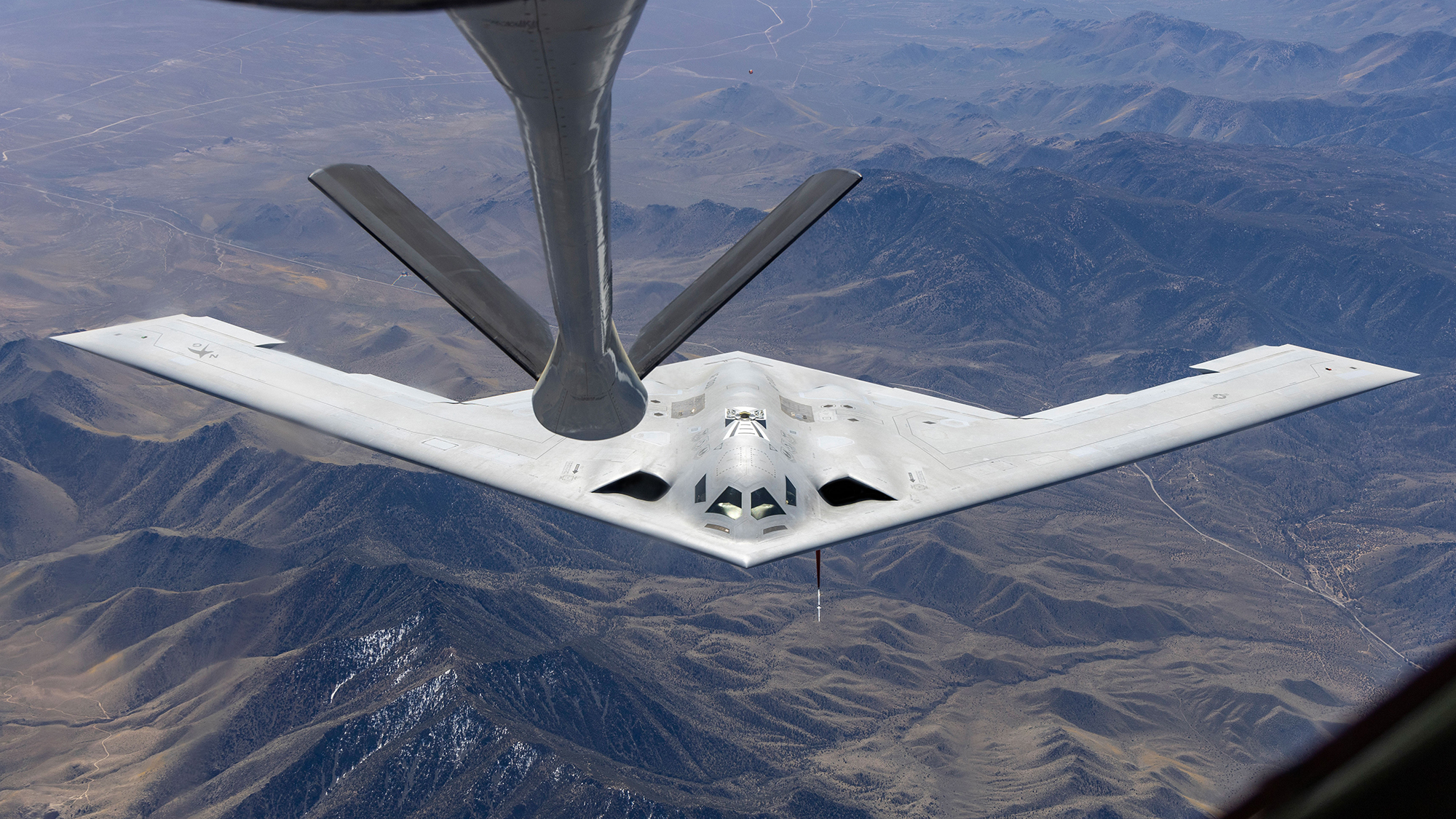
Interestingly, as we reported in November 2025, the U.S. Air Force was also considering a significant change to the B-21’s crew configuration, replacing the originally planned two-pilot arrangement with a pilot and a Weapon Systems Officer (WSO). The proposal emerged from a memorandum by Gen. Thomas Bussiere, then commander of Air Force Global Strike Command, which highlighted the complex combination of skills required to operate the Raider, including airmanship, weapons employment, electromagnetic spectrum operations, sensor management, real-time battle management and mission replanning.
Unlike the B-2 Spirit, which is operated by two pilots, the proposed configuration would assign one crew member primarily to flying the aircraft and the other to managing its increasingly complex mission systems and weapons. Although the recommendation had not yet been formally adopted as Air Force policy when it emerged, it reflected the growing importance of weapons management and mission-system integration in the B-21’s operational concept.
B-21 Flight Testing and Production continue to accelerateThe latest development follows another important achievement earlier in 2026, when the B-21 demonstrated its aerial refueling capability: the first aerial refueling mission took place over Eastern California on Mar. 10, 2026, lasted 5 hours and 33 minutes, and was documented by several photographers who were able to shot some incredible images of the first Raider prototype behind the special equipped tanker based out of Edwards Air Force Base. On Apr. 14, 2026, the U.S. Air Force publicly acknowledged that the B-21 Raider had conducted aerial refueling from a KC-135 as part of its ongoing test and evaluation program, jointly conducted with Northrop Grumman, at Edwards AFB, California.
According to Northrop Grumman, aerial refueling has enabled longer test sorties, helping accelerate the overall test campaign.
“B-21 is another step closer to giving the U.S. unrivaled deterrence,” said Tom Jones, corporate vice president and president of Northrop Grumman Aeronautics Systems. “As we’ve heard from our Air Force partners, the B-21 Combined Test Force is the envy of the entire test community for its sustained rapid test pace and progress. Northrop Grumman is turning advanced technology into real capability and delivering with both performance and speed.”
Northrop Grumman also highlighted the aircraft’s payload flexibility, explaining that the B-21 has been designed to accommodate different weapon loadouts depending on mission requirements, while its open-architecture design will allow additional weapons and capabilities to be integrated over time.
The company further reported that the Raider has demonstrated strong stealth performance during testing, although no specific technical details were disclosed.
As we have reported here at The Aviationist, an undisclosed number of B-21s are in production, with final assembly taking place at Northrop Grumman’s Palmdale, California, facility, the same plant where the B-2 Spirit was also built. As mentioned above, the second B-21 prototype was delivered on schedule to Edwards Air Force Base, California, in September 2025.
Meanwhile, production of the new bomber continues to accelerate, with the U.S. Air Force planning to increase annual production capacity by 25% and the first aircraft expected to arrive at Ellsworth Air Force Base, South Dakota, next year.
The second B-21 Raider stealth bomber at Edwards Air Force Base, California. | Source: U.S. Air Force Next: Ellsworth AFB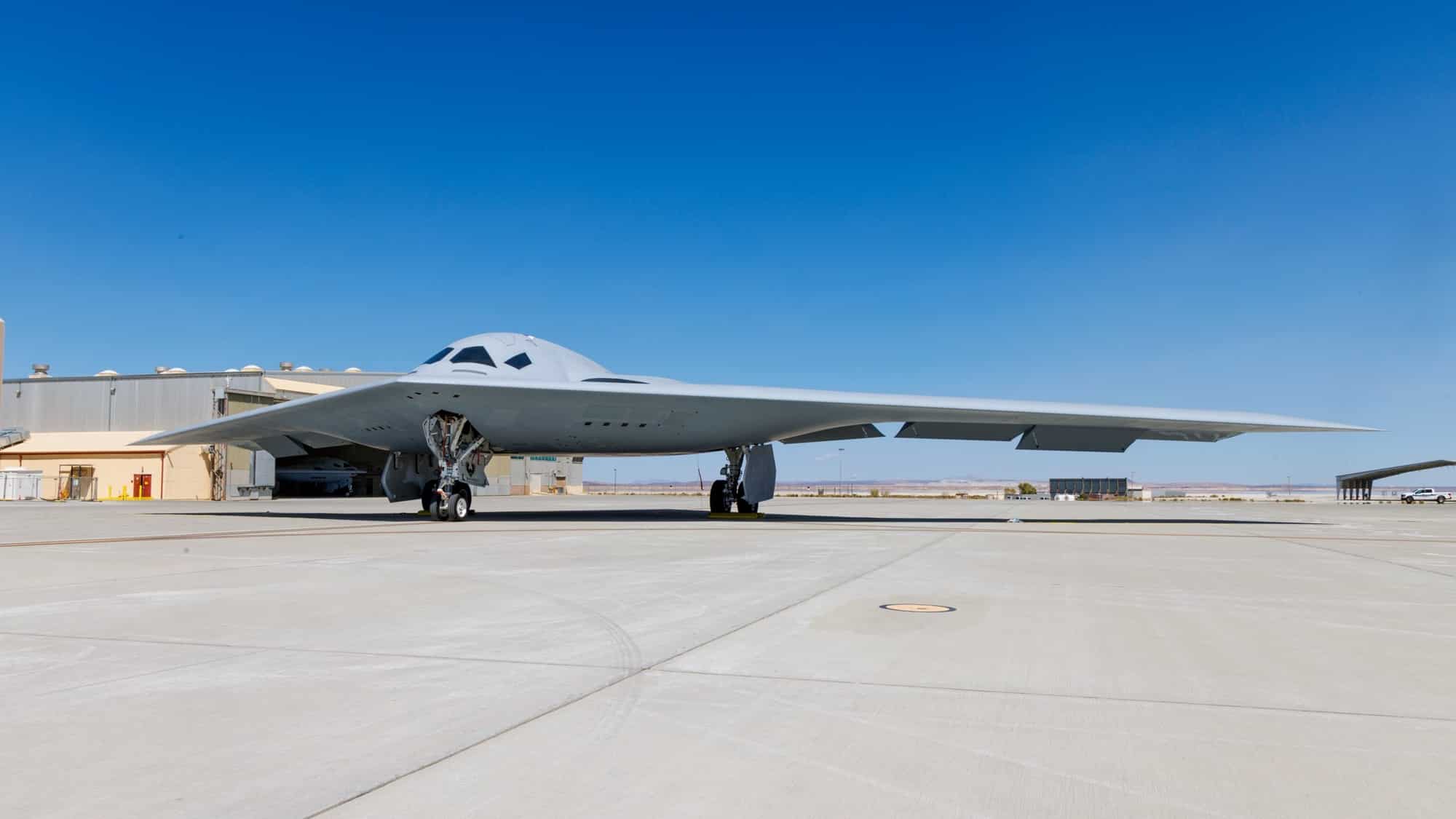
On Sept. 9, 2026, the Air Force activated the B-21 Integration Detachment 1 at Ellsworth, “dedicated to coordinating, synchronizing and executing the complex integration of the B-21 Raider.” Lt. Col. Joshua Dawkins assumed command of the detachment during a ceremony presided over by Maj. Gen. Ty Neuman, commander of Eighth Air Force.
Here’s what we wrote about the B-21’s Integration Detachment 1 in a recent story you can read here:
“Team Ellsworth faces a combination of demands – sustaining an operational legacy bomber force while preparing to receive the B-21 and building the nuclear community to employ it,” said Neuman. “The activation of Detachment 1 takes some of the responsibility from the 28th Bomb Wing allowing them to focus more fully on the operational B-1 mission and establish a command accountability for uniting thousands of individual actions, decisions, and construction projects into a single operational combat capability.”
Ellsworth is currently being transformed in the hub for the next-generation bomber’s operations. The service described the works as “a phased, deliberate process tightly coupled with operational requirements,” with construction, communications setup, and crew training moving simultaneously to “minimize transition lag and establish a highly functional combat ecosystem.”
“This is a monumental task,” added Neuman, “but I am confident Col. Dawkins is the right leader to write this playbook, one that will ensure Ellsworth [AFB] pays the learning cost once so that future B-21 beddowns at Whiteman and Dyess [Air Force Bases] can execute seamlessly.”
“Detachment 1 ensures we have a commander whose single, dedicated focus every day is solving the integration challenge,” said Col. Erick Lord, 28th Bomb Wing commander. This is particularly important because Ellsworth, as mentioned by Neuman, must prepare for the Raider while continuing to operate its existing B-1B Lancer fleet and maintain its operational responsibilities.
“This methodology directly incorporates hard-learned lessons from legacy bomber transitions, avoiding past pitfalls by ensuring that logistics, training pipelines, and maintenance infrastructure are robustly established before the first B-21 arrives on the flightline in the coming years,” said Neuman.
U.S. Air Force Airmen with the 912th Aircraft Maintenance Squadron prepare to recover the second B-21 Raider to arrive for test and evaluation at Edwards AFB, Calif., Sept. 11, 2025. | Source: U.S Air Force photo by Kyle Brasier
Catégories: Defence`s Feeds
South Korea’s Options in a Fragmented World
Seoul would be an attractive addition to several different international groupings – but joining one could mean locking South Korea out of others.
Catégories: Diplomacy & Crisis News
Japan Needs Muslim Workers. Is It Ready for Muslim Communities?
Tensions will flare up when cherished social institutions need to change to accommodate nonnegotiable religious needs. But they must start, even if it is only with a hijab or a burial.
Catégories: Diplomacy & Crisis News
Paraguay, la faillite et le fusible
Le président paraguayen Santiago Peña a été destitué le 6 novembre, emporté par la faillite d'Ueno Bank. Trois jours plus tôt, près de trois millions de clients avaient perdu l'accès à leur argent. Cette banque numérique promettait de mettre la finance à la portée de tous. Pour mener à bien (…)
/ État, Mouvement de contestation, Banque, Paraguay
Catégories: Diplomacy & Crisis News
« Tu ne l'as même pas dit à ta meilleure amie ». Les séquelles de l'accouchement qui ne disparaissent jamais
De l'incontinence à la douleur chronique, des millions de femmes continuent de souffrir, même des décennies plus tard.
Catégories: Afrique
J’ai lu… « Géoféminisme, Si tu veux la paix, prépare l’égalité » de Chloé Ridel
À l’occasion de la parution de Géoféminisme : Si tu veux la paix, prépare l’égalité (Stock), Pascal Boniface reçoit Chloé Ridel, députée européenne et cofondatrice de l’Institut Rousseau, pour un échange consacré à sa lecture féministe des relations internationales et des conflits contemporains. En réponse à la formule qu’elle associe au réalisme « Qui veut la paix prépare la guerre », elle défend une autre approche des relations internationales : l’égalité entre les femmes et les hommes comme un levier de paix et de sécurité. Elle dénonce une pensée masculiniste qui imprègnerait les théories et les pratiques géopolitiques, valorisant la force et la domination au détriment de la coopération, donnant les exemples des politiques de Vladimir Poutine et Donald Trump.
Chloé Ridel dénonce également la sous-représentation des femmes dans les fonctions de pouvoir y compris au sein de l’Union européenne. Une réflexion sur les liens entre domination masculine, rapports de force internationaux et sécurité collective, qui invite à repenser les conditions d’une paix durable.
L’article J’ai lu… « Géoféminisme, Si tu veux la paix, prépare l’égalité » de Chloé Ridel est apparu en premier sur IRIS.
Catégories: Diplomacy & Defense Think Tank News
Pages



© 2012-2018 Europa Varietas Foundation © 2015-2018 Europa Varietas Association
www.europavarietas.org | info(@)europavarietas(dot)org | Switzerland


We are looking for sponsors for the English translation of these books, please contact turkeandras(at)gmail(dot)com