
Vous êtes ici
Agrégateur de flux
Les 10 meilleures universités d'Afrique en 2026
Les universités africaines jouissent d'une reconnaissance croissante sur la scène internationale, grâce à une production scientifique solide, à des collaborations internationales et à une influence académique grandissante.
Catégories: Afrique
EMPFEHLUNG zu dem Vorschlag für einen Beschluss des Rates über den Abschluss – im Namen der Europäischen Union – des Abkommens über eine politische, wirtschaftliche und kooperative strategische Partnerschaft zwischen der Europäischen Union und ihren...
EMPFEHLUNG zu dem Vorschlag für einen Beschluss des Rates über den Abschluss – im Namen der Europäischen Union – des Abkommens über eine politische, wirtschaftliche und kooperative strategische Partnerschaft zwischen der Europäischen Union und ihren Mitgliedstaaten einerseits und den Vereinigten Mexikanischen Staaten andererseits
Ausschuss für auswärtige Angelegenheiten
Ausschuss für internationalen Handel
Borja Giménez Larraz, Javi López
Quelle : © Europäische Union, 2026 - EP
Ausschuss für auswärtige Angelegenheiten
Ausschuss für internationalen Handel
Borja Giménez Larraz, Javi López
Quelle : © Europäische Union, 2026 - EP
Catégories: Europäische Union
Marseille, les prolos, les bobos
La cité phocéenne aurait-elle définitivement basculé du côté de la « ville-spectacle » ? Plusieurs travaux révèlent qu'au sein du Marseille populaire le mistral de la résistance souffle encore. Dans une somme impressionnante, l'essayiste Alèssi Dell'Umbria retrace plus de mille ans d'histoire (…)
/ France, Ville, Histoire, Logement, Urbanisme
Catégories: Diplomacy & Crisis News
Guam: Where America’s 250th Birthday Will First Be Honored
As the country celebrates its past, let it also recognize the place where its future security begins: an island that has given more to the United States than most Americans will ever know.
Catégories: Diplomacy & Crisis News
Italy’s Indo-Pacific Strategy Turns Toward Defense Contracts
Italy is making an unexpectedly assertive return to Southeast Asia – not through trade or development aid, but through defense diplomacy.
Catégories: Diplomacy & Crisis News
Press release - Press briefing on next week’s plenary session
Spokespersons for Parliament and for the political groups will hold a briefing on the 6-9 July plenary session, on Friday at 11.00 in Parliament’s Anna Politkovskaya press room.
Source : © European Union, 2026 - EP
Source : © European Union, 2026 - EP
Catégories: European Union
BIMSTEC, Northeast India, and an Overlooked Pillar of the Act East Policy
India’s Act East Policy should be judged by its ability to change from articulating strategy to putting that strategy into practice in the Northeast, via BIMSETC.
Catégories: Diplomacy & Crisis News
Forging China-US ‘Constructive Strategic Stability’ Starts in the Nuclear Realm
Real strategic stability starts with recognizing mutual vulnerability.
Catégories: Diplomacy & Crisis News
Perspectives on Switzerland's net-negative target after 2050
Catégories: Diplomacy & Defense Think Tank News
D'abord la CAN, puis la Coupe du monde : le Sénégal pris au piège dans « l'enfer du football »
L'année cauchemardesque du Sénégal se poursuit, avec un effondrement déchirant face à la Belgique, marqué par un penalty dramatique en fin de match qui rappelait étrangement les événements de la finale chaotique de la Coupe d'Afrique des nations de cette année.
Catégories: Afrique
Schattenflotte: Warum Russland verstärkt auf eigene Flagge setzt
Russland will mehr Tanker unter eigener Flagge fahren lassen. Der Strategiewechsel ist eine Reaktion auf wachsenden internationalen Druck – und soll Festsetzungen erschweren. CDU und Grüne fordern stärkere Kontrollen, um gegen die Schattenflotte vorzugehen.
Catégories: Diplomacy & Defense Think Tank News
Taiwan’s Drone Industry Takes Centerstage in Defense Spending Debate
Funding for drones became much more hotly discussed in the wake of KMT chair Cheng Li-wun’s trip to the United States last month.
Catégories: Diplomacy & Crisis News
Where Do Japan and Vietnam Stand?
A look at the bilateral relationship, and its future direction.
Catégories: Diplomacy & Crisis News
Why Corruption Persists in Uzbekistan’s Water Sector
Real reform in the water sector means building a system that makes corruption harder to commit, easier to detect, and less rewarding for those who might try.
Catégories: Diplomacy & Crisis News
Reckoning With the Evolving China-Russia Threat
Don't underestimate the China-Russia partnership; Beijing and Moscow have already cooperated in ways that seemed unthinkable not long ago.
Catégories: Diplomacy & Crisis News
The Cyprus Presidency of the Council of the EU : An Assessment in a Time of Geopolitical Turmoil
Cleopatra Kitti, Senior Policy Advisor to ELIAMEP and Founder of the Mediterranean Growth Initiative, offers a review of Cyprus’s Presidency of the Council of the European Union, which concluded a few days ago.
Read the ELIAMEP Explainer here.
Catégories: Diplomacy & Defense Think Tank News
Inside the 20th Squadron, Italy’s Eurofighter Operational Conversion Unit
An exclusive look inside the Italian Air Force’s Typhoon Operational Conversion Unit, where pilots are trained through advanced simulation, live flying and progressive tactical training.
Grosseto Air Base has been the home of the Italian Air Force’s 4th Wing for more than 60 years, serving as one of the service’s most prestigious and operationally demanding fighter units. From this strategic base, located about 94 miles (151 km) to the northwest of Rome, the Italian Eurofighter Typhoons maintain round-the-clock Quick Reaction Alert (QRA) duties, ensuring the round-the-clock protection of both Italian and NATO airspace.
The base is also home to the 20th Squadron – Operational Conversion Unit (20° Gruppo OCU), where pilots complete the final phase of their training before joining frontline Eurofighter Typhoon squadrons. Equipped with advanced simulators and cutting-edge training technologies, the unit plays a fundamental role in preparing aircrews for the complex operational environment they will encounter.
We had the opportunity to visit both the 4th Wing and the 20th OCU, gaining first-hand insight into their daily activities and talk with instructors, pilots and support personnel. Our visit revealed how the M-346 Master (T-346 according to the ItAF designation) has fundamentally transformed the Italian Air Force’s fighter training system: rather than simply introducing a new advanced trainer, the aircraft has reshaped the entire training pipeline, allowing many tactical and operational skills to be acquired earlier in a pilot’s career.
The “twin-stick” Eurofighter during taxi before a training sortie at Grosseto Air Base. | Source: Nicolò Teta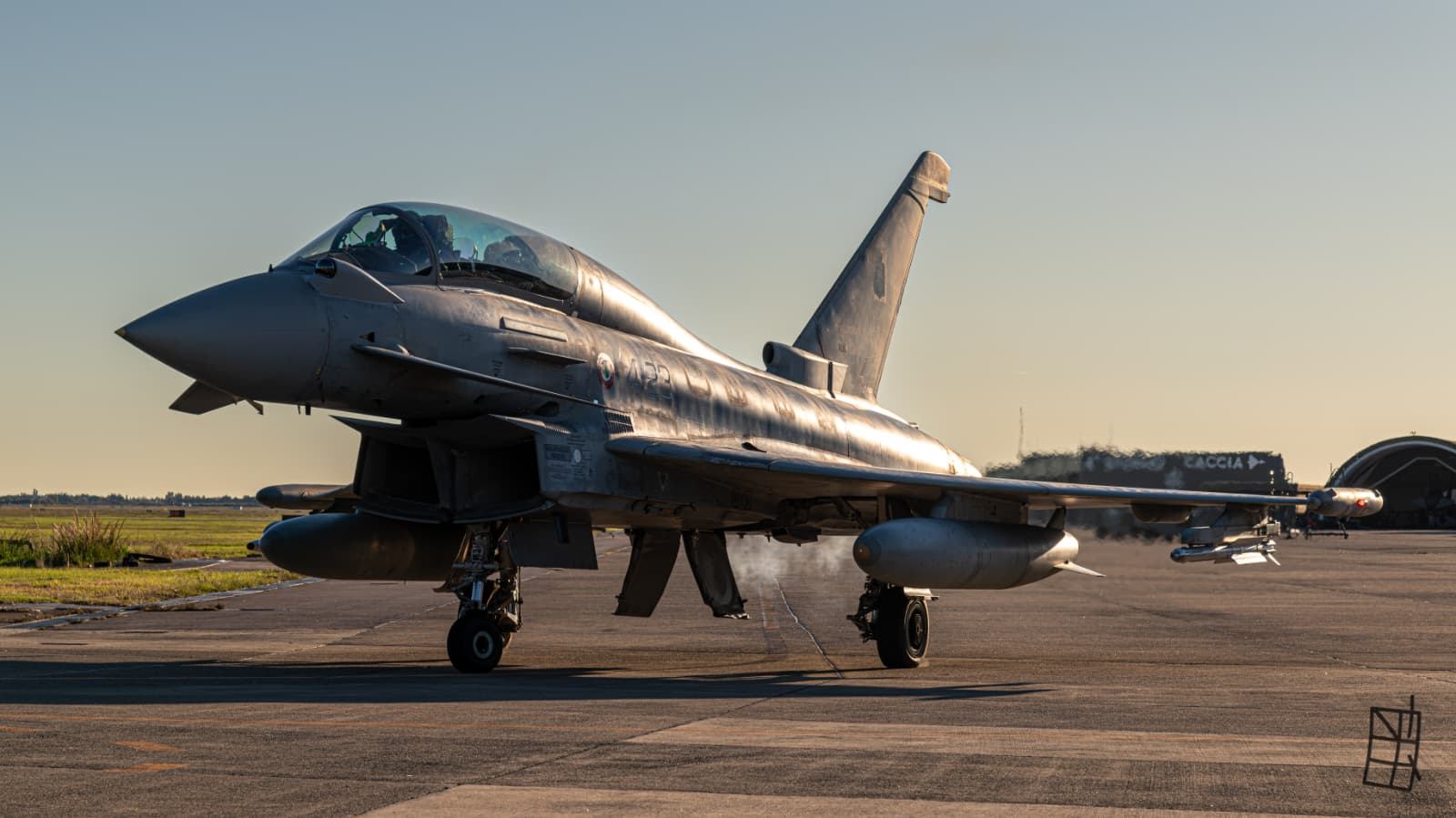
During our discussions with instructors and trainee pilots of the 20th OCU, we explored how this evolution has streamlined the transition to the Eurofighter Typhoon (F-2000A in accordance to Italy’s MoD Mission Design Series). By integrating advanced simulation, embedded training systems and a more progressive syllabus, today’s conversion course enables pilots to arrive on the frontline better prepared, making the transition to one of Europe’s most capable multirole fighters more effective than ever before.
Before the M-346: A Leap into the UnknownBefore the introduction of the M-346, pilots arrived at the 20th Squadron after completing advanced training on the MB-339CD or through international NATO programs such as the Euro NATO Joint Jet Pilot Training (ENJJPT).
An MB-339CD of the Italian Air Force, currently used for Phase III training by the 213th Squadron at Lecce Air Base. | Source: Italian Air Force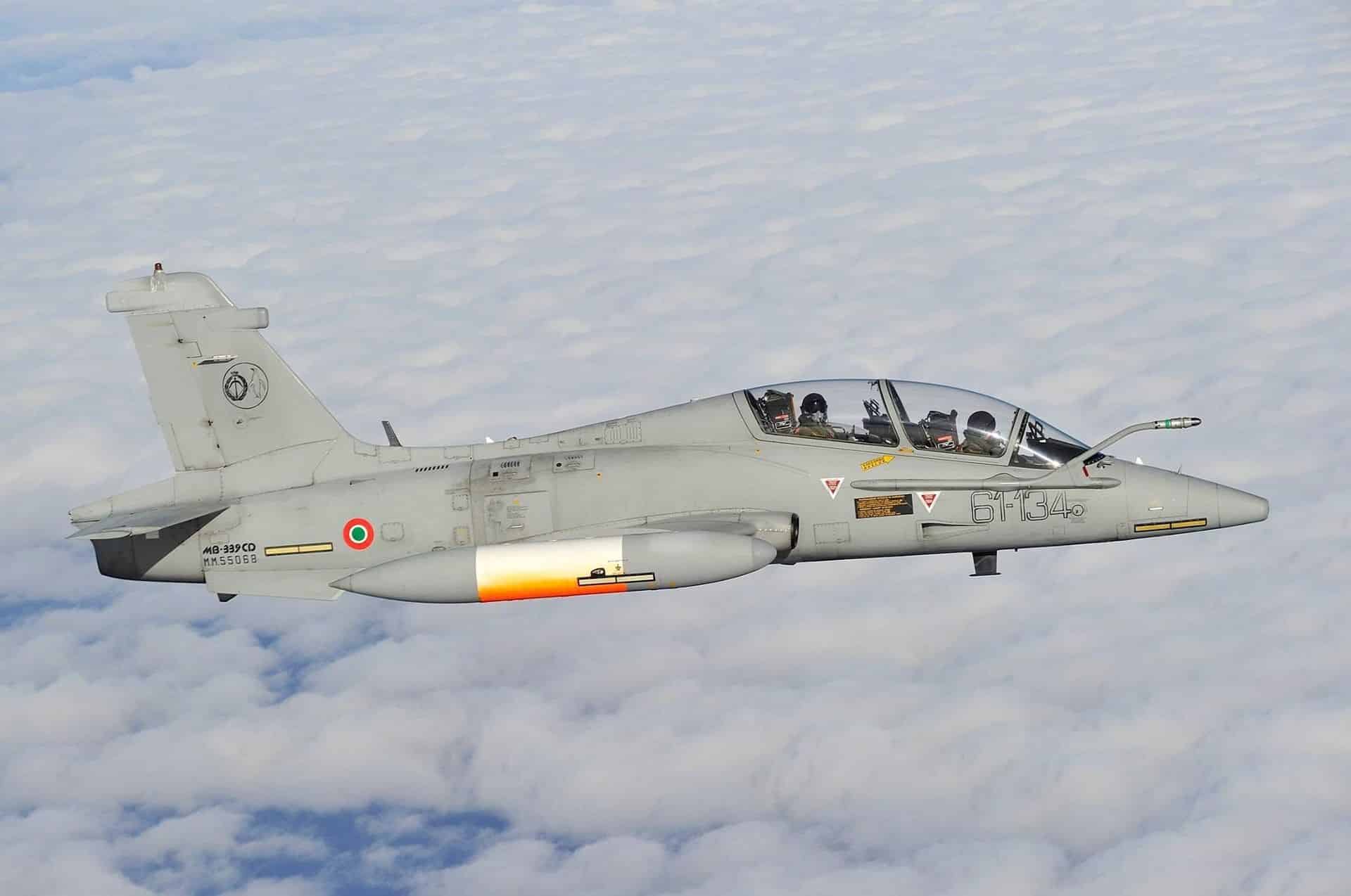
The greatest challenge was entering the world of modern combat systems. Radar operations, sensor management, tactical data fusion, and the interpretation of multifunction displays were entirely new concepts that had to be learned directly during operational conversion on the Eurofighter.
“Once pilots had mastered takeoffs and landings, the real challenge was learning to operate systems they had never encountered before,” explained an instructor.
As a result, numerous sorties were dedicated solely to learning procedures and familiarizing students with the aircraft’s onboard sensors, inevitably slowing progression toward more advanced tactical employment.
The LIFT RevolutionThe introduction of the M-346 and the Leading to Fighter Training (LIFT) concept has allowed the Italian Air Force to completely redesign its fighter training pipeline. Thanks to the aircraft’s capabilities and the seamless integration of advanced simulation with live flying, students now experience training events during their course at the 212th Squadron of the 61st Wing at Decimomannu Air Base that were once reserved exclusively for Eurofighter operational conversion.
An M-346A during a performance climb. | Source: Nicolò Teta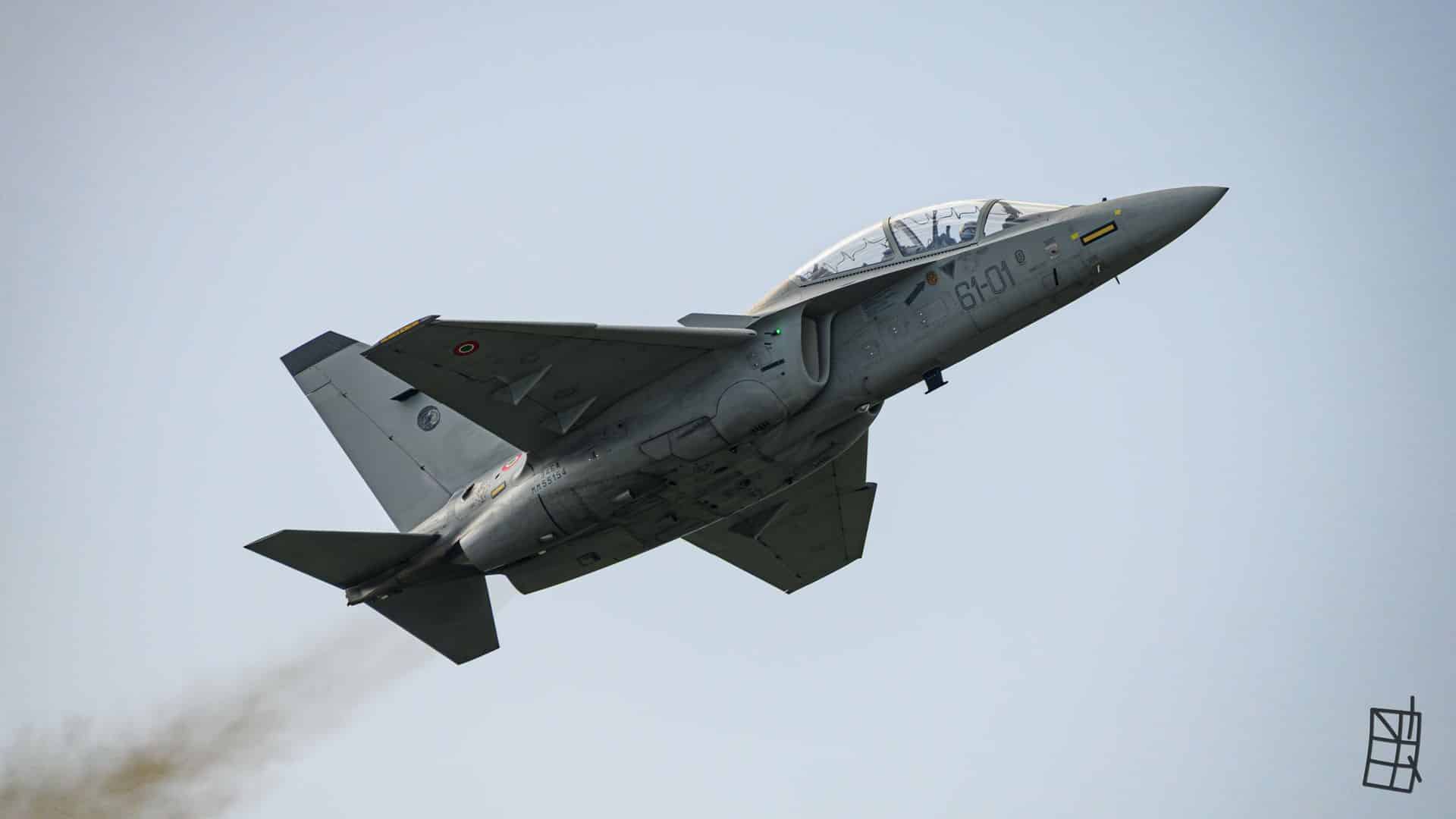
Radar intercepts, Beyond Visual Range (BVR) engagements, air-to-air combat, sensor management, simulated weapons employment, and tactical mission execution are now mastered well before pilots arrive at the OCU. The result has been a substantial shift of the training workload to earlier phases of pilot development.
“Today’s students arrive with a much stronger foundation than in the past,” the instructor explained. “This allows us to devote more time to advanced operational skills and the multirole capabilities that define today’s Typhoon.”
From Flight School to the Eurofighter: A Progressive Learning CurveFrom the students’ perspective, arriving at the 20th Squadron is no longer the dramatic leap it once was. By the time they begin OCU training, pilots already possess years of experience, hundreds of flight hours, and a solid aviation culture developed throughout their training career.
An Italian Air Force Eurofighter Typhoon begins its take-off roll at Grosseto Air Base. | Source: Nicolò Teta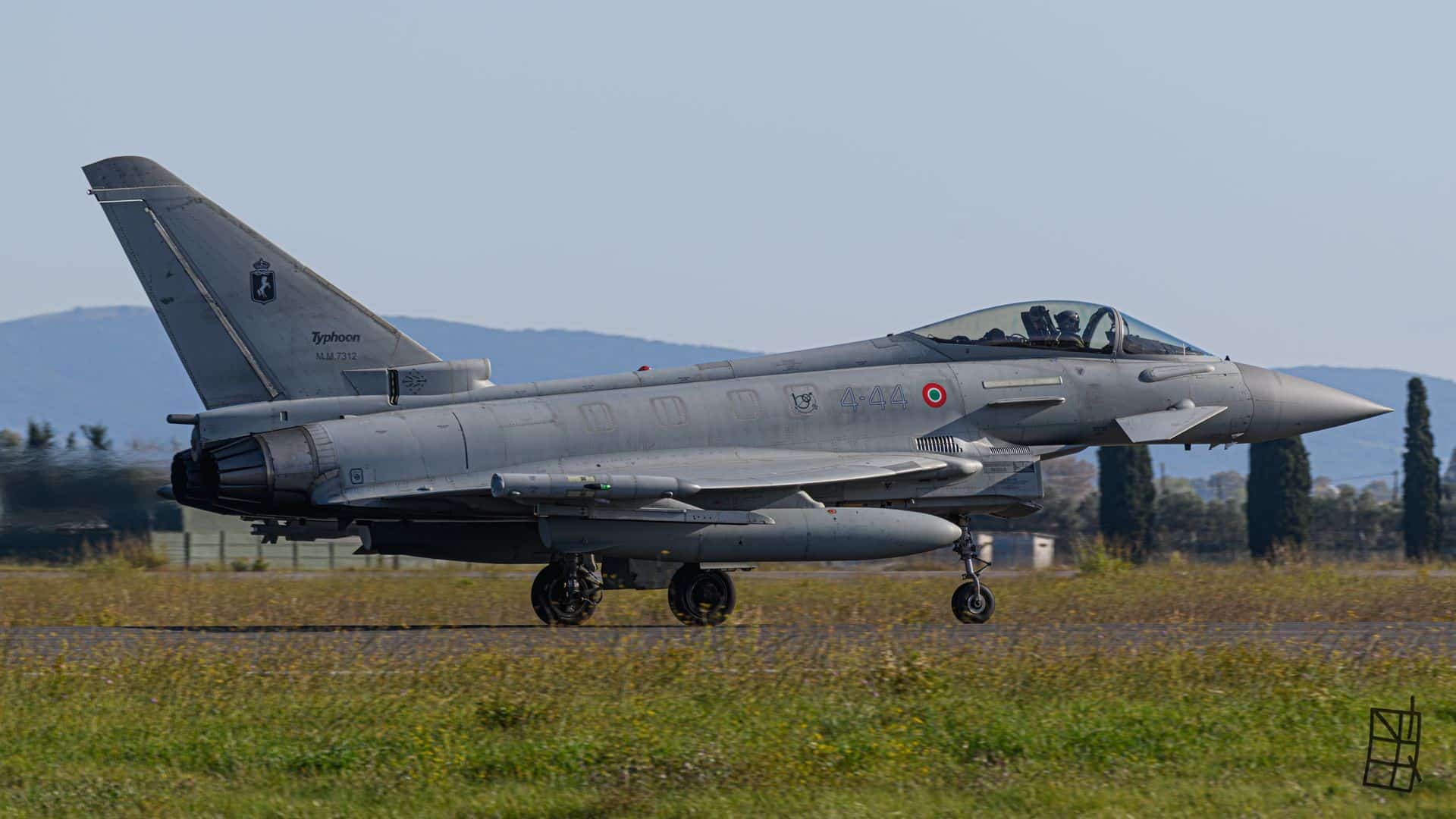
“The impact is certainly significant, but it’s no longer a leap into the unknown,” one trainee told us. “The fundamentals of airmanship and mission management have already been built over the previous years.”
The Eurofighter introduces higher levels of performance, more sophisticated systems, and greater responsibility, but many of the underlying concepts have already been assimilated during training on the M-346.
The Eurofighter Typhoon: From Air Superiority to Swing Role OperationsOriginally conceived as an air superiority fighter designed to defend national airspace, the Eurofighter Typhoon has progressively evolved into a swing role platform capable of switching between air-to-air and air-to-ground missions within the same sortie.
Two Eurofighter Typhoon aircraft from the Italian Air Force’s 4th Wing performing a high-performance manoeuvre with reheat selected. | Source: Leonardo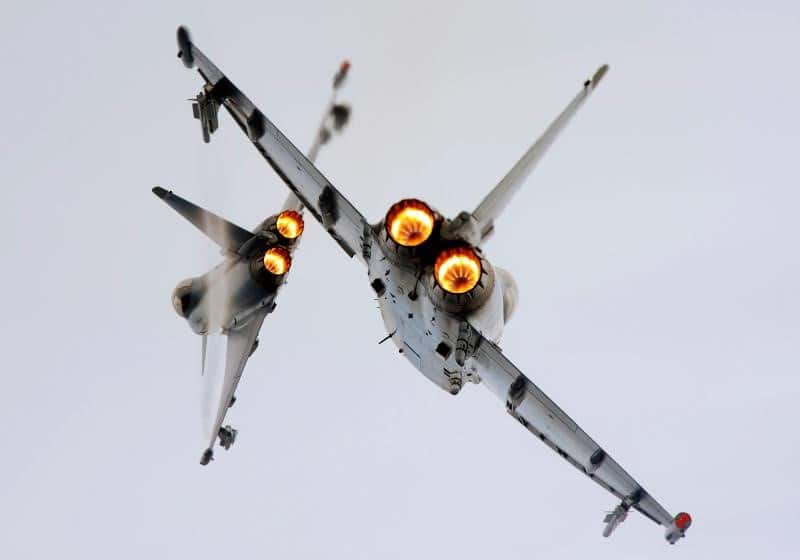
Powered by two Eurojet EJ200 afterburning engines, it can reach Mach 2 and sustain supersonic flight without afterburner in supercruise conditions. Its delta wing with canard foreplanes, combined with a fully digital fly-by-wire control system, provides exceptional agility and high-performance handling across the entire flight envelope.
With a length of 15.96 metres, a wingspan of 10.95 metres and a maximum take-off weight of 23,500 kilograms, the aircraft carries its weapon load on thirteen hardpoints, in addition to a 27 mm Mauser BK-27 internal cannon. Continuous upgrades in software, sensors and precision weapons have transformed the Typhoon into a true multirole combat system, capable of conducting air policing, strike missions and tactical reconnaissance with high effectiveness.
The twin-seat “Twin Stick” variant complements the operational fleet, playing a key role in training and conversion while retaining the majority of combat capabilities of the single-seat version.
Ground School: Building the FoundationThe course begins with an intensive Ground School phase. Days are filled with classroom instruction, individual study, and in-depth analysis of the aircraft’s technical documentation. Students spend countless hours learning the aircraft’s systems, procedures, and operational philosophy.
The entrance hall of the 20th Operational Conversion Unit, where the squadron’s heritage, from the iconic F-104 Starfighter to the Eurofighter Typhoon, is proudly preserved. | Source: Nicolò Cerantonio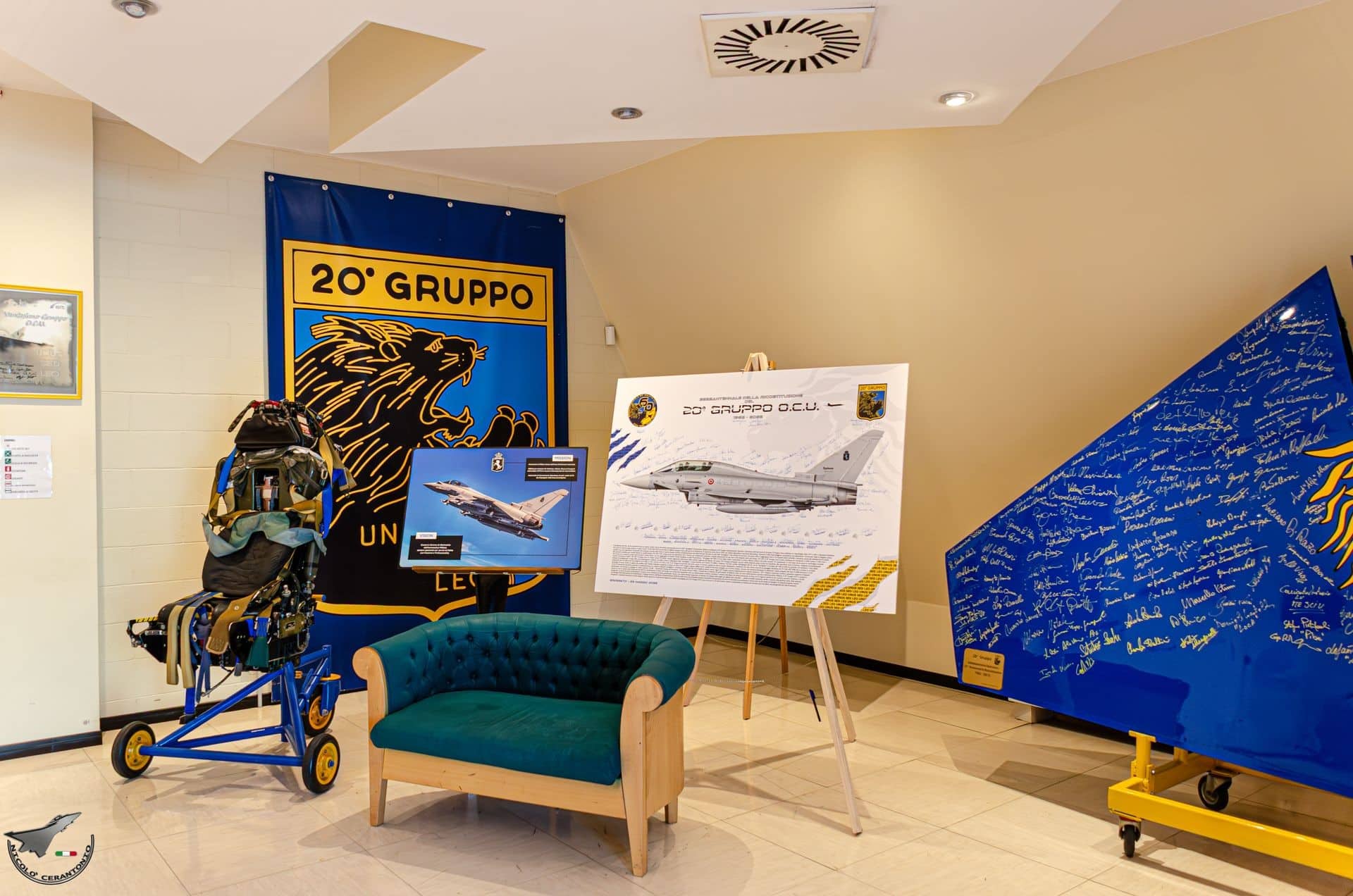
Throughout the academics, trainees are also supported by Leonardo’s instructor pilots and training personnel, who contribute to the Italian Air Force’s Eurofighter pilot programme. Working alongside the military instructional staff, they provide operational expertise and continuous guidance at every stage of the academic phase.
During this phase, instructors assess far more than technical knowledge. Professional attitude, discipline, commitment, motivation, and the ability to apply knowledge are considered just as important as technical competence.
According to the instructors, attitude is often every bit as important as technical ability.
The Gentex ACS (Aircrew Combat System) helmet with the iconic 20th Squadron helmet cover. | Source: Italian Air Force Simulation and Live Flying: An Essential Partnership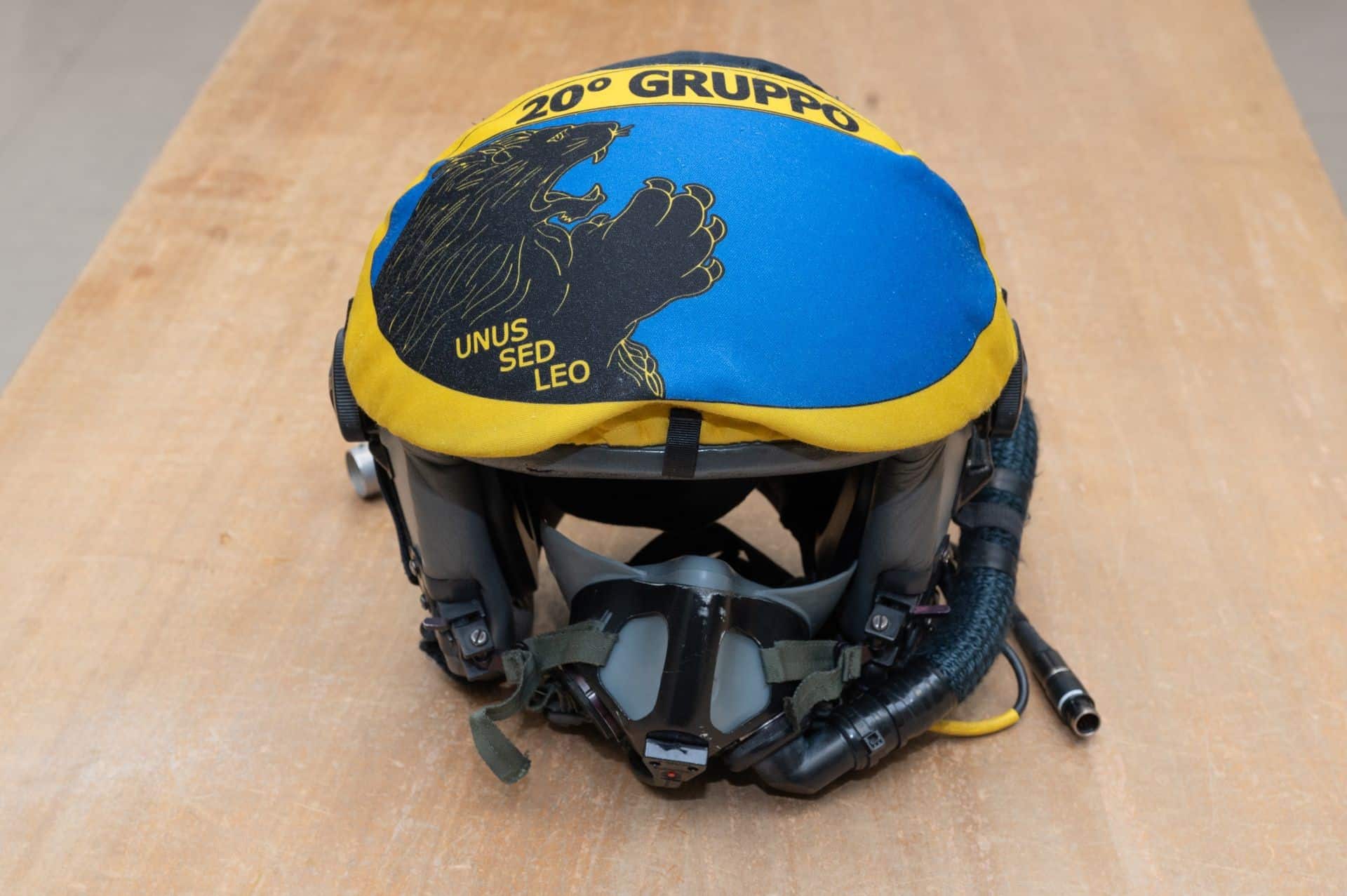
One of the cornerstones of modern fighter training is the simulator. Before ever flying the Eurofighter, students spend many hours in the Aircrew Synthetic Training Aids (ASTA) building at Grosseto Air Base, an integrated simulation environment that supports the Italian Air Force’s Eurofighter training programme.
The ASTA facility is co-located within the same building that also houses the 20th Operational Conversion Unit, ensuring full integration between simulator-based training and the operational conversion syllabus. The system employs three complementary simulator categories: the Cockpit Trainer (CT), the Full Mission Simulator (FMS), and the Enhanced Aircrew Cockpit Procedures Trainer (EACPT), each designed to progressively develop procedural knowledge, systems management, tactical awareness, and mission execution.
The importance of simulation within the training environment is also reflected in the motto displayed on the ASTA building at Grosseto Air Base: “Simulatione siderum tenus”, inspired by the traditional Air Force motto “Virtute siderum tenus”. The phrase encapsulates the role of simulation as a bridge between classroom learning and real-world operational readiness.
By the time they step into the real aircraft, the cockpit environment, procedures, and aircraft systems already feel familiar. However, even the most advanced simulator cannot fully reproduce every variable encountered in the real world.
Technical malfunctions, civilian air traffic, changing weather conditions, and the complexity of the operational environment demand decision-making skills that extend beyond simply following procedures. It is during this phase that a pilot’s professional maturity truly begins to emerge.
From Conventional Controls to Fly-by-WireAnother major evolution in training concerns digital flight control systems. The M-346 introduces students to fly-by-wire logic and Flight Control Computer management long before they transition to the Eurofighter.
“Students now arrive with a level of sensitivity that previous generations had to develop directly on the Typhoon,” said an instructor.
The advanced trainer’s performance also exposes students to high G-loads, rapid acceleration, and flight dynamics that closely resemble those of a modern frontline fighter.
Inside the cockpit of a Eurofighter Typhoon during a training sortie, showing the pilot’s in-flight working environment. (Image credit: Italian Air Force) | Source: Italian Air Force The Real Radar Remains One of the Greatest Challenges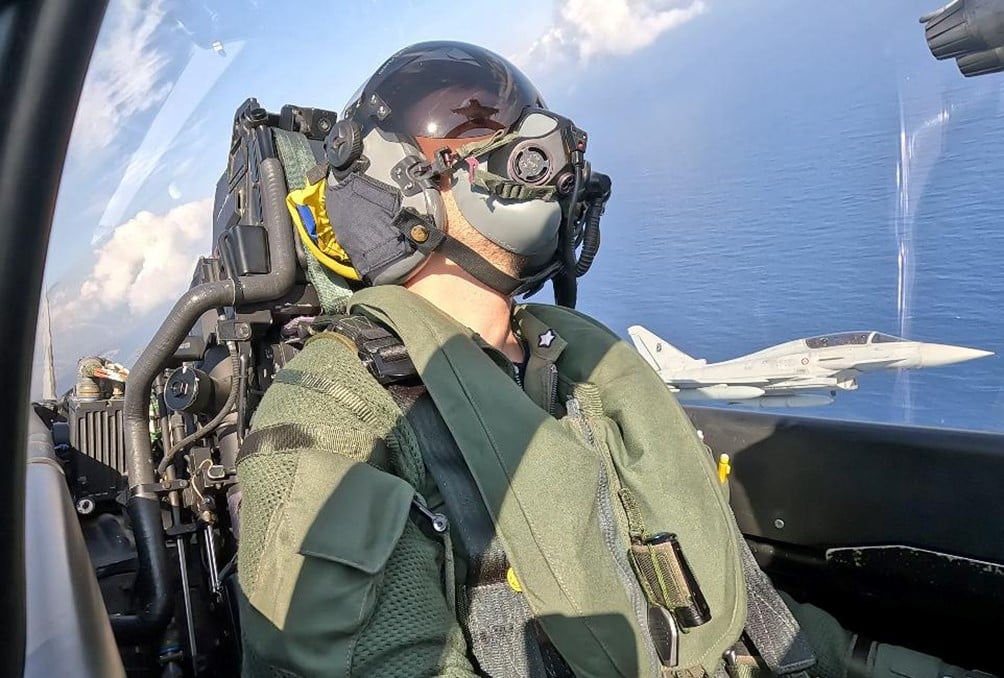
Despite remarkable advances in simulation, transitioning from a simulated radar to the real system remains one of the most demanding aspects of operational conversion.
Synthetic scenarios are carefully controlled and predictable. In the real operational environment, pilots must deal with a much larger volume of information and with phenomena that cannot be perfectly replicated.
Correctly interpreting radar returns, identifying contacts, and maintaining high levels of situational awareness remain among the most challenging elements of fighter conversion training.
[Read also: First hand account: Flying the Eurofighter Typhoon in the Aggressor role during supersonic air combat training]
From Instruction to IndependenceAs training progresses, the instructors’ role gradually evolves. Initially, they guide students step by step through every procedure.
Later, the emphasis shifts toward developing independent decision-making. Rather than simply evaluating whether a decision was correct, instructors seek to understand the student’s reasoning process, even when the outcome is less than perfect.
The objective is not to produce pilots who merely execute procedures, but professionals capable of analysing complex situations, accepting responsibility, and making sound decisions under pressure. Throughout this journey, the instructor-student relationship gradually develops into one of genuine professional mentorship.
A Eurofighter Typhoon executing a “gate climb” in QRA configuration. | Source: Nicolò Teta The Emotion of the First Solo Flight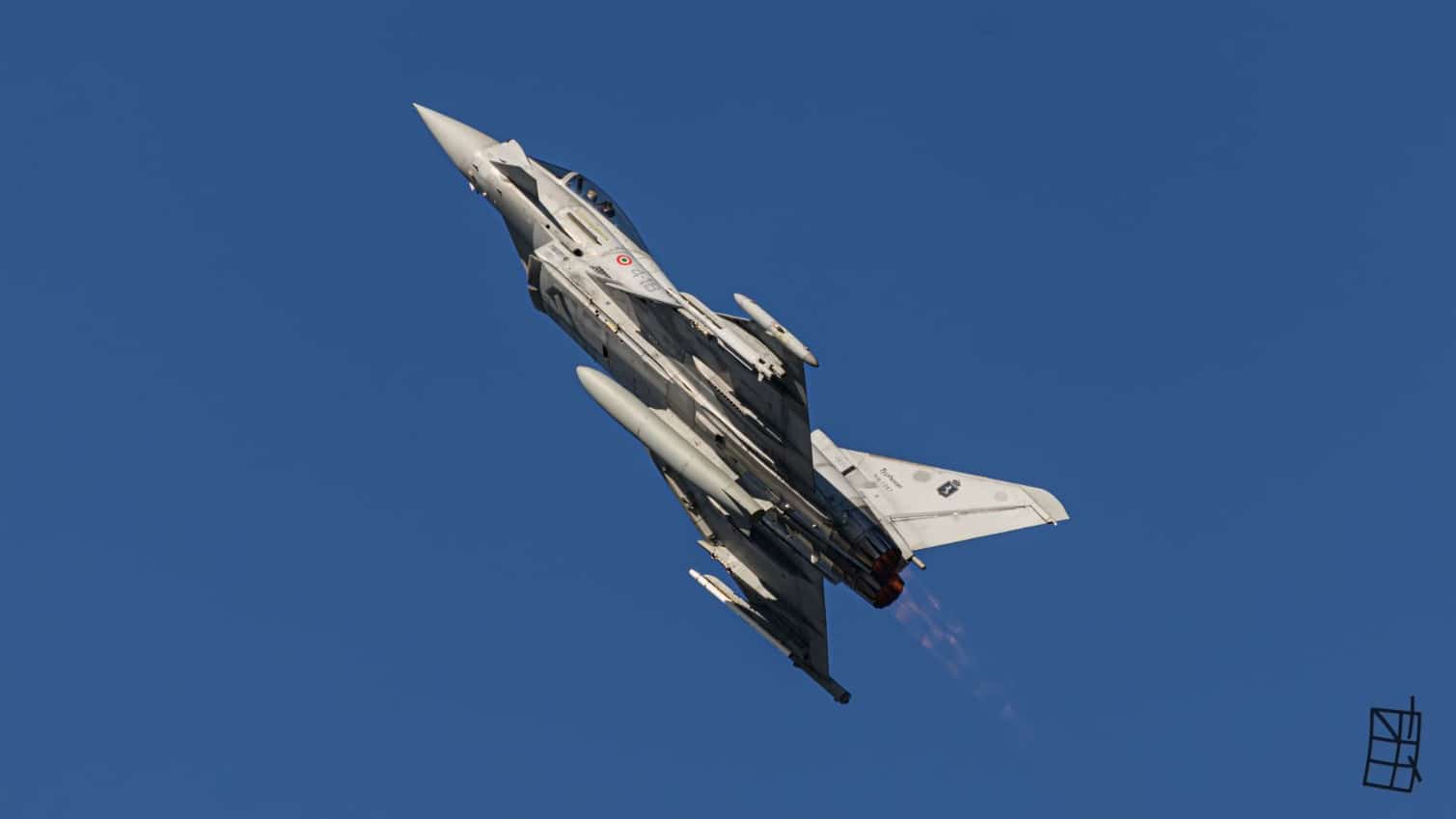
One of the defining moments of the entire training program is the first solo flight. After weeks of flying alongside instructors, students suddenly find themselves alone in the cockpit.
The initial tension is inevitable, but it quickly gives way to confidence. Everything that has been studied, rehearsed, and practiced in the simulator begins to feel natural.
Pilots gradually develop trust in their own abilities and build the confidence required for operational independence. For many, it becomes one of the most memorable and rewarding moments of their entire career.
Close Air Support and Joint OperationsAmong the most significant additions to the modern syllabus is Close Air Support (CAS) training. These missions are conducted in close cooperation with Joint Terminal Attack Controllers (JTACs) from both the Italian Army and the Italian Air Force.
A Joint Terminal Attack Controller (JTAC) coordinates a Close Air Support (CAS) mission, likely transmitting a Nine-Line brief to the supporting aircraft. | Source: Italian Air Force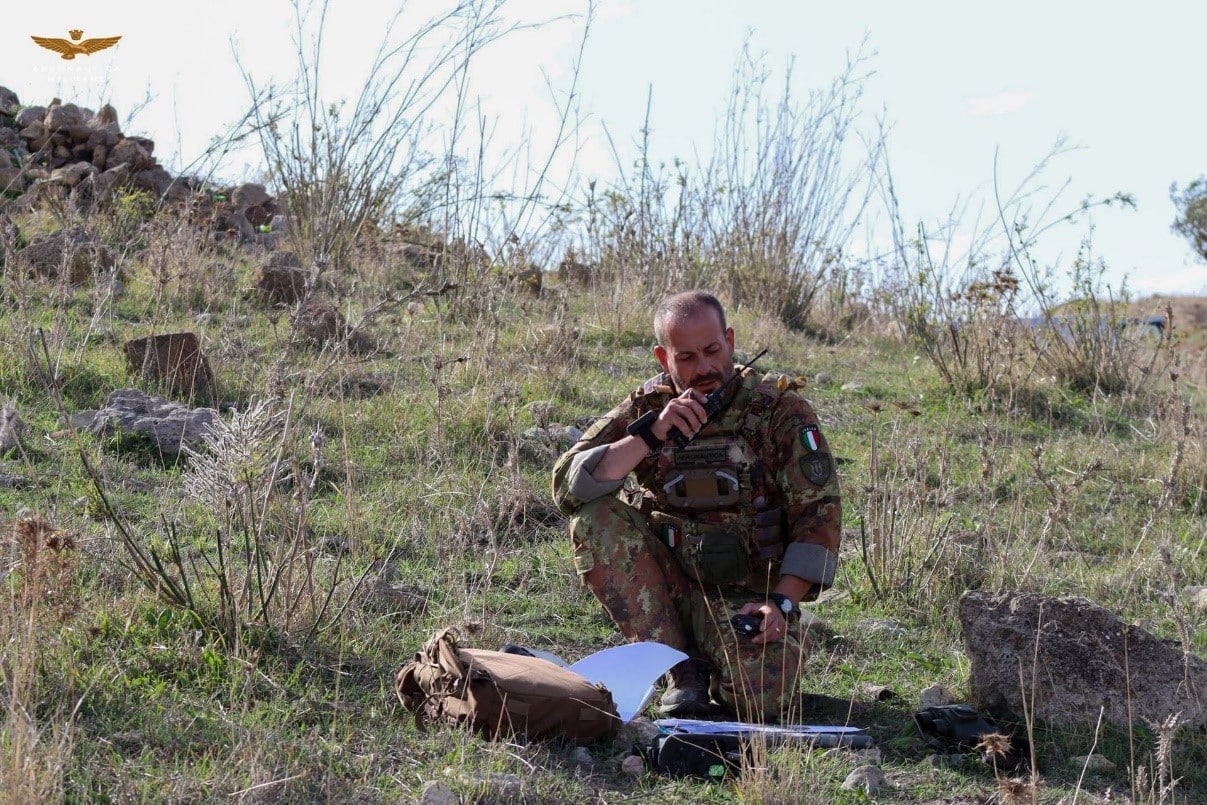
This allows future fighter pilots to better understand the needs of ground forces while developing a broader perspective of the modern battlefield. “It’s essential to understand what the personnel on the ground see, while also helping them understand how we interpret the situation from the air,” said an instructor.
This approach strengthens interoperability among the different services and enhances overall operational effectiveness.
Learning from MistakesNot every challenge encountered during training is technical. Many young fighter pilots are highly self-critical after a mission that falls short of perfection.
For this reason, learning how to deal constructively with mistakes forms an essential part of the training process. Mission debriefings analyse every detail of the sortie, allowing students to understand what happened and identify opportunities for improvement.
“The ability to move forward after making a mistake is one of the most important qualities a military pilot can develop,” said an instructor. It is a lesson that proves invaluable not only in flight, but throughout an entire professional career.
The Fulfilment of a DreamThe ultimate goal of the course is achieving Limited Combat Readiness (LCR) qualification before joining an operational squadron. For every student, this represents the culmination of a journey that began many years earlier—a path built on study, sacrifice, determination, and continuous professional growth.
A Eurofighter Typhoon prepares for a training sortie at Grosseto Air Base, with the iconic hangar of the Italian Air Force 4th Wing (4° Stormo Caccia) visible behind. | Source: Nicolò Teta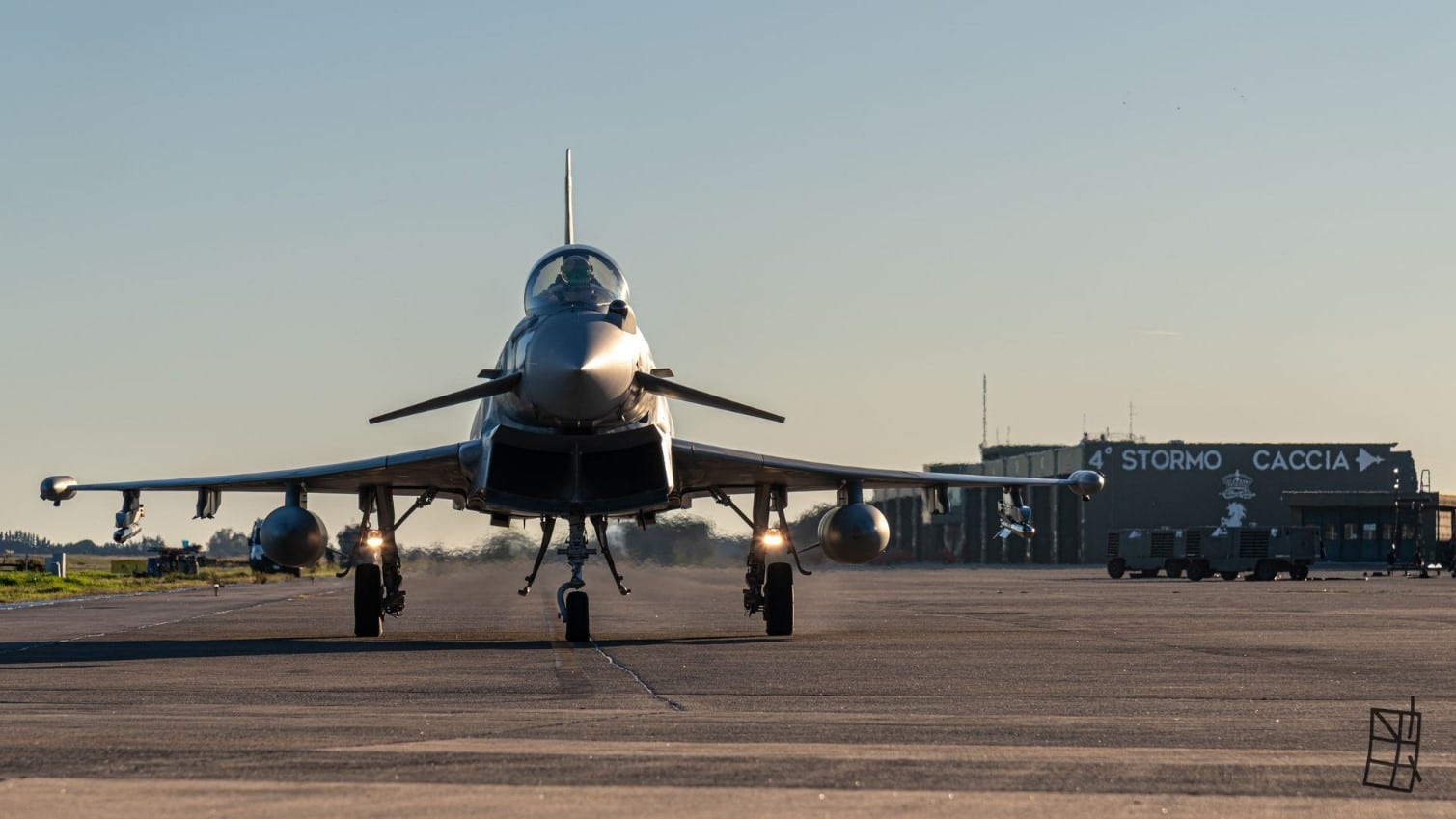
Looking back, many recognize that the course has transformed them not only as aviators but also as individuals. The Eurofighter represents the pinnacle of their training, yet it also marks the beginning of a new chapter.
Because becoming a fighter pilot is about far more than learning to fly a high-performance aircraft. It means joining a professional community entrusted every day with safeguarding national airspace through competence, responsibility, and a deep sense of service.
In an era where technology continues to evolve at an extraordinary pace, one element remains unchanged: the value of people. It is through the combination of innovation, the experience of instructors, and the determination of students that the next generation of Italian Air Force fighter pilots is being forged.
Catégories: Defence`s Feeds
Mahrang Baloch’s Conviction is a Pyrrhic Victory for the Pakistani State
They may have locked up a popular and powerful activist. But this will only convince more Baloch that there is no space for political protest or dissent.
Catégories: Diplomacy & Crisis News
UN Artificial Intelligence Panel Launches Report Ahead of Global Conference
UN Secretary-General António Guterres at the launch of the preliminary report from the UN Independent Panel on AI. Credit: UN Photo/Mark Garten
By Naureen Hossain
UNITED NATIONS, Jul 2 2026 (IPS)
The acceleration of artificial intelligence (AI) and its capabilities is far outpacing governments’ capacities to effectively regulate it. Without scientific evidence to inform their policies, countries will be left at a greater disadvantage, according to the UN’s independent panel on AI.
The UN Independent International Scientific Panel on Artificial Intelligence officially released its Preliminary Report on July 1. This is the Panel’s first global, independent scientific assessment on the opportunities, risks and impacts presented by AI. This early report work from the Panel is expected to provide a foundational evidence base to inform global policy ahead of its first comprehensive report in 2027.
The collaborative effort to build a shared understanding of AI has reached a crucial stage. Governments are making consequential decisions about AI under great uncertainty with rapidly changing, often conflicting sources of evidence and perspectives that do not necessarily reflect local realities. As AI capabilities continue to grow, the stakes for decisions made around the world are also increasing.
The preliminary report was produced by a panel composed of 40 leading experts from across multiple disciplines and every region of the world. Its members, which include the likes of computer scientists, economists, academics and human rights experts, serve in their personal capacity, independent of any government, company or institution. The report’s findings will be presented to governments at the inaugural UN Global Dialogue on AI Governance, convening in Geneva, Switzerland on 6 and 7 July.
The timing of the Panel’s report and the upcoming AI conference represents a turning point for where AI is at, according to Yoshua Bengio, one of the co-chairs of the Panel.
“It’s about the growing intelligence of machines,“ said Bengio, the renowned computer scientist who is the co-president of LawZero and founder of Mila. “You have to realise that intelligence gives power. As that power grows, it can unlock great benefits if we act wisely. But it can also lead to many perils.”
On July 1, Bengio and fellow co-chair of the panel Maria Ressa, journalist and Nobel Peace Prize winner, briefed reporters virtually on the report and the Panel’s work since it convened earlier this year. The co-chairs emphasised that the report does not give policy recommendations on the best practices for AI governance. Instead, Bengio said the policies should meet the “highest standards of scientific integrity.”
When asked about why the Panel could not make policy recommendations, Bengio remarked that their work would become very politicised and would “pollute” the Panel’s ability to “provide scientific evidence”.
Ressa added that while the differences were evident between the panel members, they found a shared language in pursuing the science behind AI. It was also where they could align in their work. “The tech has torn us apart in different realities. What the report will hopefully do for member countries of the UN is to come and bring us together to the same reality,” said Ressa.
Among the key takeaways from the report, what is clear is that in recent years, AI capabilities have accelerated, as has its adoption across multiple sectors and in societies. Currently, its advancements far outpace governments’ capacities to understand it, let alone regulate it. The decision-makers need scientific evidence to effectively govern AI, which should rise. Without this evidence, policy is weakened
The report states that AI holds “significant potential” to advance development across multiple sectors such as health, education and food production. To take advantage of that potential requires tailoring it to local contexts, institutions and user needs. The integration of AI in the health and agriculture sectors makes a case for its positive contributions, especially in the context of the Global South, where evidence has emerged of its use in these spaces. They are more effective when adapted to local contexts and when human workers are trained to use them.
With that said, countries vary in their adoption and usage of AI. The use and access of AI across the Global South lags behind the Global North, according to the report. 118 countries, predominantly in the Global South, are not engaged in major AI governance discussions, and less than one-third of developing countries have developed national AI strategies. The report warns that the Global South is disproportionately exposed to the misuse of AI due to limited capacity for mitigation and limited frameworks for influencing AI development and capacity building. The inputs and outcomes of AI also show linguistic unevenness. Existing AI model infrastructures train on only a fraction of the over 7,000 languages spoken around the world.
A select few countries concentrate AI development and computing capacity. The report shows that of the 500 largest-known public and private AI compute clusters, 75 percent were located in the United States, 15 percent in China, and 10 percent for the rest of the world. Much of the development of AI models is further concentrated in a handful of companies; 91 percent of notable AI models originated from the private sector. U.S. institutions produced 59 known AI models, compared to China’s 35 and an additional 13 from the rest of the world.
This is indicative of existing disparities when it comes to technological developments and may reinforce inequalities between developed and developing countries. This raises the risk for power to be concentrated to a select few individuals and states to shape the standards around AI. This concentration of power may then further affect economic power, military power and the power to influence public opinion.
“A handful of companies and a handful of countries are making the most consequential decisions about humanity’s future,” said Ressa.
On top of that, AI usage can challenge our shared reality. With the ease of generating and disseminating AI-generated textual and visual content, this blurs the line between what was manually created and what has been created with AI tools. This also presents complications when AI is used to create and spread deceptive, manipulated information intended to undermine institutions of information, which can have adverse effects on civic participation and democratic institutions. There is also demonstrable evidence that suggests that AI harms disproportionately affect minority communities due to limited frameworks around the training and application of AI systems.
Bengio noted that the report recognises multiple possibilities for where AI development could be headed due to the rapid acceleration and integration, although it is hard to predict where it will go. It may continue to grow exponentially, at which point it will exacerbate the gaps in AI’s capabilities and the societal risks without sufficient oversight or governance. Alternatively, AI capabilities could reach a plateau, according to Bengio, which would make AI less powerful and would give other countries more time to catch up with their expansions.
It is with these factors in mind, within the current AI landscape that begs urgent action, that governments will convene in Geneva next week for the Global Dialogue on AI Governance. There are steps that member states can take to close the gaps identified by the independent panel and other experts, not to mention a sense of urgency and duty to enact policies that will protect the human rights of their citizens. But it will require sustained commitments from member states.
“The more AI advances without shared rules, the less say governments and people will have in the outcome. So my message to governments is simple: Do not wait,” said UN Secretary-General António Guterres. “The Summit of the Future asked whether international cooperation could keep pace with the speed of technology. Today offers one answer. The science is here. We can no longer say we did not know. What we do with it is now up to all of us.”
IPS UN Bureau Report
Follow @IPSNewsUNBureau
!function(d,s,id){var js,fjs=d.getElementsByTagName(s)[0],p=/^http:/.test(d.location)?'http':'https';if(!d.getElementById(id)){js=d.createElement(s);js.id=id;js.src=p+'://platform.twitter.com/widgets.js';fjs.parentNode.insertBefore(js,fjs);}}(document, 'script', 'twitter-wjs');
Catégories: Africa
Pages



© 2012-2018 Europa Varietas Foundation © 2015-2018 Europa Varietas Association
www.europavarietas.org | info(@)europavarietas(dot)org | Switzerland




We are looking for sponsors for the English translation of these books, please contact turkeandras(at)gmail(dot)com