
You are here
The Aviationist Blog


Morocco’s First F-16 Block 72 Has Flown
The aircraft, a two-seat F-16D, is not only the first of Morocco’s new Vipers to fly, but also the first new-build F-16 Block 72 to take to the air.
The first F-16D Block 72 destined for the Royal Moroccan Air Force (RMAF) has conducted its maiden flight. Lockheed Martin announced the milestone on Oct. 6, 2026, saying that the aircraft completed its first flight from the company’s F-16 production facility in Greenville, South Carolina.
Notably, the aircraft is not only the first of Morocco’s new Vipers to fly, but also the first new-build F-16 Block 72 to take to the air. Morocco became the launch customer for the Block 72 variant when the U.S. government approved the proposed Foreign Military Sale (FMS) in March 2019.
Morocco’s first @LockheedMartin F-16 Block 72 aircraft has taken flight in Greenville, South Carolina. The milestone marks another step toward delivering the most advanced F-16 configuration to the Royal Moroccan Air Force.
— Lockheed Martin News (@LMNews) October 6, 2026
This first flight now marks a major milestone in Morocco’s effort to expand and modernize its F-16 fleet, including both new-build and upgraded Block 72s. The aircraft will now undergo further flight testing before being delivered to Morocco.
A seven-year wait for the Block 72Morocco’s acquisition dates back to March 2019, when the U.S. State Department approved a possible Foreign Military Sale (FMS) covering 25 new F-16C/D Block 72 fighters for an estimated $3.787 billion. The FMS notice did not specify how many twin-seater F-16Ds were included in the 25-aircraft total.
The proposed package included 29 Pratt & Whitney F100-PW-229 engines, of which four are spares, as well as 26 AN/APG-83 AESA radars, 26 modular mission computers, Link 16 systems, LN260 embedded navigation systems and Joint Helmet Mounted Cueing Systems. The package also included weapons and targeting equipment, including AIM-120C-7 AMRAAMs, GBU-38 JDAMs and GBU-54 Laser JDAMs, GBU-39 Small Diameter Bombs, GBU-49 Enhanced Paveway II laser-guided bombs and AN/AAQ-33 Sniper targeting pods.
A Royal Moroccan air force F-16 flies above Morocco during Exercise African Lion April 20, 2018. | Source: U.S. Air Force photo by Senior Airman Malcolm Mayfield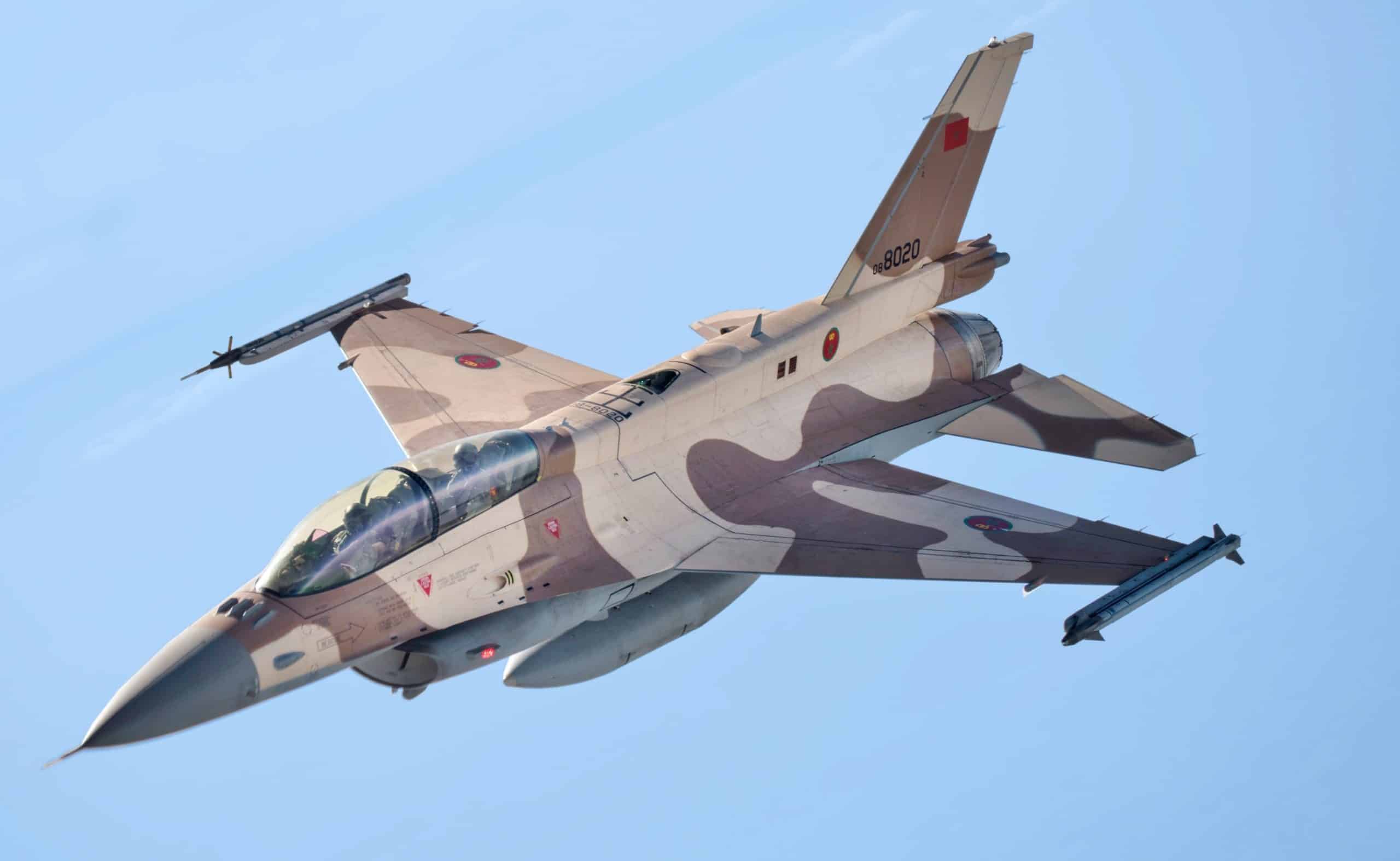
The Block 72 is part of the latest-generation F-16 Block 70/72 family, which incorporates a major modernization of the aircraft’s avionics, sensors, mission systems and cockpit while retaining the basic F-16 airframe. The distinction between the two configurations is primarily the engine.
In fact, the F-16 Block 70 is powered by General Electric’s F110-GE-129, while the Block 72 uses Pratt & Whitney’s F100-PW-229. The two versions otherwise share the same systems, mirroring the earlier Block 40/42 and Block 50/52 families.
The choice of the Block 72 is particularly relevant to Morocco because the RMAF already operates F-16C/D Block 52+ aircraft powered by the Pratt & Whitney F100 engine family. Using the same engine family on the new aircraft provides a degree of commonality in maintenance, logistics and personnel training, especially with the planned upgrade of the existing aircraft to the F-16V Block 72 configuration.
Expanding Morocco’s F-16 fleetThe 25 new F-16s Block 72 are only one part of Morocco’s broader F-16 modernization effort. In fact, alongside the purchase of the new-build aircraft, Washington approved a separate package in 2019 to upgrade Morocco’s existing F-16C/D Block 52+ fleet to the F-16V Block 72 configuration.
Four Royal Moroccan Air Force F-16 Fighting Falcon aircraft fly in formation with a U.S. Air Force B-52 Stratofortress aircraft assigned to the 23rd Expeditionary Bomb Squadron during a Bomber Task Force mission over Morocco, May 23, 2025. | Source: U.S. Air Force photo by Staff Sgt. Bryan Guthrie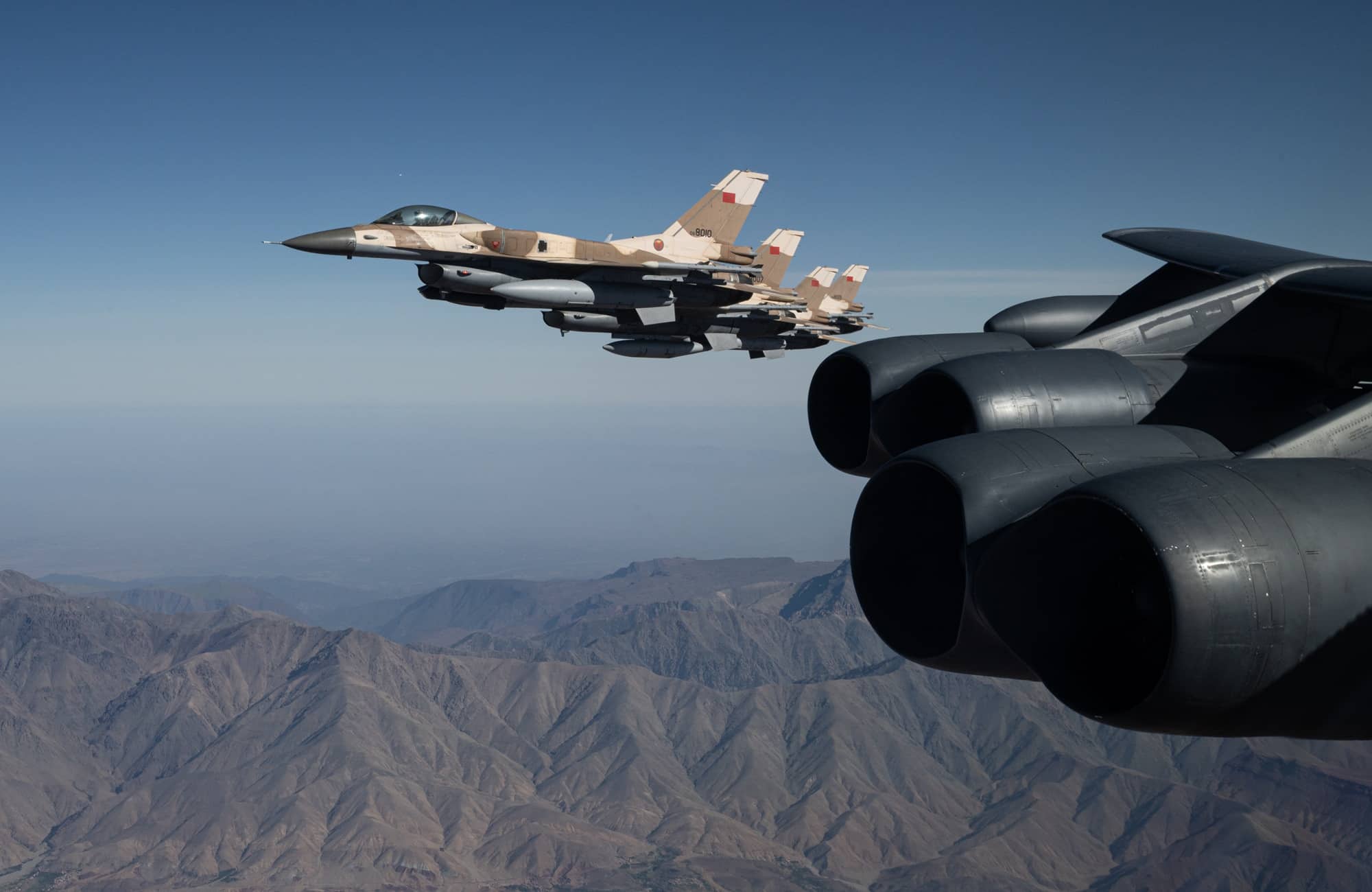
Among the new systems installed during the upgrade we can find the APG-83 AESA (Active Electronically Scanned Array) radar, a new Center Pedestal Display (CPD), the AN/APX-126 Advanced IFF (Identification Friend or Foe), Link 16 datalink, full NVIS (Night Vision Imaging System) and JHCMS II (Joint Helmet-Mounted Cueing System II) compatibility, a new Embedded GPS/INS (EGI), a modern commercial off-the-shelf (COTS)-based avionics subsystem, a high-volume, high-speed data bus and the Automatic Ground Collision Avoidance System (Auto GCAS).
The combination of new-build aircraft and upgraded fighters is intended to give the RMAF a much more homogeneous and capable F-16 fleet. The service initially received 24 aircraft ordered in 2009, with the new order now doubling the fleet.
Categories: Defence`s Feeds
Italian F-35B Seen Carrying 25mm Gun Pod for the First Time
An Italian Air Force F-35B was spotted carrying the GPU-9/A 25mm gun pod, providing the first known visual confirmation of the pod being used by an F-35 operator outside the United States.
An Italian Air Force F-35B Lightning II was spotted for the first time with the GPU-9/A 25mm gun pod, confirming Italy as the first export operator of the system. Aviation photographer Diego Mor captured a photo of the aircraft as it prepared to land at Decimomannu Air Base on Sept. 30, 2026, and kindly shared it with us.
Decimomannu is located in Sardinia, near the ranges used by the Italian Air Force for weapons training. While this might point out to live-fire activities, it is unclear if these were actually conducted and, in that case, if they were part of the operational training of the pilots or an Operational Test and Evaluation (OT&E) campaign.
The acquisition of the gun pod by Italy was already expected, although a visual confirmation of the delivery was still missing. In 2024, we reported here at The Aviationist that the GPU-9/A’s 25mm rounds were included in a multi-year program for the acquisition of new weapons for the Italian Navy’s F-35Bs.
The Italian Navy is currently replacing its AV-8B+ Harriers with 20 F-35Bs, joining forces when needed with 20 other F-35Bs being delivered to the Italian Air Force. It is unclear, however, if the Navy is already employing the gun pod on its own F-35s.
The GPU-9/A 25 mm gun pod, previously known also as the GAU-22A Gun Pod. | Source: Lockheed Martin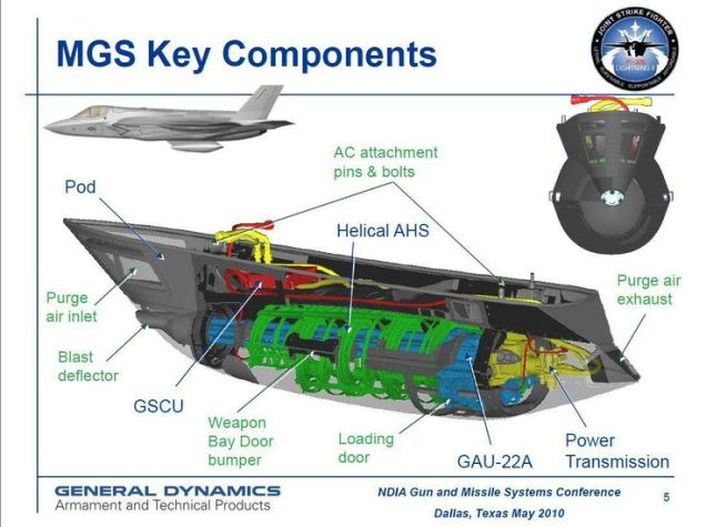
Italy is one of the three countries operating the Short Take-Off and Vertical Landing (STOVL) variant of the F-35 outside of the U.S., with the others being the UK and Japan. While the UK has confirmed that it has no plans to acquire or integrate the 25 mm gun pod on its F-35Bs, there is no information regarding the Japanese aircraft.
The GPU-9/A gun podContrary to the F-35A variant, the F-35B and F-35C don’t have the internal GAU-22/A 25mm cannon, and are thus forced to employ an externally mounted gun pod. The gun pod, technically known as the Gun Pod Unit (GPU) – 9/A has always been quite controversial, as both the F-35B and F-35C have to rely on this external device that, despite the “stealthy” shape is believed to induce a Radar Cross Section (RCS) degradation. It is worth noting that the variant used by the F-35C, although apparently similar, is designated as GPU-8/A.
Another controversy is related to the ammo carried in the pod, 220 rounds, which is less than the ammo carried by the aircraft replaced by the F-35 (300 rounds on the Harrier, 412 on the Hornet and 578 on the Super Hornet). It should be noted that the F-35A carries even less ammo, just 180 rounds.
The pod has its share of trouble, with some notable incidents, like the Class C mishap when a PGU-32/U Semi-Armor Piercing High Explosive Incendiary-Tracer (SAPHEI-T) 25mm round exploded after leaving the gun pod during a night CAS (Close Air Support) mission over the Yuma Range Complex.
A U.S. Marine Corps F-35B with the centerline gun pod clearly visible under the fuselage. | Source: U.S. Marine Corps photo by 1st Lt. Zachary Bodner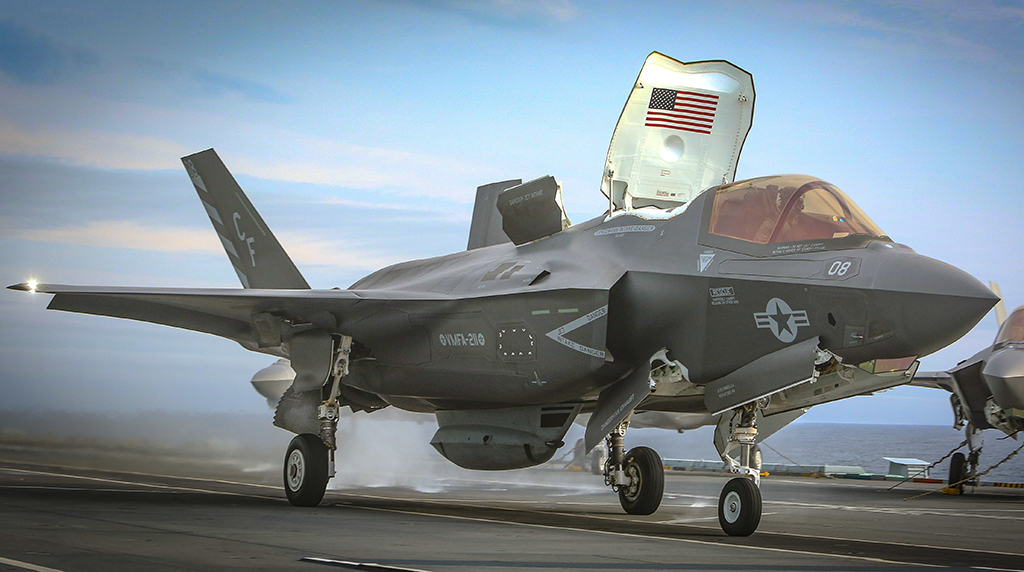
In July 2021, an USMC F-35B, which was deployed on the HMS Queen Elizabeth aircraft carrier in the Pacific Ocean, was forced to divert and land at Kadena Air Base because of unspecified issues with the gun pod, with the aircraft taxing to a remote area and with firefighters on standby as maintainers troubleshoot the problem.
The GAU-22 is reported to be more than 40 pounds lighter and requires 20 percent less overall space than the earlier GAU-12 5-barrel 25mm gun. The new GAU-22 weapon has a reported rate of fire of “up to 3,300 rounds per minute.”
One final point regarding the pod and its potential use by the Italian Air Force: it is not yet clear whether the F-35’s gun will be employed in both the air-to-ground and air-to-air roles, although the service may also be interested in exploring its use for counter-UAS missions.
At present, Italian F-35s, both the A and B variants, can only carry the AIM-120 AMRAAM (Advanced Medium Range Air-to-Air Missile) for air-to-air engagements. Italian F-35s have already supported both domestic and NATO QRA (Quick Reaction Alert) missions, and while they are expected to receive the AIM-9X Sidewinder in the future, using an advanced and relatively expensive air-to-air missile against a low-cost drone, such as those recently engaged by Italian Eurofighter Typhoons in the Baltic region, would not be a cost-effective solution in the long term. While using an F-35 to engage a Russian drone with the gun pod would still be a sub-optimal solution, it would nevertheless be preferable to expending an expensive air-to-air missile.
This means the Italian Air Force could be interested in using the gun pod not only against ground targets in a traditional CAS (Close Air Support) role, but also for counter-UAS missions, hence the need to test it in the Sardinian ranges.
Thanks again to Diego Mor for the photo he sent us. Make sure to follow him on Instagram for more!
Categories: Defence`s Feeds
Canada Advances Negotiations with Saab for GlobalEye
While not a formal purchase contract, the term sheet agreement establishes the framework for negotiation after Canada identified Saab as the preferred supplier for its future AEW&C system.
Canada and Saab have entered negotiations for the acquisition of the GlobalEye Airborne Early Warning and Control (AEW&C) system, with the company signing a “non-binding term sheet agreement” with the Canadian Defence Investment Agency. The development comes four months after Canadian Prime Minister Mark Carney in May announced Saab as the preferred supplier for the country’s future AEW&C system.
Saab announced on Sept. 25, 2026, that the agreement lays the “scope and foundation for detailed negotiations” toward the GlobalEye’s acquisition. The company clarified that the framework agreement is “not a formal purchase contract or commitment to procure” the GlobalEye.
Nevertheless, it lays the path for the current discussions towards the possible contract. “[The agreement] reflects the progress made through close collaboration between Saab, the DIA and the RCAF and provides the framework for upcoming negotiations,” said the company in its statement.
The Royal Canadian Air Force (RCAF) and Saab have said that Ottawa estimates the need to acquire six GlobalEye aircraft. The company added that the aircraft would have customized systems reflecting Canada’s operational needs.
Ottawa advances talks with Saab over possible GlobalEye purchase https://t.co/jJmG3XF5wZ
— The Globe and Mail (@globeandmail) September 25, 2026
The agreementSaab said the agreement “marks an important milestone” following Canada’s May 27, 2026, announcement identifying the company “as the preferred supplier for the nation’s future AEW&C capability.”
Saab’s president and CEO Micael Johansson said in the release: “The term-sheet agreement reflects the strong collaboration between Saab and Canada and establishes a clear framework for the next phase of our engagement. With a well-defined scope in place, we are well positioned to continue discussions and demonstrate how Saab’s proven and highly capable AEW&C solution can meet Canada’s requirements.”
As mentioned earlier, the proposed program so far outlines six GlobalEye aircraft for the RCAF, including associated systems, training and support. “The discussions will focus on a system configuration reflecting Canada’s operational requirements, as well as industrial participation, capability development and programme execution,” explained Saab.
Was a pleasure to meet with senior leadership from @Saab to discuss how our province’s advanced manufacturing expertise can contribute to the next generation of defence and aerospace opportunities.
We received an update on their Global Eye platform and the role the Ontario-made… pic.twitter.com/FDIRDKqgek
— Victor Fedeli (@VictorFedeli) September 25, 2026
The statement further added that “Saab is committed to supporting Canada’s defence and security objectives, strengthening interoperability with allies and delivering proven capabilities that meet evolving operational requirements.”
The company described the GlobalEye as an advanced AEW&C system offering an “array of active and passive sensors for long-range detection and identification of incoming threats across the domains.” Saab further said that, “by providing real-time information to military commanders, GlobalEye enhances situational awareness and enables the early detection of potential threats.”
The Netherlands, France and the North Atlantic Treaty Organization (NATO) have also selected GlobalEye, reflecting the platform’s growing popularity. Additionally, Saab announced in July an order for the system by an unidentified West Asian country.
Saab has received an order for two GlobalEye aircraft from a country in the Middle East region.
The order value is SEK 10.1 billion, and deliveries will take place in 2030. https://t.co/8eFBaV9iuo
— Saab (@Saab) July 27, 2026
Canada’s GlobalEye Connection to European Defense IndustryBoth Saab and Canada are leveraging their pre-existing mutual dependence in the GlobalEye system. Canada is the country of origin of the Bombardier Global 6500 business jet on which GlobalEye is based.Saab integrates the aircraft with its Erieye radar and other mission systems to create the GlobalEye AEW&C platform.
As per the May announcement, Saab said it was looking to establish substantial Canadian industrial participation in GlobalEye production, with Canadian companies involved in building, maintaining and upgrading the aircraft.
The development also comes as Canada appears to be deepening its defense-industrial ties with Europe. Recently, the country has inked a $564 million Joint Strike Missile (JSM) deal with Norway’s Kongsberg, and is actively considering Saab’s Gripen – with a substantial localized industrial workshare element.
This comes as ties with the U.S. remain tense and questions remain abound over the future of Canada’s F-35A Lightning II fleet. “Carney’s government still has not made a decision on its planned acquisition of 88 F-35 stealth fighter jets. That review, which was launched in response to diplomatic and trade tensions with the Trump administration, was supposed to have concluded a year ago,” CTVNews said, while reporting about the new agreement with Saab.
Categories: Defence`s Feeds
New Video Offers Clearest Look Yet At Blackbeard Hypersonic Missile On F/A-18F Super Hornet
For the first time, newly released imagery shows Castelion’s Blackbeard low-cost hypersonic weapon carried by a U.S. Navy Super Hornet during a test flight.
Newly released imagery provides the clearest look yet at Castelion’s Blackbeard hypersonic strike weapon mounted on a U.S. Navy F/A-18E/F Super Hornet.
The footage, released by Naval Air Systems Command (NAVAIR), shows two Blackbeard weapons installed under the wing of a Super Hornet, offering detailed views of the missile and its integration on the Navy’s carrier-based strike fighter.
Coming soon to a theater near you…BLACKBEARD!@USPACOM @CENTCOM @PAEAviation pic.twitter.com/KgBtIqdf8I
— NAVAIR (@NAVAIRNews) September 25, 2026
While this is not the first time Blackbeard has been seen on the aircraft, the new material offers a much better view of the weapon and its installation than the image that surfaced during the Tailhook Association symposium in August 2026. That earlier photograph, displayed as part of a Navy presentation, showed two Blackbeard test articles mounted beneath the right wing of a Super Hornet and represented the first public confirmation that physical integration work on the fighter was already underway.
The newly released imagery, showing the missile flying on the Super Hornet, comes as Blackbeard is moving at unusually high speed through the acquisition process.
BlackbeardBlackbeard is an air-launched hypersonic strike weapon developed by California-based Castelion and intended to provide U.S. naval aviation with a relatively inexpensive, long-range weapon capable of attacking both maritime and land targets.
The U.S. Navy describes Blackbeard as a “responsive, long-range, high-speed strike option” for carrier-based aircraft, meant to improve their ability to operate against sophisticated air defenses while increasing the number of long-range weapons that can be fielded.
The F/A-18E/F Super Hornet is the initial air-launched platform for the weapon. The Navy has not publicly detailed exactly when or where the latest imagery was recorded.
In April 2026, Castelion received a 105 million USD Navy contract covering further integration of Blackbeard on the F/A-18, including hardware and software integration, flight testing, system-safety work and airworthiness certification for carrier operations. At the time, the company said the objective was to transition the weapon to Early Operational Capability in 2027.
A low-cost hypersonic weaponOne of the most significant characteristics of Blackbeard is not simply its speed, but the philosophy behind the program.
Castelion has designed the weapon from the outset around large-scale production and comparatively low unit cost, in contrast with the traditionally small inventories and extremely high prices associated with U.S. hypersonic weapon programs.
The company describes Blackbeard as its first low-cost, mass-producible hypersonic strike missile and says the design makes extensive use of vertically integrated propulsion and guidance technologies as well as commercial manufacturing techniques.
Detailed performance figures remain classified; the weapon is described as hypersonic, meaning it is designed to reach speeds above Mach 5.
Rapid transition into productionBlackbeard has moved from development into procurement quite quickly.
In February 2026, the Navy awarded Castelion 49.9 million USD to advance the missile from the prototype stage toward an integrated Early Operational Capability, with that work scheduled to run through November 2027. That was followed by the $105 million F/A-18 integration contract in April.
In June 2026, the Navy placed a 23.4 million USD firm-fixed-price order for 50 Blackbeard Early Operational Capability pre-production prototypes, together with 50 shipping and storage containers. Castelion said the order marked the transition from development and flight testing toward operationally relevant production.
On Aug. 25, another 89.997 million USD award was announced to support the 50 EOC weapons and the transition of Blackbeard toward a formal Navy Program of Record. Interestingly, this work also includes Defense Exportability Features aimed at facilitating potential future sales to U.S. allies and partners.
More recently, on Sept. 14, 2026, Castelion announced a U.S. Navy production delivery order worth up to 200 million USD to manufacture, assemble, test and deliver an initial batch of production Blackbeard weapons. The Navy officially announced the award the following day. Castelion said work under the award will be performed at Project Ranger, the company’s 1,000-acre manufacturing campus in Rio Rancho, New Mexico, and at its facility in Torrance, California.
According to U.S. government contracting information subsequently reported by USNI News, an initial 43.65 million USD order covers 444 Blackbeard All-Up Rounds, an unusually large quantity for a weapon in the hypersonic category.
Blackbeard is being procured by the U.S. Navy as part of the Multi-mission Affordable Capacity Effector (MACE) program, an effort aimed at fielding a comparatively low-cost, long-range strike weapon that can be produced and deployed in much larger numbers than traditional hypersonic systems. The program reflects the Navy’s broader push toward “affordable mass,” with an emphasis on increasing magazine depth and giving carrier-based aircraft a greater number of high-speed standoff weapons for use against both maritime and land targets.
In fact, among the most important lessons learned from the recent conflicts in Ukraine and the Middle East, is the need to keep an eye on the stocks of munitions which can be quickly depleted during sustained operations. As a consequence, it is important to maintain sufficiently deep inventories and to have the industrial capacity to replace expended weapons at speed. Blackbeard appears to have been conceived with exactly these requirements in mind.
Categories: Defence`s Feeds
F-22 Raptor Spotted Again With Stealth Pods and Unusually Colored Underside
New photos provide another look at an F-22A Raptor carrying the external sensor pods, while also revealing distinctive light-colored panels on the aircraft’s underside.
Newly emerged photos provide another look at an F-22A Raptor carrying the external sensor pods which are currently being developed for the stealth fighter. Interestingly, distinctive light-colored panels can be seen on the aircraft’s underside, although their function is unknown.
The photos which you can see in this article were shared with us by our friend and contributor @stinkjet, who shared them on social media on Sept. 19, 2026. The F-22, callsign “FEVER21,” was flying over the Aerospace Valley of California at the time.
The F-22 was later spotted, accompanied by an F-16 Fighting Falcon, while refueling from the NKC-135 tanker “GHOST81.” The specialized tanker, assigned to Edwards Air Force Base, California, is modified with equipment that allows it to support test and evaluation activities.
Visualizza questo post su Instagram
Un post condiviso da Alex (@stinkjet)
The Raptor can be seen with the two pods installed beneath its outer wing stations. This is possibly the best view of the pods on the F-22 since their appearance in March 2026 alongside the new stealth external fuel tanks.
The equipment has previously been associated with the development of an infrared search and track (IRST) capability for the F-22, although the exact configuration and purpose of the individual pods have not been publicly disclosed. At least one of the pods appeared to feature a transparent section at its forward end, consistent with an infrared or other optical sensor.
The photos are particularly interesting because of the appearance of the aircraft’s underside panels. Their light coloration is clearly visible in some of the images, but it is not possible to determine from the photographs alone whether they represent a new coating, temporary test instrumentation, or another modification.
An IRST Capability for the RaptorThe F-22 was originally designed with provisions for an integrated Infrared Search and Track System (IRST), but the capability was removed during development as a result of budget constraints. The production aircraft thus does not have an equivalent to the F-35 Lightning II’s integrated Electro-Optical Targeting System (EOTS), which also limited the Raptor’s air-to-ground capability to GPS-guided munitions only.
The F-22 Raptor captured in March 2026 with both the pods and the new stealth external fuel tanks. | Source: Jarod Hamilton/jmh.creates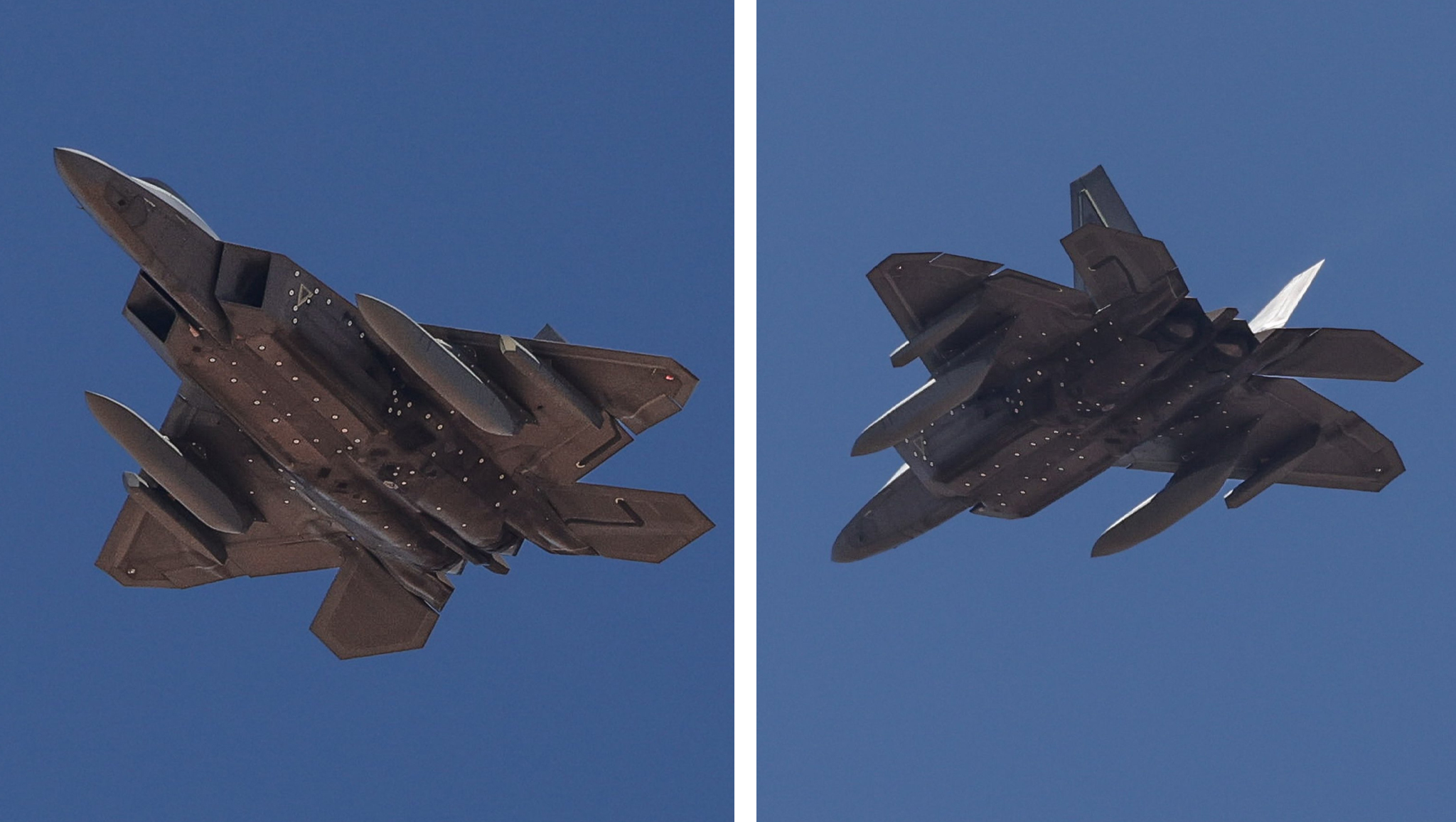
Integrating an EOTS-like solution is however not feasible for a host of reasons, starting from the heavy and expensive modifications required by the airframe. The external pod solution thus appears to offer a way to introduce new sensing capabilities without undertaking the extensive structural modifications that would be required to install a new internal sensor.
The addition of a passive optical sensing capability would represent a significant enhancement to the F-22’s ability to detect and track airborne targets, complementing the AN/APG-77 radar. Being a passive system, the IRST has also the advantage of not alerting an adversary of a target lock, contrary to the radar which can be picked up by a Radar Warning Receiver (RWR).
The new pods have been spotted during flight testing on an F-22 at the Air Force’s since February 2022. They also made an appearance under the fuselage of a Rockwell Sabreliner 65 used as airborne testbed.
Budget documents mention an InfraRed Search and Track (IRST) sensor being developed for the F-22, which could be the sensor housed inside the two pods, although they could host also other capabilities in addition to the IRST. Among these could be electronic warfare (EW) capabilities or even networking for collaborative combat aircraft (CCA).
A close-up of the stealthy pod installed under the Rockwell Sabreliner 65 airborne testbed. | Source: @SR_Planespotter The Raptor’s Light-Colored Underside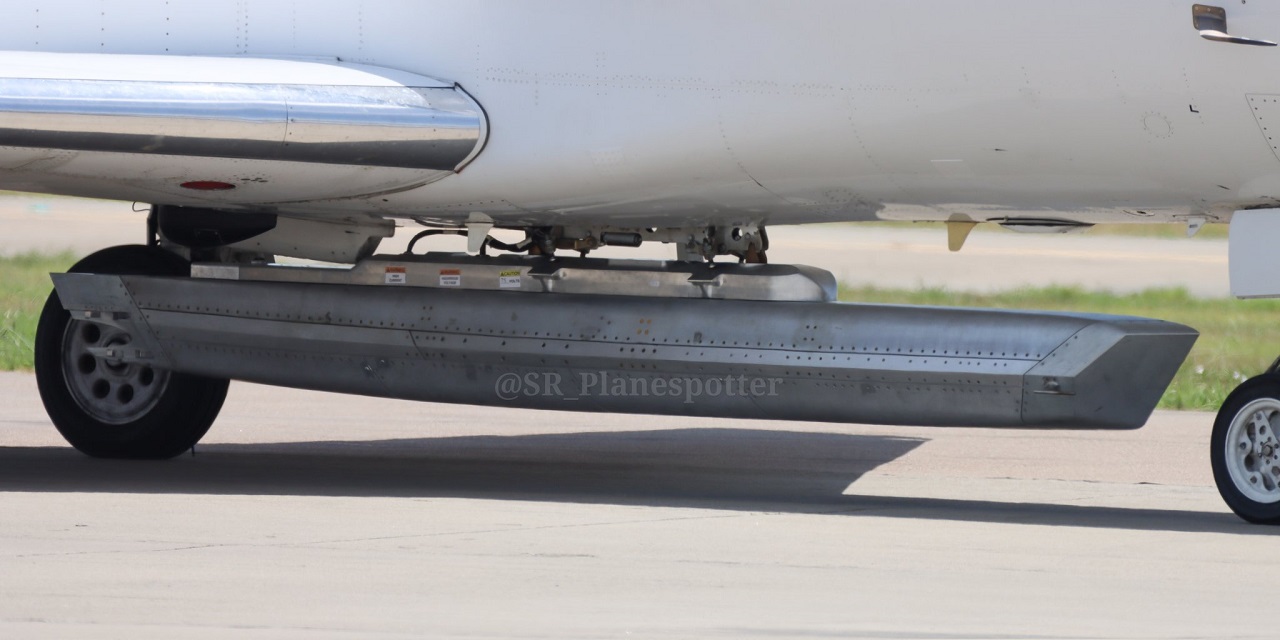
Another particularly interesting detail visible in the new imagery is the markedly lighter appearance of portions of the F-22’s underside, specifically the weapons bays’ doors and engines’ underside. The apparent difference in surface finish is sufficiently pronounced to raise questions about whether these areas have been modified.
One possibility is that the aircraft is carrying replacement or temporary panels associated with the ongoing flight-test campaign. However, the positioning and extent of the lighter areas also make it worth considering whether they could be related to testing of new low-observable materials or surface treatments.
The F-22’s radar-absorbent material (RAM) system is an integral part of its low-observable characteristics. Even relatively small changes to the aircraft’s external materials can have implications for radar signature, maintainability and environmental durability.
In the past, the F-22 was spotted with a “mirror-like” coating, which was attributed to either RAM or IR testing, although it has never been officially confirmed. However, the new images shows notable differences compared to that coating, including the reflective surface and the pattern of tiles, which here appear to be absent.
At present, however there is no evidence to conclusively link the light-colored panels to a new round of testing on surface coatings.
Thanks again to our friend @StinkJet for allowing us to use the photos. Make sure to follow him on Instagram or X for more!
Categories: Defence`s Feeds
New White House Helipad Shown Off to Reporters Ahead of Completion
President Trump toured the ornate, granite helipad under construction on the White House South Lawn with reporters, adding his signature to a piece of the stonework that could see use as soon as next month.
Commissioned following the long, highly publicized drama of the new VH-92A Patriot helicopters being unable to land at the White House without scorching the manicured grass lawn, the new helipad will be used for all helicopter movements in and out of the President’s official residence as well as for hosting events and press conferences.
It is constructed of four inch thick Californian granite and inlaid with the Presidential seal. The $5-6 million bill is reportedly being funded by Sikorsky, who manufactures the VH-92 aircraft, alongside personal donations including from President Trump.
President Trump on new White House helipad. pic.twitter.com/X1611DW4yc
— CSPAN (@cspan) August 19, 2026
“This is a helipad at the highest level. It can land any helicopter in the world, no matter how big, no matter how powerful, no matter how strong,” the President told reporters. Presumably, this means it could also accommodate the V-22 Osprey, as flown in a support role by HMX-1. The Osprey is also well known for its hot exhaust causing scorch marks and even fires on grass landing sites, and its particularly strong downdraft has destroyed less substantial helipads. While HMX-1’s V-22s do not carry the President, the ability for the type and those like it to land safely at the White House is arguably a good contingency measure for emergency scenarios.
Construction workers wait on the new helipad for President Trump to tour the new site which is under construction on the South Lawn of the White House. @POTUS pic.twitter.com/dhDMTiC5QZ
— Doug Mills (@dougmillsnyt) August 19, 2026
Used for decades to land the legacy fleet of HMX-1 helicopters and their predecessors, the White House’s South Lawn has seen a wide variety of occasions through the years. Frequently used for ceremonial occasions, most recently it controversially hosted a massive, temporary stage for the UFC Freedom 250 event. This was widely accused of causing significant damage to the lawn, though as we now know this was partially mitigated by plans for the helipad’s construction immediately afterwards. Off to the sides of the South Lawn are Presidential amenities, including a putting green, tennis courts, and swimming pool.
The grass is usually protected from damage by circular aluminium panels that could be placed on the grass ahead of a helicopter’s arrival. The skilled pilots of HMX-1 would then land the helicopter on these red dots, so that the landing gear did not damage the turf or – in wetter weather – sink into the ground.
President Barack Obama and First Lady Michelle Obama arrive on the South Lawn of the White House following their trip to Fort Bragg, N.C., Dec. 14, 2011. | Source: Official White House Photo by Chuck Kennedy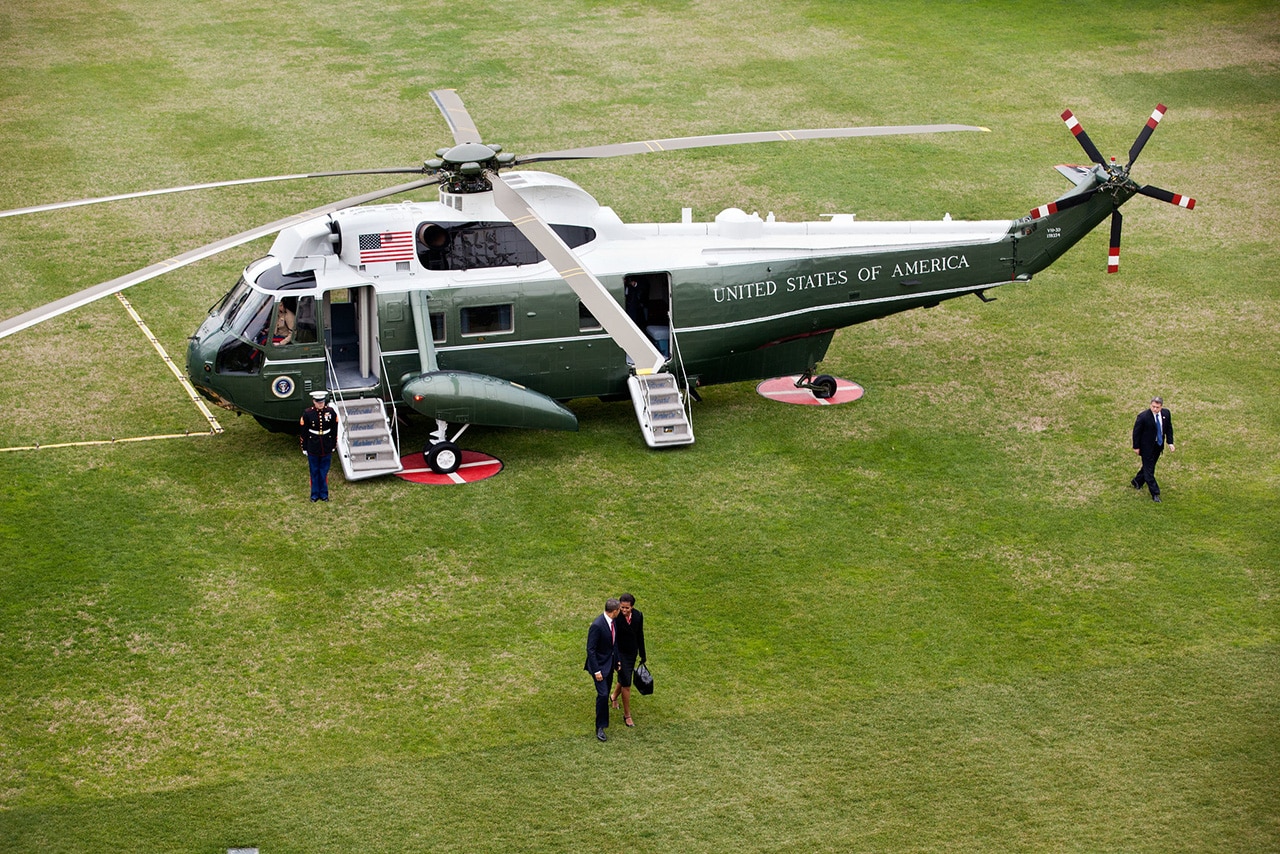
Heat damage is a newer concern, caused by the VH-92’s exhaust gases from the main engines and the auxiliary power unit (APU). While the VH-92 commenced Presidential service during President Biden’s term in office, this issue meant that helicopter transport to and from the White House itself was still primarily handled by the VH-3D Sea King and VH-60N White Hawk.
Completion of the new helipad could be achieved as soon as next month, ahead of Chinese President Xi Jinping’s visit to the White House on Sept. 24. Construction was apparently delayed after initial construction began when President Trump pushed for a redesign that involved additional ground work.
Exclusive: President Trump has directed contractors to redo weeks of work on his planned White House helipad, according to people who spoke on the condition of anonymity.
Trump has made the helipad a priority, but was dissatisfied with the results. https://t.co/Tu3Qv4DvR8 pic.twitter.com/cZC1htx0hd
— The Washington Post (@washingtonpost) August 5, 2026
Trump claims that attempts to build a dedicated helipad at the White House had been made for decades but had not made progress until now. Most Presidents assume a role closer to a caretaker when occupying the White House, and are reluctant to make significant permanent changes to the structure or the grounds unless absolutely necessary. President Trump, however – at least in his current, second term – has appeared to feel much less bound to such traditions.
WASHINGTON (AP) — The entire White House East Wing has been demolished as Trump moves forward with ballroom construction, AP photos show.
AP Photo/Jacquelyn Martin pic.twitter.com/MzV00mTN2V
— philip lewis (@Phil_Lewis_) October 23, 2025
With the covering over of the famous Rose Garden early in his term, as well as the complete demolition of the White House’s East Wing in favor of a lavish, controversial new ballroom (and, underneath, a new Presidential bunker), the addition of a granite helipad is certain to be one of the less unpopular changes. As Trump remarked of the solid stone pad, “this will be here long after we’re gone, no matter what happens with the world, this is not moving.”
Categories: Defence`s Feeds
BRRRRT Act’s Text Reveals New Details About Plan to Save the A-10s
New details in the BRRRRT Act’s full text reveal plans to keep selected Warthogs recoverable, examine potential foreign transfers and test emerging autonomous systems.
Weeks after it was first introduced to the U.S. Congress, the full text of the ‘BRRRRT Act’ has now been released. The bill’s text now reveals that the proposed legislation goes considerably further than simply preventing the U.S. Air Force from retiring the A-10 Thunderbolt II.
In fact, in addition to requiring the service to maintain at least 126 Warthogs through Fiscal Year 2033, the bill would preserve selected retired aircraft in recoverable condition, restore A-10 sustainment and training capacity, examine potential transfers to foreign partners, and explore experimenting with autonomous capabilities relevant to the A-10 mission set.
H.R. 9780, the “Bolstering Recognition, Resurgence, Retention, and Remembrance of the Thunderbolt Act of 2026,” was introduced in the House of Representatives on July 20, 2026, by Rep. Abe Hamadeh (R-Ariz.), with Rep. Don Davis (D-N.C.) and four other lawmakers as original cosponsors. The bill was referred to the House Armed Services Committee and the House Foreign Affairs Committee on the same day.
As we previously reported, the legislation would prohibit the Department of Defense from reducing the A-10 inventory below 126 aircraft from FY2027 onward, unless a higher number is deemed necessary by the Secretary of the Air Force. However, the bill also seeks to preserve the broader enterprise required to operate the aircraft.
A U.S. Air Force A-10C Thunderbolt II aircraft assigned to the 357th Fighter Generation Squadron demonstrates live fire at the Barry M. Goldwater Range near Gila Bend, Arizona, June 11, 2026. | Source: U.S. Air Force photo by Senior Airman Christopher Ornelas Jr.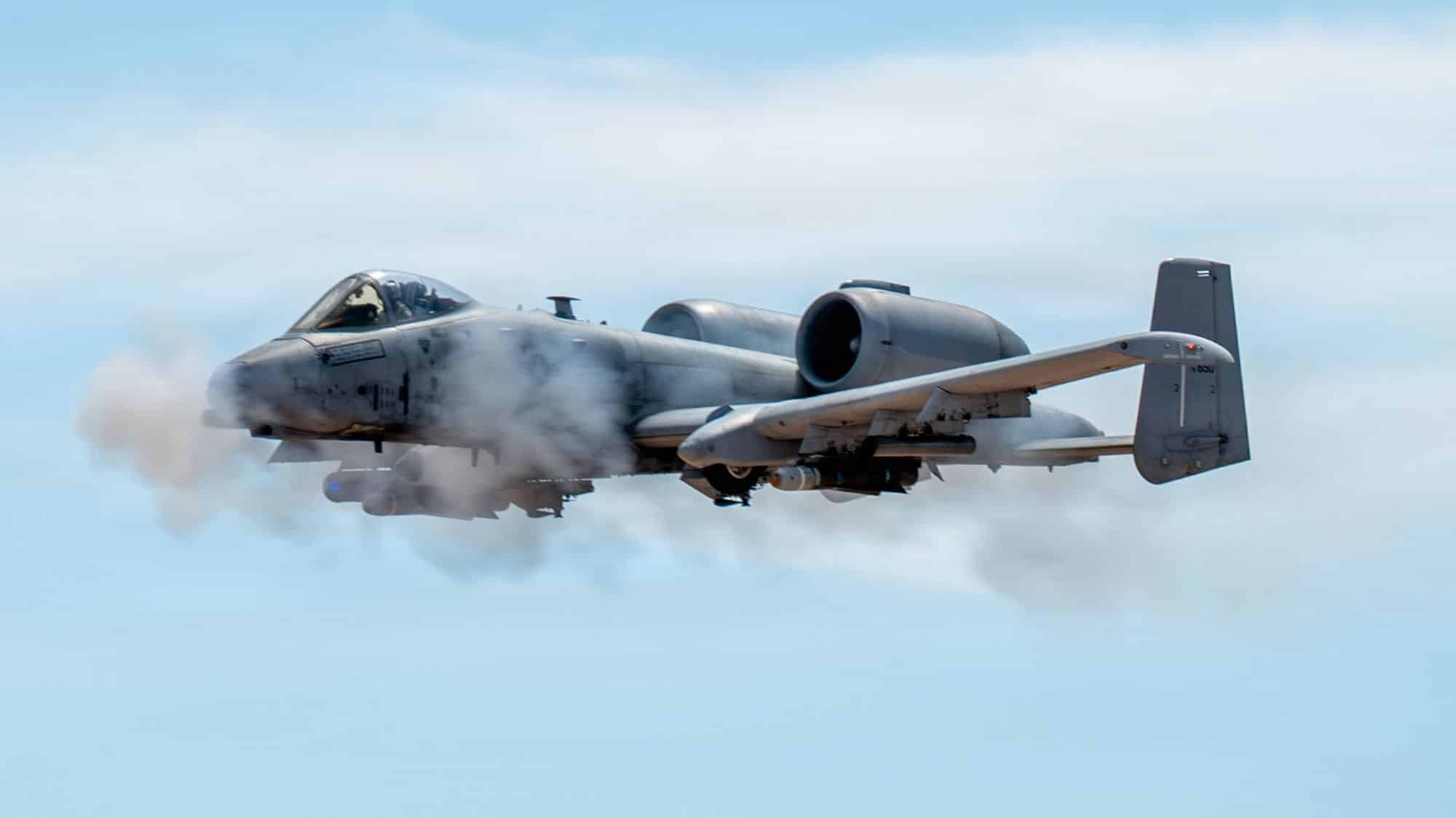
Specifically, it would prevent reductions in A-10 unit personnel, pilot training capacity, operational test capacity, depot maintenance and sustainment activities. At the same time, the legislation requires the Air Force to restore sufficient capacity to support the fleet through FY2033.
A real replacement for the A-10One of the bill’s most significant provisions is its definition of what would constitute an acceptable replacement. The bill specifically mentions that this replacement must achieve full operational capability before the restriction on the A-10’s retirement can be waived.
The replacement would have to be operationally fielded and supported by the necessary pilots, maintainers, training, sustainment logistics and depot facilities. More importantly, the replacement needs to assume the missions currently assigned to the A-10 as its primary missions, including Close Air Support (CAS), Forward Air Controller-Airborne (FAC-A), Combat Search And Rescue (CSAR) support, personnel recovery support and armed overwatch.
This means that simply assigning A-10 missions to existing aircraft, such as the F-35, F-16, F-15E and F-15EX would not necessarily satisfy the legislation’s requirements. The Pentagon would have to demonstrate that the required operational effects, personnel and supporting infrastructure are actually available.
A U.S. Air Force A-10C Thunderbolt II aircraft approaches an HC-130J Combat King II aircraft for aerial refueling in the U.S. Central Command area of responsibility, May 9, 2026. | Source: U.S. Air Force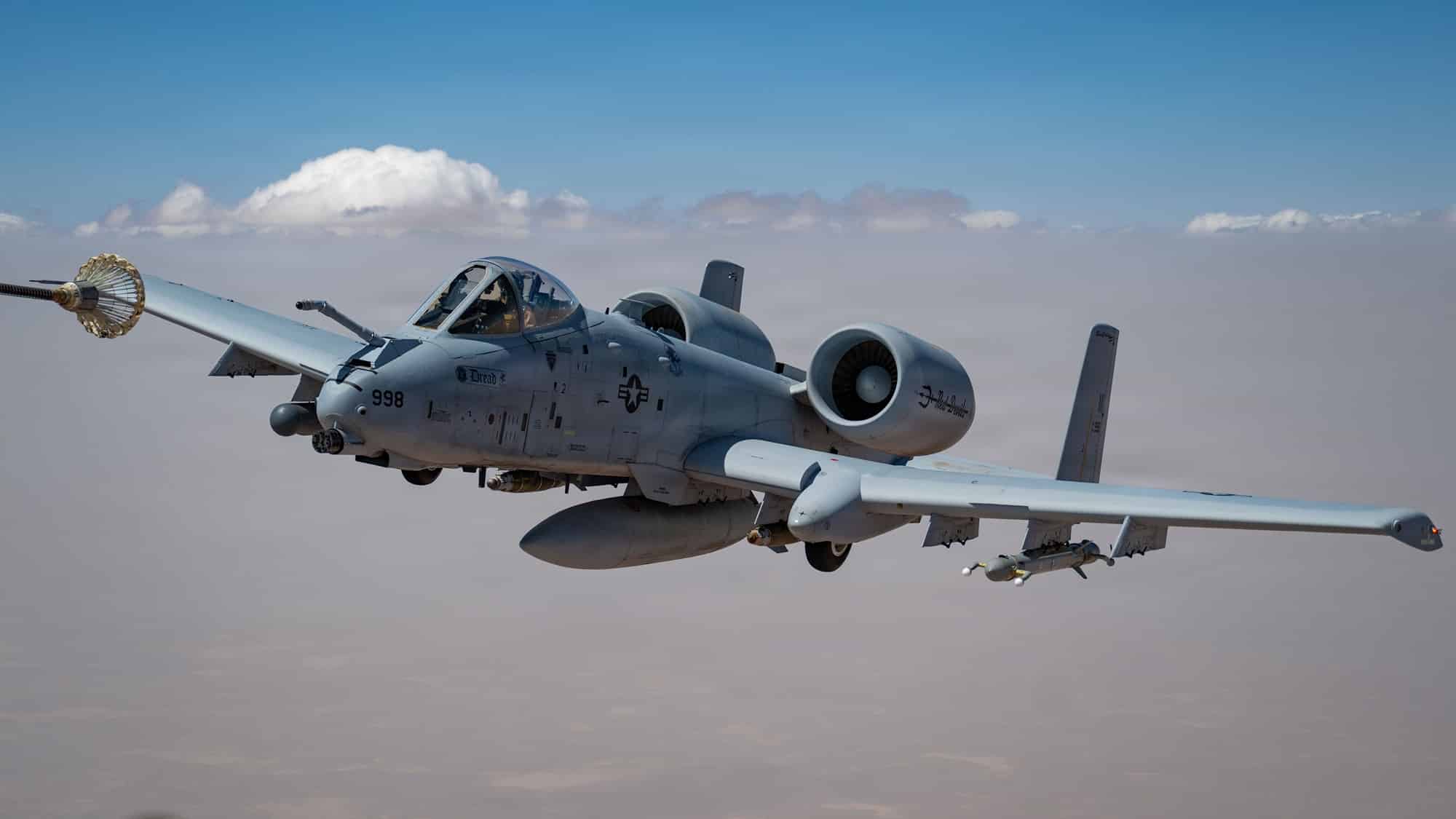
Then, the Secretary of War would have to certify that a replacement aircraft has fully assumed the A-10’s mission. That certification would also need to be approved in writing by the Secretary of the Army, the Commandant of the Marine Corps, and the Commander of U.S. Special Operations Command, confirming that it would satisfy their requirements.
Retired Warthogs in recoverable storage and no cannibalizationIn addition to preserving a minimum fleet in service, the bill also takes aim at what happens to A-10s once they leave operational service. Selected retired aircraft would have to be preserved in a recoverable storage condition, likely referring to the Type-1000 storage which maintains the aircraft in a condition that allows recall for future service.
The bill describes that the stored A-10s would retain the major systems, mission equipment and structural components needed for a potential return to service, training, testing or transfer to a foreign partner. Additionally, the aircraft could not be demilitarized or otherwise altered in a way that would unnecessarily compromise their future recoverability.
An important point in the legislation would also prohibit the cannibalization or parting out of certain A-10s. These include aircraft that have received wing replacements or service-life-extension modifications, retain more than 1,500 projected flying hours, or have been identified as candidates for reconstitution, contingency activation or foreign transfer.
A U.S. Air Force A-10 Thunderbolt II fires flares as it departs from aerial refueling with a KC-135 Stratotanker over the U.S. Central Command area of responsibility, Sept. 23, 2025. | Source: U.S. Air Force photo by Senior Airman Natalie Jones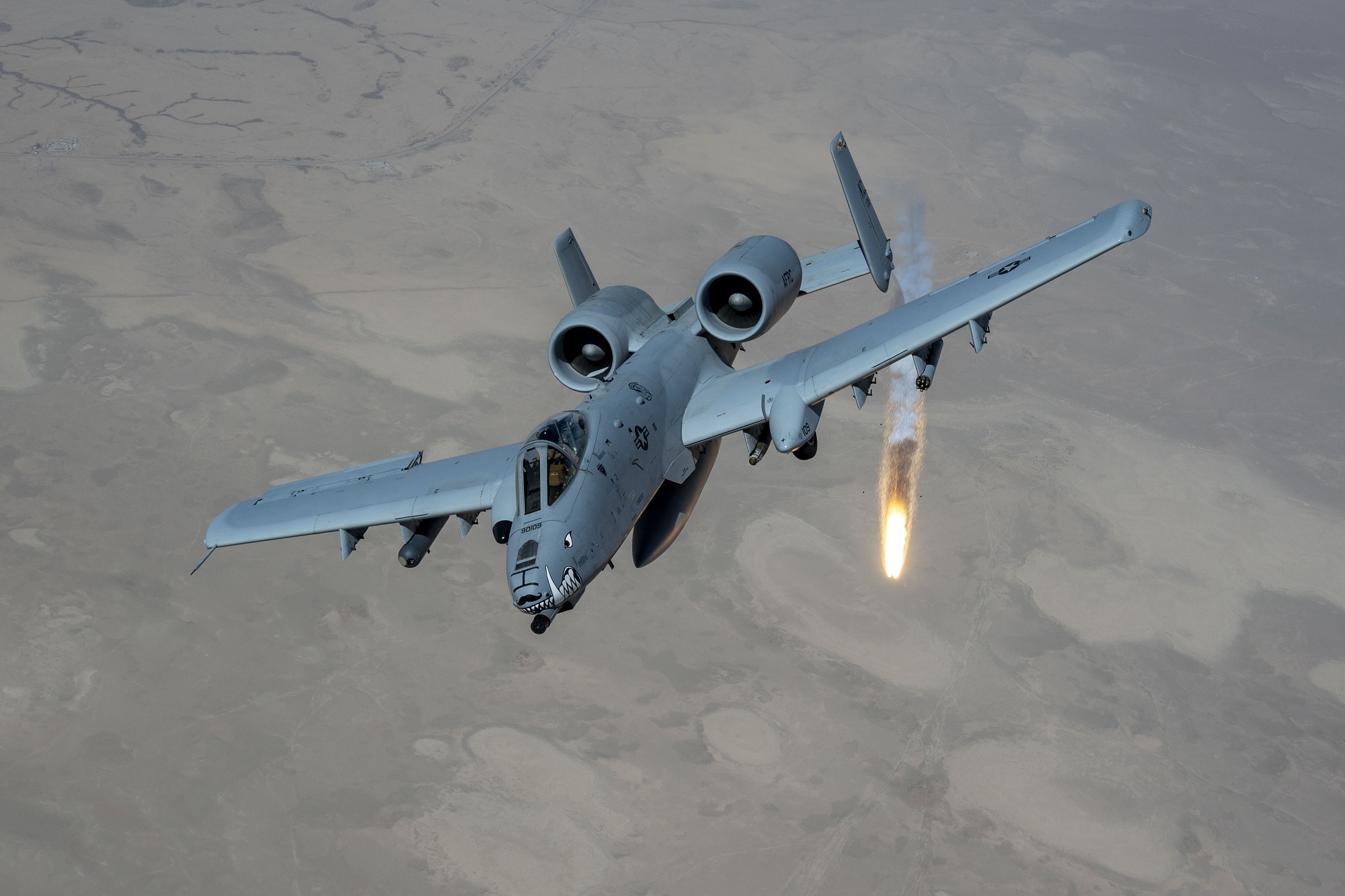
Until the Air Force submits a required sustainment roadmap, the bill would further prevent retired or retiring aircraft sent to the 309th Aerospace Maintenance and Regeneration Group (AMARG) at Davis-Monthan Air Force Base from being placed into storage or processing categories equivalent to non-recoverable reclamation, disposal or broad parts-harvest status.
Moreover, the roadmap would have to look even beyond 2033, should a replacement not be ready by then. The legislation mentions a contingency plan for maintaining sufficient A-10 capacity through FY2037 and an assessment of the costs and consequences of attempting to reconstitute the mission after its termination.
Possible A-10 transfers to foreign operatorsSince the BRRRRT Act aims to keep the A-10 in service with the U.S. Air Force, perhaps the most unexpected provision in the bill is the one that directs the Pentagon to examine whether surplus A-10s could be transferred to foreign partners. It must be noted, however, that this is not the first time lawmakers direct the Pentagon to explore such a possibility.
In fact, in 2024 lawmakers directed the military to explore a possible transfer of A-10s to Jordan. The possibility was mentioned in the 2025 National Defense Authorization Act (NDAA).
U.S. Air Force A-10 Thunderbolt II aircraft fly over the U.S. Central Command area of responsibility, Dec. 15, 2024. | Source: U.S. Air Force photo by Staff Sgt. Jackson Manske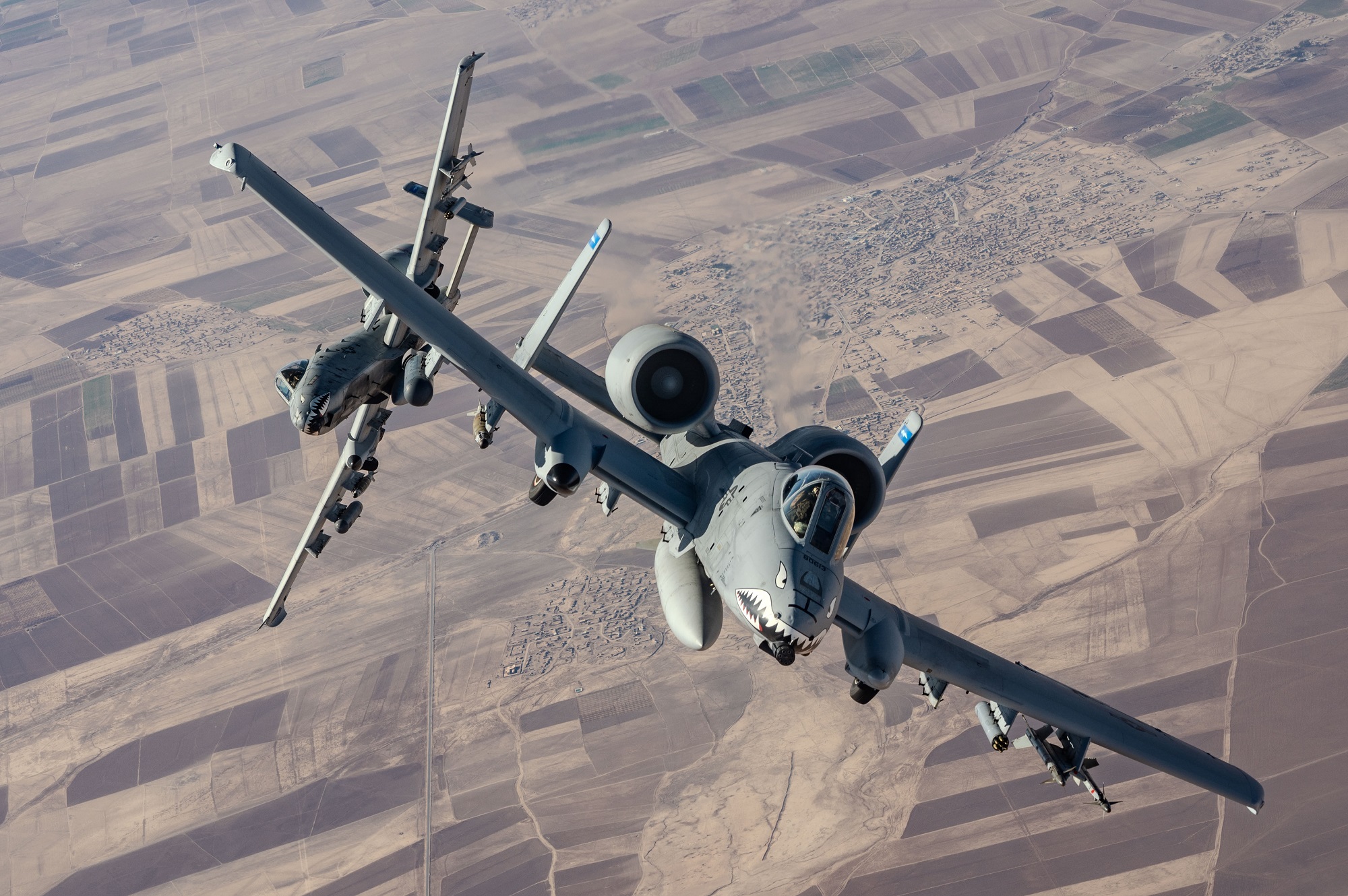
The new bill says surplus aircraft could retain value for security cooperation, partner burden-sharing and contingency operations. The administration would need to assess whether aircraft could be transferred through Foreign Military Sales, the Excess Defense Articles program or other authorities, or maintained in recoverable condition for future use.
The Secretary of War, the Secretary of the Air Force and the Defense Security Cooperation Agency would have to brief Congress on the feasibility of such transfers by January 2027. It is important to note, however, that the bill does not authorize an A-10 transfer to any particular country.
Autonomous capabilities relevant to the A-10’s mission setThe BRRRRT Act also appears to look at Manned-Unmanned Teaming (MUM-T) as a possible replacement for some of the A-10’s missions. The bill would require the Air Force to develop a plan for competitive experimentation, prototyping and operational assessment of autonomous, semi-autonomous, AI-enabled and adjunct aircraft capabilities relevant to the A-10 mission set.
According to the text, the initiative would encourage participation by nontraditional defense contractors, commercial technology companies and venture-backed defense firms capable of rapidly developing autonomy, sensing, communications and mission-system technologies. Also, the legislation explicitly calls for meaningful human command and control over mission-critical functions, including target engagement, weapons release and mission abort.
A U.S. Air Force A-10 Thunderbolt II assigned to the 303rd Expeditionary Fighter Squadron provides rescue escort during exercise Blue Phoenix in the U.S. Central Command area of responsibility, Aug 5, 2025. | Source: U.S. Air Force photo by Airman 1st Class Keagan Lee
It thus appears that there might be an opening towards a replacement of at least some of the capabilities, although the focus is obviously on a true replacement for the A-10 aircraft and its main mission set. The Secretary of the Air Force would have 180 days to present a report about this plan.
Preserving the A-10’s combat experienceThe legislation would also require the Pentagon to examine what can be learned from the A-10’s combat history, specifically citing the aircraft’s employment from Operation Desert Storm through current operations, including recent support to the recovery of downed aircrew during Operation Epic Fury.
A report to Congress would have to be presented by January 2027, would examine the A-10’s combat employment and identify lessons applicable to force design with the A-10’s successor, doctrine, training and capability development. The report would also assess potential further A-10 modernization options.
In parallel, the bill mentions the return of the A-10 demonstration team, preserving the aircraft’s visibility during the 250th anniversary of the United States. The team would operate until 2033.
H/T to John Bennett for the heads up.
Categories: Defence`s Feeds
Leonardo and Baykar Share Details of K-SWARM Test with M-346F and Kizilelma UCAV
Following the recent tests, Leonardo and Baykar shared more details about the Crewed/UnCrewed Teaming (CUC-T) that saw the M-346F light fighter aircraft take control of the Kizilema UCAV.
In a briefing at this year’s edition of the Farnborough International Airshow, Leonardo and Baykar shared additional details about the recent tests as part of the K-SWARM program. The testing, meant to demonstrate the ‘loyal wingman’ concept, saw an M-346F – the light-fighter variant of the M-346 trainer – take control of two Kizilelma uncrewed fighter aircraft.
The testingThe flight campaign was conducted in May 2026, although only announced in June, at Baykar’s flight and test center in Çorlu, Turkey. The two companies said this represents only the first phase of the live testing, setting a major milestone in the development of Crewed/UnCrewed Teaming (CUC-T) capabilities.
At the @FIAFarnborough Airshow 2026, #Leonardo and @BaykarTech provided a comprehensive overview of the Crewed-Uncrewed Teaming testing recently carried out in Turkey, involving the #M346 and #KIZILELMA aircraft. The partners illustrated the development of the algorithms required… pic.twitter.com/0v3sXYSQoy
— Leonardo (@Leonardo_live) July 20, 2026
Two M-346s were flown from Italy to Turkey, including a company-owned M-346F and an Italian Air Force T-346A which acted as safety chase aircraft. Baykar employed two Kizilelma aircraft.
Before the live testing, the two companies worked together also in the lab to prepare software and hardware and simulate the CUC-T operations. Specifically, Baykar integrated advanced Smart Fleet Autonomy capabilities into the CUC-T algorithms while Leonardo assessed algorithms and procedures in its Avionic, Flight Control Innovation Labs and product capability and concept laboratory (PC2LAB) linked with an M-346 Full Mission Simulator.
A Kizilelma takes off to rejoin the M-346F for a Crewed-Uncrewed Teaming test mission. | Source: Leonardo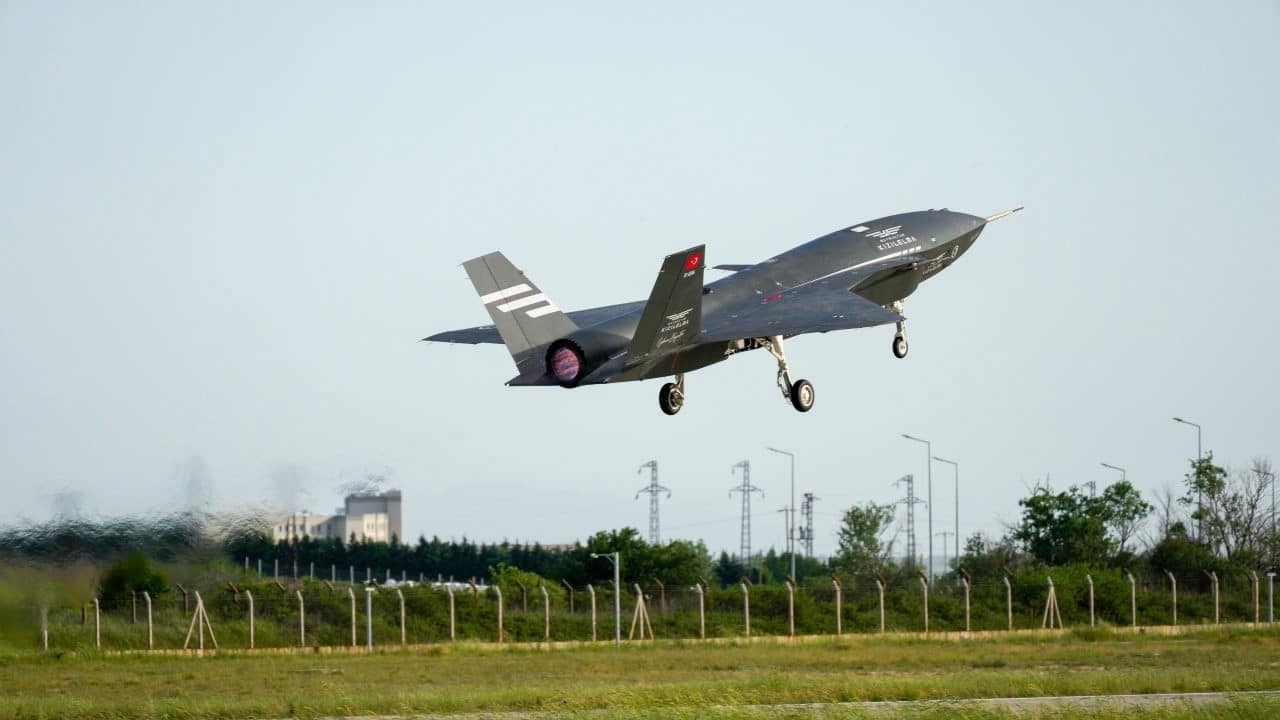
Leonardo says the build up approach adopted for the CUC-T development and testing was based on step-by-step criteria, with a progressive risk reduction through simulation-based validation, an assessment of safety-critical scenarios, including link-loss separation manoeuvres. This allowed a seamless transition from virtual to live operations with both crewed and uncrewed aircraft.
An unspecified number of live flights were then conducted, putting to the test several months of work by pilots and technicians of the Leonardo and Baykar teams. This was also made possible by an advanced radio frequency data exchange system allowed for the synchronization of all data shared between the M-346 and Kizilelma platforms, with the NATO Standard Interface for Manned-Unmanned assets enabling communications.
The datalink was protected by Leonardo’s Tactical Cybersec Platform, a proprietary cyber defense platform built on multi-agentic AI architecture which protects and monitors systems in real time. Cyber security is considered as an important part of the CUC-T operations to prevent disconnection of the uncrewed platforms and spoofing by an adversary.
During the live testing, Kizilelma autonomously conducted taxi, take-off and rejoin thanks to Smart Fleet Autonomy algorithms developed by the Baykar’s Hardware-in-the-Loop (HIL) Laboratory. Then, upon Ground Control Station approval, the M-346F assumed full control of the uncrewed Kizilelmas.
The M-346 light fighter variant during a test flight. | Source: Leonardo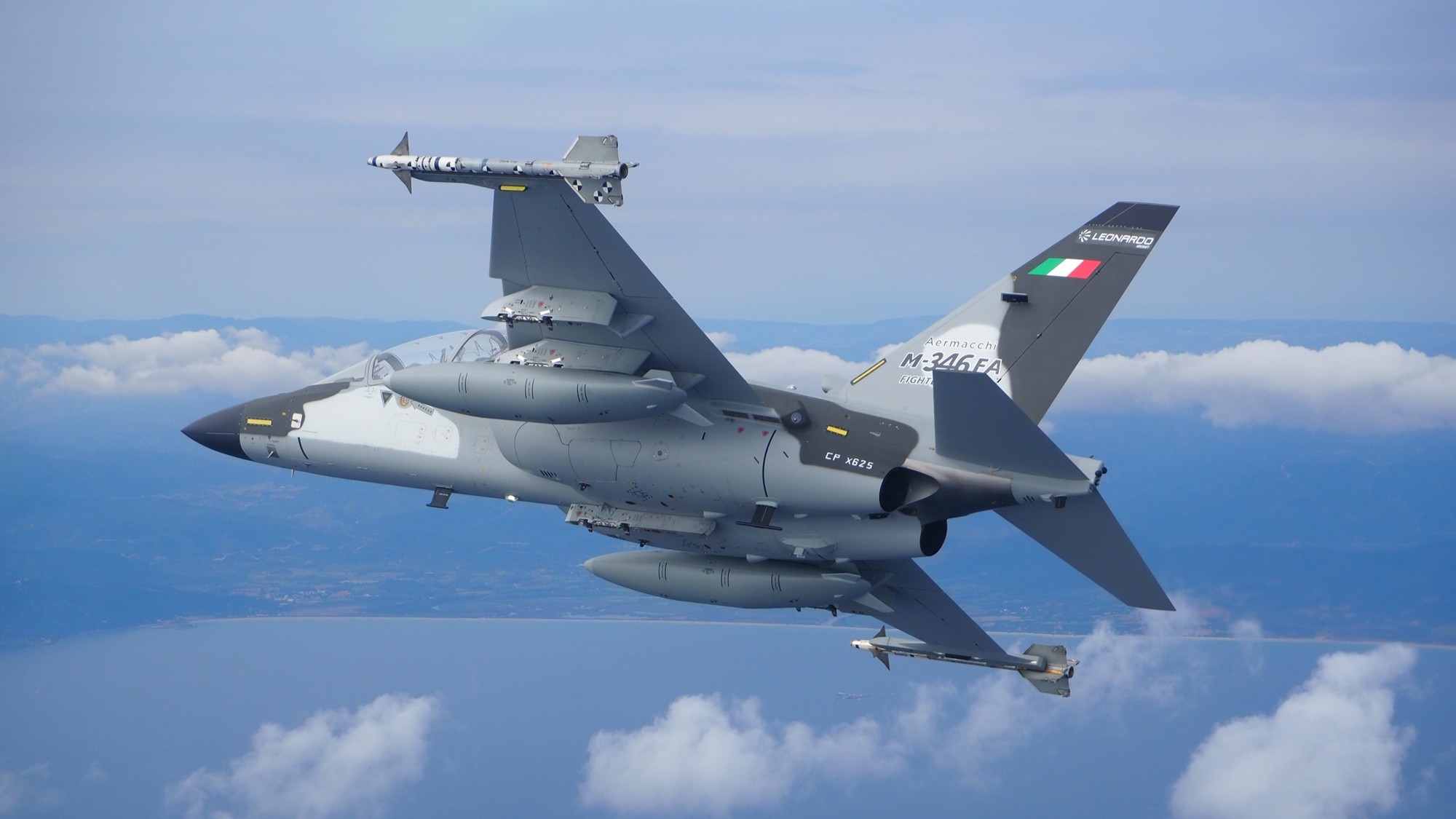
The test pilots aboard the M-346F used a ‘newly developed fully integrated onboard avionic suite’, said the joint press release. Leonardo further detailed that the dedicated user interface was integrated into the M-346F’s avionics and also featured HMI enhancements.
An image shared during the briefing provided a glimpse into the user interface, with the datalink providing the positions of the UCAVs on the Multi-Function Display’s Horizontal Situation Display (HSD) screen, while the two other MFDs were used for the selection of the formation and the training scenario, respectively. The modifications allowed full command and control of uncrewed assets, continuous situational awareness, reduced pilot workload and an effective human oversight of autonomous operations.
The M-346’s pilots were able to command different formations, which were autonomously executed by the Kizilelma. Additional maneuvers included position changes, separations and rejoins.
FutureLeonardo and Baykar say that data and analysis gathered have been crucial in defining the next steps in the K-SWARM program. The two companies are now planning to move into more complex operations “requiring greater situational awareness and assets working together ‘as one’ towards mission objectives.”
The Kizilelma taking off with a TEBER-82 guided bomb for its first live-fire test in 2025. | Source: Baykar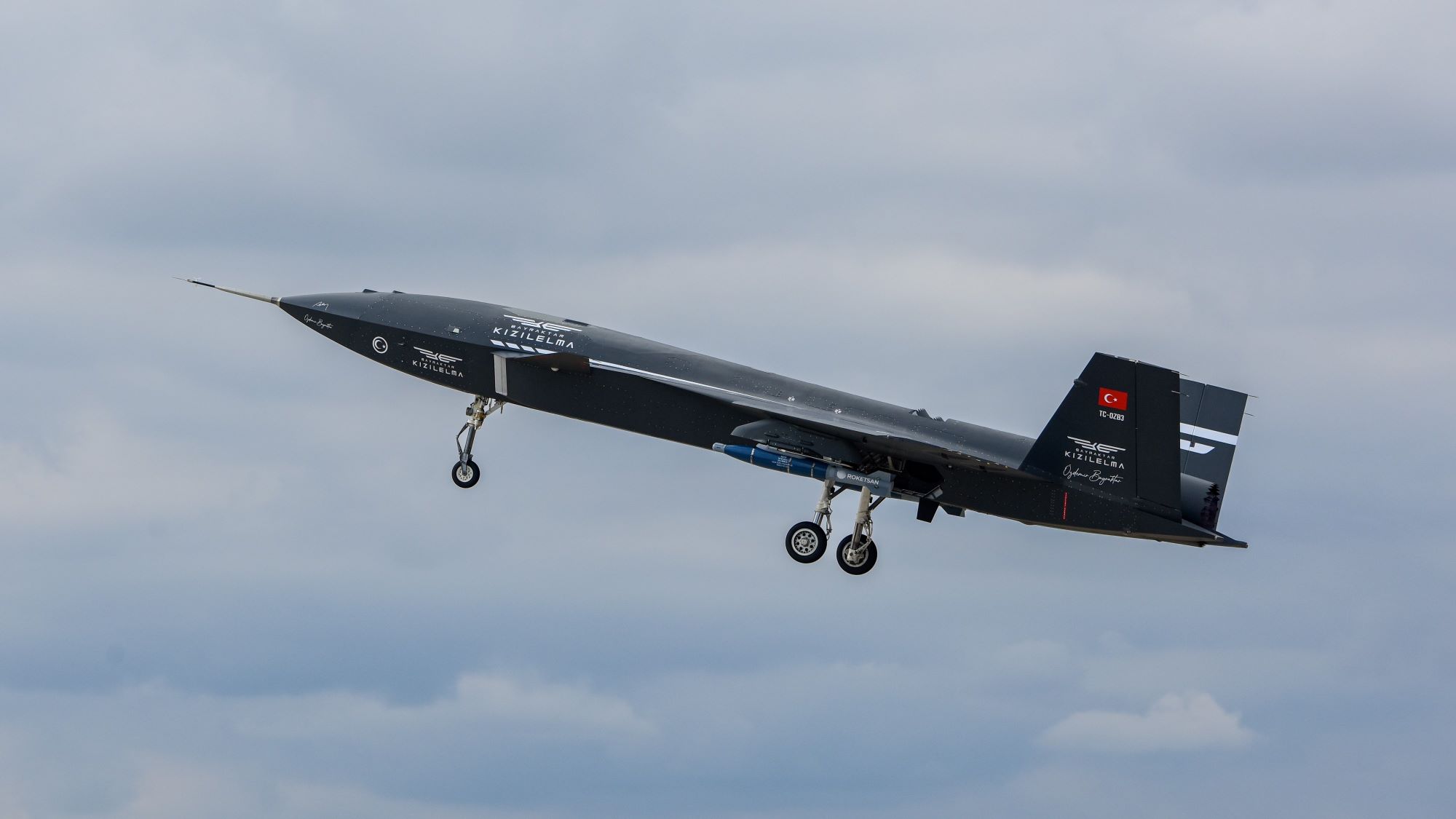
These activities have also been linked to the Global Combat Air Programme (GCAP) and its Collaborative Combat Aircraft (CCA), which already sees the involvement of Leonardo. The vision is for a high number of aircraft, currently as many as six but possibly more, to be assigned to each crewed aircraft.
The joint press release notes that this “refinement and maturity of AI technology, algorithms and collaborative procedures will enable the uncrewed systems to incrementally shift from remote piloting to autonomy, with the aim of reducing pilot workload and increasing mission efficiency while maintaining full control and decision-making.”
New tests are now planned in the coming months, with increasing complexity and additional functions. It is unclear if Leonardo plans to include in the activities also other aircraft such as the Eurofighter Typhoon.
The Aviationist’s contributors Kai Greet and James Gray helped in the preparation of this article.
Categories: Defence`s Feeds
Greek F-16 Crash Lands at Zakynthos Airport, Pilot Safe
Footage has emerged showing a Greek F-16 on fire after an emergency gear-up landing on the island of Zakynthos, commonly known as Zante. Officials have confirmed that the pilot is ‘in good health’.
Lieutenant Colonel Konstantinos Gravalos of the Hellenic Air Force told the media that the F-16C Fighting Falcon, one of over 100 operated by the Greek air arm, suffered an unspecified technical malfunction while on a training sortie on Jul. 9, 2026. The pilot elected to make an emergency landing at Zakynthos Airport, which is known to many as the popular tourist destination Zante.
Footage shows the F-16 on the airport tarmac on its belly, with flames erupting around the aircraft. Fire crews doused the flames with water and foam. It is clear that the pilot left the aircraft as normal, without ejecting, as the canopy and seat are still present on the jet.
Αναγκαστική προσγείωση F-16 στο αεροδρόμιο της Ζακύνθου pic.twitter.com/pbceDCzXuD
— Kathimerini_Web (@KathimeriniWeb) July 9, 2026
Other footage, taken as the aircraft approached the runway, confirms that the undercarriage was not deployed before landing.
Hellenic Air Force F-16 performed a gear-up landing at Dionysios Solomos (ZTH) airport on the Greek island of Zakynthos due to a landing gear malfunction today.
The F-16 caught fire on the ground and the pilot safely egressed without ejecting. pic.twitter.com/blKgZGseP2
— Thenewarea51 (@thenewarea51) July 9, 2026
Some initial reports claimed the jet belonged to the U.S. Air Force, but even before the Hellenic Air Force’s confirmation the Greek national markings and dark grey paint scheme clearly identified the operator.
Flights scheduled to arrive at the airport were diverted to a number of nearby locations, including Athens, Corfu, and Thessaloniki.
A British Airways flight to Zakynthos diverting to Athens. | Source: Flightradar24.com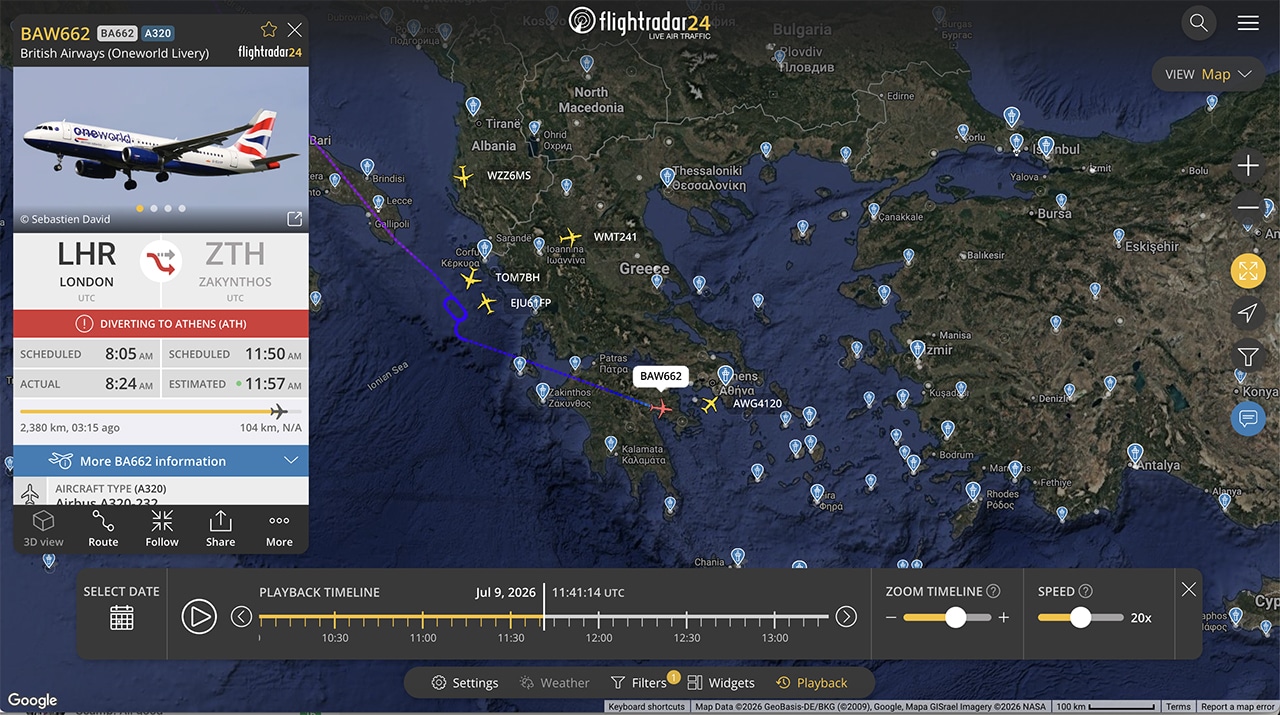
The Notice to Airmen/Aviation (NOTAM) closing Zakynthos’ runway to all but approved medical, government, and military helicopters was issued at 12:10 UTC.
Local media reports say the F-16 belongs to the 116th Combat Wing at Araxos Air Base in Eastern Greece. The wing is comprised of the 336th Bomber Squadron and 335th Squadron, both flying F-16s. They were notably the last unit in the world to operate the A-7 Corsair II, which retired in 2014.
This article concerns a developing news story and may be updated as new information becomes available.
Categories: Defence`s Feeds
Royal Navy Trials First At-Sea Strike Drone Launch
A Nyan One Way Effector (OWE) was launched from the experimental testbed vessel XV Patrick Blackett while the ship was underway off the south coast of England.
The trial, which according to image data took place in early June 2026, is billed as the next step towards the operational integration of one way effector (OWE) drones into the British military. The Nyan OWE, designed by BAE Systems subsidiary Callen-Lenz, was previously tested from land by British Army personnel in Estonia.
The Royal Navy has successfully launched a strike-capable drone from a ship at sea, marking a significant step forward in the UK’s drive to create a hybrid naval force to defend against evolving threats. | Source: Crown Copyright 2026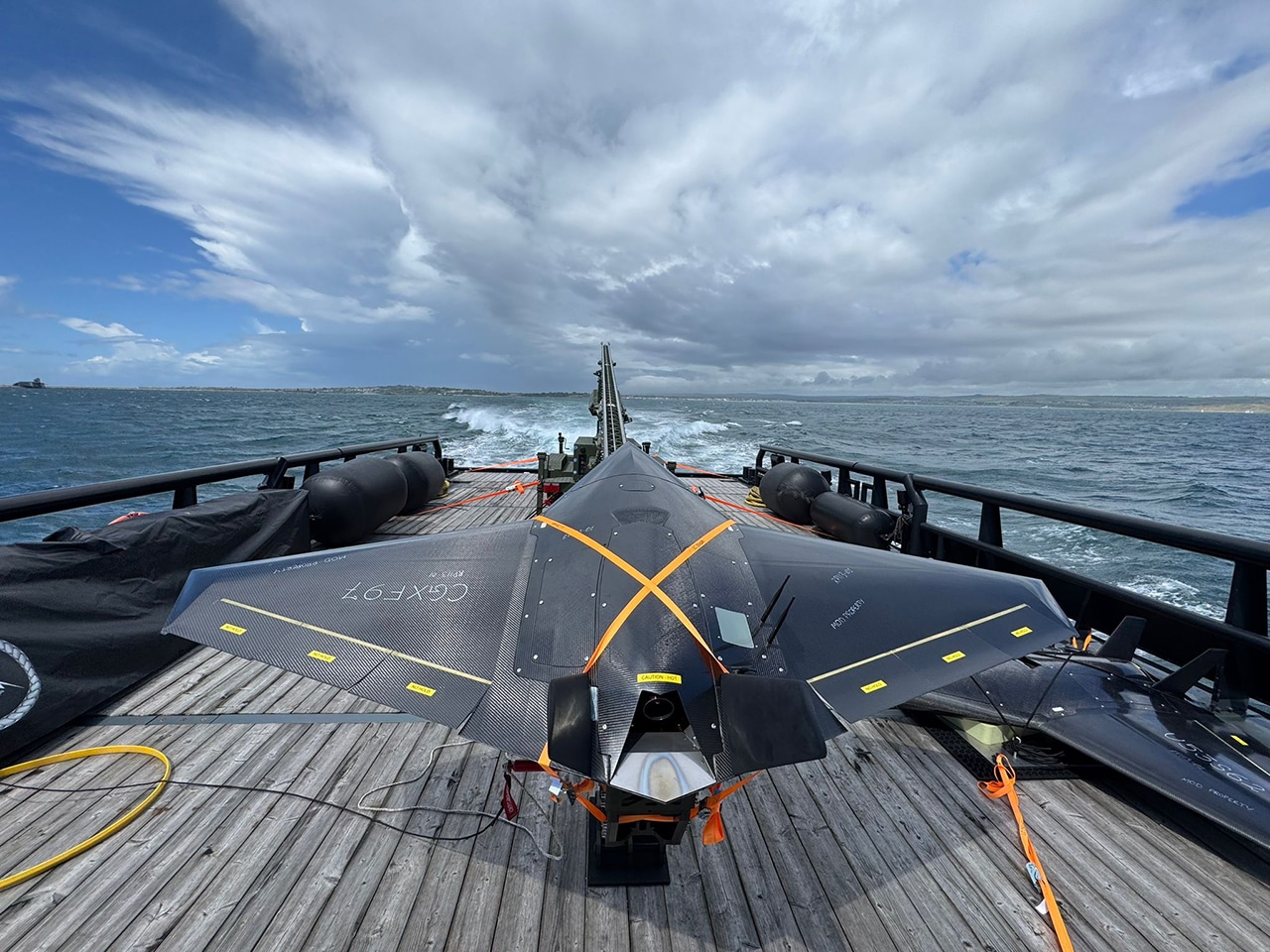
Organised under Operation Neptune Reach, the launch brought together personnel from the Royal Navy, Royal Air Force, and the British Army. Launching an OWE drone from a Royal Navy vessel has been listed as the first goal of Project VANTAGE, with latter stages focused on spreading OWE launch capability to vessels across the fleet, up to and including the Queen Elizabeth class aircraft carriers. This is a key part of the Ministry of Defence’s aim to transform the Royal Navy into a ‘hybrid navy’, leveraging a tailored blend of crewed and uncrewed systems with the mantra ‘crewed where necessary, uncrewed wherever possible‘.
.@BAESystems @callenlenz Nyan One-Way Effector launched from @XVPTBK https://t.co/KR68KfHm3I pic.twitter.com/VA8vH69274
— Navy Lookout (@NavyLookout) July 3, 2026
Lieutenant Commander David Burton, Maritime OWE capability sponsor, Royal Navy, said: “This trial makes a significant step forward in delivering Maritime One-Way Effectors at pace.
“Under Project Vantage we are planning to integrate these capabilities into the Hybrid Navy, combining crewed platforms with uncrewed systems to expand reach, increase tempo and enhance lethality. Working closely with our army colleagues, this activity demonstrates how we are accelerating Atlantic Strike concepts into practical, deployable capabilities of the Fleet,” he added.
Luke Pollard MP, Minister of State for Defence Readiness and Industry, said: “Britain is serious about the transition to a Hybrid Navy with new, powerful drones at the heart of the Royal Navy. By bringing together Army and Navy expertise to field strike drones from a ship at sea, we are accelerating the capabilities our forces need to stay ahead of our adversaries.”
View this post on Instagram
A post shared by 26th Regiment Royal Artillery (@26royalartillery)
The Nyan OWE, designed for precision strike missions, is powered by a small ‘microturbine’ jet engine, and has a wingspan of 2.9 metres. In a February 2026 direct award contract notice, the MoD noted it as the only off-the-shelf product of its type registered with the UK Military Aircraft Register, stating: “it is the only feasible option to bring into service in the near term on the grounds of safety and legality”.
British Army crews in Estonia move a Nyan OWE on the ground. | Source: via BAE Systems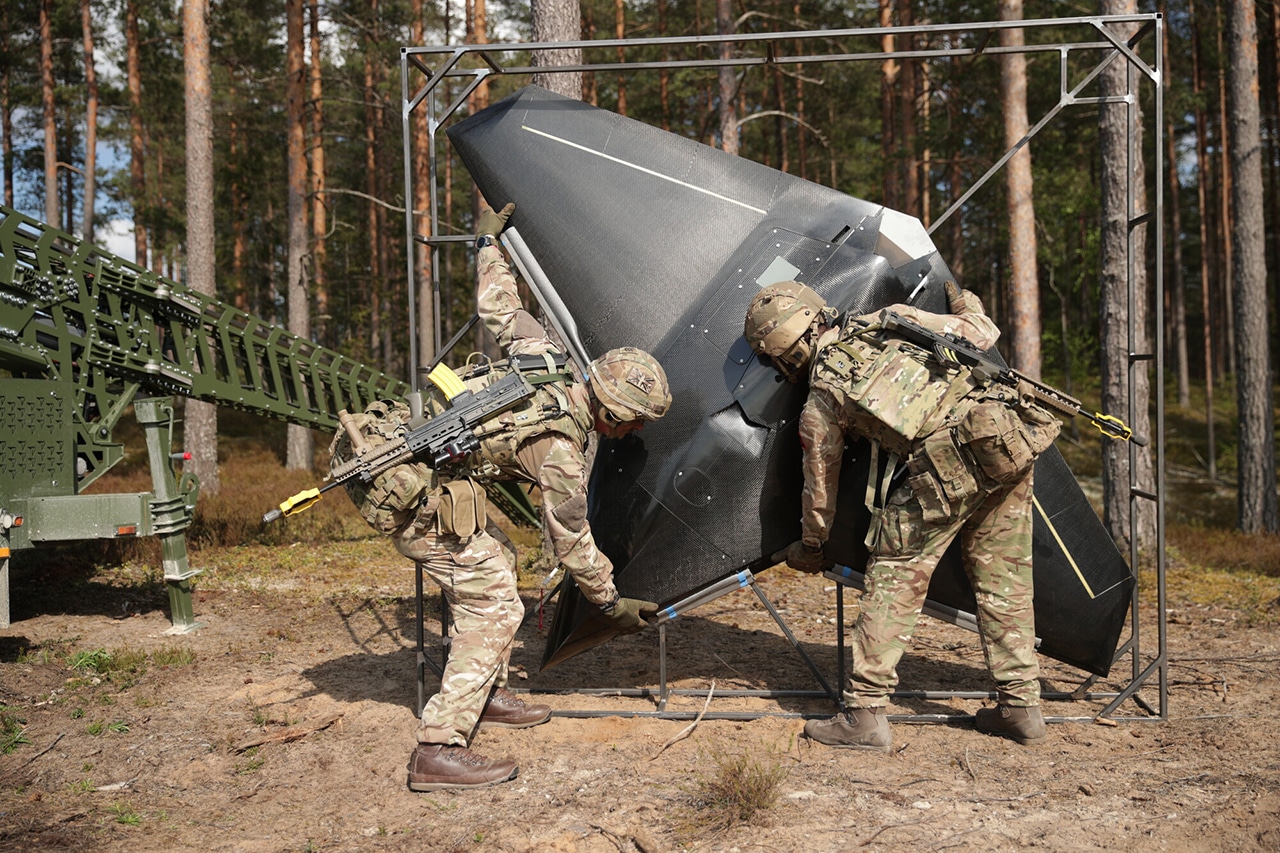
Matt Foster, CEO of BAE Systems’ Callen-Lenz, says over 1,000 Nyan units have been produced so far, and it has proven itself during land-based trials. “Now it has successfully demonstrated its ability to add real value in a maritime environment too. These trials reflect strong collaboration across the services and industry, highlighting the pace at which we can deliver innovation to advance the UK’s integrated, multi-domain defence capability.”
The drone was launched from a rail installed on the Patrick Blackett’s rear deck, and then directed towards a pre-designated target. Data from the test is now being analysed by a specialist Royal Navy team as well as the Royal Air Force’s Air and Space Warfare Centre (ASWC).
The Royal Navy has successfully launched a strike-capable drone from a ship at sea, marking a significant step forward in the UK’s drive to create a hybrid naval force to defend against evolving threats. | Source: Crown Copyright 2026 XV Patrick Blackett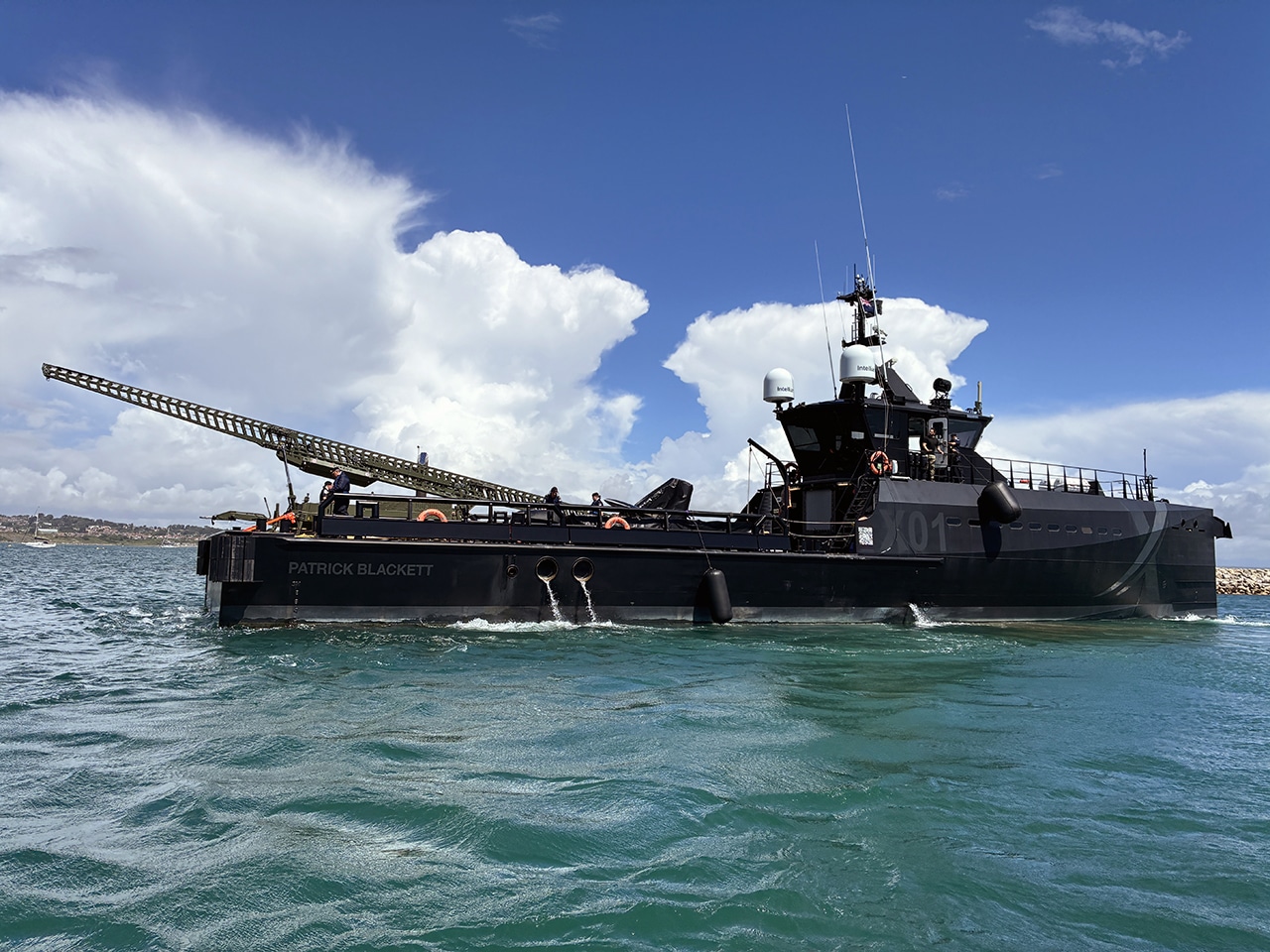
The futuristic all-black trials vessel XV Patrick Blackett was acquired by the Royal Navy in 2022, and officially began acceptance trials in February 2023. Although not a commissioned Royal Navy vessel, it is crewed by Royal Navy personnel and is wholly owned by the UK Government.
Its primary role is supporting trials of uncrewed surface and sub-surface vessels, which are in line to become a major part of the Royal Navy’s overall fleet structure in the coming years.
Confimation of the new RN construction plan, as radical as Fisher’s new navy. These were revealed in the recent Frazer-Nash NDP renders (below).
Type ?? Common Combat Vessel, smaller crewed command hub (possibly AH140 based?) to be in-service by early 2030s.
Type 91 – uncrewed… https://t.co/NJcFFPFeE3 pic.twitter.com/l2mpWVInfI
— JamesFennell MBE (@FennellJW) June 29, 2026
The ship’s large, open rear deck area is ideal for frequent configuration changes to support different programs. In this case, it provides ample room for the rail launcher. In one previous exercise, the deck area has even been used as a target area for dummy bombs dropped from a drone.
UAV Roton conducts a successful artificial bomb drop on XV Patrick Blackett as part of a training exercise in Portugal during exercise REPMUS24. | Source: LPhot Daniel Bladen/Crown Copyright 2024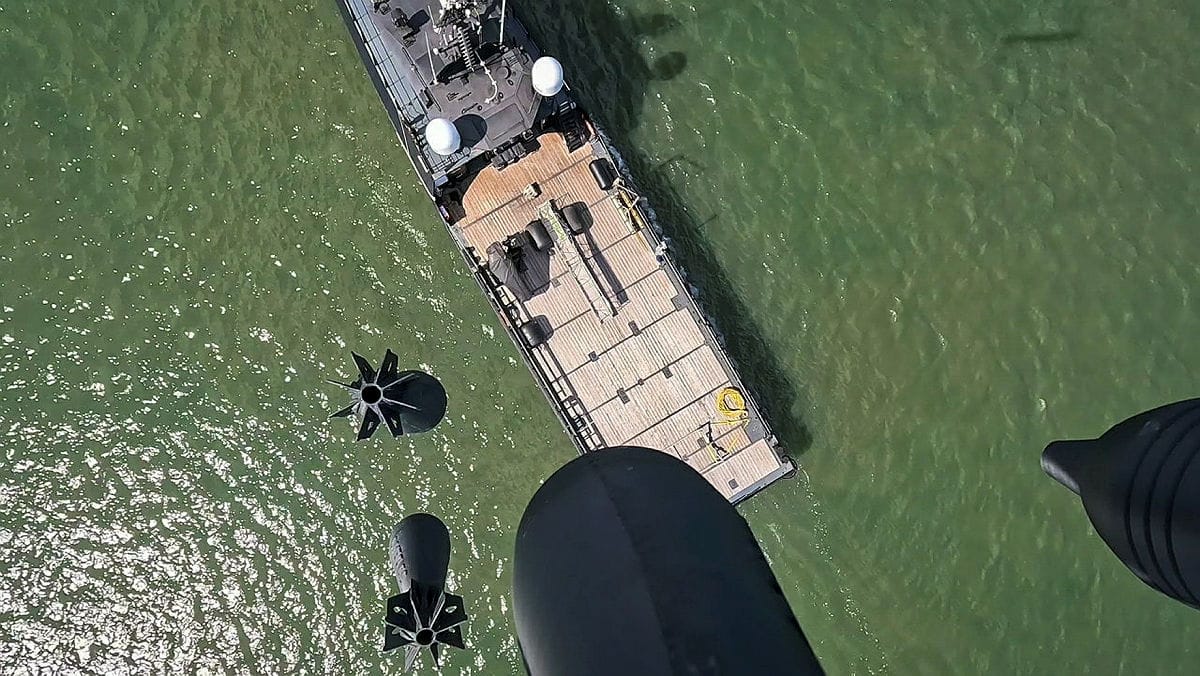
A lesser seen but vitally important additional part of XV Patrick Blackett’s duties is pioneering the use of quantum navigation equipment at sea. These systems use atom interferometry to provide inertial navigation, meaning that it could provide the answer to the problems posed by the vulnerability of GPS. Additionally, quantum navigation would work in places where GPS simply can’t – under the sea, underground, or in some of the few locations in the world where access to reliable global navigation satellite systems (GNSS) cannot be guaranteed.
The first UK test of airborne quantum navigation systems took place from MoD Boscombe Down in 2024, backed by BAE Systems and Qinetiq.
Categories: Defence`s Feeds
New Report Blames Russia’s Shadow Fleet for Europe Drone Incursions
A report by the International Institute for Strategic Studies (IISS) assesses that it is ‘highly likely’ many of recent drone incidents throughout Europe were ordered by Moscow as part of a wider hybrid campaign against NATO.
The investigation focuses on incidents taking place between August 2024 and February 2026, including incursions into the airspace of thirteen individual countries. All but one of these nations, the exception being Ireland, are members of NATO.
Among the incursions documented in the report are those which targeted U.S. Air Force sites in the UK – which The Aviationist covered in depth across three articles – as well as the incident over the French Navy ballistic missile submarine base at Île Longue.
This report assesses that it is highly likely the Kremlin conducted a coordinated Uninhabited Aerial Vehicle (UAV) campaign over Europe between August 2024 and February 2026, spanning a dozen NATO states and Ireland.
It is also likely that Russian-linked vessels and the shadow… pic.twitter.com/pGRtWRHPtE
— IISS News (@IISS_org) July 2, 2026
By corroborating the various reports of drone incursions with data relating to ships that are known or suspected to belong to Russia’s shadow fleet, the IISS has named several vessels in particular that it believes were responsible for launching and/or directing the drones.
It notes that the cargo vessel Hav Dolphin (IMO 9073854), investigated by both Germany and the Netherlands after drone incursions in the spring of 2025, was in fact docked in Hull, UK, while British and American authorities were dealing with the drone sightings over military sites in November 2024.
Suspected drone carrier / cargo ship HAV DOLPHIN entered Baltic Sea via Kiel kanal, last port Antwerp. Stated destination Vasa, FI
The Russian crewed ship is suspected if being behind drone flights over military installations in NW Germany a few months ago. pic.twitter.com/i4QfsyLyzi
— auonsson (@auonsson) August 24, 2025
At the same time, the tanker Seasons I (IMO 9308950) travelled eastbound through the Straits of Dover and routed approximately parallel to the southern coast of East Anglia where RAF Lakenheath, RAF Mildenhall, and a number of other sensitive U.S. and UK military facilities are located.
Positions of selected Russian shadow-fleet tankers around Germany and the UK, 26 November 2024 | Source: The International Institute for Strategic Studies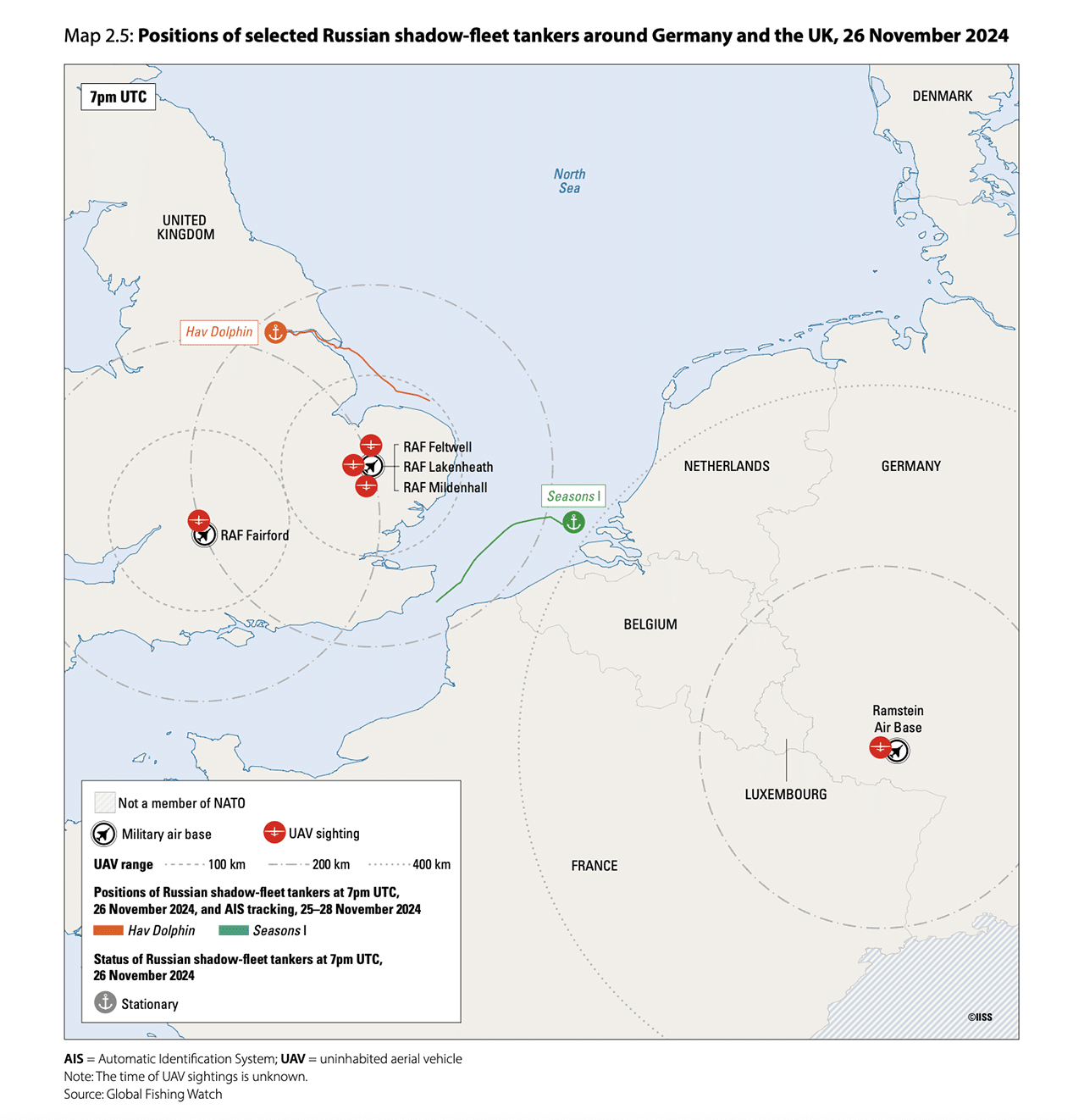
Comment from anonymous U.S. officials at the time of the incursions suggested that the drones were of a sophistication beyond what would be expected for commercially available civilian drones. As we noted, the incursions over these important U.S. bases came just days after then President Joe Biden gave Ukraine the long awaited all-clear to use long range missiles to strike targets deep inside Russian territory.
Selected reported UAV sightings in Europe by location and site, August 2024–February 2026 | Source: The International Institute for Strategic Studies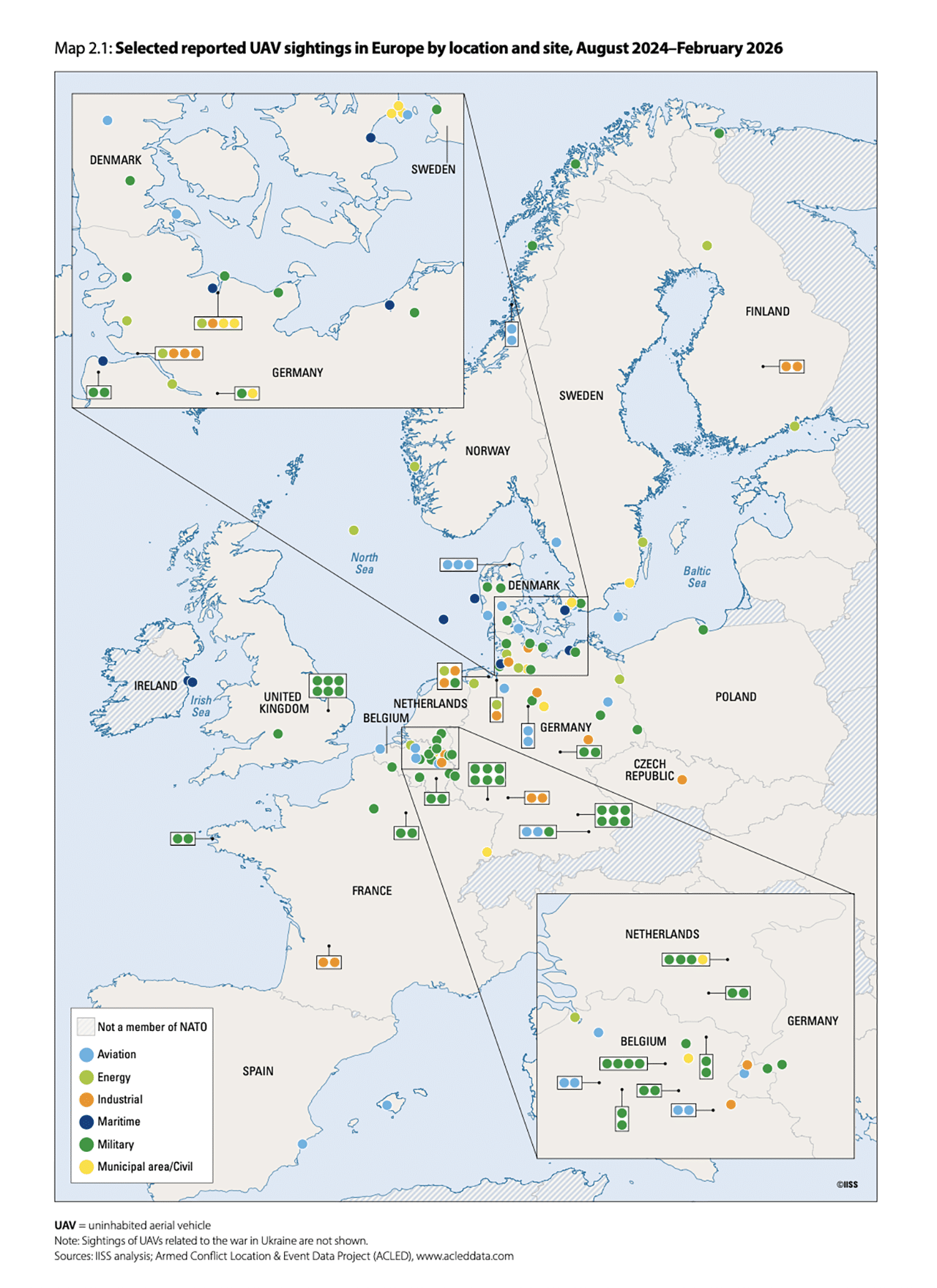
In its executive summary of the lengthy report, the IISS argues that while not every UAV incident during this period is likely to have been linked to Russia, “the aggregate pattern of UAV sightings cannot be adequately explained by misidentification, hobbyist activity or opportunistic harassment alone.”
Careful ScrutinyThere is no smoking gun that definitively proves Russia’s involvement, and none of the nations affected in these drone incursions have yet directly pointed their finger in Russia’s direction, though IISS researchers have suggested that these countries have given their tacit approval of the report. “Every government we spoke to said they would welcome the report being published,” said Charlie Edwards, Senior Fellow for Strategy & National Security.
Without the smoking gun, some have questioned the report’s findings. Dronewatch Europe have said: “The conclusions are striking. However, they also deserve careful scrutiny.”
“The report does not present physical evidence linking any specific drone to any specific vessel. No launch has been observed, no command links have been intercepted, no wreckage has been recovered, no credible video footage was recorded, and no telemetry or forensic data has been released tying a drone to a Russian ship.”
New IISS report revives ‘Russian shadow fleet drone’ theory, but fails to provide evidence https://t.co/aQNZoaX2O3 pic.twitter.com/efG2r4BgCD
— Dronewatch Europe (@DronewatchEU) July 2, 2026
This forensic data is, of course, difficult for a non-state actor to obtain. Primary radar data and advanced intelligence (including the use of electro-optical sensors, signals intelligence (SIGINT), and human intelligence (HUMINT)) capabilities would be of paramount importance to gathering the definitive facts in cases like this.
Whether the capable intelligence agencies – in many cases, world leading – of the nations involved have in fact collected these facts is unclear. While one could argue that the fact no country has stepped forward and set out a comprehensive case for Russia’s involvement, it is also true that doing so could prejudice some of the capabilities and/or sources of intelligence available to them. Proving Russia’s guilt in the public domain might not outweigh the value of these intelligence assets.
The @RoyalAirForce has recently deployed its Counter-Uncrewed Aerial System to Belgium in response to rogue drones interrupting flights at Brussels Airport. This comes just a month after the system was deployed to Denmark.
The RAF’s C-UAS capability is called ORCUS, which is a… pic.twitter.com/bS6buQuCDc
— Leonardo Electronics (@LDO_Electronics) November 11, 2025
Dronewatch’s own investigation into 61 drone sightings across Europe in 2025 found that, in many cases, “reported drones turned out to be perfectly ordinary aircraft, helicopters, stars, planets or other explainable phenomena. In numerous cases there was simply no evidence that a drone had ever been present.”.
The IISS report does touch on these earlier investigations, though it argues that “In an operating environment where European detection capability was demonstrably insufficient to reliably track low-altitude, non-cooperative UAVs, a high non-confirmation rate is the expected outcome regardless of whether the sightings were genuine.”
“A high false-positive rate in public reporting is, if anything, analytically consistent with Russian operational design: engineering an environment of ambiguity in which genuine incursions are difficult to distinguish from noise is itself a feature of the campaign,” the report continues.
Whether any of the drones were in fact linked to Russia or not, the IISS states that Europe’s counter-UAS (C-UAS) strategy has not kept up with the threat now posed by these systems: “detection is uneven, legal authorities are fragmented, response options are often disproportionate, and attribution remains too slow to support timely deterrence.”
Categories: Defence`s Feeds
F-15EX Eagle II and MQ-28 Ghost Bat Fly Together During Valiant Shield 2026
The MQ-28 Ghost Bat took part in a flight with the F-15EX and a proof-of-concept FARP operation as part of the Experimental Operations Unit’s activities during Valiant Shield 2026.
The Pacific Air Forces (PACAF) released new undated photos from Exercise Valiant Shield 2026, showing that the MQ-28 Ghost Bat flew together with the F-15EX Eagle II. The milestone flight transformed into reality Boeing’s concept artworks which suggested the goal of having the two platforms work together in Manned-Unmanned Teaming (MUM-T) operations.
“An MQ-28 Ghost Bat and U.S. Air Force F-15EX Eagle II participated in Exercise Valiant Shield 2026 over the Philippine Sea, demonstrating the future of human-machine teaming in the theater,” said PACAF in a post on social media. “Uncrewed systems act as a force multiplier, extending the reach and effectiveness of human pilots.”
It is unclear if crew of the F-15EX, assigned to the 85th Test and Evaluation Squadron, took control of the MQ-28 during the flight. It should be noted that the service’s fighter jets already took control of drones during past tests, thus the possibility of the F-15EX controlling the MQ-28 should not be excluded.
An F-15EX Eagle II and an MQ-28 Ghost Bat fly together during Valiant Shield 2026. | Source: PACAF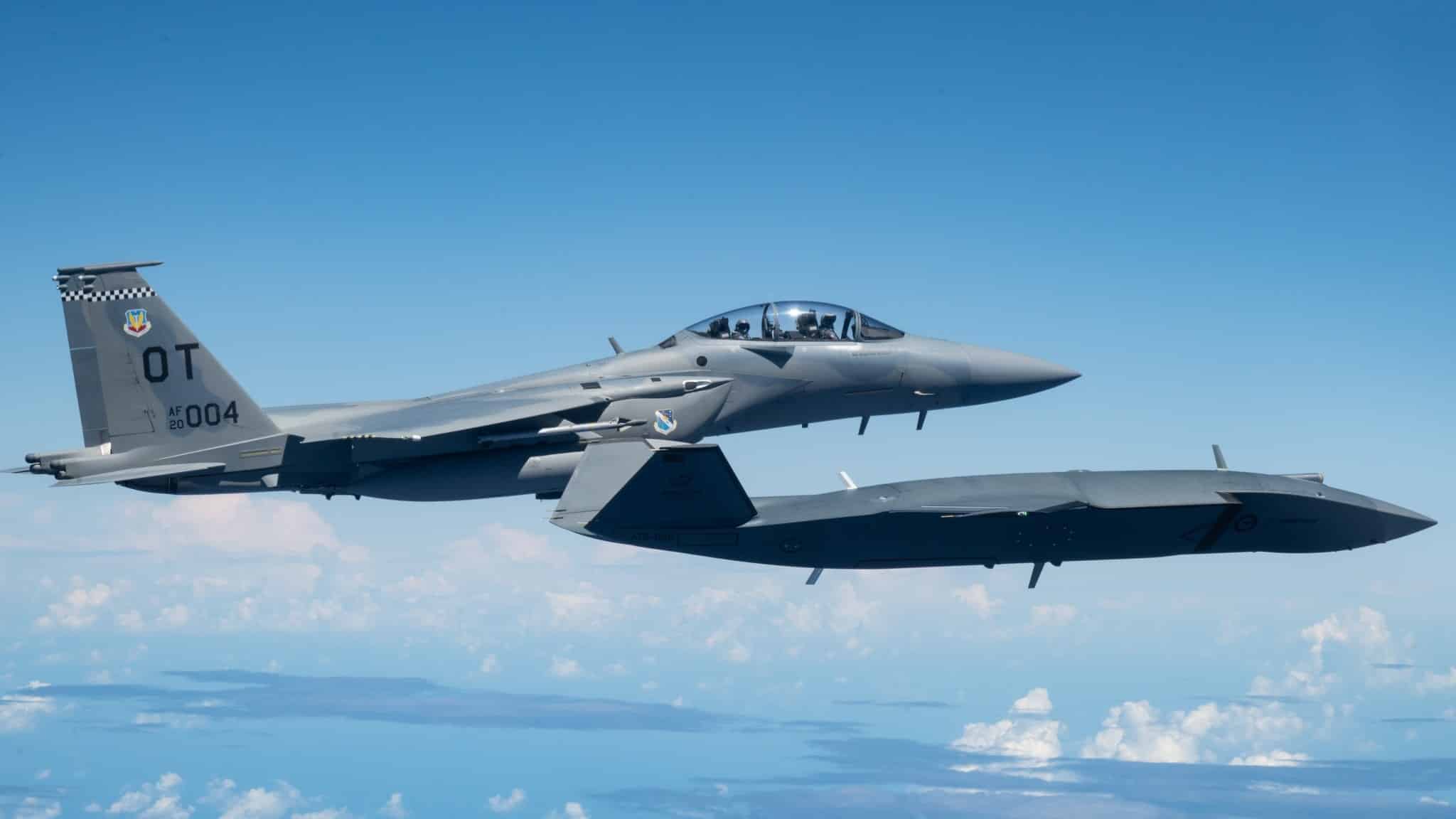
Moreover, in the press release announcing the MQ-28’s involvement in Valiant Shield last month, PACAF said “the uncrewed MQ-28 will fly in concert with crewed fighter platforms, providing a critical opportunity for the joint force to refine tactics, techniques, and procedures for this next evolution of airpower.”
Take a peek into the future.
With the F-15EX’s future manned-unmanned teaming capabilities supported by an advanced cockpit system, communication networks and two-seat configuration, the superior fighter could serve as a battle manager and joint all domain command and control. pic.twitter.com/07oRhGdIjV
— Boeing Defense (@BoeingDefense) September 4, 2025
The MQ-28 was deployed to Rota, Commonwealth of the Northern Mariana Islands, for the duration of the exercise. The specific aircraft is a production representative airframe, which is equipped with an Infra-Red Search and Track (IRST) system.
Artist concept of a Boeing F-15EX flying in formation with four MQ-28s, back when it was still known as the Boeing Airpower Teaming System (ATS) aircraft. | Source: Boeing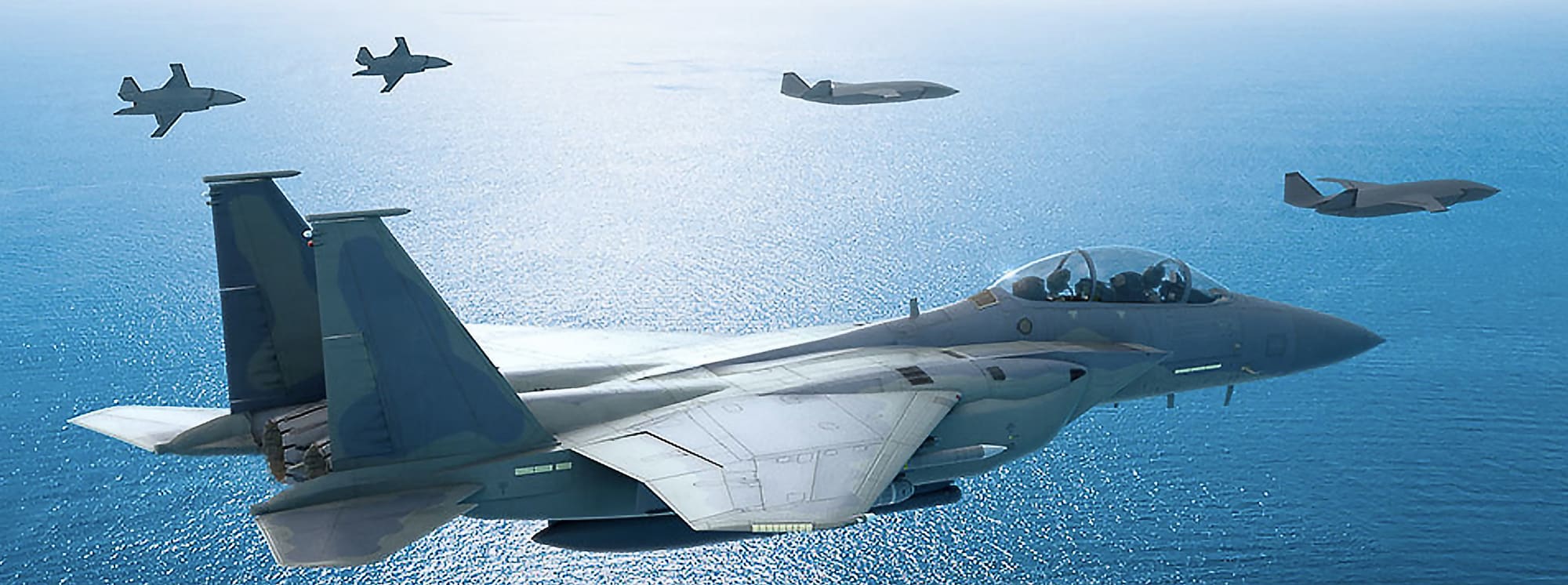
While at Rota, the MQ-28 also took part in a proof-of-concept Forward Arming and Refueling Point (FARP) operation for Collaborative Combat Aircraft (CCA) on June 28. The operation was supported by a HC-130J Combat King II and Airmen assigned to the 79th Rescue Squadron, alongside members of the Royal Australian Air Force and the Experimental Operations Unit (EOU).
The involvement of the EOU is notable as it was activated in June 2025 at Nellis Air Force Base, Nevada, to accelerate the introduction of CCA. The role of the EOU will be to develop the initial tactics, techniques and procedures needed to ensure CCAs are integrated in the fleet and tactically viable for future conflicts.
The unit recently conducted a round of testing with the YFQ-44A at Edwards Air Force Base, California. The service said the unit “executed a series of sorties that refined core operational and logistical procedures for deploying and sustaining CCA in a contested environment.”
With PACAF confirming the involvement of the EOU, it is likely the participation to Valiant Shield 2026 was part of a new round of testing which used the MQ-28 as surrogate for the FQ-42 and FQ-44. The Air Force recently awarded production contracts for the two CCAs.
A U.S. Air Force HC-130J Combat King II and Airmen assigned to the 79th Rescue Squadron, alongside members of the Royal Australian Air Force and the Nellis Air Force Base-based Experimental Operations Unit, conduct a proof-of-concept Forward Arming and Refueling Point operation for Collaborative Combat Aircraft with the MQ-28 Ghost Bat in Rota, Commonwealth of the Northern Mariana Islands, June 28, 2026, in support of VALIANT SHIELD 2026. | Source: U.S. Air Force photo by Senior Airman Austin Salazar F-15EX Visits Kadena Again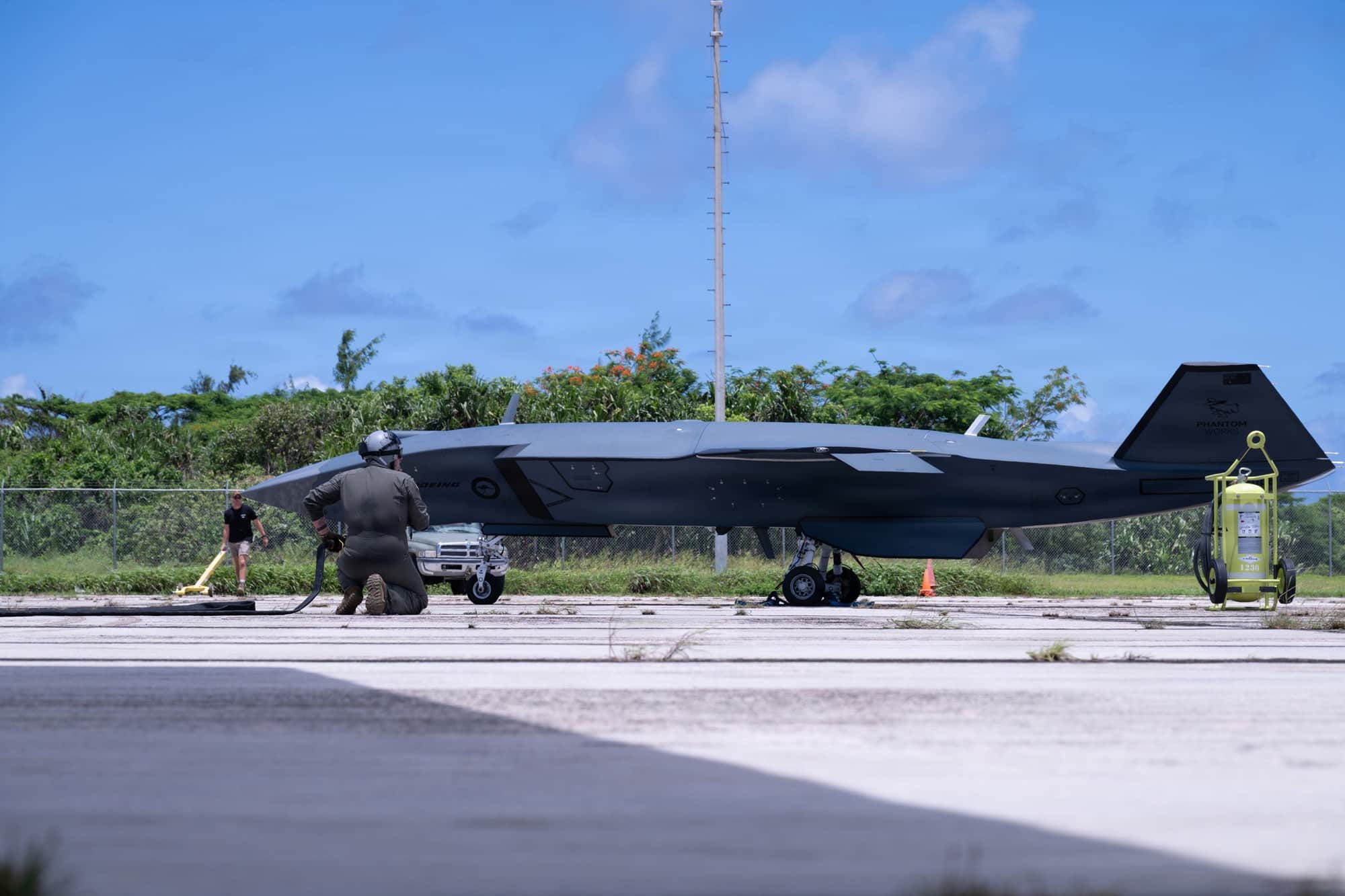
The same F-15EX which flew with the MQ-28 also arrived at Kadena Air Base, Japan, on June 29, 2026, accompanied by two F-15E Strike Eagles. The visit, whose duration is unknown, might have happened after the flight with the MQ-28, as Valiant Shield officially ended on July 1.
This is the second time an F-15EX is deployed to Kadena as the base prepares to receive its permanently assigned Eagle IIs. As we reported in the past here at The Aviationist, the base is transitioning from the F-15C/D Eagle to the new F-15EX Eagle II.
The 67th Fighter Squadron will be Kadena’s first operational F-15EX unit, followed by the 44th Fighter Squadron. A total of 36 new fighters is expected to be delivered there starting next year, according to Air Force Secretary Troy Meink.
A U.S. Air Force F-15EX Eagle II assigned to 85th Test and Evaluation Squadron, Eglin Air Force Base, Florida, lands at Kadena Air Base, Japan, June 29, 2026. | Source: U.S. Air Force photo by Airman 1st Class Gracelyn Hess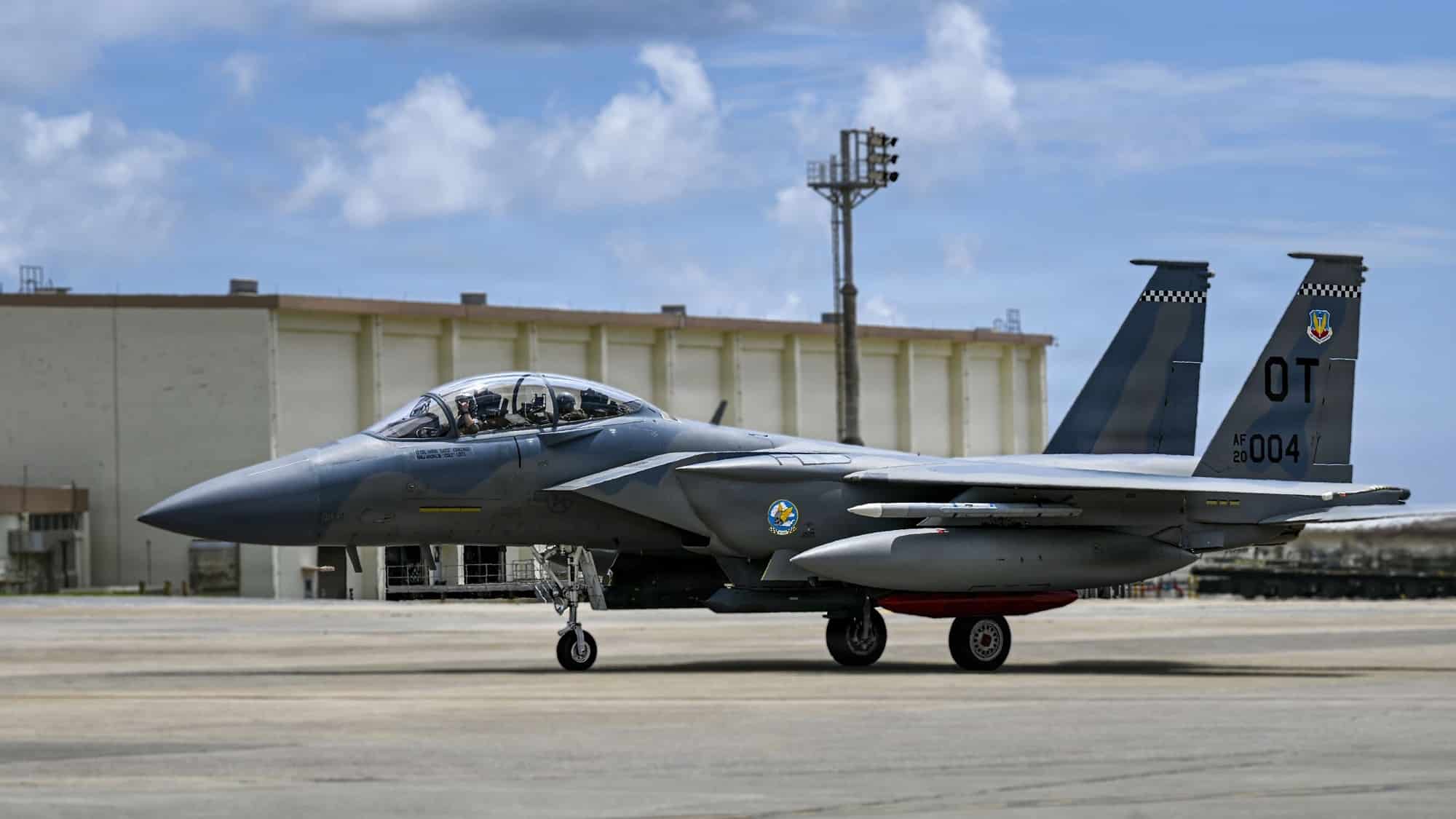
“The F-15EX represents the next chapter of airpower at Kadena,” said U.S. Air Force Brig. Gen. John Gallemore, 18th Wing commander. “Our Airmen have the opportunity to train with the aircraft, build confidence in its capabilities and ensure we’re ready to project lethality and integrate into operations as we continue providing combat power in support of a free and open Indo-Pacific.”
Valiant ShieldValiant Shield is a biennial, multinational, joint exercise focused on integrating the joint force in a multi-domain environment. The exercise brings together forces from the U.S. Air Force, Navy, Marine Corps, Army, and Space Force, alongside regional allies and partners, to train across a vast geographic area in the Pacific.
First established in 2006, Valiant Shield has evolved into one of the largest and most sophisticated military exercises in the Pacific. This reflects the growing emphasis on joint and combined operations in response to an increasingly contested security environment.
A U.S. Air Force F-15EX Eagle II and F-15E Strike Eagles assigned to the 85th Test and Evaluation Squadron, Eglin Air Force Base, Florida, fly in formation after receiving fuel from a KC-135 Stratotanker assigned to the 909th Air Refueling Squadron over the Pacific Ocean, June 29, 2026. | Source: U.S. Air Force photo by Staff Sgt. Dwane R. Young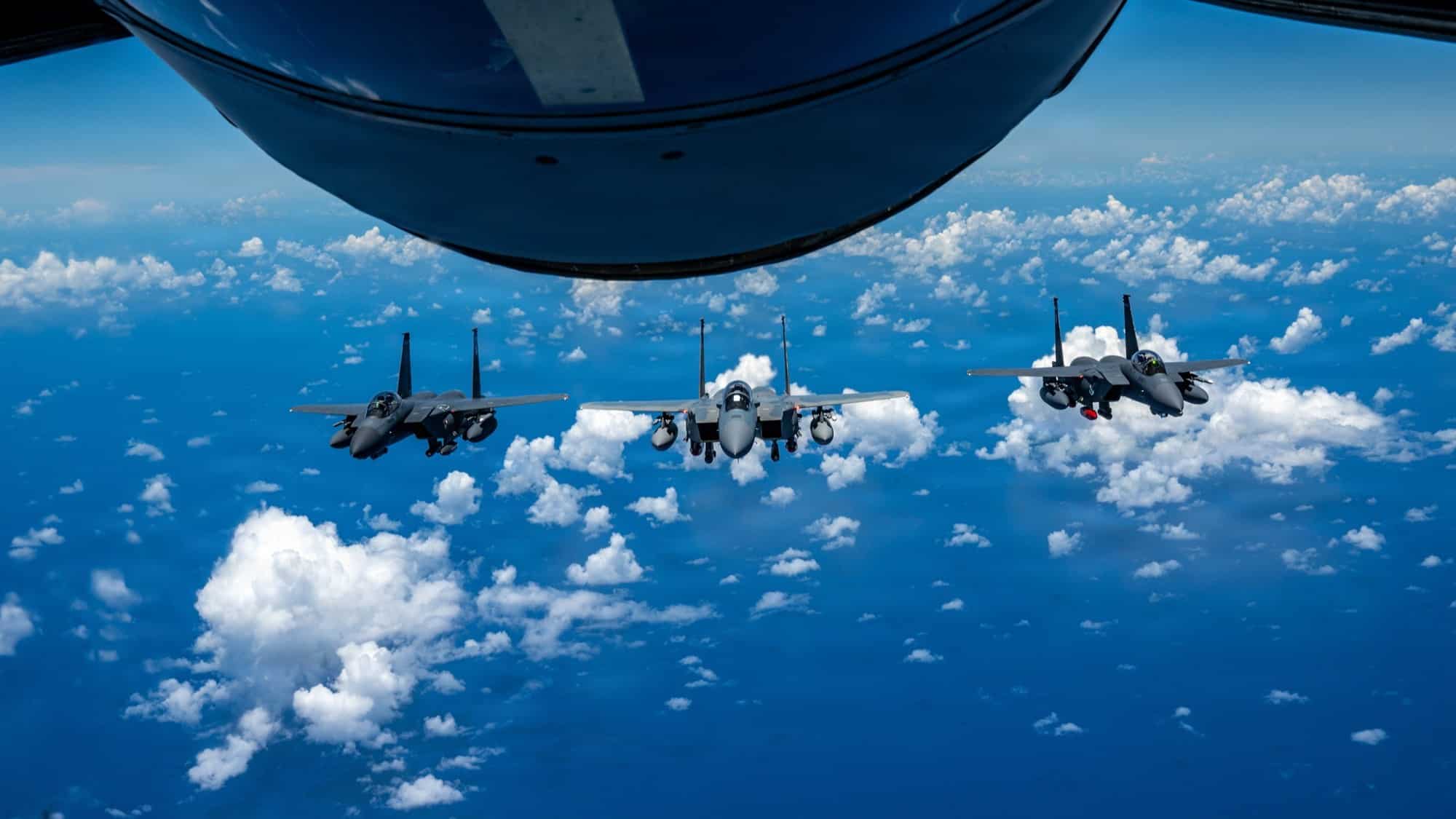
“Valiant Shield demonstrates our enduring commitment to a free and open Indo-Pacific,” Adm. Steve Koehler, commander of U.S. Pacific Fleet. “Exercising advanced multidomain capabilities with our allies ensures we continue to seamlessly innovate and operate together, project combat power together and prevail over any challenge – together.”
The exercise typically features a wide range of assets, including fighter aircraft, bombers, aerial refueling tankers, intelligence, surveillance and reconnaissance (ISR) platforms, naval surface combatants, submarines, amphibious forces, and advanced command-and-control systems. “This routine training fosters real-world proficiency in sustaining joint forces through detecting, locating, tracking, and engaging units at sea, in the air, on land, and in cyberspace in response to a range of mission areas,” explains PACAF.
Categories: Defence`s Feeds
A-10 Takes Part in Final Public Range Day in Arizona
Airmen and the local community gathered as Davis-Monthan hosted the final public A-10 Range Day at the Barry M. Goldwater Range.
Davis-Monthan Air Force Base hosted at the Barry M. Goldwater Range near Gila Bend, Arizona, the last public Range Day with the A-10C Thunderbolt II on Jun. 24, 2026 held its last Range Day. The announcement comes as the type inches towards its imminent retirement, despite Congressional approval to save the iconic aircraft.
“As the A-10C Thunderbolt II made one of its final passes over the Barry M. Goldwater Range near Gila Bend, Arizona, Airmen assigned to the 355th Wing, community members, and civic leaders gathered to witness the familiar roar that had echoed across Tucson’s skies for nearly five decades, marking one of the aircraft’s final range days,” said the press release.
For the sake of clarity, it should be noted, that while the press release mentioned “one of the aircraft’s final range days,” the title and the caption explicitly mentioned it “was the final A-10 Range Day.”
The Range Days are a traditional U.S. Air Force event held almost every other month at the Barry M. Goldwater Range by the 355th Wing. These events see the A-10C execute a live-fire demonstration of its combat mission, enthralling both public, Airmen, serving members and their families alike.
A U.S. Airman photographs two A-10C Thunderbolt II aircraft as they release flares on Jun. 25, 2026 at the Barry M. Goldwater range. | Source: U.S. Air Force photo by Airman Najzee Kuzu Imminent retirement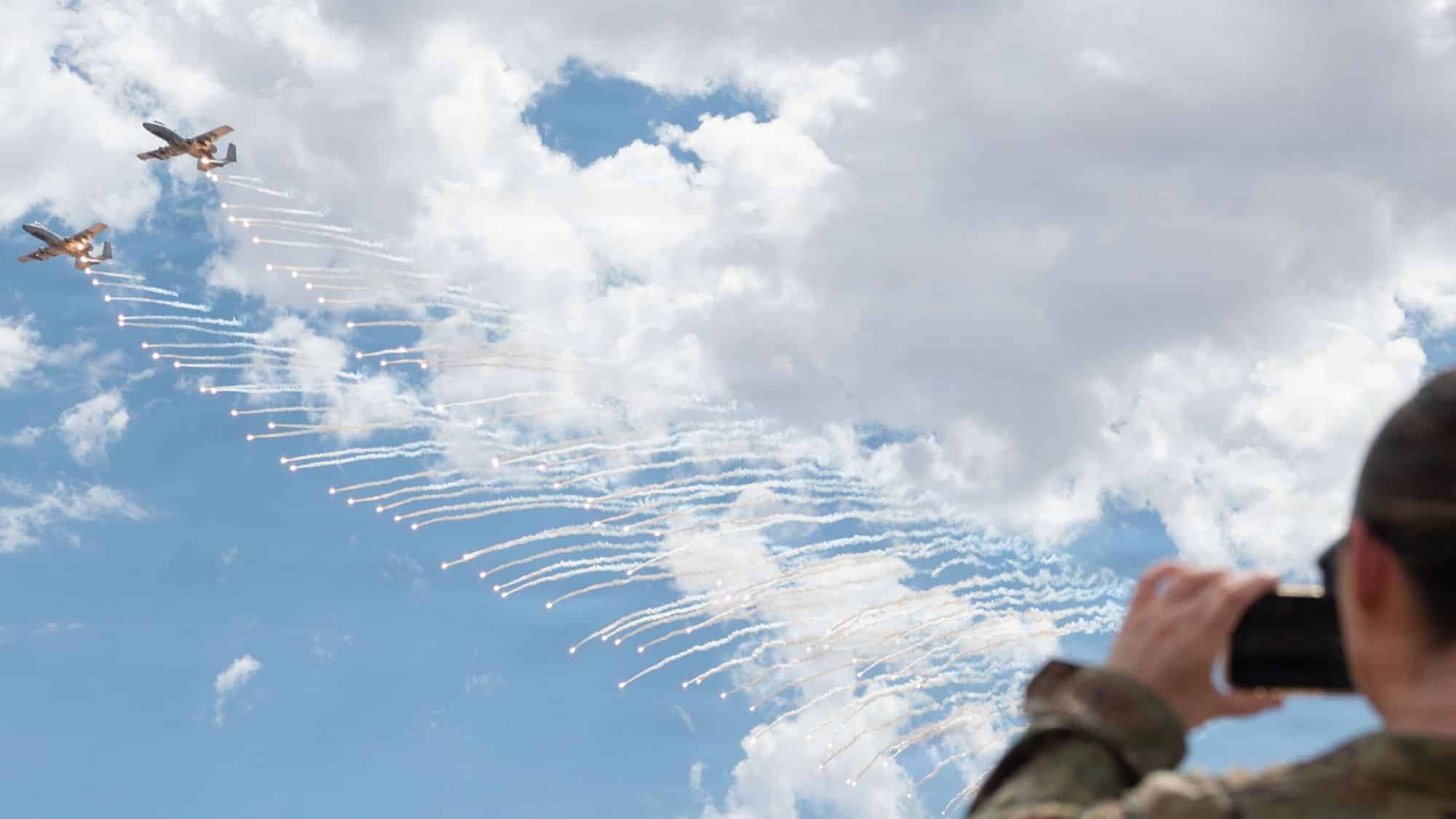
The A-10C, better known as Warthog, was earmarked for retirement by the end of 2026, however it will now remain in service at least until the 2030s. The U.S. Congress is in fact resisting attempts to fully retire the attack aircraft without a replacement.
The jets have seen considerable action against Iran during Operation Epic Fury, carrying a new refueling probe on the nose and electronic warfare pods, and returning with kill markings depicting bombs and Iranian naval vessels. The run up to the type’s eventual sundown has also seen the Air Force deactivate other associated units and activities.
This includes the shuttering of the 40th Test Flight Test Squadron’s Detachment 1 in December 2025, a geographically separate unit at Davis-Monthan AFB that executed A-10 developmental test operations. On Apr. 3, 2026, the U.S. Air Force also ended the training of the A-10C when the 357th Fighter Squadron graduated the last batch of student pilots at Davis-Monthan AFB.
Final Range DayDescribing the final Range Day as “powerful and precise,” the service said this was “a living, breathing demonstration of everything the A-10 mission represented; discipline, dedication and an unwavering commitment to those on the ground watching.”
Among the spectators was also retired U.S. Air Force Lt. Gen. Glen “Wally” Moorhead, who has witnessed the A-10 over 38 years of service. Moorhead delivered the first A-10 to Davis-Monthan nearly five decades ago, and was also one of the first pilots of the A-10C variant.
U.S. Air Force Col. Jose Cabrera, 355th Wing Commander, watches an A-10C Thunderbolt II perform. | Source: U.S. Air Force photo by Airman Najzee Kuzu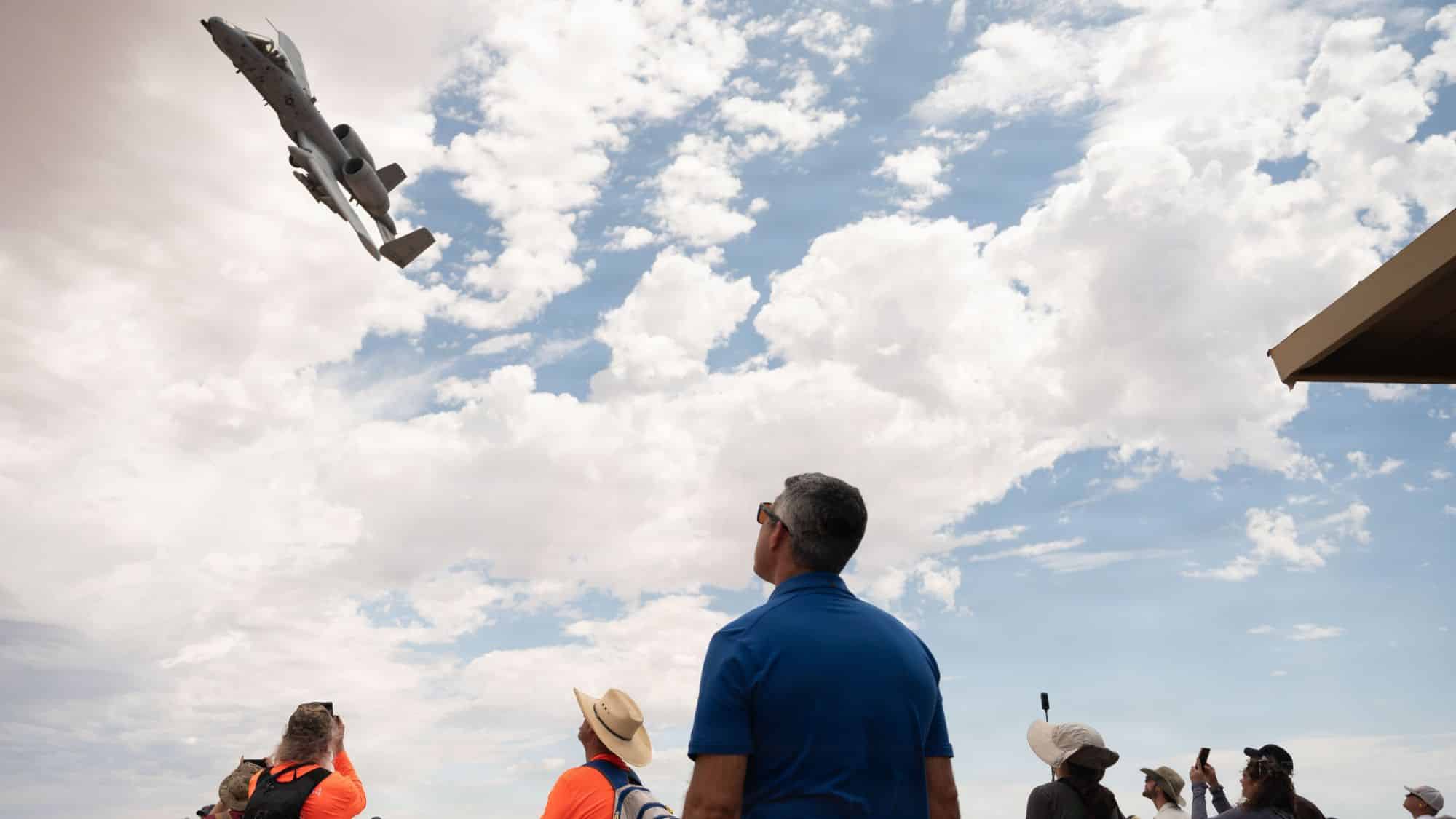
“The culture of attack is a special culture inside the United States Air Force,” reflected Moorhead. “The people flying the airplanes, the people working on them, loading them, making them work, that culture of mission is just strong, it’s extremely strong. And it’s always been a pride of mine.”
Tucson natives meanwhile have come to view the Range Days as more than just aerobatic and live-fire demonstrations. “The growl of the gatling gun, and the sight of a warthog in the clouds above have become a message from the base to the city that supports it; a message that says, without words, that the people inside that fence are mission ready constantly,” said the release.
Retired Air Force Col. Bill Pitts, who flew the A-10 for more than 14 years in his 26-year career, reflected on the community ties the event: “The attitude, the atmosphere around the A-10 is special. The pilots grow to love each other, and the attack community is a unique bunch.”
A U.S. Air Force A-10C Thunderbolt II aircraft assigned to the 357th Fighter Generation Squadron demonstrates live fire at the Barry M. Goldwater Range near Gila Bend, Arizona, June 11, 2026. | Source: U.S. Air Force photo by Senior Airman Christopher Ornelas Jr. Other recent Range DaysThe recent Range Days before the final one at Gila Bend were held from the beginning of the year on Mar. 27, 2026, May 1, May 28 and Jun. 11. Hosted by the 357th Fighter Generation Squadron (357th FGS), Range Days are attended by Airmen, civic leaders, Civil Air Patrol cadets and Junior Reserve Officers’ Training Corps Cadets where they witness the “installation’s rescue and attack mission.”
A-10 Warthog strafing run! I think it was about 107°F up there on the range tower.
I had to keep my phone and camera in the shade between passes so that it wouldn’t overheat and not be able to record! pic.twitter.com/TbJOgVJr1w
— Andrew Kelly (@andrewkphotos) June 30, 2026
Attending Airmen “recognized as top performers had the opportunity to participate in an A-10 range day to see the mission their work supports.” As for the A-10, one image caption said the range day “demonstrated the aircraft’s speed and maneuverability while supporting pilot proficiency in dynamic training environments.”
Categories: Defence`s Feeds
Lakenheath F-15Es Return From Middle East Combat Deployment With Striking Nose Art
Eleven 48th Fighter Wing Strike Eagles have returned home from the Iran air war sporting interesting nose art and bomb markings.
On Jul. 1, 2026, eleven F-15E Strike Eagles belonging to the 48th Fighter Wing returned home from their latest combat tour in the Middle East. Although some aircraft carried 494th FS markings, according to our sources all the aircrews were from the 492nd Fighter Squadron “Madhatters” (or “Bolars” from the squadron’s callsign). It is not unusual for the two squadrons of the 48th Fighter Wing to pool aircraft and borrow jets from one another when some airframes are unavailable.
The jets made their way back to RAF Lakenheath from Jordan, where they had been deployed to support Operation Epic Fury, with a stopover at Sigonella Air Base in Italy.
Flying as TREND 11-15 and TREND 21-26, the first eight jets landed before sunset. Despite the poor lighting conditions, our contributor Stewart Jack was there and took some interesting photographs of the F-15Es. The shots reveal nicknames and nose art applied to the jets, as has become a tradition for deployments to the CENTCOM AOR (area of responsibility). In this case, the nicknames appear to follow a monster/cryptid theme, mixing mythological creatures and horror figures.
Overall, the first eight Strike Eagles were nicknamed Nessie, Kraken, Yeti, Chupacabra, Cthulhu, Cerberus, Sirenhead and El Jefe. The final three F-15Es landed at around 21:45 LT, when it was much darker, and for the moment we have been unable to determine their nicknames.
More in details the aircraft arrived in the following order:
00-3001 “Nessie”
91-0329 “Kraken”
97-0221 “Yeti”
01-2001 “Chupacabra”
91-0331 “Cthulhu”
91-0309 “Cerberus”
96-0205 “Sirenhead”
91-0324 “El Jefe”
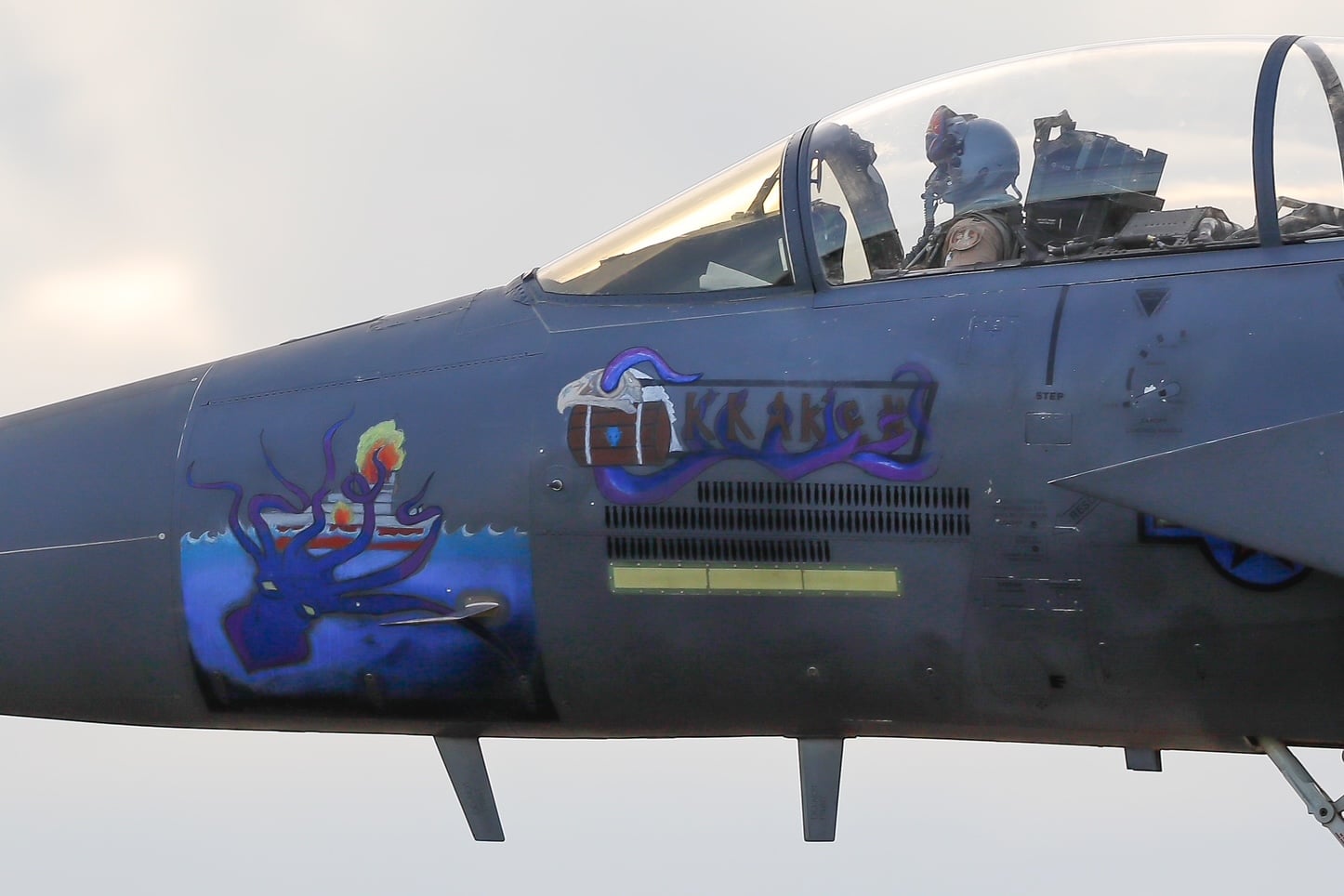
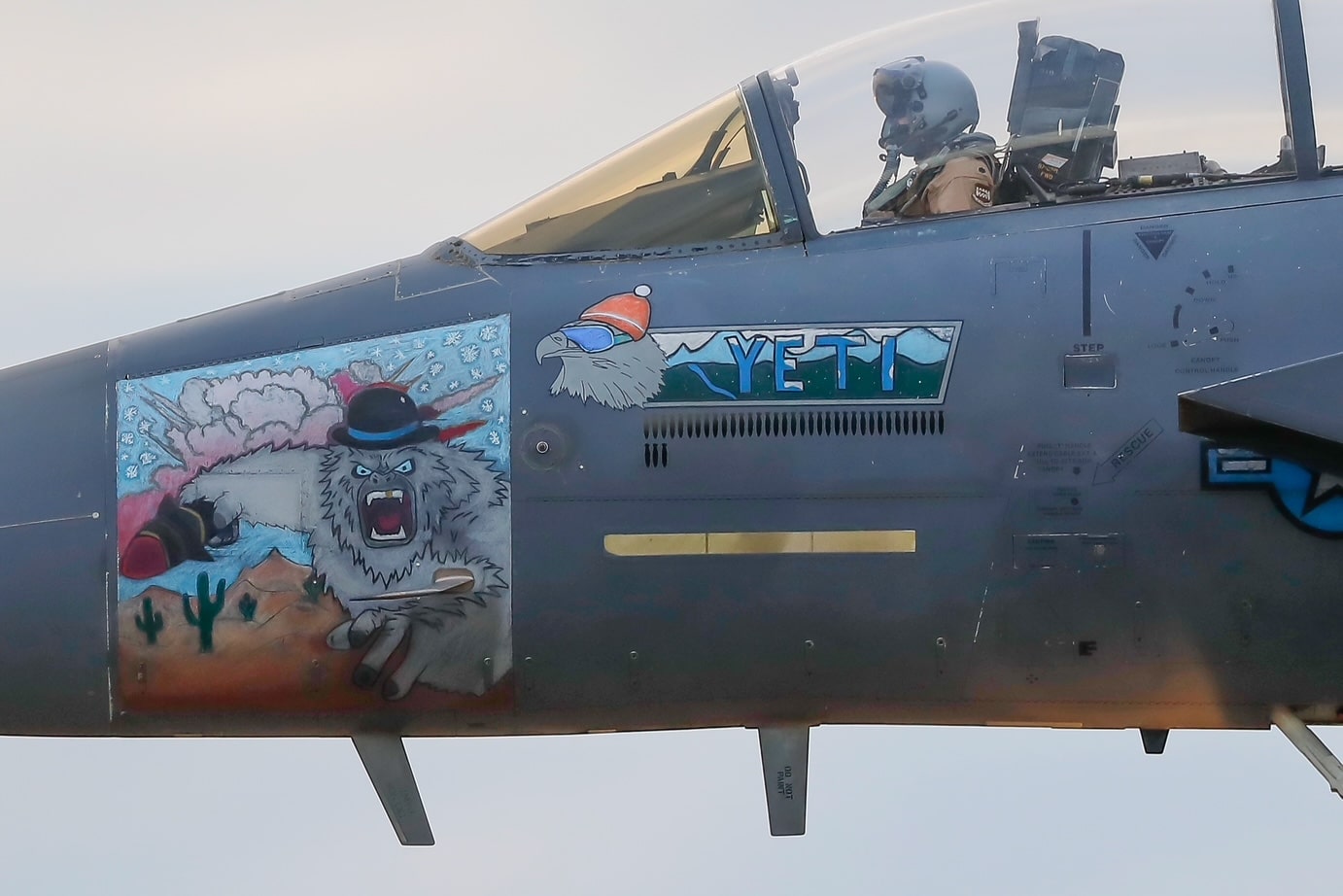
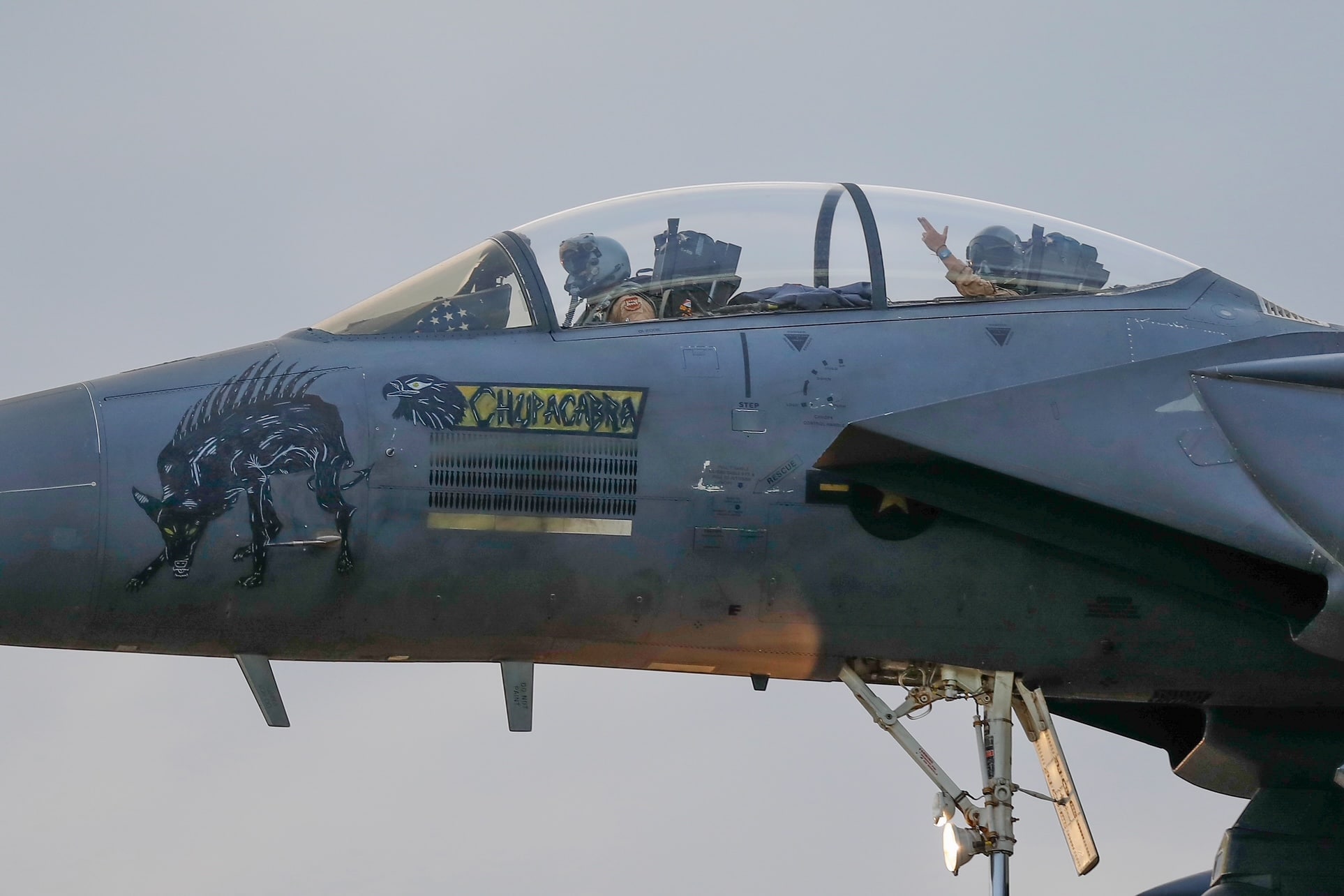
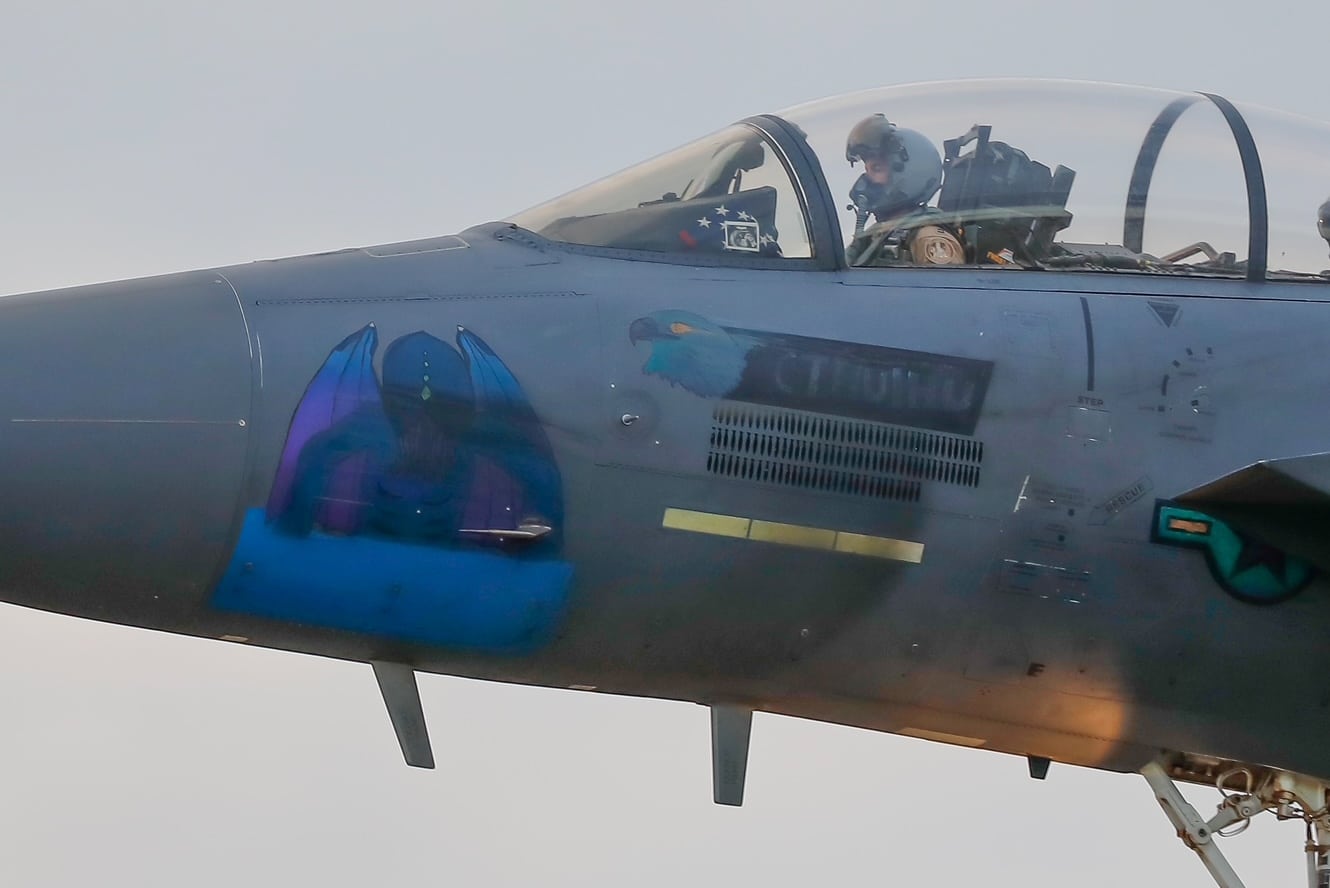
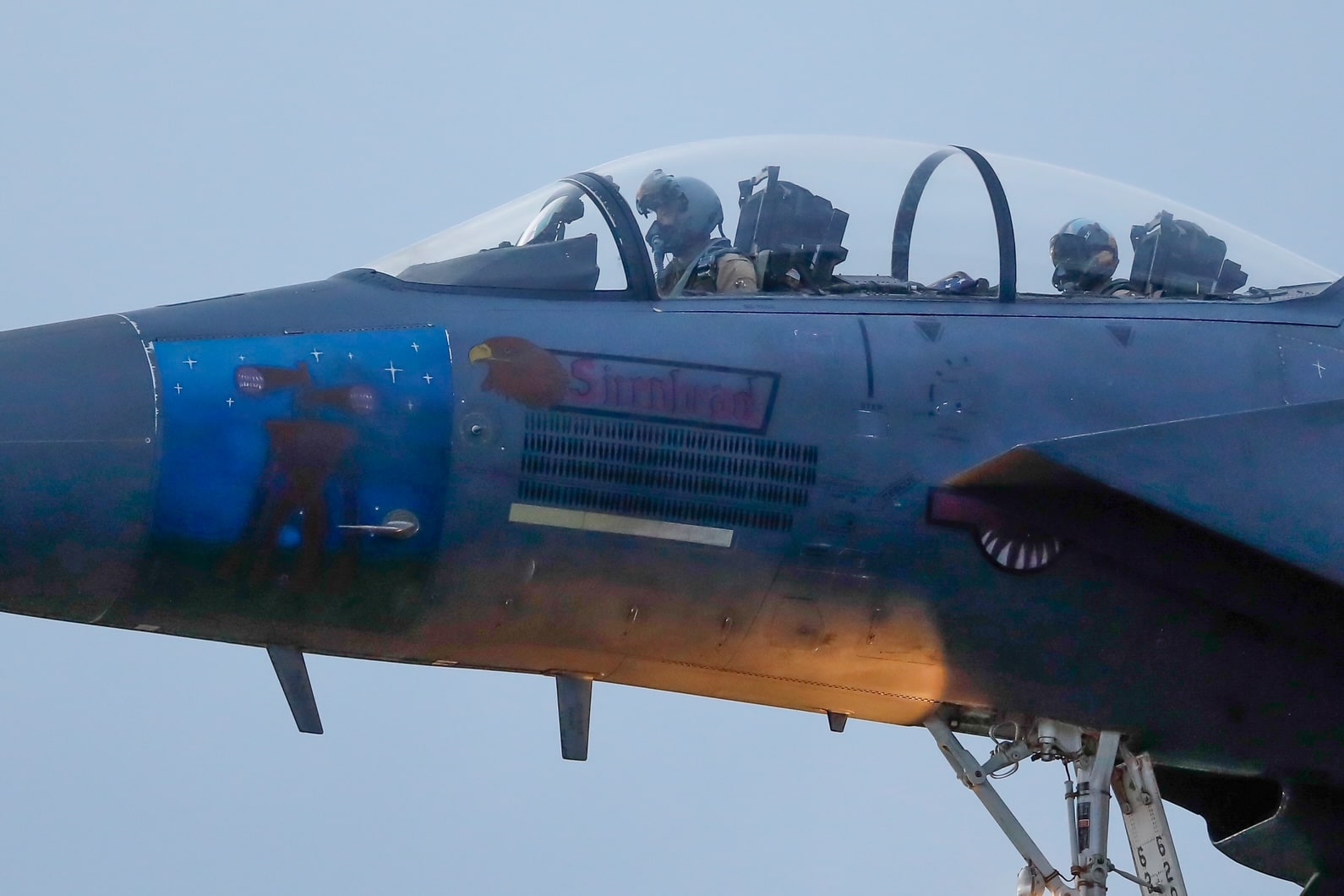
All the aircraft sport a significant number of JDAM (Joint Direct Attack Munition) markings, with two of them, “Cerberus” and “El Jefe,” also painted with what appear to be AGM-158 JASSM (Joint Air-to-Surface Standoff Missile) silhouettes. Noteworthy, the first eight aircraft don’t seem to sport any APKWS II markings.
91-0309 “Cerberus” | Source: Stewart Jack 91-0324 “El Jefe” | Source: Stewart Jack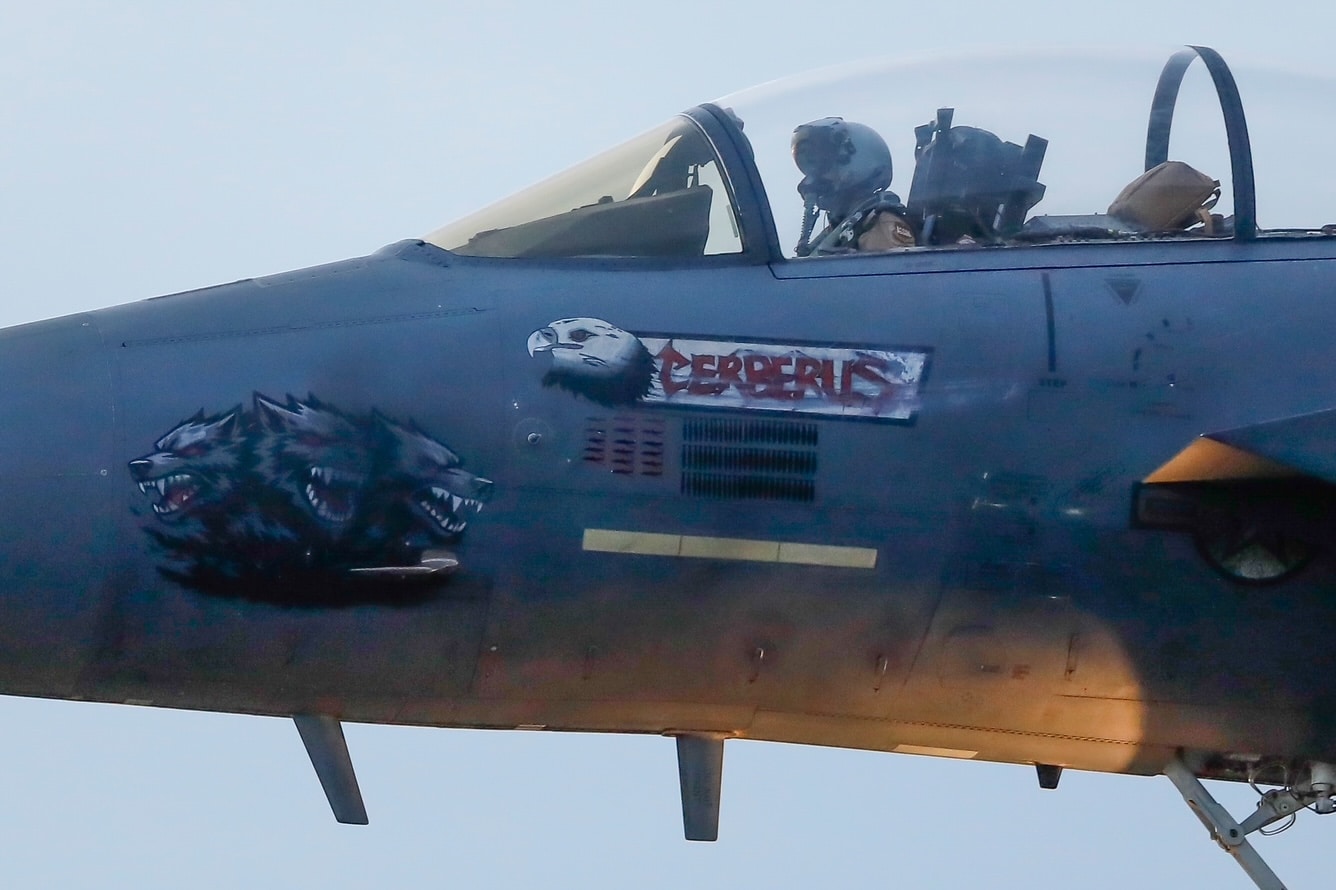
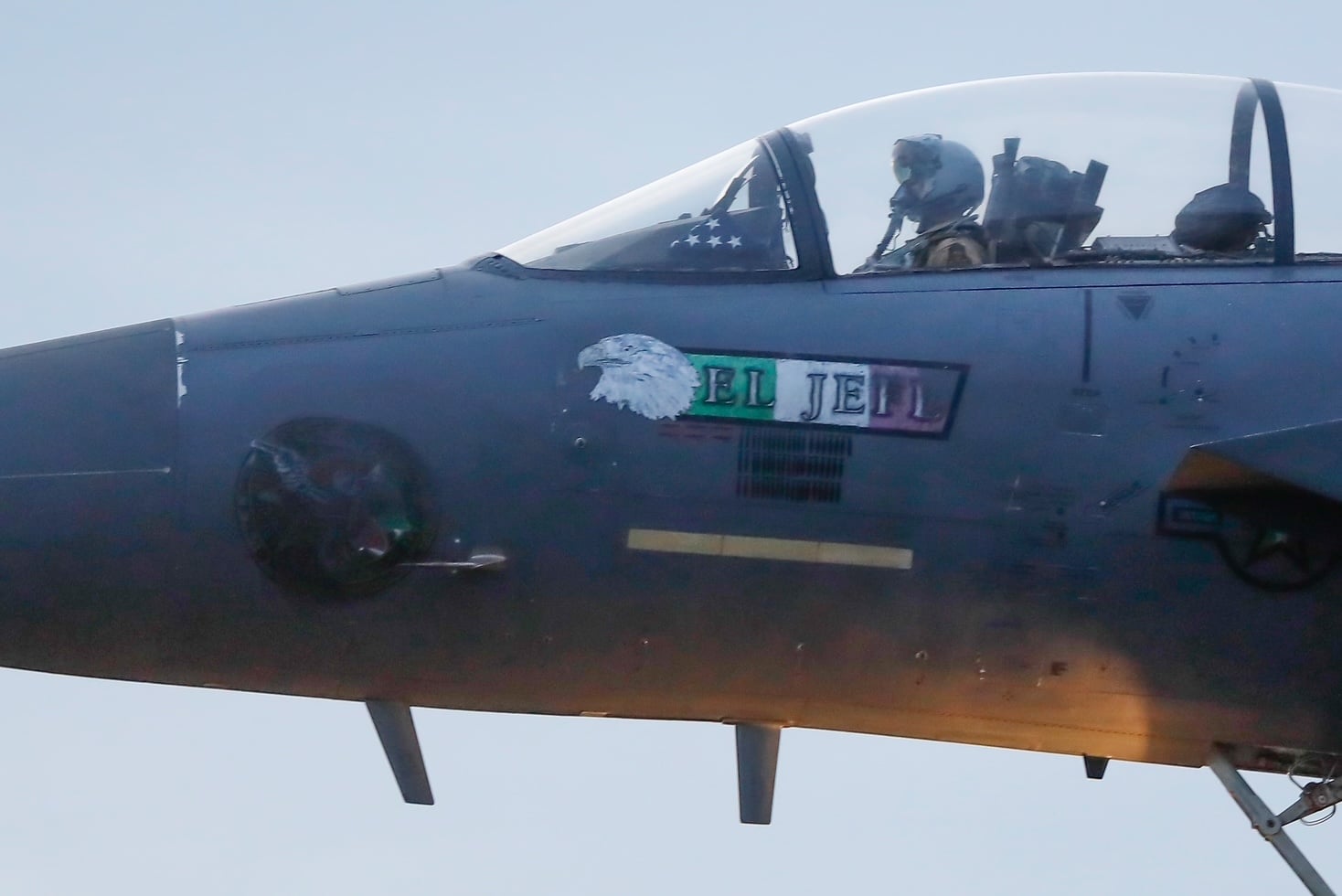
Nose art and nicknames on Strike Eagles deployed to the Middle East first appeared on the 18 F-15E Strike Eagle jets belonging to the 391st Expeditionary Fighter Squadron returning to Mountain Home AFB from OIR (Operation Inherent Resolve) in April 2019. Since then, it has become a standard for all the F-15E squadrons deployed to the CENTCOM AOR.
A big thank you to our contributor Stewart Jack Photography for sending us his photos!
Categories: Defence`s Feeds
Inside the 20th Squadron, Italy’s Eurofighter Operational Conversion Unit
An exclusive look inside the Italian Air Force’s Typhoon Operational Conversion Unit, where pilots are trained through advanced simulation, live flying and progressive tactical training.
Grosseto Air Base has been the home of the Italian Air Force’s 4th Wing for more than 60 years, serving as one of the service’s most prestigious and operationally demanding fighter units. From this strategic base, located about 94 miles (151 km) to the northwest of Rome, the Italian Eurofighter Typhoons maintain round-the-clock Quick Reaction Alert (QRA) duties, ensuring the round-the-clock protection of both Italian and NATO airspace.
The base is also home to the 20th Squadron – Operational Conversion Unit (20° Gruppo OCU), where pilots complete the final phase of their training before joining frontline Eurofighter Typhoon squadrons. Equipped with advanced simulators and cutting-edge training technologies, the unit plays a fundamental role in preparing aircrews for the complex operational environment they will encounter.
We had the opportunity to visit both the 4th Wing and the 20th OCU, gaining first-hand insight into their daily activities and talk with instructors, pilots and support personnel. Our visit revealed how the M-346 Master (T-346 according to the ItAF designation) has fundamentally transformed the Italian Air Force’s fighter training system: rather than simply introducing a new advanced trainer, the aircraft has reshaped the entire training pipeline, allowing many tactical and operational skills to be acquired earlier in a pilot’s career.
The “twin-stick” Eurofighter during taxi before a training sortie at Grosseto Air Base. | Source: Nicolò Teta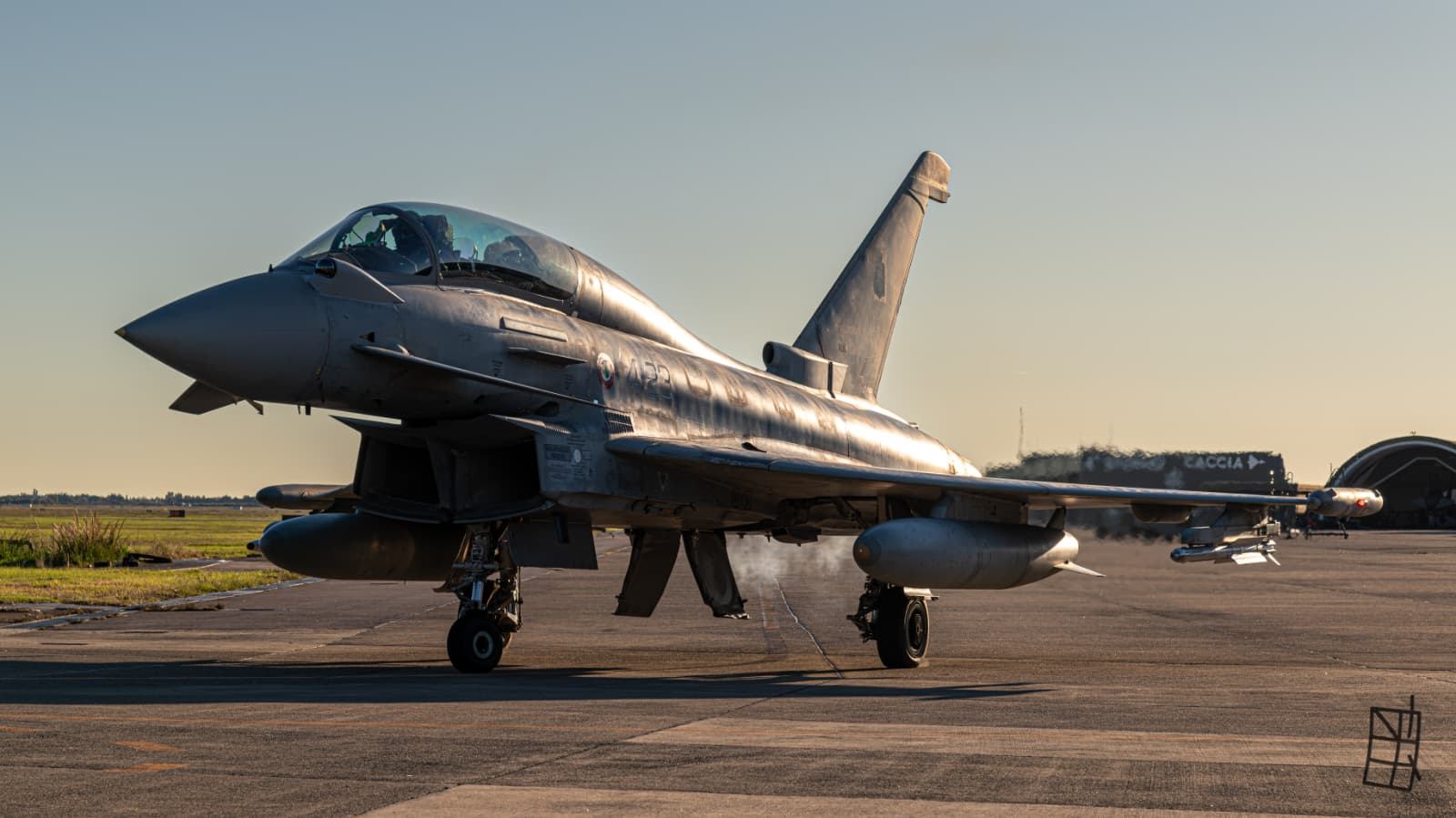
During our discussions with instructors and trainee pilots of the 20th OCU, we explored how this evolution has streamlined the transition to the Eurofighter Typhoon (F-2000A in accordance to Italy’s MoD Mission Design Series). By integrating advanced simulation, embedded training systems and a more progressive syllabus, today’s conversion course enables pilots to arrive on the frontline better prepared, making the transition to one of Europe’s most capable multirole fighters more effective than ever before.
Before the M-346: A Leap into the UnknownBefore the introduction of the M-346, pilots arrived at the 20th Squadron after completing advanced training on the MB-339CD or through international NATO programs such as the Euro NATO Joint Jet Pilot Training (ENJJPT).
An MB-339CD of the Italian Air Force, currently used for Phase III training by the 213th Squadron at Lecce Air Base. | Source: Italian Air Force
The greatest challenge was entering the world of modern combat systems. Radar operations, sensor management, tactical data fusion, and the interpretation of multifunction displays were entirely new concepts that had to be learned directly during operational conversion on the Eurofighter.
“Once pilots had mastered takeoffs and landings, the real challenge was learning to operate systems they had never encountered before,” explained an instructor.
As a result, numerous sorties were dedicated solely to learning procedures and familiarizing students with the aircraft’s onboard sensors, inevitably slowing progression toward more advanced tactical employment.
The LIFT RevolutionThe introduction of the M-346 and the Leading to Fighter Training (LIFT) concept has allowed the Italian Air Force to completely redesign its fighter training pipeline. Thanks to the aircraft’s capabilities and the seamless integration of advanced simulation with live flying, students now experience training events during their course at the 212th Squadron of the 61st Wing at Decimomannu Air Base that were once reserved exclusively for Eurofighter operational conversion.
An M-346A during a performance climb. | Source: Nicolò Teta
Radar intercepts, Beyond Visual Range (BVR) engagements, air-to-air combat, sensor management, simulated weapons employment, and tactical mission execution are now mastered well before pilots arrive at the OCU. The result has been a substantial shift of the training workload to earlier phases of pilot development.
“Today’s students arrive with a much stronger foundation than in the past,” the instructor explained. “This allows us to devote more time to advanced operational skills and the multirole capabilities that define today’s Typhoon.”
From Flight School to the Eurofighter: A Progressive Learning CurveFrom the students’ perspective, arriving at the 20th Squadron is no longer the dramatic leap it once was. By the time they begin OCU training, pilots already possess years of experience, hundreds of flight hours, and a solid aviation culture developed throughout their training career.
An Italian Air Force Eurofighter Typhoon begins its take-off roll at Grosseto Air Base. | Source: Nicolò Teta
“The impact is certainly significant, but it’s no longer a leap into the unknown,” one trainee told us. “The fundamentals of airmanship and mission management have already been built over the previous years.”
The Eurofighter introduces higher levels of performance, more sophisticated systems, and greater responsibility, but many of the underlying concepts have already been assimilated during training on the M-346.
The Eurofighter Typhoon: From Air Superiority to Swing Role OperationsOriginally conceived as an air superiority fighter designed to defend national airspace, the Eurofighter Typhoon has progressively evolved into a swing role platform capable of switching between air-to-air and air-to-ground missions within the same sortie.
Two Eurofighter Typhoon aircraft from the Italian Air Force’s 4th Wing performing a high-performance manoeuvre with reheat selected. | Source: Leonardo
Powered by two Eurojet EJ200 afterburning engines, it can reach Mach 2 and sustain supersonic flight without afterburner in supercruise conditions. Its delta wing with canard foreplanes, combined with a fully digital fly-by-wire control system, provides exceptional agility and high-performance handling across the entire flight envelope.
With a length of 15.96 metres, a wingspan of 10.95 metres and a maximum take-off weight of 23,500 kilograms, the aircraft carries its weapon load on thirteen hardpoints, in addition to a 27 mm Mauser BK-27 internal cannon. Continuous upgrades in software, sensors and precision weapons have transformed the Typhoon into a true multirole combat system, capable of conducting air policing, strike missions and tactical reconnaissance with high effectiveness.
The twin-seat “Twin Stick” variant complements the operational fleet, playing a key role in training and conversion while retaining the majority of combat capabilities of the single-seat version.
Ground School: Building the FoundationThe course begins with an intensive Ground School phase. Days are filled with classroom instruction, individual study, and in-depth analysis of the aircraft’s technical documentation. Students spend countless hours learning the aircraft’s systems, procedures, and operational philosophy.
The entrance hall of the 20th Operational Conversion Unit, where the squadron’s heritage, from the iconic F-104 Starfighter to the Eurofighter Typhoon, is proudly preserved. | Source: Nicolò Cerantonio
Throughout the academics, trainees are also supported by Leonardo’s instructor pilots and training personnel, who contribute to the Italian Air Force’s Eurofighter pilot programme. Working alongside the military instructional staff, they provide operational expertise and continuous guidance at every stage of the academic phase.
During this phase, instructors assess far more than technical knowledge. Professional attitude, discipline, commitment, motivation, and the ability to apply knowledge are considered just as important as technical competence.
According to the instructors, attitude is often every bit as important as technical ability.
The Gentex ACS (Aircrew Combat System) helmet with the iconic 20th Squadron helmet cover. | Source: Italian Air Force Simulation and Live Flying: An Essential Partnership
One of the cornerstones of modern fighter training is the simulator. Before ever flying the Eurofighter, students spend many hours in the Aircrew Synthetic Training Aids (ASTA) building at Grosseto Air Base, an integrated simulation environment that supports the Italian Air Force’s Eurofighter training programme.
The ASTA facility is co-located within the same building that also houses the 20th Operational Conversion Unit, ensuring full integration between simulator-based training and the operational conversion syllabus. The system employs three complementary simulator categories: the Cockpit Trainer (CT), the Full Mission Simulator (FMS), and the Enhanced Aircrew Cockpit Procedures Trainer (EACPT), each designed to progressively develop procedural knowledge, systems management, tactical awareness, and mission execution.
The importance of simulation within the training environment is also reflected in the motto displayed on the ASTA building at Grosseto Air Base: “Simulatione siderum tenus”, inspired by the traditional Air Force motto “Virtute siderum tenus”. The phrase encapsulates the role of simulation as a bridge between classroom learning and real-world operational readiness.
By the time they step into the real aircraft, the cockpit environment, procedures, and aircraft systems already feel familiar. However, even the most advanced simulator cannot fully reproduce every variable encountered in the real world.
Technical malfunctions, civilian air traffic, changing weather conditions, and the complexity of the operational environment demand decision-making skills that extend beyond simply following procedures. It is during this phase that a pilot’s professional maturity truly begins to emerge.
From Conventional Controls to Fly-by-WireAnother major evolution in training concerns digital flight control systems. The M-346 introduces students to fly-by-wire logic and Flight Control Computer management long before they transition to the Eurofighter.
“Students now arrive with a level of sensitivity that previous generations had to develop directly on the Typhoon,” said an instructor.
The advanced trainer’s performance also exposes students to high G-loads, rapid acceleration, and flight dynamics that closely resemble those of a modern frontline fighter.
Inside the cockpit of a Eurofighter Typhoon during a training sortie, showing the pilot’s in-flight working environment. (Image credit: Italian Air Force) | Source: Italian Air Force The Real Radar Remains One of the Greatest Challenges
Despite remarkable advances in simulation, transitioning from a simulated radar to the real system remains one of the most demanding aspects of operational conversion.
Synthetic scenarios are carefully controlled and predictable. In the real operational environment, pilots must deal with a much larger volume of information and with phenomena that cannot be perfectly replicated.
Correctly interpreting radar returns, identifying contacts, and maintaining high levels of situational awareness remain among the most challenging elements of fighter conversion training.
[Read also: First hand account: Flying the Eurofighter Typhoon in the Aggressor role during supersonic air combat training]
From Instruction to IndependenceAs training progresses, the instructors’ role gradually evolves. Initially, they guide students step by step through every procedure.
Later, the emphasis shifts toward developing independent decision-making. Rather than simply evaluating whether a decision was correct, instructors seek to understand the student’s reasoning process, even when the outcome is less than perfect.
The objective is not to produce pilots who merely execute procedures, but professionals capable of analysing complex situations, accepting responsibility, and making sound decisions under pressure. Throughout this journey, the instructor-student relationship gradually develops into one of genuine professional mentorship.
A Eurofighter Typhoon executing a “gate climb” in QRA configuration. | Source: Nicolò Teta The Emotion of the First Solo Flight
One of the defining moments of the entire training program is the first solo flight. After weeks of flying alongside instructors, students suddenly find themselves alone in the cockpit.
The initial tension is inevitable, but it quickly gives way to confidence. Everything that has been studied, rehearsed, and practiced in the simulator begins to feel natural.
Pilots gradually develop trust in their own abilities and build the confidence required for operational independence. For many, it becomes one of the most memorable and rewarding moments of their entire career.
Close Air Support and Joint OperationsAmong the most significant additions to the modern syllabus is Close Air Support (CAS) training. These missions are conducted in close cooperation with Joint Terminal Attack Controllers (JTACs) from both the Italian Army and the Italian Air Force.
A Joint Terminal Attack Controller (JTAC) coordinates a Close Air Support (CAS) mission, likely transmitting a Nine-Line brief to the supporting aircraft. | Source: Italian Air Force
This allows future fighter pilots to better understand the needs of ground forces while developing a broader perspective of the modern battlefield. “It’s essential to understand what the personnel on the ground see, while also helping them understand how we interpret the situation from the air,” said an instructor.
This approach strengthens interoperability among the different services and enhances overall operational effectiveness.
Learning from MistakesNot every challenge encountered during training is technical. Many young fighter pilots are highly self-critical after a mission that falls short of perfection.
For this reason, learning how to deal constructively with mistakes forms an essential part of the training process. Mission debriefings analyse every detail of the sortie, allowing students to understand what happened and identify opportunities for improvement.
“The ability to move forward after making a mistake is one of the most important qualities a military pilot can develop,” said an instructor. It is a lesson that proves invaluable not only in flight, but throughout an entire professional career.
The Fulfilment of a DreamThe ultimate goal of the course is achieving Limited Combat Readiness (LCR) qualification before joining an operational squadron. For every student, this represents the culmination of a journey that began many years earlier—a path built on study, sacrifice, determination, and continuous professional growth.
A Eurofighter Typhoon prepares for a training sortie at Grosseto Air Base, with the iconic hangar of the Italian Air Force 4th Wing (4° Stormo Caccia) visible behind. | Source: Nicolò Teta
Looking back, many recognize that the course has transformed them not only as aviators but also as individuals. The Eurofighter represents the pinnacle of their training, yet it also marks the beginning of a new chapter.
Because becoming a fighter pilot is about far more than learning to fly a high-performance aircraft. It means joining a professional community entrusted every day with safeguarding national airspace through competence, responsibility, and a deep sense of service.
In an era where technology continues to evolve at an extraordinary pace, one element remains unchanged: the value of people. It is through the combination of innovation, the experience of instructors, and the determination of students that the next generation of Italian Air Force fighter pilots is being forged.
Categories: Defence`s Feeds
Guam’s RQ-4B Global Hawks Permanently Relocate to Yokota Air Base
The RQ-4Bs operated by the 4th Reconnaissance Squadron permanently relocated to Yokota AB, where they already deployed every year during the typhoon season.
The U.S. Air Force permanently relocated its RQ-4B Global Hawks from Andersen Air Force Base (AFB), Guam, to Yokota Air Base, Japan, the 374th Airlift Wing announced on Jun. 15, 2026. The aircraft are operated by the 4th Reconnaissance Squadron (4th RS), a geographically separated unit of the 319th Reconnaissance Wing (319th RW).
The aircraft moved there to Japan between May 25 and 27, based on the images released on the DVIDS network. The unit routinely conducted a summer move to Yokota to find more favorable weather during typhoon season, however this time it was decided to make the move permanent to offer a persistent in-theater Intelligence, Surveillance and Reconnaissance (ISR) support to U.S. and Allied forces in the region.
The 374th AW is the host unit at Yokota AB, which operates C-130J Super Hercules with the 36th Airlift Squadron and C-12J Huron with the 419th Airlift Squadron. The already oversees unmanned aircraft with the MQ-9 Reapers of the 319th Expeditionary Reconnaissance Squadron based at Kadena AB.
As mentioned earlier, the three RQ-4B Block 40 Global Hawks of the 4th RS are a well known presence at Yokota AB because of their summer deployments. The unit has also been conducting Agile Combat Employment (ACE) deployments to various locations throughout Japan, mentions the 4th RS official page.
U.S. Pacific Air Forces has permanently relocated the 4th Reconnaissance Squadron’s RQ-4 Global Hawks from Guam to Yokota Air Base. The move improves weather resiliency during typhoon season & enhances intelligence, surveillance & reconnaissance support across the Indo-Pacific. pic.twitter.com/OCZpVf0q5O
— Yokota Air Base (@TeamYokota) June 16, 2026
The latest press mentions that the relocation is timed with favorable weather in Japan’s Kanto region during the typhoon season, which affects Guam harder. Compared to Yokota, Andersen is further east into the western Pacific.
“This ensures persistent reconnaissance in a region where challenges to a free and open Indo-Pacific continue to increase,” the statement said, referring to the strategic confrontations with China. PLA Navy and PLA Air Force activity have largely concentrated in the First Island Chain right outside its shores around Japan, Taiwan, Vietnam and the Philippines with whom Beijing has several conflicting maritime claims.
RQ-4Bs in the PacificThe statement outlined the Global Hawk’s mission to support the broad range of ISR collection missions for American, friendly militaries and joint forces in “worldwide peacetime, contingency, and crisis operations.” Commander of the 4th RS Lt. Col. Adam Otten praised Yokota’s facilities for both the deployment and their families.
“Yokota Air Base is the right location to support current and future RQ-4 operations in the theater, while upholding the quality of life of our Airmen and families,” Otten said. He also thanked Guam and the Andersen AFB community for hosting the Global Hawk in the past sixteen years. “We are excited to be here, and we are confident that the unit will thrive alongside Team Yokota,” Otten added.
The release described the Global Hawk as a high-altitude, long-endurance (HALE)-class Remotely Piloted aerial reconnaissance system that provides “persistent, day and night, high resolution, all weather imagery of large geographic areas with an array of integrated sensors and cameras.”
An RQ-4B Global Hawk takes off on Andersen Air Force Base, Guam, Sep. 17, 2024. | Source: U.S. Air Force photo by Airmen 1st Class Manasseh Demissie
The aircraft can fly at an altitude of 60,000 feet for at least 24 hours and has Synthetic Aperture Radar (SAR) and Ground-Moving Target Indicator (GMTI) sensors to be used as an Intelligence, surveillance, target acquisition, and reconnaissance (ISTAR) platform. This is further enhanced by a satellite-enabled Beyond Line of Sight (BLOS) control link.
The 4th RS’s RQ-4Bs are controlled by the 319th Operations Group, home-based at Grand Forks AFB, North Dakota. The aircraft are launched and recovered by personnel at the deployed location, with mission control at Grand Forks taking over subsequently, the 319th OG had explained in a September 2024 release about RQ-4B operations from Andersen AFB.
The U.S. is not the only operator of the drone in the region, as the service also announced on Mar. 12, 2022, the first arrival of an RQ-4B at Japan’s Misawa Air Base, which was one of the three RQ-4B Block 30 acquired by the Japan Air Self-Defense Force (JASDF). “The addition of this aircraft to the Japan Air Self-Defense Force’s inventory directly supports the defense of Japan and peace and stability in the Indo-Pacific region,” said the service.
#KeenSword25 | Misawa Elephant Walk
Four USAF F-16 Fighting Falcons, four JASDF F-35A Lightning II Joint Strike Fighters, four JASDF F-2s, a JASDF E-2D Hawkeye, a JASDF RQ-4B Global Hawk, a U.S. Navy C-12 Huron, & a U.S. Navy P-8 Poseidon performed an Elephant Walk at Misawa AB. pic.twitter.com/CfANXoEb3G
— U.S. Forces Japan (@USForcesJapan) November 4, 2024
INDOPACOM becomes PACOM againInterestingly, the development comes as the Department of War announced the restoration of the Indo-Pacific Command (INDOPACOM) theater command’s original designation, the Pacific Command (PACOM). President Donald Trump’s first administration introduced the INDOPACOM designation in 2018, capturing India’s partnership in the overall confrontation with China and encompassing the Indian Ocean Region (IOR).
While the RQ-4B’s move to Yokota might just be coincidental, the reversal to the original designation is perceived as being influenced by the developments in the West Asia conflict. India’s subdued yet official protests over the death of its three merchant mariners aboard the MV Settebello in a U.S. strike marks a sudden tension in ties.
Department of War Restores U.S. Pacific Command Designation.
CAMP H.M. SMITH, Hawaii — The Department of War announced today that the U.S. Indo-Pacific Command (USINDOPACOM) will officially restore its name to the U.S. Pacific Command (USPACOM).
Originally established on… pic.twitter.com/ZL0EL3q6Ph
— U.S. Pacific Command (@USPACOM) June 16, 2026
The PACOM however mentioned India as one of the regions within its Area of Responsibility (AoR). “USPACOM’s vast area of responsibility – spanning from the waters off the West Coast of the United States to the western border of India – remains exactly the same. The command’s fundamental mission and its unwavering commitment to maintaining a free and open theater alongside regional allies and partners are unchanged,” said the Command said on X.
Categories: Defence`s Feeds
Trouble in Whitehall: UK Armed Forces Chief Warns of Operational Cutbacks Without Additional Funding
Days after the high profile resignations from the Ministry of Defence’s political leadership, the professional head of the UK’s armed forces, Sir Rich Knighton, has said that without more funding the UK will need to ‘dial back’ both its military exercises and frontline operational activities.
The Royal Air Force Air Chief Marshal, who has served as Chief of the Defence Staff since September 2025, told the House of Lords International Relations and Defence Committee on Jun. 16, 2026, that the UK would need to “dial back our activities; our exercise, operational activity, if the level of resource funding that is available to us does not increase”.
“If you look back at the position 20 years ago, the split between resource spending and capital spending was about 80/20. Today it is about 60/40 – 60% on activity and resources, and 40% on capital. On the current projection, by the time we get to 2030 it will be 50/50.”
Rich Knighton, CDS freely saying to a House of Lord Committee that the DIP settlement that @JohnHealey_MP resigned over does not provide enough RDEL budget (day-to-day running expenses) for defence – operations and training will have to be cut.
If this is imposed, a resignation… pic.twitter.com/PJpbHeoHQ4
— Navy Lookout (@NavyLookout) June 16, 2026
Knighton here refers to what is known as the Ministry of Defence (MoD) RDEL (Resource Departmental Expenditure Limit) budget, which covers the day to day expenses of running the armed forces. Boosts to the MoD’s budget for capital expenditures, which cover the development and procurement of new equipment, have far outweighed any uplift of the RDEL budget.
This mismatch has partially resulted from several major, costly procurement programs currently ongoing – the Dreadnought class of ballistic missile submarines, the Global Combat Air Programme (GCAP) sixth generation fighter, the Type 26 frigates, and the problematic Ajax armored vehicle program to name just a few. These expensive programs have required large injections of funding into the MoD’s non-RDEL budget.
Why is the RDEL budget is critical for UK Defence?
The UK’s Ministry of Defence operates under two key funding streams: Resource DEL (RDEL) for day-to-day running costs — personnel pay, training, equipment support, operations, and maintenance — and Capital DEL (CDEL) for new… https://t.co/KOHoH9khlp
— Scotty (@scottyeders) June 17, 2026
Meanwhile, though, the RDEL costs themselves are facing major increases. Fuel costs have surged dramatically, while the MoD is simultaneously tasked to stretch itself wider than it has been at any time since the Cold War. A pivot back to Europe and the North Atlantic envisioned post-Afghanistan has been left in tatters following continual unrest in the Middle East, which has required the deployment of additional UK forces to protect national interests and support regional partners.
Ministerial ResignationsAn unavoidable backdrop to Knighton’s comments, the MoD itself has undergone a rapid, unplanned change with the departure of John Healey from the role of Secretary of State for Defence. Healey had held this role since the current government took office in 2024, having served in the shadow counterpart of the role in opposition since April 2020.
Joining Healey was the now former Under-Secretary of State for the Armed Forces Al Carns, who, until being elected to Parliament in 2024, previously served in the Royal Marines and attained the rank of Colonel. Though it has not been officially confirmed, it is an open secret in British political circles that Carns served as a senior officer in the elite Special Boat Service (SBS) and saw action in every major conflict the UK has been involved in for the last quarter of a century.
Al Carns (centre left), talking with Commander ARRC, Lieutenant General Mike Elviss (centre right). | Source: Crown Copyright 2026
Healey’s bombshell resignation took aim at the heart of the Government he had loyally defended, accusing it and the Prime Minister of failing to “to commit the resources that the nation needs to defend the country at this time of rising threats”. Insiders have said that his resignation came as a shock to the entire cabinet, and one that worsens Keir Starmer’s position amid the still open threat of leadership challenges.
One of his main critiques revolves around the still-unpublished Defence Investment Plan (DIP), which was promised to follow last year’s Strategic Defence Review. Major procurement decisions have been delayed until the DIP is finalised, which has put immense strain on businesses waiting to be awarded significant defence contracts. In one noteworthy case, Aeralis, a firm that hoped to produce an all-British modular jet trainer, collapsed into administration.
Carns added fuel to the fire, claiming that even as a defence minister he had not been included in DIP discussions until two weeks before his resignation. He has since labelled it “not fit for purpose”.
“I haven’t been included in the defence investment plan from the start. I only got read into it two weeks ago.”
Al Carns shares what “ruffled [his] feathers” enough to prompt him to resign as armed forces minister and says that in the event of a leadership race, “if someone… pic.twitter.com/0gQDNYKpfO
— Times Radio (@TimesRadio) June 13, 2026
Speaking to The Guardian, Carns lambasted what he saw as excessive waste and bureaucracy within the ministry. “It is unbelievable. You turn a stone over and get another shock – how has that been allowed to go on? And you turn another stone over, and it is just layers of bureaucracy which now cost us more than the product you’re getting itself. I can’t describe the level of inefficiency in the system that we’ve been left with and we’re trying to unpeel. But it’s actually exceptionally difficult to do.”
The new Secretary of State for Defence is Dan Jarvis, who came to the role from the Home Office where he served as Minister of State for Security. Jarvis, like Carns, is a decorated military veteran. Serving in the British Army, he attained the rank of Major before leaving the forces in 2011 after 14 years.
The new Secretary of State for Defence, Dan Jarvis MBE MP. | Source: Crown Copyright 2026
Jarvis notably served as staff officer to General Sir Mike Jackson in Kosovo when Jackson refused an order from Supreme Allied Commander Europe (SACEUR) General Wesley Clark (U.S. Army) to continue with a plan to seize Pristina International Airport despite it then being under the control of Russian forces. Best-selling singer James Blunt was also present for this affair, serving under Jackson as a Captain.
EXC: Dan Jarvis faces having to make “very significant cuts” inside the MoD if he cannot get more money.
– Options on the table last week included reducing investment in drones and artificial intelligence, cutting reserve days, and cutting exercises
– the £13.5 bn offer included…
— Larisa Brown (@larisamlbrown) June 16, 2026
Stuck between a rock and a hard place, the new secretary is said to be re-evaluating the DIP, now reportedly delayed until (at least) July. The loss of Healey and Carns is thought to have potentially swayed opinions within cabinet to back spending increases, which means Jarvis may have a smoother road. The fear of losing another defence secretary should they face a similar stumbling block will also force the hand of Starmer and the Treasury, headed by Chancellor Rachel Reeves.
Categories: Defence`s Feeds
U.S. Air Force Awards CCA Production Contracts
The U.S. Air Force has awarded contracts for both the production of CCAs and the mission autonomy software as part of the program’s Increment 1.
The U.S. Air Force awarded several contracts for the Collaborative Combat Aircraft program, including production contracts for the Increment 1 aircraft as well as mission autonomy software. The move represents a further step forward in the service’s effort to rapidly field these advanced combat capabilities which would support crewed aircraft during missions.
The award of these contracts is also a part of the new acquisition transformation principles, which aim to decouple hardware from software. The service explained that treating mission autonomy as “software sold separately” allows to field “state-of-the-art physical platforms alongside agile, easily updatable software, effectively breaking traditional procurement molds.”
“Collaborative Combat Aircraft change how we project power and generate mass in highly contested environments,” said Air Force Chief of Staff Gen. Ken Wilsbach. “Delivering this capability to our warfighters faster ensures our forces maintain the tactical edge required to deter and, if necessary, defeat any adversary.”
The service further explained that CCA represent the next critical evolution of airpower, and are designed to seamlessly integrate with crewed fighters to extend reach, awareness and survivability in contested environments.
YFQ-42 aircraft sit on the flightline at a California test location as part of the Air Force’s Collaborative Combat Aircraft flight test campaign. | Source: Courtesy photo Hardware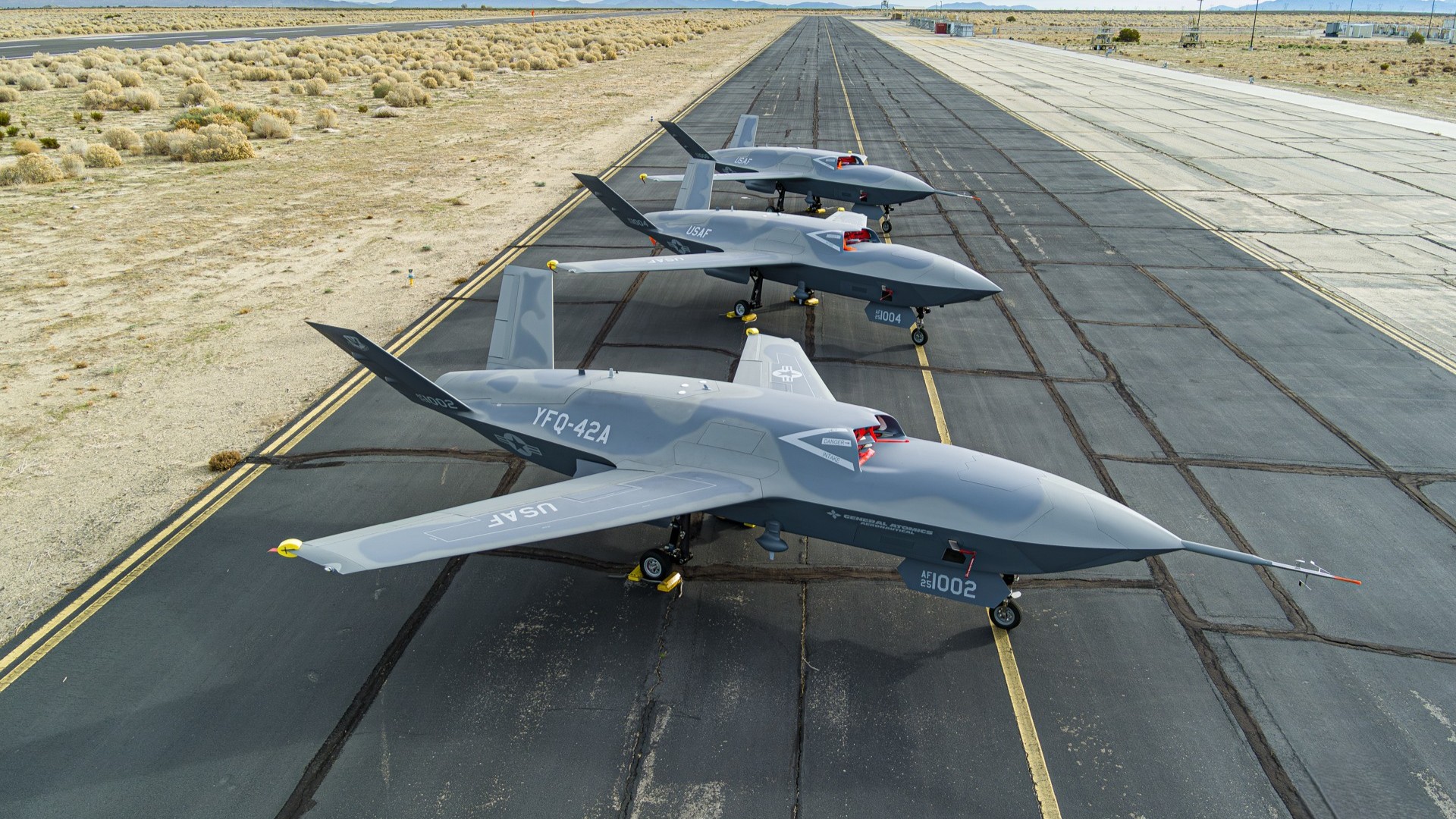
For the hardware-side of the program, the Air Force awarded engineering and manufacturing development and production contracts to both General Atomics Aeronautical Systems (GA-ASI) and Anduril for their FQ-42 and FQ-44, respectively. The service explained that the award arrived months ahead of scheduled because the two uncrewed assets already met rigorous mission requirements and are ready for full-scale manufacturing.
Notably, the two designs are now dropping the ‘Y’ designation which indicated prototypes, while maintaining the designation of UAVs (as denoted by the ‘Q’ vehicle type code) with the intended role as a fighter (indicated by the ‘F’ basic mission).
“By moving fast from competitive selection into full-scale manufacturing, we position ourselves to field highly credible and combat-ready semi-autonomous systems to stay ahead of the pacing challenge,” said Secretary of the Air Force Troy Meink. “These contracts reaffirm our confidence in the strategic path forward for the program to procure over 150 combat capable CCA by the end of the decade.”
The service intends to field approximately 1,000 combat-capable CCA throughout multiple Increments. Work is already ongoing for the Increment 2, which will build on the lessons from Increment 1.
A YFQ-44A takes off from the runway at Edwards Air Force Base, Calif., during a Collaborative Combat Aircraft exercise. | Source: U.S. Air Force photo by Ariana Ortega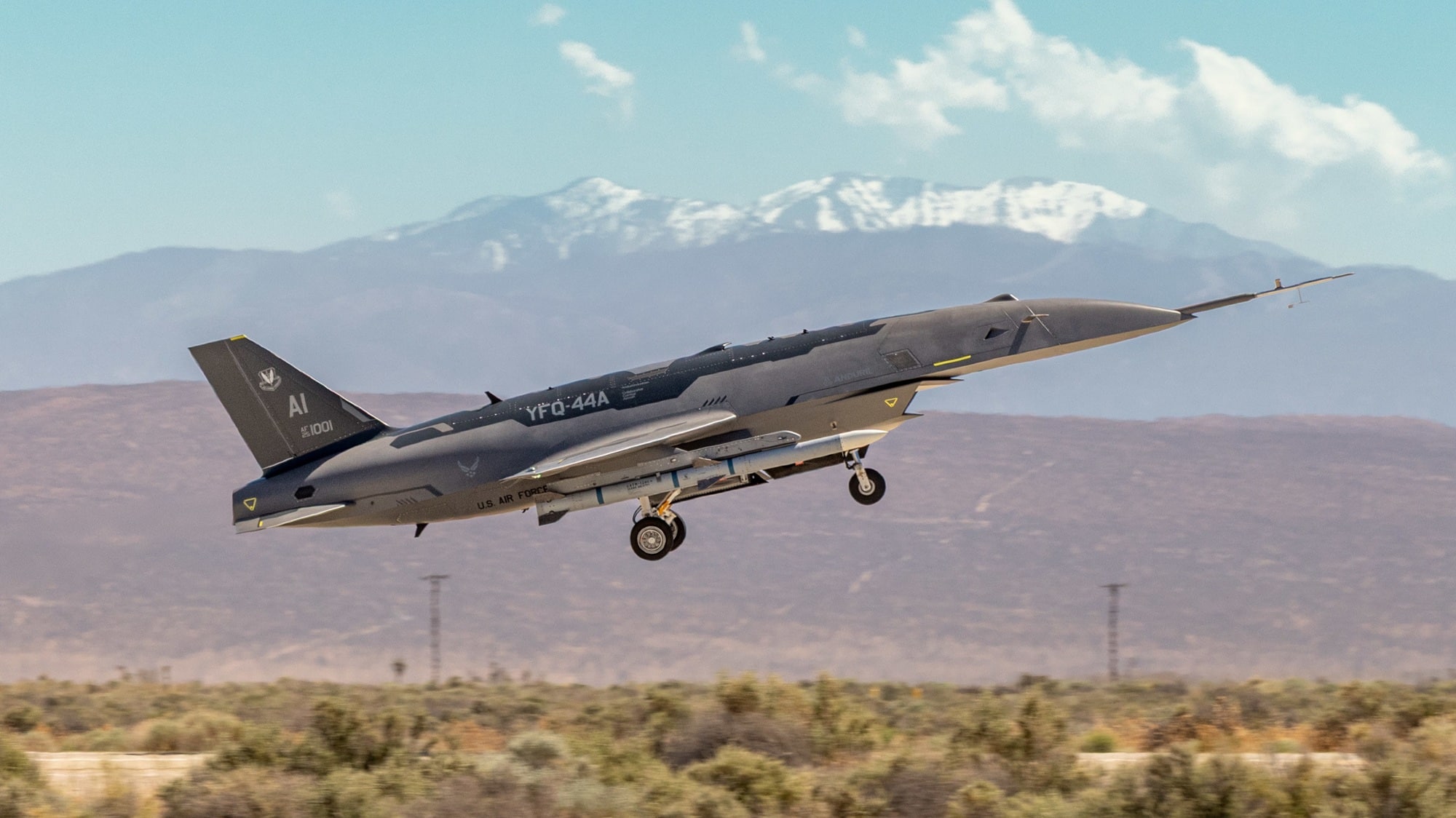
Both GA-ASI and Anduril are noting the speed of the program, which saw the move from prototype award to production in just two years. Anduril further noted that, unlike traditional fighters, CCAs can be built more quickly and with larger scales.
SoftwareFor the software, the Air Force awarded mission autonomy production contracts to a pool of six vendors, including Anduril, General Atomics, Lockheed Martin, Northrop Grumman, RTX Collins Aerospace and Shield AI. Each of them has been awarded a baseline six-year contract which provides the framework for continuous competition and rapid software development.
Additionally, Anduril, RTX Collins Aerospace, and Shield AI, have also received a competitive contract to accelerate the delivery of critical mission autonomy software. The service explained this will fund the first of two six-month competitive phases designed to speed the fielding of operational software to the warfighter.
Following this six-month period, the Air Force will evaluate the vendors’ progress and execute a second competitive award period, leading to the selection of a primary mission autonomy provider for CCA Increment 1 by summer 2027.
The second YFQ-42 in flight. | Source: GA-ASI
“Mission autonomy is the cornerstone of the CCA concept, and leveraging a competitive, multi-vendor environment ensures we capture the latest technology,” Meink said. “This approach guarantees our Airmen are equipped with state-of-the-art capabilities today but keeps the door open for the breakthroughs necessary to maintain air superiority.”
The service is also adopting a licensing approach which would allow to award licenses to any of the six vendors at any point over the next six years, procuring the best-performing and most affordable solutions as technology evolves. The Autonomy Government Reference Architecture (A-GRA) will be critical for this approach, ensuring that mission autonomy software from any vendor can be easily integrated, quickly updated, and ported across different physical aircraft platforms.
Collaborative Combat AircraftThe development of the autonomous systems has advanced more rapidly than expected, leading some to suggest that NGAD’s crewed fighter might not be as essential as initially planned. The combination of CCAs with manned platforms like the F-35 and F-15EX could provide a more affordable and flexible solution to achieving air superiority.
The rise of CCAs reflects the Air Force’s shifting priorities, where a system-of-systems approach may take precedence over a singular focus on a high-cost manned fighter. The combination of manned and unmanned systems also allows for greater flexibility and the potential to deploy assets in more distributed and resilient ways.
The YFQ-44A in flight. | Source: Anduril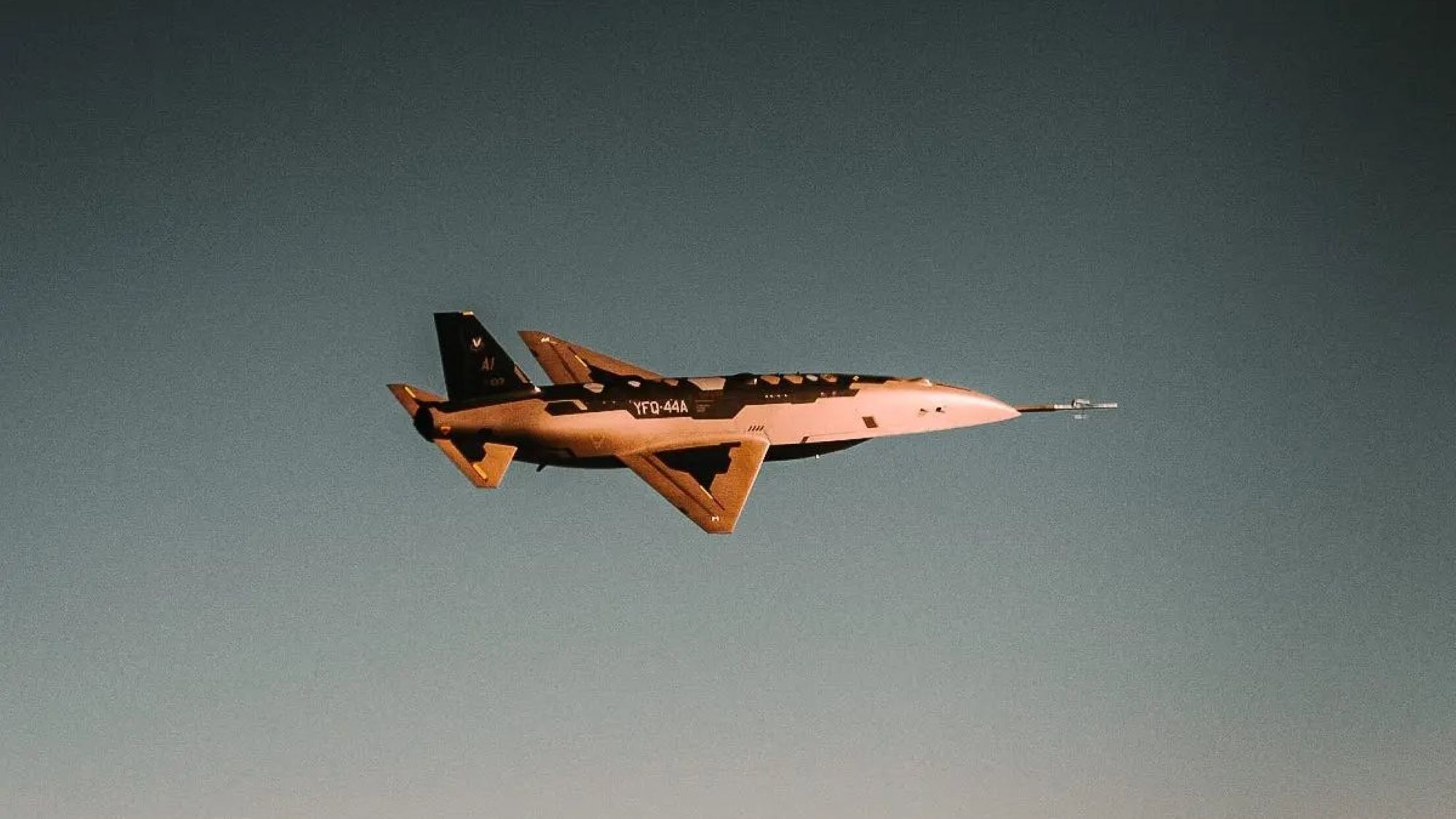
The Air Force is rapidly advancing the development of CCAs, with plans to begin deploying over 150 units in the next five years. These autonomous systems could take on a range of missions, from surveillance to direct combat, working as force multipliers in collaboration with manned platforms and taking on high-risk missions traditionally performed by manned fighters.
Unlike legacy fighters, CCAs feature modular designs, enabling rapid upgrades and streamlined maintenance. The modular design and open architecture, the latter becoming a staple in the design of modern military aircraft, allows to introduce new capabilities as they become available, allowing in turn to always field the latest technologies to keep an edge over rapidly evolving battlefields.
In early 2024, Anduril Industries and General Atomics were awarded contracts to design and test production-ready CCAs, marking a pivotal step in the program. Both companies are developing these unmanned aircraft to support both the upcoming NGAD fighters, as well as current F-35s and other manned aircraft, by sharing sensor data, executing coordinated maneuvers, and potentially carrying out combat roles.
In early 2025, the U.S. Air Force’s then Chief of Staff, General David Allvin, announced the official designation of the first two CCAs. The two aircraft by General Atomics and Anduril have been named YFQ-42A and YFQ-44A, respectively, marking the first use of the ‘Unmanned Fighter’ designation by the USAF.
The first YFQ-42 in flight. | Source: GA-ASI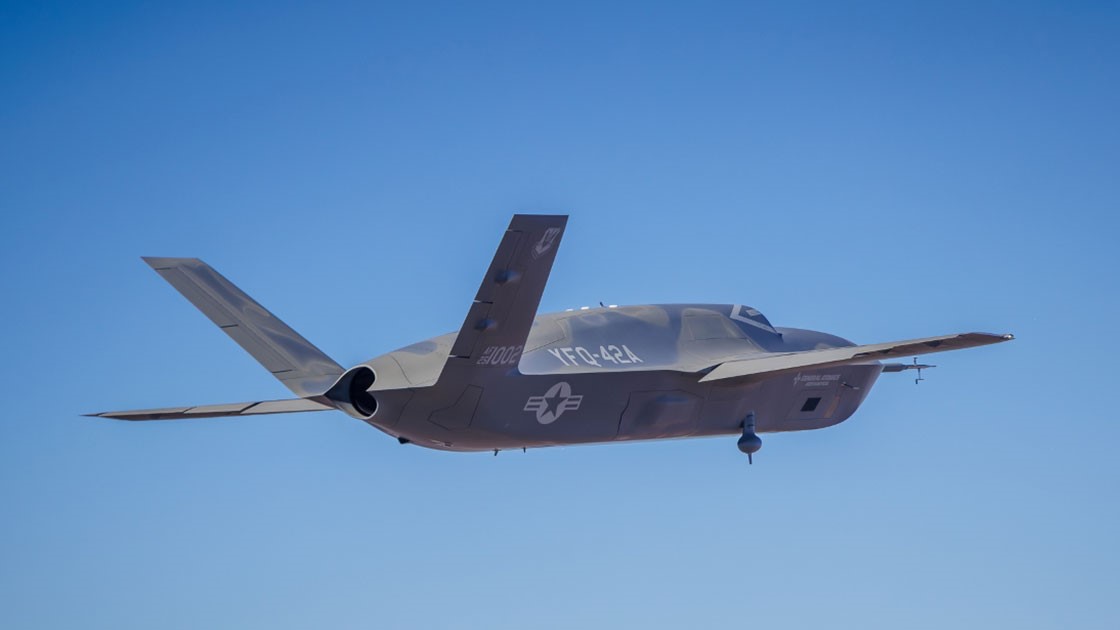
“We have two prototypes of Collaborative Combat Aircraft that were on paper less than a couple of years ago,” Allvin said. “For the first time in our history, we have a fighter designation in the YFQ-42 Alpha and the YFQ-44 Alpha – maybe just symbolic, but it’s telling the world that we are leaning into a new chapter of aerial warfare.”
These two aircraft flew for the first time in August 2025 and October 2025, respectively. Since then, they have been involved in a series of tests to demonstrate the required capabilities, working in close partnership with the service.
The Air Force is planning to field a diverse fleet of over 1,000 CCAs, designed with modular configurations for weaponry, sensor capabilities, and rapid adaptability to mission needs. One notable advancement in 2024 was the first flight of the XQ-67A, a low-cost drone designed by General Atomics under the Off-Board Sensing Station (OBSS) program, which occurred in February 2024.
This platform, along with the earlier XQ-58A Valkyrie, demonstrates a “common chassis” concept—using shared components for various drone models to streamline production and reduce costs. This approach aims to provide a scalable, cost-effective solution for enhancing combat capacity without relying on high-cost crewed jets, which is essential given the Air Force’s budget constraints and strategic emphasis on distributed, resilient forces.
“A competitive Increment 1 production decision is expected in fiscal year 2026,” says the Air Force, “with development for Increment 2 beginning that same year to expand mission applications and integrate emerging technologies.”
Categories: Defence`s Feeds
A-10s Return From Operation Epic Fury With Nose Art, Bomb Markings And Iranian Vessel Kill Markings
The bomb markings on the returning A-10 Thunderbolt II jets hint at the variety of weapons the Warthogs used against Iran, while the kill marks offer clues about some of the targets they hit.
On Jun. 12, 2026, 11 A-10C Thunderbolt II aircraft, belonging to the 75th Fighter Squadron of the 23rd Wing, from Moody Air Force Base, Georgia, arrived at RAF Lakenheath, UK, from Aviano Air Base, Italy, on their way back to the U.S. following their deployment to the CENTCOM AOR (Area Of Responsibility). During the deployment, they took part in Operation Epic Fury and also carried out missions over Iraq and Syria.
The Warthogs (as the A-10s are nicknamed) arrived in the UK split into four cells:
TABOR 11-13:
80-0175/FT “King Dedede”
79-0157/FT “Fox”
78-0649/FT “Reaper”
TABOR 14-16:
78-0613/FT “Diddy Kong”
80-0243/FT “Samus”
78-0583/FT “Sephiroth”
Tabor 21-23
80-0188/FT “Macho Man”
79-0095/FT “Lil Mac”
80-0273/FT “Kirby”
Tabor 24-25
81-0988/FT “Ridley”
78-0586/FT “Doc Holiday”
As per tradition, during their stay at Muwaffaq Salti Air Base in Jordan, the Warthogs received nose art along with bomb markings. For what deals the nicknames, based on the photos taken by our contributor and friend Stewart Jack, most appear to follow a Nintendo/Super Smash Bros. theme we had already identified from photos released by CENTCOM, with references including King Dedede, Fox, Diddy Kong, Samus, Sephiroth, Little Mac, Kirby and Ridley. Macho Man, Reaper” and Doc Holiday seem to be possible outliers from the video-games theme.
King Dedede | Source: Stewart Jack Doc Holliday (All images, credit: Stewart Jack, unless otherwise stated) | Source: Stewart Jack Macho Man | Source: Stewart Jack Lil Mac | Source: Stewart Jack Sephiroth | Source: Stewart Jack Fox | Source: Stewart Jack Reaper | Source: Stewart Jack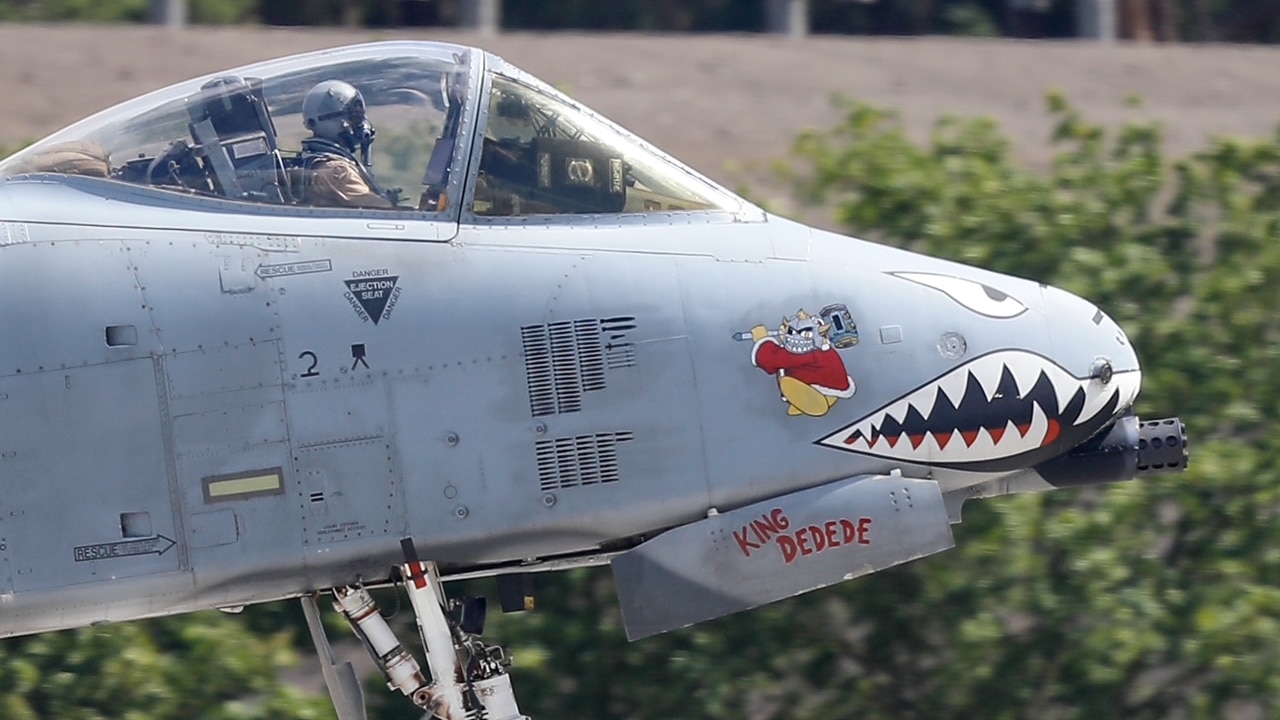
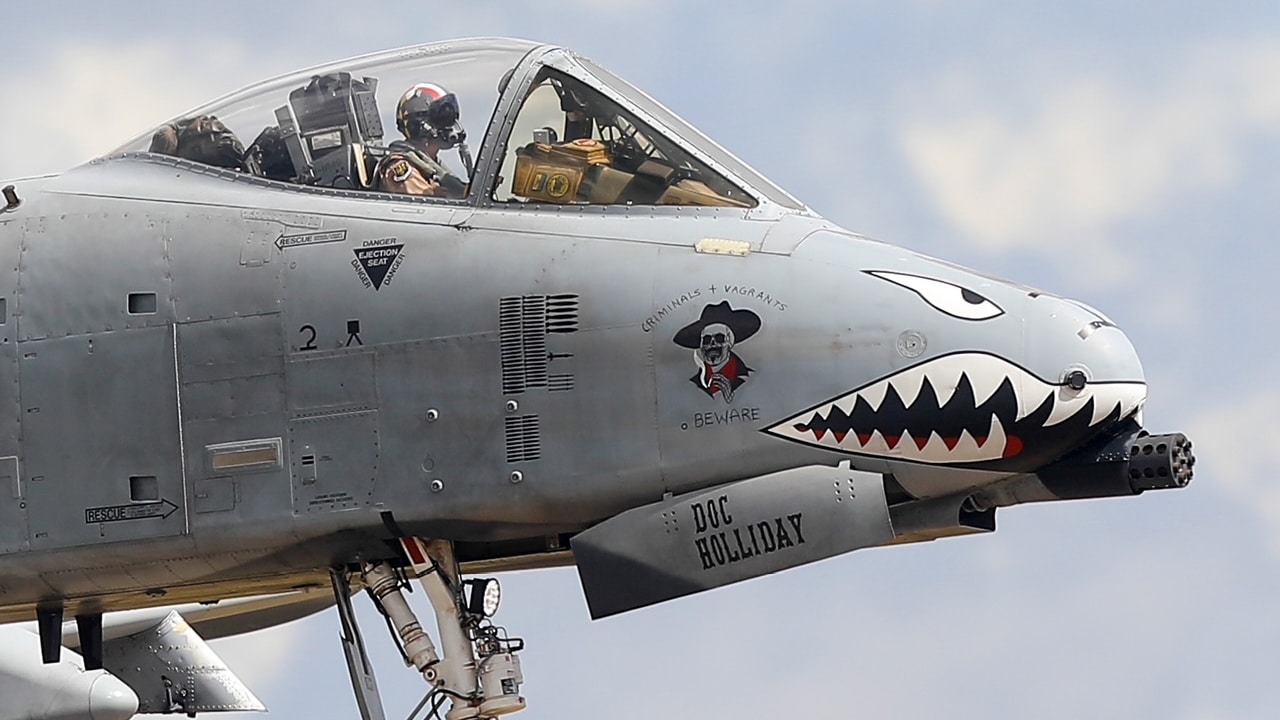
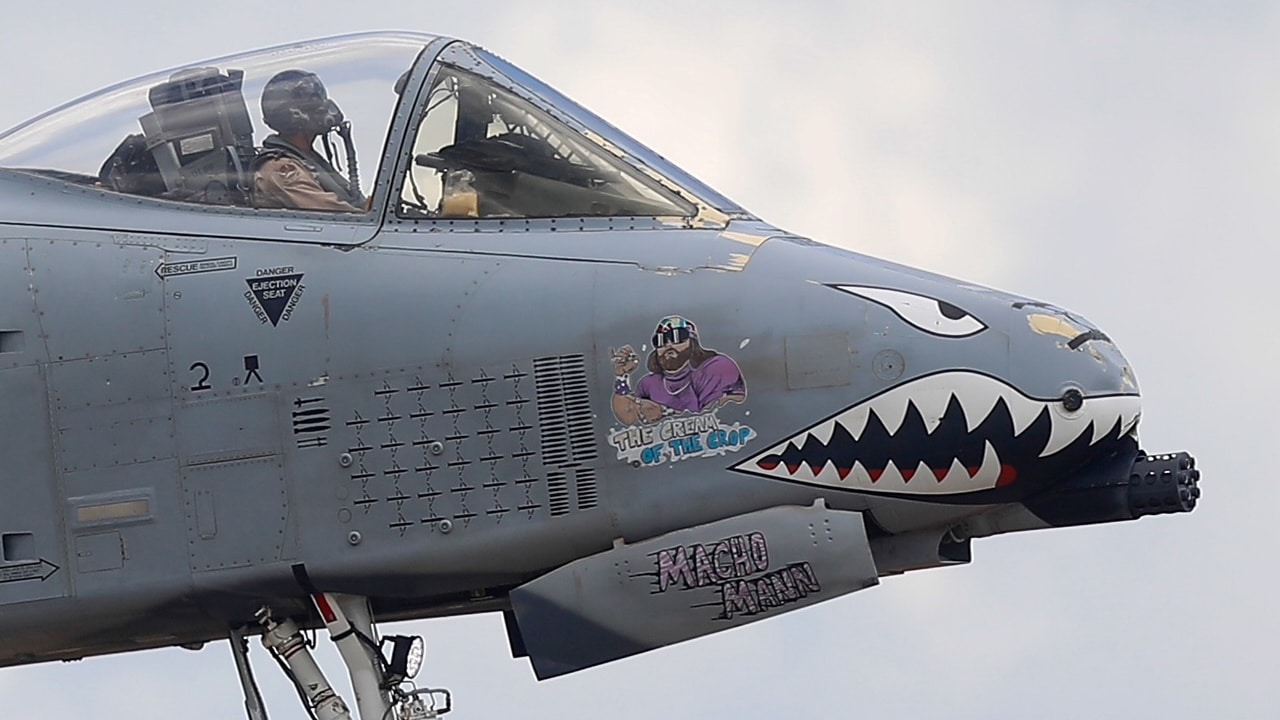
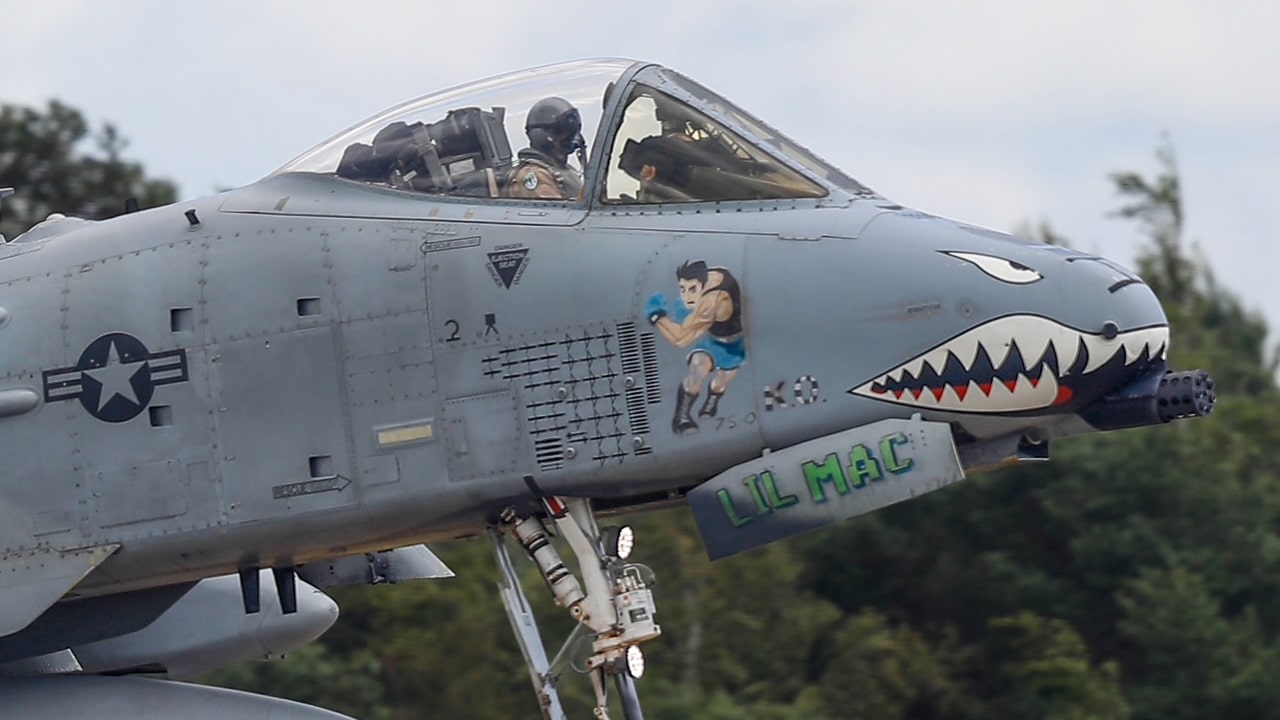
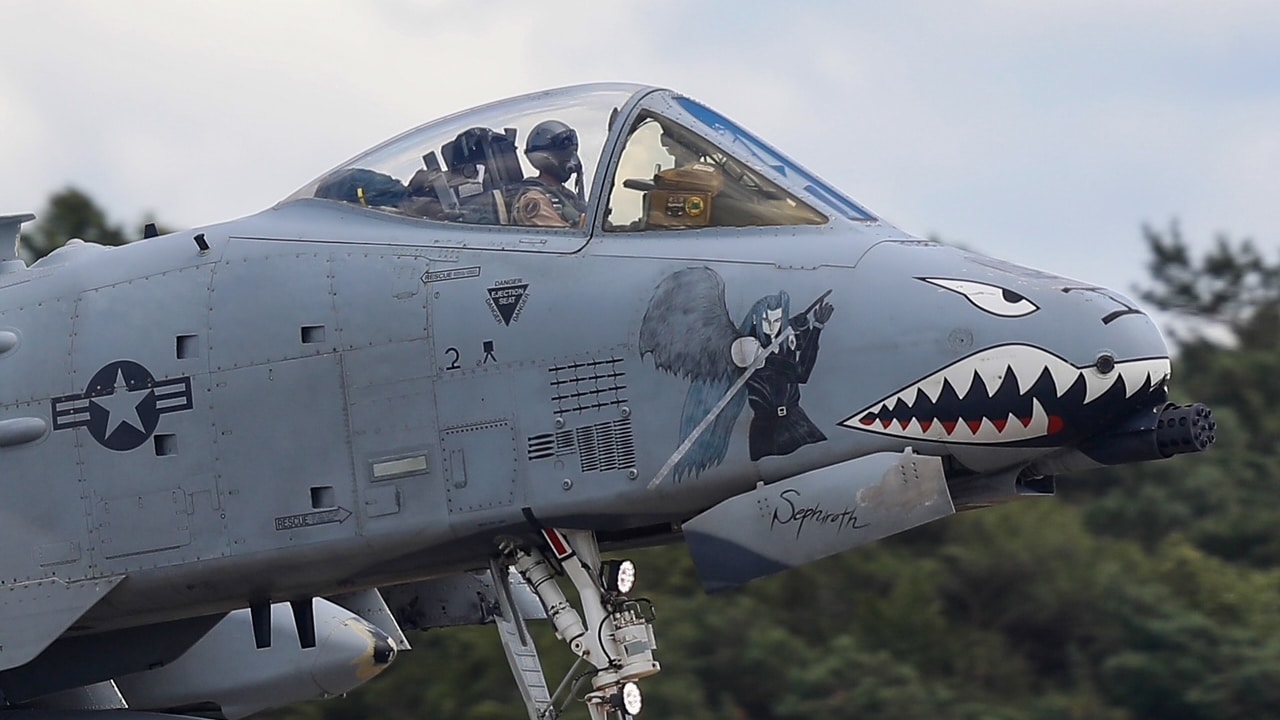
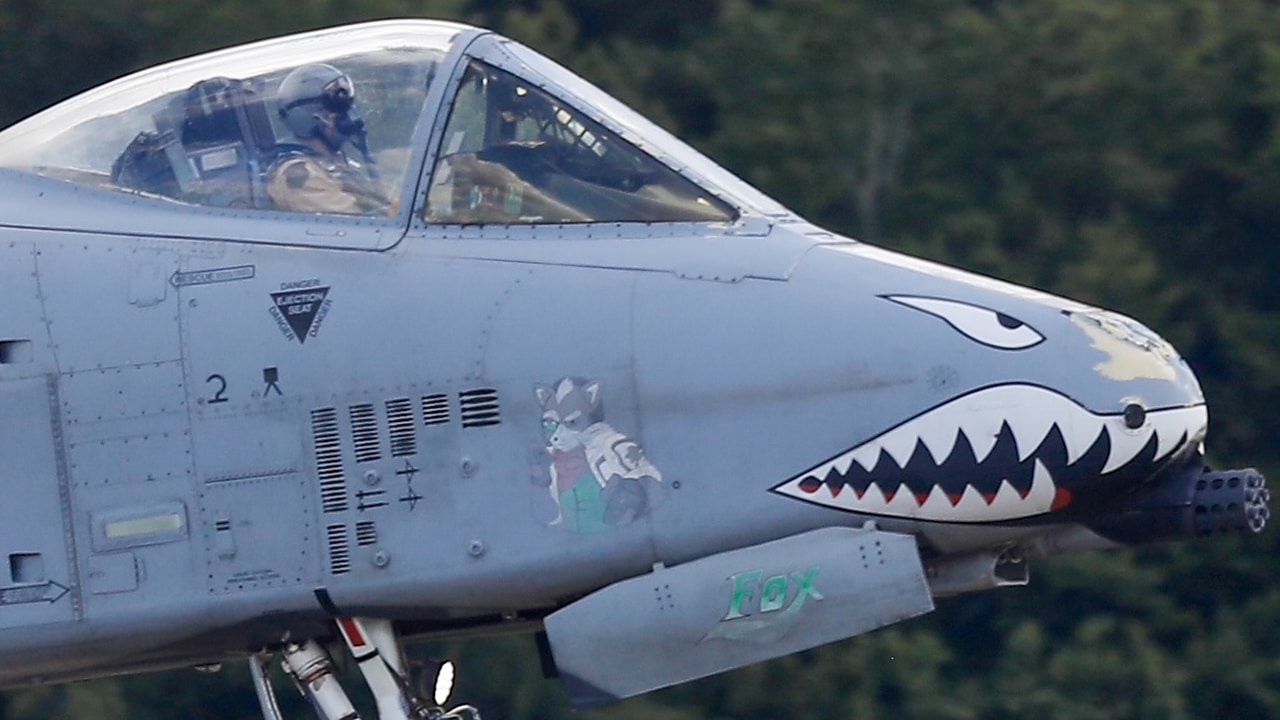
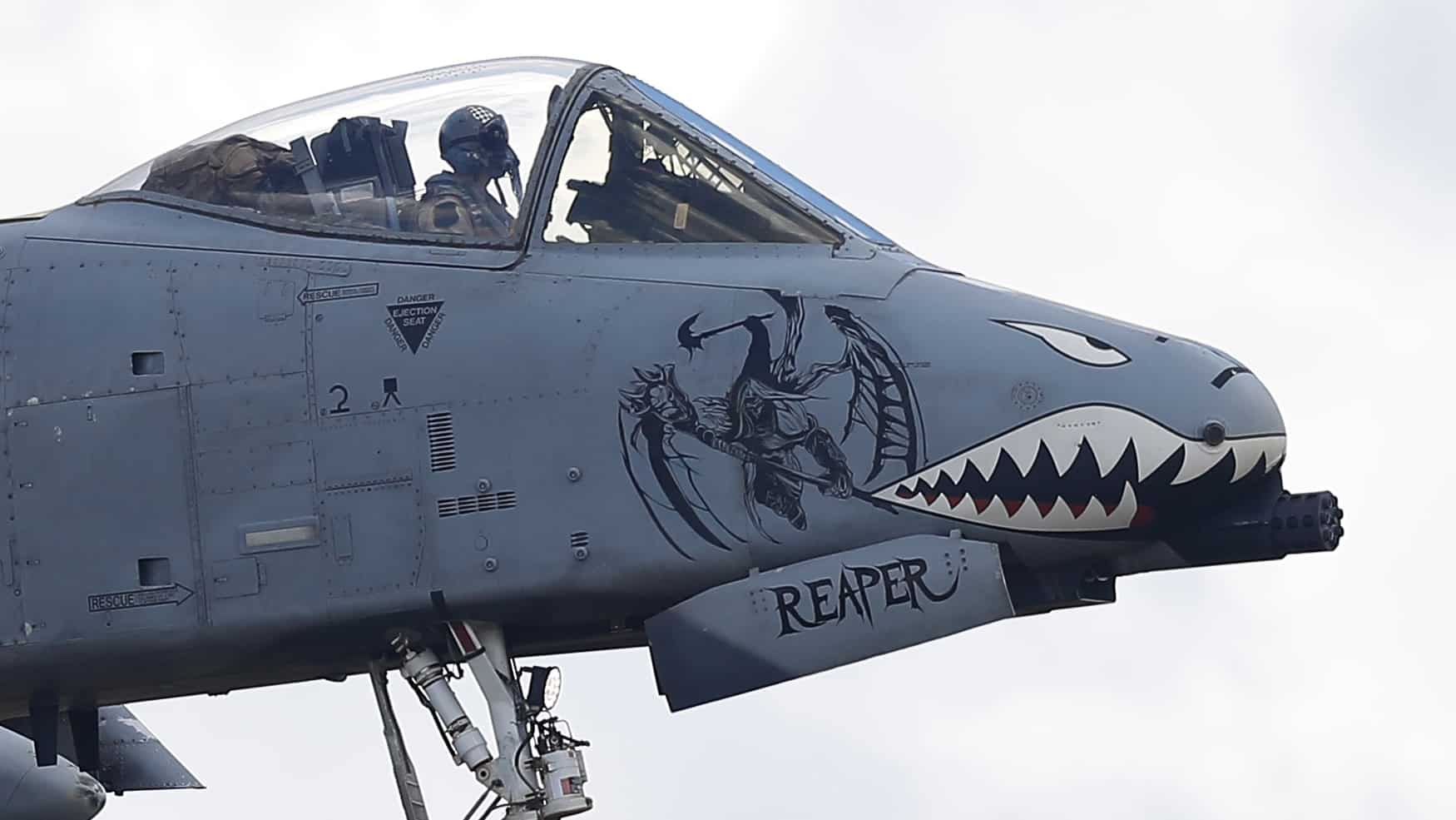
One notable missing A-10C is the one nicknamed “Toad” (#78-0614), that was depicted in the official Operation Epic Fury imagery in March. Its fate is currently unknown so we can’t rule out it is the Thunderbolt II aircraft lost during the air war in Iran..
A-10C “Toad” (Image credit: USAF) | Source: U.S. Air Force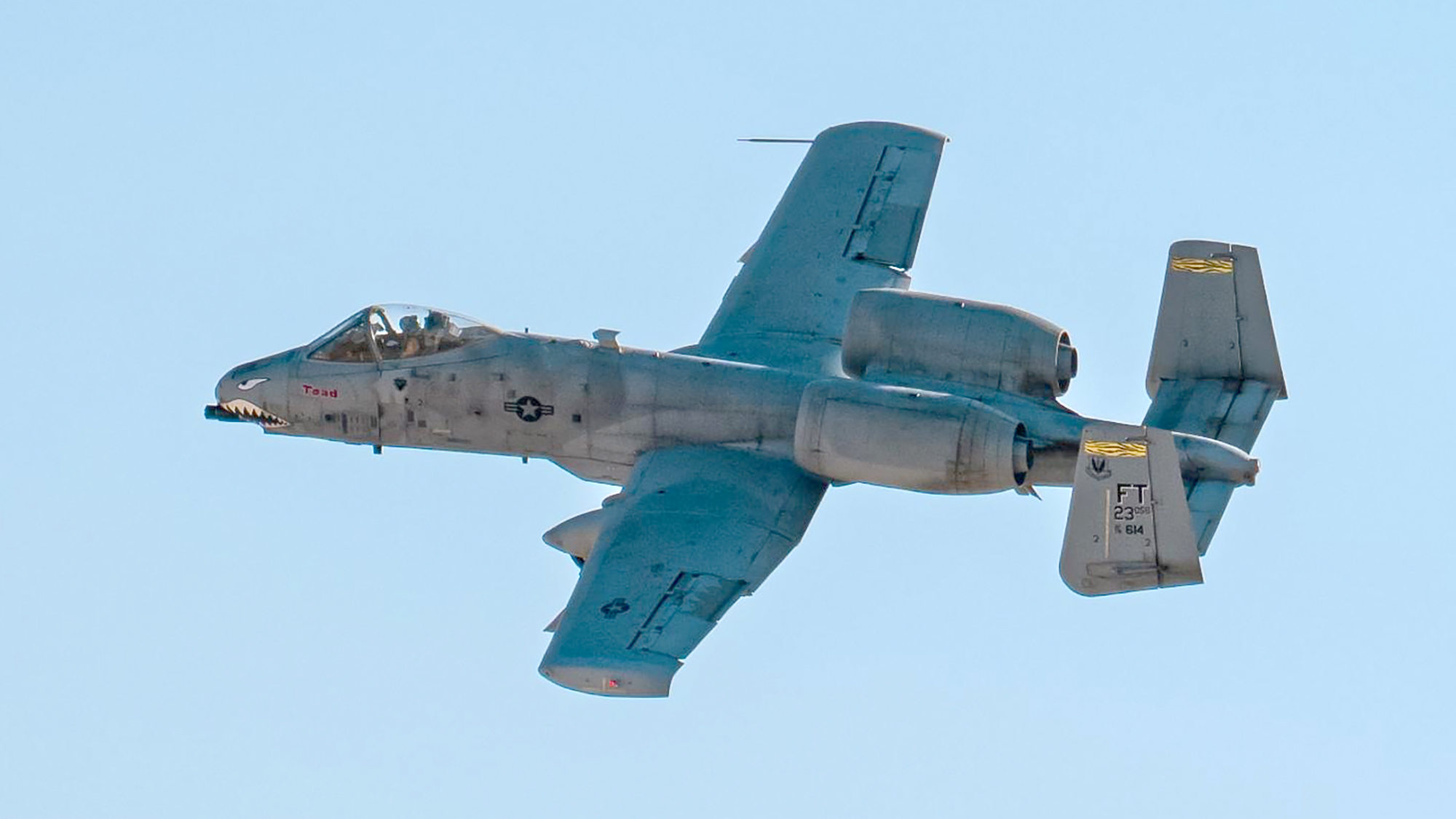
The bomb silhouettes offer a glimpse at the wide variety of weapons the A-10s expended in theater. Although some markings are not completely identifiable, overall, the aircraft show what appear to be 2,000-lb GBU-31(V)1/B bombs, mid-sized GBU-38/54 JDAMs (Joint Direct Attack Munitions) or Laser-JDAMs, AGM-65 Maverick air-to-surface guided missiles, Advanced Precision Kill Weapon System II (APKWS II) guidance kit-equipped Hydra 70 rockets, along with plenty of 30-mm rounds fired by the A-10’s trademark GAU-8 Avenger hydraulically driven seven-barrel Gatling-type gun.
Diddy Kong with several SDBs and MALD markings | Source: Stewart Jack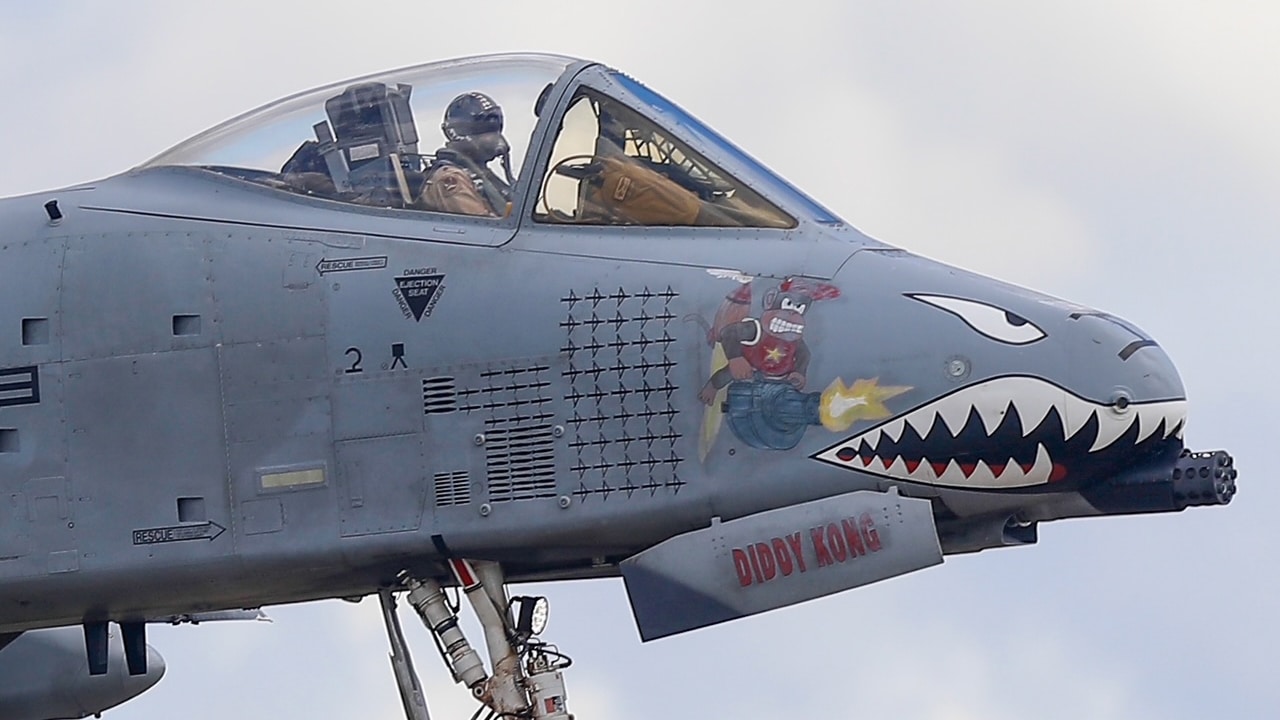
Interestingly, there are several marking that appear to depict MALDs (Miniature Air Launched Decoys). “MALDs are designed to mimic other aircraft, making them invaluable assets in diverting enemy fire away from pilots,” says Moody AFB website in an article dating back to 2024, when training with MALDs was being incorporated. “When MALDs are fired they deceive defense systems and enemy cruise missiles giving the illusion the decoy is an aircraft. MALDs can mimic the signal of various aircraft such as F-16s, B-52s, and F-35s”
U.S. Air Force Airman 1st Class Kyler Stenke, 74th Fighter Generation Squadron load crew member, tightens bolts to secure a Miniature Air-Launched Decoy onto an A-10C Thunderbolt II at Moody Air Force Base, Georgia, Feb. 14, 2024. (U.S. Air Force photo by Airman 1st Class Sir Wyrick) | Source: U.S. Air Force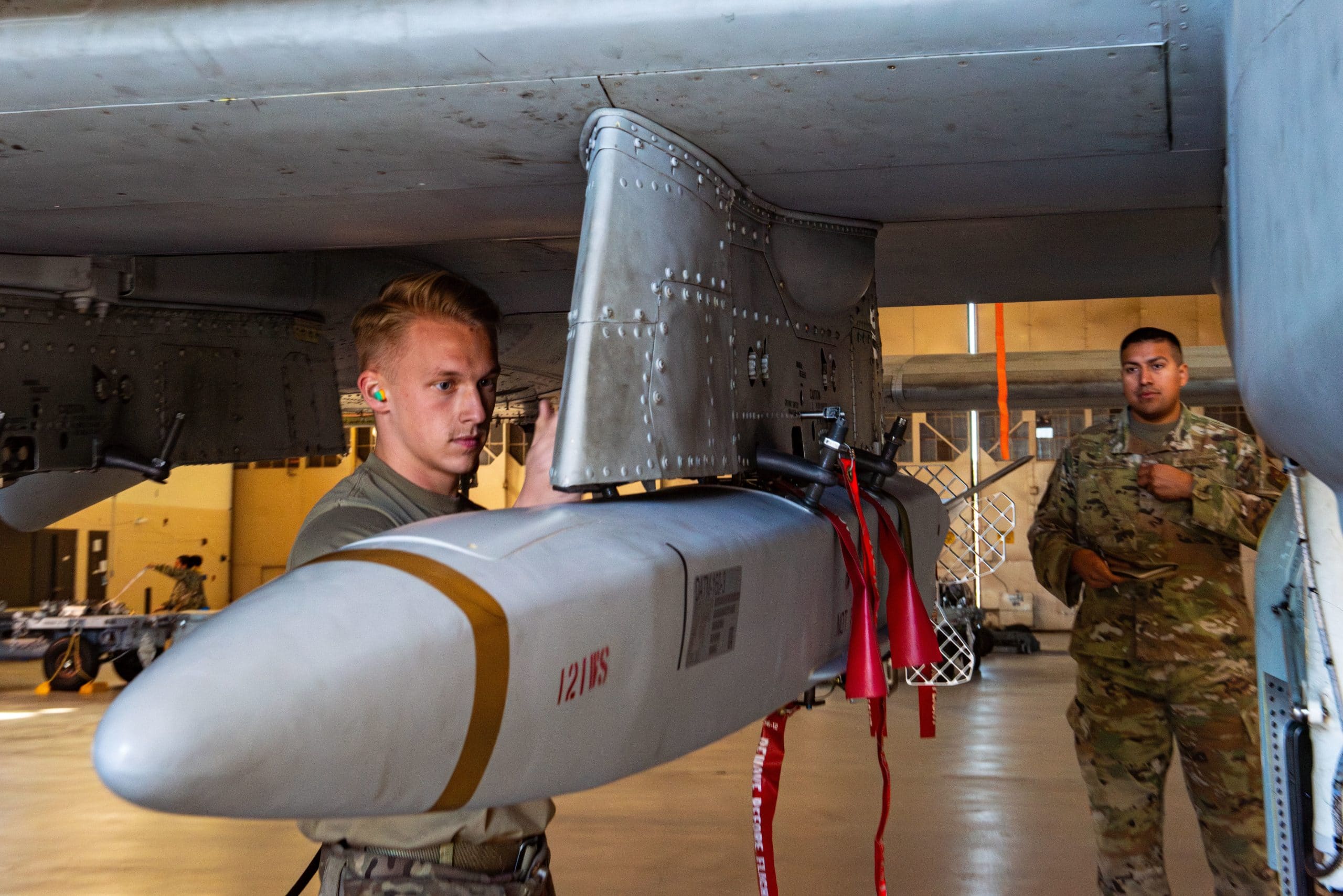
But, probably, the most interesting things are the two kills markings of two Iranian vessels sported by “Samus”. In fact, along with the traditional CAS (Close Air Support) role, the A-10s have flown the maritime strike mission in support of Operation Epic Fury.
Samus | Source: Stewart Jack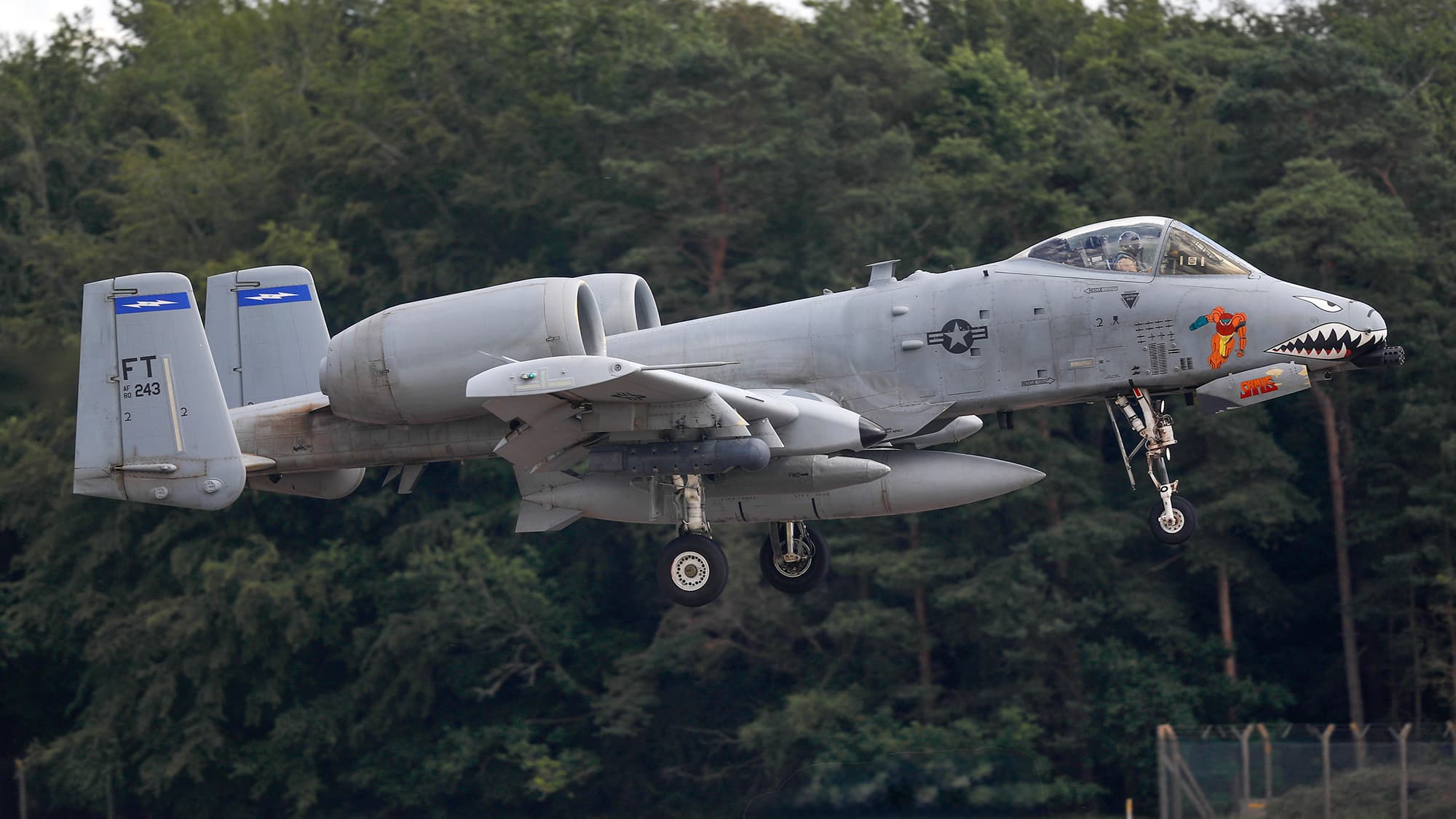
This is an excerpt of what we wrote in a previous story that you can find here.
The shift to the maritime domain, whether from Jordan or another forward operating base in the region, makes a lot of sense, considering the type has regularly taken part in U.S. submarine escort and live-fire exercises in recent years. Moreover, the U.S. Air Force had released images of its A-10s deployed to the region escorting U.S. warships in the 5th Fleet Area of Operations last month.
In 2024, we reported about Warthogs practicing overwatch of a U.S. nuclear submarine during one of the most vulnerable phases of its navigation through the Strait of San Juan de Fuca, on the Pacific Northwest coast, between the state of Washington and Vancouver Island, British Columbia, Canada.
Few months later, a formation of six A-10Cs, assigned to Moody Air Force Base, escorted an Ohio-class ballistic missile submarine, the USS Wyoming (SSBN 742). The aircraft, were also involved in a live fire exercise with their GAU-8 30 mm gun and 70 mm rockets.
Born as a pure Close Air Support and anti-tank platform, the A-10 has rarely been employed in the maritime domain until roughly 15 years ago. In 2011, during Operation Unified Protector, when an A-10 and a P-3C Orion engaged together a patrol boat and several small attack craft in the port of Misrata, Libya.
More recently, following the renewed attention towards these types of asymmetric threats caused by the attacks in the Red Sea or the skirmishes between the Ukrainian USVs (Unmanned Surface Vehicles) and the Russian Navy in the Black Sea, the type has been used to target swarms of boats and strike small vessels in several training scenarios.
In the 2020s, the Warthog took part in multiple Maritime Surface Warfare exercises and conducted unit defense training. One of the exercises saw, in Sept. 2023, two A-10s engage simulated surface threats in the Gulf of Oman with the Arleigh Burke-class guided-missile destroyer USS Stethem.
High Value Targets, like U.S. warships and civilian ships and tankers could be attacked and overwhelmed by coordinated swarms of USVs, challenging the traditional naval defense strategies. The A-10’s maneuverability at low airspeeds and altitude, flexible armament, highly accurate weapons-delivery capabilities, and extended loiter time are all key attributes that make it highly effective at against fast naval targets in the Persian Gulf and beyond.
Another interesting marking is the F-15E tail with the text “So others may live” painted on “Ridley,” that might suggest the aircraft was involved in the recovery operation of DUDE 44, the Strike Eagle shot down over Iran.
Ridley | Source: Stewart Jack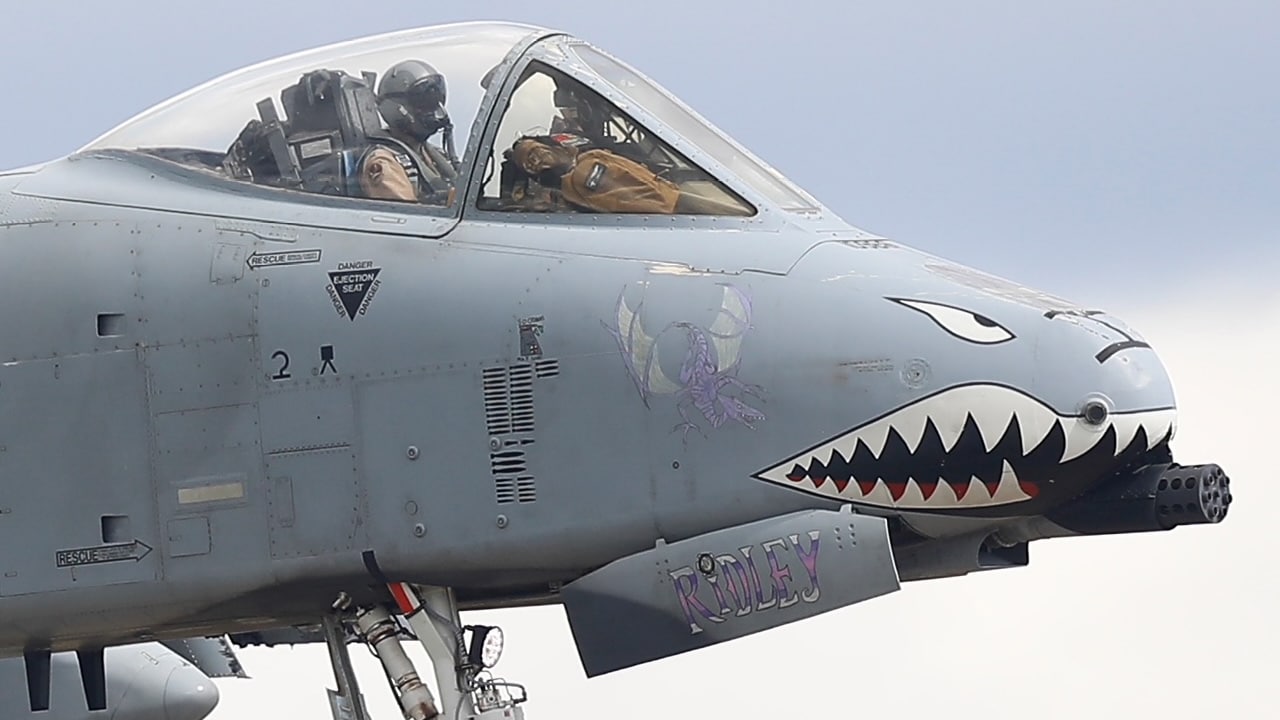
Another marking that might be worth investigating is the one sported by “Kirby”: a pickup truck, possibly a “technical,” with an explosion or mushroom cloud rising from it….
Kirby | Source: Stewart Jack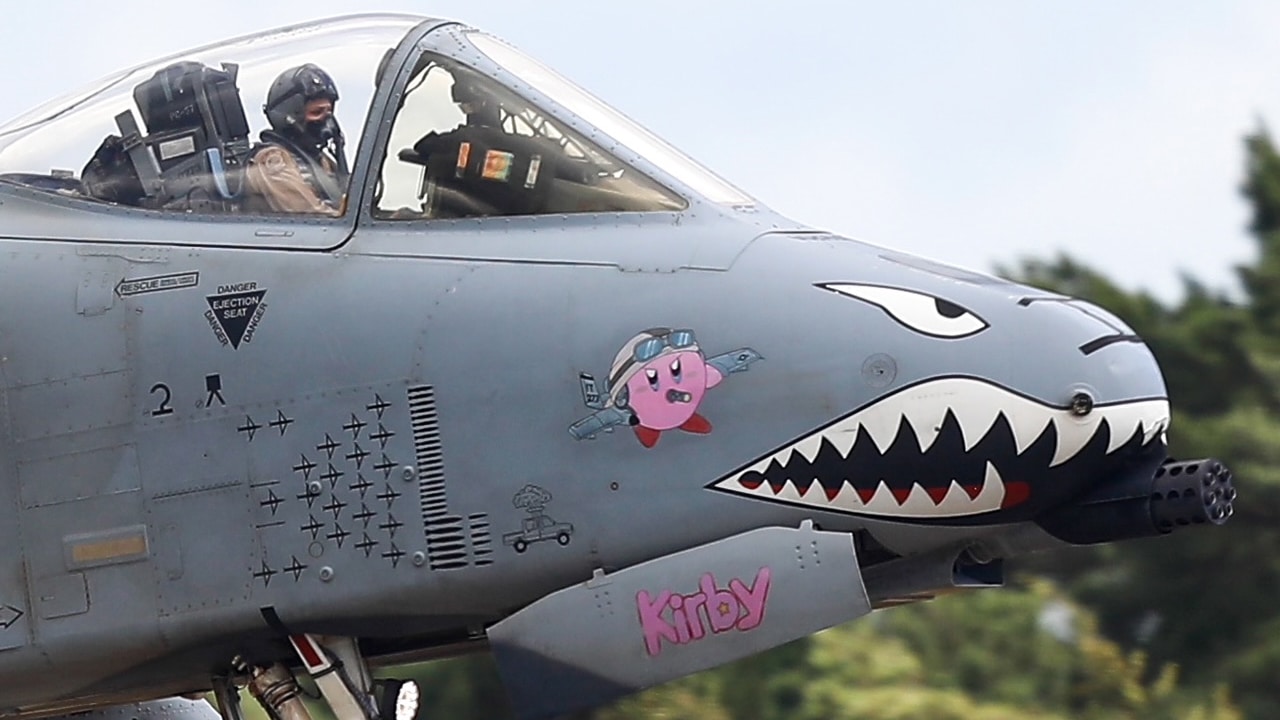
Categories: Defence`s Feeds, Europäische Union
Boeing Will Not Bid For U.S. Navy’s New Trainer Jet
Boeing determined the T-7A does not meet the U.S. Navy’s Undergraduate Jet Training System requirements and thus decided to not bid for the T-45’s replacement.
In a surprise move, Boeing has decided to not take part in the competition that will select the successor of the T-45 Goshawk. The company said in a short statement on June 12, 2026, that its T-7 Red Hawk does not meet the requirements of Undergraduate Jet Training System (UJTS), leading to the decision.
Here is the full statement:
“Boeing is focused on meeting our commitments, and we bid for programs where we believe we can provide the right solution tailored to our customers’ needs and requirements. After careful evaluation, we have determined the T-7A does not meet the U.S. Navy’s Undergraduate Jet Training System requirements. We have therefore informed the Navy that we will not bid on the current RFP. We remain committed to delivering the T-7A as a modern, growth-oriented training solution for 4th, 5th and 6th generation pilots as requirements evolve. We look forward to providing and sustaining both current and future capabilities for the Navy.”
The company did not disclose which requirements were not met. However, Aviation Week and Breaking Defense reported that, according to a company spokesperson, the T-7’s F404 engine would need long-cycle development to meet UJTS engine qualification requirements, which would hamper Boeing’s ability to quickly reach initial operational capability.
It should be noted that the Navy knows well that engine, as it is the same that powers the F/A-18 Hornet and served as the base for the F414 engine that powers the F/A-18E/F Super Hornet. Boeing is now the second company to leave the UJTS competition.
A T-45C Goshawk training aircraft from Training Squadron (VT) 9 performs a touch-and-go on the flight deck of the Nimitz-class aircraft carrier USS Dwight D. Eisenhower (CVN 69) (IKE). | Source: U.S. Navy photo by Mass Communication Specialist Seaman Apprentice Theodore Morrison
In fact, in March 2026, Lockheed Martin notified the U.S. Navy the decision to not pursue the bid after it determined the TF-50N “would not be the best solution for this program due to the required level of U.S. content and other reasons.” Notably, the TF-50N uses the same F404 engine.
This now leaves only SNC and Beechcraft in the competition. SNC is offering its Freedom trainer with Northrop Grumman and General Atomics, while Beechcraft is offering the M-346 through a partnership of parent company Textron Aviation Defense and Leonardo.
SNC’s proposal is described as a clean-sheet design also able to conduct carrier operations, although it is still on the drawing board. On the other hand, the M-346N is a variant of the M-346 trainer that has been flying operationally since 2015 for over 100,000 flight hours.
The Navy released the long-waited Request for Proposal (RFP) in March 2026. The RFP confirmed once again that the service does not plan for the new trainer jet to land on aircraft carriers or to conduct Field Carrier Landing Practice (FCLP) to touch down.
The T-7A Red Hawk lands for the first time at Joint Base San Antonio-Randolph, Texas, Dec. 5, 2025. | Source: U.S. Air Force photo by Benjamin Faske
Later on, in May 2026, the Navy raised the cost ceiling for the Engineering and Manufacturing Development phase by about $1 billion. The decision was based on feedback received after the release of the RFP, according to statements.
The RFPThe U.S. Navy has released on Mar. 26, 2026, the final Request for Proposals (RFP) for the Undergraduate Jet Training System (UJTS) program, which will replace the aging T-45 Goshawk trainer fielded in 1991. The service is looking to acquire a new aircraft on an “accelerated procured timeline” as it keeps facing problems with the T-45.
The RFP covers the Engineering, Manufacturing, and Development (EMD) phase, as well as the procurement of the first lot of Low-Rate Initial Production (LRIP) aircraft, Ground-Based Training Systems (GBTS) and Interim Contractor Logistic Services (I-CLS). The contract’s award is expected in March 2027.
An estimated fielding schedule attached to the RFP confirms that the service intends to procure 216 aircraft, with the first lot of seven LRIP aircraft to be delivered in 2032. The production would then increase to 12 aircraft in 2023 and 20 in 2034, before a full-rate production of 25 aircraft per year from 2035.
The M-346N on the ground at the Beech Factory Airport in Wichita, Kansas. | Source: Textron Aviation Defense/Greg L. Davis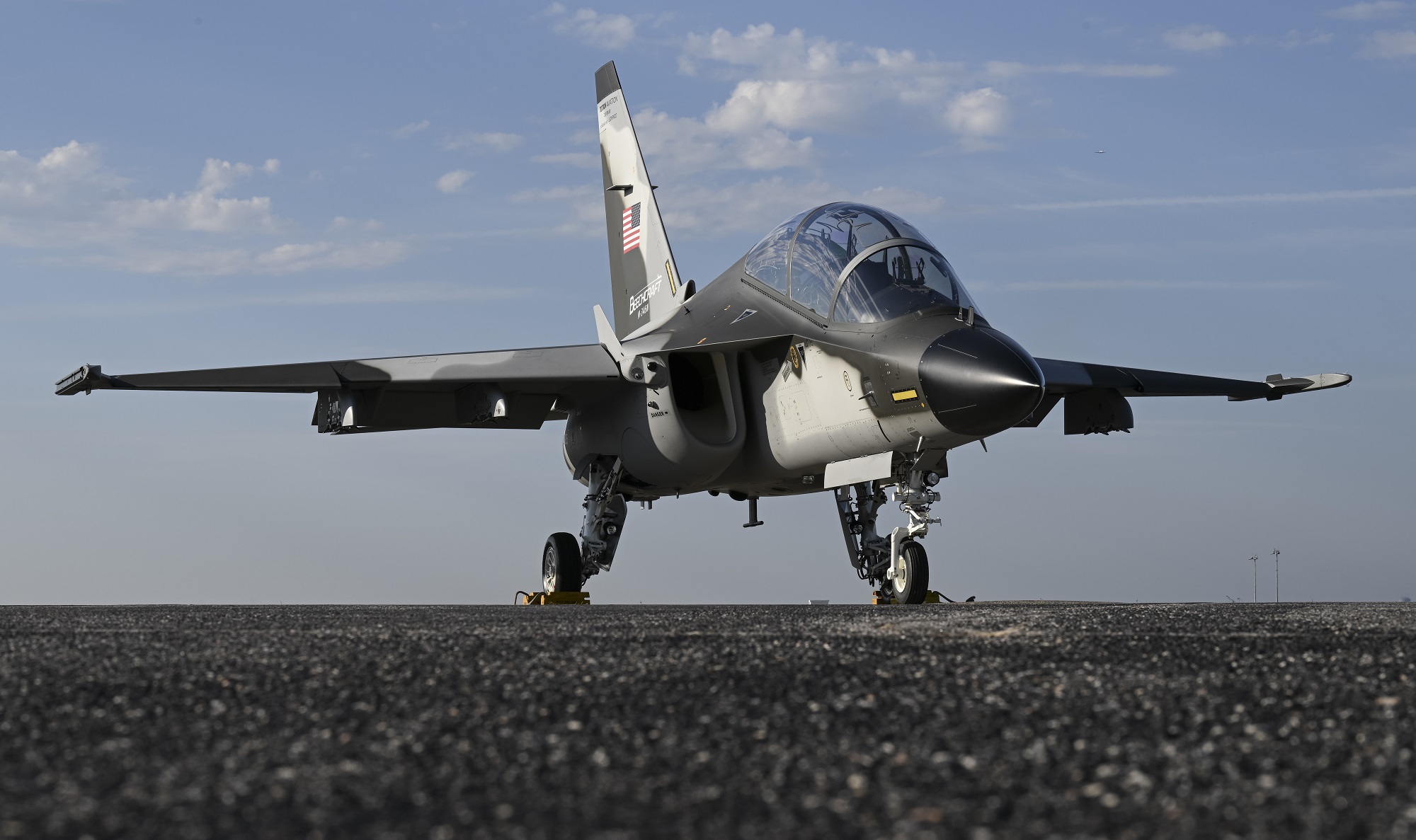
These aircraft will be divided among three locations, with Naval Air Station (NAS) Meridian, Mississippi, receiving 95 aircraft starting in 2033, NAS Kingsville, Texas, receiving 95 aircraft from 2039, and the remaining 26 aircraft going to NAS Pensacola, Florida, from 2042.
The cost will be also an important part of the selection process. Key parameters in the cost evaluation will consider if the price is reasonable and realistic, said the service.
The new aircraft will notably be used in a much different way compared to the T-45, which has been used to train future naval aviators to land on aircraft carriers. In fact, the Navy said “the UJTS air vehicle will only be required to conduct Field Carrier Landing Practice (FCLP) to wave off.”
As we previously reported, a good portion of the training command’s syllabus is centered around the FCLP, which allows new pilots to train on land bases for the entire approach and landing maneuver as performed on the aircraft carrier, just short of the arrested landing. With the new requirement, future student pilots will only perform the approach phase of the current FCLP, going around once reached the minimums, without touching down on the runway.
The Freedom trainer jet proposed for the U.S. Navy’s UJTS program. | Source: SNC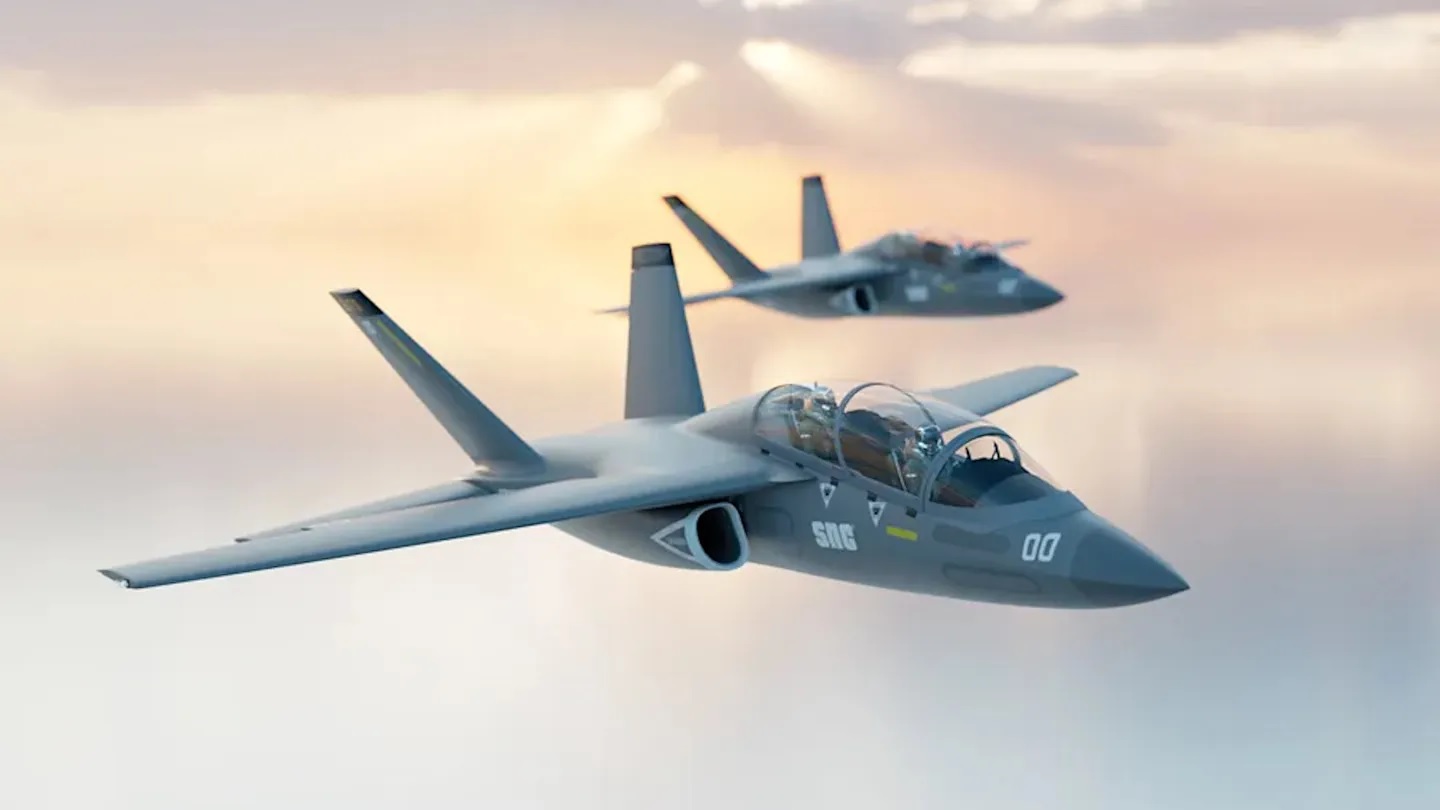
The Navy says that this decision, which sets a completely different route compared to the T-45 Goshawk and, previously, the T-2 Buckeye, is “due to advancements in operational platform landing modes and in ground-based simulation.” This means the new naval aviators will rely more on automation and perform complete FCLPs only in the flight simulator.
This has sparked controversy, as the service is now planning to move this part of the training to the Field Replacement Squadrons (FRS), where the newly appointed naval aviators transition to their assigned aircraft. That would seem counterproductive as FRSs fly much more expensive aircraft, thus increasing the cost of training.
However, this choice has also reflections on the timeline. In fact, removing the FCLP portion of the training program from UJTS allows a much quicker fielding of the new aircraft, which could now be also an already operational type.
Thus, the new trainer aircraft will not require complex and lengthy structural modifications to be adapted to the new role. Normally, an aircraft that has to trap on the carrier and launch from a catapult, or at least conduct FCLPs, has to be designed from the ground up on that premise because the structural design needs to account for very significant stresses during carrier operations.
Categories: Defence`s Feeds, Europäische Union
Pages



© 2012-2018 Europa Varietas Foundation © 2015-2018 Europa Varietas Association
www.europavarietas.org | info(@)europavarietas(dot)org | Switzerland




We are looking for sponsors for the English translation of these books, please contact turkeandras(at)gmail(dot)com