
Vous êtes ici
ELIAMEP


Iran and the United States are once again at the center of global security. Is this just another crisis, or is it the beginning of a new geopolitical era in the Middle East? – ELIAMEP experts’ views
ELIAMEP’s analysts assess the latest developments and examine possible scenarios for the future of Iran–US relations, as well as their implications for the Middle East and international security.
Read it here (in Greek).
Catégories: Diplomacy & Defense Think Tank News, Nyugat-Balkán
Digital Authoritarianism in Turkey: The Erosion of Press Freedom and the Weaponization of Technology
The following paper was awarded first prize in the policy paper competition organized by ELIAMEP’s Turkey Programme, focusing on Turkey’s domestic developments, foreign relations, and socio-political dynamics.
The policy paper examines the systematic erosion of press freedom and digital rights in Turkey, focusing particularly on events following the arrest of Istanbul Metropolitan Mayor Ekrem İmamoğlu on March 19, 2025. The Saraçhane protests that erupted in response revealed the full dimensions of the Turkish government’s digital censorship apparatus: bandwidth throttling, mass social media account suspensions, and the systematic suppression of citizen journalism. Through an analysis of recent policy developments, legal frameworks, and the relationship between the Erdoğan regime and Big Tech companies, this report documents how authoritarian governments leverage digital platforms to silence dissent.
The analysis shows that with 90% of traditional media under state control, journalists have migrated to YouTube and social media platforms only to face expensive licensing requirements, threats of arrest, and platform-level censorship. The report argues that İmamoğlu’s case represents a dangerous precedent: his social media accounts remain suspended, despite his legal case maintaining the presumption of innocence, which effectively prevents him from campaigning as a presidential candidate. This systematic destruction of information infrastructure has implications not only for Turkey, but for democratic movements worldwide.
Read here in pdf the Policy paper by Ezgi Daryurek, Master’s Program in Media and Migration Flows, National and Kapodistrian University of Athens.
Catégories: Diplomacy & Defense Think Tank News
Can There Be a “European NATO”? An Assessment of the Ankara Summit – ELIAMEP experts’ views
Sorry, this entry is only available in Greek.
Catégories: Diplomacy & Defense Think Tank News, Europäische Union
Influence without Power: Rethinking Greek-African relations
This policy brief argues that Greece should rethink its engagement with Sub-Saharan Africa through selective partnerships, education, religion, diaspora networks and civil society. Instead of competing financially with larger powers, Greece can generate long-term influence by concentrating resources where it has comparative advantages. A policy aligned with EU priorities that will focus on practical, low-cost initiatives can produce significant diplomatic dividends.
Read here in pdf the Policy brief by Asterios Huliaras, Professor in the Department of Political Science and International Relations, University of the Peloponnese and member of ELIAMEP’s Advisory Committee.
IntroductionAfrica[1] is emerging as one of the most strategically important regions of the twenty-first century. Despite armed conflicts, democratic backsliding, debt crises, and persistent poverty, the continent is characterized by rapid demographic growth, increasing urbanization, expanding markets, and rising geopolitical significance. Global actors such as China, Russia, Turkey, India, the United Arab Emirates, and Brazil have significantly expanded their political and economic engagement with African countries. Greece, by contrast, has traditionally maintained weak and fragmented relations with Sub-Saharan Africa. However, recent European developments, particularly the European Union’s Global Gateway strategy and the African Continental Free Trade Area agreement (AfCFTA), create an opportunity for a strategic rethinking of Greek policy.
The challenge for Greece is not whether it should engage with Africa, but how it can do so with limited diplomatic, financial, and administrative resources. Rather than attempting to imitate larger powers, Greece should adopt a selective strategy emphasizing concentrated partnerships, network diplomacy, educational links, and societal actors.
The Policy ChallengeThe starting point of Greek engagement with Africa is structurally weak. Although geographically close to the continent, Greece maintains only eight embassies across forty-nine countries of Sub-Saharan Africa serving a population of approximately 1.2 billion people (in comparison, Turkey maintains thirty-two embassies in the region). Furthermore, only the Greek embassy in South Africa has a commercial attaché, while official high-level political visits have been extremely rare (an exception was Foreign Minister Nikos Dendias official visits to several Sub-Saharan African countries, looking mainly for support for Greece’s candidature for the UN Security Council). No Greek Prime Minister has visited a Sub-Saharan African country during the last three decades. Greek exports to Africa represent only approximately 0.3 percent of total exports, while investment remains minimal.
The weakness of institutional engagement contrasts sharply with the continent’s growing significance. Africa currently hosts some of the fastest-growing economies in the world and the African Continental Free Trade Area aims to create a market of approximately 1.5 billion consumers. In addition, under the European Union’s Global Gateway initiative, €150 billion out of the overall €300 billion package are directed toward Africa.
At the same time, Greece possesses assets that remain largely underutilized.
Existing Greek Assets and Untapped OpportunitiesThe Orthodox Church represents one of Greece’s most important but often neglected channels of influence in Africa. The Patriarchate of Alexandria maintains bishoprics in twelve African countries with an estimated flock of approximately 1.2 million faithful. Historically, religious diplomacy has often operated as an informal channel for strengthening relations and promoting social initiatives in education, health, and community development.
The Church could therefore function as an instrument of soft power by supporting educational programmes, scholarships, local partnerships, and social services. For example, cooperation between Greek universities and schools connected to the Patriarchate of Alexandria could create educational networks extending from Egypt and Kenya to countries of Central and Southern Africa. Such initiatives would be relatively inexpensive while generating long-term influence. However, the Russian Orthodox Church has increasingly attempted to expand its presence in Africa, potentially weakening the historical position of the Patriarchate of Alexandria (numerous African Greek Orthodox priests have joined the Russian Church in recent years). Consequently, supporting the activities of the Patriarchate also acquires broader geopolitical significance, especially in the current context.
Diaspora communities constitute another important but largely underexploited resource. Although the Greek diaspora in Africa has declined dramatically—from approximately 150,000 individuals in 1960s to only a few tens of thousands today—it still provides networks and contacts across various sectors. At the same time, the African diaspora in Greece, including entrepreneurs, artists, athletes, and community organizations, has become more influential and can function as an important bridge.
Civil society organizations have already demonstrated the potential of such engagement. Organizations including the Greek-African Chamber of Commerce, several consultancies, but also NGOs like Doctors Without Borders–Greece, Lalibella, YouthmakersHub, and ELIX already undertake projects across African countries, often financed through European and private resources. University initiatives such as the AfriquEurope programme of the University of the Peloponnese illustrate that society has often moved ahead of the state and ELIAMEP’s agreement with Pretoria University.
Policy RecommendationsGiven its limited resources, Greece should avoid a continent-wide strategy and instead focus on one or two strategic partner countries that can function as anchor states. Kenya, for example, combines strong economic growth, regional influence, and importance in logistics and maritime activities. Ethiopia represents another possible case because of historical links and religious connections. Concentrating resources would allow Greece to build expertise and create visibility at manageable cost.
Second, Greece should strengthen educational and digital partnerships. Universities could expand English-language and French-language programmes specifically targeting African students. Visa procedures should also be simplified. It is inefficient for prospective African students to wait five or six months for visa appointments.
Third, Greece should establish a national volunteer programme inspired by international examples such as the Peace Corps in the US or similar programmes in Europe. Young Greeks could participate in educational, environmental, or healthcare projects in African countries. Such a programme could seek financial support from the Greek Public Employment Service (DYPA) and the EU, create networks and simultaneously improve Greece’s currently limited development profile.
Moreover, Greece should create a digital platform on Greek–African relations that could serve as an innovative mechanism for strengthening coordination, visibility, and interaction among the multiple actors involved in the relationship. The platform could function as a shared digital ecosystem bringing together public institutions, private enterprises, civil society organizations, academic institutions, diaspora networks, and cultural actors from Greece and African countries. It could include databases of ongoing initiatives and partnerships, funding opportunities, business and educational collaborations, cultural exchanges, and development projects, while also providing interactive tools such as discussion forums, thematic working groups, and networking spaces. Beyond its informational role, such a platform could facilitate dialogue and the co-production of ideas, reduce fragmentation among existing initiatives, and create synergies between actors who currently operate in isolation. In this way, it could strengthen relational ties and transform dispersed activities into a more coherent framework of engagement, enhancing Greece’s visibility and influence through networking, participation, and sustained interaction rather than through traditional forms of state power.
Finally, Greece should adopt a broader understanding of migration and mobility by creating more legal pathways for seasonal workers in agriculture, construction, and care services. Bilateral agreements with countries such as Ethiopia could address labour shortages while strengthening long-term partnerships.
ConclusionGreece cannot compete with larger powers in Africa through financial resources or extensive diplomatic infrastructures. However, it can develop influence through networks, education, religion, and societal links. Rather than perceiving Africa as a distant periphery, Greece should view the continent as an emerging strategic space where modest but carefully designed interventions can generate substantial diplomatic dividends.
[1] In this paper, the term “Africa” refers specifically to Sub-Saharan Africa, unless otherwise indicated. North Africa is treated separately due to its distinct historical, political, economic, and socio-cultural dynamics.
Catégories: Diplomacy & Defense Think Tank News
A European NATO: Strategic Autonomy, Defence Union and the Future of Transatlantic Relations
Russia’s full-scale invasion of Ukraine in 2022 and the return of Donald Trump to the White House in 2025 have produced the most consequential geopolitical jolt to European security since the end of the Cold War. Three questions have since been raised. How much should Europeans rely on the United States for their own defence? What does it mean to build a ‘European NATO’? Can the EU develop credible autonomous defence structures without fracturing the transatlantic alliance? This policy brief aims to define the concept of a ‘European NATO’, showing that “limited” European strategic autonomy is achievable within 5-10 years; full-spectrum collective defence without the United States remains difficult. The most viable near-term path is a strengthened European pillar within NATO — not decoupling from it.
- Strategic shock: Russia’s 2022 invasion of Ukraine and Trump’s 2025 return to office jointly forced Europe to confront long-deferred questions about defence dependence on the US, prompting a surge in spending (€864 billion in 2025, up 14% in one year) even as US spending fell.
- US doctrine shift: Secretary Hegseth (Feb 2025) and Under Secretary Colby (Feb 2026) delivered the clearest official US statements yet that Europe must assume primary responsibility for its own conventional defence, with Colby’s “NATO 1.0/2.0/3.0” framework describing a return to burden-sharing realism while the US retains nuclear deterrence and select capabilities.
- Defining “European NATO”: Not a formal category but a shorthand for Europeanising command, capability, and decision-making within the Alliance — distinct from replacing NATO with an EU army. It represents “de-risking, not decoupling.”
- Inside vs. alongside NATO: European allies can rebalance burden-sharing and command roles (e.g., SACEUR) within NATO, while the EU plays a complementary role through CSDP crisis missions, defence industrial policy (EDF, EDIS, EDIP, SAFE), and cyber/hybrid/space resilience.
- Post-Cold War drift: From 1991–2014 Europe cut forces sharply (Germany’s military nearly halved) chasing a “peace dividend”; repeated shocks (Yugoslavia, Iraq, Libya) failed to trigger sustained rearmament until 2022.
- Institutional track record: PESCO (2017), the Helsinki Headline Goal, and EU Battlegroups all show a pattern of ambitious commitments and underwhelming delivery, though the Rapid Deployment Capacity reached initial operational capability in 2025.
- Strategic autonomy defined: A spectrum from achievable near-term operational autonomy (crisis management) to a multi-decade goal of full-spectrum collective defence — with the “Trump paradox” being that a transactional US administration is simultaneously pushing Europe toward the autonomy it fears.
- EU Defence Union gaps: Juncker’s 2016 call for a Defence Union by 2025 remains unmet; PESCO, EDF, and EDIP show real but partial progress, blocked mainly by member states’ reluctance to pool sovereignty.
- Command and control debate: The MPCC is the EU’s only permanent military HQ but is small and limited to crisis management; expanding it toward a full EU “SHAPE-equivalent” is contested, with a moderately expanded MPCC seen as the realistic middle path.
- Five policy scenarios and recommendations: The report outlines pathways from a “Reinforced European Pillar” (most feasible, near-term) to a “Transatlantic Grand Bargain,” concluding that strengthening Europe’s role within NATO—not decoupling—is the most viable near-term route, alongside recommendations to consolidate procurement, expand the MPCC, and Europeanise command positions.
Read here in pdf the Policy Paper by Angelos Athanasopoulos, Geopolitics and Security Expert, Hellenic Foundation for European and Foreign Policy (ELIAMEP).
SummaryRussia’s full-scale invasion of Ukraine on 24 February 2022 and the return of Donald Trump to the White House in January 2025 have together produced the most consequential geopolitical jolt to European security since the end of the Cold War. The combination of a revisionist power at war on European soil and a transactional American administration openly questioning the unconditional nature of NATO’s Article 5 has finally forced Europe to confront questions it has deferred for three decades: How much should Europeans rely on the United States for their own defence? What does it mean to build a ‘European NATO’? And can the European Union develop credible autonomous defence structures without fracturing the transatlantic alliance?
This report aims to provide a comprehensive analysis of these questions. It defines the concept of a ‘European NATO’ — meaning the progressive Europeanisation of command, capability, and strategic decision-making within and alongside the Alliance — and distinguishes it from the more radical notion of replacing NATO with an EU defence organisation. It also probes the acute question of whether the EU needs its own independent command and control structure — and how far it has come toward that goal. Finally, it presents five differentiated policy scenarios with a comparative table.
The report’s central findings are as follows: European strategic autonomy is achievable in limited, operational domains within a timeframe of five to ten years; full-spectrum collective defence without the United States remains a multi-decade project at best. The most viable near-term path is a strengthened European pillar within NATO — not decoupling from it. The EU has made genuine but insufficient progress on command structures; the Military Planning and Conduct Capability (MPCC) requires significant expansion to serve as a credible autonomous headquarters. European defence spending has surged dramatically — reaching €864 billion in 2025 — but quantity does not automatically convert into usable military power without procurement consolidation, industrial integration, and political coherence. Above all, the report argues that Europe faces a structural, not cyclical, moment of strategic necessity.
Introduction: The New Strategic ContextRussia’s Return to Imperial War
Russia’s full-scale invasion of Ukraine shattered three decades of post-Cold War assumptions about the European security order. The invasion was not merely a regional conflict: it was a direct assault on the principles of sovereignty, territorial integrity, and the rules-based international system that Europe’s post-1945 order rested upon. For European NATO members, the invasion produced an immediate strategic shock. Defence spending, long stagnant across most of the Alliance, began to surge. Finland and Sweden abandoned their historic neutrality and joined NATO in 2023 and 2024 respectively, adding to the Alliance’s northern flank. The NATO Strategic Concept adopted at the Madrid Summit in June 2022 named Russia as ‘the most significant and direct threat to Allies’ security and to peace and stability in the Euro-Atlantic area’ — the clearest formulation of the Russian threat in Alliance history.
Beyond the immediate military reality, Russia’s war accelerated a broader reorientation of European strategic thinking. The invasion made tangible what analysts had argued for years: that European security could not be taken for granted, that the security dividend of the post-Cold War era had been spent, and that Europe would need to invest substantially in its own defence if it wished to maintain credible deterrence. The EU’s Strategic Compass, adopted in March 2022 just weeks after the invasion began, represented the most significant strategic document in EU defence history, committing member states to developing a Rapid Deployment Capacity (RDC) of up to 5,000 troops, expanding the MPCC, and deepening cooperation through Permanent Structured Cooperation (PESCO) and the European Defence Fund (EDF).
The Return of Donald Trump and the Transatlantic Rupture
If Russia’s invasion provided the external shock, the return of Donald Trump to the American presidency in January 2025 provided the internal one. Trump’s second administration moved rapidly to signal a strategic reorientation toward the Indo-Pacific, openly questioning the unconditional nature of America’s Article 5 commitment and demanding European allies spend up to 5% of GDP on defence. Secretary of Defence Pete Hegseth stated bluntly in February 2025 that ‘strategic realities prevent the US from taking primary responsibility for European conventional deterrence’ — a formulation without precedent in NATO’s history.[1]
The impact of this political earthquake on European capitals was immediate and profound. The Munich Security Conference of February 2025 was marked by open anxiety about American reliability. European leaders responded with a series of unprecedented commitments: the ReArm Europe plan, the Security Action for Europe (SAFE) instrument of €150 billion, activation of fiscal escape clauses for 15 EU member states, and the NATO Hague Summit of June 2025 establishing a binding 3.5% GDP defence spending target by 2035, plus 1,5% GDP for wider security-related expenditure. European defence spending — already on a sharp upward trajectory since 2022 — reached €864 billion in 2025, growing at 14% in a single year, the fastest rate of any region in the world, even as US defence spending declined by 7.5%.[2]
Yet spending increases, however dramatic, do not automatically translate into strategic capability. Europe still depends critically on the United States for intelligence, surveillance and reconnaissance (ISR), strategic airlift, air-to-air refuelling, ballistic missile defence, space-based assets, and above all nuclear deterrence. Filling these gaps — the so-called ‘strategic enablers’ — is the central challenge of European strategic autonomy and the defining question of this report.
The U.S. Policy Position: Secretary Hegseth and Under Secretary Colby
The strategic reorientation demanded of European NATO allies has been articulated with exceptional clarity and directness by two key figures in the Trump administration’s defence leadership: Secretary of War Pete Hegseth and Under Secretary of War for Policy Elbridge Colby. Their statements at successive NATO ministerial meetings — Hegseth in Brussels in February 2025 and Colby in Brussels in February 2026 — represent the most explicit official U.S. articulation of a new transatlantic burden – shifting doctrine since the Alliance’s founding. Taken together, they constitute a coherent and mutually reinforcing framework: Europe must assume primary responsibility for its own conventional defence, the era of American strategic subsidy is ending, and the Alliance’s future credibility depends on European willingness to match that rhetorical commitment with real military investment and capability. Press coverage of both interventions confirmed that their impact on European capitals was immediate and profound.
Secretary Hegseth at the NATO Ministerial, Brussels (February 2025)
Secretary Hegseth’s press conference following the February 2025 NATO Ministers of Defence Meeting in Brussels was the new administration’s opening statement on transatlantic burden-sharing. Hegseth was blunt: European leaders must take primary responsibility for the defence of the continent. He called not just for the 2% GDP target long established by NATO, but for spending of approximately 5% of GDP — a figure he described as reflecting the genuine strategic requirements of the moment: “2 percent is a start, as President Trump has said, but it’s not enough, nor is 3 percent, nor is 4 percent. More like 5 percent. Real investment. Real urgency.”[3]
Hegseth grounded his demand in a frank assessment of strategic reality, invoking the limits of hard power and the lessons of recent history: “We can talk all we want about values. Values are important. But you can’t shoot values. You can’t shoot flags and you can’t shoot strong speeches. There is no replacement for hard power.” He was equally direct about the historical precedent, invoking President Eisenhower’s warning that Europe risked making “a sucker out of Uncle Sam” and stating unequivocally: “President Trump will not allow anyone to turn Uncle Sam into Uncle Sucker.” This invocation of Eisenhower was historically and rhetorically significant: it framed the current U.S. demand not as a Trumpian aberration but as a structural concern that has defined the burden-sharing debate since the Alliance’s earliest years.[4]
On the question of European ownership, Hegseth was categorical: “Leaders of our European allies should take primary responsibility for defence of the continent, which means security ownership by all allies guided by a clear understanding of strategic realities.” This formulation — primary responsibility resting with European allies, not shared between Europe and the United States — was without precedent in the public statements of a sitting U.S. Secretary of Defence. Hegseth also tied defence industrial reform directly to the burden-shifting imperative, warning that the war in Ukraine had exposed Europe’s chronic underinvestment in production capacity, and demanding rapid expansion of the transatlantic defence industrial base on both sides of the Atlantic. He called on NATO to prioritise “reviving the transatlantic defence industrial base, rapidly fielding emerging technologies, prioritizing readiness and lethality, and establishing real deterrence.”
On the question of U.S. troop presence in Europe and the geographical rebalancing of American strategic attention toward the Indo-Pacific, Hegseth offered a forthright explanation of comparative strategic logic: “It makes a lot of sense, just in a commonsense way, to use our comparative advantages. European countries spending here in defence of this continent, in defence of allies here against an aggressor on this continent with ambitions.” He nonetheless denied that this represented abandonment: “We are committed to that NATO alliance. We understand the importance of that partnership, but it can’t endure on the status quo forever in light of the threats we face and fiscal realities. Europe has to spend more. NATO has to spend more.”[5]
Under Secretary Colby and the NATO 1.0 / 2.0 / 3.0 Framework (February 2026)
One year later, Under Secretary Colby’s address to the NATO Defence Ministerial on 12 February 2026 provided the most intellectually systematic and historically grounded articulation of the U.S. burden-shifting doctrine to date. Where Hegseth had emphasised political will and financial commitment, Colby offered a conceptual framework for understanding the Alliance’s trajectory through the categories of NATO 1.0, NATO 2.0, and NATO 3.0 — a framework that has since become a reference point in Alliance debates and academic commentary.[6]
NATO 1.0 refers, in Colby’s framework, to the Cold War Alliance in its original and most demanding form: a hard-nosed, realistic, clear-eyed approach to deterrence and defence in which all allies were expected to carry their weight from the outset. Colby traced this ethos to Article III of the Washington Treaty and the Lisbon Commitments of 1951, noting that burden-sharing debates were a constant feature of the Cold War relationship — under Johnson, Nixon, Carter, and Reagan — and that President Eisenhower himself, “one of the men most responsible for Allied victory in the Second World War and the first SACEUR,” was clear that NATO’s success depended on allies stepping up to lead their own defence. Colby explicitly credited this demanding model with the Alliance’s fundamental Cold War achievement: “It made sure that the USSR never saw military aggression against the Western Alliance as a viable strategy. It thus saw us through the Cold War with peace in Europe — an incredible achievement for which we must all be grateful.”
NATO 2.0, in Colby’s account, emerged with the collapse of the Soviet Union and dominated the post-Cold War era for approximately three decades. It was characterised by a shift away from Europe’s defence toward “out of area” operations, “substantial disarmament on the continent,” and a reorientation of the Alliance’s conceptual framework “from the hard-nosed, flexible realism of the Cold War ‘NATO 1.0’ to much more of a liberal internationalist mindset of the ‘rules-based international order.’” Colby’s assessment of this phase was direct: “It is clear, however, that this approach of ‘NATO 2.0’ is no longer fit for purpose — certainly not for the United States and, we would submit, not for our allies either.” Crucially, Colby argued that continuing to proclaim the commitments of NATO 2.0 without the capability to back them would not merely be inadequate but actively harmful: “Continuing to proclaim the shibboleths of ‘NATO 2.0’ without a credible strategy for how to meet them would not help Europe — it would hurt it, by perpetuating expectations that cannot realistically be met.”
NATO 3.0, as Colby defined it, represents the necessary return to the logic of NATO 1.0 adapted to contemporary strategic realities: a model in which Europe assumes primary responsibility for the conventional defence of the European theatre, backed by American strategic power and nuclear deterrence, and in which the transatlantic relationship is defined not by European dependency on American resources but by “common strength and a shared grammar rooted in flexible realism.” This vision is explicitly framed not as anti-European, but as an expression of confidence in Europe’s capacity: “There is nothing anti-European about this vision. To the contrary, it reflects hope and indeed confidence in Europe’s capacity to act substantially and vigorously.” Colby acknowledged that signs of movement were already visible — increased spending across several allies, reformed procurement systems, a more demanding NATO defence planning process — but insisted that the pace must accelerate. He was categorical about what the Alliance’s future should look like: “The promise of 2026 and the years beyond is this: a NATO in which Europe is the primary conventional defender of the European theatre, backed by American strategic power and global reach; an Alliance that is militarily credible, politically durable, and strategically realistic.”[7]
The core strategic logic of Colby’s speech was grounded in a clear-eyed analysis of what the United States can and cannot do simultaneously across multiple theatres. He argued that “a strategy that pretends the United States can indefinitely serve as the primary conventional defender of Europe while also carrying the decisive burden everywhere else is neither sustainable nor prudent. It is an aspiration divorced from resources.” The prioritisation of the Indo-Pacific — where “only American power can play a decisive role” — was presented not as an abandonment of Europe but as the logical corollary of European allies’ undeniable capability to field the forces required for their own conventional defence. On the U.S. commitment, Colby was explicit about what would remain: “We will continue to provide the U.S. extended nuclear deterrent. And we will also continue, in a more limited and focused fashion, to provide conventional capabilities that contribute to NATO’s defence.” Colby also stressed the imperative of moving beyond spending commitments to actual operational outputs: “For Europe, it means moving beyond inputs and intentions toward outputs and capabilities. Defence spending levels matter, and there is no substitute for it. But what matters at the end of the day is what those resources produce: ready forces, usable munitions, resilient logistics, and integrated command structures that work at scale under stress.”
The reaction to both statements in European capitals and the press was significant. NPR reported that the Hegseth press conference left allies “confused and wondering what exactly lies in store” following U.S. signals that it had initiated Ukraine peace talks without European coordination. PBS noted that EU foreign policy chief Kaja Kallas expressed surprise that the administration appeared to be listing concessions to Russia before negotiations had even formally begun. The Colby speech, described by the Small Wars Journal as “one of the clearest official articulations to date on the strategic rebalancing within NATO,” was assessed by the SSRN working paper by Breitenbauch as creating a “structural dual-contingency planning requirement” for the Alliance, forcing NATO planners to test scenarios both with and without substantial U.S. conventional participation. NATO Secretary General Mark Rutte, for his part, explicitly welcomed Colby’s presence at the ministerial, describing him as “a consistent force over the years for Europe and Canada to really step up, when it comes to defence spending, when it comes to defence industrial production.”[8]
Defining ‘European NATO’: Concepts and DistinctionsWhat Is ‘European NATO’?
The concept of a ‘European NATO’ is not a formal Alliance category but rather an analytical and political shorthand for a structural shift within the Alliance in which European allies progressively assume greater responsibility for strategic decision-making, military command, capability development, and industrial production. It refers to the Europeanisation of NATO — not its replacement or dissolution — and encompasses several interrelated dimensions:
- A stronger European pillar within NATO: European allies taking the lead in conventional deterrence on the continent, with the United States providing strategic enablers (nuclear deterrence, ISR, long-range precision strike) rather than serving as the primary conventional force.
- Redistribution of command roles: More European officers in key NATO command positions, including potentially the Supreme Allied Commander Europe (SACEUR), traditionally a US appointment since 1950.
- European-driven capability development: A shift away from dependence on US-manufactured systems toward domestically developed European platforms, driven by Permanent Structured Cooperation (PESCO), the European Defence Fund (EDF), the European Defence Industry Program (EDIP) and the forthcoming programme for agile and rapid defence innovation (AGILE) for disruptive tech and SMEs.
- A European strategic culture: A shared European approach to risk assessment, threat identification, and willingness to use military force, which has historically been fragmented across member states.
- An EU defence dimension: Development of EU-specific instruments for crisis management, industrial policy, procurement coordination, and potentially collective territorial defence that operate in parallel to and complementary with NATO.
Crucially, ‘European NATO’ does not mean a European army, a European nuclear alliance, or a European security organisation that replaces NATO. As NATO Secretary General Mark Rutte warned the European Parliament in January 2026, anyone who believes Europe can defend itself without the United States in the near term is ‘dreaming.’[9] The concept is better understood as a grand strategy of de-risking rather than decoupling — reducing European vulnerability to American volatility while preserving the fundamental transatlantic bond.
Key Terminological Distinctions
Key Concepts in European Security and Defence European Strategic Autonomy (ESA): The EU’s capacity to assess, decide, and act militarily without requiring permission from a third party. It exists on a spectrum from limited operational autonomy (crisis management) to full-spectrum collective defence. European Pillar of NATO: A strengthened bloc of European NATO members which collectively carry primary responsibility for conventional deterrence in Europe, while the Alliance’s integrated command structure, including Article 5, remains intact. Common Security and Defence Policy (CSDP): The EU’s institutional framework for crisis management, peacekeeping, and security sector reform operations outside EU territory, established under the Treaty of Lisbon. This is something different from collective territorial defence. European Defence Union (EDU): An aspirational concept — not yet achieved — for deep EU defence integration including common capability development, shared procurement, European-owned command structures, and potentially a mutual defence guarantee rooted in the EU Treaty (Article 42.7). Strategic Enablers: Critical military capabilities — intelligence, reconnaissance, strategic airlift, ballistic missile defence, nuclear deterrence — currently dominated by the United States and representing Europe’s most acute gap. Berlin Plus Arrangements (2003): The formal framework under which the EU can access NATO planning assets and capabilities for EU-led operations. The Role of European Allies: Within and Alongside the AllianceInside NATO: Rebalancing Command and Burden-Sharing
The most immediate and practically achievable dimension of European NATO concerns the redistribution of roles and responsibilities within the existing Alliance structure. This involves three interconnected areas: spending and capability, command positions, and strategic planning.
Defence Spending and Investment
The original NATO target of 2% of GDP on defence, agreed at the Wales Summit in 2014, was long met by only a handful of allies. By 2025, the landscape had transformed dramatically. The NATO Hague Summit of June 2025 adopted a new binding commitment of 3.5% of GDP on core defence by 2035, with an additional 1.5% for defence-related expenditure including infrastructure, cyber, and resilience — an effective target of 5% of GDP, matching the Trump administration’s longstanding demand. Poland has led the way, committing 4.7% of GDP in 2025, while Estonia and the Baltic states have exceeded 3%. However, Spain expressed its disagreement and received an opt-out from this arrangement. Germany overhauled its constitutional ‘debt brake’ to fund a massive multi-year rearmament programme. EU-27 defence expenditure reached €343 billion in 2024 — a 57% increase from €218 billion in 2021 — and is projected to rise further. However, increased spending alone is insufficient. Europe’s defence industry, with an annual turnover of approximately €183 billion and some 600,000 jobs, remains smaller and less efficient than its American counterpart. Three decades of underinvestment have created structural weaknesses: outdated production lines, limited surge capacity, fragmented procurement across 27 national markets, and heavy reliance on US-manufactured platforms. US Foreign Military Sales represented 51% of European NATO countries’ equipment spending between 2022 and 2024, up from 28% in the previous three-year period.[10] Correcting these structural imbalances — through EDIP, SAFE, and a consolidated European defence industrial market — is a prerequisite for genuine strategic autonomy.
Command and Leadership
The question of command distribution within NATO is politically sensitive but strategically central. The tradition of a US SACEUR — maintained since General Dwight Eisenhower in 1950 — reflects the Alliance’s historical dependence on American military primacy. If Europeans are to assume greater strategic responsibility, a fundamental debate about the structure of NATO’s command architecture becomes inevitable. Several proposals have been advanced: an empowered ‘European’ Deputy SACEUR who assumes operational command of the European theatre while the US retains strategic command; rotating the SACEUR between US and European officers; or creating a European Operational Command within NATO’s existing structure.
Any significant change to NATO’s command architecture would require consensus among all 32 members and would face strong resistance from those — particularly in Eastern Europe — who believe US leadership of NATO commands is essential to the credibility of Article 5. Nevertheless, the question of Europeanising NATO’s command positions is certain to gain political momentum as European spending rises, and the expectation of a genuine European contribution grows.
Alongside NATO: The EU’s Parallel RoleCrisis Management and the CSDP
The EU’s distinctive contribution to European security lies not in territorial collective defence — which remains NATO’s exclusive domain — but in the broader spectrum of crisis management, security sector reform, stabilisation, and hybrid threat response. The CSDP has deployed over 40 military and civilian missions since 2003, operating in the Balkans, Africa, the Middle East, and the Eastern neighbourhood. These missions represent a unique EU capability: the ability to combine military crisis management with rule of law programmes, border assistance, training, and development instruments in a single integrated response.
Since February 2022, the EU member-states have also assumed an unprecedented role in supporting Ukraine — not through direct military intervention under NATO’s Article 5 framework, but through the European Peace Facility (EPF), providing over €11 billion in military assistance to Ukrainian forces, and the EU Military Assistance Mission Ukraine (EUMAM UA) training Ukrainian soldiers on EU territory.
Defence Industrial Policy
A genuinely new EU role has emerged in defence industrial policy. The European Defence Fund (EDF), endowed with €7.95 billion for 2021–2027, has co-funded collaborative research and capability development across member states. The European Defence Industrial Strategy (EDIS, 2024) and the European Defence Industry Programme (EDIP, 2025) go further: they establish binding targets for intra-European procurement (50% of procurement within the EU by 2030; 35% collaboratively). Additionally, the SAFE instrument was created, — a €150 billion loan programme to fund joint European defence investment. The ReArm Europe/Readiness 2030 framework may mobilise up to €800 billion through a combination of these instruments, fiscal flexibility, and member state spending increases.
Hybrid Threats, Cyber, and Space
The EU has developed strength in domains that do not fall neatly within NATO’s traditional hard-power focus: cyber security, hybrid threat response, resilience and civil preparedness, election security, and space. The EU Cyber Solidarity Act, the European Cyber Resilience Act, and the Space Strategy for Security and Defence represent areas where EU regulatory and financial instruments can complement NATO’s operational focus. The Niinistö Report (2024) on EU-wide civil preparedness pointed to the need for a ‘whole of society’ approach to resilience that goes beyond what NATO alone can deliver.
European Efforts for Autonomous Security Since 1991The Post-Cold War Illusion of a Peace Dividend
The end of the Cold War in 1991 produced a broad assumption across European capitals that the era of great power conflict was over and that defence spending could be safely reduced in pursuit of a ‘peace dividend.’ Between 1991 and 2014, European NATO members consistently cut their armed forces, reduced defence budgets, and downsized military industrial capacity. Germany’s armed forces shrank from 333,000 in 1998 to approximately 185,000 by 2014. France, the UK, Italy, and Spain all followed similar trajectories.[11] By 2014, only four of NATO’s then-28 European members met the 2% GDP spending target, and the Alliance’s European military capacity had been substantially hollowed out.
This strategic holiday was periodically interrupted by sobering operational experiences. The Yugoslav wars demonstrated European military dependence on the United States. The 2003 Iraq War exposed deep transatlantic divisions over the use of force. The 2011 Libyan intervention — in which the US, after initially leading, deliberately ‘led from behind,’ exposing European allies’ lack of precision munitions, ISR, and aerial refuelling — laid bare the capability gaps in stark operational terms. Yet none of these shocks produced sustained European rearmament or institutional reform.
PESCO: Promise and Underperformance
The Permanent Structured Cooperation (PESCO), launched in December 2017 following the Brexit vote and Trump’s first term, represented the most ambitious attempt at institutionalised EU defence cooperation. With 26 participating member states and more than 70 collaborative projects across land, air, maritime, cyber, and space domains, PESCO has created a new framework for binding commitments on capability development, spending, and interoperability. However, implementation has been hampered by inadequate financial planning, divergent national priorities, the fundamental reluctance of member states to genuinely pool sovereignty in defence, and limited political ownership at the highest levels.[12]
The Helsinki Headline Goal and Battle Groups: Repeated Disappointments
Europe’s track record on rapid reaction force development is one of persistent ambition and disappointing delivery. The Helsinki Headline Goal (1999) — 60,000 troops deployable within 60 days — was never achieved. The EU Battlegroup concept (2004) created two standby battlegroups of approximately 1,500 troops each on a rotating basis; despite decades of maintenance, no EU Battlegroup has ever been deployed operationally [13], a fact that starkly illustrates the political constraints on EU military action. The 2007 Lisbon Treaty’s introduction of a mutual defence clause (Article 42.7 TEU) remained largely symbolic; when France invoked it after the November 2015 Paris terrorist attacks, the response was bilateral rather than genuinely collective.
The EU Strategic Compass of 2022 attempted to correct this pattern by establishing a Rapid Deployment Capacity (RDC) of up to 5,000 troops and strategic enablers, such as strategic airlift, ISR capabilities and space-based communications — significantly larger than the battlegroup concept — and by assigning the MPCC as its preferred headquarters. The RDC achieved initial operational capability in 2025, though its actual deployment readiness and the political will to activate it remain untested.
The French Tradition of Strategic Autonomy
France has been the most consistent advocate of European strategic autonomy; a position rooted in Gaullist strategic culture and France’s unique status as the only European nuclear power within NATO’s integrated command. France rejoined NATO’s integrated military command structure in 2009 after a 43-year absence but has simultaneously insisted on the EU’s right and duty to develop independent military capacity. President Macron has been the most vocal European proponent of a genuine European defence identity, famously declaring NATO ‘brain dead’ in 2019 and calling for a ‘European Sovereign’ capable of acting autonomously in its strategic neighbourhood.[14]
Macron’s April 2024 Sorbonne speech called for a ‘European Defence Initiative,’ including a rapid reaction force, European air defence, and a European long-range strike capability. His 2025 proposals regarding the extension of France’s nuclear deterrence to European partners[15] — discussed with Germany, Poland, and other allies — represented perhaps the most dramatic development in European nuclear doctrine since the Cold War, though the practical implications and French political willingness to genuinely multilateralise the deterrent remains deeply uncertain.
The EU and Strategic AutonomyConceptual Clarification
The concept of ‘European Strategic Autonomy’ (ESA) has been simultaneously one of the most debated and least precisely defined concepts in European security discourse. Its meaning has evolved continuously since it gained currency in the EU Global Strategy of 2016 — from an initial focus on defence to encompass economic sovereignty, technological independence, supply chain resilience, cyber capacity, and space capabilities. Some scholars and policymakers prefer the term ‘strategic sovereignty,’ others ‘capacity to act,’ arguing that ‘autonomy’ unnecessarily implies confrontation with the United States.
For the purposes of this report, European strategic autonomy in the defence domain is understood as the EU’s and its member states’ collective capacity to assess threats, make strategic decisions, and conduct military operations at a meaningful scale without requiring prior authorisation or enabling support from a third party — particularly the United States — when vital European interests are at stake. This is explicitly understood as a spectrum, not a binary. At one end lies operational autonomy for limited crisis management missions (evacuations, peace enforcement, maritime security) — achievable in the near term. At the other lies full-spectrum collective defence against a major military power — a multi-decade project involving massive capability investment and political integration far beyond what is currently envisaged.
American Perceptions: From the ‘3 Ds’ to the Trump Paradox
American attitudes toward European strategic autonomy have oscillated between cautious support and active suspicion over the past three decades. The Clinton administration’s Secretary of State Madeleine Albright famously set out the ‘3 Ds’ framework in 1998 — European defence should not Decouple from the Alliance, not Duplicate existing NATO capabilities, and not Discriminate against non-EU NATO members. This framework effectively constrained European ambitions for a generation, as any EU defence initiative could be criticised on one or more of these grounds.
The Trump paradox is historically notable: an American administration whose unilateralism and transactionalism have done more than any previous administration to convince Europeans that they must develop autonomous capacity is simultaneously one of the most assertive in demanding that Europe shoulder its own defence burden. This paradox resolves itself only if one accepts that Trump’s objective is not to weaken European defence but to make it financially and operationally less dependent on American resources — which is precisely what strategic autonomy advocates have argued for. The danger lies in the mismatch of timescales: Trump demands rapid burden-shifting that Europeans cannot responsibly achieve without years of capability development.
The Strategic Compass and Readiness 2030
The EU Strategic Compass, adopted in March 2022, was the most ambitious European strategic document since Saint-Malo (1998). It identified four operational priorities: acting (crisis management), securing (protecting EU and its partners), investing (building capabilities), and partnering (deepening cooperation). On capability development, it committed EU member states to PESCO fulfilment by 2025, MPCC expansion, the Rapid Deployment Capacity, enhanced cyber posture, and joint exercises. On the EU-NATO relationship, it affirmed complementarity while asserting the EU’s right to autonomous action.
The March 2025 White Paper for European Defence — Readiness 2030 built further on this foundation[16], presenting the ReArm Europe/Readiness 2030 framework with its Security Action for Europe (SAFE) pillar — a €150 billion EU-backed loan instrument for joint defence procurement — alongside the European Defence Industry Programme (EDIP) with €1.5 billion allocated for 2026–2027 and European Defence Projects of Common Interests (EDPCIs). The combined financial mobilisation of up to €800 billion through SAFE and the activation of the national escape clause to allow increased defence spending by member-states represents an unprecedented EU commitment to defence investment, though the conversion of financial commitments into actual deployable military capability remains the central challenge.
The EU Defence Union: Progress and GapsThe Vision of a European Defence Union
The concept of a European Defence Union (EDU) was first given prominent articulation by European Commission President Jean-Claude Juncker, who called in 2016 for a ‘fully-fledged European Defence Union by 2025.’ Juncker’s vision envisaged the progressive convergence of European defence capabilities, industrial bases, and ultimately command structures into a genuinely unified defence entity — supplementary to NATO but institutionally distinct from it, rooted in EU treaty law, and accountable to EU democratic institutions.
By 2026, this vision has not been achieved. The EU has made significant progress in specific domains — capability development frameworks (EDF, PESCO, CARD), defence industrial policy (EDIS, EDIP, SAFE), operational coordination (MPCC), and cyber/space — but a European Defence Union in the full sense remains aspirational. The fundamental obstacles are political: member states remain deeply reluctant to pool sovereignty over defence, the most jealously guarded domain of national prerogative; NATO’s integrated command structure provides a ready alternative; and the heterogeneity of European strategic cultures — ranging from the Gaullist tradition of French strategic independence to the Atlanticist orthodoxy of Poland and the Baltic states — makes genuine political convergence enormously difficult.
PESCO: The Engine of Defence Cooperation
PESCO, launched in December 2017 under Articles 42.6 and 46 of the Treaty on European Union and the Protocol No. 10, involves 26 participating member states (all except Malta) in more than 70 collaborative projects spanning all operational domains. Participating states undertake binding commitments on spending increases, collaborative procurement (35% target), PESCO project participation, and interoperability. PESCO has demonstrated genuine utility as a political forum for harmonising requirements and launching joint development programmes. Notable projects include the Eurodrone (MALE RPAS), the Cyber Ranges, the European Medical Command, the Multinational CBRN Battalion, the Military Mobility infrastructure programme, frequently mentioned as a “model PESCO project” as it fosters EU-NATO cooperation in a field of mutual interest[17] and TWISTER (space-based ballistic missile detection).
However, implementation has lagged seriously behind ambition. The second PESCO Strategic Review (2024) confirmed that commitments need to be made more measurable, that the link to EDF funding needs to be formalised, and that the operational dimension — PESCO forces actually deploying together — remains underdeveloped. Political ownership at the ministerial and head of government level has been insufficient, with PESCO largely relegated to defence ministry technocratic processes. As of 2025, a small number of the ongoing projects have been completed, and many of the most strategically significant projects remain in development phases. However, it should not be underestimated that the majority of the ongoing PESCO projects have seen progress.
The EDF and EDIP
The European Defence Fund (EDF, 2021–2027) with its €7.95 billion budget represents a historic breakthrough: the first time EU common funds have been used to co-finance collaborative defence research and capability development. EDF projects are selected based on collaborative criteria — they must involve, in principle, at least three entities from at least three member states and/or associated countries — creating financial incentives for the kind of cross-border cooperation that EU defence has historically lacked.
The European Defence Industry Programme (EDIP), approved in December 2025 with a €1.5 billion work programme for 2026–2027, goes further: it funds not just research but actual production ramp-up, ammunition stockpiling, and common procurement. EDIP also includes the Ukraine Support Instrument (€300 million), reflecting the EU’s commitment to sustaining Kyiv’s defence capacity. Together with SAFE, these instruments aim to stimulate a consolidated European defence industrial market that can support the surge in defence spending with European-manufactured products rather than continuing the trend of large-scale US arms purchases.
The European Commission is also planning a massive boost in defence spending in the upcoming 7-year Multiannual Financial Framework (MFF). According to the initial Commission’s proposal, 131 billion euros ar scheduled to be allocated for defence purposes under the European Competitiveness Fund (ECF) – a significant increase compared to the current MFF aiming to to end years of underinvestment by the EU.
Capability Gaps: The Strategic Enablers Problem
Despite this institutional and financial progress, Europe’s fundamental capability gap lies not in infantry or armoured vehicles but in the strategic enablers that multiply the effectiveness of all other forces. These include: intelligence, surveillance and reconnaissance (ISR) systems including persistent airborne surveillance and space-based imagery; strategic airlift and aerial refuelling capabilities that allow European forces to deploy rapidly at scale; ballistic missile defence, where Europe depends on US PATRIOT and THAAD systems for upper-tier intercepts; advanced command, control, communications and intelligence (C3I) integration, which at its highest classification levels depends on US systems and architecture; and nuclear deterrence, where Europe relies entirely on the American extended deterrent except for France’s independently commanded force de frappe.
Closing these gaps would require sustained investment over decades, deep political agreement on sharing sensitive capabilities across national boundaries, and willingness to accept significant US supply chain risk while European alternatives are developed. The European Union Institute for Strategic Studies (EUISS) assessment of June 2025 warned that even with the Trump administration’s anticipated European Command (EUCOM) force reductions, European allies could not absorb the loss of US strategic enablers in the near term without significant degradation of the Alliance’s deterrence posture.
Command and Control: Should the EU Develop Independent C2?The Case for EU Command Structures
The question of whether the EU should develop its own independent command and control (C2) architecture is among the most practically significant — and politically contentious — in the European security debate. The argument for an autonomous EU C2 rests on three pillars.
First, operational necessity: if the EU is to conduct crisis management operations — including potentially more demanding executive operations involving combat elements — it cannot rely indefinitely on ad hoc national headquarters offered by willing member states, nor on Berlin Plus access to NATO’s SHAPE (which is unavailable for EU operations where NATO as a whole is engaged or where political conditions prevent Alliance consensus). The EU needs a permanent, capable, and exercised planning and command structure.
Second, strategic credibility: a credible European security actor cannot depend on another organisation’s command infrastructure. If European strategic autonomy means anything operationally, it must include the capacity to plan, direct, and terminate military operations through European-controlled channels.
Third, industrial and technological sovereignty: command and control systems are not merely operational tools — they are expressions of technological sovereignty. Dependence on US command architecture entails dependence on US communication protocols, encryption standards, satellite systems, and intelligence assessments. Building European C2 systems — from battlefield networks to the strategic level — is integral to genuine strategic autonomy.
The Military Planning and Conduct Capability (MPCC)
The Military Planning and Conduct Capability (MPCC), established by the EU Council on 8 June 2017, is the EU’s first and so far, only permanent military strategic headquarters. Located in Brussels and integrated within the EU Military Staff (EUMS), the MPCC initially assumed command of the three EU non-executive training missions in Somalia, Mali, and the Central African Republic. Its scope was expanded in November 2018 to include executive missions (operations with combat elements), and it subsequently assumed command of the EU Military Assistance Mission Ukraine (EUMAM UA).
The EU Strategic Compass designated the MPCC as the preferred military strategic-level C2 structure for the new Rapid Deployment Capacity (RDC) and for EU live exercises by 2025. The MPCC achieved a significant milestone in 2024’s MILEX 24 exercise[18], successfully acting as the Operation HQ (OHQ), while Eurocorps functioned as the Force Headquarters (FHQ). As of 2025, the MPCC has reached its declared full operational capability (FOC), with the capacity to plan and conduct two small-scale or one medium-scale executive operation simultaneously, plus non-executive missions and live exercises.
The MPCC Director is double-hatted as the Director General of the EU Military Staff — a pragmatic arrangement that creates unity of direction but limits institutional depth. The MPCC has a maximum of approximately 200 personnel in its expanded configuration, compared to the thousands of staff at SHAPE. It relies partly on the Multinational Joint Headquarters Ulm (Germany) for planning support in exercises. Despite these constraints, the MPCC represents a genuine institutional achievement — the EU has, for the first time, a permanent command authority that can direct military operations through European political channels.
The Limits of the MPCC
The MPCC’s limitations reflect deeper structural realities. It lacks the depth of staff expertise and the volume of personnel to plan and conduct large-scale operations — particularly high-intensity combat operations against a peer adversary. It has no dedicated communications infrastructure and depends on member state contributions for exercise support. It is not structured to provide the full range of NATO’s planning functions: detailed contingency planning, force generation processes, logistics coordination, and the classified intelligence architecture that underpins NATO’s operational planning. The MPCC is a crisis management headquarters, not a collective defence command. For NATO-level territorial defence, the EU would need fundamentally different — and far more extensive — command structures.
The Debate on a Full European Operational HQ
An emerging debate concerns whether the MPCC should be expanded into a full European Operational Headquarters — an EU equivalent of SHAPE — capable of planning and commanding operations across the full spectrum of military tasks, including territorial defence. Advocates argue that such a headquarters is the logical endpoint of the European Defence Union and a prerequisite for genuine strategic autonomy. They point to the progressive development of the MPCC, the Eurocorps (a multinational corps headquarters available to both NATO and the EU), and the emerging EU RDC as building blocks that could be consolidated into a permanent European command structure.
Sceptics counter that a full EU operational headquarters would be ruinously expensive, would duplicate NATO’s existing command structure, would require a level of political integration — including agreement on command authority, rules of engagement, and strategic direction — that EU member states have consistently refused to contemplate, and would undermine NATO cohesion by creating a parallel command system. NATO Secretary General Rutte’s January 2026 warning against European defence structures that would replicate or substitute for American-provided capabilities is relevant here: building a European SHAPE-equivalent would be a multi-decade and multi-trillion-euro undertaking.
The most practical near-term pathway lies between these poles: a significantly expanded MPCC with greater staff depth, dedicated intelligence capabilities, permanent communications infrastructure, and the capacity to plan not only crisis management but also the higher end of the operational spectrum — without attempting to replicate NATO’s collective defence planning functions. This expanded MPCC should have a direct link to the EU Political and Security Committee and should exercise regularly with EU member state forces, Eurocorps, and national operational headquarters.
Command Structures in the Nuclear Domain
The nuclear dimension of EU command is the most sensitive and least developed aspect of European strategic autonomy. France’s ‘force de frappe’ remains strictly under national command — the French President alone holds the decision to use nuclear weapons, and France has historically refused to place its deterrent under any collective authority. The Franco-British nuclear relationship, codified in the 2010 Lancaster House Treaties, provides a bilateral framework for some cooperation in nuclear capabilities, but without a political commitment to extend deterrence.
Macron’s 2025 proposals to open a structured dialogue on France’s nuclear deterrence in the European context — potentially extending some form of French deterrence guarantee to EU partners — represent an unprecedented development. The practical modalities remain deeply unclear: France cannot credibly extend a nuclear guarantee without establishing some form of joint consultation and crisis management procedure, but any such procedure would begin to multilateralise a deterrent that French strategic culture has always insisted must remain sovereign. The debate is beginning, however, and it will inevitably involve questions of C2 — specifically, what consultation procedures, warning systems, and potentially delivery systems a European nuclear dimension would require.
Policy Scenarios: Five Pathways for European NATOThe following five scenarios represent analytically distinct pathways for the development of European NATO. They are not mutually exclusive — elements of several may co-exist — and they are presented in roughly ascending order of institutional ambition and political difficulty.
Scenario Label Key Features Risks & Challenges Feasibility 1 Reinforced European Pillar Within NATO Europeans assume primary role in conventional deterrence; US retains nuclear umbrella and strategic enablers; EU defence spending reaches 3.5% GDP; command and planning roles redistributed within NATO structures toward European officers Risk of weakening transatlantic bond if perceived as internal fragmentation; US may reduce commitments faster than Europeans can fill gap; requires unprecedented coordination among 32 allies HIGH Near-term (2025-2030) 2 EU Defence Union (Complementary to NATO) Full activation of PESCO, EDF, EDIP; MPCC upgraded to full operational headquarters; European Defence Union progressively institutionalised; EU acquires autonomous planning for crisis management; SAFE/ReArm deployed strategically Possible institutional duplication with NATO; sovereignty concerns from member states; non-EU NATO members (UK, Turkey) excluded from EU structures MEDIUM Medium-term (2027-2032) 3 Nuclear Strategic Dimension France extends nuclear deterrence framework to EU partners; structured dialogue on nuclear burden-sharing; possible revision of Franco-British nuclear cooperation post-Brexit; European deterrence dialogue formalized at EU/NATO level France’s strategic culture resists multilateralisation of its deterrent; UK outside EU creates complications; US may object to reducing reliance on extended deterrence; legal and political hurdles immense LOW-MEDIUM Long-term (2030+) 4 Differentiated Defence Integration / European Security Council (proposed by Commissioner of Defence and Space Andrius Kubilius as an intergovernmental structure) Core group of willing and capable states (France, Germany, Poland, Nordics, Baltics) forge vanguard defence arrangement within EU/PESCO framework; others join progressively; functional sovereignty pooling in specific domains Risk of two-tier Europe; smaller states may feel excluded from key decisions; institutional complexity; difficult to maintain political cohesion across a differentiated structure MEDIUM-HIGH Medium-term (2026-2031) 5 Transatlantic Grand Bargain Formal new burden-sharing compact between US and European NATO; Europeans commit to 3.5% GDP; US commits to maintaining Article 5; joint procurement frameworks; EU-NATO institutional reform to formalise European pillar with treaty basis Dependent on US political will; Congressional approval required; Trump administration’s transactionalism makes binding commitments uncertain; requires sustained diplomatic effort over multiple election cycles MEDIUM Medium-term (2026-2030)Analysis of Scenario Feasibility
Scenario 1 — the Reinforced European Pillar — represents the path of least institutional resistance and greatest near-term feasibility. It requires no new EU treaties, no new organisations, and no fundamental change to NATO’s command structure. It relies on increased spending, capability development, and political agreement among European allies to take primary responsibility for conventional deterrence. Its principal risk is that Europe cannot fill the gap quickly enough if the United States reduces commitments before European capacity is ready.
Scenario 2 — the EU Defence Union — is more institutionally ambitious and requires sustained political will across 27 member states over multiple election cycles. PESCO must be fundamentally strengthened, the MPCC significantly expanded, and the EU’s common defence provisions under Article 42 TEU meaningfully activated. This scenario is achievable over a 5–10 year horizon but requires breaking the political log-jam that has prevented genuine sovereignty pooling in defence.
Scenario 3 — the Nuclear Dimension — is the most uncertain and the longest-horizon scenario. It depends entirely on France’s political decisions about its deterrent, which remain sovereign prerogatives. The Macron initiative of 2025 has opened the debate, but translation from rhetorical opening to operational arrangements would require years of classified negotiation and potentially treaty revision.
Scenario 4 — Differentiated Integration — may be the most politically realistic pathway for genuine capability development. A smaller group of capable states with aligned strategic cultures — France, Germany, Poland, the Nordics, and potentially the Baltics — can move faster in building shared command, procurement, and operational structures than all 27 EU members acting collectively. The risk is further fragmentation of European solidarity.
Scenario 5 — the Transatlantic Grand Bargain — represents the most favourable outcome for long-term Alliance stability but depends on variables beyond European control, primarily the US political cycle and Congressional disposition. It is the scenario that European diplomacy should work toward while building autonomous capacity as insurance.
Policy RecommendationsFor European Governments
- Convert defence spending into deployable power: Create a dedicated European Defence Procurement Cell within EDA to channel increased national budgets toward jointly agreed capability priorities and avoid uncoordinated national purchases that perpetuate fragmentation.
- Enhance and deepen PESCO: Reform PESCO’s governance to provide political-level ownership, establish a formal link to the EDF and EDIP, and focus on 10 to 15 high-priority flagship projects with clear delivery milestones and financial commitments.
- Invest in European strategic enablers: Prioritise collaborative development of ISR, aerial refuelling, precision strike, and cyber capabilities through EDF-funded programmes. Accelerate the Eurodrone, TWISTER space-based missile detection, and European communication satellite programmes.
- Preserve the transatlantic link: Pursue European capability development explicitly as a contribution to NATO burden-sharing, not as an alternative to it. Engage Washington as partners in the transition, offering concrete burden-sharing compacts that formalise European commitments.
- Develop a European nuclear dialogue: Support President Macron’s invitation for a structured European nuclear discussion and develop a common European position on extended deterrence, consultation mechanisms, and burden-sharing in the nuclear domain.
For the EU Institutions
- Expand the MPCC significantly: Double the MPCC’s planning staff, develop dedicated intelligence assessment capabilities, establish permanent communication infrastructure, and exercise the MPCC regularly in scenarios beyond crisis management — including resilience and civil-military support to allies.
- Implement SAFE strategically: Ensure the €150 billion SAFE instrument is deployed primarily to fund European-manufactured capabilities, with criteria that give priority to projects that fill identified strategic enablers’ gaps and strengthen PESCO’s operational dimension.
- Develop a European defence industrial market: Accelerate the implementation of EDIS targets (50% EU procurement by 2030), reduce national industrial protectionism, and create regulatory frameworks that enable cross-border mergers in the European defence industry.
- Resolve the NATO-EU institutional deadlock: Work diplomatically to address the Turkey-Cyprus participation issue by ensuring that the Republic of Cyprus can fully exercise its legitimate right as an EU member-state.
For NATO
- Reform the Defence Planning Process: Update NATO’s defence planning methodology to account for variable US force availability, enabling the Alliance to plan contingencies in which European forces must carry primary operational responsibility with US support in strategic enabler domains only.
- Europeanise key command positions: Begin a structured discussion on rotating the SACEUR between US and European officers over an agreed multi-year timeline, while possibly offering more operational authority to DSCACEUR.
- Formalise the European pillar: Develop a formal European Pillar within NATO’s institutional structure — not a new organisation but a recognised bloc of European allies with coordinated positions, shared planning processes, and common capability targets. However, a serious and in-depth discussion should take place on the possible inclusion of non-EU member-states such as the United Kingdom in such a format.
Academic and Policy References in English
No. Reference 1 Albright, M. K. (1998). ‘The Right Balance Will Secure NATO’s Future.’ Financial Times, 7 December 1998. 2 Biscop, S. (2019). European Defence: Give PESCO a Chance. Survival, 61(3), 161–180. IISS/Taylor & Francis. 3 Biscop, S. (2022). War in Europe and the Future of European Defence. Egmont Institute, Brussels. 4 Biscop, S. (2023). The European Union and Nuclear Deterrence. Egmont Paper 120. Brussels: Egmont Institute. 5 Blockmans, S. & Koutrakos, P. (eds.) (2018). Research Handbook on the EU’s Common Foreign and Security Policy. Edward Elgar. 6 Brattberg, E. & Valasek, T. (2019). EU Defence Cooperation: Progress Amid Challenges. Carnegie Europe, Brussels. 7 Brooks, S. G. & Wohlforth, W. C. (2008). World Out of Balance: International Relations and the Challenge of American Primacy. Princeton University Press. 8 CEPS (2025). Roadmap Towards a Common Defence for Europe. Brussels: Centre for European Policy Studies. 9 DGAP (2025). Beyond Burden Sharing: Conceptualizing the European Pillar of NATO. Berlin: German Council on Foreign Relations. 10 Dorman, A. (2024). European Security after Brexit: Policy Implications. Palgrave Macmillan. 11 Duke, S. (2017). EU–NATO Relations: Running on the Fumes of Informed Deconfliction. European Foreign Affairs Review, 22(1). 12 European Commission (2025). White Paper for European Defence – Readiness 2030. Brussels: European Commission (March 2025). 13 European Defence Agency (2025). Defence Data 2024 Results. Brussels: EDA. 14 European External Action Service (2022). EU Strategic Compass for Security and Defence. Brussels: EEAS (March 2022). 15 European Union Institute for Security Studies [EUISS] (2025). Fit for Purpose? Reforming NATO in the Age of Trump 2.0. Paris: EUISS (June 2025). 16 Fiott, D. (2018). Strategic Autonomy: Towards ‘European Sovereignty’ in Defence? EUISS Brief, 12/2018. Paris. 17 Fiott, D., Missiroli, A. & Tardy, T. (2021). EU Global Strategy—5 Years On: Reshaping the EU’s World. Paris: EUISS. 18 Flanagan, S. J. et al. (2021). European Strategic Autonomy in Defence: Transatlantic Visions. Santa Monica: RAND Corporation. 19 Graegor, N. (2017). NATO Standardization: Intertextual Relations and Organizational Practices. Journal of International Relations and Development. 20 Helwig, N. (2021). EU Strategic Autonomy: A Reality Check for Europe’s Global Role. FIIA Working Paper 117. Helsinki. 21 Hofmann, S. C. (2021). European Security in NATO’s Shadow: Party Ideologies and Institution Building. Cambridge University Press. 22 Howorth, J. (2014). Security and Defence Policy in the European Union (2nd ed.). Palgrave Macmillan. 23 Howorth, J. (2019). Strategic Autonomy and EU–NATO Cooperation: A Win-Win Approach? L’Europe en Formation, 2019(2), 85–114. Cairn. 24 Howorth, J. (2025). The Europeanization of NATO: Implications for the Transatlantic Alliance. International Affairs, 101(1). 25 ICDS (2025). EU Defence Series: PESCO Must Step Up. Tallinn: International Centre for Defence and Security (October 2025). 26 Kempin, R. & Kunz, B. (2017). France, Germany and the Quest for European Strategic Autonomy. SWP Comment 2017/48. Berlin. 27 Koops, J. (2017). Theorising Inter-Organisational Relations: The ‘Inverse Logic’ of NATO and EU Institutional Development. Journal of European Integration, 33(4). 28 Kramer, F. D. & Agachi, A. (2024). The Case for a Stronger European Pillar in NATO. Atlantic Council Report. Washington DC. 29 Lippert, B., Ondarza, N. & Perthes, V. (2019). European Strategic Autonomy: Actors, Issues, Conflicts of Interests. SWP Research Paper 4. Berlin. 30 Major, C. & Molling, C. (2020). European Strategic Autonomy: What It Is, Why We Need It, How to Achieve It. SWP Comment 2020/22. Berlin. 31 Manners, I. (2002). Normative Power Europe: A Contradiction in Terms? Journal of Common Market Studies, 40(2), 235–258. 32 Martin, L. & Sinkkonen, E. (2022). Europe’s Strategic Ambiguity: Security Partnerships in a Multipolar World. Routledge. 33 Meijer, H. & Brooks, S. G. (2021). Illusions of Autonomy: Why Europe Cannot Provide for Its Own Security. International Security, 45(4). 34 Michaels, J. & Sus, M. (2024). European Strategic Autonomy: Rhetoric and Reality. European Journal of International Security, 9(1). 35 Munich Security Conference (2025). Munich Security Report 2025: ‘Turning Point.’ Munich: MSC. 36 NATO (2022). NATO 2022 Strategic Concept. Brussels: NATO Public Diplomacy Division. 37 NATO (2025). NATO 2025 Hague Summit Declaration. Brussels: NATO. 38 O’Hanlon, M. (2024). The Art of War in an Age of Peace: U.S. Grand Strategy and Resolute Restraint. Yale University Press. 39 Retter, L. et al. (2021). European Strategic Autonomy in Defence: Transatlantic Visions and Implications for NATO, US and EU Relations. RAND Research Report RRA1319-1. Santa Monica. 40 SIPRI (2026). SIPRI Yearbook 2025: Armaments, Disarmament and International Security. Stockholm: Stockholm International Peace Research Institute. 41 Tardy, T. (2018). EU–NATO: Cooperation in a Changing Context. European Security, 27(2), 160–175. 42 Taylor, P. (2024). Europe’s Defence Dilemma: Why the EU Is Finally Getting Serious. Policy Review. Brookings Institution. 43 Vanhoonacker, S. & Jacobs, A. (2023). The EU’s Quest for Strategic Autonomy: From Rhetoric to Action? Journal of European Public Policy. 44 Yost, D. S. (2007). NATO and International Organizations. NATO Defense College Forum Paper 3. Rome.Academic and Policy References in French
No. Reference 1 Balfour, R. (2025). ‘L’Europe à la croisée des chemins: autonomie stratégique ou vassalité transatlantique?’ Politique étrangère, 90(1), 45–60. 2 Bélanger, L. (2025). ‘L’Europe de la défense à l’épreuve du retour de Trump.’ Revue internationale et stratégique, 137, 21–36. 3 Biscop, S. (2023). ‘Dissuasion nucléaire européenne: utopie ou nécessité?’ Politique étrangère, 88(2), 57–70. Paris: IFRI. 4 de Brichambaut, M. P. & Wauthier, J.-F. (2021). ‘L’autonomie stratégique européenne: concept, enjeux et perspectives.’ Annuaire français de droit international, 67, 17–46. 5 Grand, C. (2024). ‘L’Europe nucléaire: entre dépendance et émancipation.’ Revue Défense Nationale, hors-série, 2024. 6 IFRI (2024). L’Europe de la défense en 2024: bilan et perspectives. Paris: Institut français des relations internationales. 7 Kauffmann, P. (2025). ‘OTAN: le pilier européen en construction.’ Revue Défense Nationale, 878, 10–22. 8 Kempf, O. (2023). ‘La boussole stratégique de l’Union européenne: ambitions et limites.’ Stratégique, 128, 71–88. 9 Lagneau, L. (2025). ‘L’autonomie stratégique européenne à l’épreuve des faits: les lacunes capacitaires.’ Opex360.com (analyses). 10 Macron, E. (2024). Discours sur l’Europe de la défense. Sorbonne, 25 avril 2024. Élysée / Documentation française. 11 Masson, H. (2024). ‘La Base industrielle et technologique de défense européenne: vers une véritable intégration?’ Annuaire stratégique et militaire 2024. Paris: Odile Jacob / FRS. 12 Maulny, J.-P. (2024). ‘PESCO, FEO, Boussole stratégique: quel bilan pour l’Europe de la défense?’ Note de l’IRIS. Paris: Institut de Relations Internationales et Stratégiques. 13 Missiroli, A. (2023). ‘De la politique étrangère commune à la défense commune: l’évolution de la PSDC.’ Cahiers de la sécurité et de la justice, 42, 12–25. 14 Pezard, S. (2024). ‘La dissuasion élargie en Europe et l’avenir du parapluie nucléaire américain.’ Revue Défense Nationale, 876, 44–57. 15 Rapport Draghi (2024). L’avenir de la compétitivité européenne. Rapport au Président du Conseil européen. Bruxelles: Commission européenne. 16 Rizzo, M. & Benhamou, Y. (2024). ‘L’européanisation de l’OTAN: entre volonté politique et réalités capacitaires.’ Questions internationales, 124, 38–52. 17 Santopinto, F. (2022). ‘La Boussole stratégique de l’UE: un pas en avant pour l’autonomie stratégique?’ Note d’analyse du GRIP. Bruxelles. 18 Tardy, T. (2023). ‘Coopération UE-OTAN: vers un partenariat stratégique équilibré?’ Politique étrangère, 88(3), 67–80. 19 Védrine, H. (2024). ‘L’Europe de la défense: réalité ou fiction?’ Le Débat, 231, 3–18. Paris: Gallimard. 20 von der Leyen, U. (2025). Livre blanc pour la défense européenne — Bâtir l’Europe 2030. Bruxelles: Commission européenne (mars 2025) [version française].Academic and Policy References in Greek
No. Reference 1 Αλεξόπουλος, Ν. (2023). «Η ευρωπαϊκή αμυντική ολοκλήρωση και η ΚΠΑΑ: προκλήσεις και προοπτικές», Διεθνής και Ευρωπαϊκή Πολιτική, 47, 15–38. 2 Αρβανιτόπουλος, Κ. & Μπαλτάς, Γ. (2022). «ΝΑΤΟ και ΕΕ σε περίοδο κρίσης: η ελληνική οπτική», Ελληνική Επιθεώρηση Πολιτικής Επιστήμης, 60, 5–30. 3 Βαληνάκης, Γ. (2021). Η Ευρωπαϊκή Ασφάλεια σε Μεταβατική Περίοδο, Αθήνα: Παπαζήση. 4 Δαλακούρας, Θ. (2024). «Η στρατηγική αυτονομία της ΕΕ και οι σχέσεις ΕΕ-ΝΑΤΟ: μία ελληνική αποτίμηση», Διεθνές και Ευρωπαϊκό Δίκαιο, 18(2), 123–148. 5 ΕΛΙΑΜΕΠ (2023). Έκθεση για την Ευρωπαϊκή Άμυνα και Ασφάλεια 2023, Αθήνα: Ελληνικό Ίδρυμα Ευρωπαϊκής και Εξωτερικής Πολιτικής. 6 ΕΛΙΑΜΕΠ (2025). Η Ελλάδα στη Νέα Αμυντική Αρχιτεκτονική της Ευρώπης, Policy Brief 142. Αθήνα. 7 Ηφαίστου-Ψαλλίδα, Π. (2019). Η Κοινή Πολιτική Ασφάλειας και Άμυνας της ΕΕ: Θεωρία και Πράξη, Αθήνα: Παπαζήση. 8 Θεοφάνους, Α. (2022). «Γεωπολιτικές διαστάσεις της ρωσικής εισβολής στην Ουκρανία και επιπτώσεις στην ευρωπαϊκή ασφάλεια», Διεθνείς Σχέσεις, 32, 7–29. 9 Κεντρωτής, Γ. (2024). «Ευρωπαϊκό ΝΑΤΟ: ορισμός, περιεχόμενο και προοπτικές», Στρατηγική Ανάλυση (ΙΔΙΣ), 12, 45–67. 10 Κουσκουβέλης, Η. (2018). Θεωρία Διεθνών Σχέσεων: Ισχύς, Ασφάλεια, Στρατηγική (4η έκδ.). Αθήνα: Παπαζήση. 11 Κουσκουβέλης, Η. & Ξαντόπουλος, Γ. (2023). «Μετά τη Μαδρίτη: ΝΑΤΟ, Ευρώπη και η ρωσική πρόκληση», Θέσεις, 162, 12–35. 12 Λυγερός, Σ. (2024). «Η Ευρώπη της Άμυνας απέναντι στη ρωσική απειλή: στρατηγικά διδάγματα», Επίκαιρα Θέματα Εξωτερικής Πολιτικής (ΕΛΙΑΜΕΠ). 13 Νικολαΐδης, Κ. (2023). «Ευρωπαϊκή κυριαρχία ή αυτονομία; Διαφορές έννοιας και πολιτικής», Εξωτερική Πολιτική, 9(1), 22–41. 14 Παπαδόπουλος, Α. (2024). «Ελλάδα, ΝΑΤΟ και Ευρωπαϊκή Αμυντική Ολοκλήρωση: Συμφέροντα και Θέσεις», ΙΔΙΣ Ανάλυση 2024/7. Αθήνα. 15 Παπασωτηρίου, Χ. (2019). Αμερικανική Εξωτερική Πολιτική: Ιστορία, Θεωρία και Πράξη. Αθήνα: Ποιότητα. 16 Σαρηγιαννίδης, Μ. (2023). «Η νομική βάση της ΚΠΑΑ: από τη Λισαβόνα στη Στρατηγική Πυξίδα», Επιστήμη & Κοινωνία, 41, 5–27. 17 Τζιφάκης, Ν. (2022). «Τα όρια της ΚΠΑΑ: θεσμοί, δυνατότητες και εθνικά συμφέροντα», Ελληνική Επιθεώρηση Πολιτικής Επιστήμης, 58, 33–60. 18 Φίλης, Κ. (2025). «ΝΑΤΟ 2025: η μεγαλύτερη πρόκληση από την ίδρυσή του», Εθνικό Συμβούλιο Εξωτερικής Πολιτικής (ΕΣΕΠ), Αθήνα. 19 Χρυσοχόου, Δ. Ν. (2021). Θεωρία Ευρωπαϊκής Ολοκλήρωσης. Αθήνα: Σάκκουλας. 20 Χρυσοχόου, Δ. Ν. & Μαυρομμάτης, Γ. (2024). «Η ευρωπαϊκή αμυντική ενοποίηση ως πολιτική διαδικασία: παράγοντες, δυναμικές, παράδοξα.» Διεθνής και Ευρωπαϊκή Πολιτική, 51, 3–26.Primary Source Documents: Hegseth and Colby
Hegseth, P., Secretary of Defense, Press Conference Following NATO Ministers of Defense Meeting in Brussels, Belgium, 13 February 2025. U.S. Department of War Official Transcript. Available at: https://www.war.gov/News/Transcripts/Transcript/Article/4066734/secretary-of-defense-pete-hegseth-press-conference-following-nato-ministers-of/ [Accessed May 2026]. Also archived at: GlobalSecurity.org, https://www.globalsecurity.org/military/library/news/2025/02/mil-250213-dod01.htm
Colby, E. A., Under Secretary of Defense for Policy, Remarks at the NATO Defense Ministerial (As Prepared), 12 February 2026. U.S. Department of War Official Speech. Available at: https://www.war.gov/News/Speeches/Speech/Article/4404801/remarks-by-under-secretary-of-war-for-policy-elbridge-colby-at-the-nato-defense/ [Accessed May 2026]. Also archived at: GlobalSecurity.org, https://www.globalsecurity.org/military/library/news/2026/02/mil-260212-dod02.htm, and Public Technologies, https://ebs.publicnow.com/view/164ABF4B01465DAE5F8A83FD9DCB6008A6BF78B3
Colby, E. A., Remarks by NATO Secretary General Mark Rutte and US Under Secretary of War, Elbridge A.
Colby. NATO Official Transcript, 12 February 2026. Available at: https://www.nato.int/en/news-and-events/events/transcripts/2026/02/12/remarks-by-nato-secretary-general-mark-rutte-with-us-under-secretary-of-war [Accessed May 2026].
Colby, E. A., ‘A Conversation With Elbridge Colby.’ Council on Foreign Relations Event Transcript, 4 March 2026. Available at: https://www.cfr.org/event/conversation-elbridge-colby [Accessed May 2026].
Hegseth, P., and Rutte, M., Joint Statement at the NATO Defense Ministerial Meeting in Brussels, Belgium. U.S. Mission to NATO, 13 February 2025. Available at: https://nato.usmission.gov/secretary-of-defense-pete-hegseth-and-secretary-general-mark-rutte-joint-statement-at-the-nato-defense-ministerial-meeting-in-brussels-belgium/ [Accessed May 2026].
Press References in English
Agrawal, R., ‘Elbridge Colby: NATO Is Actually Stronger Than Ever.’ Foreign Policy Live, 14 February 2026 (transcript published 25 February 2026). Available at: https://foreignpolicy.com/2026/02/14/elbridge-colby-us-russia-nato-america-first/ [Accessed May 2026].
Breitenbauch, H., ‘European contingency: NATO’s defence plans after Colby.’ SSRN Working Paper, submitted for review, 9 April 2026. Available at: https://papers.ssrn.com/sol3/papers.cfm?abstract_id=6587301 [Accessed May 2026].
Defense News, ‘Hegseth to Europe: You Must Take Primary Responsibility for Your Own Conventional Defense,’ 12 February 2025. Available at: www.defensenews.com [Accessed May 2026].
Jozwiak, R., ‘What To Expect From Pete Hegseth’s First Meeting At NATO.’ Radio Free Europe/Radio Liberty, 11 February 2025. Available at: https://www.rferl.org/a/pete-hegseth-nato-defense-spending/33309792.html [Accessed May 2026].
PBS NewsHour, ‘Hegseth denies U.S. is betraying Ukraine at meeting of NATO defense ministers,’ 13 February 2025. Available at: https://www.pbs.org/newshour/politics/watch-live-hegseth-holds-news-conference-at-nato-defense-ministerial-meeting-in-brussels [Accessed May 2026].
Schultz, T., ‘Defence Secretary Pete Hegseth addresses NATO for the first time.’ NPR, 13 February 2025. Available at: https://www.npr.org/2025/02/13/nx-s1-5293160/defense-secretary-pete-hegseth-addresses-nato-for-the-first-time [Accessed May 2026].
Small Wars Journal, ‘Colby NATO Speech: Rebalancing’ [staff commentary on Colby’s NATO Defence Ministerial remarks], 12 February 2026. Available at: https://smallwarsjournal.com/2026/02/12/colby-nato-speech-rebalancing/ [Accessed May 2026].
U.S. Mission to NATO, ‘Hegseth Tells NATO Hard Power Provides Deterrence, Defense.’ Available at: https://nato.usmission.gov/hegseth-tells-nato-hard-power-provides-deterrence-defense/ [Accessed May 2026].
Financial Times, ‘Pentagon Chief Signals US Strategic Pivot Away from European Defence,’ 13 February 2025.
The Guardian, ‘Europe’s Defence Spending: Historic Turning Point or Too Little Too Late?’ 28 March 2026.
Defense News, ‘Can Europe’s Defence Industry Close the Gap?’ 7 May 2026. Available at: www.defensenews.com [Accessed May 2026].
McKinsey & Company, ‘NATO Defense Spending: Tracking the Numbers,’ February 2026. Available at: www.mckinsey.com [Accessed May 2026].
NATO, ‘Secretary General’s Annual Report 2025,’ Brussels, 26 March 2026. Available at: www.nato.int [Accessed May 2026].
Références de presse en français
Le Monde, ‘Macron et l’autonomie stratégique européenne: du discours aux actes,’ 26 avril 2024.
Le Figaro, ‘Macron à la Sorbonne: l’Europe de la défense face à ses contradictions,’ 26 avril 2024.
Les Échos, ‘Défense européenne: le Livre blanc, acte fondateur ou vœu pieux?’ 20 mars 2025.
Touteleurope.eu, ‘Défense: comment l’UE et l’OTAN travaillent ensemble pour la sécurité européenne,’ septembre 2025. Disponible sur: www.touteleurope.eu [Consulté mai 2026].
RTBF, ‘OTAN: les chiffres édifiants des dépenses de défense en 2025,’ 27 mars 2026. Disponible sur: www.rtbf.be [Consulté mai 2026].
Παραπομπές από τον Ελληνικό Тύπο
Το Βήμα (της Κυριακής), πρωτοσέλιδο — τεύχος 4 Μαΐου 2025: “Οι 55 μέρες που κρίνουν την Άμυνα”. Διαθέσιμο στο: www.tovima.gr [Επισκόπηση Μαΐος 2026].
Capital.gr, “Σχέδια για ένα πιο ευρωπαΐκό ΝΑΤΟ”, 15 Απριλίου 2026. Διαθέσιμο στο: www.capital.gr [Επισκόπηση Μαΐος 2026].
Capital.gr, “Πρώην επικεφαλής ΝΑΤΟ: Βιώνουμε την ‘αποσύνθεση’ της Συμμαχίας”, 8 Μαΐου 2026. Διαθέσιμο στο: www.capital.gr [Επισκόπηση Μαΐος 2026].
Euronews ελληνικά, “Πώς θα επιταχυνθεί η ευρωπαΐκή άμυνα: καινοτομία, ΝΑΤΟ και προκλήσεις,” 7 Μαΐου 2026. Διαθέσιμο στο: gr.euronews.com [Επισκόπηση Μαΐος 2026].
[1] Defence News, ‘Hegseth to Europe: You Must Take Primary Responsibility for Your Own Conventional Defence,’ 12 February 2025. The Financial Times similarly reported that Hegseth’s statement ‘represented the most explicit US disavowal of European conventional defence responsibility since NATO’s founding.’ See: Financial Times, ‘Pentagon Chief Signals US Strategic Pivot Away from European Defence,’ 13/2/2025.
[2] NATO Secretary General Annual Report 2025, NATO HQ Brussels, 26 March 2026; McKinsey & Company, ‘NATO Defence Spending: Tracking the Numbers,’ February 2026, which noted that European defence equities had delivered a 401% total shareholder return since 2022. The Guardian reported that ‘the surge in European military budgets represents the most dramatic peacetime rearmament since the 1930s.’ The Guardian, ‘Europe’s Defence Spending: Historic Turning Point or Too Little Too Late?’ 28/3/2026.
[3] Secretary of Defence Pete Hegseth, Press Conference Following NATO Ministers of Defence Meeting in Brussels, Belgium, 13/2/2025. U.S. Department of War Transcript. Available at: https://www.war.gov/News/Transcripts/Transcript/Article/4066734/ [Accessed May 2026]. See also: U.S. Mission to NATO, ‘Hegseth Tells NATO Hard Power Provides Deterrence, Defence,’ available at: https://nato.usmission.gov/hegseth-tells-nato-hard-power-provides-deterrence-defense/ PBS NewsHour reported live on the press conference: ‘Hegseth denies U.S. is betraying Ukraine at meeting of NATO defence ministers,’ 13/2/2025, available at: https://www.pbs.org/newshour/politics/watch-live-hegseth-holds-news-conference-at-nato-defense-ministerial-meeting-in-brussels
[4] Hegseth, Press Conference, 13/2/2025, op. cit. The Eisenhower reference is drawn directly from Hegseth’s prepared remarks. NPR reported on allied reactions: Schultz, T., ‘Defence Secretary Pete Hegseth addresses NATO for the first time,’ NPR, 13/2/2025, available at: https://www.npr.org/2025/02/13/nx-s1-5293160/defense-secretary-pete-hegseth-addresses-nato-for-the-first-time. The RFE/RL preview of the ministerial noted that Hegseth had previously described NATO as ‘a defence arrangement for Europe, paid for and underwritten by the United States’: Jozwiak, R., ‘What To Expect From Pete Hegseth’s First Meeting At NATO,’ RFE/RL, 11/2/2025, available at: https://www.rferl.org/a/pete-hegseth-nato-defence-spending/33309792.html
[5] Hegseth, Press Conference, 13/2/2025, op. cit. On European reactions, PBS reported the EU’s Kaja Kallas expressing concern that pre-negotiation concessions ‘play to Russia’s court’. French Defence Minister Sébastien Lecornu warned that ‘the real question is will that still be the case in 10 or 15 years,’ describing U.S. demands as ‘a false debate.’ See: PBS NewsHour, 13/2/2025, op. cit. The joint statement of Secretary General Rutte and Secretary Hegseth is available via U.S. Mission to NATO: ‘Secretary of Defence Pete Hegseth and Secretary General Mark Rutte Joint Statement at the NATO Defence Ministerial Meeting in Brussels, Belgium,’ available at: https://nato.usmission.gov/secretary-of-defense-pete-hegseth-and-secretary-general-mark-rutte-joint-statement-at-the-nato-defense-ministerial-meeting-in-brussels-belgium/
[6] Under Secretary of Defence for Policy Elbridge Colby, ‘Remarks at the NATO Defence Ministerial (As Prepared),’ 12/2/2026. U.S. Department of War Speech. Available at: https://www.war.gov/News/Speeches/Speech/Article/4404801/remarks-by-under-secretary-of-war-for-policy-elbridge-colby-at-the-nato-defense/ [Accessed May 2026]. The speech was also distributed by GlobalSecurity.org (https://www.globalsecurity.org/military/library/news/2026/02/mil-260212-dod02.htm ) and Public Technologies. The Small Wars Journal assessed the speech as ‘one of the clearest official articulations to date on the strategic rebalancing within NATO,’ noting that Colby argued ‘Europe must assume primary responsibility for its own conventional defence’: Small Wars Journal, 12/2/2026, available at: https://smallwarsjournal.com/2026/02/12/colby-nato-speech-rebalancing/
[7] Colby, Remarks at the NATO Defence Ministerial, 12/2/2026, op. cit. The NATO 1.0 / 2.0 / 3.0 framework was further elaborated by Colby in his subsequent appearance at the Munich Security Conference and in his address to the Council on Foreign Relations on 4/3/2026. At CFR, Colby confirmed: ‘people are now bought into NATO 3.0, and similarly in the Indo-Pacific — the conversation I was having just before I came here with a major European ally is how do we think about syncing industrial production so that we can scale together.’ See: Council on Foreign Relations, ‘A Conversation with Elbridge Colby,’ 4 /3/2026, available at: https://www.cfr.org/event/conversation-elbridge-colby. At the Munich Security Conference, Colby was interviewed by Foreign Policy on Article 5, burden-sharing and the Indo-Pacific: Foreign Policy, ‘Elbridge Colby: NATO Is Actually Stronger Than Ever,’ 14/2/2026 [transcript dated 25/2/2026], available at: https://foreignpolicy.com/2026/02/14/elbridge-colby-us-russia-nato-america-first/.
[8] NPR, ‘Defence Secretary Pete Hegseth addresses NATO for the first time,’ 13 February 2025, op. cit.; PBS NewsHour, 13/2/2025, op. cit.; Small Wars Journal, 12/2/2026, op. cit.; Breitenbauch, H., ‘European contingency: NATO’s defence plans after Colby,’ SSRN Working Paper, 9/4/2026, available at: https://papers.ssrn.com/sol3/papers.cfm?abstract_id=6587301; NATO Transcript, ‘Remarks by NATO Secretary General Mark Rutte and US Under Secretary of War, Elbridge A. Colby,’ 12/2/2026, available at: https://www.nato.int/en/news-and-events/events/transcripts/2026/02/12/remarks-by-nato-secretary-general-mark-rutte-with-us-under-secretary-of-war
[9] According to a report on Greek website Capital.gr, entitled ‘Plans for a more European NATO’ 15 April 2026, NATO Secretary General Mark Rutte mentioned that these discussions concern not only technical issues but also deeper strategic disagreements. Additionally, the Greek newspaper ‘To Vima tis Kyriakis’ said that the Trump administration could be Europe’s chance, ‘To Vima, 4 May 2025.
[10] European Parliament Think Tank, ‘European Defence Industry,’ 9/2/2026. Defence News reported that the shift toward European-manufactured systems remained slow, with EU ammunition production rising from 300,000 rounds per year in 2022 to an estimated 2 million by end-2025 — a pace described by the Financial Times as ‘exceeding peacetime growth rates by a factor of three.’ Defence News, ‘Can Europe’s Defence Industry Close the Gap?’ 7/5/2026.
[11] For the relevant data, see NATO’s factsheets on defence expenditures of its member-states for the years 1998 and 2014.
[12] For more details on PESCO, see below in paragraph 6.2.
[13] For more details on this specific issue, see Spyros Blavoukos and Panos Politis Lamprou,” The ’Magnificent Seven’ of European Defence Integration”, ELIAMEP Policy Paper 73, June 2021.
[14] On Macron’s comments, see Le Monde, ‘Macron et l’autonomie stratégique européenne: du discours aux actes,’ 26/4/2024.
[15] On Macron’s speech concerning the extension of France’s nuclear deterrence, see https://www.elysee.fr/en/emmanuel-macron/2026/03/02/visit-to-the-ile-longue-operational-base
[16] European Commission, White Paper on European Defense — Looking Ahead to 2030, March 2025. The French newspaper ‘Les Échos’ reported that the White Paper “reflects an ambition unprecedented in the history of EU defense policy, while leaving questions of political will entirely unresolved.” Les Échos, “European Defense: The White Paper—A Founding Document or Wishful Thinking?” 20/3/2025. See also: Touteleurope.eu, “Defense: How the EU and NATO Are Working Together for European Security,” 20/9/2025.
[17] For more information on the PESCO Military Mobility project, see https://www.pesco.europa.eu/project/military-mobility/
[18] The Greek edition of Euronews mentioned that in the defence exhibition DEFEA 2026 in Athens it was clearly noted that the efficiency of the European defence efforts depends on EU – NATO coordination,” How can we speed up European defence?’. Euronews Greece, 7 May 2026.
Catégories: Diplomacy & Defense Think Tank News
Beyond Fragmentation: Legal Instruments, Capital Markets and the Governance of the EU Single Market
This Policy Paper examines the renewed debate on completing the EU Single Market. It argues that the challenge is not simply to adopt more EU legislation or to choose between regulations and directives, but to turn formal market access into operational market integration. Focusing on capital markets, services and governance, the paper shows that fragmentation persists when legal convergence is not matched by implementation capacity, supervisory alignment and political incentives for compliance. Completing the Single Market means making Europe the natural scale for firms, capital and innovation.
Read here in pdf the Policy Paper by Dr Apostolos Samaras, Research Fellow, European Programme ‘Ariane Condellis’, Hellenic Foundation for European and Foreign Policy (ELIAMEP).
Introduction: From Single Market Completion to European Scale“All those who, in trying to meet the economic challenges set out by the treaty of Rome, neglected the political dimension have failed. As long as [those] challenges will be addressed exclusively in an economic perspective, disregarding their political angle, we will run – I am afraid – into repeated failures”
Paul-Henri Spaak, Discours à la Chambre des Représentants, 14 June 1961.
To date the Single Market is the EU’s most significant economic achievement. However, its relevance depends on its ability to support European competitiveness under rapidly changing global conditions. In January 2025, the European Commission unveiled the so-called “competitiveness compass”, a fresh strategy aimed at revitalising EU’s dynamism (European Commission, 2025a). The Commission views competitiveness as a multifaceted concept, structured around several crucial elements including the functioning of the Single Market, access to capital, innovation, skills and infrastructure (European Commission, 2024). Within this framework, a well-functioning internal market is presented as a central condition for enabling businesses to scale, facilitating investment and supporting productivity growth across the EU.
The European Commission has consistently identified hurdles affecting the functioning of the Single Market, particularly in services and areas requiring administrative coordination (European Commission, 2020a). The aforementioned barriers increase costs for businesses, reduce legal certainty and discourage cross-border activity. Moreover, recent policy reports place these issues in a broader economic context. Draghi (2024) links Europe’s investment gap to structural inefficiencies, including fragmentation within the Single Market. Letta (2024) similarly argues that the Single Market must evolve to support scale, speed and strategic resilience. Institutional policy analysis reinforces this assessment, e.g. the International Monetary Fund (IMF) notes that Europe’s growth potential is restrained by weak productivity and limited scale (IMF, 2024).
The European Council has endorsed a renewed focus on the Single Market as a key driver of competitiveness, emphasising the need to remove barriers and improve its functioning.
These findings are indicated in current EU political priorities. The European Council has endorsed a renewed focus on the Single Market as a key driver of competitiveness, emphasising the need to remove barriers and improve its functioning (European Council, 2026). Market fragmentation is affecting investment decisions, innovation, productivity growth and the global position of European businesses, also having broader strategic implications. As recent policy analysis emphasises, the absence of an integrated internal market limits businesses’ ability to scale and raises capital costs, weakening Europe’s position in an increasingly bloc-based global economy, where size and coordination determine competitiveness (Jacques Delors Institute, 2026).
This paper argues that the next phase of Single Market reform should not be framed simply as a choice between more or less EU legislation. The central question is whether EU legal instruments, enforcement mechanisms and supervisory structures can convert formal market access into operational market integration. Capital markets and services show that fragmentation persists where legal convergence is not matched by administrative capacity, supervisory alignment and political incentives for compliance.
The Problem: What Kind of Fragmentation?Α precise understanding of fragmentation requires distinguishing between its main sources. Two factors are particularly relevant. The first is incomplete regulatory convergence. […] The second is implementation failure. Even where appropriate EU legislation exists, its application may still be uneven.
A precise understanding of fragmentation requires distinguishing between its main sources. Two factors are particularly relevant. The first is incomplete regulatory convergence. In certain areas, EU legislation does not fully eliminate cross-border burdens. Capital markets provide a clear example, where differences in insolvency law, taxation in cross-border investing and market infrastructure continue to create barriers to integration. The second is implementation failure. Even where appropriate EU legislation exists, its application may still be uneven. Although not confined to Single Market law, the persistence of infringement litigation before the Court of Justice of the European Union (CJEU) confirms that uneven application remains a structural problem in EU law enforcement, with 200 infringement actions brought between 2021 and 2025 (Court of Justice of the European Union, 2026). Enforcement mechanisms are often slow and reactive. The Commission has acknowledged the need to strengthen enforcement as part of its broader strategy (European Commission, 2022).
At a deeper level, fragmentation signifies a structural trade-off. Greater market integration entails constraints on national regulatory autonomy, especially in areas such as finance, taxation or supervision.
Moreover, Member States apply EU law within national systems shaped by domestic institutional structures and policy priorities. This can create incentives to preserve regulatory discretion or to delay reforms, particularly in politically sensitive areas, even where legal obligations are clear. At a deeper level, fragmentation signifies a structural trade-off. Greater market integration entails constraints on national regulatory autonomy, especially in areas such as finance, taxation or supervision. The extent to which this trade-off is genuinely accepted varies across Member States and over time, shaping the pace and the depth of integration.
These factors can be interlinked in practice. Regulatory divergence may endure because implementation is weak, whilst domestic political incentives sometimes discourage convergence. The European Commission’s May 2025 Single Market Strategy identifies the “Terrible Ten” barriers disrupting the market, such as restrictive national services rules, long delays in standard-setting and overly complex EU rules (European Commission, 2025b). Evidence from the services sector exemplifies this dynamic. Despite existing EU legislation, barriers remain widespread, reflecting both regulatory and implementation challenges (European Commission, 2020a).
The Digital Single Market provides a useful illustration of this broader pattern. Recent analysis identifies mutually reinforcing bottlenecks: uneven regulatory implementation, nationally siloed infrastructure, barriers to data flows and skills mobility, and insufficient growth-stage finance. This confirms that Single Market reform cannot rely on legal harmonisation alone. Uniform rules must be connected to enforcement capacity, digital infrastructure, public procurement, capital market depth and practical compliance tools if firms are to scale across borders (Aarnio et al., 2026).
IMF staff estimates suggest that persisting internal barriers within Europe may be equivalent to an indicative 110% tariff on services and 44% for manufactured goods […] recent audit evidence finds that only around 20% of services in the EU are provided cross-border, while approximately 60% of barriers identified more than two decades ago remain in place.
IMF staff estimates suggest that persisting internal barriers within Europe may be equivalent to an indicative 110% tariff on services and 44% for manufactured goods (Kammer, 2025). This shows the economic scale of fragmentation. European consumers and businesses face these costs through reduced competition, increased prices and lower productivity. Moreover, recent audit evidence finds that only around 20% of services in the EU are provided cross-border, while approximately 60% of barriers identified more than two decades ago remain in place (European Court of Auditors, 2026). At the same time, weaknesses in prioritisation, enforcement and monitoring suggest that fragmentation persists due to regulatory inconsistencies across the bloc and limited EU strategic capacity to remove the most significant obstacles (European Court of Auditors, 2026).
A competitiveness agenda that creates startups but fails to support scaleups would leave Europe’s structural scale problem unresolved.
Kyriakos Pierrakakis, the President of the Eurogroup, has stressed that Europe faces a pivotal decision: it must swiftly advance toward greater financial integration or face the risk of falling behind in a world that is rapidly changing (ANA-MPA, 2026a). More specifically, Europe’s startup problem is increasingly a scaleup problem. Eurobarometer evidence supports the view that the Single Market should be judged not only by market access, but by its capacity to help firms grow across borders. A competitiveness agenda that creates startups but fails to support scaleups would leave Europe’s structural scale problem unresolved (European Commission, 2025c). EU innovative startups and scaleups continue to face fragmented regulatory regimes, high compliance costs, limited access to late-stage capital, skills shortages and difficulties in using cross-border procurement and institutional markets (Thomadakis & Marcus, 2025).
…EU stock markets have a combined capitalisation of roughly 60% of EU GDP, while the two largest US exchanges alone exceed 200% of US GDP
A credible SIU should therefore be judged by whether it enables firms to scale inside the EU, with institutions such as the European Investment Bank helping to mobilise capital (ANA-MPA, 2026b). It is noteworthy that EU stock markets have a combined capitalisation of roughly 60% of EU GDP, while the two largest US exchanges alone exceed 200% of US GDP (Jacques Delors Institute, 2026). This disparity highlights the structural difficulty of mobilising capital at scale within a fragmented Single Market. The SIU framing places greater emphasis on the role of households and institutional investors, as well as on the integration of savings products and capital markets. Nonetheless, mobilising savings depends on trust in financial systems, consistent regulatory frameworks and efficient cross-border infrastructure.
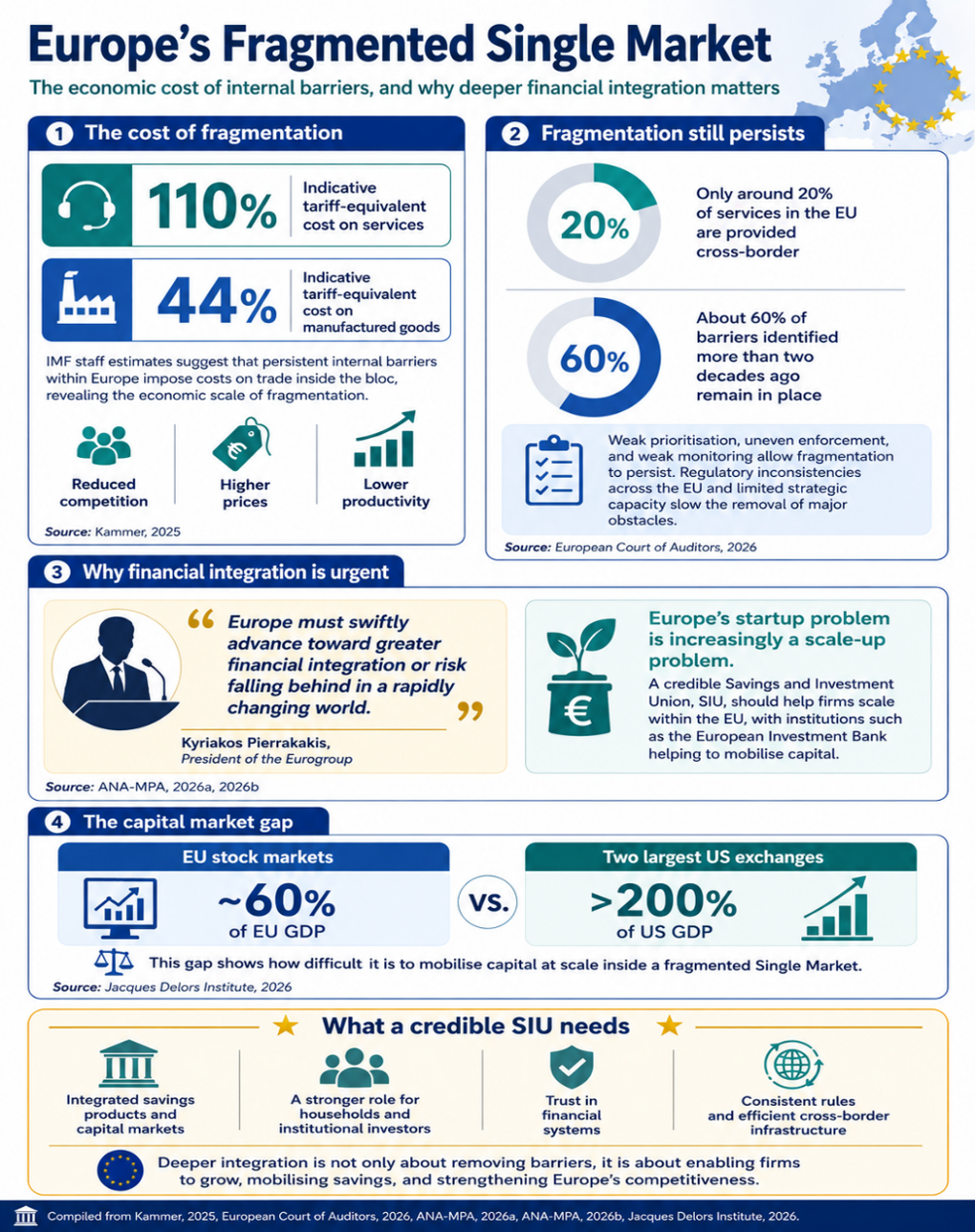
FIGURE 1: Market barriers and the rationale for the SIU
Legal Integration and its Limits
The EU’s legislation governing the Single Market is prima facie comprehensive. It encompasses primary law provisions, specified and complemented by extensive secondary law. This common binding framework establishes directly enforceable rights for economic actors and prohibits a wide array of restrictions on cross-border activities. In that respect, EU law is sound and unavoidable.
Even though it has been established that EU legislation prohibits unjustified restrictions on the free movement of capital, services, goods, and persons, it certainly does not eliminate the conditions under which those restrictions arise.
However, the strength of EU law should not obscure its limits. Even though it has been established that EU legislation prohibits unjustified restrictions on the free movement of capital, services, goods, and persons, it certainly does not eliminate the conditions under which those restrictions arise. Nor does it ensure convergence in administrative practices, regulatory approaches or institutional capacity. These are structural limitations, since the implementation of EU law depends on national authorities that operate within different legal traditions, administrative systems and policy priorities. This leads to the familiar paradox that the same EU legal rule may produce different outcomes across Member States.
…there is increasing support for regulations (Wax & Ionta, 2026), which are binding and directly applicable, reducing the scope for divergence.
Policy debates have focused on this issue, which is also intrinsically correlated to national sovereignty concerns. Directives, as binding legal acts that allow flexibility in national transposition, granting Member States some national discretion to decide how to achieve the set objectives, have often resulted in divergent implementation. In response, there is increasing support for regulations (Wax & Ionta, 2026), which are binding and directly applicable, reducing the scope for divergence. The shift towards regulations is already visible in EU legislative practice: in recent years regulations have become the dominant instrument among legislative acts adopted under the ordinary legislative procedure (Publications Office of the European Union, n.d.). This approach aims to address possible legal confusion among Member States, without being a panacea for every problem, since ultimately all EU rules depend on national enforcement. Legal uniformity, in that sense, mitigates one aspect of market fragmentation, whilst not addressing other disparities in administrative capacity or supervisory practices.
Recent OECD evidence links regulatory compliance costs to weaker productivity and lower business dynamism.
Recent OECD evidence links regulatory compliance costs to weaker productivity and lower business dynamism (Andrews et al., 2026). This matters for the Single Market because firms experience EU law also as compliance tasks, administrative procedures and enforcement practices. Regulations can reduce one important source of fragmentation by limiting divergent national transposition, but they do not remove the practical costs of compliance. Evidence on cumulative compliance costs for SMEs shows that burdens often arise from national interpretation, monitoring and enforcement practices, as well as from the accumulation of obligations over time (European Commission, 2015). These costs may affect firms’ decisions to innovate, enter new markets or expand across borders. The implication is that the choice of legal instrument matters, but it must be accompanied by clear implementation planning, proportionate enforcement and attention to administrative capacity. Otherwise, directly applicable rules may still produce uneven market effects across Member States (European Commission, 2015; Capuano, 2025).
The increasing reliance on regulations should be treated as a governance choice, not as a shortcut to integration.
Even where EU rules are directly binding, Member States remain central to how their effects materialise for businesses and citizens (OECD, 2025). The increasing reliance on regulations should be treated as a governance choice, not as a shortcut to integration. Regulations can limit national divergence, but where they postpone application, rely heavily on implementing acts, or require substantial national administrative adjustment, they may reproduce some of the same practical problems usually associated with directives (Capuano, 2025). The question is therefore not whether regulations are preferable in abstract terms, but under what conditions they can produce uniform market effects without increasing legal complexity or weakening accountability.
Policy discussions have also explored the use of optional EU-wide legal regimes, such as the so-called “28th regime” corporate legal framework, as a means of reducing fragmentation without requiring full harmonization.
Policy discussions have also explored the use of optional EU-wide legal regimes, such as the so-called “28th regime” corporate legal framework, as a means of reducing fragmentation without requiring full harmonization (Hallak, 2026). It would allow businesses to operate under a single set of EU rules across Member States, bypassing divergent national frameworks. This approach is clearly manifesting an attempt to reconcile regulatory uniformity with political limitations on deeper harmonisation. It aims to be a transition towards a legal framework specifically designed to more effectively facilitate cross-border activities in Europe. It goes hand in hand with the argument that before venturing into the global market, European companies should prioritise strengthening their presence within Europe.
Capital Markets as a Stress Test: From Free Movement to SIURegarding the freedom of capital, primary EU law is particularly liberal. Article 63 of the Treaty on the Functioning of the European Union (TFEU) prohibits all restrictions on capital movements within the EU and between Member States and third countries. The CJEU has even interpreted EU law on capital and payments in a dynamic way that reinforces its role as a central pillar of market integration (Samaras, 2022). Even so, further provisions in the TFEU stipulate a number of exceptions to the principle of free movement of capital. Article 65 TFEU stipulates derogations related to taxation, prudential supervision of financial institutions, public policy and public security.
The free movement of capital is enshrined in primary EU law, but in practice it relies largely on trust in banks, institutions, and the country’s economic performance.
Sometimes the implementation of the free movement of capital lacks certainty. As an example, one might cite the experience of “capital controls” in Cyprus (2013-2015) and in Greece (2015-2019) over the past decade, as it provides a picture of the realistic limits of legal integration within the Single Market under conditions of economic turmoil and financial crisis. The free movement of capital is enshrined in primary EU law, but in practice it relies largely on trust in banks, institutions, and the country’s economic performance. When that trust is broken, exceptions become the norm.
Today, although no comparable emergency capital controls are in place in the Member States, the free movement of capital within the EU is still not fully utilised. Capital markets provide a clear test of the limits of the current integration model.
The gradual process of further liberalising the Single Market is not always linear. Naturally, the banking and financial sector’s stability has been prioritised during periods of severe crisis. Exceptional measures have been adopted in the past, in line with EU law. Consequently, the EU’s economic freedoms are not absolutely guaranteed in perpetuity, regardless of the state of the Member States’ domestic economies and the solutions offered by the EU at the time. Even the most liberal Treaty freedom operates within institutional, financial and crisis-management constraints. Today, although no comparable emergency capital controls are in place in the Member States, the free movement of capital within the EU is still not fully utilised.
Capital markets provide a clear test of the limits of the current integration model. Successive CMU initiatives have addressed several layers of capital-market integration, including prospectus rules, securitisation, long-term investment funds, company disclosure through the European Single Access Point (ESAP), trading transparency, listing rules and withholding tax procedures.[1] Yet these measures have not removed deeper structural fragmentation in supervision, insolvency law, taxation, market infrastructure and growth-stage finance.
This means that companies and investors face higher transaction costs and legal uncertainty when operating across borders. The European Commission has identified these frictions as key impediments to the effective functioning of capital markets and to the broader objective of financing growth within the EU (European Commission, 2020b). Recent analysis indicates that the main obstacle to deeper capital market integration lies in the limited centralisation of supervisory powers at EU level, with the European Securities and Markets Authority (ESMA) still lacking the authority required to ensure consistent application of rules across Member States (Gortsos, 2026).
More integrated capital markets support private risk sharing across Member States, improve the allocation of capital and enhance the resilience of the euro area to asymmetric shocks.
The European Central Bank (ECB) has also noted the macroeconomic importance of capital market integration. More integrated capital markets support private risk sharing across Member States, improve the allocation of capital and enhance the resilience of the euro area to asymmetric shocks (European Central Bank, 2024). Fragmentation reduces these benefits, it reinforces reliance on bank-based financing and constrains access to risk capital, particularly for innovative and high-growth businesses. The CMU agenda has addressed some of these issues through targeted legislative initiatives, facilitating cross-border investment and promoting supervisory convergence. Nevertheless, structural differences in national frameworks are still problematic in a cross-border context.
The initiative for a SIU, presented by the European Commission in March 2025, suggests a recalibration into a holistic approach that incorporates the entire EU financial system, attempting to mobilise European savings more effectively and to channel them into productive investment within the EU.
The initiative for a SIU, presented by the European Commission in March 2025, suggests a recalibration into a holistic approach that incorporates the entire EU financial system, attempting to mobilise European savings more effectively and to channel them into productive investment within the EU (European Commission, 2025d). It is designed to transform the foundational work of the two main CMU Action Plans (i.e. the pioneering 2015 CMU Action Plan and the 2020 CMU Action Plan), along with the parallel efforts to develop the Banking Union, into a high-impact, more inclusive and citizen-focused, financial engine. This is closely linked to concerns about the EU’s investment gap and the need to finance large-scale transitions, including digitalisation and decarbonisation (Draghi, 2024).
Towards a results-oriented EU governance approachThe governance of the Single Market is based largely on decentralised implementation.
The governance of the Single Market is based largely on decentralised implementation. Member States are responsible for applying EU law, while the European Commission -acting as the “guardian of the Treaties”- monitors compliance and initiates enforcement when required. It is unavoidable that structural challenges and disputes rise from time to time, since the application of EU law varies in practice across the 27 EU Member States. The infringement procedure against a Member State that fails to implement EU legislation remains a crucial enforcement tool. However, despite its usefulness, it addresses specific Member State breaches of EU law, not systemic patterns of violations. The Commission has framed enforcement as a strategic and preventive function, rather than merely a reactive infringement mechanism, with particular emphasis on own-initiative investigations, incorrect transposition of directives, and infringements that obstruct fundamental freedoms or the effective functioning of the Single Market (European Commission, 2022).
…the main challenge for the EU continues to be ineffective governance.
The completion of the Single Market also requires a credible delivery framework that combines, other than political commitment, a coherent legislative package and clear timelines (Jacques Delors Institute, 2026). Recent EU initiatives point towards a more targeted and measurable enforcement strategy. The “2026 Annual Single Market and Competitiveness” report introduces the first annual “Single Market Enforcement Agenda”, focused on priority barriers such as late payments and obstacles in construction and installation services linked to the green transition, while simplification packages seek to reduce administrative burdens and make Single Market rules easier to apply in practice (European Commission, 2026). Nonetheless, institutional limits hinder enforcement. Coordination mechanisms rely on cooperation and do not always generate strong incentives for compliance. Consequently, the main challenge for the EU continues to be ineffective governance.
A turning point appears to be marked by more recent developments towards a results-oriented EU governance approach. The joint “One Europe, One Market” roadmap, agreed in late April 2026 between the European Parliament, the Council and the Commission, seeks to introduce a structured implementation framework through priority legislative deliverables and clear timelines, as well as regular monitoring through quarterly stocktaking. Europe’s fragmentation was translated into a structured work programme built around five priorities: simplifying rules, deepening Single Market integration, strengthening trade, reducing energy prices while advancing decarbonisation, and driving the digital and AI transformation, supported by more than forty legislative and policy deliverables.
The roadmap shows the political commitment of the EU institutions for setting out concrete steps towards a more operational Single Market governance (Council of the European Union, 2026). It converts a broad competitiveness agenda into a delivery test: capital markets, energy, digital infrastructure and industrial policy are placed within one political framework, with timelines that make delays more visible and politically costly (Letta, 2026a).
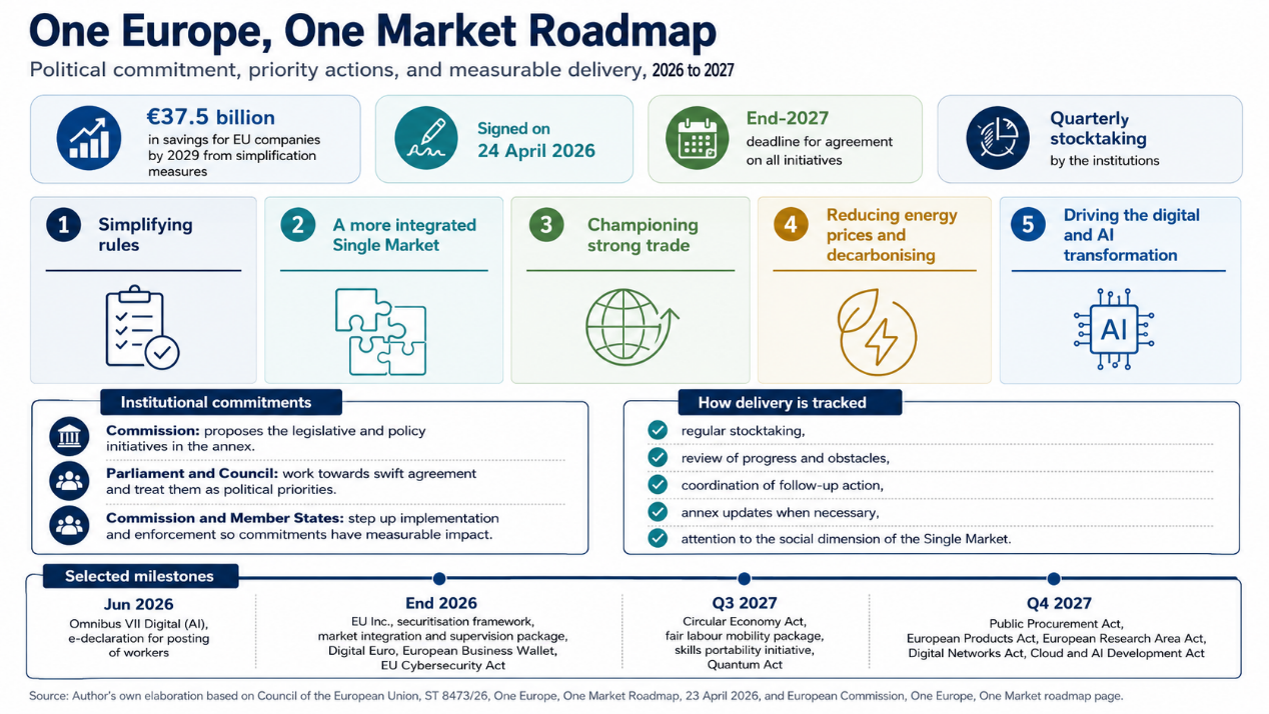
FIGURE 2: “One Europe, One Market” roadmap (April 2026), from political commitment to measurable delivery
The roadmap’s “market integration and supervision package” is particularly relevant in this respect, since the Commission’s December 2025 proposals seek to address capital-market fragmentation through changes to trading, post-trading, asset management and ESMA supervision, confirming that the SIU depends not only on new rules but on a more integrated supervisory architecture (European Commission, 2025e).
Policy RecommendationsCompleting the Single Market requires targeted action. The adoption of these strategic priorities is strongly encouraged:
- Target harmonisation and implementation where fragmentation is structural: EU legislative action should focus on areas such as insolvency, taxation procedures and other market obstacles, where national discrepancies create permanent barriers. Where the Treaty basis allows it, regulations may be more effective than directives, since they reduce transposition delays and limit divergent national implementation. Moreover, the Commission should track the implementation of major Single Market initiatives early, using detailed guidance and reporting to prevent new fragmentation from emerging. Attention should be paid to reducing “gold-plating” (adding extra layers of rules at the national level), which often increases compliance costs without clear policy justification.
- Reinforce supervisory convergence in capital markets: As has been pointed out in the Draghi Report (2024), the EU lacks a single securities market regulator. The ESMA ought to be transformed to serve as the sole common regulator for all securities markets within the EU. The EU should strengthen convergence through the ESMA, reinforcing transparency and technical standards, attaining a more unified supervision of capital markets.
- Constitutional discipline for restrictions on capital movements: Past episodes of capital controls show that EU law can accommodate emergency restrictions on capital movements where they are justified, proportionate and temporary. The unresolved issue is institutional. These safeguards have operated mainly through ad hoc assessment and monitoring, rather than through a permanent framework designed to protect capital-market integration. The EU should therefore develop, first through secondary legislation and eventually through Treaty reform, a stricter constitutional discipline for the use of Article 65 TFEU. Its provisions should not be abolished, since taxation, prudential supervision and public policy/security remain legitimate public interests. Its invocation, however, should be tied to clearer EU-level conditions: notification, time limitation, strict periodic review and consistency with the objective of capital-market integration. The aim would not be to invent new legality criteria, but to make their application more predictable, reviewable and aligned with the completion of the SIU.
Eliminating internal obstacles across the EU is essential for enabling market dynamics to operate effectively on a large scale.
In 2024, the findings and recommendations of the Letta and Draghi reports had been met with widespread enthusiasm (Kritikos, 2024). Eliminating internal obstacles across the EU is essential for enabling market dynamics to operate effectively on a large scale. A true unified market is needed, ensuring that conducting business between Vilnius and Madrid is as seamless as it is between Athens and Thessaloniki. The competitiveness debate is therefore also a debate about scale. The EU’s difficulty is that companies, banks and capital markets are primarily organised around national markets. In a global economy shaped by continental-scale competitors from the United States and China, the relevant benchmark is whether businesses in the EU can achieve sufficient growth to establish themselves as truly European entities, rather than remaining confined to national prominence. This does not alter the fact that slow convergence may be insufficient in sectors where technological cycles and global competition move faster than EU implementation.
A more integrated Single Market needs rules that are clear and sufficiently uniform to support cross-border growth, while avoiding unnecessary procedural burdens that make compliance easier for incumbents than for new entrants.
A more integrated Single Market needs rules that are clear and sufficiently uniform to support cross-border growth, while avoiding unnecessary procedural burdens that make compliance easier for incumbents than for new entrants. National regulatory discretion may protect domestic dominant players and, possibly, reduce unwanted competitive pressure from other Member States. This might explain why many barriers still exist even when their aggregate cost to the EU economy is widely recognised. Completing the Single Market requires confronting the domestic interests that benefit from partial integration.
A functioning SIU should be assessed by whether it enables European firms to grow within Europe, rather than pushing them towards capital markets elsewhere.
Greater scale should not be understood as a goal only for large Member States or large firms. Smaller Member States and SMEs may benefit most from a genuinely integrated Single Market, because domestic scale is structurally limited. Deeper integration can expand their addressable market and create more credible paths from local innovation to European growth. Besides, Europe does not lack startups or entrepreneurial talent, but many firms face a financing and market-size ceiling once they move from creation to scaleup. A functioning SIU should be assessed by whether it enables European firms to grow within Europe, rather than pushing them towards capital markets elsewhere.
Recent EU policy developments set out the way forward regarding greater regulatory uniformity and less economic overreliance on third countries. This direction addresses important aspects of the problem. However, legal convergence does not automatically produce effective integration. The central challenge is mostly operational, since the EU has demonstrated its ability to identify barriers and design policy responses. Ensuring consistent implementation across Member States is more difficult. The long-term political sustainability of the Single Market depends also on ensuring that mobility remains a choice rather than an obligation. As emphasised in recent policy debates, deeper integration must be accompanied by economic and social cohesion in order to remain politically viable (Letta, 2026b).
Completing the Single Market should be understood not only as an economic reform, but as a condition for European resilience and sovereignty.
The link between competitiveness and European security is also central to the Single Market debate. In a global economy, fragmentation weakens the EU’s capacity to invest, innovate and act strategically. Completing the Single Market should be understood not only as an economic reform, but as a condition for European resilience and sovereignty (Letta & Lamy, 2026). It is time for the EU to compete with the dominant players, benefitting from a higher degree of autonomy by boosting its economy. For the EU this requires a decisive shift from agenda-setting to delivery. It implies departing from mediocrity, with stronger enforcement, greater administrative capacity and sustained political commitment.
Completing the Single Market means making Europe the natural scale of economic activity, rather than leaving firms, capital and innovation trapped in national markets.
From the early stages of the internal market, European policymakers recognised that incomplete integration risks reducing the market to a form of managed openness instead of a fully functioning economic space (European Commission, 1985). The struggle over the same strategic choice is still relevant today. The key question is whether Europe can transition from a culture of national protectionism to a European-scale mindset. Completing the Single Market means making Europe the natural scale of economic activity, rather than leaving firms, capital and innovation trapped in national markets.
ReferencesAarnio, R., Bogucki, A., Jorge Ricart, R., Timmers, P., & Vainio, T. (2026). Building One Europe, One Market: Four strategic priorities for the digital single market (Sitra Studies 258). Sitra.
ANA-MPA. (2026a, March 17). Pierrakakis at Euronext: SIU will boost job quality across Europe. https://www.amna.gr/mobile/article/978705/Pierrakakis-at-Euronext-SIU-will-boost-job-quality-across-Europe
ANA-MPA. (2026b, May 13). Pierrakakis: We need greater integration in Europe, bank mergers, larger businesses. https://www.amna.gr/article/992554/pierrakakis-we-need-greater-integration-in-europe–bank-mergers–larger-businesses
Andrews, D., Turban, S., & Tyros, S. (2026). Regulatory compliance costs and productivity: New task-based evidence (OECD Economics Department Working Papers No. 1856). OECD Publishing. https://doi.org/10.1787/1c1da52e-en
Capuano, V. (2025). New legislative approach with old legislative tools: The recent (ab)use of regulations in European Union law. Eurojus, 4, 145–163. https://rivista.eurojus.it/new-legislative-approach-with-old-legislative-tools-the-recent-abuse-of-regulations-in-european-union-law/
Council of the European Union. (2026). One Europe, One Market Roadmap of the European Parliament, the Council of the European Union and the European Commission (ST-8473/26).
https://data.consilium.europa.eu/doc/document/ST-8473-2026-INIT/en/pdf
Court of Justice of the European Union. (2026). Annual report 2025: Statistics concerning the judicial activity of the Court of Justice. https://curia.europa.eu/site/upload/docs/application/pdf/2026-05/ra_en_court_statistiques_25.pdf
Draghi, M. (2024). The future of European competitiveness. European Commission. Part A: https://commission.europa.eu/document/download/97e481fd-2dc3-412d-be4c-f152a8232961_en; Part B: https://commission.europa.eu/document/download/ec1409c1-d4b4-4882-8bdd-3519f86bbb92_en?filename=The%20future%20of%20European%20competitiveness_%20In-depth%20analysis%20and%20recommendations_0.pdf
European Central Bank. (2024). Financial integration and structure in the euro area. https://www.ecb.europa.eu/press/fie/html/ecb.fie202406~c4ca413e65.en.html
European Commission. (1985). Completing the internal market: White paper from the Commission to the European Council (Milan, 28–29 June 1985) (COM(85) 310 final). https://eur-lex.europa.eu/legal-content/EN/TXT/?uri=CELEX:51985DC0310
European Commission [Directorate-General for Internal Market, Industry, Entrepreneurship and SMEs & Centre for Strategy & Evaluation Services]. (2015). Cost of the cumulative effects of compliance with EU law for SMEs: final report. Publications Office. https://data.europa.eu/doi/10.2873/554243
European Commission. (2020a). Identifying and addressing barriers to the Single Market (COM(2020) 93 final).
https://eur-lex.europa.eu/legal-content/EN/TXT/?uri=CELEX:52020DC0093
European Commission. (2020b). A Capital Markets Union for people and businesses: New action plan (COM(2020) 590 final).
https://eur-lex.europa.eu/legal-content/EN/TXT/?uri=CELEX:52020DC0590
European Commission. (2022). Enforcing EU law for a Europe that delivers (COM(2022) 518 final).
https://commission.europa.eu/publications/communication-commission-enforcing-eu-law-europe-delivers_en
European Commission. (2024). The 2024 Annual Single Market and Competitiveness Report (COM(2024) 77 final). https://eur-lex.europa.eu/legal-content/EN/TXT/?uri=CELEX:52024DC0077
European Commission. (2025a). A Competitiveness Compass for the EU (COM(2025) 30 final). https://eur-lex.europa.eu/legal-content/EN/TXT/?uri=celex:52025DC0030
European Commission. (2025b). The Single Market: Our European home market in an uncertain world (COM(2025) 500 final). https://single-market-economy.ec.europa.eu/publications/single-market-our-european-home-market-uncertain-world_en
European Commission. (2025c). Startups, scaleups and entrepreneurship. [Flash Eurobarometer 559]. https://europa.eu/eurobarometer/surveys/detail/3359
European Commission. (2025d). Savings and Investments Union: A strategy to foster citizens’ wealth and economic competitiveness in the EU (COM(2025) 124 final). https://eur-lex.europa.eu/legal-content/EN/TXT/?uri=CELEX:52025DC0124
European Commission. (2025e). Market integration and supervision package. https://finance.ec.europa.eu/publications/market-integration-and-supervision-package_en
European Commission. (2026). The 2026 Annual Single Market and Competitiveness Report (COM(2026) 46 final).
https://eur-lex.europa.eu/legal-content/EN/TXT/?uri=COM:2026:46:FIN
European Council. (2026). European Council conclusions, 19 March 2026.
https://www.consilium.europa.eu/en/meetings/european-council/2026/03/19/
European Court of Auditors. (2026). Single market for services: Commission action to remove barriers to cross-border services still insufficient (Special Report No 13/2026). https://www.eca.europa.eu/en/publications/SR-2026-13
Gortsos, C. (2026). European (EU) capital markets law at (close to) 50: Historical evolution and missing elements (EBI Working Paper No. 207). European Banking Institute. https://papers.ssrn.com/sol3/papers.cfm?abstract_id=6689178
Hallak, I. (2026, April). The 28th regime corporate legal framework (PE 785.710). European Parliamentary Research Service, European Parliament. https://www.europarl.europa.eu/thinktank/en/document/EPRS_BRI(2026)785710
IMF. (2024, October). Regional Economic Outlook for Europe: A Recovery Short of Europe’s Full Potential.
Jacques Delors Institute. (2026). One Europe, One market: Europe’s strongest response to a world in transformation. https://institutdelors.eu/content/uploads/2026/04/One-Europe-One-Market_paper_v3-1.pdf
Kammer, A. (2025, June). Europe’s integration imperative. International Monetary Fund. https://www.imf.org/en/publications/fandd/issues/2025/06/europes-integration-imperative-alfred-kammer
Kritikos, A. (2024). The Letta and Draghi reports: The only way to go, despite the hurdles (European Economy Policy Briefs No. 5/2024). Hellenic Foundation for European and Foreign Policy (ELIAMEP). https://www.eliamep.gr/wp-content/uploads/2024/11/Policy-briefs-special-edition-Leventis-5-EN-.pdf
Letta, E. (2024). Much more than a market. Council of the European Union.
https://www.consilium.europa.eu/media/ny3j24sm/much-more-than-a-market-report-by-enrico-letta.pdf
Letta, E. (2026a, May). One Europe, One Market Roadmap: Building Europe’s capacity to act. Centre for Economic Policy Research. https://cepr.org/system/files/publication-files/299775-one_europe_one_market_roadmap_building_europe_s_capacity_to_act.pdf
Letta, E. (2026b, February 26). One Europe. One market. Time to complete the EU single market. Politico. https://www.politico.eu/article/time-complete-eu-european-single-market-next-step/
Letta, E., & Lamy, P. (2026, March 17). Now more than ever, Europe must complete the Single Market. Project Syndicate. https://www.project-syndicate.org/commentary/eu-completing-single-market-key-to-defense-energy-security-tech-sovereignty-by-enrico-letta-and-pascal-lamy-2026-03
OECD. (2025). Better Regulation Practices across the European Union 2025. OECD Publishing. https://doi.org/10.1787/6f007516-en
Publications Office of the European Union. (n.d.). Legal acts – statistics. EUR-Lex. https://eur-lex.europa.eu/statistics/legislative-acts-statistics.html
Samaras, A. (2022). Οι κεφαλαιακοί περιορισμοί στο σύγχρονο ενωσιακό δίκαιο [Restrictions on the free movement of capital in contemporary EU law]. Nomiki Bibliothiki.
Thomadakis, A., & Marcus, J. S. (2025). Identification of hurdles that companies, especially innovative start-ups, face in the EU justifying the need for a 28th regime (PE 775.947). European Parliament, Policy Department for Justice, Civil Liberties and Institutional Affairs. https://www.europarl.europa.eu/RegData/etudes/STUD/2025/775947/IUST_STU(2025)775947_EN.pdf
Wax, E., & Ionta, N. (2026, April 28). Who killed the directive? Euractiv.
https://www.euractiv.com/news/rapporteur-who-killed-the-directive/
[1] See, indicatively, Regulation (EU) 2017/1129; Regulation (EU) 2017/2402; Regulation (EU) 2023/606; Regulation (EU) 2023/2859; Directive (EU) 2024/790; Regulation (EU) 2024/791; Regulation (EU) 2024/2809; Directive (EU) 2024/2811; Council Directive (EU) 2025/50.
Catégories: Diplomacy & Defense Think Tank News
The Cyprus Presidency of the Council of the EU : An Assessment in a Time of Geopolitical Turmoil
Cleopatra Kitti, Senior Policy Advisor to ELIAMEP and Founder of the Mediterranean Growth Initiative, offers a review of Cyprus’s Presidency of the Council of the European Union, which concluded a few days ago.
Read the ELIAMEP Explainer here.
Catégories: Diplomacy & Defense Think Tank News
The Greek defence ecosystem in the European Defence Fund (2021-2025)
Greece has established itself as a consistent and committed participant in the EDF. Across the 2021-2025 reference period, Greek entities participated in all annual EDF calls without interruption, logging 306 total participations from 88 unique entities. Participation levels remained relatively stable year-on-year.
SMES are the backbone of Greek EDF engagement. They consistently account for the largest share of Greek participants, largely mirroring the structure of the Greek Defence Technological and Industrial Base. Yet, nearly 45% of unique Greek entities participated only once and a significant share recorded no activity in the call cycle immediately following their first project.
Greece’s partners are geographically concentrated. Whether in a coordination or simple participation role, Greek entities overwhelmingly cluster around the big defence-industrial players. Critically, Greek entities tend to cooperate with large for-profit prime contractors from those countries.
Greek EDF participants view the instrument, in principle, as a strategic success but flag a set of concerns. Most respondents to the paper’s survey highlighted the absence of pathways from EDF-funded R&D outputs to actual procurement by EU member-states, creating a structural gap that diminishes the instrument’s industrial and economic multiplier and prevents sustained participation.
The paper makes 9 targeted policy recommendations:
- Strengthen matchmaking mechanisms for Greek entities with foreign entities to build EDF consortia.
- Promote strategic partnerships with major European defence ecosystems through country-level agreements.
- Develop an open-access national monitoring and mapping mechanism for EDF participation.
- Provide targeted initiatives to achieve the transition to coordinator roles.
- Further boost the EDF’s logic and budget in the next MFF.
- Launch targeted reskilling and upskilling campaigns in dual-use technologies to strengthen Greek SME participation in the EDF.
- Develop and publicly communicate a national defence technological and industrial strategy.
- Procurement-oriented initiatives for the EDF outputs should be considered for the next MFF negotiations.
- Enhance the visibility and the legitimacy of the EDF outputs.
Read here in pdf the Policy paper by Spyros Blavoukos, Head, EU Institutions & Policies Programme, ELIAMEP; Head of the ‘Ariane Condellis’ European Programme; Professor, Athens University of Economics & Business; Panos Politis Lamprou, Research Fellow, Defence Hub, ELIAMEP; Georgios Matsoukas, Junior Research Fellow, Defence Hub, ELIAMEP; Panagiotis Kakis, Research Assistant, Defence Hub, ELIAMEP.
IntroductionΤhe European Defence Fund (EDF) represents a landmark initiative in the European Union’s (EU) efforts to strengthen collaborative defence research, innovation and capability development across member-states and associated countries. Created under the 2021-2027 Multiannual Financial Framework (MFF), the EDF is endowed with a budget of nearly 8 billion EUR, of which more than 5 billion EUR is allocated to consortia-based defence capability development projects. Since its first call for proposals in 2021, the EDF has become an established financing instrument for transnational research and industrial programmes, aiming to bolster, inter alia, interoperability, with a cumulative EU budget reaching almost reaching approximately 5.25 billion EUR applied across 281 projects selected for funding based on the results for the period 2021-2025 (DG DEFIS, 2021, 2022, 2023, 2024, 2025).
Despite its institutional consolidation, the EDF emerged through contentious negotiations for the 2021-2027 MFF. The European Commission initially proposed an ambitious budget of 11.5 billion EUR (in constant 2018 prices) for the Fund. However, during the final stages of the negotiations, which were strongly influenced by the economic pressure associated with the COVID-19 pandemic, the proposed allocation was reduced by approximately 39% (Dobber, 2020). Even though the European Parliament criticised the cuts, the debate persisted over whether significant investments should be directed towards defence research and development or alternatively towards other areas, such as policies that tackle international instability before it results in war or conflict (Csernatoni & Martins, 2019). These debates remain particularly relevant in view of the next MFF negotiations. Although security and defence are framed as strategic priorities for the Union, trade tensions and inflationary pressures, very much but not exclusively due to rising energy costs and global political tensions, continue to intensify the political dilemma between ‘guns and butter’, namely between defence spending and competing socio-economic priorities.
Against this background, broader debates on the future of EU defence and competitiveness funding have gained renewed importance. While discussion on broader EU competitiveness initiatives continues and new instruments have been proposed in the framework of the next MFF, like, for example, the Commission’s proposal for a European Competitiveness Fund, the EDF, or a new and more robust permanent funding mechanism, which will follow the same logic, will need to exist within the EU’s defence industrial architecture. In this evolving context, understanding how national defence and innovation ecosystems engage with EDF-funded collaborative networks becomes increasingly important, both for assessing the EDF’s impact and for evaluating the position of member-states within the EU defence industrial landscape.
The Greek case is particularly relevant in this regard. Despite its growing importance, the participation of the Greek defence and dual-use innovation ecosystem in EDF-funded projects, at the level of individual entities, has not been systematically and thoroughly examined. Most analyses document exclusively the number and thematic distribution of projects involving Greek entities. While this remains of utmost importance, a project/country-level perspective cannot reveal which specific entities participate or the nationality of the entities with which Greek entities most frequently collaborate. These questions matter for both academic understanding and policy-oriented purposes.
Accordingly, this paper addresses the following research question: What does the Greek defence ecosystem that participates in selected for EDF funding projects consist of? Specifically, how many and what types of Greek entities participate and with entities from which countries do they tend to cooperate? A secondary research question complements this structural mapping: How do Greek participants assess the EDF instrument, and what institutional support is provided by Greek public authorities?
To respond to the abovementioned questions, the paper is structured as follows. Chapter 2 offers a brief literature review, summarising existing research on the EDF and further elaborating on our paper’s contribution and added value. Chapter 3 describes the methodology we implemented, including our data collection and mining procedures, the reference years covered and the classification system we employed to categorise entity types. Chapter 4 presents and interprets empirical findings across two sections. The country-level dimension analyses and maps Greek entities’ coordination role and project-based cooperation footprint, by visualising Greek-led consortia structures and identifying trends apparent in the country-level overviews of projects with Greek participation. The entity-level dimension profiles the categorisation and volume of Greek entities selected for EDF funding, as well as their transnational partnership patterns, illustrated by linkages between Greek and foreign entities by thematic category and year. Throughout both analytical sections of the discussion, empirical findings are contextualised by key observations integrated directly within each set of findings, alongside relevant qualitative insights drawn from questionnaires. Chapter 5 formulates targeted recommendations for public authorities.
Brief literature review and the paper’s triple added valueThe EDF serves diverse strategic and industrial purposes across member-states. According to Fiott (2024), major industrial powers such as France view the EDF as a vehicle for heavily subsidising domestic defence sectors and for building a European ‘strategic autonomy’ free from US export controls. Germany utilises common funding to support its military modernisation (Fiott, 2024; Brøgger, 2025), while Spain and Italy leverage the fund to boost their defence industrial bases. Small and medium-sized countries like Poland and Finland participate in projects led by larger partners to access new technology and secure their position in cross-border supply chains (Blavoukos, Politis Lamprou & Matsoukas, 2025; Fiott, 2024). Conversely, countries like Romania participate only to a limited extent, partly because their defence industries are small and their procurement policies prioritise off-the-shelf US military equipment for immediate security needs over long-term European integration (Iancu, 2025).
For Greece, this reliance on EU frameworks is driven by hard economic and structural realities. Following drastic budget cuts to the Ministry of National Defence during the country’s almost decade-long harsh financial crisis, Greek private-sector defence firms were forced to actively pursue alternative pan-(EU)ropean financing like the EDF (Kamaras, 2023). This structural need for supranational financing converges directly with the institutional characteristics of the EDF, whose regulatory framework and incentives architecture promote (and in certain cases, require) the inclusion of SMEs, which constitute the backbone of Greece’s domestic defence technological and industrial base. As such, Greece strategically leverages the EDF Regulation, treating it as a structural equaliser to, among others, embed its local industry into broader European supply networks (Efstathiou, 2020). Ultimately, Greece views this funding as a useful tool for research and development of military capabilities, the acquisition of technical know-how, the rebirth of its domestic industry and the reversal of the ‘brain drain’ of young scientists. At the same time, Greece demonstrates, in practice, that it supports a stronger and more robust EU defence industrial policy.
Giumelli and Marx (2023) argue that although a limited number of large industrial actors occupy a central position in market consolidation within the European defence (still far from single) market, EU institutions simultaneously promote geographical dispersion and actively encourage the inclusion of SMEs in order to safeguard institutional legitimacy. This effort aims to preserve legitimacy through participation criteria and incentives, which, on the one hand, expand the number of participating entities but, on the other hand, slow the consolidation process. Masson (2025) also highlights this tension empirically by demonstrating a clear hierarchy in funding allocation. While SMEs account for approximately 39-43% of entities selected for funding, they receive only 18-20% of EU financial contributions. As a result, a two-speed dynamic exists: one geared toward market consolidation favoring large primes, and another driven by the institutional mandate for geographical dispersion and the inclusion of SMEs.
So far, there has been no previous work exclusively focusing on the Greek defence (and dual-use) ecosystem’s participation in selected for funding EDF projects entity-wise. Our own prior data-driven research (i.e., Blavoukos, Politis Lamprou & Matsoukas, 2025) adopted only a project-based perspective, mapping the thematic distribution of projects involving Greek participation. In contrast, the present study provides additional quantitative information on project-related Greek participation and, most importantly, shifts the core of the analysis from projects to entities. As explained earlier, we examine which types of Greek actors (i.e., for profit companies, SMEs, non-profit organisations, associations, universities, governmental entities and public research organisations, and consultancies) are selected for EDF funding, how frequently they assume the role of project coordinator, and which entities from which member-states or associated countries they most commonly tend to cooperate with.
By doing so, the article has a triple added value: a) to provide data-driven insights to Greek entities interested in joining EDF calls as consortium members (or coordinators), and b) to inform foreign entities seeking to collaborate with Greek ones within the framework of the EDF, and c) to assist the relevant Greek public authorities (e.g., Secretariat-General of National Security, Directorate-General for Defence Investments and Armaments, the Hellenic Centre for Defence Innovation) in shaping a beneficial support mechanism for the Greek defence industry and beyond.
MethodologyFor the purposes of our research, we pursued the following data collection and mining process. Data were extracted for European Defence Fund (EDF) projects in which Greek entities were selected for funding based on the 2021, 2022, 2023, 2024 and 2025 results. All the data (e.g., official entities’ names, entity nationality, etc.) were extracted from the relevant official project-based factsheets available on the Commission’s website for each year.[1] Following thorough validation, these data were subsequently organised into a large database that categorises every project (including the entities and their nationality) by year and thematic category. To record industrial relationships, two (2) matrices were constructed from the database.
The first matrix classifies entities in Greece and partner entities into four distinct types: For-profit organisations; small and medium-sized enterprises (SMEs), according to the Commission’s definition (Entities that are subsidiary to other entities that do not meet the same criteria are classified as for-profit organizations); non-profit organisations, associations, universities, governmental entities and public research organisations; and consultancies. This classification partially reproduces the process implemented by the Fondation de Recherche Stratégique (FRS). This matrix aims to provide information on a) the types of Greek entities selected for EDF funding, b) the nationality of the entities under Greece’s coordination, and c) the nationality of the entities-coordinators which coordinate the Greek entities selected for EDF funding. The SME type follows the Commission’s definition, and the classification is made possible by open-access data available on each entity’s website. The consultancy type specifically documents the participation of companies whose research and development functions are limited or non-existent, recording their project management and advisory roles within these consortia. Information on each selected entity’s primary focus and/or activity was extracted from its website or public data. In some cases, however, publicly available data do not allow for a fully unambiguous classification; therefore, some deviation may occur. The authors did not access each project’s contractual agreement and/or arrangements to further investigate whether consulting/advisory companies were partially involved in the core R&D process. A sub-matrix was generated for each year to record total metrics by country. These data document the number of entities’ nationalities under Greece’s coordination as well as the number of countries coordinating with Greece.
The second matrix records industrial partnerships between countries, with each country represented by its entities. To prevent the duplication of data entries, a filtering mechanism was utilised. Entities from countries participating in a consortium in which at least one Greek entity also participates, within a specific thematic category, were excluded after their initial entry.
To complement the quantitative analysis, questionnaires were administered to representatives of Greek entities that participated in EDF consortia between 2021 and 2025. We received responses from all categories of entities, including SMEs, mid-caps, research organisations and large for-profit subsidiaries (simple participants and consortium coordinators). Questions covered motivations for participation, partner-finding mechanisms, perceived benefits, the conversion of EDF partnerships into bilateral cooperation, evaluations of the EDF instrument itself, and assessments of Greek institutional support.
Results and DiscussionCountry/project-level dimension
The following figures cover the full reference period (2021 to 2025) and distinguish between coordination and simple participation roles to avoid overlaps. Two complementary figures are presented.
The first figure captures the number of projects in which a Greek entity assumes the role of coordinator, broken down by the nationality of the other participating entities. The second figure illustrates the number of projects in which at least one Greek entity participates alongside entities from other countries, excluding projects in which a Greek entity acts as coordinator. In both figures, the thickness of each line reflects the volume of projects. The thicker the line, the greater the number of projects. For access to country-specific project numbers, the interactive version is recommended.[2]
Figure 1: Greek-coordinated projects by nationality of participating entities (2021-2025) (interactive version)
Figure 2: Projects with Greek participation by nationality of participating entities (2021-2025) (interactive version)
A pattern emerges across both figures. Greek partnerships, whether in coordination or participation, are highly concentrated within the largest EU defence industrial ecosystems. France, Italy, Germany, and Spain occupy the most prominent positions in virtually every call across both types of consortia. Given the sheer volume of participation in EDF calls, this degree of alignment is expected. The structural weight of the defence industries of said partners is reflected in the EDF, as they participate in and coordinate the largest share of projects, while maintaining the strongest presence throughout the reference period (Fiott, 2026).
Entity-level dimensionFigure 3 shows the total number of Greek entities participating in or coordinating EDF projects annually. It shows the number of unique entities involved in each year separately and does not correspond to the total number of unique entities across the entire period, as the same entity may participate in (or coordinate) projects in more than one year. [3]
Figure 3: Total number of unique Greek entities participating in or coordinating EDF projects from 2021 to 2025.
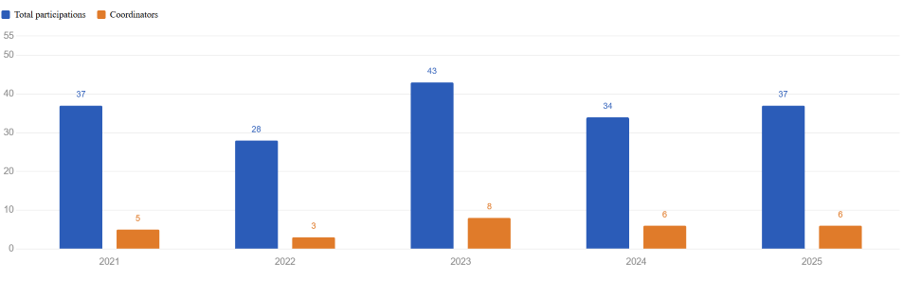
Source: Authors’ compilation from official European Commission/DG DEFIS factsheets
A first observation concerns the evolution of participation levels across the reference period. The total number of Greek entities involved in EDF projects exhibits relatively minor year-to-year fluctuations. Participation levels are influenced by the thematic priorities of each call, the readiness of domestic actors to build networks and form consortia and the access to information about EDF calls. While participation levels vary, Greek entities maintain a consistent presence across all years, indicating that the national ecosystem has successfully positioned itself from the outset within the most important supranational defence-industrial scheme. This pattern suggests that Greece is not a marginal player and could move towards a more stable and strategically coordinated participation profile. Moreover, the coordination data point to limited leadership capacity (compared to the normal participation levels) among Greek entities that have assumed coordinator roles over the years, yet coordination remains relatively sporadic. Figure 4 illustrates the top 6 Greek entities by total participation from 2021 to 2025.
Figure 4: Greek entities positioned as the most recurrent participants within the reference period (2021-2025)
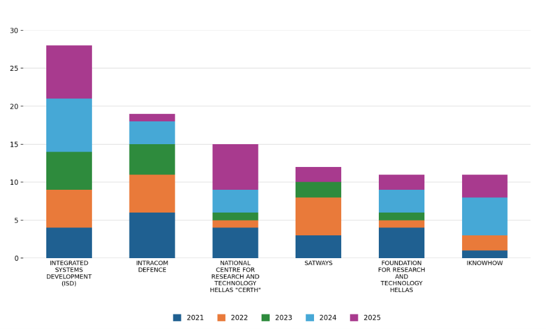
The composition of the most frequent Greek participants in the EDF broadly mirrors the structure of the wider Greek participant pool. However, the complete pool of unique Greek participants reveals more complex dynamics (Annex II). Nearly 45% of the 88 unique entities are one-time participants, suggesting that for a large share of the Greek ecosystem, EDF participation functions as a one-off experience rather than a sustained engagement. Among entities that do return, over a third record zero activity in the year immediately following their first participation. This recurring pattern suggests significant administrative friction, whereby the obligations of a first EDF project absorb substantial organisational capacity, crowding out the subsequent call cycle. What emerges is a two-speed dynamic: a small core of -primarily large- entities with genuine multi-year engagement, alongside a much larger number of smaller and medium-sized entities, with the depth of participation contingent on the capacity to absorb the instrument’s administrative demands.
The following figures present the number and types of Greek entities that received (a share of) EDF financial contribution during the period 2021-2025. The entities are classified according to the types defined in the methodology chapter and are presented both in terms of Greek coordinators and the total number of Greek participating entities.[4]
Figure 5: Categorisation per type and volume of coordinations for Greek entities in EDF projects (2021-2025)
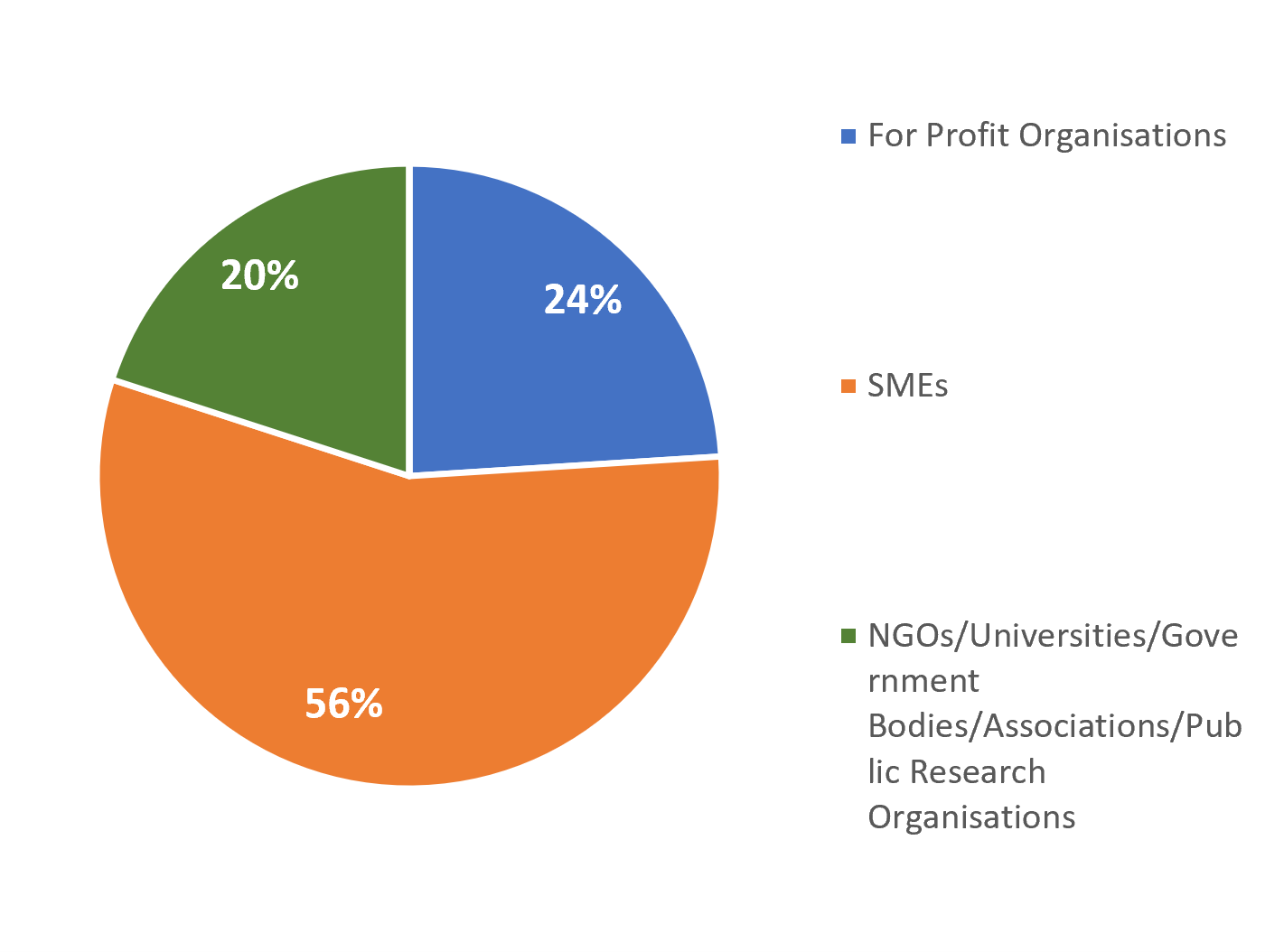
Figure 6: Categorisation per entity type and volume of total participations (including simple participations and coordinations) for Greek entities in EDF projects (2021-2025)
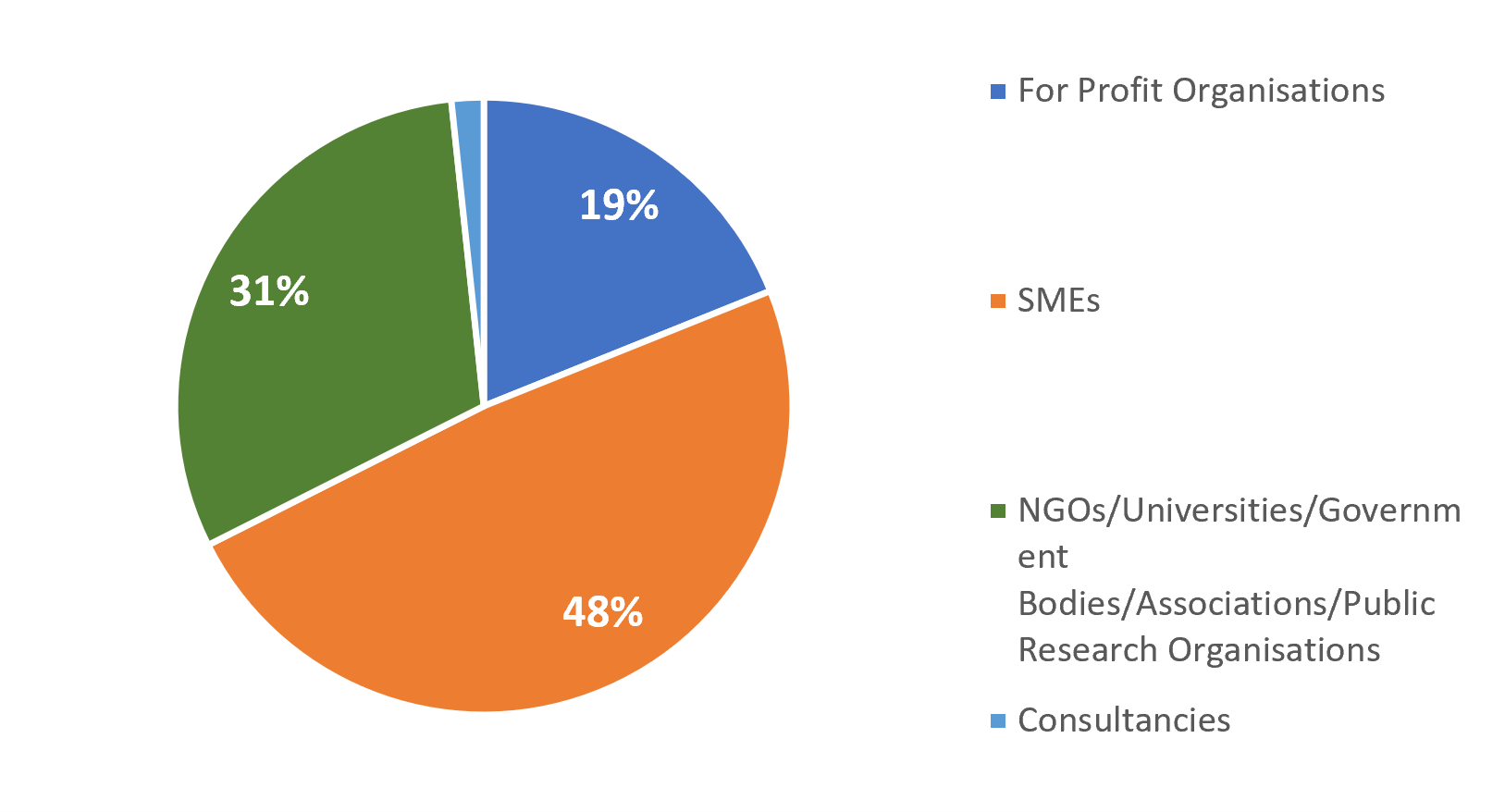
An important finding concerns the types of Greek entities involved in EDF projects. The data indicate that Greek participation is predominantly driven by SMEs, which consistently account for the largest share of Greek actors across the examined period. This trend aligns closely with the structural characteristics of the Greek Defence Technological and Industrial Base (GTIB), which is widely recognised as being composed mainly of smaller firms rather than large prime contractors. In addition to SMEs, the data also reveals a significant presence of research and non-governmental organisations, paving the way for greater involvement of the Greek university and research community. Looking more closely at the annual distribution of coordinations and total participations further reinforces this observation. The Greek industry’s interest in Open SME Calls is evident in Figure 9 below.
The following figures provide the same data visualisation but for foreign entities involved in consortia in which a Greek entity a) acts as the project coordinator, and b) participates.[5]
Figure 7: Categorisation per entity type and volume of coordinations for Greece’s foreign consortium partners in EDF projects (2021-2025)
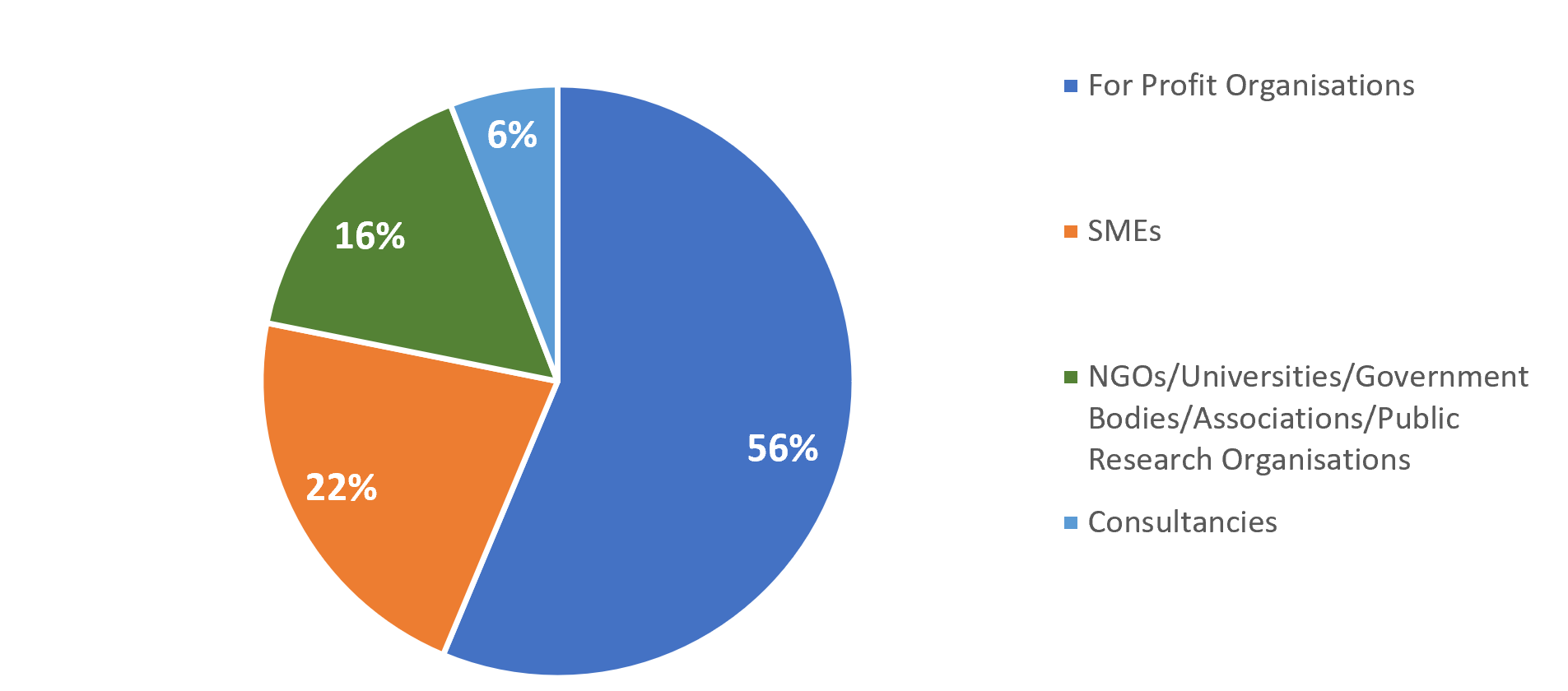
Figure 8: Categorisation per entity type and volume of total participations (simple participations and coordinations) for Greece’s foreign consortium partners in EDF projects (2021-2025)
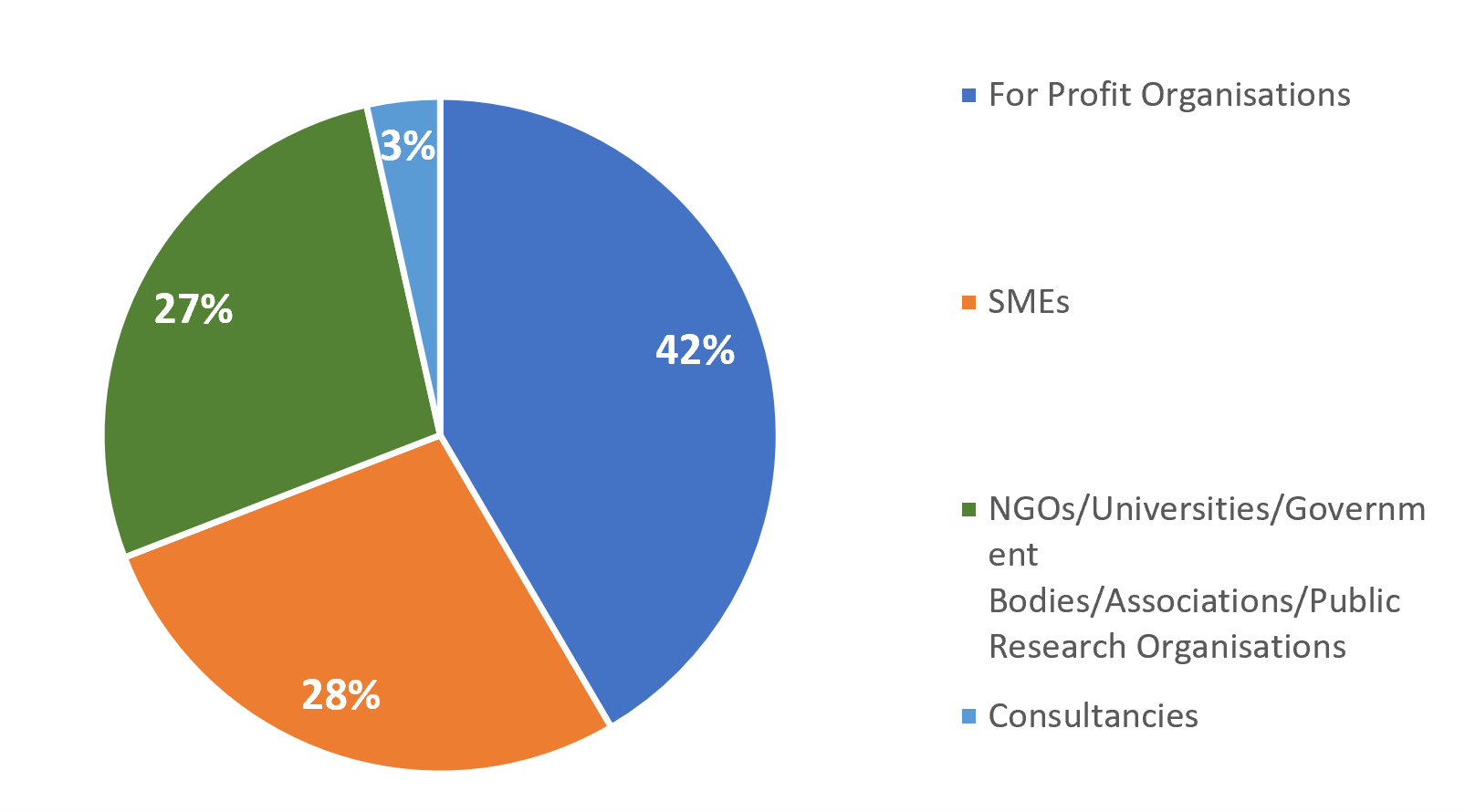
What clearly emerges is that in contrast to the Greek entities’ EDF participation, the foreign entities with which Greek actors collaborate are often for-profit companies (e.g., established defence-industrial players). Overall, the results reveal that Greek entities tend to cooperate predominantly with the largest EU defence-industrial ecosystems. This reflects both the high concentration of major defence companies in other member-states with a substantial defence industrial sector, their tendency to participate in EU-level consortia, and the incentive for Greek entities to partner with established (prime) contractors to strengthen their technological know-how and integrate smoothly into the European defence value chain.
Entity-level networks by year, Greek entity-coordinator and thematic category (2021-2025)
The following figure illustrates the number and nationality of foreign entities participating in consortia led by Greek coordinator entities, mapping the cross-border networks formed around Greek coordinators by thematic category, covering the full reference period (2021 – 2025).[6]
Figure 9: Foreign entities in consortia led by Greek coordinators per thematic area of EDF project (2021-2025) (interactive version)
Created with flourish.studio.
Greek entity-level total participations per year and thematic category (2021-2025)
The subsequent figure maps cooperation patterns at the entity level, covering the full reference period (2021 to 2025). Organised by thematic category, it illustrates the number and nationality of foreign entities collaborating with Greek entities in projects selected for EDF funding, providing a direct visualisation of transnational industrial linkages per thematic category. The darker the colour of each cell, the greater the number of entities. For access to the specific number of entities per country, the interactive version is recommended.[7]
Figure 10: Volume of third-country entity participation with Greek entities by thematic category (2021-2025) (interactive version)
Created with flourish.studio
Entity-level total participation data by nationality and thematic category reinforce our previous observation and indicate recurring patterns of intense collaboration with a group of entities from leading EU defence-industrial countries, as illustrated in Annex 1 (Figures 12-16).
In 2021, Greek entities most frequently collaborated with Italian, German, French, and Spanish entities, mainly across 4 thematic areas: energy and environment, air combat, digital transformation, and materials and components. This pattern continues in 2022, although the thematic focus expands to other areas, including medical response and CBRN, space, and sensors. In 2023, which also records the highest level of Greek participation overall, cooperation with entities from the same countries intensifies further across multiple domains, such as technological challenges, force protection and mobility, and ground combat. A similar configuration persists in 2024, particularly with French, Spanish, and Italian industrial players. Finally, a comparable trend occurs in 2025. Greek entities continue to collaborate most intensively with the aforementioned partners (plus German ones), with some evolution in thematic emphasis. Ground combat registers as the most engaging across the four core partners, closely followed by naval combat – particularly with France, Italy, and the Netherlands – while air combat remains highly relevant. Space and technological challenges consolidate as structurally significant themes across the 2025 call.
Figure 11 illustrates the distribution of the number of entities per EDF project in which at least one Greek entity participates, covering the full reference period (2021 to 2025) as well as each individual year. Each dot represents a project. The figure shows considerable variation in consortium size, ranging from 3 to 92 entities per project, with the majority clustering between 10 and 40 entities. The outlier observed in 2022 corresponds to the RESILIENCE project, which recorded the highest number of participating entities (92) across the entire reference period.[8]
Figure 11: Distribution of total volume of entities per EDF project for the reference period (2021-2025) (interactive version)
Created with flourish.studio
Insights from Greek EDF participants
The responses to the questionnaire material are organised into six thematic clusters. First, respondents articulate a range of overlapping motivations, with funding for R&D being the most commonly recurring motivation. Within this cluster, some SMEs specifically frame their motivation in terms of advancing to higher TRL. Beyond funding, participation is also linked to alignment between the technology focus and EDF priority areas, as well as to domains. A second motivation relates to access to major European prime contractors, to high-calibre consortia, and to defence markets that would otherwise remain inaccessible to Greek SMEs. A third one is more strategic in nature, framing participation as a contribution to reversing import dependence and building indigenous defence capacity, alongside engagement. Furthermore, on partner-finding mechanisms, responses reveal a relatively even distribution across three modalities: a) being approached by an existing consortium, b) proactively seeking partners, and c) establishing a consortium and inviting other entities to join. Several respondents reported using more than one of these modalities across different calls. Notably, only a minority of respondents have established consortia from scratch, a finding directly relevant to the matchmaking gap discussed below.
In addition, respondents describe benefits at multiple levels. At the technological level, EDF participation has accelerated R&D roadmaps, with one respondent reporting that their technologies are now close to the release of exploitable products. At the organisational level, one respondent reports the development of in-house capabilities in programme governance, legal and contractual management (including IPR allocation and Consortium Agreement negotiation), and financial oversight at multi-partner scale, primarily as a consequence of their coordinator role; other respondents mention capacity building in more general terms. At the strategic level, EDF involvement is described by one respondent as a “technical calling card” that provides the validation needed to enter prime contractors’ supply chains, and by another as a vehicle for European visibility and recognition. One coordinator describes a qualitative shift in positioning, from being “selected by others” to selecting partners and setting the technical and commercial agenda of collaboration, although other coordinators in the sample do not report a comparable shift, and one notes that coordination did not extend their network.
Findings regarding the conversion of EDF participation into bilateral industrial cooperation are mixed. Several respondents report concrete conversion, including business contracts, joint proposal submissions, and the exploration of other collaborative opportunities. Other respondents, however, report no conversion into bilateral cooperation or note that pre-existing relationships with primes (predating the EDF) have not been substantially altered by EDF participation. One coordinator identifies three structural barriers to conversion, namely export control constraints, differing national procurement priorities across member-states, and the inherent length of defence procurement cycles.
Respondents almost unanimously consider the EDF a success, particularly as a first-generation instrument establishing the principle of EU-level collective investment in defence R&D. Recognised achievements include the consolidation of a unified European defence ecosystem, the bridging of national industries, the increase in the number of European defence companies and their innovation capacity and a contribution to European strategic autonomy.
On the assessment of Greek institutional support, respondents who name specific Greek bodies distinguish between the General Directorate for Defence Investments and Armaments (GDDIA), described as proactive, supportive and operationally agile, and the Hellenic Centre for Defence Innovation (HCDI), described as a newcomer, still building institutional capacity but evolving rapidly. Another respondent highlights that the HCDI is now beginning to establish its support structure. These observations are consistent with recent work calling for HCDI’s budget to be doubled, as part of a wider strategy for the Greek defence technological industrial base (Kamaras, 2025).
At the same time, a consistent set of concerns emerges:
- Disproportionate administrative and reporting burden: The burden is particularly heavy for SMEs that take on coordinator roles and calls for alignment with Horizon Europe simplification practices.
- Disconnect between funded R&D and procurement: the most consistently cited weakness. Respondents describe this in various terms, including the absence of pathways from R&D to procurement, the lack of follow-up on real product development, weak adoption of EDF-developed solutions by member-states, and limited progress toward producing ammunition and platforms. The absence of a credible pan-EU joint procurement mechanism is a significant concern.
- Excessive timelines: Administrative delays are flagged as important barriers to further engagement and participation in successive calls.
- Perceived imbalances in participation: There is a view that participation remains largely concentrated among a relatively small number of member-states. In major capability categories, primes continue to play a dominant role and competition between consortia may be limited, whereas SMEs-focused calls tend to be extremely competitive, resulting in a high number of unfunded SMEs proposals. At the same time, in order to achieve maximum geographical inclusion, an entity’s (in particular, an SME’s) participation and funding may be marginal and limited compared to large primes, mostly reflecting a need by primes to satisfy specific composition requirements vis-à-vis the inclusion of SMEs in a consortium rather than a genuine intention for industrial collaboration.
- Lack of transparency in EDF commercialisation results: If we compare the U.S. Defence Innovation Unit, which publishes data vis-à-vis the number of prototype contracts and successful transitions, the EDF needs to establish a public reporting system that shows how many SMEs ultimately sell developed products to EU MoDs and what the economic multiplier of the EDF funding is.
- Barriers to a true Single Market: Export control constraints, differing national procurement priorities and lengthy procurement cycles hinder the successful conversion of EDF partnerships into long-term bilateral industrial cooperation. Concerns over participation by consultancies with limited or no R&D function.
Based on the data analysis and the discussion presented above, policy recommendations emerge for the public authorities:
- Strengthen matchmaking mechanisms for Greek entities with foreign entities to build EDF consortia
Public authorities, including the HCDI, could offer additional structured consortium-building and matchmaking services. These services should actively connect Greek entities, especially SMEs and research organisations, with potential partners in other countries, even before the publication of calls. Such initiatives could take place in international defence exhibitions, which attract a large number of relevant entities. This will allow for easier integration into the European defence value chain.
- Promote strategic partnerships with major European defence ecosystems through country-level agreements.
Our data have revealed that Greek entities frequently collaborate with entities from major defence-industrial countries. Public authorities, especially the network of Military and Economic & Commercial Affairs Attachés in our embassies abroad, should attempt to institutionalise and deepen these cooperation channels through bilateral initiatives.
- Develop an open-access national monitoring and mapping mechanism for EDF participation.
Public authorities, such as the HCDI and GDDIA, should launch an online platform that tracks Greek participation in EDF projects at the entity level, by year and by thematic category. This would allow firms (especially SMEs) and research organisations, to showcase their capabilities to potential partners across Europe. This visibility can be particularly valuable for SMEs and mid-caps that may possess strong know-how but lack international recognition compared to large prime contractors. It would also facilitate partner discovery and consortium formation among Greek actors, enabling them to form stronger national clusters before joining multinational consortia.
- Provide targeted initiatives to achieve the transition to coordinator roles.
Public authorities should implement capacity-building initiatives to strengthen coordination capabilities, particularly among high-performing SMEs. This could include training in project management, consortium building, leadership and EDF regulatory procedures
- Further boost the EDF’s logic and budget in the next MFF.
The Greek Government should actively advocate for the continuation of the EDF or a similar instrument in the next MFF, ensuring that a fund for the European defence technological and industrial base remains available. It goes without saying that the fund should be allocated a larger budget, which would expand participation opportunities.
- Launch targeted reskilling and upskilling campaigns in dual-use technologies to strengthen Greek SME participation in the EDF.
Greece’s participation in the EDF is driven predominantly by SMEs; public authorities should design structured national campaigns to reskill and upskill SMEs’ workforces in dual-use technologies directly relevant to EDF priorities, such as artificial intelligence and advanced materials. These campaigns should focus on helping civilian technology firms adapt their existing competencies to defence applications. The financing of these initiatives should be strategically layered across available instruments, such as ESPA, which could offer substantial co-financing opportunities for human capital development towards dual-use upskilling.
- Develop and publicly communicate a national defence technological and industrial strategy.
Greece should develop and publicly communicate a medium-term national defence technological and industrial strategy, identifying priority technologies and capabilities domains for public support and investment. The strategy should cover areas that the EDF does not sufficiently address, in line with Greek priorities, and aim to complement EU funding tools. This would improve predictability for Greek firms regarding future investment and research and development priorities, thereby supporting longer-term industrial planning.
- Procurement-oriented initiatives for the EDF outputs should be considered for the next MFF negotiations.
Due attention should be paid to the commercialisation process for the EDF outputs, with an emphasis on mechanisms to address the persistent procurement “disconnect” or “gap” between R&D activities (co-)funded by the EDF and the subsequent acquisition of their outcomes by interested member states.
- Enhance the visibility and the legitimacy of the EDF outputs.
Greece’s institutional stakeholders should establish a transparent reporting framework to track the transition of EDF-funded projects into defence procurement and exportable products. Inspired by the US Defence Innovation Unit’s “Transition Success” KPI, HCDI should annually report the value of EDF-supported projects that result in acquisition by the Hellenic Armed Forces, integration into European supply chains, or exports to foreign markets. This would enable better measurement of the return on public R&D investment, provide visibility for successful SMEs, incentivise the development of commercially viable technologies that strengthen both Greece’s industrial base and its export capacity and strengthen the accountability and the legitimacy of the EDF outputs.
[1] For years when the European Commission did not provide a thematic category for each project, categorisation was based on the project context and available information. Subcontractors or other entities which may participate in the execution of an EDF project, but whose names are not mentioned in the relevant factsheet, are not taken into account for the purposes of this paper.
[2] The annual breakdown, which illustrates the above figures disaggregated across each reference year, is available in Annex I.
[3] Table 1 lists all unique Greek entities that participated in at least one project selected for EDF funding during the examined years, along with the number of projects they participated in per year, in alphabetical order (See Annex II).
[4] The annual breakdown, which illustrates the categorisation of Greek beneficiaries across the 5 years, is available in Annex III. For each year, two graphs are shown, one showing Greek coordinators and one showing total participation by Greek entities.
[5] The annual breakdown, which illustrates the categorisation of foreign beneficiaries across the years, is available in Annex IV. For each year, two graphs are shown, one showing foreign coordinators and one showing total participation by foreign entities.
[6] The annual breakdown, presenting a separate figure for each year and thematic category, is available in Annex V.
[7] The annual breakdown, presenting a separate figure for each year of the reference period (2021, 2022, 2023, 2024, and 2025), is available in Annex VI.
[8] The breakdown of the most prominent foreign participants in projects involving Greek participation and coordination, by nationality and thematic area for each year of the reference period (2021-2025), is available in Annex VII.
Catégories: Afrique, Diplomacy & Defense Think Tank News
Deliberative Democracy: A Policy Case for Institutional Reform in Greece
Greece faces a democratic governance challenge with two dimensions: (a) low and declining citizens’ trust in political institutions, and (b) limited citizens participation in policymaking between elections. Institutional data underline the urgency of the matter. Greece faces a dual governance challenge: chronically low trust in political institutions and limited citizen participation. Data from the OECD (2024) and the Eurobarometer (2023–2025) consistently show Greece falling back European averages.
Deliberative democracy presents a pragmatic institutional response: it convenes a broadly representative group of people, supports them to learn from evidence and varied perspectives, and enables structured deliberation that produces reasoned recommendations. International experience and standard setting show this approach is most useful for issues involving trade-offs and values disagreements, exactly the kind of issues that can otherwise become stuck in “consultation fatigue”, mistrust, or policy reversals (OECD, 2020).
The policy implication is clear: Greece needs deliberative processes with clear mandates, inclusion safeguards, and credible follow-up in order to restore participation rates and trust in government and institutions. European and international experience and practice converge on the same lesson: impact relies less on the implementation phase alone and more on setup as the mandate, governance, recruitment, evidence integrity, and follow-up as formal response, implementation pathway, and evaluation (Bertelsmann Stiftung & FIDE, 2025).
This policy brief features a comparative-institutional synthesis of European standard-setting processes (Council of Europe, 2023; European Commission, 2023), comparative evidence on the impact of deliberative practice on institutional trust, and documented case experience from selected European best practices. Drawing on this evidence base, it derives policy opportunities and ramifications for the Greek context. The analysis aims to identify principles associated with high-integrity deliberation and to translate them into actionable policy recommendations calibrated to Greek institutional realities.
Read here in pdf the Policy Paper by: Savvas Papadopoulos, Junior Research Fellow, ELIAMEP, PhD(c), Athens University of Economics & Business; Spyros Blavoukos, Head, EU Institutions & Policies Programme; Senior Research Fellow, ELIAMEP, Professor, Athens University of Economics & Business; Myrto Xanthopoulou, Project Manager, DemoAct project, ELIAMEP; Katerina Eirini Lambrinou, Institutional Capacity building lead of the DemoAct project, ELIAMEP
The Making of Turkey’s Middle-Power Status: Resources, Agency, and Constraints
- Turkey’s middle-power status is neither rhetorical inflation nor a recent discovery; it is the product of a long-standing strategic self-positioning that combines NATO-embedded military weight, geostrategic exposure, diplomatic activism, defence-industrial growth, and regional reach. Ankara’s middle-power identity is therefore not merely about prestige, but about converting vulnerability into influence and exposure into diplomatic relevance.
- The core of Turkey’s middle-power behaviour lies in “calibrated non-exclusivity”: Ankara remains anchored in NATO, European markets, and Euro-Atlantic institutions, while simultaneously expanding room for manoeuvre with Russia, the Gulf, Central Asia, Africa, and parts of Asia. This does not amount to a full break with the West, but to a strategy of staying connected everywhere while becoming fully dependent nowhere.
- Turkey’s defence-industrial rise, especially through drones, unmanned systems, and new European partnerships such as Baykar–Leonardo and Hürjet-related cooperation with Spain, has transformed hard power into diplomatic leverage. Turkish military capacity is no longer only about deterrence; it now creates export ties, training networks, maintenance dependencies, and political influence across conflict zones and partner states.
- Geography is both Turkey’s greatest constraint and its greatest asset. The Russia–Ukraine war, Syria, Iraq, Iran–Israel tensions, the Eastern Mediterranean, and the South Caucasus all expose Turkey to overlapping crises; yet the same geography allows Ankara to act as a connector between Europe and the Middle East, NATO and the Black Sea, energy producers and consumers, and conflict zones and negotiation tables.
- Turkey’s biggest problem is not the absence of middle-power resources, but the difficulty of converting them into durable credibility. Economic fragility, inflation, currency volatility, democratic backsliding, weak rule-of-law perceptions, politicised institutions, and the unresolved post-Erdoğan question all limit Turkey’s ability to become a more trusted, coherent, and institutionally continuous middle power.
Read here in pdf the Working paper by Ahmet Erdi Öztürk, Non-Resident Senior Scholar, Turkey Programme, ELIAMEP.
Mark Carney, Canada’s prime minister and former governor of both the Bank of Canada and the Bank of England, has recently helped reopen the wider debate on middle powers by arguing that, in a fractured international order, “middle powers must act together, because if you are not at the table, you are on the menu.” Yet for Turkey, this conceptual framework is far from a novelty; rather, it represents a long-standing element of its diplomatic self-definition. Ankara has been presenting itself in broadly middle-power terms for decades: as early as 1998, Foreign Minister İsmail Cem argued that Turkey aspired to a “pivotal role” in Eurasia rather than a peripheral one. More recent Turkish foreign-policy doctrine has continued to situate the country in an expansive strategic space stretching across the Balkans, the Middle East and North Africa, the South Caucasus, and Central Asia. In this sense, Turkey did not discover the middle-power idiom after the current crisis of world order; rather, it was utilizing this framework to articulate its foreign-policy identity well before leaders such as Carney returned the concept to the forefront of geopolitical debate. This self-positioning is also grounded in material capability. NATO has repeatedly described Turkey as the ally with the second-largest army in the Alliance—a military weight that matters in a volatile neighbourhood where regional instability it is not a peripheral concern for Turkish strategy is not external to Turkish strategy but intrinsic to its immediate security environment. For a state located at the intersection of Europe, the Black Sea, the Eastern Mediterranean, the Caucasus, and the Middle East, middle-power status is therefore far more than a matter of prestige. It is an advantage indeed and rather it serves as a mechanism for converting geostrategic exposure into diplomatic relevance, alliance weight into bargaining power, and regional vulnerability into selective activism.
Which is to say middle-power status is meaningful for Turkey not because it flatters its ambitions, but because it offers the most plausible framework via which a state located amidst so many theatres of crisis can convert exposure into influence and vulnerability into strategic agency.
In the post-post-Cold War period, how states define themselves matters almost as much as the material capabilities they possess (Ikenberry 2024). In an age of layered uncertainty, strategic self-description may not eliminate ambiguity altogether, but it does clarify at least one critical dimension; how an actor wishes to be seen, what scale of role it claims, and what kind of responsibilities it is prepared to shoulder (Blühdorn 2007). In this respect, Turkey has increasingly described itself in middle-power terms in recent years. Foreign Minister Hakan Fidan has been reported as casting Turkey as a “key middle power” and vital diplomatic broker, while official Turkish foreign-policy statements consistently project the country as an effective and respected international actor pursuing a proactive, multilayered strategy across its contiguous maritime and terrestrial neighbourhoods. Yet this is not simply a voluntary branding exercise or aspirational identity claim; it is a strategic necessity dictated by Turkey’s position at the nexus of multiple overlapping security crises. Turkey sits in the middle of multiple overlapping conflict zones and security crises. These include the Russia–Ukraine war to the north, the Iran–Israel confrontation to the south-east, the some of the still on-going crises in Syria and Iraq on its southern borders, persistent tensions in the Eastern Mediterranean, and recurrent instability in the Caucasus. In such an environment, it is not enough for Ankara merely to call itself a middle power; it must also behave like one through a combination of military readiness, diplomatic activism, alliance management, regional mediation, and strategic selectivity. Which is to say middle-power status is meaningful for Turkey not because it flatters its ambitions, but because it offers the most plausible framework via which a state located amidst so many theatres of crisis can convert exposure into influence and vulnerability into strategic agency.
However, as Alper Coşkun rightly notes, Turkey’s middle-power trajectory is accompanied by important tensions and vulnerabilities. These do not stem primarily from an absence of structural assets; on the contrary, Turkey already possesses many of the material and geopolitical ingredients that make middle-power behaviour plausible. The more critical question is whether Ankara can translate these assets into a sufficiently coherent strategic posture. Coşkun’s analysis suggests that Turkey’s primary challenge lies in managing the contradictions of multi-alignment: seeking greater room for manoeuvre vis-à-vis Russia, China, and the wider non-Western world, while continuing to rely on NATO, Western markets, and established security ties that remain indispensable to its national interests. If these tensions were reduced, Turkey could derive even greater advantage from its middle-power position than it does today. But that would require greater clarity on three intertwined issues: interest, morality, and identity. Ankara must be more consistent in defining which interests are truly vital and which are negotiable; which normative principles it is prepared to defend beyond immediate expediency; and how it understands its own place between the West and the non-Western spaces with which it also seeks deeper engagement. Without such clarification, strategic flexibility risks appearing as opportunism, and autonomy as inconsistency. If these questions are answered more clearly, however, Turkey’s middle-power status would become not only more credible, but also more effective.
Against this backdrop, this policy paper proceeds from a simple but consequential premise: Turkey’s middle-power status should neither be taken for granted nor dismissed as rhetorical inflation; rather, it must be explained. The analysis therefore first examines why and how Turkey has come to occupy a middle-power position, identifying the principal pillars of that status: military capability, geostrategic location, diplomatic activism, alliance embeddedness, defence-industrial capacity, and regional reach. It then turns to a more difficult question: what prevents that status from being consolidated more fully and translated into a durable strategic advantage? In doing so, the paper argues that Turkey’s future as a middle power will depend not only on the resources it commands, but also on the coherence with which it defines its interests, the credibility with which it projects its identity, and the consistency with which it aligns power with purpose.
The Resources of Turkish Middle-Power Status: How Ankara Turns Strategic Diversity into InfluenceIn the academic literature, middle powers are generally understood not simply as states that sit somewhere between great powers and small states in material rank (Abbondanza 2020), but as countries that combine significant regional weight with the behavioural capacity to shape outcomes beyond their immediate borders through coalition-building, selective activism, and multidimensional diplomacy (Henke 2019). What distinguishes a middle power, in other words, is not size alone but the ability to convert limited structural power into disproportionate political influence (Jordaan 2003). This definition fits Turkey especially well. Turkey is neither a great power capable of unilaterally imposing order across regions, nor a secondary state subject to the preferences of stronger actors. Rather, it is a state with substantial military, economic, diplomatic, and geographic assets that allow it to project its influence across multiple theatres, even as its capabilities stop short of hegemonic control. Its middle-power status therefore rests not only on what it has, but also on how it uses what it has.
Turkey’s middle-power practice seeks to remain connected everywhere while becoming fully dependent nowhere. In doing so, Ankara endeavours to generate a diverse mix of opportunities within an international order that rewards flexibility, selective engagement, and strategic adaptability.
Turkey’s evolution into a middle power is best understood through this combination of resources and agency. A defining strength of its contemporary foreign policy is its capacity to sustain multidimensional alignments without becoming fully absorbed by any single strategic axis. In earlier decades, Turkey was often characterised—fairly or unfairly—as the satellite of a particular bloc or a straightforward extension of the Western security order. Today, that picture is no longer adequate. Ankara has not broken with the West, but neither does it allow itself to be defined solely by its Western institutional belonging. It remains embedded in NATO, tied to European markets, and connected to long-standing Euro-Atlantic institutions, while simultaneously seeking room for manoeuvre vis-à-vis Russia, the Gulf, Central Asia, Africa, and parts of Asia. This is a strategy not of detachment, but of calibrated non-exclusivity. Situated precisely at this intersection, Turkey’s middle-power practice seeks to remain connected everywhere while becoming fully dependent nowhere. In doing so, Ankara endeavours to generate a diverse mix of opportunities within an international order that rewards flexibility, selective engagement, and strategic adaptability.
That strategy is sustained by a set of concrete instruments that impart practical substance to Turkish middle-power behaviour powerhood. The first is military cooperation, through which Turkey projects influence, builds defence partnerships, and translates hard-power capacity into political leverage (Yalcinkaya and Dumankaya 2025). The second is economic engagement, including trade, investment, and infrastructure, which allows Ankara to deepen its relational ties well beyond the security sphere. The third is its geopolitical location at the intersection of Europe, the Black Sea, the Eastern Mediterranean, the Caucasus, the Middle East, and wider Eurasian corridors. The fourth is the use of religious and cultural elements, which enable it to extend its influence through softer, identity-based, and society-facing channels (Ozturk 2021). The fifth is energy, in terms both of transit routes and the wider politics of connectivity and interdependence. Taken together, these resources explain not only why Turkey can plausibly be described as a middle power, but also how it has sought to behave like one: by turning strategic diversity into influence without fully anchoring itself to any single pole within the international system.
In the sections that follow, the paper unpacks these instruments one by one. It first examines Turkey’s military and defence-industrial capacity as a source of hard-power credibility, before turning to the economic networks that sustain its external reach. It then considers the geopolitical value of Turkey’s location, the role of religion and culture in extending influence beyond formal diplomacy, and finally the importance of energy routes and connectivity in strengthening Ankara’s bargaining position. By examining these resources separately, the analysis shows how Turkey’s middle-power status is produced not by any single asset, but by the cumulative interaction of material capacity, strategic location, diplomatic agency, and adaptive statecraft.
Military Capacity and Defence Cooperation: Hard Power as Middle-Power Leverage…defence industries are increasingly shaped by technological competition, industrial integration, and the pursuit of national and regional resilience within a rapidly changing security environment. Turkey’s answer has been to build a defence sector that supports autonomy without abandoning alliance embeddedness.
Military capacity is one of the clearest foundations of Turkey’s middle-power status. Turkey has long been one of the few countries in its region able to sustain a relatively self-reliant security posture, partly because of its own state tradition and partly because of the deterrent and institutional support provided by NATO. Its membership in the Alliance has given Ankara access to strategic depth, interoperability, training, intelligence-sharing, and collective defence structures, while Turkey itself has remained one of NATO’s most militarily significant members. NATO Secretary General Mark Rutte has described Turkey as having the Alliance’s second-largest army and spending over 2% of GDP on defence, underlining its centrality to NATO’s security architecture. Yet the changing character of war has also pushed Ankara to move beyond reliance on alliance structures alone. The rise of drone warfare, air-defence saturation, electronic warfare, long-range precision strike, and hybrid conflict has encouraged Turkey to invest heavily in its own defence-industrial ecosystem. The Swedish Defence Research Agency’s Defence Industrial Outlook 2025 captures this wider global context well. According to this analysis, defence industries are increasingly shaped by technological competition, industrial integration, and the pursuit of national and regional resilience within a rapidly changing security environment. Turkey’s answer has been to build a defence sector that supports autonomy without abandoning alliance embeddedness.
The most visible symbol of this transformation has been Turkey’s drone and unmanned-systems industry.
The most visible symbol of this transformation has been Turkey’s drone and unmanned-systems industry. The Bayraktar TB2, Akıncı, Kızılelma and other unmanned aerial vehicles (UAVs/SİHAs) have provided Ankara with a relatively low-cost, politically visible, and exportable military instrument. These systems have not only reshaped Turkey’s own military doctrine; they have also expanded its influence through defence exports, training, maintenance, and operational partnerships. A recent assessment by the Bloomsbury Intelligence & Security Institute noted that Turkey’s rapid emergence as a drone power was driven by state-backed domestic production and by the export success of the Bayraktar TB2, which has become central to the country’s technological autonomy and foreign-policy reach. This matters for middle-power politics, because drones allow Turkey to convert technological niches into diplomatic leverage. They create durable relationships with partner states, increase dependence on Turkish maintenance and training ecosystems, and give Ankara visibility in conflicts where it may not wish to deploy large conventional forces directly. In other words, Turkish drones are not only weapons; they are also instruments of relationship-building.
Turkey’s military-industrial rise is also increasingly embedded in private-sector-led cooperation with European partners. The 2025 Baykar–Leonardo joint venture is especially important in this regard. Following a memorandum of understanding signed in Rome, Leonardo and Baykar established LBA Systems as a 50–50 joint venture—headquartered in Italy—for the development of unmanned technologies. Furthermore, Baykar’s acquisition of Piaggio Aerospace further deepened this Italian connection, showing that Turkey’s defence industry has moved beyond exporting platforms to entering the European defence-industrial ecosystem through ownership, co-production and joint development. A similar pattern is visible in Spain, where Airbus and Turkish Aerospace have advanced their cooperation on the Hürjet advanced jet trainer; Airbus is leading Spain’s new combat training system, while Turkish Aerospace serves as the manufacturer of the Hürjet platform. According to industry reports Spain and Turkey signed a €2.6 billion agreement for 30 Hürjet aircraft, the first foreign sale of the aircraft, with deliveries planned from 2028 through to 2036 and deeper defence cooperation between the two NATO allies expected to follow. These partnerships matter because they show Turkey acting not as a peripheral consumer of Western defence technology, but as a co-producer and agenda-shaper within European defence supply chains.
Turkey’s hard-power profile is also visible in its military footprint beyond its borders. While its overseas presence is not comparable to that of a great power, it is far more extensive than that of a typical regional state. In Somalia, the establishment of Camp TURKSOM in Mogadishu in 2017—Ankara’s largest overseas military base—has serves as a primary vehicle for training Somali forces and building a long-term security partnership. In Qatar, Turkey maintains a military presence that reinforces its Gulf security role and gives Ankara a foothold in one of the region’s most strategically sensitive theatres. In Libya, Turkish forces and military advisers have supported the Tripoli-based Government of National Unity. In wider assessments of Turkey’s regional military posture, bases or facilities linked to Misrata and Al-Watiya are consistently identified as components of Ankara’s Mediterranean security architecture. In Northern Cyprus and the Eastern Mediterranean, Turkish military deployments remain central to Ankara’s understanding of deterrence, maritime rights, and regional balance. Taken together, these deployments illustrate a classic middle-power pattern; thus, while Turkey cannot impose order globally, it can build forward positions in selected theatres where its security interests, historical ties, and diplomatic ambitions overlap.
The same logic applies to Turkey’s role in shaping conflict outcomes, where its influence often operates through training, intelligence, drones, logistics, partner-force support and diplomatic leverage rather than direct combat alone. In the South Caucasus, Ankara’s support for Azerbaijan demonstrated that Turkey could affect the regional military balance through training, defence cooperation, strategic signalling, and technological assistance, while avoiding the profile of a conventional occupying power. More broadly, Turkey’s role in the Russia–Ukraine war shows how military capacity and diplomatic positioning can reinforce one another. Ankara has maintained relations with both Moscow and Kyiv, closed the Turkish Straits to warships under the Montreux Convention, supplied military equipment to Ukraine, and repeatedly offered itself as a venue for negotiations. More recently, Turkey has signalled a possible role in any post-ceasefire reassurance or peacekeeping architecture. Carnegie Europe has argued that Turkey is positioning itself as a key player in a postwar reassurance force for Ukraine, especially in the Black Sea. Turkish officials have also indicated that any troop deployment would require a ceasefire and a clearly defined mission, and that Ankara would be well placed to support Black Sea security and freedom of navigation. Thus, Turkey’s military capacity does not simply make it stronger; it gives Ankara the practical tools to act as a broker, security provider, deterrent actor, and selective stabiliser in a highly unstable neighbourhood.
Economic Reach: Fragile Foundations, Flexible OpeningsThe economic pillar of Turkey’s middle-power status is more complicated than its military or geopolitical profile. On the one hand, the Turkish economy remains one of the most serious constraints on Ankara’s external ambition. Persistent inflationary pressures, currency volatility, dependence on external finance, periodic balance-of-payments anxieties, and uneven investor confidence all limit the degree to which Turkey can convert diplomatic ambition into sustained material power. This is a major vulnerability, and we will return to it more fully in the section on constraints. Yet it would be misleading to treat economic fragility as economic insignificance. Turkey still possesses a large domestic market, a young and substantial population, an internationally active private sector, a sizeable diaspora, and a geographic position that places it at the intersection of European, Eurasian, Middle Eastern, Mediterranean, and African commercial spaces. These assets do not make Turkey an economic great power, but they do give it the capacity to build bilateral economic partnerships, expand trade corridors, and use economic connectivity as a practical instrument of middle-power influence.
The European Union remains the central reference point in this picture. Politically, EU–Turkey relations are often strained, and the long-discussed modernisation of the Customs Union has been blocked by wider political disagreements. Economically, however, the relationship remains too significant and too deeply embedded to be treated as secondary. The European Commission states that EU–Turkey trade reached a record level of more than €210 billion in 2024, making Turkey the EU’s fifth-largest trading partner. This matters not only because of the scale of trade, but also because the relationship anchors Turkey to European production chains, investment flows, regulatory standards, customs procedures, and export markets. For Turkey, the EU is not simply one partner among many; it remains the most important economic anchor of its external relations. For Turkey, the EU is not simply one partner among many; it remains the most important economic anchor of its external relations. For the EU, Turkey is not simply a difficult candidate country; it is also an industrial, logistical, and commercial partner whose geography and market size make it strategically valuable. The paradox, therefore, is clear; political relations are often frozen, but economic interdependence remains alive. That paradox is central to Turkey’s middle-power behaviour. Ankara is seeking strategic autonomy, but does so from within a dense web of economic interdependence with Europe.
Turkey and the UK already have a trade agreement, inherited and adapted after Brexit, but redundant have been negotiating an enhanced Free Trade Agreement.
This also explains why Turkey has tried to widen, rather than replace, its economic partnerships. The United Kingdom is a useful example. Turkey and the UK already have a trade agreement, inherited and adapted after Brexit, but redundant have been negotiating an enhanced Free Trade Agreement. The UK government reported that the fourth round of negotiations took place in London in the week commencing 23 February 2026, and that progress had been made in several areas, including services. A deeper UK–Turkey agreement would matter, because it could move the relationship beyond goods trade into services, digital trade, investment, procurement, and regulatory cooperation. For Ankara, this kind of agreement is not an alternative to the EU market, but it is part of a wider strategy of diversification. Turkey’s economic statecraft is increasingly seeking to create a portfolio of relationships, with the EU serving as the structural anchor, the UK as a post-Brexit bilateral opportunity, the Gulf as a source of capital and investment, Africa as a field of commercial expansion, and the Balkans as a nearby space of trade, logistics, construction, and political familiarity. This is precisely how a middle power attempts to maximise its room for manoeuvre—not by discarding old dependencies, but by multiplying its options regarding them.
The Balkans illustrate this logic especially well. Turkey does not dominate the region economically in the way the EU does, but its presence is visible, flexible, and politically meaningful. Proximity matters, and Turkish firms can operate easily across Balkan markets. Moreover, Turkish Airlines and transport corridors connect the region to wider commercial networks, and historical and diaspora ties create familiarity that pure market metrics often miss. Turkish exports to Balkan countries reportedly rose by around 17% in 2024, reaching $23.4 billion, which points to the growing commercial density of the relationship. The Balkans’ importance for Turkey is not only trade volume, however; it is trade combined with construction, banking, infrastructure, cultural familiarity, and political access. In middle-power terms, this gives Ankara a layered form of influence. It cannot displace the EU as the region’s main economic horizon, but it can become a practical partner in sectors where speed, familiarity, and political flexibility matter. Turkey’s role in the Balkans therefore reflects the broader character of its middle-power strategy, which works best not when it tries to replace larger actors, but when it inserts itself into the gaps between them.
Africa reveals the same pattern on a larger and more ambitious scale. Turkey’s economic engagement with Africa has expanded dramatically over the past two decades, driven by trade, contracting, aviation, development assistance, diplomacy, and defence-industrial links. Turkish officials have stated that Turkey–Africa trade exceeded $37 billion in 2024, while Turkish contractors have completed major infrastructure projects across the continent. This is not Chinese-style economic statecraft based on massive lending and infrastructure dominance, nor is it EU-style engagement driven by regulatory frameworks and development conditionality. Instead, Turkey’s African presence is more relational and entrepreneurial. It combines embassies, business councils, airlines, construction firms, humanitarian agencies, schools, trade fairs, and—increasingly—defence cooperation. That combination is important, because it allows Ankara to present itself as a partner that is more accessible than Europe, less overbearing than China, and less historically freighted than some Western actors. Whether that image is always accepted is another matter, but the strategic intention is clear: Turkey uses economic networks to create political access, and political access to deepen economic opportunity.
…the Turkish economy is both a constraint and a resource: It limits Ankara’s ambitions, but it also gives Turkey enough reach to act as a middle power—not as a dominant economic pole, but as a flexible connector capable of turning commercial relationships into strategic relevance.
This is where economics connects most clearly to middle-power status. Turkey’s economy is not strong enough to sustain a global power role, and its macroeconomic fragilities can undermine credibility, raise borrowing costs, and reduce the predictability of its external commitments. Yet middle powers do not need to dominate the global economy to matter. They need to use available resources selectively, relationally, and strategically. Turkey does this by combining market size, private-sector dynamism, bilateral trade agreements, construction capacity, transport connectivity, diaspora networks, and geographic access. Its economic influence is uneven, but it is real. It is strongest where Turkish business networks, political familiarity, logistical proximity, and cultural access reinforce one another; it is weakest where financial instability and policy unpredictability damage trust. In this sense, the Turkish economy is both a constraint and a resource: It limits Ankara’s ambitions, but it also gives Turkey enough reach to act as a middle power—not as a dominant economic pole, but as a flexible connector capable of turning commercial relationships into strategic relevance.
Geography as Constraint and an AdvantageBehind Turkey’s middle-power behaviour lies a powerful geopolitical reality. Ankara’s active stance is driven not only by ambition, but also by necessity. Turkey is in one of the most demanding strategic environments in the world, where almost every major regional crisis has direct implications for its security, economy, domestic politics, and diplomatic room for manoeuvre. The Russia–Ukraine war affects Black Sea security, grain routes, energy flows, NATO strategy, and the future of the European security order. Instability in Syria and Iraq directly touches Turkey’s borders through terrorism, migration, state collapse, Kurdish politics, and the presence of external military actors. The Iran–Israel confrontation and wider Gulf tensions shape Turkey’s calculations in the Middle East, from energy security to regional alignment. The Eastern Mediterranean remains a theatre of maritime competition, energy politics, and unresolved sovereignty disputes, while the South Caucasus links Turkey to questions of corridor politics, post-conflict reconstruction, Azerbaijan, Armenia, Russia, and Central Asia. In other words, Turkey does not have the luxury of being strategically passive—its geography constantly pulls it into overlapping theatres of crisis. Its middle-power posture is therefore partly a response to exposure: Ankara must remain active, because surrounding instability would otherwise be managed by others, often in ways that could constrain Turkish interests.
Turkey is therefore pressured by its geography but also profits from it: the challenge for Ankara is to convert this exposure into influence without becoming overextended, and to use its location not only as a defensive shield but as a platform for selective, disciplined, and credible regional statecraft.
Yet the same geography that exposes Turkey to risk also gives it leverage. Turkey’s location allows it to act as a connector between spaces that are often treated separately: Europe and the Middle East, NATO and the Black Sea, the Caucasus and Central Asia, the Mediterranean and the Gulf, energy producers and energy consumers, and conflict zones and negotiation tables. This is precisely where geography becomes a middle-power asset. Turkey cannot impose order across all these spaces, but it can make itself relevant in many of them at once. It controls critical access to the Black Sea through the Straits, sits on major migration and energy routes, offers logistical corridors between Europe and Asia, and maintains political relationships with actors that often do not speak easily to one another. Its position allows Ankara to bargain, mediate, block, facilitate, and connect. This is why Turkey’s middle-power status should not be understood merely as a self-description or a diplomatic aspiration; it emerges from the interaction between geopolitical compulsion and strategic opportunity. Turkey is therefore pressured by its geography but also profits from it: the challenge for Ankara is to convert this exposure into influence without becoming overextended, and to use its location not only as a defensive shield but as a platform for selective, disciplined, and credible regional statecraft.
Normative Reach: Ottoman Memory, Sunni Islam, and Diaspora NetworksTurkey’s middle-power status is not sustained by military capacity, economic ties, or geography alone; it also rests on a set of normative and identity-based resources that allow Ankara to project influence through history, religion, culture, and diaspora mobilisation. Unlike many middle powers whose external influence is mainly institutional or economic, Turkey can draw on the symbolic geography of the former Ottoman space. This does not mean this Ottoman memory is uniformly welcomed or uncontested: in fact, it is received ambivalently in many regions and can generate suspicion (Yavuz 2016). Nonetheless, it does provide Turkish foreign policy with a recognisable historical vocabulary across the Balkans, the Middle East, North Africa, parts of the Caucasus, and beyond. Institutions such as TİKA, the Yunus Emre Institute, Turkish state media, educational organisations, and religious bodies have helped translate this historical-cultural geography into practical instruments of public diplomacy, especially in regions with which Turkey claims familiarity, shared memory, or civilisational proximity. Studies of Turkish cultural diplomacy in the Balkans identify TİKA, the Yunus Emre Institute, TRT and the Anadolu Agency as key instruments of Turkish soft power (Bechev 2012), while other work highlights Diyanet, Maarif, YTB and related organisations as part of Turkey’s wider cultural, religious and educational expansion in the region.
Under the AKP, religious diplomacy has become more visible and more institutionalised, with Diyanet playing a role not only in the provision of religious services to Turkish citizens abroad, but also in mosque construction, imam networks, religious education, and engagement with Muslim communities beyond Turkey’s borders.
Sunni Islam and Diyanet constitute a second and more explicitly religious component of this normative reach. Under the AKP, religious diplomacy has become more visible and more institutionalised, with Diyanet playing a role not only in the provision of religious services to Turkish citizens abroad, but also in mosque construction, imam networks, religious education, and engagement with Muslim communities beyond Turkey’s borders (Ozturk and Baser 2022). This matters for middle-power politics, because mosques and religious institutions can become durable social infrastructures through which Turkey sustains influence below the level of formal diplomacy. The Namazgah Mosque in Tirana, inaugurated in 2024 after construction financed by Turkey’s state-run Diyanet organisation, is a clear example: the mosque is one of the largest in the Balkans, and Diyanet is represented on its governing board. At the same time, this tool is not without limits. In Germany, for instance, concerns about foreign influence through Turkish state-employed imams have led to an agreement to gradually reduce the deployment of imams from Turkey and train more imams locally, showing that religious reach can also generate resistance in host societies. This duality is important, since Diyanet gives Turkey social access and legitimacy in some contexts, but can also generate suspicion where religion is seen as an extension of state influence.
The diaspora is the third pillar of Turkey’s normative middle-power toolkit. Ankara increasingly treats communities of Turkish origin abroad not merely as migrant populations, but as political, cultural, and diplomatic assets. The Presidency for Turks Abroad and Related Communities states that Turkey has a diaspora of around seven million people, mostly in continental Europe, and describes its role as pursuing a multidimensional and inclusive diaspora policy aimed at preserving ties between the Turkish diaspora and their homeland. Since the establishment of YTB in 2010, diaspora engagement has become more systematic, encompassing cultural programmes, scholarships, legal and social support, institutional relations, and identity-preserving activities. For a middle power, this diaspora capacity is significant because it extends Turkey’s national presence into the domestic spaces of other countries through communities, associations, business networks, religious institutions, media ecosystems, and electoral mobilisation. Yet, here too, the asset is double-edged: Diaspora engagement can strengthen Turkey’s voice, create bridges with host societies, and support public diplomacy, but it can also deepen polarisation within diaspora communities and provoke concern in host states when it appears too closely tied to Ankara’s domestic political agenda. In middle-power terms, Turkey’s normative reach is therefore powerful but delicate, since it can amplify influence where historical memory, religion and diaspora networks generate trust, but it can weaken credibility if those same tools are seen as intrusive, partisan, or overly instrumentalised.
Energy and Critical Resources: From Import Dependence to Corridor PowerEnergy is both one of Turkey’s clearest vulnerabilities and one of the most important sources of its middle-power relevance. Turkey is not an energy-rich country in the conventional sense. Its economy remains heavily dependent on imported fossil fuels, especially oil and gas, and the IEA notes that this dependence leaves the Turkish economy exposed to volatility in international energy markets. This weakness matters, since energy import dependence places pressure on the current account, magnifies the effects of exchange-rate volatility, and limits Ankara’s strategic autonomy in times of price shocks or supply disruption. Yet, as with other elements of Turkish middle-power status, the story is not only one of vulnerability. Because Turkey’s value lies less in the energy it owns than in the energy systems it can connect. Its geography places it between producers and consumers, between the Caspian and Europe, between the Middle East and the Mediterranean, and between emerging supply routes and European diversification needs. In this sense, Turkey’s energy role is not that of a dominant producer, but that of a corridor, connector, and potential hub. This is a classic middle-power advantage: namely, exerting influence through position, interdependence, and infrastructure rather than through outright resource control.
Ankara’s middle-power role is strengthened when it can position itself as the indispensable passage between regions whose direct connections are constrained by war, sanctions, geography, or mistrust.
This corridor role could become even more significant after the Iran war and the renewed anxiety over Gulf energy security. The disruption of traffic through the Strait of Hormuz has forced governments and markets to rethink alternative export routes for Middle Eastern oil and gas; it has been described Hormuz as the most critical global oil transit chokepoint, while noting that existing alternatives remain limited and vulnerable. In such a context, Turkey’s potential role in linking the Gulf, Iraq, the Eastern Mediterranean, the Caspian and Europe becomes more strategically valuable. The Iraq–Turkey pipeline, possible future connections running from the Gulf through Iraq and Turkey, and broader corridor politics all strengthen Ankara’s relevance as Europe searches for diversification options. At the same time, the Caspian and Central Asian dimension is also growing in importance. The Middle Corridor already links China and Central Asia to Europe through the Caspian Sea, the South Caucasus and Turkey, and analysts have pointed to the long-discussed Trans-Caspian pipeline as a possible way of moving Turkmen gas towards Azerbaijan and onward through the Southern Gas Corridor. These projects are politically and technically demanding, and they should not be treated as immediate solutions. Still, they do show why Turkey’s energy importance exceeds its domestic resource base: Ankara’s middle-power role is strengthened when it can position itself as the indispensable passage between regions whose direct connections are constrained by war, sanctions, geography, or mistrust.
The Eastern Mediterranean adds another layer to this picture, but also reveals the legal and political limits of Turkey’s energy ambitions. The region contains hydrocarbon resources and has long been shaped by overlapping maritime claims involving Turkey, Greece, Cyprus and other coastal actors. Turkey is not a party to UNCLOS, while Greece and Cyprus frame many of their claims through UNCLOS-based maritime entitlements; Ankara, by contrast, argues that maritime delimitation must reflect equity and cannot allow islands to generate maximal zones that effectively confine Turkey’s access to surrounding seas. This legal disagreement matters, because energy potential in the Eastern Mediterranean cannot be decoupled from maritime delimitation, sovereignty disputes, and the unresolved Cyprus question. For Turkey, the Eastern Mediterranean is therefore both an energy opportunity and a diplomatic constraint. It offers the possibility of participation in future hydrocarbon and energy-connectivity arrangements, but only if legal disputes and regional exclusion dynamics can be managed. Again, this is a middle-power pattern and Turkey has enough weight to prevent arrangements that ignore its interests, but not enough to unilaterally impose a comprehensive settlement. Its influence lies in its bargaining power, disruption capacity, and ability to make itself a necessary part of any durable regional energy architecture.
Finally, Turkey’s potential role in the energy politics of tomorrow is not limited to pipelines and hydrocarbons. Critical minerals may become increasingly important to its middle-power profile. The claimed rare earth element reserves in Beylikova, Eskişehir, reported at 694 million tons, have attracted considerable attention, although certification, processing capacity, and technological partnerships remain unresolved questions. Reports also identify other rare earth mineralisations in Turkey, including in the Konya and Sofular Malatya areas; these could become relevant as demand grows for green technologies, defence systems, batteries, electronics and advanced manufacturing. Here, too, the distinction between potential and power is crucial. Rare earth reserves do not automatically translate into strategic leverage; extraction, separation, processing and integration into global supply chains require technology, capital, environmental governance and trusted partnerships. However, if Turkey can develop these capacities, critical minerals could add a new layer to its middle-power status. They would allow Ankara to move beyond being an energy corridor and towards becoming a participant in the strategic supply chains of the green and digital transitions. In short, Turkey is energy-vulnerable today, but it is not energy-irrelevant. Its middle-power advantage lies in its ability to connect routes, mediate access, contest exclusion, and potentially convert critical resources into future strategic leverage.
The Limits of Turkish Middle-Power Status: Economy, Trust, and Democratic CredibilityIf Turkey is to consolidate itself as a more disciplined, constructive, and widely trusted middle power, it will need to move beyond strategic agility alone. The ability to speak to multiple actors, build flexible coalitions, and operate across different geopolitical theatres is already one of Ankara’s main advantages.
If Turkey is to consolidate itself as a more disciplined, constructive, and widely trusted middle power, it will need to move beyond strategic agility alone. The ability to speak to multiple actors, build flexible coalitions, and operate across different geopolitical theatres is already one of Ankara’s main advantages. Yet a more mature form of middle-power statecraft requires not only reach, but also reliability. Two constraints are especially important here. The first is economic fragility, with persistent inflation, currency volatility, external financing needs, and uncertainty over the investment environment limiting Turkey’s capacity to sustain long-term commitments and reducing the credibility of its wider strategic ambitions. The second is trust, which is closely connected to domestic democracy, the rule of law, institutional predictability, and the perception of political stability. Middle powers depend heavily on reputation and must therefore be seen not only as useful, but also as consistent, credible, and sufficiently predictable partners. Turkey’s challenge, therefore, lies not in whether it has the resources to act as a middle power, but in whether it can align those resources with the economic stability and democratic credibility needed to build broader, deeper, and more durable coalitions.
Economic Fragility: The Hardest Constraint on Turkey’s Middle-Power AmbitionThe first major constraint on Turkey’s ability to act as a more confident and coalition-building middle power is economic fragility. Middle powers do not need to be economic giants, but they do need enough macroeconomic stability to be reliable partners, credible investors, and predictable contributors to regional initiatives. Turkey’s problem is not that it lacks economic scale: it has a large domestic market, a sizeable population, an active private sector, and extensive trade links. The problem is that these strengths are repeatedly weakened by inflation, exchange-rate volatility, dependence on external finance, and vulnerability to energy-price shocks. The IMF noted that Turkey’s inflation fell from 49.4% year-on-year in September 2024 to 30.9% in December 2025, which shows some progress, but also underlines how far Turkey remains from price stability. The OECD also described Turkey’s inflation as still elevated, noting that it remained at 32.9% in October 2025, while the World Bank expects disinflation to progress gradually rather than quickly. These figures matter for foreign policy, because inflation and currency instability reduce purchasing power, complicate defence and infrastructure planning, weaken investor confidence, and make long-term external commitments harder to sustain. A middle power that wants to build coalitions must be able not only to convene, mediate, and signal ambition, but also to contribute resources consistently. Turkey’s economy gives it reach, but its volatility limits the credibility of that reach.
Unless macroeconomic stability improves, economic fragility will remain the hardest ceiling on Turkey’s transition from an agile middle power to a more trusted and durable coalition-builder.
This is one of the two biggest weaknesses in Turkey’s middle-power profile. Coalition-building requires economic contributions in the form of inter alia development finance, reconstruction support, credit lines, infrastructure investment, trade facilitation, humanitarian assistance, defence-industrial financing, and the capacity to absorb short-term costs for long-term strategic gain. Turkey can do some of this selectively, especially through trade, construction, logistics, and defence exports, but it cannot yet do it at the scale, or with the stability and predictability, expected of a more consolidated middle power. Its dependence on imported energy is especially important. Recent reporting on IMF projections notes that higher oil and gas prices following the US–Israeli conflict with Iran pushed Turkey’s 2026 current account deficit forecast to 2.8% of GDP, while S&P-linked reporting has highlighted Turkey’s reliance on imported oil and gas as a major source of inflationary and balance-of-payments vulnerability. This means that geopolitical shocks in Turkey’s surrounding regions quickly become domestic economic constraints. Ankara may have the diplomatic ambition to connect coalitions across the Balkans, the Caucasus, the Middle East, Africa, and Europe, but its ability to underwrite those coalitions materially is more limited. Put simply, while Turkey can often be a useful broker, corridor state, security partner, and political convenor, it is less consistently able to be a major financial provider. Unless macroeconomic stability improves, economic fragility will remain the hardest ceiling on Turkey’s transition from an agile middle power to a more trusted and durable coalition-builder.
Democratic Credibility and the Politics of TrustThe second major constraint on Turkey’s middle-power consolidation is political trust, and this is inseparable from the country’s domestic democratic trajectory. President Erdoğan remains the undisputed centre of political authority in Turkey, not only at the level of the presidency and ruling party, but also across much of the wider institutional field. The highly centralised presidential system has weakened parliamentary oversight and the separation of powers, while the judiciary, media environment, public bureaucracy, universities, municipalities, and regulatory bodies operate under strong executive pressure or political influence. This does not mean that Turkish society is simply passive, or that Erdoğan’s rule rests only on coercion. His political authority has always combined genuine mass support, electoral mobilisation, welfare distribution, conservative identity politics, and charismatic leadership with more coercive forms of institutional control. In other words, the system works through both consent and pressure. However, the balance between the two has increasingly shifted toward an uneven political arena in which opponents are not only defeated at the ballot box; they are often weakened before they reach it. The 2023 elections were competitive and Erdoğan won re-election, but OSCE observers also noted an uneven playing field, restrictions on freedoms, bias in public media, and problems of transparency in electoral administration. Furthermore, the European Commission’s 2025 Turkey report similarly underlined that the centralised presidential system remained in place and had seriously weakened the separation of powers along with the prerogatives of parliament.
Turkey has many of the material assets required for middle-power influence, but its democratic backsliding complicates the reputation it needs to turn those assets into durable partnerships. The treatment of opposition figures is a particularly glaring example. After the opposition’s major municipal victories in 2024, Freedom House reported that the government launched criminal investigations which led to the arrest of hundreds of opposition representatives in 2025, including Istanbul Mayor Ekrem İmamoğlu, who was arrested shortly before being formally chosen as the CHP’s presidential candidate and later faced charges carrying extremely severe potential penalties. Human Rights Watch described İmamoğlu’s detention as part of a pattern of politically motivated investigations, while the Turkish government denied a crackdown and insisted that the judiciary is independent. These cases resonate internationally, because they suggest that political competition is shaped not only through elections, but also through judicial, media, and administrative pressure before elections take place. For a country that wants to be considered a responsible, constructive, and coalition-building middle power, this creates a serious trust deficit. If Turkey were able to strengthen the rule of law, judicial independence, media pluralism, and democratic predictability, its middle-power role would become more credible and more attractive. Without such improvements, Ankara can still act as an agile and influential middle power, but it will struggle to become the kind of trusted middle power that can build broader, deeper, and more durable coalitions.
Conclusion: A Middle Power Operating Below Its PotentialTurkey is already a middle power, but it remains a middle power that operates below its potential. Its status is not imaginary, rhetorical, or merely aspirational. It rests on tangible resources: one of NATO’s most significant military capacities, a rapidly developing defence-industrial base, a strategically indispensable geography, deep economic connectivity with Europe and adjacent regions, a visible presence in the Balkans, Africa, the Caucasus and the Middle East, and a set of cultural, religious and diaspora networks that extend Turkish influence beyond formal diplomacy. Few states of comparable rank possess this combination of assets. Turkey can speak to actors that do not easily speak to one another; it can operate simultaneously within NATO and across non-Western diplomatic spaces; it can project hard power in selected theatres while presenting itself as a broker, corridor state, security provider and political intermediary. These are not the characteristics of a passive or peripheral actor. They are the foundations of genuine middle-power agency.
Yet the central argument of this paper is that resources alone do not make a fully effective middle power. Middle-powerhood is not only about what a state possesses; it is about how coherently, credibly and consistently those resources are converted into influence. This is where Turkey’s limits become visible. Ankara has learned to benefit from strategic diversity, but it has not always translated that diversity into strategic clarity. It has multiplied its options, but not always reduced ambiguity. It has built military and diplomatic reach, but its economic fragility restricts the material depth of its external commitments. It has cultivated influence through identity, religion and diaspora networks, but these tools can also generate suspicion when they appear overly partisan or instrumentalised. It has positioned itself as an autonomous actor in a fragmented order, but autonomy without predictability can easily be read as opportunism.
A further regional constraint concerns Israel. If Turkey wants to become a more effective power in its own region, it cannot treat Israel only through the language of moral opposition, crisis diplomacy or episodic confrontation. This does not mean abandoning the Palestinian question or normalising every Israeli policy. Rather, it means developing a more disciplined balance policy: one that preserves Turkey’s normative position on Palestine, while recognising Israel’s structural weight in Eastern Mediterranean security, US regional strategy, technology networks, energy politics and Gulf normalisation. A consequential middle power must be able to compete, criticise and communicate at the same time. Turkey’s ability to shape outcomes in the Middle East will therefore depend partly on whether it can manage a calibrated equilibrium with Israel without losing credibility in the wider Muslim world or undermining its Western security ties.
A more influential middle power needs the capacity to contribute materially to the coalitions it seeks to build. Turkey can convene, mediate, connect and provide selective security assistance, but persistent inflation, currency volatility, dependence on external finance and vulnerability to energy shocks limit its ability to act as a stable economic underwriter.
The two most serious constraints, however, remain economic weakness and democratic credibility. A more influential middle power needs the capacity to contribute materially to the coalitions it seeks to build. Turkey can convene, mediate, connect and provide selective security assistance, but persistent inflation, currency volatility, dependence on external finance and vulnerability to energy shocks limit its ability to act as a stable economic underwriter. Similarly, middle powers rely heavily on trust. They must be seen as useful, but also as reliable. Turkey’s domestic democratic backsliding, pressure on opposition actors, weak rule-of-law perceptions, and politicisation of institutions create reputational costs that travel beyond its borders. They do not erase Turkey’s influence, but they make that influence harder to consolidate.
There is also a temporal and institutional question. Erdoğan is currently a very powerful leader and has been central to the personalisation, visibility and tactical flexibility of Turkey’s middle-power status. Yet, precisely because so much of this activism has been associated with presidential authority, leader-to-leader diplomacy and personalised crisis management, the post-Erdoğan question remains unresolved. A durable middle power cannot depend only on one leader’s instincts, networks or risk appetite. It requires institutional capacity, bureaucratic memory, predictable decision-making, professional diplomatic depth, and policy continuity across governments. Turkey’s ability to sustain its middle-power role after Erdoğan will therefore depend on whether its status can be institutionalised beyond personal leadership. At present, that remains an open question.
This is why Turkey’s middle-power future depends less on acquiring entirely new assets than it does utilizing the assets it already has in a more disciplined manner. If Ankara can stabilise its economy, strengthen institutional predictability, restore democratic credibility, clarify the relationship between interests, morality and identity, manage a more balanced relationship with Israel, and reduce the gap between strategic flexibility and perceived inconsistency, its middle-power status could become far more durable. Turkey does not need to become a great power to matter. It needs to become a more trusted, coherent, economically resilient and institutionally continuous middle power. The paradox is therefore clear: Turkey has the geography, military capacity, diplomatic reach and historical depth to be one of the most consequential middle powers of the post-post-Cold War era. But until it resolves the internal and regional constraints that weaken its credibility, reliability and continuity, it will remain powerful enough to shape outcomes, but not stable enough to fully define them.
BibliographyAbbondanza, Gabriele. “Middle powers and great powers through history: The concept from ancient times to the present day.” History of Political Thought 41, no. 3 (2020): 397-418.
Bechev, Dimitar. “Turkey in the Balkans: Taking a broader view.” Insight Turkey 14, no. 1 (2012): 131-146.
Blühdorn, Ingolfur. “Self-description, self-deception, simulation: a systems-theoretical perspective on contemporary discourses of radical change.” Social movement studies 6, no. 1 (2007): 1-19.
Henke, Marina E. Constructing allied cooperation: Diplomacy, payments, and power in multilateral military coalitions. Cornell University Press, 2019.
Ikenberry, G. John. “Three Worlds: the West, East and South and the competition to shape global order.” International Affairs 100, no. 1 (2024): 121-138.
Jordaan, Eduard. “The concept of a middle power in international relations: distinguishing between emerging and traditional middle powers.” Politikon 30, no. 1 (2003): 165-181.
Öztürk, Ahmet Erdi, and Bahar Baser. “The transnational politics of religion: Turkey’s Diyanet, Islamic communities and beyond.” Turkish Studies 23, no. 5 (2022): 701-721.
Ozturk, Ahmet Erdi. Religion, identity and power: Turkey and the Balkans in the twenty-first century. Edinburgh University Press, 2021.
Yalçınkaya, Haldun, and Elif Merve Dumankaya. “Turkey’s military cooperation network through bilateral relations: the transition from military support recipient to provider.” Southeast European and Black Sea Studies 25, no. 1 (2025): 53-74.
Yavuz, M. Hakan. “Social and intellectual origins of neo-Ottomanism: Searching for a post-national vision.” Die Welt des Islams 56, no. 3-4 (2016): 438-465.
Turkish Foreign Policy and the Iran War: Adapting to a New Regional Environment
This edited volume is the outcome of a scholarly initiative examining the impact of recent geopolitical transformations on the evolution of Turkish foreign policy. At a time when the liberal international order is increasingly contested, great-power rivalry is intensifying, and regional conflicts are reshaping global politics, Turkey has emerged as one of the consequential middle powers in its neighbourhood. The contributions brought together in this collection explore both the regional and sectoral dimensions of Turkish foreign policy, offering a multifaceted assessment of the challenges and opportunities confronting Ankara as it seeks to navigate an increasingly fragmented and uncertain international environment. The essays included in this volume were first presented and discussed in two roundtables organized by Turkey’s International Relations Council (Uluslararası İlişkiler Konseyi – UİK) and convened by Prof. Sinem Akgül Açıkmeşe at the 67th Annual Convention of the International Studies Association (ISA), held in Columbus, Ohio, from 22 to 25 March 2026.
The contemporary transformation of the international system, marked by the erosion of the liberal international order, the relative decline of U.S. hegemony, and the proliferation of regional conflicts, has elevated the strategic importance of middle powers. Turkey, situated at the intersection of Europe, the Middle East, and Eurasia, has been particularly affected by the wars in Ukraine, Gaza, and Iran, all of which pose significant challenges to its security, economic, and diplomatic interests. Bringing together contributions from leading scholars of Turkish foreign policy, the collection explores both the regional and sectoral dimensions of Turkey’s evolving international role to an increasingly fragmented and multipolar international environment. Several chapters focus on the regional aspects of Turkish foreign policy, analyzing Turkey’s relations with Iran, Russia, the Gulf states, the broader Middle East and North Africa (MENA) region, and the Eastern Mediterranean. Other contributions examine key sectoral issues, including the implications of the Iran war for Turkey’s energy policy, defence industry, strategic posture, and mediation capabilities. Taken together, the chapters highlight the opportunities and constraints facing Turkey as it seeks to navigate an increasingly unstable regional and international landscape. The volume argues that Turkey’s future influence will depend on its ability to balance intensifying great-power competition with efforts to promote regional stability, diplomacy, and institutional cooperation. In doing so, it offers broader insights into the evolving role of middle powers in a rapidly changing global order.
Read here the Working paper.
Why must enlargement be treated as a strategic investment? – ELIAMEP experts’ views
As European Council President Antonio Costa reiterated during his visit to Sarajevo, enlargement is no longer simply an institutional process. It is a geostrategic investment in Europe’s peace, stability and security. Today’s EU–Western Balkans Summit in Tivat, Montenegro, offers an opportunity to move beyond a narrative that focuses exclusively on what the region must do for the European Union and instead recognise what the Western Balkans already contribute to Europe’s future.
The debate on enlargement is often framed around reforms, conditionality and accession benchmarks. These remain important as enlargement is a process governed by rules including democracy, rule of law, human rights and freedom of press and media among others. Yet the changing geopolitical environment requires a broader perspective. The Western Balkans should increasingly be understood not as passive recipients of European support, but as active contributors to European security, defence readiness, economic resilience and strategic autonomy.
ELIAMEP‘s recent work through the think nea – New Narratives of EU Integration initiative demonstrates that the case for enlargement is no longer solely political. It is also strategic, economic and security-driven.
The Western Balkans Are Already Contributing to Europe’s Security
Europe’s debate on enlargement has remained largely disconnected from its debate on defence. Yet the two can no longer be treated separately. The Western Balkans are increasingly evolving from security consumers into security contributors.
Key trends include:
- Defence spending across the region is rising, with most countries meeting or exceeding NATO benchmarks.
- Western Balkan states are modernising their armed forces and increasing interoperability with European and NATO partners.
- The region has provided meaningful support to Ukraine, including military equipment, ammunition and other forms of assistance.
- Western Balkan personnel continue to contribute to EU, NATO and UN missions through specialised units, trainers, medical teams and peacekeepers.
At a time when Europe faces unprecedented security challenges, these contributions demonstrate political commitment, operational reliability and strategic alignment.
Europe’s Defence Readiness Requires the Western Balkans
The war in Ukraine exposed Europe’s shortages in ammunition production, defence-industrial capacity and supply-chain resilience. The Western Balkans offer concrete solutions.
The region hosts approximately 200 defence-related companies and retains significant industrial capacities inherited from the former Yugoslav defence-industrial complex. Bosnia and Herzegovina and Serbia remain major producers of ammunition and military equipment, while Albania, North Macedonia and others are rebuilding defence-industrial capabilities.
Several strategic advantages stand out:
- Bosnia and Herzegovina possesses substantial artillery shell production capacity with potential for further expansion.
- Regional industries can produce both NATO and Soviet-standard ammunition.
- Production costs are often lower than within the EU.
- Existing facilities can contribute to addressing Europe’s urgent defence-production gaps.
At the same time, non-EU actors are increasingly investing in these sectors. Without stronger European engagement, the EU risks missing an opportunity to integrate the region into its emerging defence ecosystem.
Geography Matters
The Western Balkans are not located on the margins of Europe. They sit at the centre of several critical European transport and security corridors.
The region functions as:
- A land bridge connecting Central Europe, the Eastern flank, Ukraine and the Eastern Mediterranean.
- A key route for military mobility and logistics.
- An important contributor to supply-chain resilience.
In an era where infrastructure, connectivity and mobility have become security issues, the strategic relevance of the Western Balkans has increased significantly.
The Western Balkans Can Strengthen Europe’s Economic Security
The strategic importance of the region extends beyond defence. The Western Balkans possess substantial reserves of critical and strategic raw materials, including copper, aluminium, nickel, antimony, lithium, magnesium, cobalt and rare earth elements. These resources are increasingly important for Europe’s green transition, industrial competitiveness, defence production and economic security.
Yet the current situation reveals a strategic imbalance:
- Raw materials are often exported to China for processing.
- Higher-value products subsequently enter European markets.
- Local value creation remains limited.
- European strategic autonomy remains vulnerable to external dependencies.
A more integrated approach would allow Europe to strengthen supply-chain resilience while supporting economic convergence and industrial development in the region.
Enlargement and Strategic Integration Must Advance Together
The central conclusion emerging from ELIAMEP’s work is straightforward: Europe’s enlargement agenda and Europe’s strategic priorities increasingly overlap.
Whether the issue is defence readiness, military mobility, industrial resilience, critical raw materials, support to Ukraine or supply-chain security, the Western Balkans are already part of the solution. The challenge for the European Union is therefore not whether the region matters strategically, but how quickly existing policies can reflect this reality.
Today’s EU–Western Balkans Summit should reinforce a simple message: enlargement is not only about preparing the Western Balkans for the European Union. It is also about preparing the European Union for the geopolitical realities it faces.
The Western Balkans are not Europe’s periphery. They are an increasingly important part of Europe’s security, resilience and future prosperity. Recognising this reality is essential if enlargement is to fulfil its strategic purpose.
The morning after: what happens to Iran when the bombs stop falling? Post-war trajectories and the role of Europe
In the fourth policy paper of the collection The Iran reckoning: Essays on a war the West was not ready for, Dr. Andréas C. Hatzidiakos examines the possible post-war trajectories of Iran following the current conflict and assesses their implications for regional stability, European security, and the evolving global balance of power.
Executive Summary- There was never a plan for the morning after. The decision to strike Iran without a transition framework was not an oversight; it was a deliberate political choice consistent with the “America First” rejection of nation-building. The cost will not be borne by Washington – it is being externalised onto Europe, the Gulf, and the Iranian population itself.
- The four-scenario framing itself is a category error. What follows Operation Economic Fury will not be one of four discrete futures. It will be a messy hybrid in which slow institutional rot, IRGC-led consolidation, accelerated nuclear breakout, and territorial fragmentation play out simultaneously and selectively over a 15- to 20-year horizon, possibly longer. Policy planning organised around clean alternatives produces false confidence and missed thresholds.
- The eastern security vacuum is the most underestimated risk. Iran has been the principal regional suppressor of Sunni jihadism for two decades. The collapse of that capacity – alongside ISIS-Khorasan’s documented operational reach across the Iran-Afghanistan-Pakistan corridor – produces the largest counter-terrorism inversion since the 2003 dissolution of the Iraqi Ba’ath. The threat returns in two channels at once: hybrid operations on European soil, and a resurgence of jihadist radicalisation that the 2017 territorial defeat of ISIS was meant to have settled.
- China is becoming the centerpiece of this post-war order, not a peripheral actor. Beijing is absorbing the war’s costs as a calculated short-term loss in exchange for status power, energy security through reconstruction contracts, and a double defence and industrial window opened by the depletion of US precision-munitions stocks – a weak US presence in the Indo-Pacific and enough time to step up the quality of their defence industry.
- Europe has the largest exposure and the smallest voice. The post-war architecture is being decided without European representation. The question is no longer how to be present at the table – that opportunity has passed – but how to act from outside it. France has begun to articulate the lead: the forward deterrence doctrine, the Strait of Hormuz maritime navigation initiative, and President Macron’ s Athens address of 25 April 2026 – in which he explicitly called for the operationalisation of Article 42.7 TEU, describing the mutual defence clause as unambiguous and legally stronger than NATO’s Article 5 – collectively signal a strategic shift toward European ownership of continental security and defence. Whether that lead can be converted into a coherent European posture is the open question.
Read here the Policy paper in pdf.
The previous policy papers of the collection:
The bill will come due: The short, medium and long-term consequences of the Iran war
Implications of the Iran crisis for Greece’s defence policy
The strategy Iran built for forty years – and the war the West still doesn’t understand
Introduction: there is no morning, and there has been no peaceOn 5 May 2026, POTUS told an interviewer that there had been no war with Iran. By that point, American and Israeli aircraft had been striking Iranian territory for 66 days, the Strait of Hormuz had been partially mined for over two months, Brent crude was trading above $110 per barrel, and thousands of Iranian civilians were dead. The denial was not a slip of phrasing. It was being repeated, with discipline, across the US administration’s communication[1].
The administration has chosen to externalise the cost of ending the war by denying there ever was one.
The denial is the architecture of what comes next. A war that did not officially happen requires no formal authorisation to start, no negotiated settlement, no commitment to reconstruction, no plan for a transition. The constitutional question – that the US was at war for 66 days without congressional authorisation, in clear excess of the 60-day clock under the 1973 War Powers Resolution[2] – is being managed the same way: by the rhetorical refusal to accept that the conflict had the legal character every external observer agrees it had. The administration has chosen to externalise the cost of ending the war by denying there ever was one.
This paper is an argument with the framing that has dominated Western policy commentary in the weeks since 5 May: that we have entered the morning after; that the strategic question is now what shape the new Iran will take; and that Europe’s role in answering it, is residual. None of those propositions are correct. There is no morning, because the strikes have not stopped – they have merely been reclassified and paused. There is no settled trajectory for the new Iran, because the regime’s succession has so far consolidated rather than fractured and the post-war architecture has not been negotiated. And Europe’s role is anything but residual: Europe will pay the bill. First on its own soil, in higher energy prices and a heavier modified security architecture. Then again in reconstruction. And the only open question is whether the bill will be converted into political leverage over conditionality, sanctions sequencing and proliferation containment. The recurring pattern of European Middle East policy (substantial financing, peripheral political influence, surprise at the outcome) is poised to repeat itself with a higher bill and a smaller seat than ever before.
In the next 18 months, the political shape of the post-war Iranian state will be set. What must be avoided is European money flowing into it with residual political return – as it has into Iraq, as it has into Afghanistan, as it has into Libya, as it threatens to flow now into a country whose strategic shape is being determined elsewhere. The morning after is not coming. This is a fifteen to twenty-and-counting-year process whose first 18 months will determine its shape. Europe will pay for it. The only open question is whether Europe will pay for an order it has helped to set, or for one it has been billed to underwrite.
The absence of a plan was the planThe absence of a plan was not an oversight; it was the architecture.
The conventional critique of the Trump-Netanyahu campaign – that it lacked a coherent plan for the political phase that would follow military operations – is descriptively correct yet analytically inadequate. The absence of a plan was not an oversight; it was the architecture.
Bomb and (try to) leave is not a failure of strategic vision. It is the strategic vision.
The “America First” doctrine, articulated across the 2024 presidential campaign and the 2025 National Security Strategy, rests on three propositions: that prolonged American military engagement abroad has produced poor returns on investment; that nation-building is a category in which the US has demonstrated systematic incompetence[3]; and that the proper use of American military power is the focused, judicious strike at minimum political cost[4]. The doctrine does not merely tolerate the absence of a transition plan. It requires it. Bomb and (try to) leave is not a failure of strategic vision. It is the strategic vision.
…the apparent expectation was that Iran would respond like Venezuela, that the population would receive American bombs as liberation, and that a short, sharp operation would not only be feasible, but would generate domestic and international acclaim.
There is no doubt that Trump was briefed in detail by his military planners. As George W. Bush was briefed in 2003. The US national security apparatus does not leave presidents uninformed about the consequences of major military action. And yet the decision appears to have been made by a very small circle, with reasoning closer to political theatre than strategic and military calculation; the apparent expectation was that Iran would respond like Venezuela, that the population would receive American bombs as liberation, and that a short, sharp operation would not only be feasible, but would generate domestic and international acclaim[5]. It is difficult to avoid the conclusion that Trump was, to a significant degree, maneuvered into the decision by Benjamin Netanyahu, who had every incentive to lock in direct American military engagement against Iran[6]. Whether the historical record ultimately confirms this judgment, the operational logic is striking: the primary strategic beneficiary of US military engagement is Israel, and the US entered the conflict without a coherent exit strategy.
The consequences of this calculus are externalised.
The consequences of this calculus are not borne by its authors. They are externalised. The Gulf monarchies, which absorbed approximately 83% of Iran’s retaliatory missile and drone strikes during the war (against 17% launched against Israel)[7], will also absorb the diplomatic burden of managing whatever emerges in Tehran. Europe, which had no operational role in the campaign, will be expected to underwrite financial reconstruction. The Iranian population, on whose behalf no transition framework has been negotiated, will live within whatever order the IRGC or the surviving security services impose. This is a deliberate transfer of strategic costs from the actor responsible for them to the actors unable to refuse them.
…the “CIA playbook” requires three things to work, and all three were absent . First, a military in disarray.[…] Second, an isolated leader with no institutional base. […] Third, a credible political alternative.
The decision to authorise Operation Epic Fury will occupy historians for decades. To those who mistake symptoms for causes, the conditions seemed aligned: mass protests across Iranian cities; an economy in freefall; an exile opposition with a recognisable figurehead in Reza Pahlavi; and a population exhausted by decades of misrule. The pattern looked familiar – the kind of operation US covert and overt action has run before, from Iran 1953[8] to Guatemala 1954[9] to Chile 1973[10]. But the “CIA playbook” requires three things to work, and all three were absent[11]. First, a military in disarray: the IRGC did not fracture – it held, and it mobilised. Second, an isolated leader with no institutional base: the Islamic Republic is a deep, layered system with billions of dollars of economic interests embedded inside it. Third, a credible political alternative. Reza Pahlavi commands real visibility in the diaspora, but the son of the former Shah is relatively unknown inside Iran, his actual domestic support is uncertain[12], and the opposition remains fragmented with no unified political horizon[13]. When the bombs fell, even citizens who despised their government closed ranks. Not necessarily behind the regime, but to survive. The regime absorbed the strikes and converted them into precisely the narrative it has been selling for forty years: America does not want to free Iran; it wants to destroy it.
There is one further problem that deserves to be named directly: the information war – not only the one waged between Washington and Tehran, but the one conducted within the alliance itself. In a conflict of this magnitude, allies should at minimum be told the truth. Western publics and governments should not be placed in the position of having to evaluate whether the operational claims made by Washington – about strikes, casualties, the state of the Strait, the negotiations – are accurate or theatrical. The systematic blurring of domestic political messaging and wartime operational reality has, at times, rendered Washington’s narrative so indiscernible from Tehran’s, that allied governments find themselves in the indefensible position of not knowing whose account to credit. The situation has reached a peculiar inversion: when Iranian state media amplifies claims that would ordinarily be dismissed as crude propaganda, the reflex is no longer automatic – because Washington’s own conduct has made the implausible seem plausible. Trump’s erratic communication has, paradoxically, lent Tehran a degree of credibility it does not deserve. This is corrosive: it degrades alliance cohesion, undermines intelligence sharing, and weakens the very coalition any credible endgame requires. In wartime, truth is not optional. It is a strategic asset – and right now, it is being squandered.
Four futures, simultaneously: a two-axis reframingThe standard analytical move is to present a menu of four scenarios – negotiated transformation, regime survival, accelerated nuclear breakout, territorial fragmentation. The format is familiar, yet misleading. These are not alternatives among which the post-war Iranian state will resolve. They are processes that will play out simultaneously, in different regions, on different timelines. One cannot keep doing the same thing and expect different results. A more honest framing organises the future around two axes: whether the regime survives or falls, and whether central authority is maintained or breaks down. The four resulting quadrants are not destinations. They are the corners of the space within which Iran will move, possibly visiting several over the next 15 to 20 years – and based on the Libyan or Lebanese precedents, possibly longer.
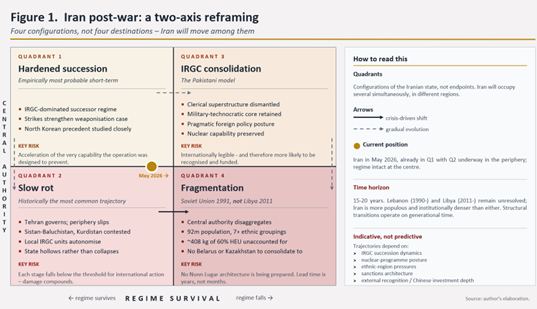
Source: author’s elaboration
Regime survives, central authority maintained – the “hardened succession” outcome (Q1). Empirically the most probable near-term configuration. Mojtaba Khamenei’s confirmation and survival (as the living vessel of a succession narrative), IRGC operational continuity, and the absence of mass protests during the bombing, all suggest institutional resilience. The configuration is not stable. A successor that has lost its founding leader, watched its conventional military take catastrophic losses, and absorbed the operational lesson that nuclear ambiguity invited an attack rather than deterred it, will rebuild on a different basis. The assessment is that the strikes may have strengthened the political case for weaponisation within Iran – and, arguably, elsewhere as well – capturing the irony of the outcome[14]. The regime survives – and accelerates the very capability the operation was designed to prevent. The North Korean precedent has been studied closely in Tehran.
Regime survives, central authority degrades – the “slow rot” outcome (Q2). Historically the most common trajectory. Tehran continues to govern formally and maintain coercive authority in the major cities, but its capacity to project authority into Sistan-Baluchistan, the Kurdish provinces, Khuzestan, and the eastern frontier with Afghanistan progressively erodes. Local IRGC and Basij units, no longer reliably paid, begin to operate as autonomous regional networks rather than instruments of central command. The state does not collapse; it hollows. Each stage of degradation falls below the threshold for international action, and the cumulative damage is largest precisely for that reason.
Regime falls, central authority maintained – the “IRGC consolidation” outcome (Q3). A constitutional regime change in which the clerical superstructure is dismantled but the IRGC remains as the operational core. The model is approximately Pakistani: a military-technocratic authority retaining nuclear capability, conducting foreign policy with greater pragmatism, dropping the most ideologically maximalist commitments. Rhetorically less alarming than its alternatives, but operationally more dangerous in one respect: a post-clerical IRGC state is more legible to international diplomacy, more capable of negotiating credible commitments, and consequently more likely to receive the recognition and reconstruction support that consolidates its (nuclear) position. Europe should be careful what it wishes for.
Regime falls, central authority breaks down – the “fragmentation” outcome (Q4). The configuration most often invoked, most often misunderstood, and most often modelled on the wrong analogy. Libya is the wrong frame: Libya’s pre-war population was approximately 6.4 million (2010), predominantly Arab-Berber in composition; Iran’s is approximately 92 million across at least seven significant ethnic groupings[15]. Libya’s institutional legacy was the absence of any genuine state structure[16]; Iran’s institutional skeleton – civil service, judiciary, central bank, tax administration – is qualitatively more sophisticated and more durable. The right comparison is the Soviet Union of 1991: a multi-ethnic, multi-confessional, nuclear-armed state whose central authority disaggregated into successor entities of varying legitimacy. That comparison opens onto a question no one is asking – whether a Nunn-Lugar-style cooperative threat reduction architecture[17] is being prepared for the fissile-material control problem a fragmenting Iran would generate[18]. The honest answer is that it is not. Iran possesses approximately 408 kilograms of 60% enriched uranium of which the IAEA has lost continuity of knowledge[19], sufficient for several weapons within weeks of further enrichment. There is no Belarus, no Kazakhstan, no Ukraine to consolidate the material to. There is no Russia to receive it.
A nuclear breakout in the centre, slow rot in the east, IRGC consolidation in the security apparatus, and pockets of fragmentation in Sistan-Baluchistan are not mutually exclusive.
A nuclear breakout in the centre, slow rot in the east, IRGC consolidation in the security apparatus, and pockets of fragmentation in Sistan-Baluchistan are not mutually exclusive – they are the most plausible composite outcome.
The eastern vacuum: the inversion no one is namingFor the better part of two decades, Iran has functioned as a significant – if self-interested – regional force in suppressing Sunni jihadism directed at Shia communities and Iranian state interests[20]. The Quds Force deployed to Iraq from June 2014 and played a central operational role in the fight against the Islamic State[21]. In Syria, Iran’s sustained military support for the Assad government served multiple objectives: preserving the land corridor to Hezbollah, maintaining a forward position against Israel, and – as a secondary effect – denying ISIS the territorial contiguity its proto-state required[22]. The IRGC has conducted repeated operations against Jaish ul-Adl in Sistan-Baluchistan, a Sunni Baluch militant group designated as a terrorist organisation by both Iran and the US[23].
If that capacity is degraded – by the war, by the succession, by the fiscal pressure of reconstruction, or by all three – the suppression collapses. ISIS-Khorasan Province (ISKP) does not need to conquer Iran. It needs Iran to be unable to police its own eastern frontier. The UN Analytical Support and Sanctions Monitoring Team has assessed ISKP as posing “the greatest extraregional terrorist threat” in its current configuration[24], with documented operational reach into Iran, Russia, and Western Europe[25]. The 3 January 2024 Kerman bombing against a Soleimani commemoration was conducted by ISKP Tajik nationals[26]. The Crocus City Hall attack in Moscow in March 2024 was the same operational network[27]. As of late 2025, ISKP is assessed as a resilient and still operationally potent affiliate, raising concerns about its potential to conduct high‑impact attacks in Asia or Europe in 2026[28].
The destruction of the IRGC’s external operational capacity produces a vacuum that ISKP, Jaish ul-Adl, Tehrik-e-Taliban Pakistan (TTP) and the constellation of Sunni jihadist networks across the Iran-Afghanistan-Pakistan corridor are already organised to occupy. The principal beneficiary of a degraded IRGC is the actor that has spent the past years rebuilding the operational infrastructure that the 2017 territorial defeat of ISIS was meant to have settled definitively.
Europe risks inheriting Iran-backed hybrid operations on European soil and a resurgence of jihadist radicalisation in its own neighbourhood simultaneously.
For European security services, the threat geometry is about to change in two channels at once. MI5 disrupted over forty Iran-backed plots in the UK between January 2022 and October 2025[29]. Successive Europol TE‑SAT reports document a pattern of jihadist plots in Belgium, France, Germany and Austria, with several transnational networks linked to the Islamic State and ISKP[30]. Iran-backed plots may, under fiscal pressure, become marginally less capable; ISKP networks, freed from their principal regional adversary, will become more so. Europe risks inheriting Iran-backed hybrid operations on European soil and a resurgence of jihadist radicalisation in its own neighbourhood simultaneously – the very combination of state‑assisted hybrid attacks and homegrown jihadist activity the 2017 territorial defeat of ISIS was supposed to have put an end to.
Reconstruction: the centerpiece is BeijingThe standard treatment of reconstruction proceeds through familiar coordinates: Washington has no appetite; Brussels has financial capacity but lacks operational presence as evidenced by their absence at the negotiation table; the Gulf states have means and proximity but limited will to help the neighbour that attacked them. Each observation is correct. Each is also peripheral, because the actor that will most consequentially shape the architecture is not present in the conventional Western framing at all.
China imported approximately 1.5 million barrels per day of Iranian (sanctioned) crude through 2025[31], accounting for roughly 90% of Iran’s oil exports and 12% of China’s total crude imports[32]. The 2021 Comprehensive Strategic Partnership agreement with Iran commits China to up to $400 billion in Iranian energy, banking, and infrastructure investment over twenty-five years against a discounted Iranian oil supply[33]. When the strikes began on 28 February, Beijing absorbed the immediate cost and is still continuing to do so. The IMF’s April 2026 World Economic Outlook revised China’s 2026 growth forecast downward 0.1% points from January to 4.4% – a modest revision reflecting Chinese strategic stockpiles, diversified sourcing, and overland Russian supply[34]. The cost is real but absorbable.
Beijing’s broader grand strategy of strategic patience: advancing its long-term interests without triggering immediate retaliation or coercive measures from the US or its allies. […] Beijing accumulates three structural gains.
The strategic return on absorbing it is considerable. China has positioned itself, throughout the war, as the calm power: condemning the strikes, calling for de-escalation, blocking US-led UNSC resolutions, and presenting itself as the multilateral interlocutor. This is not a contradiction with simultaneously enabling Iranian sanctions evasion through the Shandong “teapot” refinery network[35] and the shadow tanker fleet; it is the same strategy operating on two timelines. This dual-track approach allows China to reap the strategic benefits of Iranian oil – lower prices, increased leverage over global energy markets, and enhanced bargaining power in negotiations with both Tehran and Washington – while maintaining plausible deniability and limiting direct diplomatic fallout. It reflects Beijing’s broader grand strategy of strategic patience: advancing its long-term interests without triggering immediate retaliation or coercive measures from the US or its allies. In doing so, Beijing accumulates three structural gains.
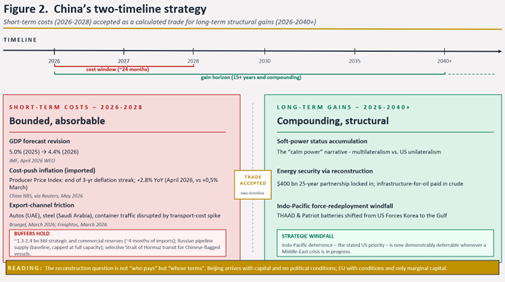
Sources: IMF, “World Economic Outlook: Global Economy in the Shadow of War”, 04/2026, p. 7; Alicia García-Herrero, “What the war in Iran means for China”, Bruegel, Analysis 06/2026, 17/03/2026; Yukun Zhang and Liz Lee, “China’s factory inflation hits 45-month high on energy price shock”, Reuters, 11/05/2026; Freightos, “Iran war pushing air rates up, and disrupting ocean”, Weekly freight updates, 10/03/2026.
First, status. China is establishing itself as the rising superpower whose conduct during a Middle Eastern crisis is characterised by restraint and adherence to international consensus, in deliberate contrast to the US, which undermines the very rules-based order it claims to defend. This will be the main soft-power win from the post-war moment, achieved without deploying a single military asset.
Second, energy security through reconstruction. Whatever post-war configuration emerges in Tehran, China will be present at the reconstruction table – in some respects, China is the reconstruction table. The infrastructure-for-oil arrangements pre-date the war[36]; they will be expanded after it. Chinese state enterprises will build the airports, refineries, and transport networks any post-war Iranian government will require – and will be paid in crude.
Third – the dimension that should most concern European and Indo-Pacific planners – a defence-industrial window. The Iran war has depleted US precision-munitions stocks at a rate without recent precedent: approximately $1.9 billion per day in operational expenditure in the opening phase, $16.5 billion by Day 12, much of it on interceptors expended against Iranian drone and missile salvoes[37]. As of March 2026, the US was actively transferring elements of THAAD and Patriot air defence batteries from US Forces Korea to the Middle East – effectively leaving the Indo-Pacific flank exposed and vulnerable to Chinese coercion, precisely when Washington lacks the long-range munitions, air defense systems, and interceptors needed to deter or fight a protracted war with China[38]. The 2025 National Security Strategy had identified Indo-Pacific deterrence – and specifically the prospect of conflict with China over Taiwan – as the principal organising priority of US force posture[39]. What the Iran war has produced is not a deferral of that priority by political choice, but by material constraint. Replenishing US’ depleted stocks will take years. European defence-industrial timelines are similar. China’s relative position improves not by its own action but by the involuntary slowdown in Western output, and the time gained will allow to close the qualitative gaps that remain in some Chinese platforms.
The Gulf will also play a role, but a different one than is commonly assumed. Saudi Arabia and the UAE have the financial means and the proximity to engage substantively. The UAE’s posture, articulated through the closure of its Tehran embassy, its withdrawal from OPEC+, and accelerated bilateral defence cooperation with Israel, is to harden against post-war Iran[40]; Saudi Arabia, having maintained its Tehran channel and joined the quadrilateral mediation effort with Egypt, Turkey, and Pakistan, is positioning to manage rather than confront[41]. The Gulf reconstruction contribution will be real but politically conditional, sectorally specific, and unlikely to operate through a unified GCC framework given the documented Saudi-UAE divergence on Yemen, Sudan, and now Iran.
Where Europe still has leverage, and where it has already lost itEurope was not at the table at the Islamabad talks of 12 April 2026. The negotiations that collapsed after 21 hours involved the US and Iran, mediated by Pakistan; the six countries whose airports, energy infrastructure and civilian neighbourhoods had been struck during the preceding 40 days were not formally consulted, nor was any European country or EU institution. Nor were they in the subsequent phases. That window has closed. The leverage Europeans hold from this point onward is not the leverage of presence at the negotiating architecture, but the leverage of structural positions they still hold outside it. Three remain: procedural-political (sanctions), technical (verification), and economic (reconstruction inputs). The first two leverages are still exercisable; the third is a residual hold that China is methodically substituting on a deliberate long timeline. All three are structural positions Europeans have, in similar past circumstances, forfeited by default.
The first is the sanctions architecture. The September 2025 snapback of UN sanctions[42], invoked by France, Germany and the United Kingdom (the “E3”) under UNSC Resolution 2231, restored the pre-2015 sanctions regime against Iran[43]. Unlike bilateral US sanctions, the UN architecture cannot be lifted unilaterally by Washington. Any reconstruction trajectory that requires sanctions relief must, at the UN level, pass through the “E3”. At the EU level, the same is true through its autonomous proliferation-related sanctions architecture it reimposed in parallel with the snapback, through Council regulations[44]. This second layer is purely European, modifiable only by the Council, meaning that any comprehensive economic component of an Iran settlement must also pass through European political scrutiny. This is the most concentrated point of European influence in the post-war period and yet the most easily traded away or disregarded – as evidenced in the current negotiations, the Trump administration has proceeded as though the EU/UN sanctions architecture were a mere administrative formality, a footnote to be inserted in the final deal. Any decision to support sanctions relief without commensurate political conditionality (verified IAEA re-access, operational dismantling of the IRGC’s external operations apparatus, specific commitments on the proxy network) converts this leverage into a one-time gift. The precedent of Iraq, Afghanistan and Libya, where European reconstruction commitments were extended without strategic conditionality, suggests this is the default trajectory unless a deliberate decision is taken otherwise.
The second is the verification and export control infrastructure. The IAEA has explicitly acknowledged that it has lost continuity of knowledge over Iran’s enriched material[45]. Any post-war re-establishment of inspector access will rest on technical infrastructure in which the EU holds a distinct institutional position. The European Commission’s Joint Research Centre operates the principal non-US supporting infrastructure for IAEA environmental sample analysis in 3 different locations[46]. These are EU institutional assets structurally integrated into the IAEA’s safeguards verification system. The multilateral export-control architecture through which Iranian reintegration into the global nuclear economy must pass – the Nuclear Suppliers Group, Missile Technology Control Regime, Wassenaar Arrangement – operates by consensus[47]: a settlement that bypasses these regimes does not deliver reintegration, and one that goes through them goes necessarily through European votes.
The third position is hybrid: a residual leverage today, but a structural advantage China is methodically working to substitute. The EU and its Member States currently hold, at the technical and regulatory frontier of reconstruction, inputs no other actor can replace in the near term – euro-clearing and the European banking system through which any non-Chinese/Asian component of sanctions relief must operate[48]; the energy-services expertise of TotalEnergies, Eni, and Shell; the EU dual-use export control regime[49]; and a significant share of the estimated $100 billion Iranian frozen funds globally, whose release is a European political decision. None of these is replicable by Beijing in 2026. But each is being progressively eroded along a trajectory China has been deliberately constructing since the 2018 US withdrawal from the JCPOA. In the Iran-China bilateral channel, yuan settlement is now operational and growing through China’s Cross-Border Interbank Payment System (CIPS), though the system remains a fallback rather than a substitute at scale[50]. The European banking system continues to chokepoint Iran’s trade with non-Chinese/Asian partners [51] but no longer chokepoints the Iran-China channel itself. The technical lead of European oil majors – exposed between 2018 and 2019 when CNPC inherited TotalEnergies’ operatorship on South Pars Phase 11 and then withdrew without delivering[52] – is being closed through Chinese involvement in sanctioned Iranian and Russian projects. Chinese-based procurement networks have substantially eroded the enforcement reach of the EU dual-use regime since 2018 by serving as transshipment hubs and front-company intermediaries that route US, European, and Japanese-origin components to Iranian missile, drone, and other military programmes; the European regulatory architecture still nominally governs export licensing but is increasingly defeated at the implementation layer. Frozen assets remain a uniquely European hold on past Iranian holdings, but future reserves placed in yuan and Chinese banking infrastructure route around this leverage entirely.
China will invest in infrastructure, energy, and logistics, setting the technical standards and accepting zero conditionality on governance.
The implication for European reconstruction planning is therefore not what the conventional Western reading suggests. Europe will pay (substantially, on humanitarian assistance, refugee management, civil society and judicial reconstruction, transitional justice), by “normative-power reflex”, and because these are the categories that translate least into political influence and that Beijing is content to leave to others. China will invest in infrastructure, energy, and logistics, setting the technical standards and accepting zero conditionality on governance. Europeans risk watching the strategic shape of the country they are helping to feed be determined elsewhere. This is the recurring pattern of European Middle East and Sahel policy: in Iraq, European reconstruction commitments since 2003 have produced little political weight in Baghdad; in the Sahel, two decades of European development and security investment did not prevent the active expulsion of EU CSDP missions between 2022 and 2024, and European actors are now perceived primarily through the very colonial register the investments were meant to displace. What distinguishes Iran from these precedents is the time horizon. The European inputs are real today; their Chinese substitution is a project of years for some categories and decades for others. The window in which European reconstruction conditionality could be exercised as leverage, is open. But it is narrow, and it is closing.
…the relevant question is therefore no longer whether the EU has a leader but which capital is best placed to lead.
The emerging architecture. What no structural position can substitute for is the political agency to exercise it. France has begun to construct that agency on three fronts, each whose translation into European leverage is contingent on partners following. The “dissuasion avancée” doctrine presented by President Macron at Île Longue on 2 March 2026 opened a Franco-European nuclear dialogue with eight partners[53] and was framed against a deteriorating strategic environment shaped by Russian coercion, uncertainty over U.S. extended deterrence, and the wider fallout of the Iran conflict[54]. The Strait of Hormuz maritime navigation initiative co-chaired by Macron and Prime Minister Starmer on 17 April 2026 assembled 49 non-belligerent states around an instrument explicitly designed to be more agile than EU consensus permits[55], and notably without US participation[56]. Macron’s Athens visit on 25 April 2026 extended the 2021 Franco-Greek Strategic Partnership Agreement and used the occasion to elevate Article 42.7 TEU – the EU’s mutual assistance clause, used only once by France itself – as the operative legal architecture for European collective defence, described by Macron as “reinforced concrete” (béton armé) and “stronger” than NATO Article 5[57]. The recent joint Franco-Greek response (even without activation of article 42.7 TEU) to the drone attack on the British airbase at Akrotiri (Cyprus) during the US-Israel strikes on Iran was cited as evidentiary proof that the clause operates as a binding commitment rather than a symbolic gesture. The relevant strategic actor in these initiatives is France leading the way with whatever partners can be assembled. Whether Berlin, Rome, Madrid, Warsaw, and other capitals convert these initiatives into a sustained European posture will determine whether the structural leverage outlined above is translated into operational leverage in the coming decade. Either path settles a question European strategic discourse has long preferred to leave ambiguous. In the first, partners step up and the EU institutional framework absorbs what France has begun, giving the architecture the appearance of multilateral/European cohesion. In the second, partners do not step up, and the post-war moment formalises what the recurring pattern of European foreign and security policy (from the “E3” on Iran to the Normandy format on Ukraine, from Operation IRINI in the Mediterranean to the Indo-Pacific strategy) has already been making increasingly difficult to deny: that the EU does not lead in the sense the term is usually understood. European leverage, as exercised, depends on lead states willing to act ahead of consensus, and the relevant question is therefore no longer whether the EU has a leader but which capital is best placed to lead on which file (and the depth of the lead). The two paths are not equally probable; the empirical record of EU CFSP/CSDP overwhelmingly favours the lead-state model.
What is missing is not capacity. It is political will to convert capacity into coordinated action before the reconstruction trajectory institutionalises around configurations that no longer admit European conditionality. The window is approximately the next eighteen months.
Conclusion: the cost of strategic absenceThe war that didn’t start, did not, in any meaningful sense, stop.
The war that didn’t start, did not, in any meaningful sense, stop. The Iranian state continues under economic siege, partial territorial fragmentation in its eastern provinces, accelerating nuclear ambition, an external proxy network in operational uncertainty, and a reconstruction landscape whose principal financier is a power whose strategic interests are not aligned with any European preference. The morning after is not a moment. It is a 15 to 20-year process whose first eighteen months will determine its shape.
The recurring pattern of European Middle East policy – absent at the political architecture, present at the financing, surprised at the outcome – has been remarked upon for the better part of three decades. What the 2026 conflict has done is render the pattern’s costs immediate rather than deferred. Migration flows from a fragmenting Iran will not terminate at the EU’s external border; the proliferation cascade will not respect the Mediterranean; the ISKP operational tempo will not pause for European institutional consensus; the reconstruction investments shaped by Beijing will not be re-shaped by Brussels after the fact.
The choice now facing European institutions is not whether to be involved in post-war Iran. The choice is whether the involvement will be strategic or supplementary.
The choice now facing European institutions is not whether to be involved in post-war Iran. The choice is whether the involvement will be strategic or supplementary. The institutional and political prerequisites for strategic involvement are achievable on the 18-month timeline the war has imposed. They are not, on current evidence, being assembled. The bill for the Iran war will, as the previous paper in this series argued, come due over years rather than weeks. The bill for European strategic absence will come due faster.
Policy recommendations
- European institutions must condition all reconstruction financing on verifiable political outcomes – IAEA re-access to Iranian nuclear material, dismantling of the IRGC’s external operations apparatus, and substantive commitments on proxy networks. Conditionality requires institutional unity across the “E3” and substantive coordination with the EU institutions; it cannot be assembled bilaterally after the fact.
- The E3 should treat the snapback sanctions architecture as a strategic asset rather than a bargaining chip. Any sanctions relief negotiated through the post-war process must be sequenced against verified political and proliferation outcomes, not bundled into a single grand bargain.
- European defence, intelligence and counter-terrorism services should prepare urgently for the inversion of the regional Sunni-jihadist threat geometry. The degradation of IRGC counter-jihadist capacity, combined with ISKP’s documented operational reach, will produce simultaneous changes in both Iran-backed hybrid operations on European soil and Sunni jihadist threat profiles. The institutional reflex to treat the two threats as separate categories must be replaced by an integrated framework.
- The EU and its member states must build a Nunn-Lugar-equivalent fissile material control architecture for the contingency of Iranian central authority degradation. Approximately 408 kilograms of 60% enriched uranium, of which the IAEA has lost continuity of knowledge, is unaccounted for in any current planning framework. The institutional and technical lead time for cooperative threat reduction architectures is measured in years, not months. It must begin now.
- Europe must convert the French initiatives – forward deterrence, the Strait of Hormuz initiative, the TEU’s 42.7 article – into a sustained European posture. The relevant lead actor is not the EU as an institution but Europe broadly conceived, led by capitals capable of action and capable of federating other countries. Aggregating European money with Chinese capital on equivalent political terms is the worst of available options; the alternative is to act through the channels Europe controls, on the conditions Europe sets.
[1] Operation Epic Fury was declared concluded on 5 May 2026 in a brief statement by US Secretary of State Marco Rubio. See US Department of State, “Statement by Secretary of State Marco Rubio on the conclusion of Operation Epic Fury”, 5 May 2026.
[2] War Powers Resolution of 1973 (Public Law 93-148), Section 5(b): the President must terminate the introduction of US armed forces into hostilities within sixty calendar days unless Congress has declared war or extended the period by law. See also Congressional Research Service, “The War Powers Resolution: Concepts and Practice”, Report R42699, 03/08/2019.
[3] The White House, “National Security Strategy of the United States of America 2025”, Washington, DC: Executive Office of the President, 04/12/2025.
[4] US Department of War, “2026 National Defense Strategy”, 23/01/2026.
[5] Stephen Pomper, “One man’s war”, Foreign Affairs, 03/03/2026; for the documented MAGA split, see Molly Ball, “Can Trump bomb Iran and still be ‘America First’?”, Wall Street Journal/ABC News Daily, 26/06/2025.
[6] Dahlia Scheindlin, “Kill or Die: How Israel’s Netanyahu Has Waged War on Diplomacy for Decades”, Haaretz, 20/03/2026.
[7] Stefanie Hausheer Ali, “’They have been exposed’: The Iran war upends Gulf states’ security and business model”, Atlantic Council, 20/04/2026.
[8] Scott Koch, “The Road to Covert Action in Iran, 1953”, Studies in Intelligence, Vol. 48, No. 2, pp. 33-44.
[9] CIA History Staff Analysis Gerald Haines, “CIA and Guatemala Assassination Proposals 1952-1954”, CIA Historical Review Program, Released as sanitised, 1997.
[10] Directorate of Intelligence, “Chile: Pinochet and the Military [redacted]”, CIA, Declassified and approved for release 07/2000. See also Select Committee to study governmental operations with respect to intelligence activities, “Staff Report: Covert Action in Chile 1963-1973”, United States Senate, 1975.
[11] There is no single canonical “playbook” document. The pattern is reconstructed from operational records. See notably CRS, “Covert Action and Clandestine Activities of the Intelligence Community: Selected Definitions”, Report R45175, 29/11/2022.
[12] Eldar Mamedov, “The Pahlavi Mirage”, Foreign Policy in Focus, 19/02/2026
[13] For the Mojahedin-e-Khalq or MEK’s lack of domestic legitimacy, see CRS, “The Mojahedin-e-Khalq (MEK) or People’s Mojahedin Organization of Iran (PMOI)”, Report R48433, 25/02/2025.
[14] See previous policy paper “The strategy Iran built for forty years – and the war the West still doesn’t understand”, ELIAMEP, Policy paper #204, 05/2026; See also Arms Control Association, “U.S. War with Iran: New and Lingering Nuclear Risks”, Issue Briefs, Vol. 18, Issue 4, 10/03/2026; See Georgia Cole, “The Iran War Risks Triggering a New Wave of Nuclear Proliferation”, Chatham House, 30/03/2026.
[15] See Minority Rights Group, “Iran” country profile, 2024. Persian-share estimates range from 61 to 65%; the variance reflects the absence of authoritative ethnic census data since 1979.
[16] For a deeper dive into Libya’s structure, an excellent read: Peter Cole and Brian McQuinn (eds.), “The Libyan Revolution and Its Aftermath”, Hurst, 02/2015.
[17] The Nunn-Lugar Cooperative Threat Reduction (CTR) programme, established by the U.S. Congress in 1991 (sponsored by Senators Sam Nunn and Richard Lugar), provided funding and technical expertise to secure, consolidate, and dismantle nuclear, chemical, and biological weapons inherited by successor states following the Soviet collapse. It oversaw the denuclearisation of Belarus, Kazakhstan, and Ukraine, and the securing of fissile material across Russia. No comparable multilateral architecture currently exists for a potential Iranian fragmentation scenario. See Center for Arms Control and Non-proliferation, “Factsheet: The Nunn-Lugar Cooperative Threat Reduction Program”, 29/03/2022.
[18] The Soviet collapse left ~30,000 nuclear weapons across four successor states; the architecture took over a decade to consolidate. For more information, see Jason Ellis and Todd Perry (eds.), “Nunn-Lugar’s Unfinished Agenda”, Arms Control Today, 10/1997, republished by the Belfer Center for Science and International Affairs, Harvard Kennedy School.
[19] IAEA, “Verification and Monitoring in the Islamic Republic of Iran in light of UN Security Council resolution 2231 (2015)”, 31/05/2025, pp. 3 and 9; see also “IAEA Director General Grossi’s Statement to UNSC on Situation in Iran”, Vienna, 20/06/2025.
[20] Of note: this counter-jihadist posture, however, coexists with a deliberate and well-documented exception: Iran has consistently financed and armed Hamas and Palestinian Islamic Jihad – both Sunni organisations – on the basis of shared anti-Israel strategic objectives, irrespective of the Sunni-Shia theological divide (Erik Skare, “Iran, Hamas, and Islamic Jihad: A Marriage of Convenience”, European Council on Foreign Relations, 18/12/2023). The IRGC’s regional role is thus best characterised not as a principled counter-jihadist architecture, but as a selectively applied instrument of Iranian geopolitical interest.
[21] With Major General Qasem Soleimani personally coordinating the Iranian-backed Popular Mobilisation Forces. For a deeper dive on the implications of the rise of ISIS in Iran’s immediate neighbourhood for Tehran’s policies in Syria and Iraq, see Dina Esfandiary and Ariane Tabatabai, “Iran’s ISIS Policy”, International Affairs, Vol. 91, Issue 1, 01/2015.
[22] See the CTC Sentinel, “Special Issue”, Vol. 6, Issue 8, 08/2013 and in particular the following article: Karim Sadjadpour, “Iran’s Unwavering Support to Assad’s Syria”, pp. 11-13.
[23] Janatan Sayeh, “Jaish al-Adl Claims Responsibility for Twin Attacks in Iran’s Sistan and Baluchistan”, Long War Journal, 01/10/2024.
[24] UNSC, “Thirty-fifth report of the Analytical Support and Sanctions Monitoring Team submitted pursuant to resolution 2734 (2024) concerning ISIL (Da’esh), Al-Qaida and associated individuals and entities”, S/2025/71, 06/02/2025.
[25] Soufan Center, “Nearing the End of 2025, what is the State of the Islamic State?”, Intelbrief, 19/12/2025.
[26] National Counterterrorism Center, “ISIS-Khorasan (ISIS-K)”, Terrorist Groups, Counter Terrorism Guide, 03/2025. For more information on the development of the terrorist threat in Central Asia, see Brianne Todd, “Assessing the Terror Threat Landscape in South and Central Asia and Examining Opportunities for Cooperation”, statement before the Subcommittee on South and Central Asia, Committee on Foreign Affairs, U.S. House of Representatives, 119th Cong., 26/06/2025.
[27] Jessica Rawnsley, “Nineteen jailed over deadly Moscow concert attack”, BBC, 12/03/2026.
[28] Soufan Center, op. cit.
[29] 20 Iran-backed plots between January 2022 and October 2024 and another 20 between October 2024 and October 2025. Sir Ken McCallum (MI5 Director General), Annual Threat Updates of 8 October 2024 and 16 October 2025.
[30] Europol, “European Union Terrorism Situation and Trend Report (TE-SAT)”, 2024 (pp. 11-14) and 2025 (pp. 23-24) editions.
[31] China imported a record-high 11.6 million barrels per day of crude oil in 2025, including sanctioned crude from Iran and Venezuela. Low oil prices, geopolitical risks, and global oversupply made it strategically advantageous to stockpile Iranian crude as part of China’s energy security strategy, given its heavy reliance on imported oil (over 70% of consumption, 90% seaborne). See Erica Downs, “Where China Gets Its Oil: Crude Imports in 2025 Reveal Stockpiling and Changing Fortunes of Certain Suppliers, Including Those Sanctioned”, Center on Global Energy Policy, Columbia University, SIPA, 29/01/2026. According to China’s General Administration of Customs (GAC), no oil imports have been made from Iran since 2022 – it is generally rebranded as Malaysian. See also Erica Downs, “Implications of the Conflict in the Middle East for China’s Energy Security”, Center on Global Energy Policy, Columbia University, SIPA, 04/03/2026.
[32] US-China Economic and Security Review Commission, “China-Iran Fact Sheet”, 16/03/2026, pp. 4-5.
[33] Ibid., p. 4. See also Austin Ramzy, “Why China Is Doing So Little to Help a Friend under Fire”, Wall Street Journal, 03/03/2026.
[34] International Monetary Fund, “World Economic Outlook”, 04/2026, p. 11.
[35] The term “teapot refineries” refers to independent, smaller-scale Chinese refineries that were historically regional and processed mostly domestic crude oil. In the 2010s, the Chinese government granted them the right to import crude oil, which transformed them into key players in China’s refining sector. Today, teapot refineries play a crucial role in importing sanctioned oil from Iran, Venezuela, and Russia, leveraging their operational flexibility and connections to sanctions-evasion networks while avoiding the stricter geopolitical constraints faced by China’s major state-owned oil companies (such as Sinopec or CNPC – China National Petroleum Company). They rely on sophisticated sanctions-evasion networks involving shadow tankers, ship-to-ship transfers at sea, falsified shipping documentation, and complex financial transactions to obscure the origin of the crude.
[36] The Comprehensive Strategic Partnership agreement signed in Tehran on 27/03/2021.
[37] Mark Cancian and Chris Park, “Iran War Cost Estimate Update”, Center for Strategic and International Studies, 13/03/2026.
[38] Seth G. Jones, “Is the United States prepared for a war with China?”, Center for Strategic Studies, CSIS Brief, 05/2026.
[39] The White House, National Security Strategy of the United States of America 2025, Washington, DC: Executive Office of the President, 04/12/2025, pp. 20 and 23. See also Congressional Research Service (written by Daniel J. Longo), “U.S.-South Korea Alliance: Background and issues for Congress”, Report R48877, 05/03/2026, pp. 14-17.
[40] Javad Heiran-Nia and Hessam Habibi Doroh, “Iran Applies Different Postwar Approaches to the Persian Gulf Arab States”, Stimson Center, 07/05/2026.
[41] Eric Alter, “What Gulf states need in a US-Iran deal”, Atlantic Council, 07/05/2026.
[42] United Nations Security Council, “Resolution 2231”, S/RES/2231, 20/07/2015.
[43] Congressional Research Service (written by Paul Kerr), “Iran”s Nuclear Program and UN Sanctions Reimposition”, Report IF11583, 06/04/2026.
[44] Council Regulation (EU) 2025/1975 of 29 September 2025 amending Regulation (EU) No 267/2012, sectoral measures; Council Implementing Regulation (EU) 2025/1980 of 29 September 2025, reinstating EU autonomous asset-freeze designations; Council Implementing Regulation (EU) 2025/1982 of 29 September 2025, reinstating UN-mandated designations in Annex VIII. All three amend the consolidated framework of Council Council Regulation (EU) 267/2012 of 23 March 2012 concerning restrictive measures against Iran. For a complete overview and timeline, see Council of the European Union, “Iran sanctions snapback: Council reimposes restrictive measures”, press release, 29/09/2025 and Council of the European Union, “Timeline – EU Sanctions against Iran”.
[45] IAEA, “Verification and Monitoring […]”, p. 3, op. cit.
[46] JRC-Karlsruhe (Germany) is an accredited NWAL (IAEA’s Network of Analytical Laboratories (NWAL) for particle analysis) laboratory for particle analysis, see European Commission, “Environmental sample analysis”, Joint Research Center (JRC); JRC-Geel (Belgium) supplies the certified reference materials and interlaboratory comparison programme against which NWAL measurements are calibrated, see IAEA, “The IAEA Safeguards Analytical Laboratories”, Information series, 12-4278/Factsheets/October 2012/E; the EURATOM on-site laboratory at La Hague (France) provides direct measurement capability inside a reprocessing facility, see European Commission, “Operating the Euratom on-site Laboratory”, JRC.
[47] On the consensus rule and membership: Nuclear Suppliers Group, “NSG at a Glance”, Arms Control Association (48 participating governments; all decisions by consensus); Missile Technology Control Regime, “Frequently Asked Questions” (35 partners; informal arrangement; consensus decisions); and Wassenaar Arrangement, “About us” (42 participating states; all Plenary decisions by consensus). On the binding character of European votes in past supply-architecture decisions, see the 2008 NSG waiver for India, in which consensus (admittedly, under US pressure) had to be actively secured from several European holdouts; for analysis, see Mark Hibbs, “Will India and Pakistan Ever Join the Nuclear Suppliers Group?”, Arms Control Today, 11/2024.
[48] The euro is the dominant non-dollar settlement currency, and euro-clearing runs through eurozone infrastructure (notably TARGET2, operated by the Eurosystem) under European regulatory supervision. The INSTEX experience (2019-2023) demonstrated that formal sanctions relief produces no economic effect if European banks decline to process transactions: sustained European banking cooperation is therefore a separate political decision from sanctions removal. See Jack Percival, “The INSTEX project: why did Europe’s ambitious financial vehicle fail, and what next?”, Foreign Affairs Review.
[49] Regulation (EU) 2021/821, 20/05/2021, establishing a Union regime for the control of exports, brokering, technical assistance, transit, and transfer of dual-use items.
[50] Launched by the People’s Bank of China in 2015, CIPS connected 1,683 financial institutions across the globe by May 2025 (with the majority being indirect participants) and processed an annual transaction volume of approximately 175,49 trillion yuan ($24,45 trillion), a 43% year-over-year increase. Daily transaction volume rose to approximately $134 billion in March 2026 – which is not to be read as proof of Iranian oil payments solely, but rather as a sign of broader growth. The system remains nonetheless, for the moment, a “dollar bypass” rather than a substitute at scale: yuan’s share of global SWIFT payments stood at 3% in February 2026, against 24% for the euro and 48% for the dollar. For more information, see Alisha Chhangani, “Inside Tehran’s toll booth”, Atlantic Council, 02/04/2026; see also Joe Baker, “Is China’s cross-border payments network on the rise?”, FXC Intelligence, 04/07/2025.
[51] The EU and its Member states, UK, Japan, South Korea, India, Türkiye, the Gulf states.
[52] In July 2017, Total SA (renamed TotalEnergies in 2021) signed a $4.8 billion contract with NIOC (National Iranian Oil Company) and CNPC to develop South Pars Phase 11 (Total 50.1% as operator, CNPC 30%, Petropars 19.9% as subsidiary of NIOC). Total withdrew in August 2018 following the US reimposition of secondary sanctions; NIOC reassigned the operatorship to CNPC in November 2018, but CNPC withdrew on 6 October 2019 without delivering meaningful development. Petropars became sole developer. The episode is the clearest documented test case of Chinese substitution for a European international oil major in Iranian energy development; the substitution was attempted and abandoned, primarily reflecting Chinese reluctance to defy US secondary sanctions.
[53] The United Kingdom, Germany, Poland, the Netherlands, Belgium, Greece, Sweden, and Denmark.
[54] Élysée, “Discours du Président de la République sur la dissuasion nucléaire de la France”, Île Longue, 02/03/2026; see also Héloïse Fayet, “France has a new nuclear doctrine of ‘forward deterrence’ for Europe. What does it mean?”, Bulletin of the Atomic Scientists, 05/03/2026.
[55] Hereby recognising that the unanimity requirement of EU foreign and security policy is incompatible with the operational tempo of the post-war moment.
[56] Élysée, “Strait of Hormuz maritime navigation initiative”, 17/04/2026; “France-UK joint statement on the Strait of Hormuz”, 17/04/2026.
[57] Élysée and Hellenic Republic Prime Minister’s Office, joint communiqué, Athens, 25 April 2026; on Macron’s elevation of Article 42.7 TEU, see “Mitsotakis-Macron reinforce mutual defense pact as ‘reinforced concrete’ commitment”, Athens Times, 26/04/2026. On the legal architecture itself, see EEAS, “Article 42(7) TEU – The EU’s mutual assistance clause”, 06/10/2022. Of note is also the 2021 Franco-Greek Strategic Partnership on Defence and Security Cooperation which was, at the time of signature, the first bilateral mutual defence pact between two NATO members; Article 2 commits the parties to mutual military assistance “by the use of armed force” in the event of armed aggression, pursuant to Article 51 of the UN Charter – a commitment legally separate from and additional to both NATO Article 5 and Article 42.7 TEU. For a deeper dive, see Bruno Tertrais, “Reassurance and Deterrence in the Mediterranean: the Franco-Greek Defense Deal”, Institut Montaigne, 17/11/2021.
Catégories: Diplomacy & Defense Think Tank News
Why Greece Should (Re)Establish a Bilateral Development Assistance Program
The policy brief argues that Greece should re-establish a substantial bilateral development aid programme, as its current contribution remains particularly low compared both to its international commitments and to pre-crisis levels. Development aid is not only as an act of solidarity, but also an instrument of foreign policy, security, and public diplomacy.
- Greek official development assistance remains very low (0.14% of Gross National Income in 2024), far below the country’s international commitments.
- The crises in Ukraine, Gaza, and Sudan require increased humanitarian assistance and reconstruction support.
- Development aid is an instrument of foreign policy, security, and public diplomacy. It is an investment in stability and international credibility. If Greece wishes to play a role in its broader geopolitical region and participate actively in major European Union initiatives, like the Global Gateway, it must develop a bilateral aid programme.
Read here (in Greek) the Policy brief by Asteris Huliaras, Professor, Department of Political Science and International Relations, University of the Peloponnese; Member of the Advisory Board of ELIAMEP.
Catégories: Diplomacy & Defense Think Tank News
From Raw Ores to Strategic Autonomy: The Western Balkans in Europe’s Critical Raw Materials Strategy
The policy brief authored by Dr. Ana Krstinovska, Senior Research Fellow, think nea – New Narratives of EU Integration & Research Fellow, Wider Europe Programme, ELIAMEP titled: “From Raw Ores to Strategic Autonomy: The Western Balkans in Europe’s Critical Raw Materials Strategy”, is an expansion of the finding of the thematic report “Raw Materials for a Resilient Europe: The EU’s Strategic Partnership with the Western Balkans” (authored by Dr. A. Krstinovska and Dr. A. Wolf) and it examines the strategic importance of the Western Balkans for Europe’s critical raw materials security and industrial resilience. The brief is part of think nea – New Narratives of EU Integration, an initiative implemented by the Hellenic Foundation for European & Foreign Policy (ELIAMEP) and supported by the Open Society Foundations – Western Balkans.
Against the backdrop of the EU Critical Raw Materials Act (CRMA) and growing geopolitical competition over access to strategic resources, the brief analyses how the Western Balkans have emerged as a significant, yet underutilized, component of Europe’s raw materials ecosystem. It highlights the region’s deposits of copper, lithium, aluminium, nickel, antimony, and rare earth elements, while examining the geopolitical and economic implications of existing extraction and trade patterns.
The analysis demonstrates how current value chains often channel raw ores and concentrates from the Western Balkans towards China, while processed goods flow to EU markets, reinforcing Europe’s strategic vulnerabilities and limiting regional industrial development. The paper also explores the growing role of non-EU actors in the region’s extractive industries, the lack of local refining and processing capacities, and the governance, environmental, and social challenges associated with major mining projects.
Drawing on these findings, the brief argues that the EU should move beyond a narrowly extractive approach and embed raw materials cooperation within the enlargement process itself. It proposes a strategy centred on value-chain upgrading, regional industrial integration, investment in processing and recycling capacities, updated geological mapping, and stronger governance conditionality linked to EU accession chapters.
The paper concludes that the Western Balkans can contribute substantially to Europe’s strategic autonomy if integrated into EU industrial and regulatory frameworks in a credible and sustainable manner. In this sense, the brief presents raw materials cooperation not only as an economic necessity, but also as a geopolitical and enlargement opportunity capable of strengthening both European resilience and the EU accession perspective of the region.
You can read the policy brief here.
Catégories: Diplomacy & Defense Think Tank News
How does the Xi–Trump summit affect the strategic equilibrium of US–China relations, and what might the implications be for international security and the global economy? – ELIAMEP experts’ views
Ino Afentouli, Senior Policy Advisor; Head of the Observatory of Geopolitics and Diplomacy, ELIAMEP
The Xi–Trump summit brings together two vastly different personalities who serve as the primary architects of their countries’ strategic policies. The first, a scion of the Party elite, embodies the Chinese perception of the ‘Middle Kingdom’—of China as the realm between heaven and earth. In this view, China does not need to keep pace with time; instead, time is seen as an asset that works in its favour. Trump, by contrast, is operating on a far more constrained timeline, with only two years remaining of his presidency. His penchant for taking decisions on his own often leads to choices detrimental to his country’s interests, as evidenced by the course of the war in Iran. There can be no doubt that the Chinese leadership has taken note of the mistakes the US has made in its handling of the crisis.
Trump’s personality makes it more likely that the US, rather than China, will fall into the so-called Thucydides Trap. As an ascending power, and true to its strategic tradition of defeating an opponent without engaging in battle, China has the luxury of patience. This is something Trump’s America lacks. The US has to preserve the hegemony it has constructed over eight decades, underpinned by its strategic partnerships across Europe and Asia. But Trump is allergic to alliances; under his presidency, the US risks forfeiting the strategic added value that has enabled American primacy in both continents.
China’s approach to establishing spheres of influence, not only within its own periphery but also on a broader international scale, will be crucial to the emerging balance of power. Chinese strategy over recent decades has prioritized economic penetration as a primary vehicle for exerting political influence. During his 15 years in power, Xi has combined economic power with military might. Huge investments have been made in the armed forces; furthermore, the recent purges—which effectively decapitated virtually the entire military high command—underscore that establishing military primacy remains among his highest strategic priorities. Will this primacy be projected defensively or offensively? The answer to this question will determine the global equilibrium in the years ahead. Xi could exploit the vulnerabilities in Trump’s character, manoeuvring him towards Thucydides’ trap. Possessing strategic patience, Xi is capable of ensnaring Trump in the logic of war through actions that do not jeopardize China’s own security. In this light, the debacle in Iran assumes far greater proportions for the US than a mere military failure. One can only hope the Chinese leader does not pursue such a course while Trump is in office.
Eleni Ekmetsioglou, Non-Resident Fellow, ELIAMEP; Senior Fellow, British American Security Information Council (BASIC)
The Xi-Trump meeting happens at a very unfavorable moment for the US. As many analysts have argued, with the US trapped in the Middle East, China seems to have the upper hand on most of the agenda items. Whereas tariffs, technology and probably Taiwan will dominate the discussions, it might, nevertheless, be the right moment for the US to try and press on other -equally important and highly consequential- issues such as nuclear risk reduction measures. Given that US pundits and official intelligence reports make ominous speculations about the future trajectory of China’s nuclear arsenal, it is in US interests to push for an institutionalized track 1 dialogue for both parties to work towards a better mutual understanding on nuclear issues that might lead to tangible risk reduction measures such as the establishment of a formal missile launch notification regime, for instance. With the quantitative increase in China’s nuclear arsenal, the US has been feeling that its current nuclear modernization might not be fit for purpose in a world with two peer competitors, Russia and China. After the expiration of the New Start treaty last February, the US is not bound by restrictions over the numbers of its deployed warheads. With both countries investing in their nuclear arsenals for quantitative and qualitative improvements, the nuclear component inevitably plays a bigger role in the relationship creating a dangerous dynamic where even a minor crisis between the two powers will have the potential of turning into a nuclear crisis with unprecedented consequences for the region and the whole planet. The Biden administration scored a major success when the two parties agreed to always include a human in the loop for nuclear decision making. AI and nuclear command and control was the low hanging fruit for the Biden administration but it could mark a great starting point towards a more diverse dialogue on precise risk reduction measures in order to boost crisis stability between the two countries. Hopefully, the Trump administration will be prepared to press Xi on this deeply consequential aspect of the bilateral relationship and continue the positive trend that the Biden administration kicked off in San Francisco back in 2023.
George Tzogopoulos, Senior Research Fellow, ELIAMEP; European Institute of Nice, Centre international de formation européenne (CIFE)
Understanding China remains an extremely complex undertaking in the West. For instance, while US think tanks and media assess that President Trump will not hold the upper hand in his meeting with Chinese President Xi Jinping, Beijing does not operate within this Western paradigm. From a Chinese perspective, it matters little where the White House is occupied by Donald Trump, Joe Biden or anyone else. The web of Sino-American relations is so intricate that a single summit—regardless of its gravity—cannot be expected to yield a definitive breakthrough. China predicates its success on its own strategic choices, negotiating only to secure a measure of relative stability in its relations with Washington. While stability serves the interests of both nations, the path forward is arduous—a reality consistent with historical precedent. Although Sino-American competition is set to intensify, it remains within the power of both states to mitigate the risk of catastrophic consequences. The United States will remain the sole superpower, yet China—as the world’s second-largest economy—will command an amplified voice in global economic and geopolitical affairs. It is this very dynamic that is causing tremors in the international system, as the United States is forced to adapt to a reality far removed from the unipolar era it enjoyed for two decades following the Cold War.
Dimitris Tsarouhas, Senior Research Fellow, ELIAMEP; Professor, Center for European and Transatlantic Studies (CEUTS) at Virginia Tech
Measured tones and muted expectations
In a normal political and economic climate, a meeting between a US President and his Chinese counterpart would be front-page news here in Washington, sparking a deluge of analysis aimed at gauging Beijing’s intentions. However, the current climate is anything but normal—at least for Donald Trump.
With inflation hitting 3.8%, its highest level in nearly three years, the gap between the President’s campaign promises and the economic reality has reignited public frustration with the administration’s fiscal direction. Pledges to shield Americans from an unstable global environment are being belied on the ground. Not only is the US embroiled in yet another conflict in the Middle East at great economic and political cost, the administration’s tariff regime—aimed largely at Chinese imports—is also faltering amidst judicial scrutiny and bureaucratic deadlock.
Against this backdrop, the shift since their last October 2025 summit could not be clearer: it is now President Xi who holds the stronger hand (to echo Trump’s infamous remark to his Ukrainian counterpart). Even as the US is being forced into a de facto capitulation in its undeclared—yet very real—trade war with China, Beijing continues to dictate the terms of the broader geopolitical game. It does so by imposing unilateral export restrictions on its rare earth minerals and by bolstering the Russian war machine on the Ukrainian front. And while the blockade of the Strait of Hormuz undoubtedly burdens the Chinese economy as well, officials in Beijing remain optimistic. They anticipate that their recurring tactic—promising multi-billion-dollar commodity purchases—will appease President Trump and pave the way for ‘constructive’ talks. In practice, this means negotiations that bypass the core of Chinese ambitions: namely, the status of Taiwan and the subjugation of neighbouring states’ rights in the South China Sea, where Beijing continues to assert a unilateral right of intervention. Against this backdrop, Washington harbours few illusions regarding the outcome of this meeting—and rightfully so.
Catégories: Diplomacy & Defense Think Tank News
Turkey – Iran: Managed Rivalry under Maximum Pressure
Turkey–Iran relations are generally characterized as managed rivalry. After the October 2023 Hamas attack and Israel’s war on Gaza, the region had entered a new era of escalating conflicts and Iran’s network of proxies has been significantly weakened. In February 2026, the US and Israel waged war on Iran, which in turn prompted Iran’s attack on the Gulf countries. The new era of conflict had evolved into an era of war. This paper explores the pressures for change emanating from the global and regional levels on this managed rivalry. With that purpose, the paper first maps out the different dimensions of the bilateral relations, noting the resilient and challenging aspects. Then, the paper looks at developments over the last two years at the global and regional level and how they impacted both bilateral relations and the two countries’ positioning within their regions—the Middle East mostly, but also South Caucasus. Finally, the paper assesses the potentials and limits of managed rivalry and Turkey’s statecraft by identifying stress tests that lie ahead under war and post-conflict conditions. Turkey’s economic statecraft toward Iran, as well as increased geopolitical rivalry, reveal the conditions under which middle-power geoeconomic and diplomatic tools hit a ceiling, demonstrating that middle-power economic statecraft operates within, not outside, the structures set by global politics and regional security dynamics.
Read here in pdf the Working paper by Dr Derya Göçer, Associate Professor, Middle East Technical University, Area Studies Programme.
IntroductionThe Gaza war 2023 and the fall of the Assad regime in 2024 opened a new era of increased conflict in Middle Eastern regional politics. Israel’s attacks on Iran’s proxies—Hamas and Hezbollah—as well as Iran itself; Houthi attack on maritime trade in the Red Sea; Druze and Kurds fighting Damascus forces in Syria on different occasions, as well as violence against Alawites in the coastal regions; UAE-backed separatist forces rapidly seizing most of southern Yemen, provoking Saudi airstrikes and forcing the UAE to withdraw its military personnel in 2025 are a few episodes from this era of conflict. This momentum, centred around increased Israeli aggression in the region and friction with Iran’s proxies, culminated first in the June 2025 attacks on Iran, which were joined by the US. In February 2026, the US president, together with Israel, declared ‘special combat operations’ on Iran to eliminate any nuclear threat, destroy the country’s ballistic missile programme and bring about regime-change in Iran.
This new era in the region coincides with the weakening of the norms-based international order and the growing resort to armed force at the global level. There is an ongoing debate over whether there is a transition to a new order at both the regional and international levels, or whether they constitute a rupture whose aftermath cannot yet be foreseen. In either case, the depth and scale of the changes are undeniable, and with change on this scale comes stress tests for seemingly resilient relationships in the region. Turkey–Iran relations are generally regarded as just a such resilient relationship—one fraught with tensions which do not escalate into confrontation, and with some degree of cooperation in important domains, such as energy.
Türkiye-Iran relations are generally framed as a managed rivalry: both are pragmatic and cautious, eager to contain each other’s regional activism, yet insistent on avoiding confrontation with each other. Historical episodes are transformed into myths in support of both these rivalry (Ottoman-Safavid wars, WWI attacks) and management (long-standing border agreements) elements. This paper explores whether this relationship can withstand the pressures of change and war emanating from the global and regional levels. Answering this question requires an examination of the existing dimensions of the bilateral relationship, along with both states’ positioning within the new regional and global politics; only then can we identify the actual and potential stress tests those dimensions will need to withstand.
The core argument of this paper is as follows: Turkey–Iran bilateral relations are, in essence, a managed rivalry with increasingly intensifying limitations. In recent years, Turkey has increased the potency of its diplomatic and economic statecraft across the region, achieving a deepening of its relationship with Iraq and normalization with key Arab states. Iran, by contrast, has weakened in terms of both regional influence and domestic stability; as of March 2026, it is also weakened in terms of both military capabilities and civilian infrastructure (logistics, industrial, health and energy sectors). However, Iran is not necessarily defeated and has demonstrated significant strategic leverage over both the Gulf region and the world economy and global connectivity. It is not yet certain when—or how—the 2026 war will end, but if Iran comes out of the war with sanctions lifted and the Strait of Hormuz under its partial control, there might be path ahead for reconstruction. Bilateral relations in the 2020s exhibit a structural ceiling which has constrained Turkey’s statecraft—a ceiling whose principal sources are the international sanctions regime and the stances of the United States and Israel towards Iran. Although both Ankara and Tehran demonstrate a commitment to preserving the bilateral relationship, the “maximum pressures” cascading from the global level, coupled with the fluidity of the regional environment, are testing that commitment in unprecedented ways.
Dimensions of Turkey–Iran Bilateral Relations in the 21st CenturyThe Border
The Turkey–Iran border is one of the oldest settled boundaries in the Middle East. It is also the first dimension of what scholars have called a managed rivalry. The origins of this stability are conventionally traced to the Kasr-i Shirin Agreement of 1639 between the Ottomans and Safavid Iran. Four centuries of interaction across this frontier, which at times endured conflict, occupation and turmoil in the life of frontier communities, culminated in the finalization of the boundary during the First World War, with the final treaty settling all remaining disputes signed in 1937. As Turkey’s Ministry of Foreign Affairs puts it: “Iran is an important neighbour with whom we share a 560 km border that has remained unchanged for nearly 400 years.” This is Turkey’s second longest land border, after the Syrian border. In a region marked by civil wars, external interventions and territorial disintegration, the durability of this border has been a focal point of current bilateral affairs. Despite high volumes of irregular migrant crossings facilitated by smuggling networks, neither side has allowed border disputes to destabilize the relationship. The narrative of an unchanging boundary, though a myth, has itself become a political resource, repeatedly invoked by both states to affirm the mutual recognition on which their modern statehood rests.
Yet the length of this border, with its many potential crossing points, is also a shared vulnerability. Turkey in particular fears mass migration in a prolonged war scenario on its eastern flank. The start of the war prompted the suspension of day trips to Turkey. Even in the absence of armed conflict, irregular migration through this border, especially by Afghan nationals, is deeply intertwined with Turkey’s domestic politics. The issue has become especially salient in the context of rising secular nationalist politics, where an anti-migration agenda has gained significant traction. It is also a topic addressed in bilateral discussions during official visits. As Foreign Minister Fidan acknowledged, the two countries “have fallen somewhat behind on connectivity, transport and logistics,” noting the need to increase the number of border crossings and improve their efficiency, while also addressing joint efforts to combat irregular migration originating from Afghanistan. So, while the border is a point of strength in peaceful times, it may turn out to be a crucial vulnerability during times of war and in a post-conflict economic crisis. It is also a dimension amenable to further improvement via greater control over the border and by increasing border crossings to facilitate the flow of goods and people in times of peace. The depth of the border as a problem will be partially determined by the length of the 2026 war and the destruction it causes. As of April 2026, number of border crossings have not risen to alarming levels.
Pragmatism
The restraint that Turkey and Iran have shown towards one another, particularly at moments of domestic, regional and global crisis, constitutes the second dimension of the bilateral relationship. Scholars have framed this restraint in different ways: as “compartmentalization”, as “managed rivalry”, or as a product of contending but coexisting “strategic depths” (Şen 2024). What all these framings share is an emphasis on pragmatism. Turkey and Iran’s foreign policy establishments have consistently demonstrated the ability to prevent tensions in one domain, such as opposing positions in the Syrian civil war, from spilling over into another, such as energy relations. The success of the management part of this relationship can be best observed in economic relations. Table 1 shows the bilateral trade over the last four years, with Turkish exports remaining at around the same value while Iranian exports, have been reduced somewhat. That reduction has improved the asymmetry in trade relations, with the trade balance favouring Turkey since 2023.
Table 1: Turkey–Iran Bilateral Trade, 2022–2025 (USD billions)
2022 2023 2024 2025* Turkey’s exports to Iran 3.07 3.31 3.23 2.80 Turkey’s imports from Iran 3.35 2.18 2.45 2.30 Total trade volume 6.42 5.49 5.68 5.10 Trade balance –0.28 +1.13 +0.78 +0.50Source: Turkish Statistical Institute (TurkStat). *2025 figures cover January–November.
Despite a lack of progress in trade volumes, the Turkish business community insisted on keeping its options open regarding investment and trade with Iran. This trend continued even under structural constraints that will be detailed in the next section. Both Turkey’s Ministry of Trade and the Presidential Office supported this push, arguing that two major regional powers should cooperate more closely with regard to investment, trade, construction and tourism—these being the four factors that are always underlined in official speeches during visits and at forums. Erdoğan himself declared in 2024, at the Joint Business Forum convened in Ankara, that, despite the sanctions, both governments intended to proceed with deepening economic relations, since Ankara did not adhere to the principle of unilateral sanctions. This bore some results, including an increase in product diversity (from 700 to 1,383 items), but was not consequential overall. Iran supplies energy, Turkey supplies manufactured goods; there has been little structural deepening, and the main asymmetry remains, whereby exports to Turkey are important for Iran, but Iran ranks low among Turkey’s export destinations.
There is one bilateral factor that impacts economic relations as negatively at both global and regional levels, if not as structurally, and that is the prominence of the Islamic Revolutionary Guards Corps (IRGC) in the Iranian economy, and how that can sometimes impede economic relations. In the mid-2000s, two major Turkish investment bids in Iran—TAV’s contract to operate Imam Khomeini International Airport (IKA) and Turkcell’s licence to become Iran’s first private mobile operator—were derailed by conservative forces within the Iranian system. Most dramatically, in May 2004, the IRGC physically seized IKA just hours after it opened to air traffic, deploying vehicles on the runways and diverting an incoming passenger jet with a fighter escort on the pretext that TAV’s Turkish partners had links to Israel. Akdevelioğlu argues that the primary driver was not anti-Turkish sentiment but rather the intra-regime struggle between Reformists favouring economic liberalisation and Conservatives—with the IRGC at their core—defending Iran’s state-capitalist model and their own commercial interests, given that an IRGC-affiliated consortium had lost the airport bid to TAV. This episode is an example of national level factors preventing the deepening of economic relations.
Three forthcoming developments will serve as stress tests for the durability of bilateral economic ties and the political will underpinning them. The first is the renewal of the Iran–Turkey gas deal, which is due in 2026. In 2024, Iranian and Russian gas constituted 20 % and 45 % respectively of Turkey’s long-term contract imports. Turkey has already started its pivot to LNG purchases from US companies, with reduced Russian imports. Whether Turkey opts to renew, renegotiate, or allow the Iranian contract to lapse will reveal much about the limits of Ankara’s realignment with Washington, both globally and in the Middle East and South Caucasus. Energy agreements, alongside trade frameworks, remain among the most deliberately managed components of the bilateral rivalry.
The second test concerns the future of proclaimed agreements, most notably the Maku Free Trade Zone on Iran’s northwestern border. First discussed in 2014 at the Turkey–Iran Economic Commission following the signing of the Preferential Trade Agreement, the Maku MoU was only finalized a decade later, in January 2024, during Raisi’s visit to Ankara—one of ten agreements signed on that occasion. In principle, a functioning cross-border free zone would boost bilateral connectivity and position both countries along the China–Europe transit corridor. In practice, progress has been so incremental as to resemble a declaration of intent rather than an actionable programme: Iranian officials themselves have acknowledged the slow pace, urging their own stakeholders to accelerate implementation. The project exemplifies a broader pattern: genuine economic complementarity that cannot be realised under the weight of prevailing global and regional constraints. These constraints have now been intensified immensely by the war, and will remain so during any immediate ceasefire period.
Connectivity corridor competition represents the third stress test for the geoeconomics of the Turkey–Iran rivalry. Whether it will be a zero-sum game will depend on how well the rivalry is managed, and whether there is stability in the Middle East and South Caucasus. Turkey is pursuing multiple routes to position itself as a transit hub: the Development Road Project linking Basra to Europe via Turkey, the Middle Corridor across the Caspian, which is attracting growing but still modest EU investment, and the US-backed TRIPP route through Armenia. Iran, for its part, is anchoring its connectivity ambitions in the International North–South Transport Corridor (INSTC)—a 7,200-kilometre route that is approximately 75 % complete and saw freight volumes rise 19 % in 2024. However, the constant postponement of the completion of the Rasht–Astara railway segment has led China to route shipments via the Trans-Caspian instead. Tehran is also pursuing the Shalamcheh–Basra railway link to Iraq. In addition, in the wake of the June 2025 war, an Iranian company has proposed a full share acquisition of the Russian Astrakhan port to secure its northern corridor access. Notably, both countries find themselves excluded from the India–Middle East–Europe Economic Corridor (IMEC), which was stalled by the Gaza war and the June 2025 Israel–Iran conflict, but has shown signs of revival following the Trump–Modi announcement in February 2025 and the EU–India FTA agreed in January 2026. Iran’s Chamber of Commerce has publicly acknowledged that the country has been “practically ignored” in major connectivity initiatives in recognition of the fact that sanctions and geopolitical isolation are eroding Iran’s transit relevance with regards to new infrastructural investment. Turkey’s corridor portfolio is broader and has attracted more international backing, but its constituent corridors each face significant implementation risks, ranging from Iraqi political fragmentation to unresolved regional conflicts. Crucially, the two countries’ networks are not inherently incompatible: both share an interest in border infrastructure that could complement rather than undercut their respective corridor strategies, provided the political will exists to coordinate rather than compete.
The war on Iran, and Iran using the Strait of Hormoz as leverage in its retaliation against US and Israel attacks, has only increased the importance of the issue of corridors for Turkey, Iran and the regional and global economy. Turkey’s proposed corridors—the Development Road and Middle Corridor—have gained traction. Yet, if the war spills over to Iraq, and even to the Caspian Sea, no regional corridor is totally safe for trade transit. Additionally, the Development Road was going to be financed by Qatar and the UAE, two GCC countries which will need to rebuild their own infrastructure and revitalize their economies, both of which have been severely damaged in the war. So, while in principle all of Turkey’s alternative corridors have gained in prominence, their financing will need to be rethought. Multilateral Development Banks such as AIIB and EBRD constitute a large financial pool of institutions capable of doing so, but hostilities would need to end for them to invest.
Maximum Pressure and an Increasingly Fluid RegionThe third dimension of Turkey–Iran relations is the consistent influence of global-level developments on bilateral economic and political relations and on managed rivalry dynamics in the region. Such developments, including the recent Iran war, increase and intensify the rivalry. Some argue that nature of the change at other levels has augmented this influence: what was once a largely compartmentalized rivalry, in which competition in one arena did not necessarily spill over into another, has transformed into a multilayered and interconnected contest spanning the Middle East and the South Caucasus (Azizi 2025). In the 2020s, global- and regional-level developments interacted in such a way as to intensify the rivalry.
Globally
At the global level, as we witnessed with Iran’s recent firing of missiles at Turkey, Turkey’s anchors in NATO and its bilateral relations with the US are the primary frame within which Turkey and Iran managed their relationship. These anchors translate to Turkey complying with the sanctions regime enforced by EU, and most notably US, actors in peace time. Turkey does so with some frictions. The maximum pressure campaigns of the first and second term Trump administrations, and increased military pressure in 2025 and early 2026, highlight this issue further. NATO air defence systems dealt with the missiles that Turkey declared to have come from Iran’s territory but Iran denied firing, arguing that this was provocation by third parties. Turkey and Iran managed this military tension in a manner consistent with the managed rivalry approach, but it was a test that will weigh on the future of their relationship.
Russia’s preoccupation with its war against Ukraine and withdrawal from Syria is another global-level development that has affected Turkey–Iran relations. Iran’s Shahed drones were used by Russia in the Ukraine conflict, while Turkey supplied military assistance to Ukraine, creating a proxy military tension. Ukraine’s new military deals with GCC countries to counter Iran’s attacks highlight the regionalization of this global tension.
Turkey’s compliance with the Western sanctions has had a direct and measurable impact on bilateral Iran-Turkey economic relations. Şen provides a detailed account of how successive rounds of sanctions have constrained mutual investment and trade, narrowing the scope of bilateral commerce to a handful of exempted sectors such as food, agricultural products, and medical supplies. The 2018 US withdrawal from the JCPOA triggered a sharp contraction in Turkey–Iran trade, which fell by nearly half within a single year. The Halkbank prosecution further disciplined Turkish actors, with business associations explicitly committing to operating within the boundaries of international sanctions.
Turkey’s sanctions compliance is not a single isolated issue; rather, it is part of the two actors’ global positioning, whereby Turkey is still comfortable following US visions for the regions while simultaneously seeking to increase its strategic autonomy and revise the international order through narratives such as “the world is bigger than five”. The main point of contention between Turkey and the US was the latter’s support in Syria for the SDF, which Turkey viewed as a threat to its national security. This tension has mostly resolved in this new era, especially since the fall of Asad and in parallel with domestic processes including the domestic reset vis-à-vis the Kurdish issue. Turkey is also adamant about finding itself a place in the Gulf-based regional order.
After some very turbulent years in its engagement with the Middle East regions, Turkey has entered a phase of normalization with Arab states in the region, most notably Saudi Arabia, the UAE and Egypt. This normalization period underlines the coming together of geopolitics and geoeconomics in Turkey’s statecraft vis-à-vis the region and the opportunities it creates. In the 2020s, Turkey has also substantially increased its political, security and economic footprint in Iraq through bilateral agreements and regular joint permanent committee meetings. In addition, 2025 saw the signing of a water deal—a crucial component in regional politics in an age of water scarcity. In 2024, the Development Road Project also made headway, with Qatar and UAE also co-signing the project together with Turkey and Iraq. Turkey also seems to be quelling most of its security concerns in Syria. The 29 January 2026 deal between Damascus and the SDF seems to be a step in the right direction for Turkey in terms of post-conflict settlements in Syria. Through these bilateral—and, in the case of the Development Road Project, quadrilateral—agreements, Turkey has developed a distinctive model of middle-power economic statecraft (whose features include the capacity to align state institutions, capital groups, and infrastructure investment toward strategic ends) which is most fully demonstrated in Turkey–Iraq relations. This statecraft facilitated Turkey’s deepening of relations with Saudi Arabia in particular, and also multilateral ventures such as the recent discussions on Pakistan–Saudi Arabia–Turkey defence cooperation.
In contrast to Turkey’s realignment with the US and normalization with the Arab states, Iran objects to the US presence in the region and has been a revisionist actor in terms of the international order. At the regional level, Iran had embarked on a diplomatic and economic rapprochement with Saudi Arabia and the larger Gulf region. If the Gaza war had not brought this rapprochement to a halt, there could perhaps have been a deepening of relations, but any relational depth is now prevented by the larger existential threats confronting Iran. It can thus be seen that Turkey and Iran both attempted normalizations, but with diverging outcomes.
The 28 February US and Israeli attack on Iran and Iran’s retaliatory attacks on GCC countries, of which the heaviest hit was the UAE, changed the normalization dynamics between Iran and the Gulf countries, most notably the UAE and to some extent Saudi Arabia. Qatar and Oman are attempting a more neutral approach in the conflict. Turkey’s normalization path brought it ever closer to Saudi Arabia, as explained above, and the recent Iran war has intensified Iran and Turkey’s divergence vis-à-vis the Gulf countries. Turkey has participated in joint declarations and meetings in Saudi Arabia, with Minister of Foreign Affairs Hakan Fidan being vocal and active in regional de-escalation efforts. Here de-escalation is a large and ambiguous agenda item, as the post-conflict positions of various Gulf countries and Turkey vis-à-vis Iran will diverge.
Overall, the two countries’ global and regional positioning are divergent and there are structural constraints imposed by the global level. Together, these two trends have served to intensify the managed rivalry, making its management more of a challenge.
Regional intensification of rivalry
The 2003 Iraq war and 2011 Arab Uprisings had the effect of extending Iran’s network in the region, especially in Iraq and Syria. This expansion increased the threat perception of Iran among policy makers in Turkey, and even more so in GCC countries such as Saudi Arabia. It also increased bilateral rivalry, as the two states positioned themselves on opposing sides in the Syrian civil war. The 2020s brought new regional challenges that intensified this rivalry. In that regard, what Şen argues with regard to the 2010s is equally valid for the 2020s: ‘‘The Turkish–Iranian rivalry intensified as states in their vicinity—Syria and Iraq—got weaker and more penetrable with institutional, political, and territorial fragmentation.’’ In that regard, both the fall of Assad in 2024 in Syria, which bolstered Turkey’s influence in Syrian affairs, and the current governmental transition in Iraq, which is to be finalized in 2026, are current developments that will test the delicate management of this rivalry. When Iran had to withdraw from Syria, it rendered its influence over Iraq even more crucial for its survival. Turkey’s own dual-track relations with the KRG and Baghdad, along with Ankara’s realignment with the US over Syria and Iraq, has been simultaneous with Iran weakening in Syria and attempting to retain its influence in Iraq. As a result, issues such as the future of the PMF in Iraq or the new Iraqi president cease to simply be Iraqi domestic issues and become issues of rivalry between Turkey and Iraq. This is especially true given increased US pressure to eliminate Maliki’s presidential candidacy and Iranian elements from Iraq. That Turkey has sought to support the attempts to disarm PMF and establish communications with them are evidence both of that rivalry and of Turkey’s managing of it.

However, Israel’s increased military aggression in the region, including the unprecedented attack on Qatar, a US ally, in 2025 as well as the 2026 attack on Iran, is another regional-level development that has reshaped bilateral and regional affairs, leaving Iran weakened military, but perhaps emboldened strategically. While it has an immediate defence need against Iran, Israel’s posturing in the region creates a need for balancing. Israel has emerged as a shared but asymmetric threat for Iran the most but also Turkey and even less so some Gulf countries such as Oman and Qatar. In that regard, Turkey has attempted to play a role it persistently pursues: that of a mediator between US and Iran in collaboration with Arab counterparts, especially Qatar, Oman and Saudi Arabia. Turkey explicitly opposed the US military action against Iran. In January 2026, when the widespread protests in Iran were being suppressed in a bloody military crackdown, Fidan stated: “We are against a military intervention against Iran. Iran needs to solve its authentic internal problems on its own”. Erdoğan was also vocal, calling Iranians their brothers: ‘‘By prioritizing dialogue and diplomacy, we believe our Iranian brothers will overcome this trap-filled period.” Tensions with Israel also surfaced in statements over Turkey’s positioning towards Iran: AKP spokesperson Çelik explicitly named Israel as instrumentalizing protests. Following several bilateral meetings and consultations with the US, Turkey proposed Istanbul as the venue for US-Iran talks; however, the talks shifted to Oman at Iran’s insistence. This insistence underlines the presence of rivalry and mistrust in bilateral relations, and both states’ intolerance towards increased activism on the part of the other. In April 2026, the ceasefire negotiations were mediated by Pakistan; although they were supported by Turkey, it is another instance of the limits of the managed rivalry approach.
The bilateral meetings between Iran and Turkey through January 2026 were presented by Turkey as an attempt to prevent regional destabilization. War on Turkey’s eastern border may trigger refugee flows; the collapse of the Iranian state would create a vacuum with consequences far worse than managed rivalry. By attempting to mediate, Turkey has increased its geopolitical capital as a mediator and is potentially protecting its economic interests (gas contract, trade, exposure to secondary sanctions) in the near future, should the tensions ease. The January 2026 negotiations and March 2026 de-escalation diplomacy were the diplomatic track of Turkey’s revised statecraft towards the Middle East and were in alignment with the managed rivalry approach. Turkey did gain from the normalization with the region achieved by its economic and diplomatic statecraft over the last five years. However, a prolonged and broad US attack on Iran jeopardizes bilateral relations and border security, and affects those achievements in the region negatively. Turkey’s approach to the region hinges on a relative absence of conflict and on the security of larger borders, infrastructure, trade routes and investment platforms. A region that is continuously being intervened in militarily by great powers and having to allocate funds to reconstruction is not conducive to such statecraft. The war rendered the delicate balance that Turkey needs to perform between the US, the Gulf countries and Iran even more difficult, but not impossible.
Conclusion: Turkey’s StatecraftTurkey–Iran relations, despite several achievements in the 21st century, have exposed the limits of Turkey’s revised statecraft towards, and engagements with, the Middle East. The geoeconomic tools that Turkey deploys effectively in Iraq, but also with Qatar and Saudia Arabia (trade-led investment penetration, construction sector expansion, corridor development, defence sector deals, institutional committee structures) are structurally constrained in the Iranian case. The constraints do not originate primarily at the bilateral level, where more potential for economic complementarity exists and the Turkish side has shown itself willing; rather, the constraints mostly originate from the global and regional levels. At the global level, the limitations stem from a multilayered sanctions architecture including US and EU sanctions, as well as from the military conflict itself. As of January 2026, the already slow trade trend was slowing down due to Trump administration policies. “Trade with Iran has become extremely difficult due to intensifying US pressure and the ongoing protests,” a member of the Turkish Exporters Assembly (TİM) stated during the January protests in 2026.
At the regional level the factors range from corridor competition in the South Caucasus, which is now facing the potential threat of Iranian attacks; proxy conflicts in the Middle East; Israel’s disruptive role in the region; Iraq’s domestic political and military tensions in the wake of national elections in 2025; and Syria’s contested reconstruction. These limitations constrain the ‘management’ of Turkish–Iranian rivalry and stress the rivalry aspect between two actors in the Middle East and South Caucasus.
Turkey’s economic statecraft over the last couple of years vis-à-vis the Middle East underline the benefits of merging economic statecraft with military posturing. However, Turkey’s economic statecraft toward Iran also increased the nations’ geopolitical rivalry, revealing the conditions under which middle-power geoeconomic tools hit a ceiling. Turkey–Iran relations demonstrate that middle-power economic statecraft operates within not outside the structures set by global politics and regional security dynamics. The 2026 war only highlighted this ceiling further. US pressure on Iraq to reduce its dependence on Iran may open space for Turkey, while US pressure on Iran itself threatens Turkey’s interests. The same power, the US, has opposing effect on Turkey’s relations with its neighbours. This structural ceiling on Turkey’s statecraft stemming from the US and Israel’s position on the Middle East also underline Turkey’s reliance on regional stability, which it needs if it is to perform as a trading, connecting, constructing middle power at bilateral and regional levels. Returning to the broader discussion on the changing international order, in which middle powers are expected to play an enlarged role, Turkey–Iran relations illustrate the limits of middle-power statecraft in fostering interdependence and stability. Both the military action launched against Iran by Israel’s Netanyahu government and the Trump administration, and the mobilisation of Turkey and Gulf states to avert and then end it, expose new potentials and constraints in middle-power activism—Turkey’s, but also that of other aspiring regional middle powers, such as Saudi Arabia.
Catégories: Diplomacy & Defense Think Tank News
Europe at a Crossroads: Setting the Course for a Resilient Continent
The policy brief by Frauke Seebass (Research Fellow, Wider Europe Programme – ELIAMEP & Researcher, think nea – New Narratives of EU Integration), “Europe at a Crossroads: Setting the Course for a Resilient Continent”, was prepared in the framework of ELIAMEP’s initiative think nea – New Narratives of EU Integration, supported by the Open Society Foundations – Western Balkans.
This policy brief explores how the European Union can reconcile internal reform with geopolitical enlargement in an increasingly unstable global environment. It argues that the EU must adopt a more strategic and integrated approach to enlargement, security, competitiveness, and democratic resilience in order to strengthen its strategic autonomy and global relevance.
The brief highlights the untapped potential of enlargement countries—particularly the Western Balkans, Ukraine, and Moldova—in areas such as defense, infrastructure, critical raw materials, and supply chains. At the same time, it stresses the importance of safeguarding democratic values, improving institutional effectiveness, and involving citizens more directly in shaping Europe’s future. Ultimately, it argues that closer cooperation with candidate countries and like-minded partners is essential for building a more resilient, united, and future-proof Europe.
You can read the policy brief here.
This policy brief was profoundly informed by Europe at a Crossroads, a two-day high-level dialogue to explore forward-looking strategies for Europe’s future held by ELIAMEP on 19 and 20 February 2026, with the kind support of Konrad Adenauer Foundation Greece & Cyprus and Wilfried Martens Centre for European Studies.
Catégories: Diplomacy & Defense Think Tank News
ELIAMEP Explainer – Hungarian elections: what are the implications of Magyar’s victory for Europe?
Ioannis Alexandris, Research Fellow and Alessandro Ieranò, Research Assistant at the Wider Europe Programme of ELIAMEP explore Hungary’s landmark electoral shift and its broader implications for the European Union. It highlights the key drivers behind Peter Magyar’s victory and assesses how a new political era in Budapest could reshape the country’s relationship with Brussels and the trajectory of EU integration.
Read the ELIAMEP Explainer here.
The EU’s Strategic Dependence on Critical Raw Materials
Europe’s dependence on critical raw materials, deriving mainly from the green and digital transition, is best understood as a problem of asymmetric interdependence rather than a simple trade deficit. The principal vulnerabilities are located in specific chokepoints of the supply chain (refining and conversion, intermediates, logistics corridors, finance, and standards). In the context of an intensifying geopolitical competition and a competitive EU-China relationship, such chokepoints can become instruments of leverage, often exercised through selective trade restrictions.
- Demand is rising for structural reasons. Europe’s energy transition and industrial policies increase mineral demand. International Energy Agency underlines that demand for minerals used in clean energy technologies will more than double by 2040.
- Processing is often the weakest link. Europe is often most exposed not at the mine extraction level, but in processing, conversion, and intermediate products needed for manufacturing.
- China’s leverage derives from scale and policy tools. China’s position is strongest in several processing and intermediate segments. China weaponises tools such as export controls to slow or reshape flows.
- The EU has moved from elaboration to implementation. The Critical Raw Materials Act entered into force on 23 May 2024, and the EU has started to implement it through “Strategic Projects”, including 47 projects inside the EU and 13 in third countries. Further initiatives were developed by late 2025 in the context of RESourceEU.
- Rules can improve resilience, but timing matters. Compared with China’s faster, more coordinated model, Europe risks turning regulatory credibility into a liability.
Read here in pdf the Policy paper by Panagiotis Moumtsakis, DPhil student in Politics, University of Oxford.
Catégories: Balkans Occidentaux, Diplomacy & Defense Think Tank News
Pages



© 2012-2018 Europa Varietas Foundation © 2015-2018 Europa Varietas Association
www.europavarietas.org | info(@)europavarietas(dot)org | Switzerland




We are looking for sponsors for the English translation of these books, please contact turkeandras(at)gmail(dot)com