
Vous êtes ici
Africa
Missions - AFET Mission to Serbia - 22-24 January 2026 - 22-01-2026 - Committee on Foreign Affairs
A delegation of nine Members from the Committee on Foreign Affairs, led by Marta Temido, (S&D, Portugal), visited Belgrade on 23 January. During the visit MEPs met with representatives of the government and the National Assembly, political parties from both the majority and the opposition, as well as with representatives of media, civil society, think tanks, academia and students.
The delegation visit took place as a follow-up to EP resolution on Serbia adopted on 22 October 2025, asking ''to assess, on the ground, the state of democracy, the ongoing protests, attacks on demonstrators and repression targeting students, academics, educators and public-sector employees''.
Press release
Mission report
Source : © European Union, 2026 - EP
The delegation visit took place as a follow-up to EP resolution on Serbia adopted on 22 October 2025, asking ''to assess, on the ground, the state of democracy, the ongoing protests, attacks on demonstrators and repression targeting students, academics, educators and public-sector employees''.
Press release
Mission report
Source : © European Union, 2026 - EP
Catégories: Africa, European Union
Generative AI Could Deepen Inequality, Revenue Losses in Creative Industries
Cover photo of the new UNESCO report, Re|Shaping Policies for Creativity. Credit: Diana Ejaita/UNESCO
By Oritro Karim
UNITED NATIONS, Feb 25 2026 (IPS)
As generative artificial intelligence (AI) rapidly expands across nearly every sector of society, those that work in cultural and creative industries are expected to bear some of the greatest losses. With AI-generated content projected to dominate global markets in the coming years, combined with a lack of strong regulatory frameworks to protect intellectual property and AI’s ability to produce content quickly at a low cost, the United Nations Educational, Scientific, and Cultural Organization (UNESCO) warns that generative AI may become a major driver of inequality, threatening the livelihoods of millions of cultural workers around the world.
“It is no longer sufficient to simply celebrate the potential of digital tools,” said Lodovico Folin-Calabi, Director of the UNESCO Liaison Office in Brussels and UNESCO Representation to the European Union.“We must critically examine how these technologies are deployed, who is designing them, and whose voices are represented or excluded in their development.”
On February 18, UNESCO released the latest edition of its flagship report, Re|Shaping Policies for Creativity, examining how digital transformation and emerging technologies are reshaping the global cultural landscape. Drawing on data from more than 120 countries, the report highlights the growing impact of artificial intelligence, changing global trade dynamics, and increasing pressures on artistic freedom. UNESCO calls on governments, international institutions, and technology platforms to strengthen policy frameworks to prevent widening inequalities and protect the rights and livelihoods of creators, presenting a roadmap of more than 8,100 policy measures.
The report emphasizes that while emerging digital technologies offer new opportunities for innovation and provide artists with tools to expand their reach and streamline creative production, they have also deepened existing inequalities and made economic success increasingly uncertain. It projects that generative AI could lead to global revenue losses of up to 24 percent for music creators and 21 percent for audiovisual creators by 2028. These losses are compounded by artists’ growing reliance on digital income streams, which now account for nearly 35 percent of their earnings—marking a 17 percent increase from 2018.
As digital technologies become more integral to artists’ livelihoods, the rise of AI-generated content, increased risks of intellectual property infringement, and ongoing market volatility may make it even more difficult for cultural workers to remain sustainable. In recent years, streaming platforms and content curation systems have shifted to prioritize specific forms of content from popular creators, leaving smaller, lesser-known creators with far fewer opportunities for exposure or success.
“I think emerging artists struggle more than established artists with the rise of AI,” said Kiersten Beh, a traditional illustrator based in New Jersey. “Senior artists—especially freelance ones—already know how to promote themselves and get their work out there, and many of them have built strong relationships with clients over time. I fear that as an emerging artist, I don’t have these connections yet and instead find myself competing with AI directly.”
The report also underscores persistent gaps in how countries protect artists and their work. Only 61 percent of the countries surveyed were found to have adequate frameworks in place to safeguard artistic freedom and prevent intellectual property infringement from AI.
While approximately 85 percent of countries included cultural and creative sectors in their national development plans, just 56 percent outlined specific cultural objectives, highlighting a clear disconnect between broad commitments and concrete action. Furthermore, only 37 percent of the countries surveyed reported having measures to support cultural workers operating in environments entrenched in political instability, prolonged conflict, or displacement.
“We, international organizations, states, artists, and humanity in general, must stand together in ensuring that AI does not limit the rights of everyone who wants to be involved in artistic creativity,” said Alexandra Xanthaki, United Nations (UN) Special Rapporteur in the field of cultural rights. “This includes not only artists, but anyone who wants to take part in artistic life.”
These challenges are particularly pronounced in the Global South, where artists face heightened risks tied to technological barriers and widening digital divides. The report notes that essential digital skills are held by approximately 67 percent of people in developed countries, compared with just 28 percent in developing nations. Additionally, only 48 percent of surveyed countries have developed systems to track the consumption of digital cultural content.
Colombian independent expert Viviana Rangel emphasized these imbalances when speaking to UNESCO in October 2025. “Our region doesn’t produce this kind of technology–it consumes it. This places us in a more vulnerable position against the unintended effects of these technologies in the cultural field,” she said, adding that AI systems often sideline the perspectives and inputs of artists in the Global South.
Meanwhile, support for vulnerable artists remains significantly inconsistent and underfunded, leaving many exposed to emerging risks such as digital surveillance and algorithmic bias. Direct public funding for cultural sectors remains strikingly low – below 0.6 percent of the global GDP – and is projected to decline further in the coming years.
Additionally, progress toward ensuring universal support for cultural workers remains uneven, with a pronounced gender gap affecting female artists. Although the share of women leading cultural institutions worldwide has increased from 31 percent in 2017 to 46 percent in 2024, significant disparities persist: women hold 64 percent of leadership roles in developed countries, compared to just 30 percent in developing nations. Moreover, entrenched policy frameworks continue to position women primarily as cultural consumers rather than recognizing and supporting them as creators and leaders.
Achieving a sustainable future for artists and cultural workers in the age of AI will require more than technological adaptation–it demands equitable policy reform and coordinated global action. Through its latest report, UNESCO calls for renewed investment, a more balanced market, and stronger collaborative measures between governments, institutions, and industry leaders to safeguard artistic freedom and ensure that creative work remains a viable livelihood. The agency further stresses that creativity must continue to serve as a vital source of economic opportunity, cultural diversity, and social cohesion in a rapidly digitizing world.
IPS UN Bureau Report
Follow @IPSNewsUNBureau
!function(d,s,id){var js,fjs=d.getElementsByTagName(s)[0],p=/^http:/.test(d.location)?'http':'https';if(!d.getElementById(id)){js=d.createElement(s);js.id=id;js.src=p+'://platform.twitter.com/widgets.js';fjs.parentNode.insertBefore(js,fjs);}}(document, 'script', 'twitter-wjs');
Video of a committee meeting - Wednesday, 25 February 2026 - 08:00 - Committee on Foreign Affairs
Length of video : 30'
Disclaimer : The interpretation of debates serves to facilitate communication and does not constitute an authentic record of proceedings. Only the original speech or the revised written translation is authentic.
Source : © European Union, 2026 - EP
Disclaimer : The interpretation of debates serves to facilitate communication and does not constitute an authentic record of proceedings. Only the original speech or the revised written translation is authentic.
Source : © European Union, 2026 - EP
Catégories: Africa, European Union
After a Brutal Winter, Millions of Ukrainians Face Deepening Displacement and Uncertainty
Result of the General Assembly vote on the draft resolution "Support for lasting peace in Ukraine" adopted during the emergency special session. 24 February 2026 Four years after Russia launched its full-scale invasion of Ukraine, the UN is marked the day with high-level debate and renewed calls to end the war - including in the General Assembly which passed a resolution reaffirming its strong commitment to the sovereignty, independence and territorial integrity of Ukraine. Credit: UN Photo/Manuel Elías
By Philippe Leclerc
GENEVA, Feb 25 2026 (IPS)
After surviving the harshest winter in a decade, millions of displaced Ukrainians are confronting a growing crisis marked by hardship and ongoing attacks as peace prospects remain distant.
Inside Ukraine, repeated attacks on housing, energy systems and essential services throughout the winter left millions without heating or electricity for prolonged periods. While temperatures are slowly rising, the damage remains. An estimated 10.8 million people inside the country need humanitarian assistance in 2026, and 3.7 million are internally displaced.
At the same time, 5.9 million Ukrainians remain refugees abroad. Across Europe, host countries have provided protection and opportunities at an unprecedented scale, giving refugees access to education, healthcare and employment. This has helped millions regain stability and contribute to host communities.
As the war continues, however, more is needed to support refugees from a displacement crisis with no clear end. Alongside Temporary Protection, States should explore options for alternative arrangements for longer stay. These can bring stability for the most vulnerable in particular, for whom return may not be immediately possible even after the war.
Evidence shows that meaningful inclusion delivers results and refugees significantly boost host country economies. In Poland, analysis by UNHCR and Deloitte showed that Ukrainian refugees’ net impact amounted to 2.7 per cent of the Polish GDP, in 2024. With increased language training and wider recognition of credentials, access to decent work and self-reliance can improve for refugees across the region.
Inside Ukraine, communities continue to repair homes, restore services and rebuild livelihoods, with the support of UNHCR and NGO partners. But after four years of war, resilience has limits. Sustained humanitarian assistance remains essential, alongside scaled-up recovery and reconstruction support to prevent further displacement and enable safe conditions for return.
When conditions allow, gradual and voluntary returns will be critical for Ukraine’s recovery. UNHCR is working with the Government and partners to restore people’s documents, support rehabilitation of social infrastructure and repair war-damaged homes. UNHCR also works with partners to analyse refugees’ intentions, forecast return movements and support Ukraine’s recovery planning.
Since the start of the full-scale war, UNHCR and partners have supported 10 million people with emergency aid, protection services and psychosocial support. In 2026, UNHCR plans to assist a further 2 million people inside the country, subject to sufficient funding. Across the region, UNHCR and partners are supporting 1.7 million refugees and the States hosting them, with a focus on inclusion and self-reliance.
As winter fades, the humanitarian crisis does not. We must support the people of Ukraine with humanitarian relief and recovery inside the country, and with safety and self-reliance abroad.
Philippe Leclerc is UNHCR’s Regional Director for Europe and Regional Refugee Coordinator for the Ukraine Situation
IPS UN Bureau
Follow @IPSNewsUNBureau
!function(d,s,id){var js,fjs=d.getElementsByTagName(s)[0],p=/^http:/.test(d.location)?'http':'https';if(!d.getElementById(id)){js=d.createElement(s);js.id=id;js.src=p+'://platform.twitter.com/widgets.js';fjs.parentNode.insertBefore(js,fjs);}}(document, 'script', 'twitter-wjs');
Catégories: Africa, Diplomacy & Defense Think Tank News
Senegal PM proposes tougher anti-LGBT law, doubling prison terms
The bill seeks prison terms of five to ten years for what it describes as "acts against nature".
Drones hammer Sudan's gold and oil zone - the pivotal new front line
Intensified attacks in the Kordofan region have led to mass casualties as peace remains elusive.
Catégories: Africa, Balkans Occidentaux
Drones hammer Sudan's gold and oil zone - the pivotal new front line
Intensified attacks in the Kordofan region have led to mass casualties as peace remains elusive.
Can “Human Fraternity” Move Peace?
Participants observe a visual montage linking Abu Dhabi’s Zayed Award ceremony, the Sant’Egidio interfaith forum in Rome and the Astana Congress of Leaders of World and Traditional Religions — symbolizing the emerging “rehearsal space” where religion, civil society and state diplomacy converge. (Credit: INPS / Illustrative image)
By Katsuhiro Asagiri
ABU DHABI, United Arab Emirates, Feb 24 2026 (IPS)
As wars drag on and the international order grows increasingly unstable, Abu Dhabi has been offering a different kind of narrative. It sought to recognize early efforts at reconciliation, bring religious leaders into the same space, and place former adversaries under the same spotlight. At the heart of the February 4, 2026 Zayed Award for Human Fraternity ceremony was an attempt to make visible, in a public setting, the choice of moving in the direction of easing conflict.
Pope Francis and Ahmed el-Tayeb sign the Document on Human Fraternity。Credit: Vatican News
Timed to coincide with the United Nations–designated International Day of Human Fraternity, the ceremony drew heads of state, religious leaders and civil-society representatives. The award traces its origins to the 2019 Document on Human Fraternity, signed in Abu Dhabi by Pope Francis and the Grand Imam of Al-Azhar, Ahmed Al-Tayeb. The document is widely regarded as a historic declaration that set out a global call for interreligious dialogue and peaceful coexistence.Seven years on, the international landscape has become even more fragmented. Even so, the organizers have framed the ceremony not merely as an awards event, but as a symbolic platform intended to encourage a minimum measure of restraint when politics turns turbulent.
Shoring Up a Fragile Peace
The moment that drew the most attention this year was the recognition of Armenian Prime Minister Nikol Pashinyan and Azerbaijani President Ilham Aliyev for their peace agreement. After decades of confrontation, the award functioned as a form of international endorsement for a still-fragile peace process in the South Caucasus.
Zayed Prize 2026 to Armenia and Azerbaijan Credit: Vatican News
Peace agreements are often most vulnerable immediately after they are reached. Domestic political backlash and deep-seated mistrust can easily undermine implementation. In that sense, bringing the two leaders onto the same stage was not a declaration that the journey was complete; it was an attempt to “reinforce” diplomatic progress. By recognizing leaders who chose dialogue at an early stage, the award appears aimed at widening the political space for compromise—and at making it harder for opponents to overturn the agreement.The award, however, extended beyond state leadership. The 2026 laureates also included Afghan girls’ education advocate Zarqa Yaftali and the Palestinian nonprofit Taawon, honoring efforts to continue humanitarian and development work under conditions of conflict and political instability. It also underscores the award’s intention to bridge “top-down politics,” such as peace agreements, with “bottom-up peacebuilding” that supports communities on the ground. The underlying message is clear: even with treaties and agreements in place, peace cannot take root if the schools, healthcare, and local support systems needed to sustain society remain fragile.
A Dialogue Circuit Linking Rome and Astana
The closing ceremony held against the backdrop of the ancient Roman ruins, the Colosseum. Credit: Community of Sant’Egidio
Abu Dhabi’s ceremony is not an isolated event. In October 2025, Rome hosted the annual forum “Religions and Cultures in Dialogue for Peace,” organized by the Community of Sant’Egidio. Inheriting the spirit of the 1986 Assisi gathering, the forum serves as a continuing platform that brings together religious leaders, political figures, and representatives of civil society. The Holy See (the Vatican) is a central participant, exercising its moral authority to connect ethical appeals with debates in international politics.Further east, Kazakhstan has institutionalized interfaith engagement through the Congress of Leaders of World and Traditional Religions in Astana. Both the Holy See and the Grand Imam of Al-Azhar have consistently participated, helping to sustain the congress as a venue for structured interreligious dialogue.
Seen in this light, Rome, Astana, and Abu Dhabi are not merely separate events; they emerge as nodal points in a broader space of dialogue that links religion and diplomacy. Put differently, they function like a regular service designed to keep the lines of communication open—ensuring that the ability to meet and talk does not fall silent.
Religious Actors Across Borders
On Feb. 4, a Soka Gakkai delegation led by Vice President Hirotsugu Terasaki attended the 2026 Zayed Award for Human Fraternity ceremony in Abu Dhabi, UAE. At the invitation of @ZayedAward, the delegation joined global religious leaders. On Feb. 3, the delegation met with Judge Mohamed Abdelsalam, Secretary-General of the Zayed Award for Human Fraternity and they delivered a letter from Soka Gakkai President Minoru Harada to the Grand Imam of Al-Azhar His Eminence Ahmed Al-Tayeb. Credit: SGI
Not only states sustain this network. Like the Holy See and religious leaders from around the world, Hirotsugu Terasaki, Director-General for Peace Affairs of Soka Gakkai International (SGI) — an organization with some 13 million members worldwide — has taken part in dialogue venues in Abu Dhabi, Rome and Astana.Ahead of the Abu Dhabi ceremony, Terasaki met with Judge Mohamed Abdelsalam, Secretary-General of the award, and delivered a letter from Minoru Harada, President of Soka Gakkai, addressed to Grand Imam Ahmed Al-Tayeb. The two exchanged views on the need to further strengthen “heart-to-heart dialogue” that transcends religious differences.
The stages created by the United Arab Emirates and Kazakhstan—both of which place emphasis on “spiritual diplomacy”—are more than mere events. What gives these settings moral authority and lends them ethical weight as arenas for peacebuilding is a sustained architecture of dialogue, underpinned by relationships that religious and civil-society leaders have cultivated over many years. Put differently, it is a system for meeting regularly and ensuring that lines of communication do not fall silent. Even when interstate relations grow tense, religious and civil-society networks can keep channels of dialogue open, serving as a buffer against rupture.
The fact that Kazakh President Kassym-Jomart Tokayev engaged with this year’s award ceremony through a video address, and that Director-General Terasaki has moved across dialogue venues such as Abu Dhabi, Rome, and Astana, quietly suggests the presence of such networks where religion and diplomacy intersect. Likewise, the Holy See has also been one of the actors continuously involved in all three of these settings.
Kazakh President Kassym-Jomart Tokayev extended his congratulations to Azerbaijani President Ilham Aliyev and Armenian Prime Minister Nikol Pashinyan on being given the Sheikh Zayed Award for Human Fraternity in a video address. Credit: Akorda
Shared Words, Different Realities
The vocabulary repeatedly invoked in these forums is strikingly consistent: fraternity, coexistence, dialogue, and human dignity. At a time when multilateralism is faltering and traditional channels of mediation are weakening, this language also serves a political purpose—allowing states to signal, at home and abroad, a preference for dialogue over force and to project the image that they are not stoking confrontation, but providing a venue in which tensions can be managed.
Yet the distance between ceremony and reality does not disappear. Celebrating a peace agreement does not necessarily guarantee its implementation. Honoring efforts in girls’ education does not automatically reopen classrooms. Proclaiming coexistence does not stop violence overnight. Awards can encourage compromise and bless dialogue, but they are not mechanisms that can compel outcomes.
Even so, governments and religious and civil-society networks continue to engage in these venues—through attendance, public statements, and sustained involvement—because they remain among the few public settings where opposing parties can appear side by side. There are not many spaces where actors in tense relationships can stand in the same room, where restraint is openly affirmed, and where interfaith ties can function as informal diplomatic channels.
A Place to “Rehearse” Peace
A woman crafts a mosaic depicting a peace dove in the Za’atari refugee camp in Jordan. Credit: UN Women/Christopher Herwig
The Zayed Award for Human Fraternity, the peace commemorations in Rome, and the interfaith congress in Astana—taken together—reveal the growing reach of a diplomatic approach that advances not through force or pressure, but through convening, dialogue, and the steady maintenance of relationships. It is a framework that can be symbolic at times, yet capable of exerting a quiet influence.They also point toward the emergence of a new diplomatic domain where religion, civil society and state interests converge.
In today’s international environment, it is precisely these small points of contact that can carry real significance. Before peace is institutionalized as policy, there are only limited spaces where its shape can be publicly “rehearsed.”
The Abu Dhabi ceremony is one of those rare stages. It did not resolve a conflict, nor did it erase suspicion. Even so, choosing dialogue—and continuing to make that choice visible in the open—constitutes an act in itself: a clear signal, in an age of polarization, of a commitment to restraint over enmity.
This article is brought to you by INPS Japan in collaboration with Soka Gakkai International, in consultative status with the UN’s Economic and Social Council (ECOSOC).
INPS Japan
IPS UN Bureau
Follow @IPSNewsUNBureau
!function(d,s,id){var js,fjs=d.getElementsByTagName(s)[0],p=/^http:/.test(d.location)?'http':'https';if(!d.getElementById(id)){js=d.createElement(s);js.id=id;js.src=p+'://platform.twitter.com/widgets.js';fjs.parentNode.insertBefore(js,fjs);}}(document, 'script', 'twitter-wjs');
Catégories: Africa, Diplomacy & Defense Think Tank News
Senegal decries imprisonment of fans after Afcon clashes
Senegal's prime minister says it is "regrettable" that 18 of its football fans have been handed prison sentences related to disturbances at the 2025 Afcon final.
Iran: A Regime with Nothing Left but Force
Credit: Georgios Kostomitsopoulos/NurPhoto via Getty Images
By Inés M. Pousadela
MONTEVIDEO, Uruguay, Feb 24 2026 (IPS)
The Islamic Republic of Iran has put down another uprising, with a ferocity that makes previous crackdowns seem restrained. The theocratic regime has survived, but it has done so by substituting violence for the economic security it cannot provide and the political legitimacy it no longer has. Its show of force is also an admission of weakness.
The protests that began on 28 December were triggered by a specific event — the collapse of the rial to a record low — but rooted in years of accumulated grievances. The second half of 2025 alone saw at least 471 labour protests across 69 Iranian cities. Inflation stood at 49.4 per cent. The 12-day war with Israel in June sent the Tehran Stock Exchange down around 40 per cent and cost many people their jobs. The United Nations Security Council reimposed sanctions in September. The government cut fuel subsidies in November and slashed exchange-rate subsidies in December. Over 40 per cent of Iranian households now live below the poverty line and around half the population consume fewer than the recommended 2,100 calories per day.
It was this collapse that brought typically conservative bazaar merchants onto the streets. Within two weeks, the protests had spread to all of Iran’s 31 provinces, drawing in the urban middle class, working-class communities and people from rural provinces who had historically been among the regime’s most reliable supporters. What began as an economic stoppage rapidly became political defiance. For the millions who joined the striking merchants, the plummeting currency and rising cost of food were not market failures; they were proof of the regime’s corruption and ineptitude. Generation Z played a central role, demanding not reform but profound change. Lethal repression provided further confirmation the system was beyond reform.
The state’s response evolved. Initially it offered token economic concessions alongside its usual crowd control violence such as batons and teargas. When it became clear that a widespread movement with political demands had taken hold, it shifted to total attrition. On 8 January, authorities imposed a near-total internet shutdown and authorised security forces to use military-grade weapons against crowds. The Islamic Revolutionary Guard Corps (IRGC) – a parallel military structure, major political force and economic empire with a direct stake in the regime’s survival – spearheaded the crackdown, with its affiliated Basij paramilitary networks playing a central role in street-level violence.
The casualty figures were deliberately obscured by the internet blackout, but all evidence points in the same direction. Hengaw Organisation for Human Rights reported that at least 3,000 civilians — including 44 children — were killed in the first 17 days. Iran Human Rights, citing Ministry of Health sources, documented a minimum of 3,379 deaths across 15 provinces. The US-based Human Rights Activists News Agency reported around 7,000 verified fatalities by mid-February, with 12,000 further cases under review. Time magazine cited hospital records suggesting the toll may have reached 30,000. Even the lowest of these figures vastly eclipses the 537 deaths recorded during the 2022-2023 Woman, Life, Freedom protests. Supreme Leader Ali Khamenei’s concession that ‘several thousand’ had been killed confirmed the order of magnitude.
By 16 January the streets had been cleared, but a quieter repressive campaign continued, with nighttime raids, enforced disappearances and mass detentions in unofficial holding sites outside the legal system, targeting not only protesters but also doctors who treated the wounded, lawyers who provided legal assistance, bystanders who helped and people who posted supportive statements online. Authorities have detained over 50,000 people. Revolutionary Courts have fast-tracked mass indictments through summary trials, often conducted online and lasting mere minutes, with defendants denied independent legal counsel and confessions extracted under torture. Eighteen-year-old Saleh Mohammadi, whose retracted confession was obtained after interrogators broke bones in his hand, has been sentenced to be publicly hanged at the site of his alleged crime. Dozens more face imminent execution.
The regime has, for now, held: its security forces have not fractured, there have been no significant elite defections, and the IRGC has maintained its capacity for suppression. But it rules over a country with a wrecked economy, a battered nuclear programme, weakened regional proxies and a population that has run out of reasons to comply. Each protest cycle has required a higher threshold of state violence to suppress, a sign the regime has no other tool left.
What prevents weakness from becoming collapse is the absence of any alternative. The international response briefly suggested external pressure might tell – but did not. Donald Trump told Iranian protesters that ‘help is on its way’. The European Union listed the IRGC as a terrorist organisation. The UK imposed fresh sanctions. The Iranian diaspora held at least 168 protests across 30 countries. But the international noise simply enabled the regime to spread the narrative that the uprising was foreign-directed.
The exiled opposition is fragmented along ethnic, ideological and generational lines, seemingly more consumed by internal rivalries than the task of converting widespread discontent into sustained political pressure. Inside Iran, the most credible opposition voices — Nobel laureate Narges Mohammadi, reformist politician Mostafa Tajzadeh and veteran leader Mir Hossein Mousavi — are imprisoned or cut off from public life.
A weakened regime facing a leaderless opposition can endure, but what it cannot do is reverse its decay. Violence may clear the streets, but it cannot rebuild the economy, restore trust or give Iran’s young people a reason to stay. The regime has bought time, at an ever-rising price, but the crisis it’s suppressed isn’t going away.
Inés M. Pousadela is CIVICUS Head of Research and Analysis, co-director and writer for CIVICUS Lens and co-author of the State of Civil Society Report. She is also a Professor of Comparative Politics at Universidad ORT Uruguay.
For interviews or more information, please contact research@civicus.org
Follow @IPSNewsUNBureau
!function(d,s,id){var js,fjs=d.getElementsByTagName(s)[0],p=/^http:/.test(d.location)?'http':'https';if(!d.getElementById(id)){js=d.createElement(s);js.id=id;js.src=p+'://platform.twitter.com/widgets.js';fjs.parentNode.insertBefore(js,fjs);}}(document, 'script', 'twitter-wjs');
Catégories: Africa, Diplomacy & Defense Think Tank News
People’s Pursuit of Dignity, Equality and Justice is Unshakeable
UN Secretary-General António Guterres speaks at the opening of the 61st session of the Human Rights Council at the Palais des Nations, in Geneva. Meanwhile, Volker Turk, UN High Commissioner for Human Rights, addresses (below) at the opening of the High-level segment of the Human Rights Council. Credit: UN Photo/Violaine Martin
By Volker Turk
GENEVA, Feb 24 2026 (IPS)
A fierce competition for power, control and resources is playing out on the world stage at a rate and intensity unseen for the past 80 years.
People are feeling unmoored, anxious and insecure. The gears of global power are shifting; the consequences are not clear. Some are signalling the end of the world order as we know it.
But today, I want to talk about another world order. One that is organised from the ground up, and that is unshakeable. A foundational system of how people relate to each other, based on our inherent worth, our hopes, and our common values.
I am referring to people’s pursuit of dignity, equality, and justice. This quest is innate to what makes us human: to be free, to be heard, and to have our basic needs met.
And it is a strong counterbalance to the top-down, autocratic trends we see today. The use of force to resolve disputes between and within countries is becoming normalized.
Inflammatory threats against sovereign nations are thrown about, with no regard to the fire they could ignite. The laws of war are being brutally violated.
Mass civilian suffering – from Sudan, to Gaza, to Ukraine, to Myanmar – is unfolding before our eyes. In Sudan, there needs to be accountability for all violations by all parties – notably, the war crimes and possible crimes against humanity committed by the Rapid Support Forces in El Fasher. Such atrocities must not be repeated in Kordofan or elsewhere. All those with influence need to act urgently to put an end to this senseless war.
The situation in Gaza remains catastrophic. Palestinians are still dying from Israeli fire, cold, hunger, and treatable diseases. The aid allowed in is not enough to meet the massive needs. There are concerns over ethnic cleansing in both Gaza and the West Bank, where Israel is accelerating efforts to consolidate unlawful annexation. Any sustainable solution must be based on two states living side by side in equal dignity and rights, in line with UN resolutions and international law.
Tomorrow marks four years since Russia’s full-scale invasion of Ukraine. Four interminable and agonizing years. Civilian casualties have soared, and Russia’s systematic attacks on Ukraine’s energy and water infrastructure could amount to international crimes. The fighting needs to end, and I urge a focus on human rights and justice in any ceasefire or peace agreement.
In Myanmar, five years after the military coup, the awful conflict is claiming even more civilian lives, and the humanitarian situation continues to deteriorate. The recent elections staged by the military have only deepened people’s despair.
Across most violent conflicts today, journalists, health and aid workers are targeted, in blatant violation of international law. These actions must not be allowed to harden into the new normal.
States need to be persistent objectors to violations of the law – by pursuing accountability, and by clearly denouncing these egregious crimes with consistency, and without exception.
Meanwhile, violence and tensions are resurging in some countries, including South Sudan and Ethiopia. And authorities in Iran have violently repressed mass protests with lethal force, killing thousands.
I will provide more detail on these and other country situations in my global update later this week. Developments around the world point to a deeply worrying trend: domination and supremacy are making a comeback.
If we listen to the rhetoric of some leaders, what lurks behind it is a belief that they are above the law, and above the UN Charter. They claim exceptional status, exceptional danger or exceptional moral judgement to pursue their own agenda at any cost. And why wouldn’t they try, when they are unlikely to face consequences?
They build and sustain systems that perpetuate inequalities within and between countries. Some weaponise their economic leverage. They spread disinformation to distract, silence and marginalize.
A tight clique of tech tycoons controls an outsize proportion of global information flows, distorting public debate, markets, and even governance systems. Corporate and state interests ravage our environment, robbing the riches of the earth for their own gain.
But at the same time, people are not watching all this from the sidelines. They are activating their power, from the ground up. Women and young people especially are leading these movements.
They are claiming their right to basic living conditions, to fair pay, to bodily autonomy, to self-determination, to be heard, to vote freely, and many other rights. From Nepal to Madagascar, from Serbia to Peru and beyond, people are demanding equality and denouncing corruption.
Neighbours and communities are standing up for each other – sometimes even risking their lives. People are protesting war and injustice in places far from home, expressing solidarity and pressuring their governments to act.
They see human rights as a practical force for good – and they are right. Human rights are anathema to supremacy: they are a direct challenge to those who seek and cling to power. That is what makes human rights radical, and that is what gives them force.
They are universal, timeless, and indestructible.
Human rights didn’t magically appear with the Universal Declaration on 10 December 1948.
People have been seeking freedom and equality long before these principles were codified in national or international agreements.
In the late 1700s, enslaved people in modern-day Haiti rose up against colonial rule, in the name of racial equality. The American and French revolutions challenged unaccountable authority. The Abolitionist movement was a rejection of the Transatlantic slave trade – the most brutal system of subjugation.
In the early 1900s, women joined together to demand the right to vote. The fight for gender equality continues. After the bloodshed of two World Wars and the Holocaust, the UN Charter reasserted faith in fundamental human rights, and in the dignity and worth of the human person.
The 20th century then ushered in a period of decolonization, which reaffirmed the right to self-determination. People mobilized to end racial segregation, for labour rights, and to protect the rights of LGBT people.
Mothers marched together to seek justice for their disappeared children, from Argentina to Sri Lanka to Syria. And young people raised their voices for climate justice.
Human rights are the thread that runs through all these movements. And we do not take their achievements for granted. Tyranny will seize any chance and exploit any opening. We must keep standing up for human rights, in solidarity with each other.
When we come together, we wield more power than any autocrat or tech billionaire. The struggle for human rights can never be derailed by the whims of a handful of leaders with reactionary, supremacist agendas.
While some States are weakening the multilateral system, we need bolder and more joined-up responses.
First, this means calling out violations of international law, regardless of the perpetrators. Too often, denouncing violations by one party is labelled as siding with the enemy. In reality, it is upholding universality, and the pursuit of justice for all.
The alternative – selective, fragmented responses – weakens international law and hurts us all.
The entire human rights ecosystem is designed to promote universality and ensure consistency. This includes the tools mandated by this Council. I condemn all attacks against them.
Second, we need stronger commitment to accountability. This includes strengthening the International Criminal Court and encouraging national prosecutions under the principle of universal jurisdiction. We need to increase the cost of breaking international law.
Third, let’s forge coalitions to champion what unites us, and uphold equality, dignity, and justice for all. We must protect the diversity of the human family and demonstrate what we gain by standing together.
In the coming weeks, we will set in motion a Global Alliance for Human Rights to capture the energy and commitment that is palpable everywhere.
This will be a cross-regional, multi-stakeholder coalition of States, businesses, cities, philanthropists, scientists, artists, philosophers, young people and civil society.
It will confront top-down domination with grassroots solidarity and support. It will represent the quiet majority, who want a different world. Human rights are not political currency, and they are not up for grabs.
Our future depends on our joint commitment to defend every person’s rights, every time, everywhere.
https://news.un.org/en/story/2026/02/1167015
IPS UN Bureau
Follow @IPSNewsUNBureau
!function(d,s,id){var js,fjs=d.getElementsByTagName(s)[0],p=/^http:/.test(d.location)?'http':'https';if(!d.getElementById(id)){js=d.createElement(s);js.id=id;js.src=p+'://platform.twitter.com/widgets.js';fjs.parentNode.insertBefore(js,fjs);}}(document, 'script', 'twitter-wjs');
Catégories: Africa, Diplomacy & Defense Think Tank News
5 mesures d'urgence pour la souveraineté numérique africaine
L'entrepreneur technologique et analyste des dynamiques géopolitiques numériques Bembong Ngala Francis Gildes adresse une lettre ouverte à la Commission de l'Union Africaine. Le professionnel du numérique alerte sur l'extraction massive des données africaines via l'IA et les risques liés au CLOUD Act américain.
AMENDMENTS 1 - 47 - Draft report Global Gateway -– past impacts and future orientation - PE785.126v01-00
AMENDMENTS 1 - 47 - Draft report Global Gateway -– past impacts and future orientation
Committee on Foreign Affairs
Committee on Development
Hildegard Bentele, Chloé Ridel
Source : © European Union, 2026 - EP
Committee on Foreign Affairs
Committee on Development
Hildegard Bentele, Chloé Ridel
Source : © European Union, 2026 - EP
Catégories: Africa, European Union
Le retour de Mourinho à Madrid, le choc des titans de la Ligue 1 et plus encore : pariez sur les affiches clés de la C1 européenne !
Les 24 et 25 février donneront lieu aux matchs retour de la plus prestigieuse compétition de clubs d'Europe. Le meilleur site de paris sportifs international, 1xBet, propose une pléthore de marchés et les meilleures cotes pour ces rencontres. Pariez de manière responsable via le lien et gagnez gros !
Inter - Bodø/Glimt, 24 février
Le finaliste de la dernière édition de la Ligue des champions quittera la compétition dès les barrages. L'équipe de Cristian Chivu s'est inclinée 1-3 sur une pelouse synthétique inhabituelle à Bodø. Selon le manager des Nerazzurri, le mauvais état du terrain peut être blâmé.
L'Inter se trouve dans une situation délicate. Cependant, la formation a inscrit 11 buts lors de ses trois derniers matchs à domicile et est tout à fait capable de renverser la situation. Déplorable nouvelle : Lautaro Martínez sera absent pour ce match suite à une blessure contractée en Norvège.
L'euphorie est palpable à Bodø/Glimt. Après la rencontre, l'entraîneur Kjetil Knutsen a déclaré que ses pépites avaient livré une prestation moyenne. Si les Norvégiens parviennent à conserver leur avantage au score lors du match retour, une série télévisée pourrait bien être réalisée sur cette histoire.
V1 - 1,302, X - 6,96, V2 - 9,65.
Paris Saint-Germain - AS Monaco, 25 février
Menés 2-0, avec des penalties non transformés et la blessure de leur leader en milieu de première mi-temps, peu de signes suggéraient le retournement de situation après un tel début. Pourtant, pour le Paris Saint-Germain, partenaire officiel de 1xBet, le ciel est la limite. Lors du match aller contre Monaco, les Parisiens avaient égalisé avant même la pause, avant de s'imposer en seconde période.
Monaco a prouvé qu'il pouvait surprendre n'importe quel adversaire, mais pour le match retour, les locaux aborderont la rencontre avec une concentration maximale dès les premières minutes. Les statistiques ne sont pas en faveur des Monégasques : ils n'ont pris le dessus sur les Rouge et Bleu qu'une seule fois sur la pelouse du PSG ces neuf dernières années.
Le groupe de Luis Enrique est la grande favorite de ce match retour et tentera de se rapprocher de la défense de sa couronne.
V1 - 1,29, X - 6,55, V2 - 11,4.
Real Madrid - Benfica, 25 février
José Mourinho fait son retour à Madrid, mais nous ne le verrons pas sur le banc. Le Portugais a écopé d'un carton rouge lors d'un match tendu à Lisbonne, et même cela ne l'a pas aidé à voler la vedette ce soir-là. La gloire est revenue à Vinícius Júnior. Le Brésilien a inscrit un superbe but en seconde période, a célébré sa victoire en performant une danse triomphale près du poteau de corner orné du logo de Benfica, a essuyé des insultes, et finalement, ces incidents ont davantage fait parler d'eux que le jeu lui-même.
Malgré ce succès étriqué, le Real n'a pas semblé supérieur à son adversaire. Les « Aigles » ont régulièrement pris le contrôle du ballon et contraint Thibaut Courtois à des arrêts exceptionnels.
Avant le match aller, José Mourinho avait déclaré souhaiter ce score pour permettre à son équipe de se battre pour la progression ultérieure en compétition à Madrid. Il a obtenu gain de cause, mais on a le sentiment que la plus grande partie de sa magie footballistique s'est concentrée sur le but d'Anatoliy Trubin en phase de groupes.
V1 - 1,494, X - 5,08, V2 - 6,7.
Juventus - Galatasaray, 25 février
Luciano Spalletti a affirmé que ses hommes se rendaient à Istanbul pour gagner, mais le score final de 2-5 compromet sérieusement leurs chances d'atteindre les huitièmes de finale. Barış Yılmaz a tout simplement anéanti le flanc gauche de la défense adverse, d'où provenaient la plupart des occasions dangereuses pour la Juventus.
À Turin, Galatasaray ne bénéficiera pas d'un soutien offensif aussi précieux. Cependant, l'équipe se montre au meilleur de sa forme : lors des cinq premiers matchs de février, les Lions ont fait trembler les filets 20 fois.
Beaucoup pensent que la qualification de la Juventus pour le tour suivant relèvera du miracle. Pourtant, lors de cette édition de la Ligue des champions, Galatasaray a déjà subi une branlée face à l'Eintracht, une équipe pourtant considérée comme faible, sur le score de 1-5. Les Turinois doivent donc avoir confiance en leurs capacités.
V1 - 1,564, X - 4,925, V2 - 5,78.
Nous espérons que notre analyse vous aidera à faire des pronostics gagnants. Jouez de manière responsable, pariez sur le meilleur site de paris sportifs international, 1xBet, en suivant le lien, et partagez la victoire avec vos favoris !
L'entrée au FInAB est gratuite ce mardi 24 février
Le Festival international des arts du Bénin (FInAB), grand évènement culturel et artistique se poursuit au Family Beach de Cotonou. La participation ce mardi 24 février 2026, est totalement gratuite.
Ce mardi 24 février 2026, le FInAB s'offre gratuitement au public. Les tickets d'entrée selon les organisateurs, sont offerts par NSIA Banque, l'un des partenaires de l'évènement. Conférences débats, divers jeux et animations, vernissage, Chill & Showtimes DJ, et plusieurs autres activités vont rythmer cette journée spéciale. Seul ou entre amis, c'est le moment parfait pour découvrir la richesse des talents, soutenir les artistes, capturer du contenu incroyable et vibrer au rythme de l'art béninois.
Démarré vendredi 20 février 2026, le FInAB se poursuit jusqu'au 1er mars prochain.
F. A. A.
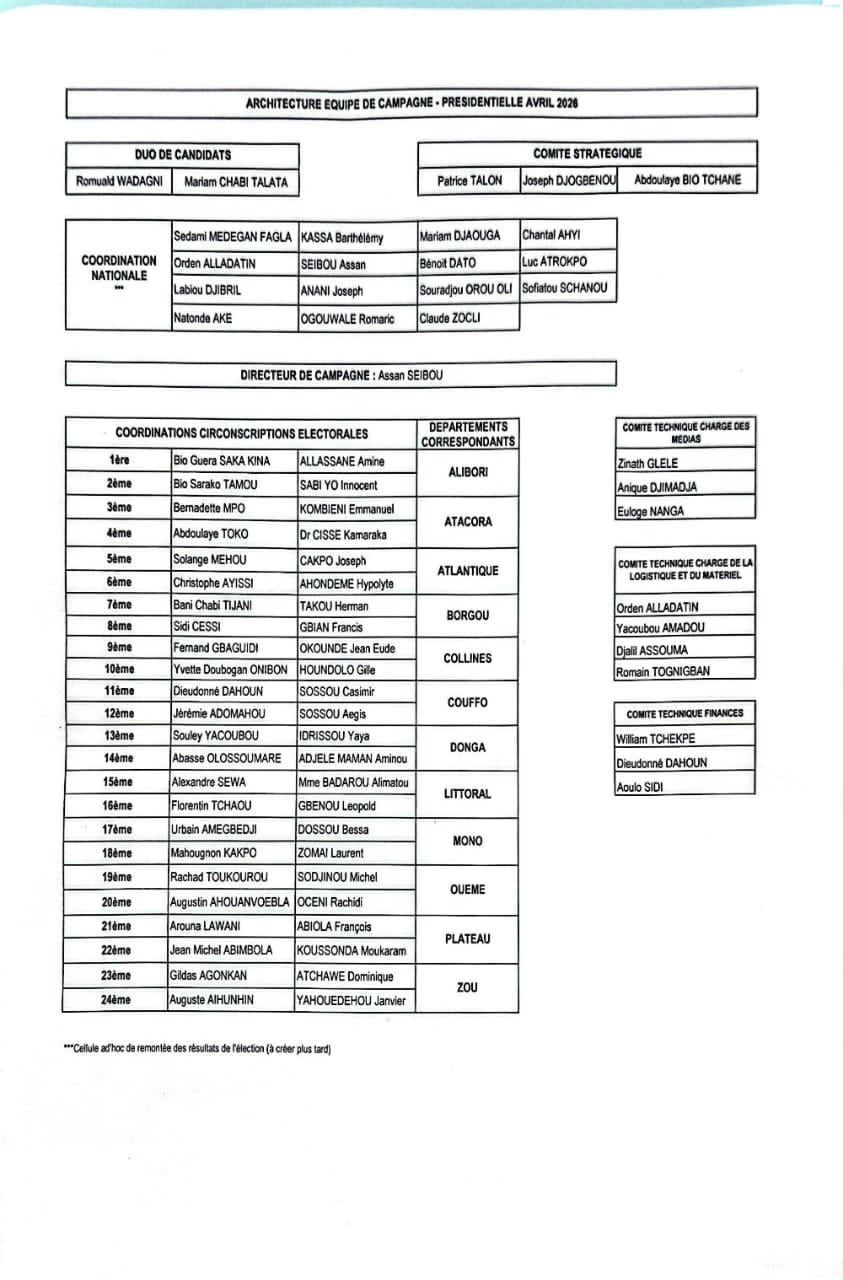
Talon dans le Comité de campagne du duo Wadagni-Talata
À moins de deux mois de l'élection présidentielle du 12 avril 2026, la mouvance présidentielle béninoise a rendu publique la liste des membres de l'équipe de campagne du duo de candidats formé par Romuald Wadagni et Mariam Chabi Talata.
Le pilotage de la campagne du duo de candidats Romuald Wadagni et Mariam Chabi Talata à la présidentielle du 12 avril prochain est confié à un Comité Stratégique composé des figures de proue de la majorité.
On y retrouve notamment le Président Patrice Talon ; Joseph Djogbénou, président de l'Union Progressiste le Renouveau (UP-R) et président de l'Assemblée nationale ; Abdoulaye Bio Tchané, secrétaire national du Bloc Républicain (BR).
Au poste de Directeur de Campagne, le député Assan Seibou sera assisté d'une équipe de coordination nationale incluant des ministres en exercice et des députés influents. Il s'agit des députés Orden Alladatin ; Aké Natondé ; Sofiath Schanou ; Barthélemy Kassa ; Joseph Anani ; Chantal Ahyi et le ministre des sports Bénoît Dato.
Un maillage territorial des 24 Circonscriptions Electorales
La stratégie repose sur un quadrillage des 24 Circonscriptions Electorales. Pour chacune d'elles, des binômes de responsables ont été désignés afin d'assurer l'animation et la mobilisation locales.
Dans le nord, des responsables comme Bio Guera Saka Kina et Bani Chabi Tijani sont chargés de coordonner les activités de campagne.
Dans le sud, le député et maire honoraire de Cotonou, Luc Atrokpo, le député et ex ministre du Tourisme, de la Culture et des Arts, Jean-Michel Abimbola, figurent parmi les personnalités mobilisées.
Pour encadrer la campagne, plusieurs comités spécialisés ont été mis en place, notamment un comité des finances, placé sous la responsabilité de William Tchékpé ; un comité technique chargé des médias, ainsi qu'un comité logistique en charge de l'organisation des déplacements et des rassemblements. Le comité chargé des médias est composé de Zinath Glèlè ; Anique Djimadja et Euloge Nanga.
Le tandem Wadagni-Talata se présente comme le garant de la poursuite des réformes engagées ces dernières années sous le leadership du président sortant Patrice Talon.
Que sait-on de l'opération qui a conduit à la mort d'"El Mencho", le trafiquant de drogue le plus recherché par le Mexique et les États-Unis ?
Les forces armées mexicaines ont mené une opération dans le sud de l'État de Jalisco qui a abouti à la capture et à la mort de Nemesio Oseguera, alias "El Mencho", le baron de la drogue le plus recherché par le Mexique et les États-Unis.
Prédictions de performance pour les équipes de la CAF Champions League
Les résultats passés et les données actuelles permettent de prévoir avec exactitude. Des sites comme https://1xbet.sn/fr fournissent des données précises qui permettent d'évaluer les tendances et la performance des équipes. Une étude approfondie des performances et des formations permet de prévoir l'évolution du championnat et de cibler les clubs les plus forts.
Quelles sont les raisons des performances cette saison ?
Les performances sont influencées par plusieurs facteurs. Les plans de jeu changent et impactent directement le rendement de l'équipe. Si une formation reste performante, elle a un avantage important. La stabilité des performances est également influencée par les blessures de joueurs majeurs, les suspensions et les changements dans le club. La possession du ballon, les occasions créées et le rapport entre les buts marqués et les buts encaissés illustrent clairement la solidité structurelle d'une équipe compétitive.
Les analystes examinent aussi la cohérence tactique afin de discerner les formations capables de maintenir un niveau constant sur plusieurs matchs successifs. Si les données statistiques convergent avec les résultats observés, elles confirment la fiabilité des projections établies par les spécialistes. L'accès à des informations actualisées, notamment via https://1xbet.sn/fr/registration, permet d'observer les variations de performance et de contextualiser les tendances récentes. Cette observation continue aide à déceler des signaux faibles qui annoncent parfois une progression ou un déclin imminent.
Comment analyser les joueurs avant chaque rencontre ?
Le travail commence par l'analyse du passé récent des clubs. Si un groupe gagne contre des équipes de la même catégorie, son énergie influence directement la prochaine rencontre. Pour une meilleure compréhension, les données anciennes sont combinées avec les indicateurs actuels. Les informations personnelles des joueurs permettent d'identifier des points forts ou des faiblesses particuliers qui influencent la performance globale. Les conditions de succès sont différentes selon l'équipe.
Quels sont les principaux types de formation ?
Il s'impose avec stabilité tactique et diversité de son équipe. Si les meilleurs joueurs sont en forme, le groupe va continuer à performer dans toutes les phases du tournoi. Le Zamalek est également un rival fiable. D'autres équipes en forte croissance, telles que les clubs nigérians et marocains, évoluent rapidement, mais leur instabilité rend difficile la mise en place de pronostic.
Les statistiques influencent-elles l'estimation des performances ?
Statistiquement, les chances de succès sont bonnes. En possession, en tirs précis ou en efficacité offensive, une équipe sera plus susceptible de gagner des matchs. Les défenses fortes réduisent la quantité de buts qu'elles inscrivent et renforcent leur stabilité, tandis que les défenses faibles sont variables. Les experts mettent également en avant une corrélation entre l'approche tactique et le succès lors des phases d'élimination directe.
Une liste de facteurs clés
Plus de performance :
- Stabilité tactique et unité de l'équipe
- Meilleure forme des grands joueurs
- Récits de victoire en tournoi africain
- Adaptabilité aux conditions de jeu
- Efficacité défensive et offensive
La performance est limitée :
- Inconstance dans les dernières analyses.
- Absences prolongées de cadres importants.
- Récurrence stratégique ou compositionnelle
- Déplacements et rencontres sur les terrains des concurrents.
- Défense insuffisante ou manque de coordination collective.
C'est quoi les performances ?
L'analyse des données de plusieurs matchs révèle les principales tendances. Si les résultats sont identiques sur de nombreuses plateformes, cela confirme l'analyse des experts sur le potentiel d'une entreprise. Des différences plus importantes suggèrent des questions sur des événements particuliers, comme un arrêt ou une modification stratégique.
Ces constats permettent d'établir une hiérarchie et d'identifier des détails souvent occultés dans des analyses simples. De plus, suivre les résultats lors du tournoi permet de voir l'évolution réelle des équipes. Enfin, la relation entre les performances nouvelles et les changements tactiques permet d'établir une étude détaillée de la dynamique de la concurrence.
Que pouvons-nous apprendre de la CAF Cup ?
Les projections chiffrées anticipent la concurrence. Les équipes qui sont les plus susceptibles de se qualifier sont : Quelques équipes en développement présentent un fort potentiel de croissance et surprennent, bien qu'elles soient plus jeunes. L'analyse systématique des performances permet de réduire les doutes et d'afficher les forces et faiblesses de chaque équipe.
Loneliness on Planet Earth
Chronic loneliness and social isolation have been consistently linked to detrimental effects on physical and mental health and increased risk of early death. Credit: Shutterstock
By Joseph Chamie
PORTLAND, USA, Feb 24 2026 (IPS)
Loneliness is a significant health concern on planet Earth. It affects virtually every aspect of human wellbeing and development worldwide.
As loneliness knows no borders and impacts individuals of all ages and socio-economic background, it has become a major public health issue. Social isolation is now being taken seriously enough to prompt intervention by governments, international agencies, institutions, and communities.
Chronic loneliness and social isolation have been consistently linked to detrimental effects on physical and mental health and increased risk of early death. The World Health Organization (WHO) has recognized loneliness as a pressing global health threat and a defining challenge of our time.
To address this problem, WHO launched an international commission on social connection in November 2023. The commission aimed to have loneliness recognized and resourced as a global public health priority.
The commission issued a report in June 2025 that highlighted three messages. First, social disconnection is widespread, across all regions and age groups. Second, its impacts are severe, affecting health, well-being, and development. And third, solutions exist and should be scaled up urgently.
Additionally, in a 2023 report, the U.S. Surgeon General reported that loneliness increases one’s risk for cardiovascular disease, dementia, stroke, and premature death. Persistent loneliness was reported to be worse for your health than being sedentary or obese and is similar to smoking more than half a pack of cigarettes a day.
The complex interactions among societal changes, technological advancements, especially artificial intelligence, and the Covid-19 pandemic, which reduced economic and social activities, have contributed to increasing levels of loneliness and social isolation. People are meeting in person less frequently than in the past, while self-reported feelings of connection have recently shown signs of worsening.
According to a 2023 Meta-Gallup global survey encompassing 142 countries, 24% of those aged 15 and older, totaling 1.5 billion people worldwide, reported feeling very lonely or fairly lonely on a regular basis. Additionally, 27% or 1.7 billion people reported feeling a little lonely, while 49% or 3 billion people reported not feeling lonely at all (Figure 1).
Source: Meta-Gallup Survey.
Those surveyed who reported feeling lonely were 36 percentage points more likely to experience sadness than those who did not feel lonely. They were also 30 percentage points more likely to experience worry and stress compared to their counterparts who did not experience loneliness. These findings underscore the significant physical and mental health effects of frequent feelings of loneliness and social isolation.
The level of loneliness reported in the 2023 Gallup poll varies significantly across countries, ranging from a high of 45% in Comoros to a low of 6% in Vietnam. In 22 countries, the percentage of adults who felt lonely the day before exceeded 30%, with more than half of them located in Africa (Figure 2).
Source: Gallup Survey.
While loneliness varies significantly among countries, no country is immune to it. Loneliness is not just seen as a personal challenge, but also as a matter of public policy.
Loneliness affects all age groups, but young adults seem to be the most vulnerable. Around 30% of them report feeling lonely every day, with about 63% experiencing significant symptoms of anxiety and depression related to loneliness
Loneliness affects all age groups, but young adults seem to be the most vulnerable. Around 30% of them report feeling lonely every day, with about 63% experiencing significant symptoms of anxiety and depression related to loneliness.
Among older adults, feelings of loneliness decrease, with about 17% of those aged 65 and older reporting loneliness. However, many older adults face isolation due to factors such as declining health, loss of social connections, or decreased mobility. Loneliness is also linked to increased risks of developing dementia, coronary artery disease or stroke.
A follow-up international survey conducted by Gallup in 2024 found that 23% of respondents felt lonely “a lot of the day” just the day before the survey. Additionally, approximately one in five employees worldwide reported experiencing loneliness a lot the previous day.
Moreover, loneliness is more prevalent among employees under the age of 35 than those aged 35 and older. Loneliness also contributes to significant economic and social strain, reducing productivity, and impacting education.
The Gallup survey found that financial status has a strong effect on loneliness worldwide. Men and women who are struggling financially, meaning they find it difficult to get by on their present income, are about twice as likely as those who are better off financially to say they felt lonely a lot the previous day. Additionally, unmarried individuals are more likely to feel lonely than those who are married or in a domestic partnership.
Social isolation and chronic loneliness have long-term negative consequences on the physical and mental health of individuals. Health studies have found that the risk of mortality among people who lack community and social ties is two times greater than that of people who have many social contacts. A WHO report found that loneliness is linked to an estimated 100 deaths every hour, totaling more than 871,000 deaths annually.
Other effects of loneliness and social isolation include a shortened lifespan, cognitive decline, exacerbated mental illness, reduced quality of sleep, higher stress and anxiety levels, adoption of unhealthy habits, and self-loathing thoughts. Strong social connections can lead to better health and reduce the effects of loneliness (Table 1).
Source: Author’s compilation based on health studies.
A variety of factors can contribute to an individual experiencing loneliness, and the scope, duration, and intensity of loneliness can vary. In many cases, there is no single cause, but rather a number of factors that can overlap and intensify each other.
Some of the factors contributing to loneliness are internal, while others are external. Internal factors often involve the way people see themselves and the world around them. They can also include shyness, introversion, low self-esteem, lack of communication skills, and social withdrawal. On the other hand, external factors include physical isolation, relocation, bereavement, divorce, physical disabilities, social exclusion, and over-reliance on social media.
Interacting with another person, even a stranger, can significantly reduce loneliness. Conversely, doing nothing to address social isolation tends to increase loneliness.
Some studies suggest that interacting with an AI companion can reduce loneliness.
Advocates argue that the latest AI chatbots might provide better company than many real people and societies should consider the benefits that AI companions could offer to those who are lonely. Soon, some believe, the most interesting, and maybe the most empathetic conversation that an individual could have will be with AI on almost any topic.
Instead of reacting with horror, advocates of AI chatbots suggest that societies should consider the benefits that AI companions could provide to those who are lonely. Some AI promoters maintain that an inability to relate to humans should not be viewed as a defect, but rather as a virtue.
AI chatbots are becoming increasingly popular as preferred confidants and companions. For example, a study of younger individuals discovered that one-third of teenagers use AI chatbots for social interaction. These teenagers have stated a preference for AI companions over humans for serious conversations, finding them more fulfilling than conversations with actual people.
Nevertheless, there are concerns about using AI companions to address loneliness. Health experts are warning that many individuals, particularly the youth, are developing emotional connections to AI chatbot companions.
Despite these concerns, individuals, especially young people, are seeking companionship and emotional support from AI chatbots. Some fear that relying on AI companions may result in younger generations forming emotional bonds with entities that lack the ability to empathize and care.
By recognizing the signs of loneliness, engaging in meaningful activities, and seeking professional assistance, individuals may be able to reduce their feelings of loneliness and social isolation. A combination of behavioral changes, social intervention, and professional support can be helpful in dealing with loneliness.
Additionally, managing stress resulting from loneliness can be facilitated by exercising, eating healthy, and getting enough sleep. Pursuing enjoyable hobbies and activities may also offer a distraction from loneliness.
Communicating one’s loneliness to family, friends, and colleagues can strengthen existing relationships and provide emotional support. To manage feelings of loneliness, it is also helpful for individuals to remain open to making new connections, stay healthy, and seek professional assistance.
Loneliness is a complex and pervasive issue that exists worldwide. However, there are ways to manage and address it. Methods aimed at reducing loneliness exist at the national, community, family, and individual levels. These methods include increasing awareness and modifying government policies to strengthen social infrastructure, foster inclusivity, and provide psychological support.
Joseph Chamie is a consulting demographer, a former director of the United Nations Population Division, and author of many publications on population issues.
Catégories: Africa, Diplomacy & Defense Think Tank News
La CRIET maintient en détention l'ex député Soumaïla Sounon
La Cour de Répression des Infractions Economiques et du Terrorisme (CRIET) a rejeté, lundi 23 février 2026, la demande de mise en liberté provisoire de l'ancien député Soumaïla Sounon Boké.
Incarcéré dans le cadre de l'enquête sur la tentative de coup d'État du 7 décembre 2025, l'ex député Soumaïla Sounon Boké est maintenu derrière les barreaux.
La Cour de Répression des Infractions Economiques et du Terrorisme (CRIET) a opposé une fin de non-recevoir à la demande de l'ex député du parti Les Démocrates.
Malgré les arguments de la défense plaidant pour une comparution libre, le juge d'instruction a ordonné le maintien sous mandat de dépôt.
Arrêté le 23 décembre 2025, Soumaïla Sounon Boké est poursuivi pour « apologie de crime contre la sûreté de l'État » et « incitation à la rébellion ».
L'instruction se poursuit pour déterminer le degré de participation de chaque acteur dans cette tentative de renversement du pouvoir.
Pour l'heure, aucune date de procès n'a été avancée par le parquet spécial.
M. M.
Pages



© 2012-2018 Europa Varietas Foundation © 2015-2018 Europa Varietas Association
www.europavarietas.org | info(@)europavarietas(dot)org | Switzerland




We are looking for sponsors for the English translation of these books, please contact turkeandras(at)gmail(dot)com